Every problem in the chapter beside the book’s answer, a chapter at a time as you scroll.
Chapter 19: Transition Metals and Coordination Chemistry
33 problems · 9 figuresExample 19.1 §19.1 source ↗
Answer
Example 19.2 §19.1 source ↗
Answer
Example 19.3 §19.1 source ↗
Answer
Example 19.4 §19.2 source ↗
Answer
Example 19.5 §19.2 source ↗
Answer
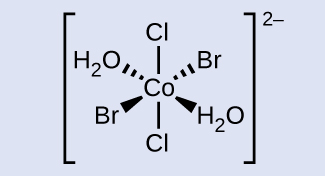
Example 19.6 §19.2 source ↗
Answer
Example 19.7 §19.3 source ↗
Answer
Example 19.8 §19.3 source ↗
Answer
Example 19.9 §19.3 source ↗
Answer
19-1 §19.1 source ↗
Write the electron configurations for each of the following elements:
(a) Sc
(b) Ti
(c) Cr
(d) Fe
(e) Ru
Answer
19-3 §19.1 source ↗
Write the electron configurations for each of the following elements and its 3+ ions:
(a) La
(b) Sm
(c) Lu
Answer
19-5 §19.1 source ↗
Answer
19-7 §19.1 source ↗
Answer
19-9 §19.1 source ↗
Answer
19-11 §19.1 source ↗
Answer
19-13 §19.1 source ↗
Find the potentials of the following electrochemical cell:
Cd | Cd2+, M = 0.10 ‖ Ni2+, M = 0.50 | Ni
Answer
19-15 §19.1 source ↗
Answer
19-17 §19.1 source ↗
Predict the products of each of the following reactions. (Note: In addition to using the information in this chapter, also use the knowledge you have accumulated at this stage of your study, including information on the prediction of reaction products.)
(a)
(b)
(c)
(d)
(e)
(f)
Answer
19-19 §19.1 source ↗
Predict the products of the following reactions and balance the equations.
(a) Zn is added to a solution of Cr2(SO4)3 in acid.
(b) FeCl2 is added to a solution containing an excess of in hydrochloric acid.
(c) Cr2+ is added to in acid solution.
(d) Mn is heated with CrO3.
(e) CrO is added to 2HNO3 in water.
(f) FeCl3 is added to an aqueous solution of NaOH.
Answer
19-21 §19.1 source ↗
Predict the products of each of the following reactions and then balance the chemical equations.
(a) Fe is heated in an atmosphere of steam.
(b) NaOH is added to a solution of Fe(NO3)3.
(c) FeSO4 is added to an acidic solution of KMnO4.
(d) Fe is added to a dilute solution of H2SO4.
(e) A solution of Fe(NO3)2 and HNO3 is allowed to stand in air.
(f) FeCO3 is added to a solution of HClO4.
(g) Fe is heated in air.
Answer
19-23 §19.1 source ↗
Answer
As more CN− is added,
19-25 §19.1 source ↗
Give the oxidation state of the metal for each of the following oxides of the first transition series. (Hint: Oxides of formula M3O4 are examples of mixed valence compounds in which the metal ion is present in more than one oxidation state. It is possible to write these compound formulas in the equivalent format MO·M2O3, to permit estimation of the metal’s two oxidation states.)
(a) Sc2O3
(b) TiO2
(c) V2O5
(d) CrO3
(e) MnO2
(f) Fe3O4
(g) Co3O4
(h) NiO
(i) Cu2O
Answer
19-27 §19.2 source ↗
Give the coordination numbers and write the formulas for each of the following, including all isomers where appropriate:
(a) tetrahydroxozincate(II) ion (tetrahedral)
(b) hexacyanopalladate(IV) ion
(c) dichloroaurate(I) ion (note that aurum is Latin for "gold")
(d) diamminedichloroplatinum(II)
(e) potassium diamminetetrachlorochromate(III)
(f) hexaamminecobalt(III) hexacyanochromate(III)
(g) dibromobis(ethylenediamine) cobalt(III) nitrate
Answer
19-29 §19.2 source ↗
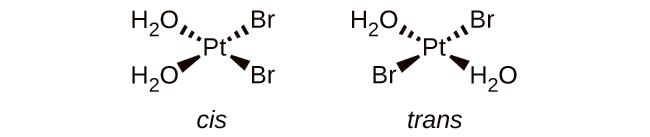
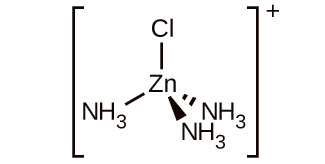
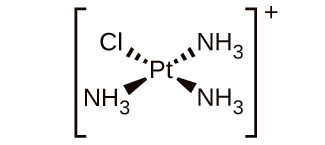
Sketch the structures of the following complexes. Indicate any cis, trans, and optical isomers.
(a) [Pt(H2O)2Br2] (square planar)
(b) [Pt(NH3)(py)(Cl)(Br)] (square planar, py = pyridine, C5H5N)
(c) [Zn(NH3)3Cl]+ (tetrahedral)
(d) [Pt(NH3)3Cl]+ (square planar)
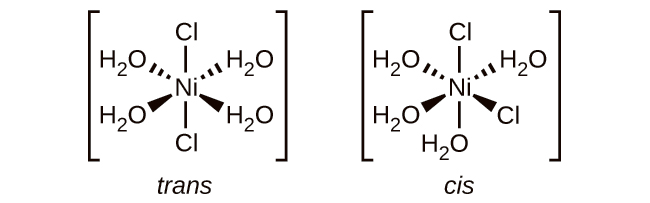
(e) [Ni(H2O)4Cl2]
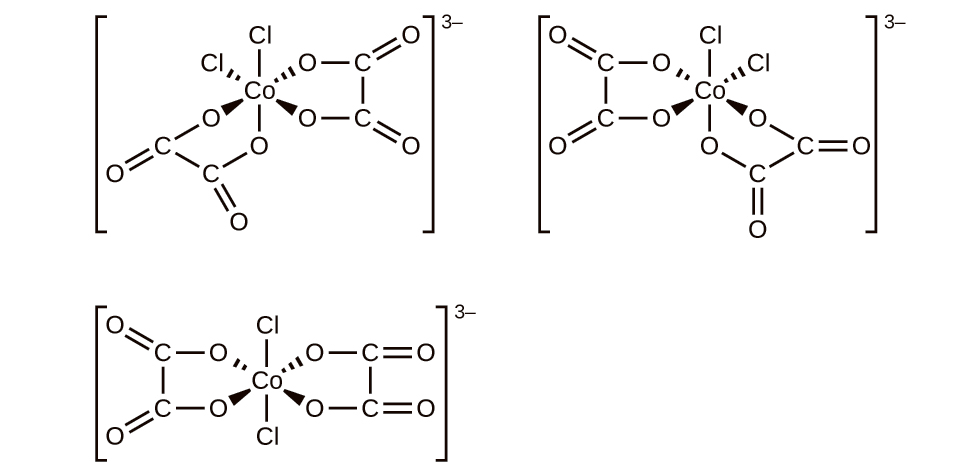
(f) [Co(C2O4)2Cl2]3− (note that is the bidentate oxalate ion,
Answer
(a) [Pt(H2O)2Br2]:
(b) [Pt(NH3)(py)(Cl)(Br)]:

(c) [Zn(NH3)3Cl]+ :
(d) [Pt(NH3)3Cl]+ :
(e) [Ni(H2O)4Cl2]:
(f) [Co(C2O4)2Cl2]3−:
19-31 §19.2 source ↗
Answer
19-33 §19.2 source ↗
Specify whether the following complexes have isomers.
(a) tetrahedral [Ni(CO)2(Cl)2]
(b) trigonal bipyramidal [Mn(CO)4NO]
(c) [Pt(en)2Cl2]Cl2
Answer
19-35 §19.2 source ↗
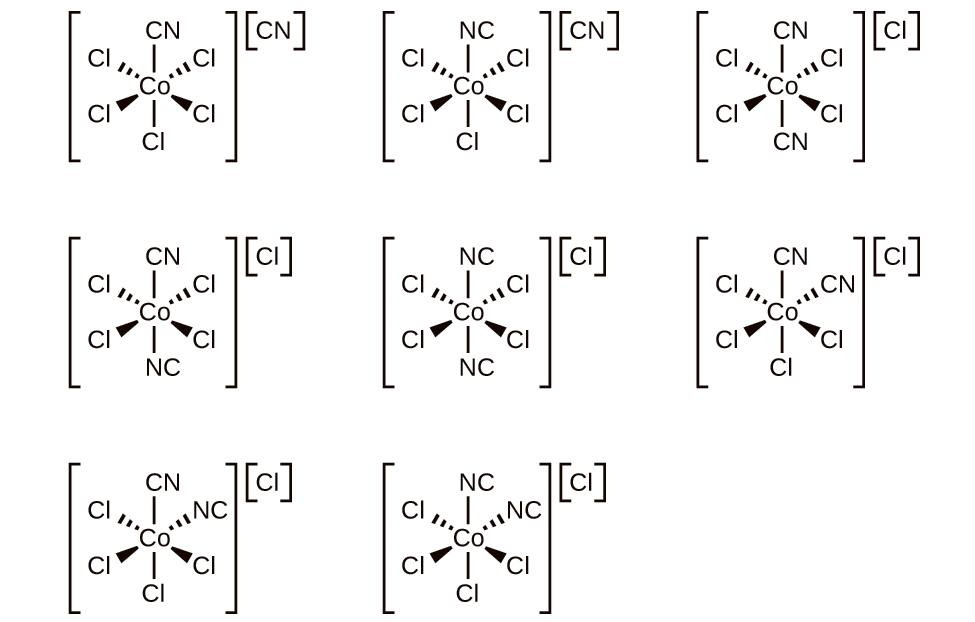
Answer
19-37 §19.3 source ↗
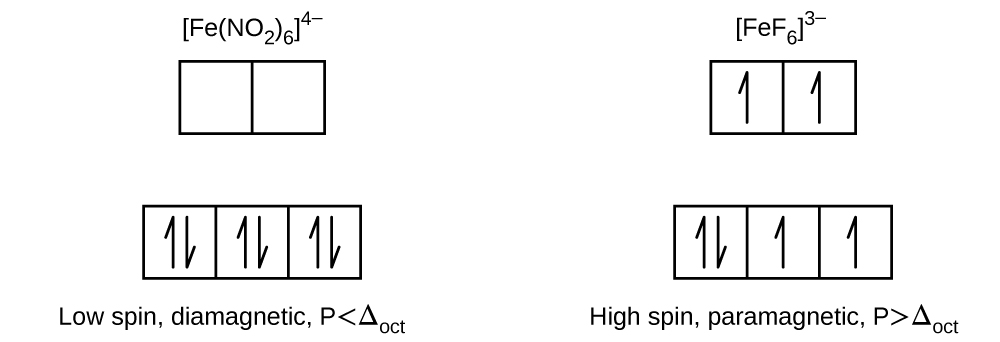
Answer
19-39 §19.3 source ↗
Answer
19-41 §19.3 source ↗
How many unpaired electrons are present in each of the following?
(a) [CoF6]3− (high spin)
(b) [Mn(CN)6]3− (low spin)
(c) [Mn(CN)6]4− (low spin)
(d) [MnCl6]4− (high spin)
(e) [RhCl6]3− (low spin)
Answer
19-43 §19.3 source ↗
For complexes of the same metal ion with no change in oxidation number, the stability increases as the number of electrons in the t2g orbitals increases. Which complex in each of the following pairs of complexes is more stable?
(a) [Fe(H2O)6]2+ or [Fe(CN)6]4−
(b) [Co(NH3)6]3+ or [CoF6]3−
(c) [Mn(CN)6]4− or [MnCl6]4−
Answer
19-45 §19.3 source ↗
Answer
19-47 §19.3 source ↗
Answer
Loading chapter 20…
Problems and answers are adapted from Chemistry 2e by Paul Flowers, Klaus Theopold, Richard Langley and William R. Robinson, OpenStax, and are used under the CC BY-NC-SA 4.0 licence. Access for free at https://openstax.org/books/chemistry-2e/pages/1-introduction. Illustrations: Copyright Rice University, OpenStax, under CC BY-NC-SA 4.0 license. This adaptation is released under the same licence, is non-commercial, and is neither affiliated with nor endorsed by OpenStax or Rice University.