Every problem in the chapter beside the book’s answer, a chapter at a time as you scroll.
Chapter 17: Physics of Hearing
56 problems · 6 figures17-1 §17.2 source ↗
Answer
17-3 §17.2 source ↗
Answer
17-5 §17.2 source ↗
Answer
17-7 §17.2 source ↗
Answer
17-9 §17.2 source ↗
(a) If a submarine’s sonar can measure echo times with a precision of 0.0100 s, what is the smallest difference in distances it can detect? (Assume that the submarine is in the ocean, not in fresh water.)
(b) Discuss the limits this time resolution imposes on the ability of the sonar system to detect the size and shape of the object creating the echo.
Answer
(a) 7.70 m
(b) This means that sonar is good for spotting and locating large objects, but it isn’t able to resolve smaller objects, or detect the detailed shapes of objects. Objects like ships or large pieces of airplanes can be found by sonar, while smaller pieces must be found by other means.
17-11 §17.2 source ↗
Answer
(a) 18.0 ms, 17.1 ms
(b) 5.00%
(c) This uncertainty could definitely cause difficulties for the bat, if it didn’t continue to use sound as it closed in on its prey. A 5% uncertainty could be the difference between catching the prey around the neck or around the chest, which means that it could miss grabbing its prey.
17-12 §17.3 source ↗
Answer
17-14 §17.3 source ↗
Answer
17-16 §17.3 source ↗
Answer
17-18 §17.3 source ↗
Answer
(a) 93 dB
(b) 83 dB
17-20 §17.3 source ↗
Answer
(a) 50.1
(b) or
17-22 §17.3 source ↗
Answer
17-24 §17.3 source ↗
Answer
17-26 §17.3 source ↗
Answer
17-28 §17.3 source ↗
Answer
17-30 §17.4 source ↗
Answer
(a) 878 Hz
(b) 735 Hz
17-32 §17.4 source ↗
Answer
17-34 §17.4 source ↗
Answer
(a) 12.9 m/s
(b) 193 Hz
17-36 §17.4 source ↗
Answer
First eagle hears
Second eagle hears
17-38 §17.5 source ↗
Answer
17-40 §17.5 source ↗
Answer
17-42 §17.5 source ↗
Answer
(a) 256 Hz
(b) 512 Hz
17-44 §17.5 source ↗
Answer
17-46 §17.5 source ↗
Answer
17-48 §17.5 source ↗
Answer
(a) 0.334 m
(b) 259 Hz
17-50 §17.5 source ↗
Answer
17-52 §17.5 source ↗
Answer
(a) 367 Hz
(b) 1.07 kHz
17-54 §17.5 source ↗
Answer
(a)
(b)
17-55 §17.6 source ↗
Answer
17-57 §17.6 source ↗
Answer
17-59 §17.6 source ↗
Answer
17-61 §17.6 source ↗
Answer
17-63 §17.6 source ↗
Answer
(a) 23 dB
(b) 70 dB
17-65 §17.6 source ↗
Answer
17-67 §17.6 source ↗
Answer
(a)
(b)
17-69 §17.6 source ↗
Answer
17-71 §17.6 source ↗
Answer
17-72 §17.7 source ↗
Unless otherwise indicated, for problems in this section, assume that the speed of sound through human tissues is 1540 m/s.
What is the sound intensity level in decibels of ultrasound of intensity , used to pulverize tissue during surgery?
Answer
17-74 §17.7 source ↗
Unless otherwise indicated, for problems in this section, assume that the speed of sound through human tissues is 1540 m/s.
Find the sound intensity level in decibels of ultrasound used in medical diagnostics.
Answer
17-76 §17.7 source ↗
Unless otherwise indicated, for problems in this section, assume that the speed of sound through human tissues is 1540 m/s.
In the clinical use of ultrasound, transducers are always coupled to the skin by a thin layer of gel or oil, replacing the air that would otherwise exist between the transducer and the skin. (a) Using the values of acoustic impedance given in Table 17.5 calculate the intensity reflection coefficient between transducer material and air. (b) Calculate the intensity reflection coefficient between transducer material and gel (assuming for this problem that its acoustic impedance is identical to that of water). (c) Based on the results of your calculations, explain why the gel is used.
| Medium | Density (kg/m3) | Speed of Ultrasound (m/s) | Acoustic Impedance |
|---|---|---|---|
| Air | 1.3 | 330 | |
| Water | 1000 | 1500 | |
| Blood | 1060 | 1570 | |
| Fat | 925 | 1450 | |
| Muscle (average) | 1075 | 1590 | |
| Bone (varies) | 1400–1900 | 4080 | to |
| Barium titanate (transducer material) | 5600 | 5500 |
Answer
(a) 1.00
(b) 0.823
(c) Gel is used to facilitate the transmission of the ultrasound between the transducer and the patient’s body.
17-78 §17.7 source ↗
Unless otherwise indicated, for problems in this section, assume that the speed of sound through human tissues is 1540 m/s.
(a) Find the size of the smallest detail observable in human tissue with 20.0-MHz ultrasound. (b) Is its effective penetration depth great enough to examine the entire eye (about 3.00 cm is needed)? (c) What is the wavelength of such ultrasound in air?
Answer
(a)
(b) Effective penetration depth = 3.85 cm, which is enough to examine the eye.
(c)
17-80 §17.7 source ↗
Unless otherwise indicated, for problems in this section, assume that the speed of sound through human tissues is 1540 m/s.
(a) How far apart are two layers of tissue that produce echoes having round-trip times (used to measure distances) that differ by ? (b) What minimum frequency must the ultrasound have to see detail this small?
Answer
(a)
(b)
17-82 §17.7 source ↗
Unless otherwise indicated, for problems in this section, assume that the speed of sound through human tissues is 1540 m/s.
A dolphin is able to tell in the dark that the ultrasound echoes received from two sharks come from two different objects only if the sharks are separated by 3.50 m, one being that much farther away than the other. (a) If the ultrasound has a frequency of 100 kHz, show this ability is not limited by its wavelength. (b) If this ability is due to the dolphin’s ability to detect the arrival times of echoes, what is the minimum time difference the dolphin can perceive?
Answer
(a) Because the wavelength is much shorter than the distance in question, the wavelength is not the limiting factor.
(b) 4.55 ms
17-84 §17.7 source ↗
Unless otherwise indicated, for problems in this section, assume that the speed of sound through human tissues is 1540 m/s.
Ultrasound reflected from an oncoming bloodstream that is moving at 30.0 cm/s is mixed with the original frequency of 2.50 MHz to produce beats. What is the beat frequency? (Assume that the frequency of 2.50 MHz is accurate to seven significant figures.)
Answer
974 Hz
(Note: extra digits were retained in order to show the difference.)
AP Test Prep 17.1 §17.2 source ↗
A teacher wants to demonstrate that the speed of sound is not a constant value. Considering her regular classroom voice as the control, which of the following will increase the speed of sound leaving her mouth?
I. Submerge her mouth underwater and speak at the same volume.
II. Increase the temperature of the room and speak at the same volume.
III. Increase the pitch of her voice and speak at the same volume.
- a.I only
- b.I and II only
- c.I, II and III
- d.II and III
- e.III only
Answer
AP Test Prep 17.3 §17.3 source ↗
- a.twice as much
- b.three times as much
- c.approximately 4.8 times as much
- d.six times as much
- e.nine times as much
Answer
AP Test Prep 17.5 §17.4 source ↗
- a.The frequency of the plane will be lower pitched according to the baggage handler and will become even lower pitched as the plane slows to a stop.
- b.The frequency of the plane will be lower pitched according to the baggage handler but will increase in pitch as the plane slows to a stop.
- c.The frequency of the plane will be higher pitched according to the baggage handler but will decrease in pitch as the plane slows to a stop.
- d.The frequency of the plane will be higher pitched according to the baggage handler and will further increase in pitch as the plane slows to a stop.
Answer
AP Test Prep 17.7 §17.5 source ↗
Answer
AP Test Prep 17.9 §17.5 source ↗
- a.4A
- b.A
- c.2A, on the side of the original wave pulse
- d.2A, on the side of the second wave pulse
Answer
AP Test Prep 17.11 §17.5 source ↗
A student is shaking a flexible string attached to a wooden board in a rhythmic manner. Which of the following choices will decrease the wavelength within the rope?
I. The student could shake her hand back and forth with greater frequency.
II. The student could shake her hand back in forth with a greater amplitude.
III. The student could increase the tension within the rope by stepping backwards from the board.
- a.I only
- b.I and II
- c.I and III
- d.II and III
- e.I, II, and III
Answer
AP Test Prep 17.13 §17.5 source ↗
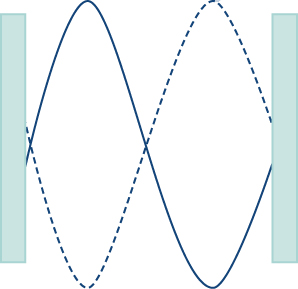
A string is vibrating between two posts as shown above. Students are to determine the speed of the wave within this string. They have already measured the amount of time necessary for the wave to oscillate up and down. The students must also take what other measurements to determine the speed of the wave?
- a.The distance between the two posts.
- b.The amplitude of the wave
- c.The tension in the string
- d.The amplitude of the wave and the tension in the string
- e.The distance between the two posts, the amplitude of the wave, and the tension in the string
Answer
AP Test Prep 17.15 §17.5 source ↗
A tube is open at one end. If the fundamental frequency f is created by a wavelength λ, then which of the following describes the frequency and wavelength associated with the tube’s fourth overtone?
| f | λ | |
| (a) | 4f | λ/4 |
| (b) | 4f | λ |
| (c) | 9f | λ/9 |
| (d) | 9f | λ |
Answer
AP Test Prep 17.17 §17.5 source ↗
When a student blows across a glass half-full of water, a resonant frequency is created within the air column remaining in the glass. Which of the following can the student do to increase this resonant frequency?
I. Add more water to the glass.
II. Replace the water with a more dense fluid.
III. Increase the temperature of the room.
- a.I only
- b.I and III
- c.II and III
- d.all of the above
Answer
AP Test Prep 17.18 §17.5 source ↗
Answer
AP Test Prep 17.19 §17.5 source ↗
- a.The guitar string
- b.The air inside the guitar
- c.The air surrounding the guitar
- d.The ground beneath the musician
Answer
AP Test Prep 17.21 §17.5 source ↗
- a.f0/2
- b.f0
- c.2f0
- d.There is no frequency at which a standing wave will be formed.
Answer
Loading chapter 18…
Problems and answers are adapted from College Physics for AP® Courses 2e by Gregg Wolfe, Erika Gasper, John Stoke, Julie Kretchman, David Anderson and others, OpenStax, and are used under the CC BY-NC-SA 4.0 licence. Access for free at https://openstax.org/books/college-physics-ap-courses-2e/pages/1-connection-for-ap-r-courses. Illustrations: Copyright Rice University, OpenStax, under CC BY-NC-SA 4.0 license. This adaptation is released under the same licence, is non-commercial, and is neither affiliated with nor endorsed by OpenStax or Rice University.