Every problem in the chapter beside the book’s answer, a chapter at a time as you scroll.

Chapter 23: Electromagnetic Induction, AC Circuits, and Electrical Technologies

54 problems · 9 figures

23-1 §23.1 source ↗

What is the value of the magnetic flux at coil 2 in Figure 23.53 due to coil 1?
Figure 23.53 in the book ↗
(a) The planes of the two coils are perpendicular. (b) The wire is perpendicular to the plane of the coil.

Answer

Zero

23-3 §23.2 source ↗

Referring to Figure 23.54(a), what is the direction of the current induced in coil 2: (a) If the current in coil 1 increases? (b) If the current in coil 1 decreases? (c) If the current in coil 1 is constant? Explicitly show how you follow the steps in the Problem-Solving Strategy for Lenz's Law.
Figure 23.54 in the book ↗
(a) The coils lie in the same plane. (b) The wire is in the plane of the coil

Answer

(a) CCW

(b) CW

(c) No current induced

23-5 §23.2 source ↗

Referring to Figure 23.55, what are the directions of the currents in coils 1, 2, and 3 (assume that the coils are lying in the plane of the circuit): (a) When the switch is first closed? (b) When the switch has been closed for a long time? (c) Just after the switch is opened?
Figure 23.55 in the book ↗

Answer

(a) 1 CCW, 2 CCW, 3 CW

(b) 1, 2, and 3 no current induced

(c) 1 CW, 2 CW, 3 CCW

23-9 §23.2 source ↗

(a) An MRI technician moves his hand from a region of very low magnetic field strength into an MRI scanner’s 2.00 T field with his fingers pointing in the direction of the field. Find the average emf induced in his wedding ring, given its diameter is 2.20 cm and assuming it takes 0.250 s to move it into the field. (b) Discuss whether this current would significantly change the temperature of the ring.

Answer

(a) 3.04 mV
(b) As a lower limit on the ring, estimate R = 1.00 mΩ. The heat transferred will be 2.31 mJ. This is not a significant amount of heat.

23-11 §23.2 source ↗

An emf is induced by rotating a 1000-turn, 20.0 cm diameter coil in the Earth’s 5.00×10⁻⁵T magnetic field. What average emf is induced, given the plane of the coil is originally perpendicular to the Earth’s field and is rotated to be parallel to the field in 10.0 ms?

Answer

0.157 V

23-13 §23.2 source ↗

Integrated Concepts

Approximately how does the emf induced in the loop in Figure 23.54(b) depend on the distance of the center of the loop from the wire?

Figure 23.54 in the book ↗
(a) The coils lie in the same plane. (b) The wire is in the plane of the coil

Answer

proportional to 1 r

23-17 §23.3 source ↗

(a) A jet airplane with a 75.0 m wingspan is flying at 280 m/s. What emf is induced between wing tips if the vertical component of the Earth’s field is 3.00×10⁻⁵T? (b) Is an emf of this magnitude likely to have any consequences? Explain.

Answer

(a) 0.630 V

(b) No, this is a very small emf.

23-19 §23.3 source ↗

At what speed must the sliding rod in Figure 23.10 move to produce an emf of 1.00 V in a 1.50 T field, given the rod’s length is 30.0 cm?
Figure 23.10 in the book ↗
(a) A motional emf=Bℓv is induced between the rails when this rod moves to the right in the uniform magnetic field. The magnetic field B is into the page, perpendicular to the moving rod and rails and, hence, to the area enclosed by them. (b) Lenz’s law gives the directions of the induced field and current, and the polarity of the induced emf. Since the flux is increasing, the induced field is in the opposite direction, or out of the page. RHR-2 gives the current direction shown, and the polarity of the rod will drive such a current. RHR-1 also indicates the same polarity for the rod. (Note that the script E symbol used in the equivalent circuit at the bottom of part (b) represents emf.)

Answer

2.22 m/s

23-25 §23.3 source ↗

Integrated Concepts

The Tethered Satellite discussed in this module is producing 5.00 kV, and a current of 10.0 A flows. (a) What magnetic drag force does this produce if the system is moving at 7.80 km/s? (b) How much kinetic energy is removed from the system in 1.00 h, neglecting any change in altitude or velocity during that time? (c) What is the change in velocity if the mass of the system is 100,000 kg? (d) Discuss the long term consequences (say, a week-long mission) on the space shuttle’s orbit, noting what effect a decrease in velocity has and assessing the magnitude of the effect.

Answer

(a) 10.0 N

(b) 2.81 × 10 8 J

(c) 0.36 m/s

(d) For a week-long mission (168 hours), the change in velocity will be 60 m/s, or approximately 1%. In general, a decrease in velocity would cause the orbit to start spiraling inward because the velocity would no longer be sufficient to keep the circular orbit. The long-term consequences are that the shuttle would require a little more fuel to maintain the desired speed, otherwise the orbit would spiral slightly inward.

23-28 §23.5 source ↗

Calculate the peak voltage of a generator that rotates its 200-turn, 0.100 m diameter coil at 3600 rpm in a 0.800 T field.

Answer

474 V

23-30 §23.5 source ↗

What is the peak emf generated by rotating a 1000-turn, 20.0 cm diameter coil in the Earth’s 5.00×10⁻⁵T magnetic field, given the plane of the coil is originally perpendicular to the Earth’s field and is rotated to be parallel to the field in 10.0 ms?

Answer

0.247 V

23-32 §23.5 source ↗

(a) A bicycle generator rotates at 1875 rad/s, producing an 18.0 V peak emf. It has a 1.00 by 3.00 cm rectangular coil in a 0.640 T field. How many turns are in the coil? (b) Is this number of turns of wire practical for a 1.00 by 3.00 cm coil?

Answer

(a) 50

(b) yes

23-34 §23.5 source ↗

(a) A car generator turns at 400 rpm when the engine is idling. Its 300-turn, 5.00 by 8.00 cm rectangular coil rotates in an adjustable magnetic field so that it can produce sufficient voltage even at low rpms. What is the field strength needed to produce a 24.0 V peak emf? (b) Discuss how this required field strength compares to those available in permanent and electromagnets.

Answer

(a) 0.477 T

(b) This field strength is small enough that it can be obtained using either a permanent magnet or an electromagnet.

23-36 §23.5 source ↗

A 75-turn, 10.0 cm diameter coil rotates at an angular velocity of 8.00 rad/s in a 1.25 T field, starting with the plane of the coil parallel to the field. (a) What is the peak emf? (b) At what time is the peak emf first reached? (c) At what time is the emf first at its most negative? (d) What is the period of the AC voltage output?

Answer

(a) 5.89 V

(b) At t=0

(c) 0.393 s

(d) 0.785 s

23-38 §23.5 source ↗

Unreasonable Results

A 500-turn coil with a 0.250m2 area is spun in the Earth’s 5.00×10⁻⁵T field, producing a 12.0 kV maximum emf. (a) At what angular velocity must the coil be spun? (b) What is unreasonable about this result? (c) Which assumption or premise is responsible?

Answer

(a) 1.92×10⁶rad/s

(b) This angular velocity is unreasonably high, higher than can be obtained for any mechanical system.

(c) The assumption that a voltage as great as 12.0 kV could be obtained is unreasonable.

23-39 §23.6 source ↗

Suppose a motor connected to a 120 V source draws 10.0 A when it first starts. (a) What is its resistance? (b) What current does it draw at its normal operating speed when it develops a 100 V back emf?

Answer

(a) 12.00 Ω

(b) 1.67 A

23-41 §23.6 source ↗

What is the back emf of a 120 V motor that draws 8.00 A at its normal speed and 20.0 A when first starting?

Answer

72.0 V

23-43 §23.6 source ↗

Integrated Concepts

The motor in a toy car is powered by four batteries in series, which produce a total emf of 6.00 V. The motor draws 3.00 A and develops a 4.50 V back emf at normal speed. Each battery has a 0.100 Ω internal resistance. What is the resistance of the motor?

Answer

0.100 Ω

23-44 §23.7 source ↗

A plug-in transformer, like that in Figure 23.25, supplies 9.00 V to a video game system. (a) How many turns are in its secondary coil, if its input voltage is 120 V and the primary coil has 400 turns? (b) What is its input current when its output is 1.30 A?
Figure 23.25 in the book ↗
Plug-in transformers are used in low voltage applications such as lighting and for using US products (where the outlet voltage is 120 V) in Europe (where the voltage is 230 V) and vice versa. Transformers are also essential components in consumer electronic devices. (credit: Tamar More)

Answer

(a) 30.0

(b) 9 . 75 × 10 − 2 A

23-46 §23.7 source ↗

A cassette recorder uses a plug-in transformer to convert 120 V to 12.0 V, with a maximum current output of 200 mA. (a) What is the current input? (b) What is the power input? (c) Is this amount of power reasonable for a small appliance?

Answer

(a) 20.0 mA

(b) 2.40 W

(c) Yes, this amount of power is quite reasonable for a small appliance.

23-48 §23.7 source ↗

(a) The plug-in transformer for a laptop computer puts out 7.50 V and can supply a maximum current of 2.00 A. What is the maximum input current if the input voltage is 240 V? Assume 100% efficiency. (b) If the actual efficiency is less than 100%, would the input current need to be greater or smaller? Explain.

Answer

(a) 0.063 A

(b) Greater input current needed.

23-50 §23.7 source ↗

A large power plant generates electricity at 12.0 kV. Its old transformer once converted the voltage to 335 kV. The secondary of this transformer is being replaced so that its output can be 750 kV for more efficient cross-country transmission on upgraded transmission lines. (a) What is the ratio of turns in the new secondary compared with the old secondary? (b) What is the ratio of new current output to old output (at 335 kV) for the same power? (c) If the upgraded transmission lines have the same resistance, what is the ratio of new line power loss to old?

Answer

(a) 2.2

(b) 0.45

(c) 0.20, or 20.0%

23-52 §23.7 source ↗

Unreasonable Results

The 335 kV AC electricity from a power transmission line is fed into the primary coil of a transformer. The ratio of the number of turns in the secondary to the number in the primary is Ns/Np=1000. (a) What voltage is induced in the secondary? (b) What is unreasonable about this result? (c) Which assumption or premise is responsible?

Answer

(a) 335 MV

(b) way too high, well beyond the breakdown voltage of air over reasonable distances

(c) input voltage is too high

23-54 §23.8 source ↗

Integrated Concepts

A short circuit to the grounded metal case of an appliance occurs as shown in Figure 23.57. The person touching the case is wet and only has a 3.00 kΩ resistance to earth/ground. (a) What is the voltage on the case if 5.00 mA flows through the person? (b) What is the current in the short circuit if the resistance of the earth/ground wire is 0.200 Ω ? (c) Will this trigger the 20.0 A circuit breaker supplying the appliance?

Figure 23.57 in the book ↗
A person can be shocked even when the case of an appliance is grounded. The large short circuit current produces a voltage on the case of the appliance, since the resistance of the earth/ground wire is not zero.

Answer

(a) 15.0 V

(b) 75.0 A

(c) yes

23-55 §23.9 source ↗

Two coils are placed close together in a physics lab to demonstrate Faraday’s law of induction. A current of 5.00 A in one is switched off in 1.00 ms, inducing a 9.00 V emf in the other. What is their mutual inductance?

Answer

1.80 mH

23-57 §23.9 source ↗

The 4.00 A current through a 7.50 mH inductor is switched off in 8.33 ms. What is the emf induced opposing this?

Answer

3.60 V

23-61 §23.9 source ↗

A large research solenoid has a self-inductance of 25.0 H. (a) What induced emf opposes shutting it off when 100 A of current through it is switched off in 80.0 ms? (b) How much energy is stored in the inductor at full current? (c) At what rate in watts must energy be dissipated to switch the current off in 80.0 ms? (d) In view of the answer to the last part, is it surprising that shutting it down this quickly is difficult?

Answer

(a) 31.3 kV

(b) 125 kJ

(c) 1.56 MW

(d) No, it is not surprising since this power is very high.

23-63 §23.9 source ↗

A precision laboratory resistor is made of a coil of wire 1.50 cm in diameter and 4.00 cm long, and it has 500 turns. (a) What is its self-inductance? (b) What average emf is induced if the 12.0 A current through it is turned on in 5.00 ms (one-fourth of a cycle for 50 Hz AC)? (c) What is its inductance if it is shortened to half its length and counter-wound (two layers of 250 turns in opposite directions)?

Answer

(a) 1.39 mH

(b) 3.33 V

(c) Zero

23-65 §23.9 source ↗

When the 20.0 A current through an inductor is turned off in 1.50 ms, an 800 V emf is induced, opposing the change. What is the value of the self-inductance?

Answer

60.0 mH

23-67 §23.9 source ↗

Integrated Concepts

A very large, superconducting solenoid such as one used in MRI scans, stores 1.00 MJ of energy in its magnetic field when 100 A flows. (a) Find its self-inductance. (b) If the coils “go normal,” they gain resistance and start to dissipate thermal energy. What temperature increase is produced if all the stored energy goes into heating the 1000 kg magnet, given its average specific heat is 200 J/kg·ºC ?

Answer

(a) 200 H

(b) 5.00ºC

23-69 §23.10 source ↗

If you want a characteristic RL time constant of 1.00 s, and you have a 500 Ω resistor, what value of self-inductance is needed?

Answer

500 H

23-71 §23.10 source ↗

A large superconducting magnet, used for magnetic resonance imaging, has a 50.0 H inductance. If you want current through it to be adjustable with a 1.00 s characteristic time constant, what is the minimum resistance of system?

Answer

50.0 Ω

23-73 §23.10 source ↗

Suppose you have a supply of inductors ranging from 1.00 nH to 10.0 H, and resistors ranging from 0.100 Ω to 1.00 MΩ . What is the range of characteristic RL time constants you can produce by connecting a single resistor to a single inductor?

Answer

0.100 s to 1.00×10⁻¹⁸ s

23-75 §23.10 source ↗

What percentage of the final current I 0 flows through an inductor L in series with a resistor R, three time constants after the circuit is completed?

Answer

95.0%

23-77 §23.10 source ↗

(a) Use the exact exponential treatment to find how much time is required to bring the current through an 80.0 mH inductor in series with a 15.0 Ω resistor to 99.0% of its final value, starting from zero. (b) Compare your answer to the approximate treatment using integral numbers of τ. (c) Discuss how significant the difference is.

Answer

(a) 24.6 ms

(b) 26.7 ms

(c) 9% difference, which is greater than the inherent uncertainty in the given parameters.

23-79 §23.11 source ↗

At what frequency will a 30.0 mH inductor have a reactance of 100 Ω ?

Answer

531 Hz

23-81 §23.11 source ↗

What capacitance should be used to produce a 2.00 MΩ reactance at 60.0 Hz?

Answer

1.33 nF

23-83 §23.11 source ↗

(a) Find the current through a 0.500 H inductor connected to a 60.0 Hz, 480 V AC source. (b) What would the current be at 100 kHz?

Answer

(a) 2.55 A

(b) 1.53 mA

23-85 §23.11 source ↗

A 20.0 kHz, 16.0 V source connected to an inductor produces a 2.00 A current. What is the inductance?

Answer

63.7 µH

23-87 §23.11 source ↗

(a) An inductor designed to filter high-frequency noise from power supplied to a personal computer is placed in series with the computer. What minimum inductance should it have to produce a 2.00 kΩ reactance for 15.0 kHz noise? (b) What is its reactance at 60.0 Hz?

Answer

(a) 21.2 mH

(b) 8.00 Ω

23-89 §23.11 source ↗

The capacitor in Figure 23.52(b) will filter high-frequency signals by shorting them to earth/ground. (a) What capacitance is needed to produce a reactance of 10.0 mΩ for a 5.00 kHz signal? (b) What would its reactance be at 3.00 Hz? (c) Discuss the implications of your answers to (a) and (b).
Figure 23.52 in the book ↗
Capacitors and inductors. Capacitor with high frequency and low frequency.

Answer

(a) 3.18 mF

(b) 16.7 Ω

23-92 §23.12 source ↗

An RL circuit consists of a 40.0 Ω resistor and a 3.00 mH inductor. (a) Find its impedance Z at 60.0 Hz and 10.0 kHz. (b) Compare these values of Z with those found in Example 23.12 in which there was also a capacitor.

Answer

(a) 40.02 Ω at 60.0 Hz, 193 Ω at 10.0 kHz

(b) At 60 Hz, with a capacitor, Z=531 Ω , over 13 times as high as without the capacitor. The capacitor makes a large difference at low frequencies. At 10 kHz, with a capacitor Z=190 Ω , about the same as without the capacitor. The capacitor has a smaller effect at high frequencies.

23-94 §23.12 source ↗

An LC circuit consists of a 3.00mH inductor and a 5.00μF capacitor. (a) Find its impedance at 60.0 Hz and 10.0 kHz. (b) Compare these values of Z with those found in Example 23.12 in which there was also a resistor.

Answer

(a) 529 Ω at 60.0 Hz, 185 Ω at 10.0 kHz

(b) These values are close to those obtained in Example 23.12 because at low frequency the capacitor dominates and at high frequency the inductor dominates. So in both cases the resistor makes little contribution to the total impedance.

23-96 §23.12 source ↗

To receive AM radio, you want an RLC circuit that can be made to resonate at any frequency between 500 and 1650 kHz. This is accomplished with a fixed 1.00 μH inductor connected to a variable capacitor. What range of capacitance is needed?

Answer

9.30 nF to 101 nF

23-98 §23.12 source ↗

What capacitance do you need to produce a resonant frequency of 1.00 GHz, when using an 8.00 nH inductor?

Answer

3.17 pF

23-100 §23.12 source ↗

The lowest frequency in the FM radio band is 88.0 MHz. (a) What inductance is needed to produce this resonant frequency if it is connected to a 2.50 pF capacitor? (b) The capacitor is variable, to allow the resonant frequency to be adjusted to as high as 108 MHz. What must the capacitance be at this frequency?

Answer

(a) 1.31 μH

(b) 1.66 pF

23-102 §23.12 source ↗

An RLC series circuit has a 1.00 kΩ resistor, a 150 μH inductor, and a 25.0 nF capacitor. (a) Find the circuit’s impedance at 500 Hz. (b) Find the circuit’s impedance at 7.50 kHz. (c) If the voltage source has Vrms=408V, what is Irms at each frequency? (d) What is the resonant frequency of the circuit? (e) What is Irms at resonance?

Answer

(a) 12.8 kΩ

(b) 1.31 kΩ

(c) 31.9 mA at 500 Hz, 312 mA at 7.50 kHz

(d) 82.2 kHz

(e) 0.408 A

23-104 §23.12 source ↗

An RLC series circuit has a 1.00 kΩ resistor, a 150 μH inductor, and a 25.0 nF capacitor. (a) Find the power factor at f = 7.50 Hz . (b) What is the phase angle at this frequency? (c) What is the average power at this frequency? (d) Find the average power at the circuit’s resonant frequency.

Answer

(a) 0.159

(b) 80.9º

(c) 26.4 W

(d) 166 W

23-106 §23.12 source ↗

Referring to Example 23.14, find the average power at 10.0 kHz.

Answer

16.0 W

23-107 §23.12 source ↗

Critical Thinking A length of 4.000 m of wire is to be used to detect a magnetic field. The wire is made into a single square loop and rotated at a rate of 400 cycles per second. (a) If the magnetic field is 0.02000 T, what is the magnitude of the average emf that can be generated in the first quarter cycle, provided the loop is initially oriented in a plane perpendicular to the magnetic field? (b) Is there a difference in the magnitude of the average emf generated if the wire is made into two square loops and rotated at the same rate, starting with the same orientation of the loops as that of the loop in part a? If so, what is the average emf possible for the first quarter cycle for two loops being rotated at 400 cycles per second in the magnetic field? (c) If the wire is made into a figure eight, what is the average emf for the first quarter cycle that can be generated by rotating it at 400 cycles per second in the magnetic field, again starting with the same orientation of the oops with respect to the magnetic field? The wire crosses itself in this arrangement. (d) Does the shape of the loop matter?

Answer

(a) emf = 1 Δϕ Δt = 1.000(0.02000) 100 V= 0.0002000 V

(b) emf = 2 Δϕ Δt = 2(0.2500)(0.02000) 100 V= 0.0001000 V

(c) The average emf is 0 since the loops are made by a wire that crosses, so the voltage from each loop cancels the emf from the other.

(d) No.

AP Test Prep 23.1 §23.1 source ↗

To produce current with a coil and bar magnet you can:

(a) move the coil but not the magnet.

(b) move the magnet but not the coil.

(c) move either the coil or the magnet.

(d) It is not possible to produce current.

Answer

(c)
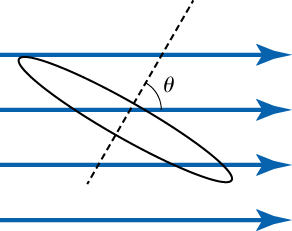
An oval object inclined at an angle theta within a uniform horizontal flow field, indicated by parallel blue arrows. Figure 23.58

AP Test Prep 23.3 §23.5 source ↗

The emf induced in a coil that is rotating in a magnetic field will be at a maximum when
  1. a.
    the magnetic flux is at a maximum.
  2. b.
    the magnetic flux is at a minimum.
  3. c.
    the change in magnetic flux is at a maximum.
  4. d.
    the change in magnetic flux is at a minimum.

Answer

C. the change in magnetic flux is at a maximum.

AP Test Prep 23.5 §23.7 source ↗

Which of the following statements is true for a step-down transformer? Select two answers.
  1. a.
    Primary voltage is higher than secondary voltage.
  2. b.
    Primary voltage is lower than secondary voltage.
  3. c.
    Primary current is higher than secondary current.
  4. d.
    Primary current is lower than secondary current.

Answer

A. Primary voltage is higher than secondary voltage. · D. Primary current is lower than secondary current.

AP Test Prep 23.7 §23.8 source ↗

Which of the following statements is true for an isolation transformer?
  1. a.
    It has more primary turns than secondary turns.
  2. b.
    It has fewer primary turns than secondary turns.
  3. c.
    It has an equal number of primary and secondary turns.
  4. d.
    It can have more, fewer, or an equal number of primary and secondary turns.

Answer

C. It has an equal number of primary and secondary turns.

Loading chapter 24…

Problems and answers are adapted from College Physics for AP® Courses 2e by Gregg Wolfe, Erika Gasper, John Stoke, Julie Kretchman, David Anderson and others, OpenStax, and are used under the CC BY-NC-SA 4.0 licence. Access for free at https://openstax.org/books/college-physics-ap-courses-2e/pages/1-connection-for-ap-r-courses. Illustrations: Copyright Rice University, OpenStax, under CC BY-NC-SA 4.0 license. This adaptation is released under the same licence, is non-commercial, and is neither affiliated with nor endorsed by OpenStax or Rice University.