Every problem in the chapter beside the book’s answer, a chapter at a time as you scroll.

Chapter 4: Dynamics: Force and Newton's Laws of Motion

41 problems · 28 figures

4-1 §4.3 source ↗

You may assume data taken from illustrations is accurate to three digits.

A 63.0-kg sprinter starts a race with an acceleration of 4.20 m/s2. What is the net external force on him?

Answer

265 N

4-3 §4.3 source ↗

You may assume data taken from illustrations is accurate to three digits.

A cleaner pushes a 4.50-kg laundry cart in such a way that the net external force on it is 60.0 N. Calculate the magnitude of its acceleration.

Answer

13.3 m/s 2

4-7 §4.3 source ↗

(a) If the rocket sled shown in Figure 4.31 starts with only one rocket burning, what is the magnitude of its acceleration? Assume that the mass of the system is 2100 kg, the thrust T is 2.59×10⁴ N, and the force of friction opposing the motion is known to be 650 N. (b) Why is the acceleration not one-fourth of what it is with all rockets burning?
Figure 4.30 in the book ↗
Figure 4.31 in the book ↗

Answer

(a) 12 m/s 2 .

(b) The acceleration is not one-fourth of what it was with all rockets burning because the frictional force is still as large as it was with all rockets burning.

4-9 §4.3 source ↗

Suppose two children push horizontally, but in exactly opposite directions, on a third child in a wagon. The first child exerts a force of 75.0 N, the second a force of 90.0 N, friction is 12.0 N, and the mass of the third child plus wagon is 23.0 kg.

a. What is the system of interest if the acceleration of the child in the wagon is to be calculated?

b. Draw a free-body diagram, including all forces acting on the system.

c. Calculate the acceleration.

d. What would the acceleration be if friction were 15.0 N?

Figure 4.31 in the book ↗

Answer

(a) The system is the child in the wagon plus the wagon.

(b)
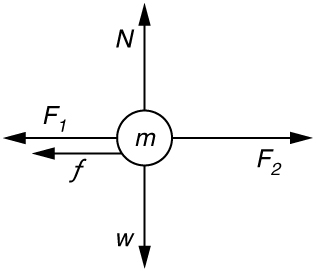
An object represented as a dot labeled m is shown at the center. One force represented by an arrow labeled as vector F sub 2 acts toward the right. Another force represented by an arrow labeled as vector F sub 1 having a slightly shorter length in comparison with F sub 2 acts on the object pointing left. A friction force represented by an arrow labeled as vector f having a small length acts on the object toward the left. Weight, represented by an arrow labeled as vector W, acts on the object downward, and normal force, represented by an arrow labeled as vector N, acts upward, having the same length as W.

(c) a=0.130 m/s2 in the direction of the second child’s push.

(d) a=0.00 m/s2

4-11 §4.3 source ↗

The rocket sled shown in Figure 4.32 accelerates at a rate of 49.0 m/s2. Its passenger has a mass of 75.0 kg. (a) Calculate the horizontal component of the force the seat exerts against his body. Compare this with his weight by using a ratio. (b) Calculate the direction and magnitude of the total force the seat exerts against his body.
Figure 4.31 in the book ↗
Figure 4.32 in the book ↗

Answer

(a) 3.68 × 10 3 N . This force is 5.00 times greater than his weight.

(b) 3750 N; 11.3º above horizontal

4-13 §4.3 source ↗

The weight of an astronaut plus their space suit on the Moon is only 250 N. How much do they weigh on Earth? What is the mass on the Moon? On Earth?
Figure 4.32 in the book ↗

Answer

1.5× 10 3 N, 150 kg, 150 kg

4-15 §4.4 source ↗

What net external force is exerted on a 1100-kg artillery shell fired from a battleship if the shell is accelerated at 2.40×10⁴ m/s2? What is the magnitude of the force exerted on the ship by the artillery shell?

Answer

Force on shell: 2.64×10⁷N

Force exerted on ship = −2.64×10⁷N, by Newton’s third law

4-17 §4.5 source ↗

Two teams of nine members each engage in a tug of war. Each of the first team’s members has an average mass of 68 kg and exerts an average force of 1350 N horizontally. Each of the second team’s members has an average mass of 73 kg and exerts an average force of 1365 N horizontally. (a) What is magnitude of the acceleration of the two teams? (b) What is the tension in the section of rope between the teams?

Answer

(a) 0.11 m/s2
(b) 1.2× 10 4 N

4-19 §4.5 source ↗

(a) Calculate the tension in a vertical strand of spider web if a spider of mass 8.00×10⁻⁵ kg hangs motionless on it. (b) Calculate the tension in a horizontal strand of spider web if the same spider sits motionless in the middle of it much like the tightrope walker in Figure 4.16. The strand sags at an angle of 12º below the horizontal. Compare this with the tension in the vertical strand (find their ratio).
Figure 4.16 in the book ↗
The weight of a tightrope walker causes a wire to sag by 5.0 degrees. The system of interest here is the point in the wire at which the tightrope walker is standing.

Answer

(a) 7.84×10⁻⁴ N

(b) 1.89×10⁻³ N. This is 2.41 times the tension in the vertical strand.

4-21 §4.5 source ↗

Show that, as stated in the text, a force F⊥ exerted on a flexible medium at its center and perpendicular to its length (such as on the tightrope wire in Figure 4.16) gives rise to a tension of magnitude T=F⊥2sin(θ).
Figure 4.16 in the book ↗
The weight of a tightrope walker causes a wire to sag by 5.0 degrees. The system of interest here is the point in the wire at which the tightrope walker is standing.

Answer

Newton’s second law applied in vertical direction gives

F y = F − 2 T sin θ = 0 F = 2T sin θ T = F 2 sin θ .

4-23 §4.6 source ↗

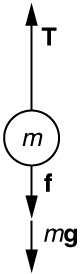
A 5.00×10⁵-kg rocket is accelerating straight up. Its engines produce 1.250×10⁷ N of thrust, and air resistance is 4.50×10⁶ N. What is the rocket’s acceleration? Explicitly show how you follow the steps in the Problem-Solving Strategy for Newton’s laws of motion.

Answer

An object of mass m is shown. Three forces acting on it are tension T, shown by an arrow acting vertically upward, and friction f and gravity m g, shown by two arrows acting vertically downward.

Using the free-body diagram:

Fnet= T− f− mg= ma,

so that

a= T−f−mgm= 1.250×10⁷ N−4.50×10⁶ N−(5.00×10⁵ kg)(9.80 m/s2)5.00×105 kg= 6.20 m/s2.

4-25 §4.6 source ↗

Calculate the force a 70.0-kg high jumper must exert on the ground to produce an upward acceleration 4.00 times the acceleration due to gravity. Explicitly show how you follow the steps in the Problem-Solving Strategy for Newton’s laws of motion.

Answer

1. Use Newton’s laws of motion. Two forces are acting on an object of mass m: F, shown by an arrow pointing upward, and its weight w, shown by an arrow pointing downward. Acceleration a is represented by a vector arrow pointing upward. The figure depicts the forces acting on a high jumper.
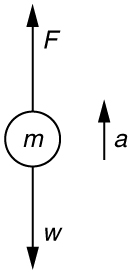
2. Given : a= 4.00g= (4.00)(9.80 m/s2)= 39.2 m/s2 ; m=70.0 kg,

Find: F.

3. ∑F=+F−w=ma , so that F= ma+ w= ma+ mg= m(a+g).

F= (70.0 kg)[(39.2 m/s2)+(9.80 m/s2)]=3.43×103 N. The force exerted by the high-jumper is actually down on the ground, but F is up from the ground and makes him jump.

4. This result is reasonable, since it is quite possible for a person to exert a force of the magnitude of 103 N.

4-27 §4.6 source ↗

A freight train consists of two 8.00 × 10 4 -kg engines and 45 cars with average masses of 5.50 × 10 4 kg . (a) What force must each engine exert backward on the track to accelerate the train at a rate of 5.00×10⁻² m/s2 if the force of friction is 7.50×10⁵ N, assuming the engines exert identical forces? This is not a large frictional force for such a massive system. Rolling friction for trains is small, and consequently trains are very energy-efficient transportation systems. (b) What is the force in the coupling between the 37th and 38th cars (this is the force each exerts on the other), assuming all cars have the same mass and that friction is evenly distributed among all of the cars and engines?

Answer

(a) 4.41×10⁵ N

(b) 1.50×10⁵ N

4-29 §4.6 source ↗

A 1100-kg car pulls a boat on a trailer. (a) What total force resists the motion of the car, boat, and trailer, if the car exerts a 1900-N force on the road and produces an acceleration of 0.550 m/s2? The mass of the boat plus trailer is 700 kg. (b) What is the force in the hitch between the car and the trailer if 80% of the resisting forces are experienced by the boat and trailer?

Answer

(a) 910 N

(b) 1.11×10³ N

4-31 §4.6 source ↗

Two children pull a third child on a snow saucer sled exerting forces F 1 and F 2 as shown from above in Figure 4.35. Find the acceleration of the 49.00-kg sled and child system. Note that the direction of the frictional force is unspecified; it will be in the opposite direction of the sum of F 1 and F 2 .
Figure 4.34 in the book ↗
Figure 4.35 in the book ↗
An overhead view of the horizontal forces acting on a child’s snow saucer sled.

Answer

a = 0.139 m/s2, θ = 12.4º north of east

4-33 §4.6 source ↗

What force is exerted on the tooth in Figure 4.37 if the tension in the wire is 25.0 N? Note that the force applied to the tooth is smaller than the tension in the wire, but this is necessitated by practical considerations of how force can be applied in the mouth. Explicitly show how you follow steps in the Problem-Solving Strategy for Newton’s laws of motion.
Figure 4.36 in the book ↗
Figure 4.37 in the book ↗
Braces are used to apply forces to teeth to realign them. Shown in this figure are the tensions applied by the wire to the protruding tooth. The total force applied to the tooth by the wire, Fapp, points straight toward the back of the mouth.

Answer

1. Use Newton’s laws since we are looking for forces.

2. Draw a free-body diagram: A horizontal dotted line with two vectors extending downward from the mid-point of the dotted line, both at angles of fifteen degrees. A third vector points straight downward from the intersection of the first two angles, bisecting them; it is perpendicular to the dotted line.
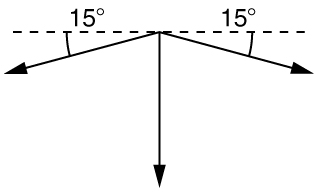
3. The tension is given as T=25.0 N. Find Fapp. Using Newton’s laws gives: Σ Fy=0, so that applied force is due to the y-components of the two tensions: Fapp= 2 T sin θ= 2(25.0 N)sin(15º)= 12.9 N

The x-components of the tension cancel. ∑Fx=0.

4. This seems reasonable, since the applied tensions should be greater than the force applied to the tooth.

4-40 §4.7 source ↗

A flea jumps by exerting a force of 1.20×10⁻⁵ N straight down on the ground. A breeze blowing on the flea parallel to the ground exerts a force of 0.500×10⁻⁶ N on the flea. Find the direction and magnitude of the acceleration of the flea if its mass is 6.00×10⁻⁷ kg. Do not neglect the gravitational force.

Answer

10.2 m/s 2 , 4.67º from vertical

4-42 §4.7 source ↗

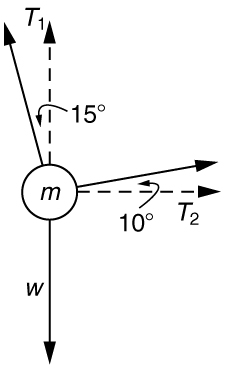
A 76.0-kg person is being pulled away from a burning building as shown in Figure 4.40. Calculate the tension in the two ropes if the person is momentarily motionless. Include a free-body diagram in your solution.
Figure 4.39 in the book ↗
Achilles tendon
Figure 4.40 in the book ↗
The force T2 needed to hold steady the person being rescued from the fire is less than her weight and less than the force T1 in the other rope, since the more vertical rope supports a greater part of her weight (a vertical force).

Answer

An object of mass m is shown being pulled by two ropes. Tension T sub two acts toward the right at an angle of ten degrees above the horizontal. Another rope makes an angle fifteen degrees to the left of the vertical direction, and tension in the rope is T sub one, shown by a vector arrow. Weight w is acting vertically downward.

T 1 = 736 N

T 2 = 194 N

4-44 §4.7 source ↗

Integrated Concepts When starting a foot race, a 70.0-kg sprinter exerts an average force of 650 N backward on the ground for 0.800 s. (a) What is his final speed? (b) How far does he travel?
Figure 4.40 in the book ↗
The force T2 needed to hold steady the person being rescued from the fire is less than her weight and less than the force T1 in the other rope, since the more vertical rope supports a greater part of her weight (a vertical force).

Answer

(a) 7.43 m/s

(b) 2.97 m

4-46 §4.7 source ↗

Integrated Concepts A basketball player jumps straight up for a ball. To do this, they lower their body 0.300 m and then accelerate through this distance by forcefully straightening their legs. This player leaves the floor with a vertical velocity sufficient to carry the player 0.900 m above the floor. (a) Calculate the player's velocity when they leave the floor. (b) Calculate their acceleration while they are straightening their legs. They go from zero to the velocity found in part (a) in a distance of 0.300 m. (c) Calculate the force they exert on the floor to do this, given that their mass is 110 kg.
Figure 4.40 in the book ↗
The force T2 needed to hold steady the person being rescued from the fire is less than her weight and less than the force T1 in the other rope, since the more vertical rope supports a greater part of her weight (a vertical force).

Answer

(a) 4.20 m/s

(b) 29.4 m/s2

(c) 4.31×10³ N

4-48 §4.7 source ↗

Integrated Concepts Repeat Exercise 4.47 for a shell fired at an angle 10.0º from the vertical.
Figure 4.40 in the book ↗
The force T2 needed to hold steady the person being rescued from the fire is less than her weight and less than the force T1 in the other rope, since the more vertical rope supports a greater part of her weight (a vertical force).

Answer

(a) 47.1 m/s

(b) 2.47×10³ m/s2

(c) 6.18×10³ N . The average force is 252 times the shell’s weight.

4-52 §4.8 source ↗

(a) What is the strength of the weak nuclear force relative to the strong nuclear force? (b) What is the strength of the weak nuclear force relative to the electromagnetic force? Since the weak nuclear force acts at only very short distances, such as inside nuclei, where the strong and electromagnetic forces also act, it might seem surprising that we have any knowledge of it at all. We have such knowledge because the weak nuclear force is responsible for beta decay, a type of nuclear decay not explained by other forces.

Answer

(a) 1×10⁻¹³

(b) 1×10⁻¹¹

4-54 §4.8 source ↗

What is the ratio of the strength of the strong nuclear force to that of the electromagnetic force? Based on this ratio, you might expect that the strong force dominates the nucleus, which is true for small nuclei. Large nuclei, however, have sizes greater than the range of the strong nuclear force. At these sizes, the electromagnetic force begins to affect nuclear stability. These facts will be used to explain nuclear fusion and fission later in this text.

Answer

10 2

4-55 §4.8 source ↗

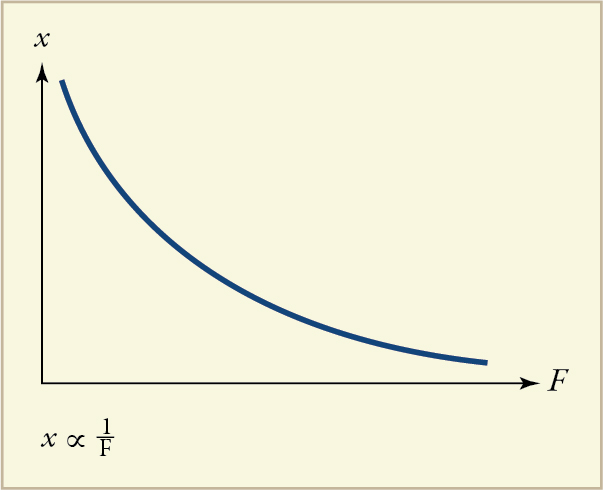
Critical Thinking Two boxes of equal mass slide start from rest and slide with different horizontal applied forces across frictionless surfaces to reach the same distance away. Box A has a horizontal force of three times that of box B. (a) Which box is traveling faster at this distance away from the starting point? Briefly explain your reasoning. (b) Based on experimental data, an equation that fits the data is suggested for the final speed, V, which may not be correct: V=KF, where K is a constant with appropriate units and F is the horizontal applied force. Is this equation consistent with your answer from part a? Explain why or why not. Does this equation make sense? Explain why or why not. (c) Now the applied force can be any value and the distance from the starting point is measured when the speed gets to a consistent value. Graph the distance the box gets to at a given speed as a function of the applied force.

Answer

(a) Box A travels faster at the finishing distance since a greater force with equal mass results in a greater acceleration. Also, a greater acceleration over the same distance results in a greater final speed.

(b) i. Yes, it is consistent because a greater force results in a greater final speed. ii. It does not make sense because V= 2(f/m)x = K (F) .

(c)

The figure is a plot of x as a function of F. The curve starts at a high value of x just to the right of the x axis and decreases in both value and slope, tending asymptotically to the F axis. Under the graph it is noted that x is proportional to 1 over F. Figure 4.41

AP Test Prep 4.1 §4.1 source ↗

Figure 4.42 in the book ↗
Figure 4.43 in the book ↗

The figure above represents a racetrack with semicircular sections connected by straight sections. Each section has length d, and markers along the track are spaced d/4 apart. Two people drive cars counterclockwise around the track, as shown. Car X goes around the curves at constant speed vc, increases speed at constant acceleration for half of each straight section to reach a maximum speed of 2vc, then brakes at constant acceleration for the other half of each straight section to return to speed vc. Car Y also goes around the curves at constant speed vc, increases its speed at constant acceleration for one-fourth of each straight section to reach the same maximum speed 2vc, stays at that speed for half of each straight section, then brakes at constant acceleration for the remaining fourth of each straight section to return to speed vc.

(a) On the figures below, draw an arrow showing the direction of the net force on each of the cars at the positions noted by the dots. If the net force is zero at any position, label the dot with 0.

The position of the six dots on the Car Y track on the right are as follows:

• The first dot on the left center of the track is at the same position as it is on the Car X track.

• The second dot is just slight to the right of the Car X dot (less than a dash) past three perpendicular hash marks moving to the right.

• The third dot is about one and two-thirds perpendicular hash marks to the right of the center top perpendicular has mark.

• The fourth dot is in the same position as the Car X figure (one perpendicular hash mark above the center right perpendicular hash mark).

• The fifth dot is about one and two-third perpendicular hash marks to the right of the center bottom perpendicular hash mark.

• The sixth dot is in the same position as the Car Y dot (one and two third perpendicular hash marks to the left of the center bottom hash mark).

(b)

i. Indicate which car, if either, completes one trip around the track in less time, and justify your answer qualitatively without using equations.

ii. Justify your answer about which car, if either, completes one trip around the track in less time quantitatively with appropriate equations.

Answer
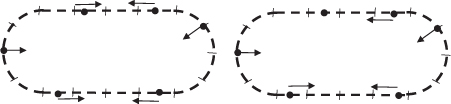
Two identical diagrams feature oval-shaped dashed paths with alternating plus and minus signs. Each path includes black dots with arrows indicating specific vector directions at points along the loop. Figure 4.44

Car X is shown on the left, and Car Y is shown on the right.

i.

Car X takes longer to accelerate and does not spend any time traveling at top speed. Car Y accelerates over a shorter time and spends time going at top speed. So Car Y must cover the straightaways in a shorter time. Curves take the same time, so Car Y must overall take a shorter time.

ii.

The only difference in the calculations for the time of one segment of linear acceleration is the difference in distances. That shows that Car X takes longer to accelerate. The equation d4vc=tc corresponds to Car Y traveling for a time at top speed.

Substituting a=vct1 into the displacement equation in part (b) ii gives D=32vct1. This shows that a car takes less time to reach its maximum speed when it accelerates over a shorter distance. Therefore, Car Y reaches its maximum speed more quickly, and spends more time at its maximum speed than Car X does, as argued in part (b) i.

AP Test Prep 4.3 §4.1 source ↗

A hawk accelerates as it glides in the air. Does the force causing the acceleration come from the hawk itself? Explain.

Answer

A body cannot exert a force on itself. The hawk may accelerate as a result of several forces. The hawk may accelerate toward Earth as a result of the force due to gravity. The hawk may accelerate as a result of the additional force exerted on it by wind. The hawk may accelerate as a result of orienting its body to create less air resistance, thus increasing the net force forward.

AP Test Prep 4.5 §4.4 source ↗

What object or objects commonly exert forces on the following objects in motion? (a) a soccer ball being kicked, (b) a dolphin jumping, (c) a parachutist drifting to Earth.

Answer

(a) A soccer player, gravity, air, and friction commonly exert forces on a soccer ball being kicked.

(b) Gravity and the surrounding water commonly exert forces on a dolphin jumping. (The dolphin moves its muscles to exert a force on the water. The water exerts an equal force on the dolphin, resulting in the dolphin’s motion.)

(c) Gravity and air exert forces on a parachutist drifting to Earth.

AP Test Prep 4.7 §4.4 source ↗

Which of the following is true?
  1. a.
    Earth exerts a force due to gravity on your body, and your body exerts a smaller force on the Earth, because your mass is smaller than the mass of the Earth.
  2. b.
    The Moon orbits the Earth because the Earth exerts a force on the Moon and the Moon exerts a force equal in magnitude and direction on the Earth.
  3. c.
    A rocket taking off exerts a force on the Earth equal to the force the Earth exerts on the rocket.
  4. d.
    An airplane cruising at a constant speed is not affected by gravity.

Answer

C. A rocket taking off exerts a force on the Earth equal to the force the Earth exerts on the rocket.

AP Test Prep 4.9 §4.4 source ↗

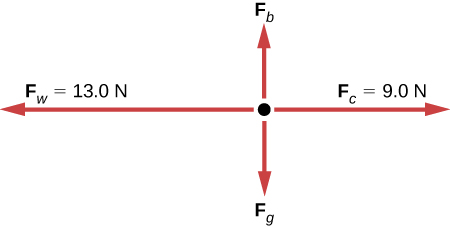
The current in a river exerts a force of 9.0 N on a balloon floating in the river. A wind exerts a force of 13.0 N on the balloon in the opposite direction. Draw a free-body diagram to show the forces acting on the balloon. Use your free-body diagram to predict the effect on the balloon.

Answer

A free-body diagram illustrating four forces acting on a central point. Fw (13.0 N) points left, Fc (9.0 N) points right, Fb points upward, and Fg points downward. Figure 4.45

The diagram consists of a black dot in the center and two small red arrows pointing up (Fb) and down (Fg) and two long red arrows pointing right (Fc = 9.0 N) and left (Fw=13.0 N).

In the diagram, Fg represents the force due to gravity on the balloon, and Fb represents the buoyant force. These two forces are equal in magnitude and opposite in direction. Fc represents the force of the current. Fw represents the force of the wind. The net force on the balloon will be Fw−Fc=4.0 N and the balloon will accelerate in the direction the wind is blowing.

AP Test Prep 4.11 §4.4 source ↗

A parachutist’s fall to Earth is determined by two opposing forces. A gravitational force of 539 N acts on the parachutist. After 2 s, she opens her parachute and experiences an air resistance of 615 N. At what speed is the parachutist falling after 10 s?

Answer

Since m=F/a, the parachutist has a mass of 539 N/9.8 km/s2= 55 kg.

For the first 2 s, the parachutist accelerates at 9.8 m/s2.

v = a t = 9.8 m s 2 • 2 s = 19.6 m s

Her speed after 2 s is 19.6 m/s.

From 2 s to 10 s, the net force on the parachutist is 539 N – 615 N, or 76 N upward.

a = F m = − 76 N 55 ​ ​ ​ ​ kg = − 1.4 m s 2

Since v=v0+at, v= 19.6 m/s2+ (−1.4 m/s2)(8s) = 8.4 m/s2.

At 10 s, the parachutist is falling to Earth at 8.4 m/s.

AP Test Prep 4.13 §4.4 source ↗

A landscaper is easing a wheelbarrow full of soil down a hill. Define the system you would analyze and list all the forces that you would need to include to calculate the acceleration of the wheelbarrow.

Answer

The system includes the gardener and the wheelbarrow with its contents. The following forces are important to include: the weight of the wheelbarrow, the weight of the gardener, the normal force for the wheelbarrow and the gardener, the force of the gardener pushing against the ground and the equal force of the ground pushing back against the gardener, and any friction in the wheelbarrow’s wheels.

AP Test Prep 4.15 §4.4 source ↗

A figure skater has a mass of 40 kg and her partner's mass is 50 kg. She pushes against the ice with a force of 120 N, causing her and her partner to move forward. Calculate the pair’s acceleration. Assume that all forces opposing the motion, such as friction and air resistance, total 5.0 N.

Answer

The system undergoing acceleration is the two figure skaters together.

Net force = 120 N – 5.0 N = 115 N.

Total mass = 40 kg + 50 kg = 90 kg.

Using Newton’s second law, we have that

a = F m = 115 N 90 kg = 1.28 m s 2

The pair accelerates forward at 1.28 m/s2.

AP Test Prep 4.17 §4.5 source ↗

A cable raises a mass of 120.0 kg with an acceleration of 1.3 m/s2. What force of tension is in the cable?

Answer

The force of tension must equal the force of gravity plus the force necessary to accelerate the mass. F=mg can be used to calculate the first, and F=ma can be used to calculate the second.

For gravity:

F = m g = ( 120.0 kg)(9 .8 m/s 2 ) = 1205.4 N

For acceleration:

F = m a = ( 120.0 kg)(1 .3 m/s 2 ) = 159.9 N

The total force of tension in the cable is 1176 N + 156 N = 1332 N.

AP Test Prep 4.19 §4.5 source ↗

Two teams are engaging in a tug–of-war. The rope suddenly snaps. Which statement is true about the forces involved?
  1. a.
    The forces exerted by the two teams are no longer equal; the teams will accelerate in opposite directions as a result.
  2. b.
    The forces exerted by the players are no longer balanced by the force of tension in the rope; the teams will accelerate in opposite directions as a result.
  3. c.
    The force of gravity balances the forces exerted by the players; the teams will fall as a result
  4. d.
    The force of tension in the rope is transferred to the players; the teams will accelerate in opposite directions as a result.

Answer

B. The forces exerted by the players are no longer balanced by the force of tension in the rope; the teams will accelerate in opposite directions as a result.

AP Test Prep 4.21 §4.5 source ↗

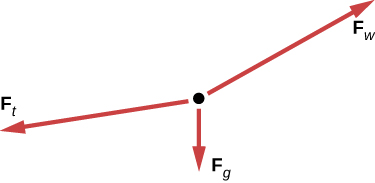
Draw a free-body diagram to represent the forces acting on a kite on a string that is floating stationary in the air. Label the forces in your diagram.

Answer

A free-body diagram illustrates three forces acting on a point: gravitational force (Fg) downward, tension force (Ft) leftward, and wind force (Fw) upward and rightward. Figure 4.47

The diagram has a black dot and three solid red arrows pointing away from the dot. Arrow Ft is long and pointing to the left and slightly down. Arrow Fw is also long and is a bit below a diagonal line halfway between pointing up and pointing to the right. A short arrow Fg is pointing down.

Fg is the force on the kite due to gravity.

Fw is the force exerted on the kite by the wind.

Ft is the force of tension in the string holding the kite. It must balance the vector sum of the other two forces for the kite to float stationary in the air.

AP Test Prep 4.23 §4.6 source ↗

A toboggan with two riders has a total mass of 85.0 kg. A third person is pushing with a force of 42.5 N in the direction of motion on a toboggan moving on a sloped surface at the top of a hill that has a downward angle of 15°. The force of friction on the toboggan is 31.0 N. Which statement describes an accurate free-body diagram to represent the situation?
  1. a.
    An arrow of magnitude 10.5 N points down the slope of the hill.
  2. b.
    An arrow of magnitude 833 N points straight down.
  3. c.
    An arrow of magnitude 833 N points perpendicular to the slope of the hill.
  4. d.
    An arrow of magnitude 73.5 N points down the slope of the hill.

Answer

B. An arrow of magnitude 833 N points straight down.

AP Test Prep 4.25 §4.6 source ↗

Which statement is true about drawing free-body diagrams?
  1. a.
    Drawing a free-body diagram should be the last step in solving a problem about forces.
  2. b.
    Drawing a free-body diagram helps you compare forces quantitatively.
  3. c.
    The forces in a free-body diagram should always balance.
  4. d.
    Drawing a free-body diagram can help you determine the net force.

Answer

D. Drawing a free-body diagram can help you determine the net force.

AP Test Prep 4.27 §4.7 source ↗

Two people push on a boulder to try to move it. The mass of the boulder is 825 kg. One person pushes north with a force of 64 N. The other pushes west with a force of 38 N. Predict the magnitude of the acceleration of the boulder. Assume that friction is negligible.

Answer

A free-body diagram would show a northward force of 64 N and a westward force of 38 N. The net force is equal to the sum of the two applied forces. It can be found using the Pythagorean theorem:

F net = F x 2 + F y w = ( 38 N ) 2 + ( 64 ​ N ) 2 = 74.4 N

Since a=Fm,

a = 74.4 N 825 kg = 0.09 m/s 2

The boulder will accelerate at 0.09 m/s2.

AP Test Prep 4.29 §4.8 source ↗

Which phenomenon correctly describes the direction and magnitude of normal forces?
  1. a.
    electromagnetic attraction
  2. b.
    electromagnetic repulsion
  3. c.
    gravitational attraction
  4. d.
    gravitational repulsion

Answer

B. electromagnetic repulsion

AP Test Prep 4.31 §4.8 source ↗

Which of the basic forces best explains tension in a rope being pulled between two people? Is the acting force causing attraction or repulsion in this instance?
  1. a.
    gravity; attraction
  2. b.
    electromagnetic; attraction
  3. c.
    weak and strong nuclear; attraction
  4. d.
    weak and strong nuclear; repulsion

Answer

B. electromagnetic; attraction

AP Test Prep 4.33 §4.8 source ↗

The gravitational force is the weakest of the four basic forces. In which case can the electromagnetic, strong, and weak forces be ignored because the gravitational force is so strongly dominant?
  1. a.
    a person jumping on a trampoline
  2. b.
    a rocket blasting off from Earth
  3. c.
    a log rolling down a hill
  4. d.
    all of the above

Answer

D. all of the above

Loading chapter 5…

Problems and answers are adapted from College Physics for AP® Courses 2e by Gregg Wolfe, Erika Gasper, John Stoke, Julie Kretchman, David Anderson and others, OpenStax, and are used under the CC BY-NC-SA 4.0 licence. Access for free at https://openstax.org/books/college-physics-ap-courses-2e/pages/1-connection-for-ap-r-courses. Illustrations: Copyright Rice University, OpenStax, under CC BY-NC-SA 4.0 license. This adaptation is released under the same licence, is non-commercial, and is neither affiliated with nor endorsed by OpenStax or Rice University.