Every problem in the chapter beside the book’s answer, a chapter at a time as you scroll.
Chapter 8: Linear Momentum and Collisions
58 problems · 2 figures8-1 §8.1 source ↗
Answer
(a)
(b) 625 to 1
(c)
8-3 §8.1 source ↗
Answer
(a)
(b)
(c) Because the momentum of the airplane is 3 orders of magnitude smaller than of the ship, the ship will not recoil very much. The recoil would be , which is probably not noticeable.
8-5 §8.1 source ↗
Answer
8-7 §8.2 source ↗
Answer
8-9 §8.2 source ↗
Answer
a) toward the leg
b) The force on each hand would have the same magnitude as that found in part (a) (but in opposite directions by Newton’s third law) because the change in momentum and the time interval are the same.
8-11 §8.2 source ↗
Professional Application
Suppose a child drives a bumper car head on into the side rail, which exerts a force of 4000 N on the car for 0.200 s. (a) What impulse is imparted by this force? (b) Find the final velocity of the bumper car if its initial velocity was 2.80 m/s and the car plus driver have a mass of 200 kg. You may neglect friction between the car and floor.
Answer
a) away from the wall
b) away from the wall
8-13 §8.2 source ↗
Professional Application
A 75.0-kg person is riding in a car moving at 20.0 m/s when the car runs into a bridge abutment. (a) Calculate the average force on the person if he is stopped by a padded dashboard that compresses an average of 1.00 cm. (b) Calculate the average force on the person if he is stopped by an air bag that compresses an average of 15.0 cm.
Answer
(a) away from the dashboard
(b) away from the dashboard
8-15 §8.2 source ↗
Answer
8-17 §8.2 source ↗
Answer
8-19 §8.2 source ↗
Answer
8-21 §8.2 source ↗
Answer
8-23 §8.3 source ↗
Professional Application
Train cars are coupled together by being bumped into one another. Suppose two loaded train cars are moving toward one another, the first having a mass of 150,000 kg and a velocity of 0.300 m/s, and the second having a mass of 110,000 kg and a velocity of . (The minus indicates direction of motion.) What is their final velocity?
Answer
8-25 §8.3 source ↗
Professional Application
Consider the following question: A car moving at 10 m/s crashes into a tree and stops in 0.26 s. Calculate the force the seatbelt exerts on a passenger in the car to bring him to a halt. The mass of the passenger is 70 kg. Would the answer to this question be different if the car with the 70-kg passenger had collided with a car that has a mass equal to and is traveling in the opposite direction and at the same speed? Explain your answer.
Answer
8-27 §8.3 source ↗
Answer
8-29 §8.4 source ↗
Professional Application
Two piloted satellites approach one another at a relative speed of 0.250 m/s, intending to dock. The first has a mass of , and the second a mass of . If the two satellites collide elastically rather than dock, what is their final relative velocity?
Answer
8-31 §8.5 source ↗
Answer
(a) 86.4 N perpendicularly away from the bumper
(b) 0.389 J
(c) 64.0%
8-33 §8.5 source ↗
Professional Application
Using mass and speed data from Example 8.1 and assuming that the football player catches the ball with his feet off the ground with both of them moving horizontally, calculate: (a) the final velocity if the ball and player are going in the same direction and (b) the loss of kinetic energy in this case. (c) Repeat parts (a) and (b) for the situation in which the ball and the player are going in opposite directions. Might the loss of kinetic energy be related to how much it hurts to catch the pass?
Answer
(a) 8.06 m/s
(b) -56.0 J
(c)(i) 7.88 m/s; (ii) -223 J
8-35 §8.5 source ↗
Professional Application
Two piloted satellites approaching one another, at a relative speed of 0.250 m/s, intending to dock. The first has a mass of , and the second a mass of . (a) Calculate the final velocity (after docking) by using the frame of reference in which the first satellite was originally at rest. (b) What is the loss of kinetic energy in this inelastic collision? (c) Repeat both parts by using the frame of reference in which the second satellite was originally at rest. Explain why the change in velocity is different in the two frames, whereas the change in kinetic energy is the same in both.
Answer
(a) 0.163 m/s in the direction of motion of the more massive satellite
(b) 81.6 J
(c) in the direction of motion of the less massive satellite, 81.5 J. Because there are no external forces, the velocity of the center of mass of the two-satellite system is unchanged by the collision. The two velocities calculated above are the velocity of the center of mass in each of the two different individual reference frames. The loss in KE is the same in both reference frames because the KE lost to internal forces (heat, friction, etc.) is the same regardless of the coordinate system chosen.
8-37 §8.5 source ↗
Professional Application
Space probes may be separated from their launchers by exploding bolts. (They bolt away from one another.) Suppose a 4800-kg satellite uses this method to separate from the 1500-kg remains of its launcher, and that 5000 J of kinetic energy is supplied to the two parts. What are their subsequent velocities using the frame of reference in which they were at rest before separation?
Answer
0.704 m/s
–2.25 m/s
8-38 §8.5 source ↗
Answer
(a) 4.58 m/s away from the bullet
(b) 31.5 J
(c) –0.491 m/s
(d) 3.38 J
8-40 §8.5 source ↗
Professional Application
The Moon’s craters are remnants of meteorite collisions. Suppose a fairly large asteroid that has a mass of (about a kilometer across) strikes the Moon at a speed of 15.0 km/s. (a) At what speed does the Moon recoil after the perfectly inelastic collision (the mass of the Moon is ) ? (b) How much kinetic energy is lost in the collision? Such an event may have been observed by medieval English monks who reported observing a red glow and subsequent haze about the Moon. (c) In October 2009, NASA crashed a rocket into the Moon, and analyzed the plume produced by the impact. (Significant amounts of water were detected.) Answer part (a) and (b) for this real-life experiment. The mass of the rocket was 2000 kg and its speed upon impact was 9000 km/h. How does the plume produced alter these results?
Answer
(a)
(b) (almost all KE lost)
(c) Recoil speed is , energy lost is . The plume will not affect the momentum result because the plume is still part of the Moon system. The plume may affect the kinetic energy result because a significant part of the initial kinetic energy may be transferred to the kinetic energy of the plume particles.
8-42 §8.5 source ↗
Answer
8-44 §8.5 source ↗
Answer
(a) 4.00 kg
(b) 210 J
(c) The clown does work to throw the barbell, so the kinetic energy comes from the muscles of the clown. The muscles convert the chemical potential energy of ATP into kinetic energy.
8-45 §8.6 source ↗
Answer
(a) 3.00 m/s, below -axis
(b) Find speed of first puck after collision:
Verify that ratio of initial to final KE equals one:
8-47 §8.6 source ↗
Answer
(a)
(b)
(c) The ground will exert a normal force to oppose recoil of the cannon in the vertical direction. The momentum in the vertical direction is transferred to the earth. The energy is transferred into the ground, making a dent where the cannon is. After long barrages, cannon have erratic aim because the ground is full of divots.
8-49 §8.6 source ↗
Professional Application
Ernest Rutherford (the first New Zealander to be awarded the Nobel Prize in Chemistry) demonstrated that nuclei were very small and dense by scattering helium-4 nuclei from gold-197 nuclei . The energy of the incoming helium nucleus was , and the masses of the helium and gold nuclei were and , respectively (note that their mass ratio is 4 to 197). (a) If a helium nucleus scatters to an angle of during an elastic collision with a gold nucleus, calculate the helium nucleus’s final speed and the final velocity (magnitude and direction) of the gold nucleus. (b) What is the final kinetic energy of the helium nucleus?
Answer
(a) at
(b)
8-51 §8.6 source ↗
Starting with equations and for conservation of momentum in the - and -directions and assuming that one object is originally stationary, prove that for an elastic collision of two objects of equal masses,
as discussed in the text.
Answer
We are given that . The given equations then become:
and
Square each equation to get
Add these two equations and simplify:
Multiply the entire equation by to recover the kinetic energy:
8-53 §8.7 source ↗
Professional Application
Antiballistic missiles (ABMs) are designed to have very large accelerations so that they may intercept fast-moving incoming missiles in the short time available. What is the takeoff acceleration of a 10,000-kg ABM that expels 196 kg of gas per second at an exhaust velocity of
Answer
8-55 §8.7 source ↗
Professional Application
Calculate the increase in velocity of a 4000-kg space probe that expels 3500 kg of its mass at an exhaust velocity of . You may assume the gravitational force is negligible at the probe’s location.
Answer
8-57 §8.7 source ↗
Answer
8-60 §8.7 source ↗
Answer
8-61 §8.7 source ↗
Professional Application
(a) A 5.00-kg squid initially at rest ejects 0.250-kg of fluid with a velocity of 10.0 m/s. What is the recoil velocity of the squid if the ejection is done in 0.100 s and there is a 5.00-N frictional force opposing the squid’s movement. (b) How much energy is lost to work done against friction?
Answer
(a) 0.421 m/s away from the ejected fluid.
(b) .
AP Test Prep 8.1 §8.1 source ↗
- a.He feels an upward force to compensate for the downward trajectory of the snowball.
- b.He feels a backward force exerted by the snowball he is throwing.
- c.He feels no net force.
- d.He feels a forward force, the same force that propels the snowball.
Answer
AP Test Prep 8.3 §8.2 source ↗
- a.33 N, up
- b.120 N, up
- c.120 N, down
- d.240 N, down
Answer
AP Test Prep 8.5 §8.2 source ↗
- a.1.6 m
- b.2.8 m
- c.3.2 m
- d.5.6 m
Answer
AP Test Prep 8.7 §8.2 source ↗
A 2.5-kg block slides across a frictionless table toward a horizontal spring.As the block bounces off the spring, a probe measures the velocity of the block (initially negative, moving away from the probe) over time as follows:
What is the average force exerted on the block by the spring over the entire 0.60-s time interval of the collision?
(a) 50 N
(b) 60 N
(c) 100 N
(d) 120 N
| Velocity (m/s) | Time (s) |
|---|---|
| −12.0 | 0 |
| −10.0 | 0.10 |
| −6.0 | 0.20 |
| 0 | 0.30 |
| 6.0 | 0.40 |
| 10.0 | 0.50 |
| 12.0 | 0.60 |
Answer
AP Test Prep 8.9 §8.2 source ↗
- a.The (negative) acceleration of the car before it hits the wall and the distance the car travels while braking.
- b.The (negative) acceleration of the car before it hits the wall and the velocity of the car just before impact.
- c.The velocity of the car just before impact and the duration of the collision with the wall.
- d.The duration of the collision with the wall and the distance the car travels while braking.
Answer
AP Test Prep 8.11 §8.2 source ↗
- a.0.308 N
- b.0.616 N
- c.56 N
- d.112 N
Answer
AP Test Prep 8.13 §8.2 source ↗
The graph in Figure 8.15 represents the force exerted on a particle during a collision. What is the magnitude of the change in momentum of the particle as a result of the collision?
- a.1.2 kg • m/s
- b.2.4 kg • m/s
- c.3.6 kg • m/s
- d.4.8 kg • m/s
Answer
AP Test Prep 8.15 §8.3 source ↗
- a.Two air cars colliding on a track elastically.
- b.Two air cars colliding on a track and sticking together.
- c.A bullet being fired into a hanging wooden block and becoming embedded in the block, with the system then acting as a ballistic pendulum.
- d.A bullet being fired into a hillside and becoming buried in the earth.
Answer
AP Test Prep 8.17 §8.3 source ↗
- a.It will be greater before the collision.
- b.It will be equal before and after the collision.
- c.It will be greater after the collision.
- d.The answer depends on whether the collision is elastic or inelastic.
Answer
AP Test Prep 8.19 §8.3 source ↗
- a.before, after
- b.before, 0 after
- c.before, after
- d.0 before, 0 after
Answer
AP Test Prep 8.21 §8.4 source ↗
- a.−27 kg • m/s
- b.zero
- c.+27 kg • m/s
- d.It depends on whether the collision is elastic or inelastic.
Answer
AP Test Prep 8.23 §8.4 source ↗
Puck A (200 g) slides across a frictionless surface to collide with puck B (800 g), initially at rest. The velocity of each puck is measured during the experiment as follows:
What is the change in momentum of the center of mass of the system as a result of the collision?
- a.+1.6 kg•m/s
- b.+0.8 kg•m/s
- c.0
- d.−1.6 kg•m/s
| Time | Velocity A | Velocity B |
|---|---|---|
| 0 | +8.0 m/s | 0 |
| 1.0 s | +8.0 m/s | 0 |
| 2.0 s | −2.0 m/s | +2.5 m/s |
| 3.0 s | −2.0 m/s | +2.5 m/s |
Answer
AP Test Prep 8.25 §8.4 source ↗
- a.same as the original 15 m/s speed, opposite direction
- b.equal to car B’s velocity prior to the collision
- c.equal to the average of the two velocities, in its original direction
- d.equal to the average of the two velocities, in the opposite direction
Answer
AP Test Prep 8.27 §8.4 source ↗
- a.Energy was required to deform the ball’s shape during the collision with the floor.
- b.Energy was lost due to work done by the ball pushing on the floor during the collision.
- c.Energy was lost due to friction between the ball and the floor.
- d.Energy was lost due to the work done by gravity during the motion.
Answer
AP Test Prep 8.29 §8.4 source ↗
- a.After the collision, mass A is at rest, and mass B moves 14 m/s in the +x-direction.
- b.After the collision, mass A moves 4 m/s in the –x-direction, and mass B moves 18 m/s in the +x-direction.
- c.After the collision, the two masses stick together and move 7 m/s in the +x-direction.
- d.After the collision, mass A moves 4 m/s in the +x-direction, and mass B moves 10 m/s in the +x-direction.
Answer
AP Test Prep 8.31 §8.4 source ↗
- a.3.0 m/s in the +x-direction
- b.5.0 m/s in the +x-direction
- c.3.0 m/s in the –x-direction
- d.5.0 m/s in the –x-direction
Answer
AP Test Prep 8.33 §8.4 source ↗
- a.Both momentum and kinetic energy are conserved.
- b.Momentum is conserved, but kinetic energy is not conserved.
- c.Neither momentum nor kinetic energy is conserved.
- d.More information is needed in order to determine which is conserved.
Answer
AP Test Prep 8.35 §8.4 source ↗
- a.Momentum is conserved, and kinetic energy is conserved.
- b.Momentum is conserved, and kinetic energy is not conserved.
- c.Momentum is not conserved, and kinetic energy is conserved.
- d.Momentum is not conserved, and kinetic energy is not conserved.
Answer
AP Test Prep 8.37 §8.4 source ↗
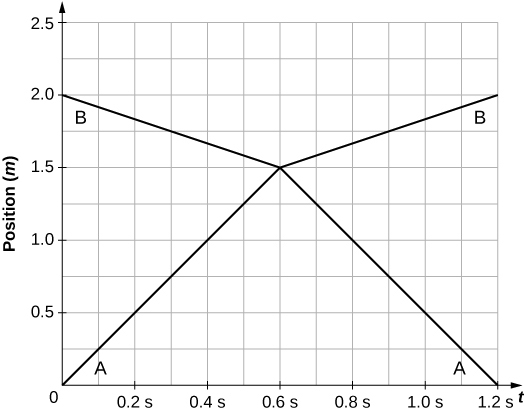
This figure shows the positions of two colliding objects measured before, during, and after a collision. Mass A is 1.0 kg. Mass B is 3.0 kg. Which of the following statements is true?
- a.This is an elastic collision, with a total momentum of 0 kg • m/s.
- b.This is an elastic collision, with a total momentum of 1.67 kg • m/s.
- c.This is an inelastic collision, with a total momentum of 0 kg • m/s.
- d.This is an inelastic collision, with a total momentum of 1.67 kg • m/s.
Answer
AP Test Prep 8.39 §8.4 source ↗
- a.There will be no change in the center-of-mass velocity.
- b.The center-of-mass velocity will decrease by 2 m/s.
- c.The center-of-mass velocity will decrease by 6 m/s.
- d.The center-of-mass velocity will decrease by 8 m/s.
Answer
AP Test Prep 8.41 §8.5 source ↗
- a.Both will move 0.5 m/s in the –x-direction.
- b.Mass A will stop; mass B will move 9 m/s in the +x-direction.
- c.Mass B will stop; mass A will move 9 m/s in the –x-direction.
- d.Mass A will move 5 m/s in the –x-direction; mass B will move 4 m/s in the +x-direction.
Answer
AP Test Prep 8.43 §8.5 source ↗
Mass A (2.0 kg) is moving with an initial velocity of 15 m/s in the +x-direction, and it collides with mass B (5.0 kg), initially at rest. After the collision, the two objects stick together and move as one. What is the change in kinetic energy of the system as a result of the collision?
(a) no change
(b) decrease by 225 J
(c) decrease by 161 J
(d) decrease by 64 J
Answer
AP Test Prep 8.45 §8.5 source ↗
- a.Momentum is conserved during the collision, but it is not conserved during the motion before and after the collision.
- b.Momentum is not conserved at any time during this analysis.
- c.Momentum is conserved at all times during this analysis.
- d.Momentum is not conserved during the collision, but it is conserved during the motion before and after the collision.
Answer
AP Test Prep 8.47 §8.5 source ↗
- a.A is not moving; B is moving 24 m/s in the +x-direction.
- b.Neither A nor B is moving.
- c.A is moving 24 m/s in the –x-direction. B is not moving.
- d.Both A and B are moving together 8 m/s in the +x-direction.
Answer
AP Test Prep 8.49 §8.5 source ↗
- a.6 m/s in the +x-direction
- b.4 m/s in the +x-direction
- c.zero
- d.4 m/s in the –x-direction
Answer
AP Test Prep 8.51 §8.6 source ↗
- a.The center-of-mass velocity will decrease after the collision as a result of lost energy (but not drop to zero).
- b.The center-of-mass velocity will remain the same after the collision since momentum is conserved.
- c.The center-of-mass velocity will drop to zero since the two objects stick together.
- d.The magnitude of the center-of-mass velocity will remain the same, but the direction of the velocity will change.
Answer
Loading chapter 9…
Problems and answers are adapted from College Physics for AP® Courses 2e by Gregg Wolfe, Erika Gasper, John Stoke, Julie Kretchman, David Anderson and others, OpenStax, and are used under the CC BY-NC-SA 4.0 licence. Access for free at https://openstax.org/books/college-physics-ap-courses-2e/pages/1-connection-for-ap-r-courses. Illustrations: Copyright Rice University, OpenStax, under CC BY-NC-SA 4.0 license. This adaptation is released under the same licence, is non-commercial, and is neither affiliated with nor endorsed by OpenStax or Rice University.