Every problem in the chapter beside the book’s answer, a chapter at a time as you scroll.

Chapter 7: Work, Energy, and Energy Resources

58 problems · 13 figures

7-1 §7.1 source ↗

How much work does a supermarket checkout attendant do on a can of soup he pushes 0.600 m horizontally with a force of 5.00 N? Express your answer in joules and kilocalories.

Answer

3 . 00  J = 7 . 17 × 10 − 4  kcal

7-3 §7.1 source ↗

(a) Calculate the work done on a 1500-kg elevator car by its cable to lift it 40.0 m at constant speed, assuming friction averages 100 N. (b) What is the work done on the elevator car by the gravitational force in this process? (c) What is the total work done on the elevator car?

Answer

(a) 5.92×10⁵J

(b) −5.88×10⁵J

(c) The net force is zero.

7-5 §7.1 source ↗

Calculate the work done by an 85.0-kg man who pushes a crate 4.00 m up along a ramp that makes an angle of 20.0º with the horizontal. (See Figure 7.32.) He exerts a force of 500 N on the crate parallel to the ramp and moves at a constant speed. Be certain to include the work he does on the crate and on his body to get up the ramp.
Figure 7.32 in the book ↗
A man pushes a crate up a ramp.

Answer

3 . 14 × 10 3 J

7-7 §7.1 source ↗

A shopper pushes a grocery cart 20.0 m at constant speed on level ground, against a 35.0 N frictional force. He pushes in a direction 25.0º below the horizontal. (a) What is the work done on the cart by friction? (b) What is the work done on the cart by the gravitational force? (c) What is the work done on the cart by the shopper? (d) Find the force the shopper exerts, using energy considerations. (e) What is the total work done on the cart?

Answer

(a) − 700 J

(b) 0

(c) 700 J

(d) 38.6 N

(e) 0

7-9 §7.2 source ↗

Compare the kinetic energy of a 20,000-kg truck moving at 110 km/h with that of an 80.0-kg astronaut in orbit moving at 27,500 km/h.

Answer

1 / 250

7-11 §7.2 source ↗

Confirm the value given for the kinetic energy of an aircraft carrier in Table 7.1. You will need to look up the definition of a nautical mile (1 knot = 1 nautical mile/h).
Table 7.1 Energy of Various Objects and Phenomena in the book ↗
Object/phenomenon Energy in joules
Big Bang 10 68
Energy released in a supernova 10 44
Fusion of all the hydrogen in Earth’s oceans 10 34
Annual world energy use 4 × 10 20
Large fusion bomb (9 megaton) 3 . 8 × 10 16
1 kg hydrogen (fusion to helium) 6 . 4 × 10 14
1 kg uranium (nuclear fission) 8 . 0 × 10 13
Hiroshima-size fission bomb (10 kiloton) 4 . 2 × 10 13
90,000-metric ton aircraft carrier at 30 knots 1 . 1 × 10 10
1 barrel crude oil 5 . 9 × 10 9
1 ton TNT 4 . 2 × 10 9
1 gallon of gasoline 1 . 2 × 10 8
Daily home electricity use (developed countries) 7 × 10 7
Daily adult food intake (recommended) 1 . 2 × 10 7
1000-kg car at 90 km/h 3 . 1 × 10 5
1 g fat (9.3 kcal) 3 . 9 × 10 4
ATP hydrolysis reaction 3 . 2 × 10 4
1 g carbohydrate (4.1 kcal) 1 . 7 × 10 4
1 g protein (4.1 kcal) 1 . 7 × 10 4
Tennis ball at 100 km/h 22
Mosquito (10–2g at 0.5 m/s) 1 . 3 × 10 − 6
Single electron in a TV tube beam 4 . 0 × 10 − 15
Energy to break one DNA strand 10 − 19

Answer

1 . 1 × 10 10 J

7-13 §7.2 source ↗

A car’s bumper is designed to withstand a 4.0-km/h (1.12-m/s) collision with an immovable object without damage to the body of the car. The bumper cushions the shock by absorbing the force over a distance. Calculate the magnitude of the average force on a bumper that collapses 0.200 m while bringing a 900-kg car to rest from an initial speed of 1.12 m/s.

Answer

2 . 8 × 10 3 N

7-15 §7.2 source ↗

Using energy considerations, calculate the average force a 60.0-kg sprinter exerts backward on the track to accelerate from 2.00 to 8.00 m/s in a distance of 25.0 m, if he encounters a headwind that exerts an average force of 30.0 N against him.

Answer

102 N

7-16 §7.3 source ↗

A hydroelectric power facility (see Figure 7.35) converts the gravitational potential energy of water behind a dam to electric energy. (a) What is the gravitational potential energy relative to the generators of a lake of volume 50.0 km3 (mass= 5.00×10¹³kg ), given that the lake has an average height of 40.0 m above the generators? (b) Compare this with the energy stored in a 9-megaton fusion bomb.
Figure 7.35 in the book ↗
Hydroelectric facility (credit: Denis Belevich, Wikimedia Commons)

Answer

(a) 1.96 × 10¹⁶ J

(b) The ratio of gravitational potential energy in the lake to the energy stored in the bomb is 0.52. That is, the energy stored in the lake is approximately half that in a 9-megaton fusion bomb.

7-18 §7.3 source ↗

Suppose a 350-g kookaburra (a large kingfisher bird) picks up a 75-g snake and raises it 2.5 m from the ground to a branch. (a) How much work did the bird do on the snake? (b) How much work did it do to raise its own center of mass to the branch?

Answer

(a) 1.8 J

(b) 8.6 J

7-20 §7.3 source ↗

A 100-g toy car is propelled by a compressed spring that starts it moving. The car follows the curved track in Figure 7.36. Show that the final speed of the toy car is 0.687 m/s if its initial speed is 2.00 m/s and it coasts up the frictionless slope, gaining 0.180 m in altitude.
Figure 7.36 in the book ↗
A toy car moves up a sloped track. (credit: Leszek Leszczynski, Flickr)

Answer

v f = 2 gh + v 0 2 = 2 ( 9.80 m /s 2 ) ( − 0 .180 m ) + ( 2 .00 m/s ) 2 = 0 .687 m/s

7-22 §7.4 source ↗

A 5.00×10⁵-kg subway train is brought to a stop from a speed of 0.500 m/s in 0.400 m by a large spring bumper at the end of its track. What is the force constant k of the spring?

Answer

7.81 × 10 5 N/m

7-24 §7.5 source ↗

A 60.0-kg skier with an initial speed of 12.0 m/s coasts up a 2.50-m-high rise as shown in Figure 7.37. Find her final speed at the top, given that the coefficient of friction between her skis and the snow is 0.0800. (Hint: Find the distance traveled up the incline assuming a straight-line path as shown in the figure.)
Figure 7.37 in the book ↗
The skier’s initial kinetic energy is partially used in coasting to the top of a rise.

Answer

9.46 m/s

7-26 §7.6 source ↗

Using values from Table 7.1, how many DNA molecules could be broken by the energy carried by a single electron in the beam of an old-fashioned TV tube? (These electrons were not dangerous in themselves, but they did create dangerous x rays. Later model tube TVs had shielding that absorbed x rays before they escaped and exposed viewers.)
Table 7.1 Energy of Various Objects and Phenomena in the book ↗
Object/phenomenon Energy in joules
Big Bang 10 68
Energy released in a supernova 10 44
Fusion of all the hydrogen in Earth’s oceans 10 34
Annual world energy use 4 × 10 20
Large fusion bomb (9 megaton) 3 . 8 × 10 16
1 kg hydrogen (fusion to helium) 6 . 4 × 10 14
1 kg uranium (nuclear fission) 8 . 0 × 10 13
Hiroshima-size fission bomb (10 kiloton) 4 . 2 × 10 13
90,000-metric ton aircraft carrier at 30 knots 1 . 1 × 10 10
1 barrel crude oil 5 . 9 × 10 9
1 ton TNT 4 . 2 × 10 9
1 gallon of gasoline 1 . 2 × 10 8
Daily home electricity use (developed countries) 7 × 10 7
Daily adult food intake (recommended) 1 . 2 × 10 7
1000-kg car at 90 km/h 3 . 1 × 10 5
1 g fat (9.3 kcal) 3 . 9 × 10 4
ATP hydrolysis reaction 3 . 2 × 10 4
1 g carbohydrate (4.1 kcal) 1 . 7 × 10 4
1 g protein (4.1 kcal) 1 . 7 × 10 4
Tennis ball at 100 km/h 22
Mosquito (10–2g at 0.5 m/s) 1 . 3 × 10 − 6
Single electron in a TV tube beam 4 . 0 × 10 − 15
Energy to break one DNA strand 10 − 19

Answer

4 × 10 4  molecules

7-27 §7.6 source ↗

Using energy considerations and assuming negligible air resistance, show that a rock thrown from a bridge 20.0 m above water with an initial speed of 15.0 m/s strikes the water with a speed of 24.8 m/s independent of the direction thrown.

Answer

Equating ΔPEg and ΔKE, we obtain v= 2gh + v02= 2(9.80 m/s2)(20.0 m)+(15.0 m/s)2= 24.8 m/s

7-29 §7.6 source ↗

(a) Use of hydrogen fusion to supply energy is a dream that may be realized in the next century. Fusion would be a relatively clean and almost limitless supply of energy, as can be seen from Table 7.1. To illustrate this, calculate how many years the present energy needs of the world could be supplied by one millionth of the oceans’ hydrogen fusion energy. (b) How does this time compare with historically significant events, such as the duration of stable economic systems?
Table 7.1 Energy of Various Objects and Phenomena in the book ↗
Object/phenomenon Energy in joules
Big Bang 10 68
Energy released in a supernova 10 44
Fusion of all the hydrogen in Earth’s oceans 10 34
Annual world energy use 4 × 10 20
Large fusion bomb (9 megaton) 3 . 8 × 10 16
1 kg hydrogen (fusion to helium) 6 . 4 × 10 14
1 kg uranium (nuclear fission) 8 . 0 × 10 13
Hiroshima-size fission bomb (10 kiloton) 4 . 2 × 10 13
90,000-metric ton aircraft carrier at 30 knots 1 . 1 × 10 10
1 barrel crude oil 5 . 9 × 10 9
1 ton TNT 4 . 2 × 10 9
1 gallon of gasoline 1 . 2 × 10 8
Daily home electricity use (developed countries) 7 × 10 7
Daily adult food intake (recommended) 1 . 2 × 10 7
1000-kg car at 90 km/h 3 . 1 × 10 5
1 g fat (9.3 kcal) 3 . 9 × 10 4
ATP hydrolysis reaction 3 . 2 × 10 4
1 g carbohydrate (4.1 kcal) 1 . 7 × 10 4
1 g protein (4.1 kcal) 1 . 7 × 10 4
Tennis ball at 100 km/h 22
Mosquito (10–2g at 0.5 m/s) 1 . 3 × 10 − 6
Single electron in a TV tube beam 4 . 0 × 10 − 15
Energy to break one DNA strand 10 − 19

Answer

(a) 25×106years

(b) This is much, much longer than human time scales.

7-30 §7.7 source ↗

The Crab Nebula (see Figure 7.38) pulsar is the remnant of a supernova that occurred in A.D. 1054. Using data from Table 7.3, calculate the approximate factor by which the power output of this astronomical object has declined since its explosion.
Figure 7.38 in the book ↗
Crab Nebula (credit: ESO, via Wikimedia Commons)
Table 7.3 Power Output or Consumption in the book ↗
Object or PhenomenonPower in Watts
Supernova (at peak) 5×1037
Milky Way galaxy1037
Crab Nebula pulsar1028
The Sun4×1026
Volcanic eruption (maximum)4×10¹⁵
Lightning bolt2×1012
Nuclear power plant (total electric and heat transfer)3×10⁹
Aircraft carrier (total useful and heat transfer)108
Dragster (total useful and heat transfer)2×10⁶
Car (total useful and heat transfer)8×10⁴
Football player (total useful and heat transfer)5×10³
Clothes dryer4×103
Person at rest (all heat transfer) 100
Typical incandescent light bulb (total useful and heat transfer) 60
Heart, person at rest (total useful and heat transfer) 8
Electric clock 3
Pocket calculator10−3

Answer

2 × 10 − 10

7-32 §7.7 source ↗

A person in good physical condition can put out 100 W of useful power for several hours at a stretch, perhaps by pedaling a mechanism that drives an electric generator. Neglecting any problems of generator efficiency and practical considerations such as resting time: (a) How many people would it take to run a 4.00-kW electric clothes dryer? (b) How many people would it take to replace a large electric power plant that generates 800 MW?

Answer

(a) 40

(b) 8 million

7-34 §7.7 source ↗

A large household air conditioner may consume 15.0 kW of power. What is the cost of operating this air conditioner 3.00 h per day for 30.0 d if the cost of electricity is $0.110 per kW⋅h?

Answer

$149

7-36 §7.7 source ↗

(a) What is the average useful power output of a person who does 6.00×10⁶J of useful work in 8.00 h? (b) Working at this rate, how long will it take this person to lift 2000 kg of bricks 1.50 m to a platform? (Work done to lift his body can be omitted because it is not considered useful output here.)

Answer

(a) 208 W

(b) 141 s

7-38 §7.7 source ↗

(a) How long will it take an 850-kg car with a useful power output of 40.0 hp (1 hp = 746 W) to reach a speed of 15.0 m/s, neglecting friction? (b) How long will this acceleration take if the car also climbs a 3.00-m-high hill in the process?

Answer

(a) 3.20 s

(b) 4.04 s

7-40 §7.7 source ↗

(a) What is the available energy content, in joules, of a battery that operates a 2.00-W electric clock for 18 months? (b) How long can a battery that can supply 8.00×10⁴J run a pocket calculator that consumes energy at the rate of 1.00×10⁻³ W?

Answer

(a) 9.46×10⁷ J

(b) 2.54 y

7-42 §7.7 source ↗

Calculate the power output needed for a 950-kg car to climb a 2.00º slope at a constant 30.0 m/s while encountering wind resistance and friction totaling 600 N. Explicitly show how you follow the steps in the Problem-Solving Strategies for Energy.

Answer

Identify knowns: m=950 kg, slope angleθ= 2.00º, v=3.00 m/s, f=600 N

Identify unknowns: power P of the car, force F that car applies to road

Solve for unknown:

P= W t = Fd t = F d t = Fv ,

where F is parallel to the incline and must oppose the resistive forces and the force of gravity:

F= f+ w= 600 N+ mg sinθ

Insert this into the expression for power and solve:

P = f + mg sin θ v = 600 N + 950 kg 9.80 m/s 2 sin 2º ( 30.0 m/s ) = 2.77 × 10 4 W

About 28 kW (or about 37 hp) is reasonable for a car to climb a gentle incline.

7-44 §7.8 source ↗

(a) How long can you rapidly climb stairs (116/min) on the 93.0 kcal of energy in a 10.0-g pat of butter? (b) How many flights is this if each flight has 16 stairs?

Answer

(a) 9.5 min

(b) 69 flights of stairs

7-46 §7.8 source ↗

Calculate the power output in watts and horsepower of a shot-putter who takes 1.20 s to accelerate the 7.27-kg shot from rest to 14.0 m/s, while raising it 0.800 m. (Do not include the power produced to accelerate his body.)
Figure 7.39 in the book ↗
Shot putter at the Dornoch Highland Gathering in 2007. (credit: John Haslam, Flickr)

Answer

641 W, 0.860 hp

7-48 §7.8 source ↗

Energy that is not utilized for work or heat transfer is converted to the chemical energy of body fat containing about 39 kJ/g. How many grams of fat will you gain if you eat 10,000 kJ (about 2500 kcal) one day and do nothing but sit relaxed for 16.0 h and sleep for the other 8.00 h? Use data from Table 7.5 for the energy consumption rates of these activities.
Table 7.5 Energy and Oxygen Consumption Rates2 (Power) in the book ↗
Activity Energy consumption in watts Oxygen consumption in liters O2/min
Sleeping 83 0.24
Sitting at rest 120 0.34
Standing relaxed 125 0.36
Sitting in class 210 0.60
Walking (5 km/h) 280 0.80
Cycling (13–18 km/h) 400 1.14
Shivering 425 1.21
Playing tennis 440 1.26
Swimming breaststroke 475 1.36
Ice skating (14.5 km/h) 545 1.56
Climbing stairs (116/min) 685 1.96
Cycling (21 km/h) 700 2.00
Running cross-country 740 2.12
Playing basketball 800 2.28
Cycling, professional racer 1855 5.30
Sprinting 2415 6.90

Answer

31 g

7-50 §7.8 source ↗

What is the efficiency of a subject on a treadmill who puts out work at the rate of 100 W while consuming oxygen at the rate of 2.00 L/min? (Hint: See Table 7.5.)
Table 7.5 Energy and Oxygen Consumption Rates2 (Power) in the book ↗
Activity Energy consumption in watts Oxygen consumption in liters O2/min
Sleeping 83 0.24
Sitting at rest 120 0.34
Standing relaxed 125 0.36
Sitting in class 210 0.60
Walking (5 km/h) 280 0.80
Cycling (13–18 km/h) 400 1.14
Shivering 425 1.21
Playing tennis 440 1.26
Swimming breaststroke 475 1.36
Ice skating (14.5 km/h) 545 1.56
Climbing stairs (116/min) 685 1.96
Cycling (21 km/h) 700 2.00
Running cross-country 740 2.12
Playing basketball 800 2.28
Cycling, professional racer 1855 5.30
Sprinting 2415 6.90

Answer

14.3%

7-52 §7.8 source ↗

Very large forces are produced in joints when a person jumps from some height to the ground. (a) Calculate the magnitude of the force produced if an 80.0-kg person jumps from a 0.600–m-high ledge and lands stiffly, compressing joint material 1.50 cm as a result. (Be certain to include the weight of the person.) (b) In practice the knees bend almost involuntarily to help extend the distance over which you stop. Calculate the magnitude of the force produced if the stopping distance is 0.300 m. (c) Compare both forces with the weight of the person.

Answer

(a) 3.21×10⁴ N

(b) 2.35×10³ N

(c) Ratio of net force to weight of person is 41.0 in part (a); 3.00 in part (b)

7-54 §7.8 source ↗

(a) Calculate the energy in kJ used by a 55.0-kg person who does 50 deep knee bends in which their center of mass is lowered and raised 0.400 m. (They do work in both directions.) You may assume their efficiency is 20%. (b) What is the average power consumption rate in watts if they do this in 3.00 min?

Answer

(a) 108 kJ

(b) 599 W

7-56 §7.8 source ↗

The swimmer shown in Figure 7.41 exerts an average horizontal backward force of 80.0 N with his arm during each 1.80 m long stroke. (a) What is his work output in each stroke? (b) Calculate the power output of his arms if he does 120 strokes per minute.
Figure 7.41 in the book ↗

Answer

(a) 144 J

(b) 288 W

7-58 §7.8 source ↗

Figure 7.42 in the book ↗
Ancient pyramids were probably constructed using ramps as simple machines. (credit: Franck Monnier, Wikimedia Commons)
The awe-inspiring Great Pyramid of Cheops was built more than 4500 years ago. Its square base, originally 230 m on a side, covered 13.1 acres, and it was 146 m high, with a mass of about 7×10⁹kg. (The pyramid’s dimensions are slightly different today due to quarrying and some sagging.) Historians estimate that 20,000 workers spent 20 years to construct it, working 12-hour days, 330 days per year. (a) Calculate the gravitational potential energy stored in the pyramid, given its center of mass is at one-fourth its height. (b) Only a fraction of the workers lifted blocks; most were involved in support services such as building ramps (see Figure 7.42), bringing food and water, and hauling blocks to the site. Calculate the efficiency of the workers who did the lifting, assuming there were 1000 of them and they consumed food energy at the rate of 300 kcal/h. What does your answer imply about how much of their work went into block-lifting, versus how much work went into friction and lifting and lowering their own bodies? (c) Calculate the mass of food that had to be supplied each day, assuming that the average worker required 3600 kcal per day and that their diet was 5% protein, 60% carbohydrate, and 35% fat. (These proportions neglect the mass of bulk and nondigestible materials consumed.)

Answer

(a) 2.50×10¹² J

(b) 2.52%

(c) 1.4×10⁴  kg (14 metric tons)

7-60 §7.9 source ↗

Integrated Concepts

(a) Calculate the force the woman in Figure 7.43 exerts to do a push-up at constant speed, taking all data to be known to three digits. (b) How much work does she do if her center of mass rises 0.240 m? (c) What is her useful power output if she does 25 push-ups in 1 min? (Should work done lowering her body be included? See the discussion of useful work in Work, Energy, and Power in Humans.

Figure 7.43 in the book ↗
Forces involved in doing push-ups. The woman’s weight acts as a force exerted downward on her center of gravity (CG).

Answer

(a) 294 N

(b) 118 J

(c) 49.0 W

7-62 §7.9 source ↗

Integrated Concepts

The 70.0-kg swimmer in Figure 7.41 starts a race with an initial velocity of 1.25 m/s and exerts an average force of 80.0 N backward with his arms during each 1.80 m long stroke. (a) What is his initial acceleration if water resistance is 45.0 N? (b) What is the subsequent average resistance force from the water during the 5.00 s it takes him to reach his top velocity of 2.50 m/s? (c) Discuss whether water resistance seems to increase linearly with velocity.

Figure 7.41 in the book ↗

Answer

(a) 0.500 m /s2

(b) 62.5 N

(c) Assuming the acceleration of the swimmer decreases linearly with time over the 5.00 s interval, the frictional force must therefore be increasing linearly with time, since f=F−ma. If the acceleration decreases linearly with time, the velocity will contain a term dependent on time squared (t2). Therefore, the water resistance will not depend linearly on the velocity.

7-64 §7.9 source ↗

Integrated Concepts

(a) What force must be supplied by an elevator cable to produce an acceleration of 0.800 m/s2 against a 200-N frictional force, if the mass of the loaded elevator is 1500 kg? (b) How much work is done by the cable in lifting the elevator 20.0 m? (c) What is the final speed of the elevator if it starts from rest? (d) How much work went into thermal energy?

Answer

(a) 16.1×10³N

(b) 3.22×10⁵J

(c) 5.66 m/s

(d) 4.00 kJ

7-66 §7.9 source ↗

Unreasonable Results

Body fat is metabolized, supplying 9.30 kcal/g, when dietary intake is less than needed to fuel metabolism. The manufacturers of an exercise bicycle claim that you can metabolize 0.500 kg of fat per day by vigorously exercising for 2.00 h per day on their machine. (a) How many kcal are supplied by the metabolization of 0.500 kg of fat? (b) Calculate the kcal/min that you would have to utilize to metabolize fat at the rate of 0.500 kg in 2.00 h. (c) What is unreasonable about the results? (d) Which premise is unreasonable, or which premises are inconsistent?

Answer

(a) 4.65×10³ kcal

(b) 38.8 kcal/min

(c) This power output is higher than the highest value on Table 7.5, which is about 35 kcal/min (corresponding to 2415 watts) for sprinting.

(d) It would be impossible to maintain this power output for 2 hours (imagine sprinting for 2 hours!).

Table 7.5 Energy and Oxygen Consumption Rates2 (Power) in the book ↗
Activity Energy consumption in watts Oxygen consumption in liters O2/min
Sleeping 83 0.24
Sitting at rest 120 0.34
Standing relaxed 125 0.36
Sitting in class 210 0.60
Walking (5 km/h) 280 0.80
Cycling (13–18 km/h) 400 1.14
Shivering 425 1.21
Playing tennis 440 1.26
Swimming breaststroke 475 1.36
Ice skating (14.5 km/h) 545 1.56
Climbing stairs (116/min) 685 1.96
Cycling (21 km/h) 700 2.00
Running cross-country 740 2.12
Playing basketball 800 2.28
Cycling, professional racer 1855 5.30
Sprinting 2415 6.90

7-69 §7.9 source ↗

Integrated Concepts

A 105-kg basketball player crouches down 0.400 m while waiting to jump. After exerting a force on the floor through this 0.400 m, their feet leave the floor and their center of gravity rises 0.950 m above its normal standing erect position. (a) Using energy considerations, calculate the player's velocity when they leave the floor. (b) What average force did the player exert on the floor? (Do not neglect the force to support their weight as well as that to accelerate them.) (c) What was the player's power output during the acceleration phase?

Answer

(a) 4.32 m/s

(b) 3.47×10³N

(c) 8.93 kW

7-70 §7.9 source ↗

Critical Thinking Two boxes of the same mass are pressed against pistons that compress and release the boxes on frictionless surfaces. Box A’s piston has a constant force F over a distance x before the box is released while box B starts at zero force and increases linearly to a force of 2F before releasing the box at a distance of 1/2d. (a) Which of these boxes has the greatest speed after releasing from the piston? (b) Based on experimental data for trials similar to box A, an equation that fits the data is suggested for the change in kinetic energy, ΔKE, which may not be correct: ΔKE= KF1/2x1/2, where K is a constant with appropriate units, F is the applied force, and x is the distance the piston moves in contact with the box. Is this equation consistent with your answer from part a? Explain why or why not. Does this equation make sense? Explain why or why not. (c) If the applied force of the piston is proportional to the distance in contact with the box, graph the work done on the box vs. the distance in contact with the piston and box.

Answer

(a) Box A has the greatest speed since it has the greatest work done; work equals change in kinetic energy and thus fastest speed.

(b) i. Yes, this equation is consistent. An increased force or distance increases the work done, and thus increases the change in kinesthetic energy. ii. No, this equation does not make sense.

(c)
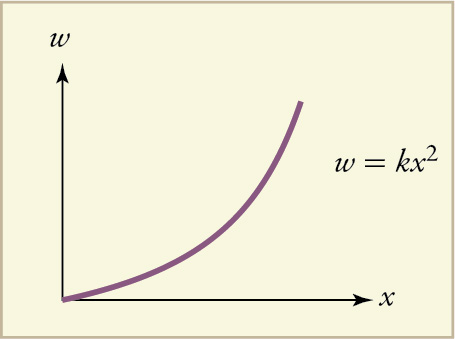
The figure is a plot of w as a function of x. The plot starts at the origin and increases monotonically in both value and slope. The equation w equals k times x squared is shown next to the graph. Figure 7.44

AP Test Prep 7.1 §7.1 source ↗

Given Table 7.7 about how much force does the rocket engine exert on the 3.0-kg payload?
  1. a.
    150 N
  2. b.
    300 N
  3. c.
    450 N
  4. d.
    600 N
Table 7.7 in the book ↗
Distance traveled with rocket engine firing (m) Payload final velocity (m/s)
500 310
490 300
1020 450
505 312

Answer

B. 300 N

AP Test Prep 7.3 §7.1 source ↗

Look at Figure 7.10(c). You compress a spring by x, and then release it. Next you compress the spring by 2x. How much more work did you do the second time than the first?
  1. a.
    Half as much
  2. b.
    The same
  3. c.
    Twice as much
  4. d.
    Four times as much
Figure 7.10 in the book ↗
(a) An undeformed spring has no PEs stored in it. (b) The force needed to stretch (or compress) the spring a distance x has a magnitude F=kx , and the work done to stretch (or compress) it is 12kx2. Because the force is conservative, this work is stored as potential energy (PEs) in the spring, and it can be fully recovered. (c) A graph of F vs. x has a slope of k, and the area under the graph is 12kx2. Thus the work done or potential energy stored is 12kx2.

Answer

D. Four times as much

AP Test Prep 7.5 §7.1 source ↗

A crane is lifting construction materials from the ground to an elevation of 60 m. Over the first 10 m, the motor linearly increases the force it exerts from 0 to 10 kN. It exerts that constant force for the next 40 m, and then winds down to 0 N again over the last 10 m, as shown in the figure. What is the total work done on the construction materials?
  1. a.
    500 kJ
  2. b.
    600 kJ
  3. c.
    300 kJ
  4. d.
    18 MJ
Figure 7.45 in the book ↗

Answer

A. 500 kJ

AP Test Prep 7.7 §7.2 source ↗

A roller coaster is set up with a track in the form of a perfect cosine. Describe and graph what happens to the kinetic energy of a cart as it goes through the first full period of the track.

Answer

The kinetic energy should change in the form of –cos, with an initial value of 0 or slightly above, and ending at the same level.

AP Test Prep 7.9 §7.2 source ↗

In what direction relative to the direction of travel can a force act on a car (traveling on level ground), and not change the kinetic energy? Can you give examples of such forces?

Answer

Any force acting perpendicular will have no effect on kinetic energy. Obvious examples are gravity and the normal force, but others include wind directly from the side and rain or other precipitation falling straight down.

AP Test Prep 7.11 §7.2 source ↗

You are participating in the Iditarod, and your sled dogs are pulling you across a frozen lake with a force of 1200 N while a 300 N wind is blowing at you at 135 degrees from your direction of travel. What is the net force, and will your kinetic energy increase or decrease?

Answer

Note that the wind is pushing from behind and one side, so your KE will increase. The net force has components of 1400 N in the direction of travel and 212 N perpendicular to the direction of travel. So the net force is 1420 N at 8.5 degrees from the direction of travel.

AP Test Prep 7.13 §7.2 source ↗

You are launching a 0.315-kg potato out of a potato cannon. The cannon is 1.5 m long and is aimed 30.0 degrees above the horizontal. It exerts an average 45 N force on the potato. Ignoring friction, what is the kinetic energy of the potato as it leaves the muzzle of the potato cannon?

Answer

Gravity has a component perpendicular to the cannon (and to displacement, so it is irrelevant) and has a component parallel to the cannon. The latter is equal to 9.8 N. Thus the net force in the direction of the displacement is 45 N − 9.8 N, and the kinetic energy is 53 J.

AP Test Prep 7.15 §7.2 source ↗

Describe a system in which the main forces acting are parallel or antiparallel to the center of mass, and justify your answer.

Answer

The potato cannon (and many other projectile launchers) above is an option, with a force launching the projectile, friction, potentially gravity depending on the direction it is pointed, etc. A drag (or other) car accelerating is another possibility.

AP Test Prep 7.17 §7.2 source ↗

A child has two red wagons, with the rear one tied to the front by a (non-stretching) rope. If the child pushes on the rear wagon, what happens to the kinetic energy of each of the wagons, and the two-wagon system?

Answer

The kinetic energy of the rear wagon increases. The front wagon does not, until the rear wagon collides with it. The total system may be treated by its center of mass, halfway between the wagons, and its energy increases by the same amount as the sum of the two individual wagons.

AP Test Prep 7.19 §7.3 source ↗

A 1.0 kg baseball is flying at 10 m/s. How much kinetic energy does it have? Potential energy?
  1. a.
    10 J, 20 J
  2. b.
    50 J, 20 J
  3. c.
    unknown, 50 J
  4. d.
    50 J, unknown

Answer

D. 50 J, unknown

AP Test Prep 7.21 §7.3 source ↗

You have a 120-g yo-yo that you are swinging at 0.9 m/s. How much energy does it have? How high can it get above the lowest point of the swing without your doing any additional work, on Earth? How high could it get on the Moon, where gravity is 1/6 Earth’s?

Answer

0.049 J; 0.041 m, 0.25 m

AP Test Prep 7.23 §7.4 source ↗

A spring with a force constant of 5000 N/m and a rest length of 3.0 m is used in a catapult. When compressed to 1.0 m, it is used to launch a 50 kg rock. However, there is an error in the release mechanism, so the rock gets launched almost straight up. How high does it go, and how fast is it going when it hits the ground?

Answer

20 m high, 20 m/s.

AP Test Prep 7.25 §7.4 source ↗

You are loading a toy dart gun, which has two settings, the more powerful with the spring compressed twice as far as the lower setting. If it takes 5.0 J of work to compress the dart gun to the lower setting, how much work does it take for the higher setting?
  1. a.
    20 J
  2. b.
    10 J
  3. c.
    2.5 J
  4. d.
    40 J

Answer

A. 20 J

AP Test Prep 7.27 §7.4 source ↗

Old-fashioned pendulum clocks are powered by masses that need to be wound back to the top of the clock about once a week to counteract energy lost due to friction and to the chimes. One particular clock has three masses: 4.0 kg, 4.0 kg, and 6.0 kg. They can drop 1.3 meters. How much energy does the clock use in a week?
  1. a.
    51 J
  2. b.
    76 J
  3. c.
    127 J
  4. d.
    178 J

Answer

D. 178 J

AP Test Prep 7.29 §7.4 source ↗

Old-fashioned pocket watches needed to be wound daily so they wouldn’t run down and lose time, due to the friction in the internal components. This required a large number of turns of the winding key, but not much force per turn, and it was possible to overwind and break the watch. How was the energy stored?
  1. a.
    A small mass raised a long distance
  2. b.
    A large mass raised a short distance
  3. c.
    A weak spring deformed a long way
  4. d.
    A strong spring deformed a short way

Answer

C. A weak spring deformed a long way

AP Test Prep 7.31 §7.5 source ↗

You are in a room in a basement with a smooth concrete floor (friction force equals 40 N) and a nice rug (friction force equals 55 N) that is 3 m by 4 m. However, you have to push a very heavy box from one corner of the rug to the opposite corner of the rug. Will you do more work against friction going around the floor or across the rug, and how much extra?
  1. a.
    Across the rug is 275 J extra
  2. b.
    Around the floor is 5 J extra
  3. c.
    Across the rug is 5 J extra
  4. d.
    Around the floor is 280 J extra

Answer

B. Around the floor is 5 J extra

AP Test Prep 7.33 §7.6 source ↗

You do 30 J of work to load a toy dart gun. However, the dart is 10 cm long and feels a frictional force of 10 N while going through the dart gun’s barrel. What is the kinetic energy of the fired dart?
  1. a.
    30 J
  2. b.
    29 J
  3. c.
    28 J
  4. d.
    27 J

Answer

C. 28 J

AP Test Prep 7.35 §7.6 source ↗

A child has two red wagons, with the rear one tied to the front by a stretchy rope (a spring). If the child pulls on the front wagon, the ____ increases.
  1. a.
    kinetic energy of the wagons
  2. b.
    potential energy stored in the spring
  3. c.
    both A and B
  4. d.
    not enough information

Answer

C. both A and B

AP Test Prep 7.37 §7.6 source ↗

Which of the following are closed systems?
  1. a.
    Earth
  2. b.
    a car
  3. c.
    a frictionless pendulum
  4. d.
    a mass on a spring in a vacuum

Answer

C. a frictionless pendulum · D. a mass on a spring in a vacuum

AP Test Prep 7.39 §7.6 source ↗

A 5.0-kg rock falls off of a 10 m cliff. If air resistance exerts an average force of 10 N, what is the kinetic energy when the rock hits the ground?
  1. a.
    400 J
  2. b.
    12.6 m/s
  3. c.
    100 J
  4. d.
    500 J

Answer

A. 400 J

AP Test Prep 7.41 §7.6 source ↗

Before railroads were invented, goods often traveled along canals, with mules pulling barges from the bank. If a mule is exerting a 1200 N force for 10 km, and the rope connecting the mule to the barge is at a 20 degree angle from the direction of travel, how much work did the mule do on the barge?
  1. a.
    12 MJ
  2. b.
    11 MJ
  3. c.
    4.1 MJ
  4. d.
    6 MJ

Answer

B. 11 MJ

Loading chapter 8…

Problems and answers are adapted from College Physics for AP® Courses 2e by Gregg Wolfe, Erika Gasper, John Stoke, Julie Kretchman, David Anderson and others, OpenStax, and are used under the CC BY-NC-SA 4.0 licence. Access for free at https://openstax.org/books/college-physics-ap-courses-2e/pages/1-connection-for-ap-r-courses. Illustrations: Copyright Rice University, OpenStax, under CC BY-NC-SA 4.0 license. This adaptation is released under the same licence, is non-commercial, and is neither affiliated with nor endorsed by OpenStax or Rice University.