Every problem in the chapter beside the book’s answer, a chapter at a time as you scroll.
Chapter 18: Electric Charge and Electric Field
45 problems · 12 figures18-1 §18.1 source ↗
Answer
(a)
(b)
18-3 §18.1 source ↗
Answer
18-5 §18.2 source ↗
Answer
18-7 §18.2 source ↗
Answer
18-9 §18.2 source ↗
Answer
18-15 §18.3 source ↗
Answer
(a)
(b) one charge of
18-17 §18.3 source ↗
Answer
(a) 0.252 N to the left
(b)
18-19 §18.3 source ↗
Answer
(a)The electric field at the center of the square will be straight up, since and are positive and and are negative and all have the same magnitude.
(b)
18-21 §18.3 source ↗
Answer
18-23 §18.3 source ↗
Answer
(a) , below the horizontal.
(b) No
18-25 §18.4 source ↗
Answer
(a) 0.263 N
(b) If the charges are distributed over some area, there will be a concentration of charge along the side closest to the oppositely charged object. This effect will increase the net force.
18-27 §18.4 source ↗
Answer
18-31 §18.4 source ↗
Answer
18-32 §18.4 source ↗
Answer
(a) 3.2
(b) If the distance increases by 3.2, then the force will decrease by a factor of 10 ; if the distance decreases by 3.2, then the force will increase by a factor of 10. Either way, the force changes by a factor of 10.
18-34 §18.4 source ↗
Answer
(a) C
(b) This charge is approximately 1 nC, which is consistent with the magnitude of charge typical for static electricity
18-37 §18.4 source ↗
Answer
18-39 §18.4 source ↗
Answer
(a) 0.859 m beyond negative charge on line connecting two charges
(b) 0.109 m from lesser charge on line connecting two charges
18-42 §18.5 source ↗
Answer
18-44 §18.5 source ↗
Answer
(a)
(b)
18-46 §18.5 source ↗
Answer
(a)
(b)
18-52 §18.8 source ↗
Answer
(a)
(b)the coulomb force is extraordinarily stronger than gravity
18-54 §18.8 source ↗
Answer
(a)
(b)
(c)
18-56 §18.8 source ↗
Answer
18-69 §18.8 source ↗
Answer
(a) The forces are balanced in the x-direction, so the net force is vertical. It is composed of the sum of the vertical components of the Coulomb force and the gravitational force.
(b) No, it is in a metastable position. Since it cannot move horizontally, it cannot traverse any part of the track.
(c)
(d) Yes.
(e) It will reach before it will change direction.
(f) The metastable positions where there is no component in one direction are , , , and . They number 4.
AP Test Prep 18.1 §18.1 source ↗
- a.Electrons are removed from the silk.
- b.Electrons are removed from the rod.
- c.Protons are removed from the silk.
- d.Protons are removed from the rod.
Answer
AP Test Prep 18.3 §18.1 source ↗
- a.X has positive charge and Y has negative charge.
- b.X has negative charge and Y has positive charge.
- c.X and Y both have positive charge.
- d.X is neutral and Y has a charge.
Answer
AP Test Prep 18.5 §18.1 source ↗
- a.negative
- b.positive
- c.neutral
- d.cannot be determined
Answer
AP Test Prep 18.7 §18.1 source ↗
- a.Pieces of paper repel the comb.
- b.Pieces of paper are attracted to the comb.
- c.Some pieces of paper are attracted and some repel the comb.
- d.There is no attraction or repulsion between the pieces of paper and the comb.
Answer
AP Test Prep 18.9 §18.1 source ↗
Suppose an object has a charge of 1 C and gains 6.88×10¹⁸ electrons.
(a) What will be the net charge of the object?
(b) If the object has gained electrons from a neutral object, what will be the charge on the neutral object?
(c) Find and explain the relationship between the total charges of the two objects before and after the transfer.
(d) When a third object is brought in contact with the first object (after it gains the electrons), the resulting charge on the third object is 0.4 C. What was its initial charge?
Answer
AP Test Prep 18.11 §18.1 source ↗
In an experiment the following observations are made by a student for four charged objects W, X, Y, and Z:
• A glass rod rubbed with silk attracts W.
• W attracts Z but repels X.
• X attracts Z but repels Y.
• Y attracts W and Z.
Estimate whether the charges on each of the four objects are positive, negative, or neutral.
Answer
AP Test Prep 18.13 §18.2 source ↗
When the balloon is brought closer to the sphere, there will be a redistribution of charges. What is this phenomenon called?
- a.electrostatic repulsion
- b.conduction
- c.polarization
- d.none of the above
Answer
AP Test Prep 18.15 §18.2 source ↗
- a.positive
- b.negative
- c.zero
- d.It can be positive or negative depending on the material.
Answer
AP Test Prep 18.17 §18.2 source ↗
- a.positive
- b.negative
- c.zero
- d.It can be positive or negative depending on the material.
Answer
AP Test Prep 18.19 §18.2 source ↗
As shown in the figure above, two metal balls are suspended and a negatively charged rod is brought close to them.
(a) If the two balls are in contact with each other what will be the charges on each ball?
(b) Explain how the balls get these charges.
(c) What will happen to the charge on the second ball (i.e., the ball further away from the rod) if it is momentarily grounded while the rod is still there?
(d) If (instead of grounding) the second ball is moved away and then the rod is removed from the first ball, will the two balls have induced charges? If yes, what will be the charges? If no, why not?
Answer
AP Test Prep 18.21 §18.3 source ↗
An electric field due to a positively charged spherical conductor is shown above. Where will the electric field be weakest?
- a.Point A
- b.Point B
- c.Point C
- d.Same at all points
Answer
AP Test Prep 18.23 §18.3 source ↗
Answer
AP Test Prep 18.25 §18.4 source ↗
For questions 25–27, suppose that the electrostatics force between two charges is F.
What will be the force if the distance between them is halved?
- a.4F
- b.2F
- c.F/4
- d.F/2
Answer
AP Test Prep 18.27 §18.4 source ↗
- a.It will be 3.25×10−38 F.
- b.It will be 3.25×1038 F.
- c.It will be equal to F.
- d.It is not possible to determine the gravitational force as the masses of the particles are not given.
Answer
AP Test Prep 18.29 §18.4 source ↗
(a) What is the electrostatic force between two charges of 1 C each, separated by a distance of 0.5 m?
(b) How will this force change if the distance is increased to 1 m?
Answer
AP Test Prep 18.31 §18.5 source ↗
Two particles with charges +2q and +q are separated by a distance r. The +2q particle has an electric field E at distance r and exerts a force F on the +q particle. Use this information to answer questions 31–32.
What is the electric field of the +q particle at the same distance and what force does it exert on the +2q particle?
- a.E/2, F/2
- b.E, F/2
- c.E/2, F
- d.E, F
Answer
AP Test Prep 18.33 §18.5 source ↗
- a.inward for both positive and negative charges.
- b.outward for both positive and negative charges.
- c.inward for other positive charges and outward for other negative charges.
- d.outward for other positive charges and inward for other negative charges.
Answer
AP Test Prep 18.35 §18.5 source ↗
- a.positive
- b.negative
- c.neutral
- d.cannot be determined
Answer
AP Test Prep 18.37 §18.5 source ↗
Suppose that the force exerted on an electron is 5.6×10⁻¹⁷ N, directed to the east.
(a) Find the magnitude of the electric field that exerts the force.
(b) What will be the direction of the electric field?
(c) If the electron is replaced by a proton, what will be the magnitude of force exerted?
(d) What will be the direction of force on the proton?
Answer
AP Test Prep 18.39 §18.6 source ↗
Four objects, each with charge +q, are held fixed on a square with sides of length d, as shown in the figure. Objects X and Z are at the midpoints of the sides of the square. The electrostatic force exerted by object W on object X is F. Use this information to answer questions 39–40.
What is the magnitude of force exerted by object W on Z?
- a.F/7
- b.F/5
- c.F/3
- d.F/2
Answer
AP Test Prep 18.41 §18.6 source ↗
The figure above represents the electric field in the vicinity of three small charged objects, R, S, and T. The objects have charges −q, +2q, and −q, respectively, and are located on the x-axis at −d, 0, and d. Field vectors of very large magnitude are omitted for clarity.
(a) i) Briefly describe the characteristics of the field diagram that indicate that the sign of the charges of objects R and T is negative and that the sign of the charge of object S is positive.
ii) Briefly describe the characteristics of the field diagram that indicate that the magnitudes of the charges of objects R and T are equal and that the magnitude of the charge of object S is about twice that of objects R and T.
For the following parts, an electric field directed to the right is defined to be positive.
(b) On the axes below, sketch a graph of the electric field E along the x-axis as a function of position x.
(c) Write an expression for the electric field E along the x-axis as a function of position x in the region between objects S and T in terms of q, d, and fundamental constants, as appropriate.
(d) Your classmate tells you there is a point between S and T where the electric field is zero. Determine whether this statement is true, and explain your reasoning using two of the representations from parts (a), (b), or (c).
Answer
(a) i) Field vectors near objects point toward negatively charged objects and away from positively charged objects.
(a) ii) The vectors closest to R and T are about the same length and start at about the same distance. We have that , so the charge on R is about the same as the charge on T. The closest vectors around S are about the same length as those around R and T. The vectors near S start at about 6 units away, while vectors near R and T start at about 4 units. We have that , so , and so the charge on S is about twice that on R and T.
(b)
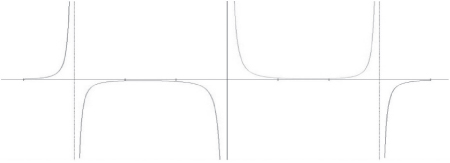 Figure 18.65 A vector diagram.
(c)
(d) The statement is not true. The vector diagram shows field vectors in this region with nonzero length, and the vectors not shown have even greater lengths. The equation in part (c) shows that, when , the denominator of the negative term is always greater than the denominator of the third term, but the numerator is the same. So the negative term always has a smaller magnitude than the third term and since the second term is positive the sum of the terms is always positive.
Loading chapter 19…
Problems and answers are adapted from College Physics for AP® Courses 2e by Gregg Wolfe, Erika Gasper, John Stoke, Julie Kretchman, David Anderson and others, OpenStax, and are used under the CC BY-NC-SA 4.0 licence. Access for free at https://openstax.org/books/college-physics-ap-courses-2e/pages/1-connection-for-ap-r-courses. Illustrations: Copyright Rice University, OpenStax, under CC BY-NC-SA 4.0 license. This adaptation is released under the same licence, is non-commercial, and is neither affiliated with nor endorsed by OpenStax or Rice University.