Every problem in the chapter beside the book’s answer, a chapter at a time as you scroll.
Chapter 2: Kinematics
40 problems · 13 figures2-1 §2.1 source ↗
Answer
(a) 7 m
(b) 7 m
(c)
2-3 §2.1 source ↗
Answer
a.
b.
c.
2-5 §2.3 source ↗
Answer
(a)
(b) 0 m/s
2-7 §2.3 source ↗
Answer
2-9 §2.3 source ↗
Answer
2-11 §2.3 source ↗
Answer
(a)
(b) 34.3 km/h,
(c)
2-13 §2.3 source ↗
Answer
2-15 §2.3 source ↗
Answer
(a)
(b) 0 m/s
2-16 §2.4 source ↗
Answer
2-18 §2.4 source ↗
Answer
(a)
(b)
2-20 §2.5 source ↗
Answer
(a)
(b)
2-21 §2.5 source ↗
Answer
2-23 §2.5 source ↗
Answer
(a)
(b)
(c)
2-25 §2.5 source ↗
Answer
(a)
(b)
(c) This result does not really make sense. If the runner starts at 9.00 m/s and decelerates at , then she will have stopped after 4.50 s. If she continues to decelerate, she will be running backwards.
2-27 §2.5 source ↗
Answer
2-29 §2.5 source ↗
Answer
(a)
(b)
(c) 7.68 km to accelerate and 713 m to decelerate
2-31 §2.5 source ↗
Answer
(a)
(b)
2-33 §2.5 source ↗
Answer
(a)
(b)
2-35 §2.5 source ↗
Answer
(a)
(b) . This is about 3 times the deceleration of the pilots, who were falling from thousands of meters high!
2-37 §2.5 source ↗
Answer
(a)
(b)
(c) , because the assumption of constant acceleration is not valid for a dragster. A dragster changes gears, and would have a greater acceleration in first gear than second gear than third gear, etc. The acceleration would be greatest at the beginning, so it would not be accelerating at during the last few meters, but substantially less, and the final velocity would be less than 162 m/s.
2-39 §2.5 source ↗
Answer
2-40 §2.5 source ↗
Answer
(a) ;
(b)
2-41 §2.7 source ↗
Assume air resistance is negligible unless otherwise stated.
Calculate the displacement and velocity at times of (a) 0.500, (b) 1.00, (c) 1.50, and (d) 2.00 s for a ball thrown straight up with an initial velocity of 15.0 m/s. Take the point of release to be .
Answer
(a) ;
(b) ;
(c) ;
(d) ;
2-43 §2.7 source ↗
Assume air resistance is negligible unless otherwise stated.
A basketball referee tosses the ball straight up for the starting tip-off. At what minimum velocity must a basketball player leave the ground to rise 1.25 m above the floor in an attempt to get the ball?
Answer
2-45 §2.7 source ↗
Assume air resistance is negligible unless otherwise stated.
A dolphin in an aquatic show jumps straight up out of the water at a velocity of 13.0 m/s. (a) List the knowns in this problem. (b) How high does his body rise above the water? To solve this part, first note that the final velocity is now a known and identify its value. Then identify the unknown, and discuss how you chose the appropriate equation to solve for it. After choosing the equation, show your steps in solving for the unknown, checking units, and discuss whether the answer is reasonable. (c) How long is the dolphin in the air? Neglect any effects due to his size or orientation.
Answer
(a) ; ;
(b) . Unknown is distance to top of trajectory, where velocity is zero. Use equation because it contains all known values except for , so we can solve for . Solving for gives
Dolphins measure about 2 meters long and can jump several times their length out of the water, so this is a reasonable result.
(c)
2-47 §2.7 source ↗
Assume air resistance is negligible unless otherwise stated.
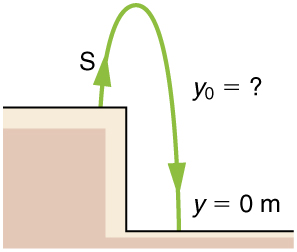
(a) Calculate the height of a cliff if it takes 2.35 s for a rock to hit the ground when it is thrown straight up from the cliff with an initial velocity of 8.00 m/s. (b) How long would it take to reach the ground if it is thrown straight down with the same speed?
Answer
(a) 8.26 m
(b) 0.717 s
2-49 §2.7 source ↗
Assume air resistance is negligible unless otherwise stated.
You throw a ball straight up with an initial velocity of 15.0 m/s. It passes a tree branch on the way up at a height of 7.00 m. How much additional time will pass before the ball passes the tree branch on the way back down?
Answer
2-51 §2.7 source ↗
Assume air resistance is negligible unless otherwise stated.
Standing at the base of one of the cliffs of Mt. Arapiles in Victoria, Australia, a hiker hears a rock break loose from a height of 105 m. He can’t see the rock right away but then does, 1.50 s later. (a) How far above the hiker is the rock when he can see it? (b) How much time does he have to move before the rock hits his head?
Answer
(a) 94.0 m
(b) 3.13 s
2-53 §2.7 source ↗
Assume air resistance is negligible unless otherwise stated.
There is a 250-m-high cliff at Half Dome in Yosemite National Park in California. Suppose a boulder breaks loose from the top of this cliff. (a) How fast will it be going when it strikes the ground? (b) Assuming a reaction time of 0.300 s, how long will a tourist at the bottom have to get out of the way after hearing the sound of the rock breaking loose (neglecting the height of the tourist, which would become negligible anyway if hit)? The speed of sound is 335 m/s on this day.
Answer
(a) -70.0 m/s (downward)
(b) 6.10 s
2-55 §2.7 source ↗
Assume air resistance is negligible unless otherwise stated.
Suppose you drop a rock into a dark well and, using precision equipment, you measure the time for the sound of a splash to return. (a) Neglecting the time required for sound to travel up the well, calculate the distance to the water if the sound returns in 2.0000 s. (b) Now calculate the distance taking into account the time for sound to travel up the well. The speed of sound is 332.00 m/s in this well.
Answer
(a)
(b)
2-57 §2.7 source ↗
Assume air resistance is negligible unless otherwise stated.
A coin is dropped from a hot-air balloon that is 300 m above the ground and rising at 10.0 m/s upward. For the coin, find (a) the maximum height reached, (b) its position and velocity 4.00 s after being released, and (c) the time before it hits the ground.
Answer
(a) 305 m
(b) 262 m, -29.2 m/s
(c) 8.91 s
2-59 §2.8 source ↗
Note: There is always uncertainty in numbers taken from graphs. If your answers differ from expected values, examine them to see if they are within data extraction uncertainties estimated by you.
(a) By taking the slope of the curve in Figure 2.58, verify that the velocity of the jet car is 115 m/s at . (b) By taking the slope of the curve at any point in Figure 2.59, verify that the jet car’s acceleration is .
Answer
(a)
(b)
2-61 §2.8 source ↗
Note: There is always uncertainty in numbers taken from graphs. If your answers differ from expected values, examine them to see if they are within data extraction uncertainties estimated by you.
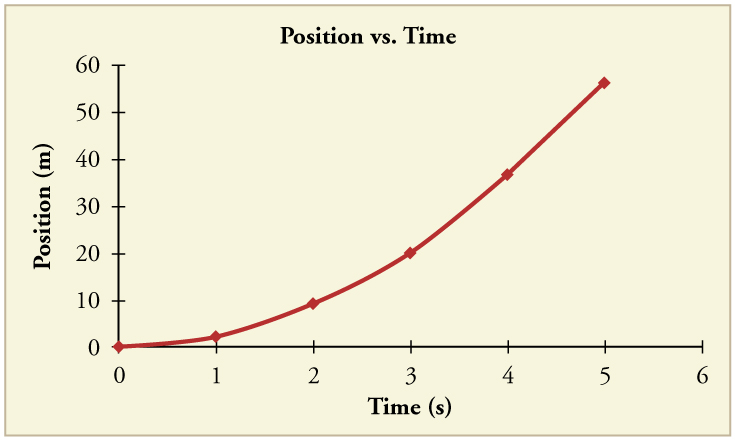
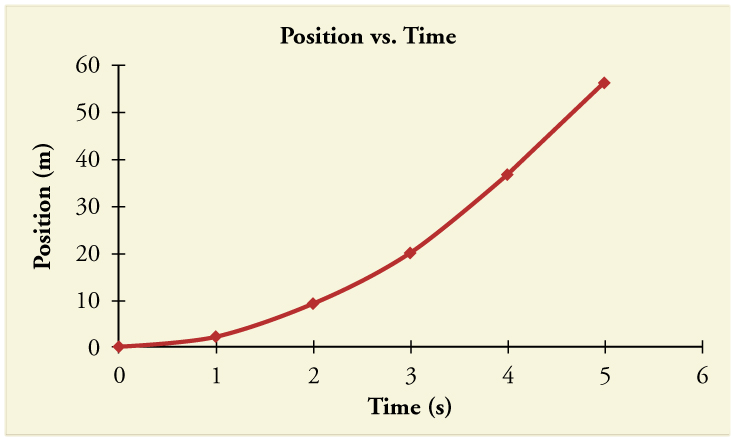
Using approximate values, calculate the slope of the curve in Figure 2.60 at and at find the velocity at these times. (b) Using your answer to part a, find the approximate acceleration at . Assume all values are known to 2 significant figures.
Answer
2-63 §2.8 source ↗
Note: There is always uncertainty in numbers taken from graphs. If your answers differ from expected values, examine them to see if they are within data extraction uncertainties estimated by you.
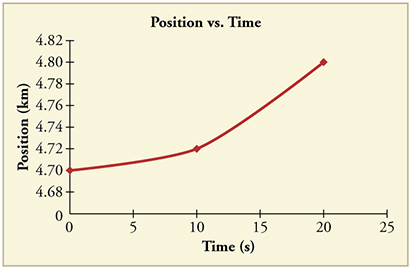
Construct the position graph for the subway shuttle train as shown in Figure 2.18(a). Your graph should show the position of the train, in kilometers, from t = 0 to 20 s. You will need to use the information on acceleration and velocity given in the examples for this figure.
Answer
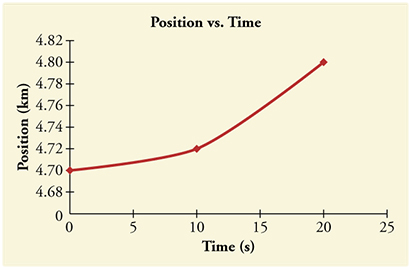
2-65 §2.8 source ↗
Note: There is always uncertainty in numbers taken from graphs. If your answers differ from expected values, examine them to see if they are within data extraction uncertainties estimated by you.
A graph of is shown for a world-class track sprinter in a 100-m race. (See Figure 2.65). (a) What is his average velocity for the first 4 s? (b) What is his instantaneous velocity at ? (c) What is his average acceleration between 0 and 4 s? (d) What is his time for the race?
Answer
(a) 6 m/s
(b) 12 m/s
(c)
(d) 10 s
2-67 §2.8 source ↗
Note: There is always uncertainty in numbers taken from graphs. If your answers differ from expected values, examine them to see if they are within data extraction uncertainties estimated by you.
Critical Thinking Two cars are side by side on a path where friction is negligible. Car A starts from rest and has a positive, constant acceleration while car B travels at a constant speed. The cars reach the same check point down the road at the same time. (a) Which car is traveling faster at the check point? Briefly explain your reasoning. (b) Based on experimental data, an equation that fits the data is suggested for the speed of car A at the check point, V, which may not be correct: , where K is a constant with appropriate units and is the initial velocity of car B. Is this equation consistent with your answer from part a? Explain why or why not. Does this equation make sense? Explain why or why not. (c) Graph the velocity of car A and the velocity of car B vs. distance along the path, starting when the cars are side by side.
Answer
(a) Car A is traveling faster at the checkpoint because it must go past the speed of car B to reach the same distance.
(b) i. Yes, the equation is consistent with the answer because the speed of car A is only a constant away from the correct answer. ii. Yes, the equation makes sense because .
(c)
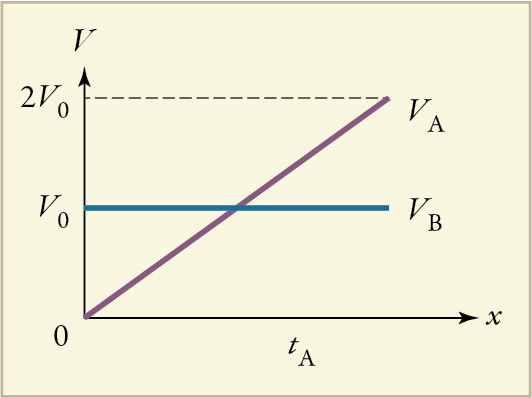 Figure 2.67
AP Test Prep 2.1 §2.1 source ↗
- a.An object may record a distance traveled of zero while recording a non-zero displacement.
- b.An object may record a non-zero distance traveled while recording a displacement of zero.
- c.An object may record a non-zero distance traveled while maintaining a position of zero.
- d.An object may record a non-zero displacement while maintaining a position of zero.
Answer
AP Test Prep 2.3 §2.3 source ↗
A group of students has two carts, A and B, with wheels that turn with negligible friction. The two carts travel along a straight horizontal track and eventually collide. Before the collision, cart A travels to the right and cart B is initially at rest. After the collision, the carts stick together.
(a) Describe an experimental procedure to determine the velocities of the carts before and after the collision, including all the additional equipment you would need. You may include a labeled diagram of your setup to help in your description. Indicate what measurements you would take and how you would take them. Include enough detail so that another student could carry out your procedure.
(b) There will be sources of error in the measurements taken in the experiment both before and after the collision. Which velocity will be more greatly affected by this error: the velocity prior to the collision or the velocity after the collision? Or will both sets of data be affected equally? Justify your answer.
Answer
(a) Use tape to mark off two distances on the track — one for cart A before the collision and one for the combined carts after the collision. Push cart A to give it an initial speed. Use a stopwatch to measure the time it takes for the cart(s) to cross the marked distances. The speeds are the distances divided by the times.
(b) If the measurement errors are of the same magnitude, they will have a greater effect after the collision. The speed of the combined carts will be less than the initial speed of cart A. As a result, these errors will be a greater percentage of the actual velocity value after the collision occurs. (Note: Other arguments could properly be made for ‘more error before the collision' and error that ‘equally affects both sets of measurement.')
AP Test Prep 2.5 §2.4 source ↗
Push a book across a table and observe it slow to a stop.
Draw graphs showing the book's position vs. time and velocity vs. time if the direction of its motion is considered positive.
Draw graphs showing the book's position vs. time and velocity vs. time if the direction of its motion is considered negative.
Answer
The position vs. time graph should be represented with a positively sloped line whose slope steadily decreases to zero. The y-intercept of the graph may be any value. The line on the velocity vs. time graph should have a positive y-intercept and a negative slope. Because the final velocity of the book is zero, the line should finish on the x-axis.
The position vs. time graph should be represented with a negatively sloped line whose slope steadily decreases to zero. The y-intercept of the graph may be any value. The line on the velocity vs. time graph should have a negative y-intercept and a positive slope. Because the final velocity of the book is zero, the line should finish on the x-axis.]
AP Test Prep 2.7 §2.7 source ↗
- a.0 m/s2
- b.0.03 m/s2
- c.0.20 m/s2
- d.0.65 m/s2
- e.33 m/s2
Answer
Loading chapter 3…
Problems and answers are adapted from College Physics for AP® Courses 2e by Gregg Wolfe, Erika Gasper, John Stoke, Julie Kretchman, David Anderson and others, OpenStax, and are used under the CC BY-NC-SA 4.0 licence. Access for free at https://openstax.org/books/college-physics-ap-courses-2e/pages/1-connection-for-ap-r-courses. Illustrations: Copyright Rice University, OpenStax, under CC BY-NC-SA 4.0 license. This adaptation is released under the same licence, is non-commercial, and is neither affiliated with nor endorsed by OpenStax or Rice University.