Every problem in the chapter beside the book’s answer, a chapter at a time as you scroll.
Chapter 6: Uniform Circular Motion and Gravitation
33 problems · 3 figures6-1 §6.1 source ↗
Answer
6-3 §6.1 source ↗
Answer
6-5 §6.1 source ↗
Answer
6-7 §6.1 source ↗
Answer
76.2 rad/s
728 rpm
6-8 §6.1 source ↗
Integrated Concepts When kicking a football, the kicker rotates his leg about the hip joint.
(a) If the velocity of the tip of the kicker’s shoe is 35.0 m/s and the hip joint is 1.05 m from the tip of the shoe, what is the shoe tip’s angular velocity?
(b) The shoe is in contact with the initially stationary 0.500 kg football for 20.0 ms. What average force is exerted on the football to give it a velocity of 20.0 m/s?
(c) Find the maximum range of the football, neglecting air resistance.
Answer
(a) 33.3 rad/s
(b) 500 N
(c) 40.8 m
6-10 §6.2 source ↗
Answer
6-12 §6.2 source ↗
Answer
6-14 §6.2 source ↗
An ordinary workshop grindstone has a radius of 7.50 cm and rotates at 6500 rev/min.
(a) Calculate the magnitude of the centripetal acceleration at its edge in meters per second squared and convert it to multiples of .
(b) What is the linear speed of a point on its edge?
Answer
a) ,
b)
6-16 §6.2 source ↗
Olympic ice skaters are able to spin at about 5 rev/s.
(a) What is their angular velocity in radians per second?
(b) What is the centripetal acceleration of the skater’s nose if it is 0.120 m from the axis of rotation?
(c) An exceptional skater named Dick Button was able to spin much faster in the 1950s than anyone since—at about 9 rev/s. What was the centripetal acceleration of the tip of his nose, assuming it is at 0.120 m radius?
(d) Comment on the magnitudes of the accelerations found. It is reputed that Button ruptured small blood vessels during his spins.
Answer
a)
b)
c)
d)The centripetal acceleration felt by Olympic skaters is 12 times larger than the acceleration due to gravity. That’s quite a lot of acceleration in itself. The centripetal acceleration felt by Button’s nose was 39.2 times larger than the acceleration due to gravity. It is no wonder that he ruptured small blood vessels in his spins.
6-18 §6.2 source ↗
Verify that the linear speed of an ultracentrifuge is about 0.50 km/s, and Earth in its orbit is about 30 km/s by calculating:
(a) The linear speed of a point on an ultracentrifuge 0.100 m from its center, rotating at 50,000 rev/min.
(b) The linear speed of Earth in its orbit about the Sun (use data from the text on the radius of Earth’s orbit and approximate it as being circular).
Answer
a) 0.524 km/s
b) 29.7 km/s
6-20 §6.2 source ↗
At takeoff, a commercial jet has a 60.0 m/s speed. Its tires have a diameter of 0.850 m.
(a) At how many rev/min are the tires rotating?
(b) What is the centripetal acceleration at the edge of the tire?
(c) With what force must a determined bacterium cling to the rim?
(d) Take the ratio of this force to the bacterium’s weight.
Answer
(a)
(b)
(c)
(d)
6-21 §6.2 source ↗
Integrated Concepts
Riders in an amusement park ride shaped like a Viking ship hung from a large pivot are rotated back and forth like a rigid pendulum. Sometime near the middle of the ride, the ship is momentarily motionless at the top of its circular arc. The ship then swings down under the influence of gravity. The speed at the bottom of the arc is 23.4 m/s. The radius of the arc is 14.0 m.
(a) What is the centripetal acceleration at the bottom of the arc?
(b) Draw a free body diagram of the forces acting on a rider at the bottom of the arc.
(c) Find the force exerted by the ride on a 60.0 kg rider and compare it to her weight.
(d) Discuss whether the answer seems reasonable.
Answer
(a)
(b)
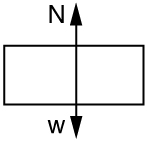
(c) , that is, the normal force (upward) is five times her weight.
(d) This answer seems reasonable, since she feels like she’s being forced into the chair MUCH stronger than just by gravity.
6-22 §6.2 source ↗
Unreasonable Results
A mother pushes her child on a swing so that his speed is 9.00 m/s at the lowest point of his path. The swing is suspended 2.00 m above the child’s center of mass.
(a) What is the magnitude of the centripetal acceleration of the child at the low point?
(b) What is the magnitude of the force the child exerts on the seat if his mass is 18.0 kg?
(c) What is unreasonable about these results?
(d) Which premises are unreasonable or inconsistent?
Answer
a)
b) 905 N
c) The force in part (b) is very large. The acceleration in part (a) is too much, about 4 g.
d) The speed of the swing is too large. At the given velocity at the bottom of the swing, there is enough kinetic energy to send the child all the way over the top, ignoring friction.
6-23 §6.3 source ↗
(a) A 22.0 kg child is riding a playground merry-go-round that is rotating at 40.0 rev/min. What centripetal force must she exert to stay on if she is 1.25 m from its center?
(b) What centripetal force does she need to stay on an amusement park merry-go-round that rotates at 3.00 rev/min if she is 8.00 m from its center?
(c) Compare each force with her weight.
Answer
a) 483 N
b) 17.4 N
c) 2.24 times her weight, 0.0807 times her weight
6-25 §6.3 source ↗
Answer
6-27 §6.3 source ↗
(a) What is the radius of a bobsled turn banked at 75.0° and taken at 30.0 m/s, assuming it is ideally banked?
(b) Calculate the centripetal acceleration.
(c) Does this acceleration seem large to you?
Answer
a) 24.6 m
b)
c) This does not seem too large, but it is clear that bobsledders feel a lot of force on them going through sharply banked turns.
6-29 §6.3 source ↗
A large centrifuge, like the one shown in Figure 6.34(a), is used to expose aspiring astronauts to accelerations similar to those experienced in rocket launches and atmospheric reentries.
(a) At what angular velocity is the centripetal acceleration if the rider is 15.0 m from the center of rotation?
(b) The rider’s cage hangs on a pivot at the end of the arm, allowing it to swing outward during rotation as shown in Figure 6.34(b). At what angle below the horizontal will the cage hang when the centripetal acceleration is ? (Hint: The arm supplies centripetal force and supports the weight of the cage. Draw a free body diagram of the forces to see what the angle should be.)
Answer
a) 2.56 rad/s
b)
6-30 §6.3 source ↗
Integrated Concepts
If a car takes a banked curve at less than the ideal speed, friction is needed to keep it from sliding toward the inside of the curve (a real problem on icy mountain roads). (a) Calculate the ideal speed to take a 100 m radius curve banked at 15.0º. (b) What is the minimum coefficient of friction needed for a frightened driver to take the same curve at 20.0 km/h?
Answer
a) 16.2 m/s
b) 0.234
6-32 §6.3 source ↗
Unreasonable Results
(a) Calculate the minimum coefficient of friction needed for a car to negotiate an unbanked 50.0 m radius curve at 30.0 m/s.
(b) What is unreasonable about the result?
(c) Which premises are unreasonable or inconsistent?
Answer
a) 1.84
b) A coefficient of friction this much greater than 1 is unreasonable .
c) The assumed speed is too great for the tight curve.
6-33 §6.5 source ↗
Earth is not a perfect sphere. Its radius as well as the value of g vary with latitude. (a) Calculate Earth’s mass given the acceleration due to gravity at the North Pole is and the radius of the Earth at the pole is 6356.8 km.
(b) Compare this with the accepted value of .
Answer
a)
b) This is slightly, but measurably, smaller than the accepted value, differing in the third significant digit. The equation we used to find g assumes a sphere, but we already noted that the radius at the pole is smaller than at the equator. The calculation gives the mass for a sphere of the radius we used—and ignores the additional mass outside that radius.
6-35 §6.5 source ↗
(a) What is the acceleration due to gravity on the surface of the Moon?
(b) On the surface of Mars? The mass of Mars is and its radius is .
Answer
a)
b)
6-37 §6.5 source ↗
The Moon and Earth rotate about their common center of mass, which is located about 4700 km from the center of Earth. (This is 1690 km below the surface.)
(a) Calculate the magnitude of the acceleration due to the Moon’s gravity at that point.
(b) Calculate the magnitude of the centripetal acceleration of the center of Earth as it rotates about that point once each lunar month (about 27.3 d) and compare it with the acceleration found in part (a). Comment on whether or not they are equal and why they should or should not be.
Answer
a)
b)
The values are nearly identical. One would expect the gravitational force to be the same as the centripetal force at the core of the system.
6-39 §6.5 source ↗
(a) Calculate the magnitude of the gravitational force exerted on a 4.20 kg baby by a 100 kg father 0.200 m away at birth (he is assisting, so he is close to the child).
(b) Calculate the magnitude of the force on the baby due to Jupiter if it is at its closest distance to Earth, some away. How does the force of Jupiter on the baby compare to the force of the father on the baby? Other objects in the room and the hospital building also exert similar gravitational forces. (Of course, there could be an unknown force acting, but scientists first need to be convinced that there is even an effect, much less that an unknown force causes it.)
Answer
a)
b) ,
6-41 §6.5 source ↗
(a) The Sun orbits the Milky Way galaxy once each , with a roughly circular orbit averaging light years in radius. (A light year is the distance traveled by light in 1 y.) Calculate the centripetal acceleration of the Sun in its galactic orbit. Does your result support the contention that a nearly inertial frame of reference can be located at the Sun?
(b) Calculate the average speed of the Sun in its galactic orbit. Does the answer surprise you?
Answer
a)
b)
6-42 §6.5 source ↗
Unreasonable Result
A mountain 10.0 km from a person exerts a gravitational force on him equal to 2.00% of his weight.
(a) Calculate the mass of the mountain.
(b) Compare the mountain’s mass with that of Earth.
(c) What is unreasonable about these results?
(d) Which premises are unreasonable or inconsistent? (Note that accurate gravitational measurements can easily detect the effect of nearby mountains and variations in local geology.)
Answer
a)
b)
of the Earth’s mass.
c) The mass of the mountain and its fraction of the Earth’s mass are too great.
d) The gravitational force assumed to be exerted by the mountain is too great.
6-44 §6.6 source ↗
Answer
6-46 §6.6 source ↗
| Parent | Satellite | Average orbital radius r(km) | Period T(y) | r3 / T2 (km3 / y2) |
|---|---|---|---|---|
| Earth | Moon | 0.07481 | ||
| Sun | Mercury | 0.2409 | ||
| Venus | 0.6150 | |||
| Earth | 1.000 | |||
| Mars | 1.881 | |||
| Jupiter | 11.86 | |||
| Saturn | 29.46 | |||
| Neptune | 164.8 | |||
| Pluto | 248.3 | |||
| Jupiter | Io | 0.00485 (1.77 d) | ||
| Europa | 0.00972 (3.55 d) | |||
| Ganymede | 0.0196 (7.16 d) | |||
| Callisto | 0.0457 (16.19 d) |
Answer
6-48 §6.6 source ↗
Integrated Concepts
Space debris left from old satellites and their launchers is becoming a hazard to other satellites. (a) Calculate the speed of a satellite in an orbit 900 km above Earth’s surface. (b) Suppose a loose rivet is in an orbit of the same radius that intersects the satellite’s orbit at an angle of relative to Earth. What is the velocity of the rivet relative to the satellite just before striking it? (c) Given the rivet is 3.00 mm in size, how long will its collision with the satellite last, approximating acceleration as constant and the rivet comes to a stop? (d) If its mass is 0.500 g, what is the average force it exerts on the satellite? (e) How much energy in joules is generated by the collision? (The satellite’s velocity does not change appreciably, because its mass is much greater than the rivet’s.)
Answer
a)
b)
c)
d)
e)
6-49 §6.6 source ↗
Unreasonable Results
(a) Based on Kepler’s laws and information on the orbital characteristics of the Moon, calculate the orbital radius for an Earth satellite having a period of 1.00 h. (b) What is unreasonable about this result? (c) What is unreasonable or inconsistent about the premise of a 1.00 h orbit?
Answer
a)
b) This radius is unreasonable because it is less than the radius of earth.
c) The premise of a one-hour orbit is inconsistent with the known radius of the earth.
6-51 §6.6 source ↗
Answer
(a) The normal force is greatest at point B. At point A, the normal force and the weight are the net force; at point B, only the normal force points in the same direction as the net force.
(b) i. This is not consistent because a larger radius should decease the net force and tension, not increase it. ii. This does not make sense because .
(c)
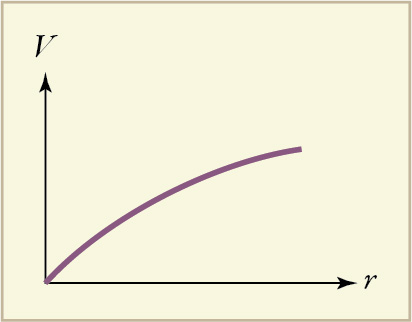 Figure 6.36
AP Test Prep 6.1 §6.5 source ↗
- a.Greater
- b.Less
- c.About the same
- d.Not enough information
Answer
AP Test Prep 6.3 §6.5 source ↗
- a.The acceleration due to gravity
- b.A gravitational constant that is the same everywhere in the universe
- c.A gravitational constant that is inversely proportional to the radius
- d.The factor by which you multiply the inertial mass to obtain the gravitational mass
Answer
AP Test Prep 6.5 §6.5 source ↗
- a.19 m/s2
- b.4.9 m/s2
- c.2.5 m/s2
- d.9.8 m/s2
Answer
Loading chapter 7…
Problems and answers are adapted from College Physics for AP® Courses 2e by Gregg Wolfe, Erika Gasper, John Stoke, Julie Kretchman, David Anderson and others, OpenStax, and are used under the CC BY-NC-SA 4.0 licence. Access for free at https://openstax.org/books/college-physics-ap-courses-2e/pages/1-connection-for-ap-r-courses. Illustrations: Copyright Rice University, OpenStax, under CC BY-NC-SA 4.0 license. This adaptation is released under the same licence, is non-commercial, and is neither affiliated with nor endorsed by OpenStax or Rice University.