Every problem in the chapter beside the book’s answer, a chapter at a time as you scroll.
Chapter 5: Further Applications of Newton's Laws: Friction, Drag, and Elasticity
23 problems · 2 figures5-1 §5.1 source ↗
Answer
5-4 §5.1 source ↗
Answer
(a) 588 N
(b)
5-6 §5.1 source ↗
Answer
(a) 3.29 m/s2
(b) 3.52 m/s2
(c) 980 N; 945 N
5-10 §5.1 source ↗
Answer
5-14 §5.1 source ↗
Answer
(a)
(b)
(c)
5-16 §5.1 source ↗
Answer
(a)
(b)
5-18 §5.1 source ↗
Answer
(a)
(b)
5-20 §5.2 source ↗
Answer
5-22 §5.2 source ↗
Answer
5-24 §5.2 source ↗
Answer
5-26 §5.2 source ↗
Answer
5-28 §5.2 source ↗
Answer
5-29 §5.3 source ↗
Answer
5-31 §5.3 source ↗
Answer
(b) This does seem reasonable, since the lead does seem to shrink a little when you push on it.
5-33 §5.3 source ↗
Answer
(b)This seems reasonable for nylon climbing rope, since it is not supposed to stretch that much.
5-35 §5.3 source ↗
Answer
5-37 §5.3 source ↗
Answer
5-39 §5.3 source ↗
Answer
(a)
(b)
5-41 §5.3 source ↗
Answer
5-43 §5.3 source ↗
Answer
5-45 §5.3 source ↗
Answer
(a) Bead A has the larger radius because both have the same weight and drag force. Since A takes longer to fall, its speed is less and, therefore, it must have larger area or radius.
(b) i. This equation is not consistent because it shows that the bead that took longer to fall has a smaller radius. ii. It does not make sense because r is proportional to t.
(c)
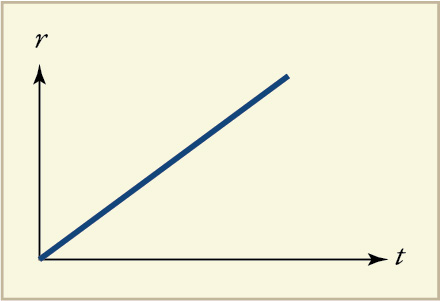 Figure 5.23
AP Test Prep 5.1 §5.1 source ↗
- a.is equal to 0.5.
- b.is greater than 0.5.
- c.is less than 0.5.
- d.cannot be determined.
Answer
AP Test Prep 5.3 §5.1 source ↗
- a.Friction will be in the same direction as the block's motion because molecular interactions between the block and the floor will deform the block in the direction of motion.
- b.Friction will be in the same direction as the block's motion because thermal energy generated at the interface between the block and the floor adds kinetic energy to the block.
- c.Friction will be in the opposite direction of the block's motion because molecular interactions between the block and the floor will deform the block in the opposite direction of motion.
- d.Friction will be in the opposite direction of the block's motion because thermal energy generated at the interface between the block and the floor converts some of the block's kinetic energy to potential energy.
Answer
Loading chapter 6…
Problems and answers are adapted from College Physics for AP® Courses 2e by Gregg Wolfe, Erika Gasper, John Stoke, Julie Kretchman, David Anderson and others, OpenStax, and are used under the CC BY-NC-SA 4.0 licence. Access for free at https://openstax.org/books/college-physics-ap-courses-2e/pages/1-connection-for-ap-r-courses. Illustrations: Copyright Rice University, OpenStax, under CC BY-NC-SA 4.0 license. This adaptation is released under the same licence, is non-commercial, and is neither affiliated with nor endorsed by OpenStax or Rice University.