Every problem in the chapter beside the book’s answer, a chapter at a time as you scroll.

Chapter 20: Laboratory Analysis of the Immune Response

28 problems · 1 figure

20-1 §20.MC source ↗

For many uses in the laboratory, polyclonal antibodies work well, but for some types of assays, they lack sufficient ________ because they cross-react with inappropriate antigens.
  1. a.
    specificity
  2. b.
    sensitivity
  3. c.
    accuracy
  4. d.
    reactivity

Answer

A. specificity

20-2 §20.MC source ↗

How are monoclonal antibodies produced?
  1. a.
    Antibody-producing B cells from a mouse are fused with myeloma cells and then the cells are grown in tissue culture.
  2. b.
    A mouse is injected with an antigen and then antibodies are harvested from its serum.
  3. c.
    They are produced by the human immune system as a natural response to an infection.
  4. d.
    They are produced by a mouse’s immune system as a natural response to an infection.

Answer

A. Antibody-producing B cells from a mouse are fused with myeloma cells and then the cells are grown in tissue culture.

20-3 §20.MC source ↗

The formation of ________ is a positive result in the VDRL test.
  1. a.
    flocculant
  2. b.
    precipitin
  3. c.
    coagulation
  4. d.
    a bright pink color

Answer

A. flocculant

20-4 §20.MC source ↗

The titer of a virus neutralization test is the highest dilution of patient serum
  1. a.
    in which there is no detectable viral DNA.
  2. b.
    in which there is no detectable viral protein.
  3. c.
    that completely blocks plaque formation.
  4. d.
    that reduces plaque formation by at least 50%.

Answer

D. that reduces plaque formation by at least 50%.

20-5 §20.MC source ↗

In the Ouchterlony assay, we see a sharp precipitin arc form between antigen and antiserum. Why does this arc remain visible for a long time?
  1. a.
    The antibody molecules are too large to diffuse through the agar.
  2. b.
    The precipitin lattice is too large to diffuse through the agar.
  3. c.
    Methanol, added once the arc forms, denatures the protein and blocks diffusion.
  4. d.
    The antigen molecules are chemically coupled to the gel matrix.

Answer

B. The precipitin lattice is too large to diffuse through the agar.

20-6 §20.MC source ↗

We use antisera to distinguish between various ________ within a species of bacteria.
  1. a.
    isotypes
  2. b.
    serovars
  3. c.
    subspecies
  4. d.
    lines

Answer

B. serovars

20-7 §20.MC source ↗

When using antisera to characterize bacteria, we will often link the antibodies to ________ to better visualize the agglutination.
  1. a.
    latex beads
  2. b.
    red blood cells
  3. c.
    other bacteria
  4. d.
    white blood cells

Answer

A. latex beads

20-8 §20.MC source ↗

The antibody screening test that is done along with pretransfusion blood typing is used to ensure that the recipient
  1. a.
    does not have a previously undetected bacterial or viral infection.
  2. b.
    is not immunocompromised.
  3. c.
    actually does have the blood type stated in the online chart.
  4. d.
    is not making antibodies against antigens outside the ABO or Rh systems.

Answer

D. is not making antibodies against antigens outside the ABO or Rh systems.

20-9 §20.MC source ↗

The direct Coombs’ test is designed to detect when people have a disease that causes them to
  1. a.
    have an excessively high fever.
  2. b.
    quit making antibodies.
  3. c.
    make too many red blood cells.
  4. d.
    produce antibodies that bind to their own red blood cells.

Answer

D. produce antibodies that bind to their own red blood cells.

20-10 §20.MC source ↗

Viral hemagglutination assays only work with certain types of viruses because
  1. a.
    the virus must be able to cross-link red blood cells directly.
  2. b.
    the virus must be able to lyse red blood cells.
  3. c.
    the virus must not be able to lyse red blood cells.
  4. d.
    other viruses are too dangerous to work with in a clinical lab setting.

Answer

A. the virus must be able to cross-link red blood cells directly.

20-11 §20.MC source ↗

In an enzyme immunoassay, the enzyme
  1. a.
    is bound by the antibody’s antigen-binding site.
  2. b.
    is attached to the well of a microtiter plate.
  3. c.
    is conjugated to the suspect antigen.
  4. d.
    is bound to the constant region of the secondary antibody.

Answer

D. is bound to the constant region of the secondary antibody.

20-12 §20.MC source ↗

When using an EIA to study microtubules or other structures inside a cell, we first chemically fix the cell and then treat the cells with alcohol. What is the purpose of this alcohol treatment?
  1. a.
    It makes holes in the cell membrane large enough for antibodies to pass.
  2. b.
    It makes the membrane sticky so antibodies will bind and be taken up by receptor-mediated endocytosis.
  3. c.
    It removes negative charges from the membrane, which would otherwise repulse the antibodies.
  4. d.
    It prevents nonspecific binding of the antibodies to the cell membrane.

Answer

A. It makes holes in the cell membrane large enough for antibodies to pass.

20-13 §20.MC source ↗

In a lateral-flow pregnancy test, you see a blue band form on the control line and no band form on the test line. This is probably a ________ test for pregnancy.
  1. a.
    positive
  2. b.
    false-positive
  3. c.
    false-negative
  4. d.
    negative

Answer

D. negative

20-14 §20.MC source ↗

When performing an FEIA, the fluorogen replaces the ________ that is used in an EIA.
  1. a.
    antigen
  2. b.
    chromogenic substrate
  3. c.
    enzyme
  4. d.
    secondary antibody

Answer

B. chromogenic substrate

20-15 §20.MC source ↗

Suppose you need to quantify the level of CD8 T cells in the blood of a patient recovering from influenza. You treat a sample of the patient’s white blood cells using a fluorescent mAb against CD8, pass the cells through a flow cytometer, and produce the histogram shown below. The area under the peak to the left (blue) is three times greater than the area of the peak on the right (red). What can you determine from these data?
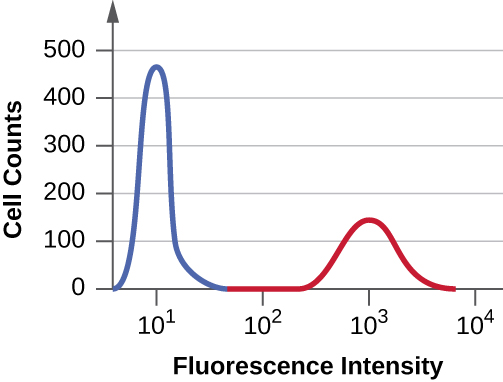
A graph with Fluorescence intensity on the X axis and cell counts on the Y axis. The first peak reaches 450 and the second reaches 100.
  1. a.
    There are no detectable CD8 cells.
  2. b.
    There are three times as many CD4 cells than CD8 cells.
  3. c.
    There are three times as many CD8 cells than CD4 cells.
  4. d.
    CD8 cells make up about one-fourth of the total number of cells.

Answer

D. CD8 cells make up about one-fourth of the total number of cells.

20-16 §20.MC source ↗

In the data described in the previous question, the average fluorescence intensity of cells in the second (red) peak is about ________ that in the first (blue) peak.
  1. a.
    three times
  2. b.
    100 times
  3. c.
    one-third
  4. d.
    1000 times

Answer

B. 100 times

20-17 §20.MC source ↗

In a direct fluorescent antibody test, which of the following would we most likely be looking for using a fluorescently-labeled mAb?
  1. a.
    bacteria in a patient sample
  2. b.
    bacteria isolated from a patient and grown on agar plates
  3. c.
    antiserum from a patient smeared onto a glass slide
  4. d.
    antiserum from a patient that had bound to antigen-coated beads

Answer

A. bacteria in a patient sample

20-18 §20.FITB source ↗

When we inject an animal with the same antigen a second time a few weeks after the first, ________ takes place, which means the antibodies produced after the second injection will on average bind the antigen more tightly.

Answer

affinity maturation

20-19 §20.FITB source ↗

When using mAbs to treat disease in humans, the mAbs must first be ________ by replacing the mouse constant region DNA with human constant region DNA.

Answer

humanized

20-20 §20.FITB source ↗

If we used normal mouse mAbs to treat human disease, multiple doses would cause the patient to respond with ________ against the mouse antibodies.

Answer

neutralizing antibodies

20-21 §20.FITB source ↗

A polyclonal response to an infection occurs because most antigens have multiple ________,

Answer

epitopes

20-22 §20.FITB source ↗

When slowly adding antigen to an antiserum, the amount of precipitin would gradually increase until reaching the ________; addition of more antigen after this point would actually decrease the amount of precipitin.

Answer

equivalence zone or zone of equivalence

20-23 §20.FITB source ↗

The radial immunodiffusion test quantifies antigen by mixing ________ into a gel and then allowing antigen to diffuse out from a well cut in the gel.

Answer

antiserum

20-24 §20.FITB source ↗

In the major cross-match, we mix ________ with the donor red blood cells and look for agglutination.

Answer

patient serum

20-25 §20.FITB source ↗

Coombs’ reagent is an antiserum with antibodies that bind to human ________.

Answer

immunoglobulins/antibodies and/or complement

20-26 §20.FITB source ↗

To detect antibodies against bacteria in the bloodstream using an EIA, we would run a(n) ________, which we would start by attaching antigen from the bacteria to the wells of a microtiter plate.

Answer

indirect ELISA

20-27 §20.FITB source ↗

In flow cytometry, cell subsets are labeled using a fluorescent antibody to a membrane protein. The fluorogen is activated by a(n) ________ as the cells pass by the detectors.

Answer

laser

20-28 §20.FITB source ↗

Fluorescence in a flow cytometer is measured by a detector set at an angle to the light source. There is also an in-line detector that can detect cell clumps or ________.

Answer

fragments

Loading chapter 21…

Problems and answers are adapted from Microbiology by Nina Parker, Mark Schneegurt, Anh-Hue Thi Tu, Philip Lister and Brian M. Forster, OpenStax, and are used under the CC BY-NC-SA 4.0 licence. Access for free at https://openstax.org/books/microbiology/pages/1-introduction. Illustrations: Copyright Rice University, OpenStax, under CC BY-NC-SA 4.0 license. This adaptation is released under the same licence, is non-commercial, and is neither affiliated with nor endorsed by OpenStax or Rice University.