Every problem in the chapter beside the book’s answer, a chapter at a time as you scroll.
Chapter 1: Sets
92 problems · 30 figuresYour Turn 1.1 §1.1 source ↗
Answer
Set notation lists the elements inside curly braces, separated by commas. Your list may include different tools. Sets are usually designated with capital letters.
One possible solution: .Your Turn 1.2 §1.1 source ↗
For each of the following collections, determine if it represents a well-defined set.
A collection of medium-sized potatoes.Answer
Your Turn 1.2 (b) §1.1 source ↗
For each of the following collections, determine if it represents a well-defined set.
The original members of the Black Eyed Peas musical group.Answer
Your Turn 1.3 §1.1 source ↗
Answer
When there are no elements that satisfy the set conditions, you represent the set with either version of the empty set notation: a zero with a slash through it or empty curly braces.
Your Turn 1.4 §1.1 source ↗
Answer
Be sure to include zero because the requirements include “greater than or equal to zero.” You stop before 10 because 10 is not a single-digit number.
Your Turn 1.5 §1.1 source ↗
Answer
This set is infinite. You represent large sets by giving enough numbers to define the pattern, and then using three dots, the ellipsis, to show that the set continues. When no number follows the ellipsis, you know the set continues infinitely.
Your Turn 1.6 §1.1 source ↗
Answer
The roster method lists the elements of the set. Set builder notation uses a letter to represent a sample member of the set, a vertical bar, and then a description of a sample member. In this case, because it is not practical to list all types of cars, it is much easier to use set builder notation.
Your Turn 1.7 §1.1 source ↗
Answer
The roster method lists the elements of the set. Set builder notation uses a letter to represent a sample member of the set, a vertical bar, and then a description of a sample member. In this case, because it is not practical to list all musical instruments, it is much easier to use set builder notation.
Your Turn 1.8 §1.1 source ↗
Write the cardinal value of each of the following sets in symbolic form.
Set is the set of prime numbers less than 2.Answer
The cardinal value is the number of elements in the set. There are no prime numbers less than 2.
Your Turn 1.8 (b) §1.1 source ↗
Write the cardinal value of each of the following sets in symbolic form.
Set is the set of lowercase letters of the English alphabet, .Answer
The cardinal value is the number of elements in the set. There are 26 lowercase letters of the English alphabet.
Your Turn 1.9 §1.1 source ↗
Classify each of the following sets as infinite or finite.
Answer
Your Turn 1.9 (b) §1.1 source ↗
Classify each of the following sets as infinite or finite.
Answer
Your Turn 1.10 §1.1 source ↗
Determine if the following pairs of sets are equal, equivalent, or neither.
Set and setAnswer
Your Turn 1.10 (b) §1.1 source ↗
Determine if the following pairs of sets are equal, equivalent, or neither.
Set and setAnswer
Your Turn 1.10 (c) §1.1 source ↗
Determine if the following pairs of sets are equal, equivalent, or neither.
Set and setAnswer
Check Your Understanding 1.1.1 §1.1 source ↗
Answer
Check Your Understanding 1.1.2 §1.1 source ↗
Answer
Check Your Understanding 1.1.3 §1.1 source ↗
Answer
Check Your Understanding 1.1.4 §1.1 source ↗
Answer
A well-defined set clearly communicates whether the element is a member of the set or not. You can list the names of the twelve people who had walked on the moon as of March 12, 2021.
M = {Neil Armstrong, Edwin “Buzz” Aldrin, Charles “Pete” Conrad, Alan Bean, Alan Shepard Jr., Edgar Mitchell, David Scott, James Irwin, John Young, Charles Duke, Eugene Cernan, Harrison Schmitt}
12Check Your Understanding 1.1.5 §1.1 source ↗
Answer
Check Your Understanding 1.1.6 §1.1 source ↗
Answer
Check Your Understanding 1.1.7 §1.1 source ↗
Answer
The roster method lists the individual members of the set inside curly braces, separated by commas. Once you have established the pattern, you can use the ellipsis to avoid needing to list them all. Be sure to list the final member of the set (Z) to avoid giving the appearance of an infinite set.
Set builder notation uses a letter to represent a sample member of the set, a vertical bar, and then a description of a sample member.
Roster method: and set builder notation:
Your Turn 1.11 §1.2 source ↗
Answer
Step 1: Begin with the set itself, as every set is a subset of itself. The original set has two elements, so its cardinality is 2.
Step 2: Next, list all the proper subsets containing one less element than the original set. That is, list the sets with one element.
Step 3: Continue this process, reducing the number of elements in the subset by one each step. On this step, list the subsets with zero elements, or the empty set.
and
Your Turn 1.12 §1.2 source ↗
Consider the set of generation I legendary Pokémon, . Give an example of a proper subset containing:
one member.Answer
A set is a proper subset of L if every member of the subset is a member of L and the subset does not contain an element that is in L. The proper subsets of L with one member include the following.
A set with one member could contain any one of the following:
.
Your Turn 1.12 (b) §1.2 source ↗
Consider the set of generation I legendary Pokémon, . Give an example of a proper subset containing:
three members.Answer
A set is a proper subset of L if every member of the subset is a member of L and the subset does not contain an element that is in L. The proper subsets of L with three members will include three elements and leave out one.
Any of the following combinations of three members would work:
,, or .
Your Turn 1.12 (c) §1.2 source ↗
Consider the set of generation I legendary Pokémon, . Give an example of a proper subset containing:
no members.Answer
Your Turn 1.13 §1.2 source ↗
Answer
The set of even numbers given in this question is a subset of the set of natural numbers. The set of even numbers is a proper subset because there are members of the natural numbers (1 and 3 for example) that are not even numbers. The notation for “the even numbers are a proper subset of the natural numbers”:
Note that there are also negative even numbers that were not a part of this question.
Your Turn 1.14 §1.2 source ↗
Answer
Use the formula for the number of subsets of set A with n elements: .
Set T has nine elements.
512
Your Turn 1.15 §1.2 source ↗
Answer
Set builder notation uses a letter to represent a sample member of the set, a vertical bar, and then a description of a sample member.
Your Turn 1.16 §1.2 source ↗
Answer
Serena also ordered a fish sandwich and chicken nuggets, because for the two sets to be equal they must contain the exact same items: {fish sandwich, chicken nuggets} = {fish sandwich, chicken nuggets}.
Equal sets have the same elements. For the choices to be equal, they needed to order the same food. Serena ordered a fish sandwich and chicken nuggets.Your Turn 1.17 §1.2 source ↗
Answer
Check Your Understanding 1.2.8 §1.2 source ↗
Answer
Check Your Understanding 1.2.9 §1.2 source ↗
Answer
Check Your Understanding 1.2.10 §1.2 source ↗
Answer
Check Your Understanding 1.2.11 §1.2 source ↗
Answer
Check Your Understanding 1.2.12 §1.2 source ↗
Answer
Use the formula for the number of subsets of set A with n elements: .
Set A has ten elements.
Check Your Understanding 1.2.13 §1.2 source ↗
Answer
Check Your Understanding 1.2.14 §1.2 source ↗
Answer
Your Turn 1.18 §1.3 source ↗
Answer
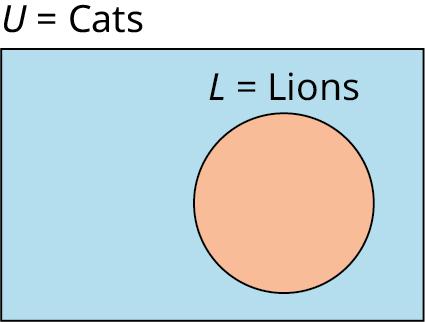
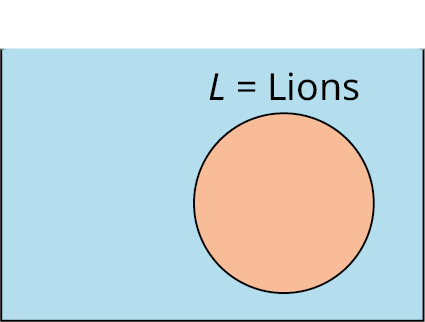
L is a subset of U if every element of L is a member of U. Because all lions are cats, every member of the set of Lions is a member of the set of Cats.
The set of lions is a subset of the universal set of cats. In other words, the Venn diagram depicts the relationship that all lions are cats. This is expressed symbolically as .
Your Turn 1.19 §1.3 source ↗
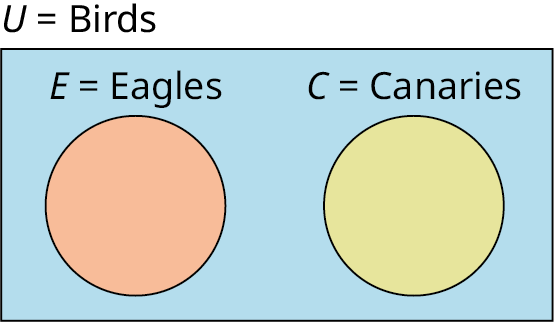
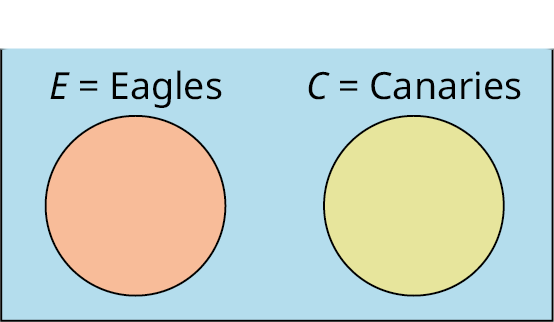
Describe the relationship between the sets in the following Venn diagram.
Answer
Your Turn 1.20 §1.3 source ↗
Answer
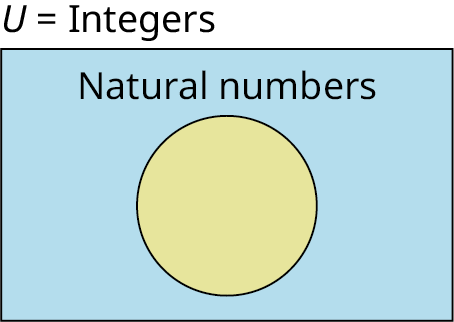
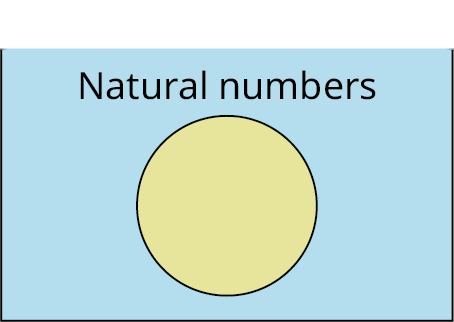 Venn diagram with universal set, , and subset .
Your Turn 1.20 (b) §1.3 source ↗
Answer
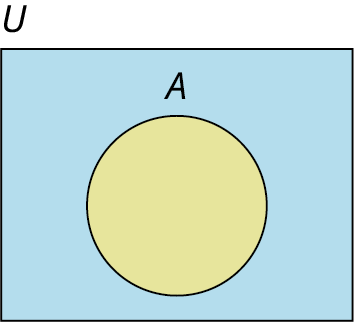
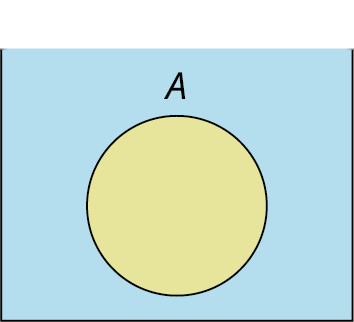 Venn Diagram with universal set, and subset .
Your Turn 1.21 §1.3 source ↗
Answer
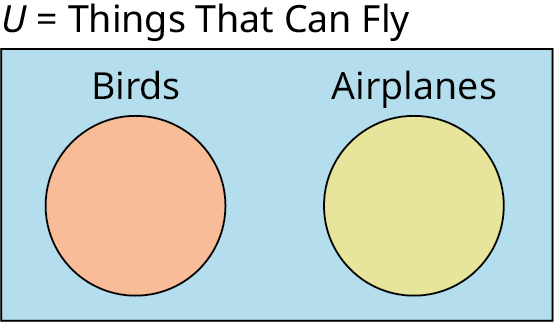
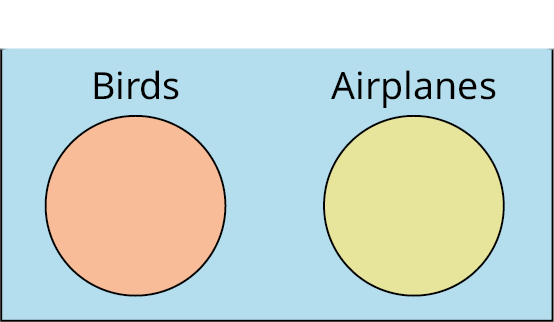 Venn Diagram with universal set, Things that can fly with disjoint subsets Airplanes and Birds.
Your Turn 1.22 §1.3 source ↗
For both of the questions below, is a proper subset of .
Given the universal set and set , find .Answer
represents the complement of set A. The complement of set A is the set of all elements in the universal set U that are not in set A. List the elements of U that are not in A.
Your Turn 1.22 (b) §1.3 source ↗
For both of the questions below, is a proper subset of .
Given the universal set and set find .Answer
represents the complement of set A. The complement of set A is the set of all elements in the universal set U that are not in set A. List the elements of U that are not in A. Because A includes the cats that are not lions, the complement will include the cats that are lions.
or
Check Your Understanding 1.3.15 §1.3 source ↗
Answer
Check Your Understanding 1.3.16 §1.3 source ↗
Answer
Check Your Understanding 1.3.17 §1.3 source ↗
Answer
Check Your Understanding 1.3.18 §1.3 source ↗
Answer
Check Your Understanding 1.3.19 §1.3 source ↗
Answer
Your Turn 1.23 §1.4 source ↗
Answer
The members that two sets have in common are included in the intersection of the sets. Only element a is in both sets.
Your Turn 1.24 §1.4 source ↗
Answer
The members that two sets have in common are included in the intersection of the sets. The sets have no elements in common, so their intersection is the empty set. You can represent the empty set by either the zero with a slash or empty curly braces.
or
Your Turn 1.25 §1.4 source ↗
Answer
The members that two sets have in common are included in the intersection of the sets. The two sets have the vowels in common.
Your Turn 1.26 §1.4 source ↗
Answer
The union of two sets includes all the members of the first set and all the members of the second set. Do not list duplicates twice.
Your Turn 1.27 §1.4 source ↗
Answer
The union of two sets includes all the members of the first set and all the members of the second set. Do not list duplicates twice.
Your Turn 1.28 §1.4 source ↗
Answer
The union of two sets includes all the members of the first set and all the members of the second set. Do not list duplicates twice. The vowels in set B are a subset of set A, so the union is equal to set A.
.
Your Turn 1.29 §1.4 source ↗
Answer
33
Use the formula:
Your Turn 1.30 §1.4 source ↗
Answer
113
Use the formula:
Your Turn 1.31 §1.4 source ↗
and and
Find the set consisting of elements in:
Answer
To find A or B, find . The union of two sets includes all the members of the first set and all the members of the second set. Do not list duplicates twice.
or
Your Turn 1.31 (b) §1.4 source ↗
and and
Find the set consisting of elements in:
Answer
To find A and C, find . The intersection of two sets includes the elements that are in both sets.
and
Your Turn 1.31 (c) §1.4 source ↗
and and
Find the set consisting of elements in:
Answer
To find B or C, find . The union of two sets includes all the members of the first set and all the members of the second set. Do not list duplicates twice.
or
Your Turn 1.31 (d) §1.4 source ↗
and and
Find the set consisting of elements in:
Answer
To find (A and C) and B, you need to follow the order of operations and evaluate the parentheses first.
First, evaluate inside the parentheses. Find . The intersection of two sets includes the elements that are in both sets.
To find (A and C) and , find .
( and ) and
Your Turn 1.32 §1.4 source ↗
Ravi and Priya are serving soup and salad along with the main course at their wedding reception. The reception will have a total of 150 guests in attendance. A total of 92 soups and 85 salads were ordered, while 23 guests did not order any soup or salad.
How many guests had soup or salad or both?Answer
127
Total number of guests = 150
n(neither soup nor salad) = 23
To find the number who had soup, salad, or both, subtract 23 from 150.
Your Turn 1.32 (b) §1.4 source ↗
Ravi and Priya are serving soup and salad along with the main course at their wedding reception. The reception will have a total of 150 guests in attendance. A total of 92 soups and 85 salads were ordered, while 23 guests did not order any soup or salad.
How many guests had both soup and a salad?Answer
50
Total number of guests = 150
n(neither soup nor salad) = 23
To find the number who had soup, salad, or both, subtract 23 from 150.
This represents the number of elements in the union of the sets of Soup and Salad eaters.
n(Soup Salad) = 127
n (Soup) = 92
n (Salad) = 85
Use the formula:
| Substitute. | |
| Simplify. | |
| Subtract 127. | |
| Simplify. | |
| Add the variable. | |
| Simplify. |
Your Turn 1.33 §1.4 source ↗
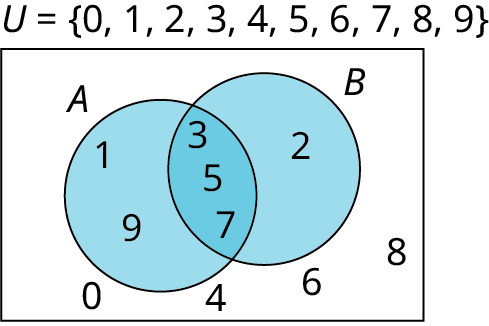
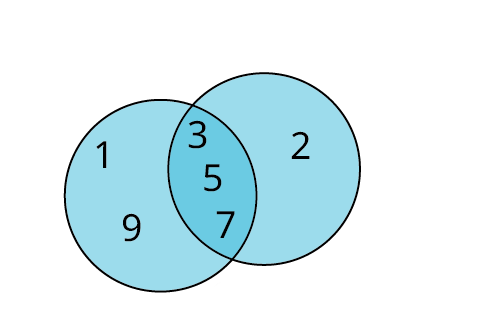 Venn diagram with two intersecting sets and members. Find .
Answer
.
The members that two sets have in common are included in the intersection of the sets. Look for the elements where the circles overlap.
Your Turn 1.33 (b) §1.4 source ↗
Venn diagram with two intersecting sets and members. Find .Answer
.
The union of two sets includes all the members of the first set and all the members of the second set. Do not list duplicates twice. List the elements that are inside the two circles.
Your Turn 1.33 (c) §1.4 source ↗
Venn diagram with two intersecting sets and members. Find .Answer
.
First, find , the complement of B. The complement of set B is the set of all elements in the universal set U that are not in set B. List the elements of U that are not in B.
Now find
The intersection of two sets are the elements that are in both sets.
Your Turn 1.33 (d) §1.4 source ↗
Venn diagram with two intersecting sets and members. Find .Answer
.
First, find , the complement of B. The complement of set B is the set of all elements in the universal set U that are not in set B. List the elements of U that are not in B.
Now find
The intersection of two sets are the elements that are in both sets.
is the number of elements in the set, which is two.
Your Turn 1.34 §1.4 source ↗
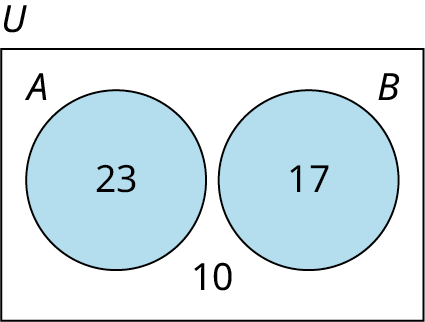
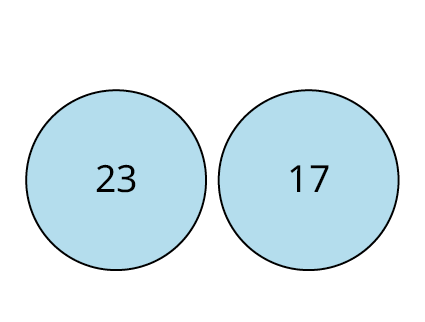 Venn diagram with two disjoint sets and number of elements in each section. Find .
Answer
To find A or B, find . The union of two sets includes all the members of the first set and all the members of the second set. Do not list duplicates twice.
Because the two sets are disjoint, the number of elements in the union of the two sets is the sum of the number of elements in the two sets.
40
Your Turn 1.34 (b) §1.4 source ↗
Venn diagram with two disjoint sets and number of elements in each section. Find .Answer
To find A or B, find . The intersection of two sets includes the elements they have in common. They have no elements in common, so the number of elements in the intersection is zero.
0Your Turn 1.34 (c) §1.4 source ↗
Venn diagram with two disjoint sets and number of elements in each section. Find .Answer
is the complement of A. The complement of set A is the set of all elements in the universal set U that are not in set A. The number of elements that are not in set A:
27
Check Your Understanding 1.4.20 §1.4 source ↗
Answer
intersection
Check Your Understanding 1.4.21 §1.4 source ↗
Answer
union
Check Your Understanding 1.4.22 §1.4 source ↗
Answer
It is very helpful that the union symbol looks somewhat like a U.
Check Your Understanding 1.4.23 §1.4 source ↗
Answer
Check Your Understanding 1.4.24 §1.4 source ↗
Answer
Check Your Understanding 1.4.25 §1.4 source ↗
Answer
The union of two sets includes all the members of the first set and all the members of the second set. Do not list duplicates twice.
Because A is a subset of B, all the elements of A are also in B. There can be no elements in A that are not in B. Thus, .
Check Your Understanding 1.4.26 §1.4 source ↗
Answer
Check Your Understanding 1.4.27 §1.4 source ↗
Answer
Your Turn 1.35 §1.5 source ↗
Use the same Venn diagram in the example above to answer the following questions.
How many people donated blood with a type B blood factor?Answer
Count every blood type that has any type of B as part of the blood type.
Your Turn 1.35 (b) §1.5 source ↗
Use the same Venn diagram in the example above to answer the following questions.
How many people who donated blood did not have a type B blood factor?Answer
You could count every type that does not have a B as part of the blood type. However, if you did the previous exercise, you already know the complement of B.
Your Turn 1.35 (c) §1.5 source ↗
Use the same Venn diagram in the example above to answer the following questions.
How many people who donated blood had a type B blood factor or were Rh+?Answer
Count the number of people who are in either the B circle or the RH+ circles.
Your Turn 1.36 §1.5 source ↗
Answer
Draw a rectangle to represent the universal set. Label it with “U = Conference Attendees = 50.”
Inside the rectangle, draw three overlapping circles. Label one circle Soup, one Sandwich, and one Salad. In the Soup circle, write 4 in the part that does not overlap any other circle, write 2 in the part that only overlaps the Sandwich circle, write 8 in the part that overlaps all three circles, and write 3 in the part that overlaps only the Salad circle. In the Sandwich circle, write 15 in the part that does not overlap any other circle and write 10 in the part that only overlaps the Salad circle. In the Salad circle, write 8 in the part that does not overlap any other circle. Write 0 outside all the circles.
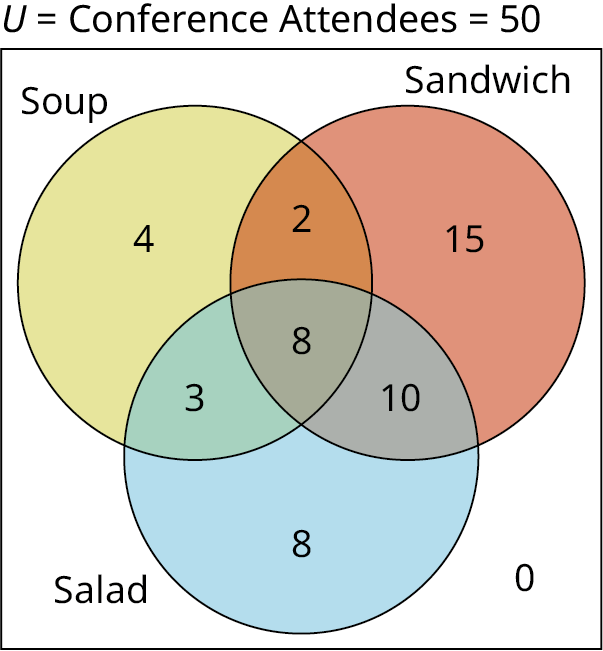
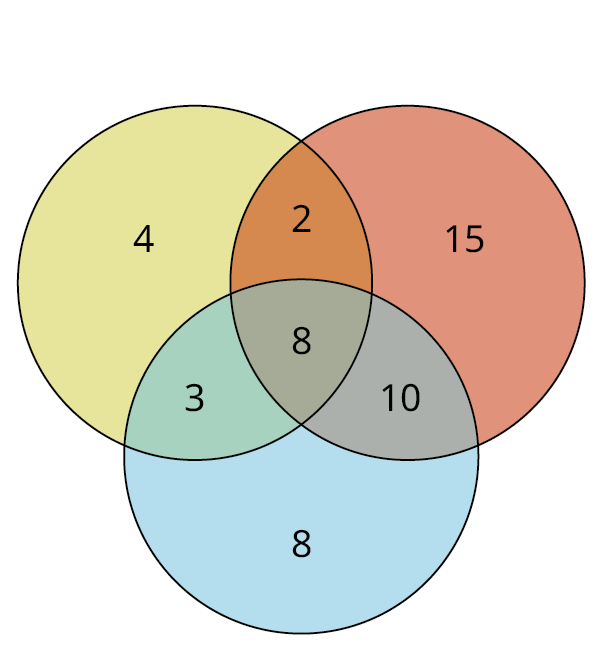 Venn diagram – Attendees at a conference with sets: Soup, Sandwich, Salad – Complete Solution
Your Turn 1.37 §1.5 source ↗
Using the same sets from Example 1.37, perform the set operations indicated.
Find .Answer
First, evaluate the operation inside the parentheses.
The intersection of two sets includes the elements that are common to both sets.
Your Turn 1.37 (b) §1.5 source ↗
Using the same sets from Example 1.37, perform the set operations indicated.
Find .Answer
Evaluate the expression in the left parentheses.
The intersection of two sets includes the elements that are common to both sets.
Evaluate the expression in the right parentheses.
Now, you can find .
Your Turn 1.37 (c) §1.5 source ↗
Using the same sets from Example 1.37, perform the set operations indicated.
Find .Answer
, the complement of C, includes the elements of U that are not in C.
and
Evaluate the expression in the left parentheses.
The intersection of two sets includes the elements that are common to both sets.
Evaluate the expression in the right parentheses.
Now, you can find .
Your Turn 1.38 §1.5 source ↗
Answer
First, draw the left side of the equation.
For A ∩ B, draw a rectangle to represent the universal set U. Label the rectangle “U.” Inside the rectangle, draw overlapping circles to represent two sets. Label one circle “A” and the other circle “B.” Shade the overlap.
Now, draw the complement of the intersection. Draw the same Venn diagram, but shade everything except the overlap to represent .
Now, draw the right side of the equation: .
First, draw . Draw a rectangle to represent the universal set U. Label the rectangle “U.” Inside the rectangle, draw a circle and label the circle “A.” Shade everything outside the circle.
To the right of the rectangle, draw the ∪ symbol.
Now, draw . Draw a rectangle to represent the universal set U. Label the rectangle “U.” Inside the rectangle, draw a circle and label the circle “B.” Shade everything outside the circle.
To the right of the second rectangle, draw the equal symbol: =.
For , draw a rectangle to represent the universal set U. Label the rectangle “U.” Inside the rectangle, draw overlapping circles to represent two sets. Label one circle “A” and the other circle “B.” Shade everything except for the overlap.
The left side of the equation is:
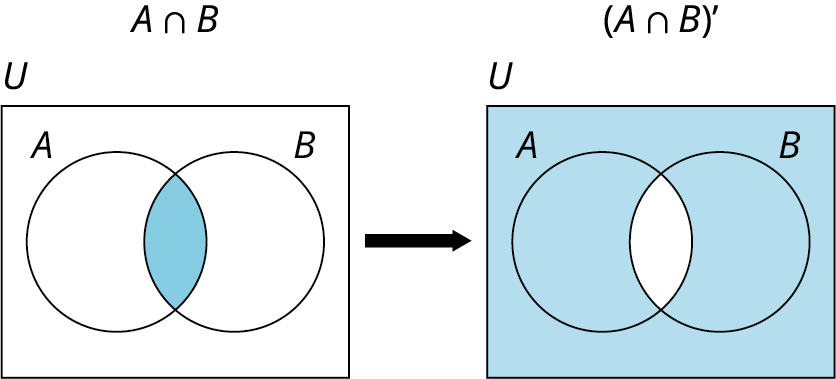
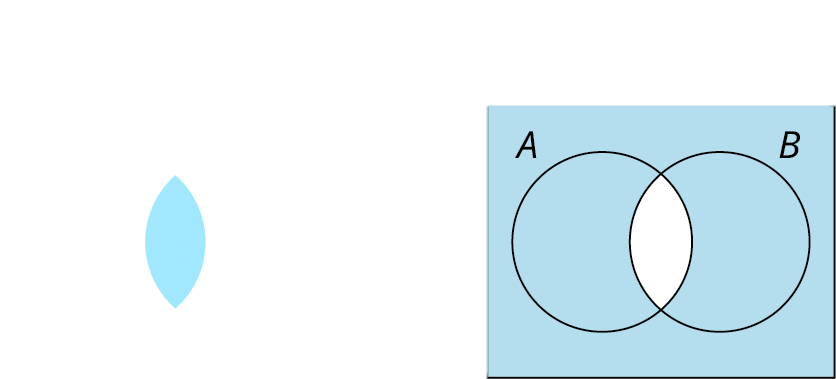 Venn diagram of intersection of two sets and its complement.
The right side of the equation is given by:
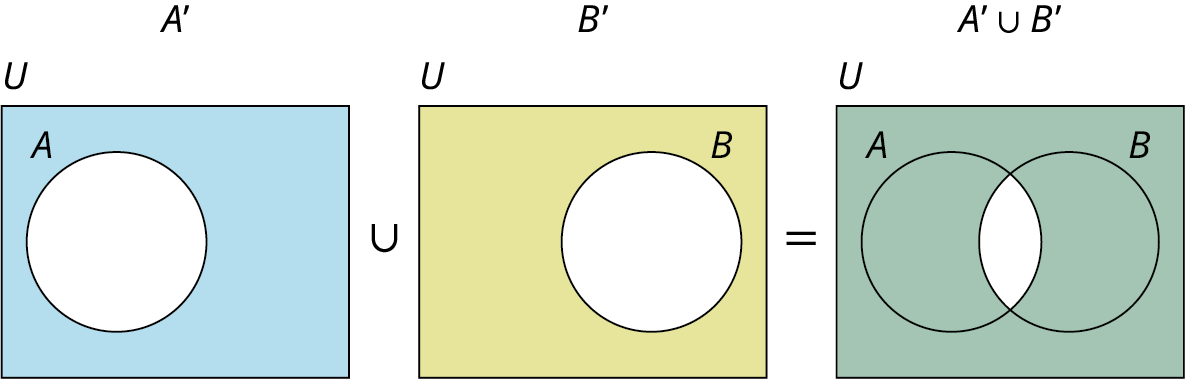
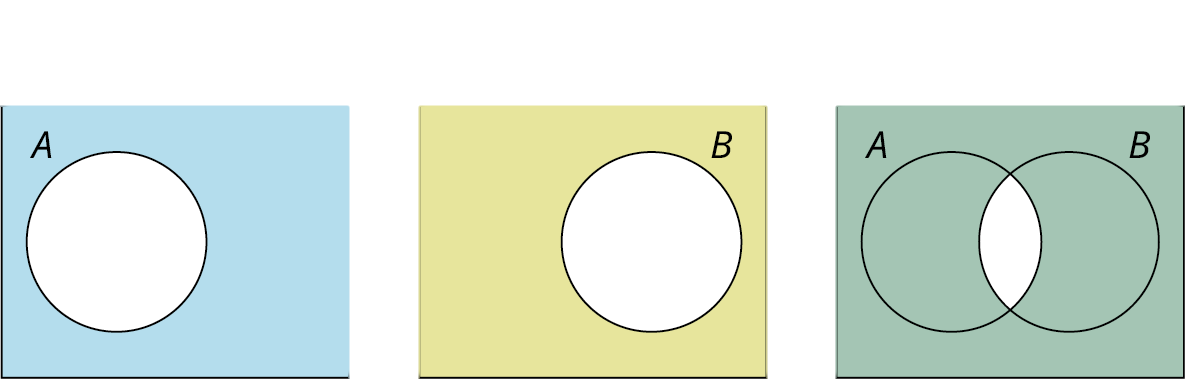 Venn diagram of union of the complement of two sets.
Check Your Understanding 1.5.28 §1.5 source ↗
Answer
overlap
By beginning with the region involving the most overlap, you start with the regions involving the most sets and the most complexity. Work toward the simpler parts of the diagram.Check Your Understanding 1.5.29 §1.5 source ↗
Answer
Check Your Understanding 1.5.30 §1.5 source ↗
Answer
Check Your Understanding 1.5.31 §1.5 source ↗
Answer
Check Your Understanding 1.5.32 §1.5 source ↗
Answer
Loading chapter 2…
Problems and answers are adapted from Contemporary Mathematics by Donna Kirk, OpenStax, and are used under the CC BY-NC-SA 4.0 licence. Access for free at https://openstax.org/books/contemporary-mathematics/pages/1-introduction. Illustrations: Copyright Rice University, OpenStax, under CC BY-NC-SA 4.0 license. This adaptation is released under the same licence, is non-commercial, and is neither affiliated with nor endorsed by OpenStax or Rice University.