Every problem in the chapter beside the book’s answer, a chapter at a time as you scroll.
Chapter 11: Voting and Apportionment
142 problems · 2 figuresYour Turn 11.1 §11.1 source ↗
Answer
A simple majority is a number equaling more than 50 percent of the total.
0.50(158,394,605) = 79,197,302.5
Yes, Joe Biden secured a majority of the votes because he had more than 79,197,302.5 votes.
Yes, Joe Biden won the majority.Your Turn 11.2 §11.1 source ↗
Answer
Your Turn 11.3 §11.1 source ↗
The student government bylaws of a particular college require that a new president is elected annually by plurality voting. In the event of a tie, the bylaws require the candidate(s) with the fewest votes to be removed from the ballot and a runoff election to be held with the remaining candidates. This process is repeated until a single candidate receives a plurality and wins the election. The results of two voting rounds are given in the table below.
| Candidate | Votes in First Round | Votes in Second Round |
|---|---|---|
| Ferguson | 158 | 168 |
| Garcia | 103 | 104 |
| Hearn | 157 | 180 |
| Isaac | 123 | 123 |
| Jackman | 58 | Eliminated |
| Kelly | 72 | 74 |
| Lim | 158 | 180 |
Answer
Your Turn 11.3 (b) §11.1 source ↗
The student government bylaws of a particular college require that a new president is elected annually by plurality voting. In the event of a tie, the bylaws require the candidate(s) with the fewest votes to be removed from the ballot and a runoff election to be held with the remaining candidates. This process is repeated until a single candidate receives a plurality and wins the election. The results of two voting rounds are given in the table below.
| Candidate | Votes in First Round | Votes in Second Round |
|---|---|---|
| Ferguson | 158 | 168 |
| Garcia | 103 | 104 |
| Hearn | 157 | 180 |
| Isaac | 123 | 123 |
| Jackman | 58 | Eliminated |
| Kelly | 72 | 74 |
| Lim | 158 | 180 |
Answer
Your Turn 11.4 §11.1 source ↗
| P | V | R | L | T | C | |
|---|---|---|---|---|---|---|
| Option A | 3 | 4 | 1 | 3 | 4 | 1 |
| Option B | 1 | 3 | 2 | 1 | 3 | 2 |
| Option C | 2 | 2 | 3 | 2 | 1 | 4 |
| Option D | 4 | 1 | 4 | 4 | 2 | 3 |
The board uses plurality method and a runoff in the event of a tie, such that the option(s) with the least votes will be eliminated in each round. Which option will be chosen?
Answer
Step 1: Determine the number of votes necessary to have a majority. There are six members, so 50 percent of 6 is 0.5(6) = 3. A majority is at least one more than 50 percent, which is 4 or more votes.
Step 2: In the first round, A and B have 2 votes. C and D have 1 vote. No one has the majority. C and D tie for the least number of votes, so eliminate them both.
Step 3: Reorder the votes with the remaining options.
| P | V | R | L | T | V | |
|---|---|---|---|---|---|---|
| Option A | 2 | 2 | 1 | 2 | 2 | 1 |
| Option B | 1 | 1 | 2 | 1 | 1 | 2 |
Option B now has 4 votes, which wins the majority.
Option B.Your Turn 11.5 §11.1 source ↗
| Number of Ballots | 4 | 6 | 4 | 7 |
|---|---|---|---|---|
| Red | 2 | 6 | 2 | 5 |
| Blue | 1 | 2 | 1 | 4 |
| Green | 6 | 5 | 5 | 2 |
| Yellow | 5 | 4 | 6 | 3 |
| Purple | 4 | 3 | 4 | 1 |
| Pink | 3 | 1 | 3 | 6 |
Answer
The numbers in the top row tell you the number of ballots.
4 + 6 + 4 + 7 = 21
Your Turn 11.5 (b) §11.1 source ↗
| Number of Ballots | 4 | 6 | 4 | 7 |
|---|---|---|---|---|
| Red | 2 | 6 | 2 | 5 |
| Blue | 1 | 2 | 1 | 4 |
| Green | 6 | 5 | 5 | 2 |
| Yellow | 5 | 4 | 6 | 3 |
| Purple | 4 | 3 | 4 | 1 |
| Pink | 3 | 1 | 3 | 6 |
Answer
Your Turn 11.5 (c) §11.1 source ↗
| Number of Ballots | 4 | 6 | 4 | 7 |
|---|---|---|---|---|
| Red | 2 | 6 | 2 | 5 |
| Blue | 1 | 2 | 1 | 4 |
| Green | 6 | 5 | 5 | 2 |
| Yellow | 5 | 4 | 6 | 3 |
| Purple | 4 | 3 | 4 | 1 |
| Pink | 3 | 1 | 3 | 6 |
Answer
Your Turn 11.6 §11.1 source ↗
| Number of Ballots | 7 | 6 | 10 | 8 | 4 | 5 | 6 | 7 | 2 | 3 |
|---|---|---|---|---|---|---|---|---|---|---|
| Han Solo | 3 | 5 | 1 | 3 | 2 | 4 | 2 | 2 | 1 | 4 |
| Princess Leia | 2 | 1 | 3 | 6 | 4 | 3 | 3 | 1 | 3 | 2 |
| Luke Skywalker | 6 | 6 | 6 | 1 | 5 | 5 | 5 | 4 | 6 | 1 |
| Chewbacca | 4 | 4 | 5 | 4 | 6 | 1 | 6 | 5 | 4 | 5 |
| Yoda | 1 | 2 | 4 | 2 | 3 | 2 | 1 | 3 | 2 | 3 |
| R2-D2 | 5 | 3 | 2 | 5 | 1 | 6 | 4 | 6 | 5 | 6 |
Answer
Step 1: Determine the number of votes needed to achieve a majority.
Add the number of ballots.
7 + 6 + 10 + 8 + 4 + 5 + 6 + 7 + 2 + 3 = 58
0.50(58) = 29
To win a majority requires 30 or more votes.
Step 2: Count the number of first-place votes for each candidate. If a candidate has a majority, then you are done. Otherwise, eliminate the candidate with the fewest votes and repeat this step.
Han Solo: 10 + 2 = 12
Princess Leia: 6 + 7 = 13
Luke Skywalker: 8 + 3 = 11
Chewbacca: 5
Yoda: 7 + 6 = 13
R2-D2 = 4
No one won. Eliminate R2-D2.
Second Round:
| Number of Ballots | 7 | 6 | 10 | 8 | 4 | 5 | 6 | 7 | 2 | 3 |
|---|---|---|---|---|---|---|---|---|---|---|
| Han Solo | 3 | 4 | 1 | 3 | 1 | 4 | 2 | 2 | 1 | 4 |
| Princess Leia | 2 | 1 | 2 | 5 | 3 | 3 | 3 | 1 | 3 | 2 |
| Luke Skywalker | 5 | 5 | 5 | 1 | 4 | 5 | 4 | 4 | 5 | 1 |
| Chewbacca | 4 | 3 | 4 | 4 | 5 | 1 | 5 | 5 | 4 | 5 |
| Yoda | 1 | 2 | 3 | 2 | 2 | 2 | 1 | 3 | 2 | 3 |
Han Solo: 10 + 4 + 2 = 16
Princess Leia: 6 + 7 = 13
Luke Skywalker: 8 + 3 = 11
Chewbacca: 5
Yoda: 7 + 6 = 13
Still, no one has the majority. Eliminate Chewbacca.
Third Round:
| Number of Ballots | 7 | 6 | 10 | 8 | 4 | 5 | 6 | 7 | 2 | 3 |
|---|---|---|---|---|---|---|---|---|---|---|
| Han Solo | 3 | 3 | 1 | 3 | 1 | 3 | 2 | 2 | 1 | 4 |
| Princess Leia | 2 | 1 | 2 | 4 | 3 | 2 | 3 | 1 | 3 | 2 |
| Luke Skywalker | 4 | 4 | 4 | 1 | 4 | 4 | 4 | 4 | 4 | 1 |
| Yoda | 1 | 2 | 3 | 2 | 2 | 1 | 1 | 3 | 2 | 3 |
Han Solo: 10 + 4 + 2 = 16
Princess Leia: 6 + 7 = 13
Luke Skywalker: 8 + 3 = 11
Yoda: 7 + 5 + 6 = 18
Still, no one has the majority. Eliminate Luke Skywalker.
Fourth Round:
| Number of Ballots | 7 | 6 | 10 | 8 | 4 | 5 | 6 | 7 | 2 | 3 |
|---|---|---|---|---|---|---|---|---|---|---|
| Han Solo | 3 | 3 | 1 | 2 | 1 | 3 | 2 | 2 | 1 | 3 |
| Princess Leia | 2 | 1 | 2 | 3 | 3 | 2 | 3 | 1 | 3 | 1 |
| Yoda | 1 | 2 | 3 | 1 | 2 | 1 | 1 | 3 | 2 | 2 |
Han Solo: 10 + 4 + 2 = 16
Princess Leia: 6 + 7 + 3 = 16
Yoda: 7 + 8 + 5 + 6 = 26
Still, no one has the majority. Eliminate both Han Solo and Princess Leia. Only Yoda remains and would have the majority.
Yoda wins.
Your Turn 11.7 §11.1 source ↗
Answer
Step 1: For each cell in the table, multiply the number of votes times (6 minus the rank assigned). The 6 comes from the number of colors in the table.
For the color blue, find the points for each column:
First column: 4 × (6 – 1) = 4 × 5 = 20
Second column: 6 × (6 – 2) = 6 × 4 = 24
Third column: 4 × (6 – 1) = 4 × 5 = 20
Fourth column: 7 × (6 – 4) = 7 × 2 = 14
Step 2: Add the points for each column.
20 + 24 + 20 + 14 = 78
Blue received 78 points.
Blue received 78 points.Your Turn 11.8 §11.1 source ↗
Answer the following questions using the table below, which summarizes Imaginarian voter preferences.
| Number of Ballots | 12 | 19 | 27 | 29 | 31 | 21 |
|---|---|---|---|---|---|---|
| Candidate A | 1 | 1 | 2 | 2 | 3 | 3 |
| Candidate B | 2 | 3 | 1 | 3 | 1 | 2 |
| Candidate C | 3 | 2 | 3 | 1 | 2 | 1 |
Answer
Ranked Choice Method:
Step 1: Determine the number of votes needed to achieve a majority.
Add the number of ballots.
12 + 19 + 27 + 29 + 31 +21 = 139
0.50(139) = 69.5
To win a majority requires 70 or more votes.
Step 2: Count the number of first-place votes for each candidate. If a candidate has a majority, then you are done. Otherwise, eliminate the candidate with the fewest votes and repeat this step.
A: 12 + 19 = 31
B: 27 + 31 = 58
C: 29 + 21 = 50
No one has the majority. Eliminate Candidate A.
Second Round:
| Number of Ballots | 12 | 19 | 27 | 29 | 31 | 21 |
|---|---|---|---|---|---|---|
| Candidate B | 1 | 2 | 1 | 2 | 1 | 2 |
| Candidate C | 2 | 1 | 2 | 1 | 2 | 1 |
B: 12 + 27 + 31 = 70
C: 19 + 29 + 21 = 69
Candidate B wins the majority vote using the ranked-choice method.
Candidate B would be considered the winner using the ranked-choice voting method.Your Turn 11.8 (b) §11.1 source ↗
Answer the following questions using the table below, which summarizes Imaginarian voter preferences.
| Number of Ballots | 12 | 19 | 27 | 29 | 31 | 21 |
|---|---|---|---|---|---|---|
| Candidate A | 1 | 1 | 2 | 2 | 3 | 3 |
| Candidate B | 2 | 3 | 1 | 3 | 1 | 2 |
| Candidate C | 3 | 2 | 3 | 1 | 2 | 1 |
Answer
To save subtracting all the time, a first-place vote earns 2 points. A second-place vote wins 1 point. A last place vote wins no points.
| Number of Ballots | 12 | 19 | 27 | 29 | 31 | 21 |
|---|---|---|---|---|---|---|
| Candidate A | 1 | 1 | 2 | 2 | 3 | 3 |
| Candidate B | 2 | 3 | 1 | 3 | 1 | 2 |
| Candidate C | 3 | 2 | 3 | 1 | 2 | 1 |
Candidate A: 12(2) + 19(2) + 27(1) + 29(1) + 31(0) + 21(0) = 118
Candidate B: 12(1) + 19(0) + 27(2) + 29(0) + 31(2) + 21(1) = 149
Candidate C: 12(0) + 19(1) + 27(0) + 29(2) + 31(1) + 21(2) = 150
Candidate C has the most points, so Candidate C wins.
Candidate C would be considered the winner using the Borda count method.Your Turn 11.8 (c) §11.1 source ↗
Answer the following questions using the table below, which summarizes Imaginarian voter preferences.
| Number of Ballots | 12 | 19 | 27 | 29 | 31 | 21 |
|---|---|---|---|---|---|---|
| Candidate A | 1 | 1 | 2 | 2 | 3 | 3 |
| Candidate B | 2 | 3 | 1 | 3 | 1 | 2 |
| Candidate C | 3 | 2 | 3 | 1 | 2 | 1 |
Answer
Your Turn 11.9 §11.1 source ↗
According to Variety magazine, there were 8,469 eligible Oscar voters in 2020. To make our matrix easier to work with, we've rounded this number up to 8,700. We'd never do this in a real voting situation. Suppose that the voter preferences for the ballot for Best Director had been as shown in the table below.
| Number of Ballots | 2,400 | 2,100 | 1,900 | 1,200 | 1,100 |
|---|---|---|---|---|---|
| Martin Scorsese, The Irishman | 3 | 1 | 4 | 5 | 2 |
| Todd Phillips, Joker | 1 | 4 | 5 | 2 | 4 |
| Sam Mendes, 1917 | 5 | 5 | 3 | 4 | 5 |
| Quentin Tarantino, Once Upon a Time in Hollywood | 4 | 2 | 1 | 3 | 3 |
| Bong Joon-ho, Parasite | 2 | 3 | 2 | 1 | 1 |
Refer to the table to answer each question.
Construct a pairwise comparison matrix for the Best Director ballots.Answer
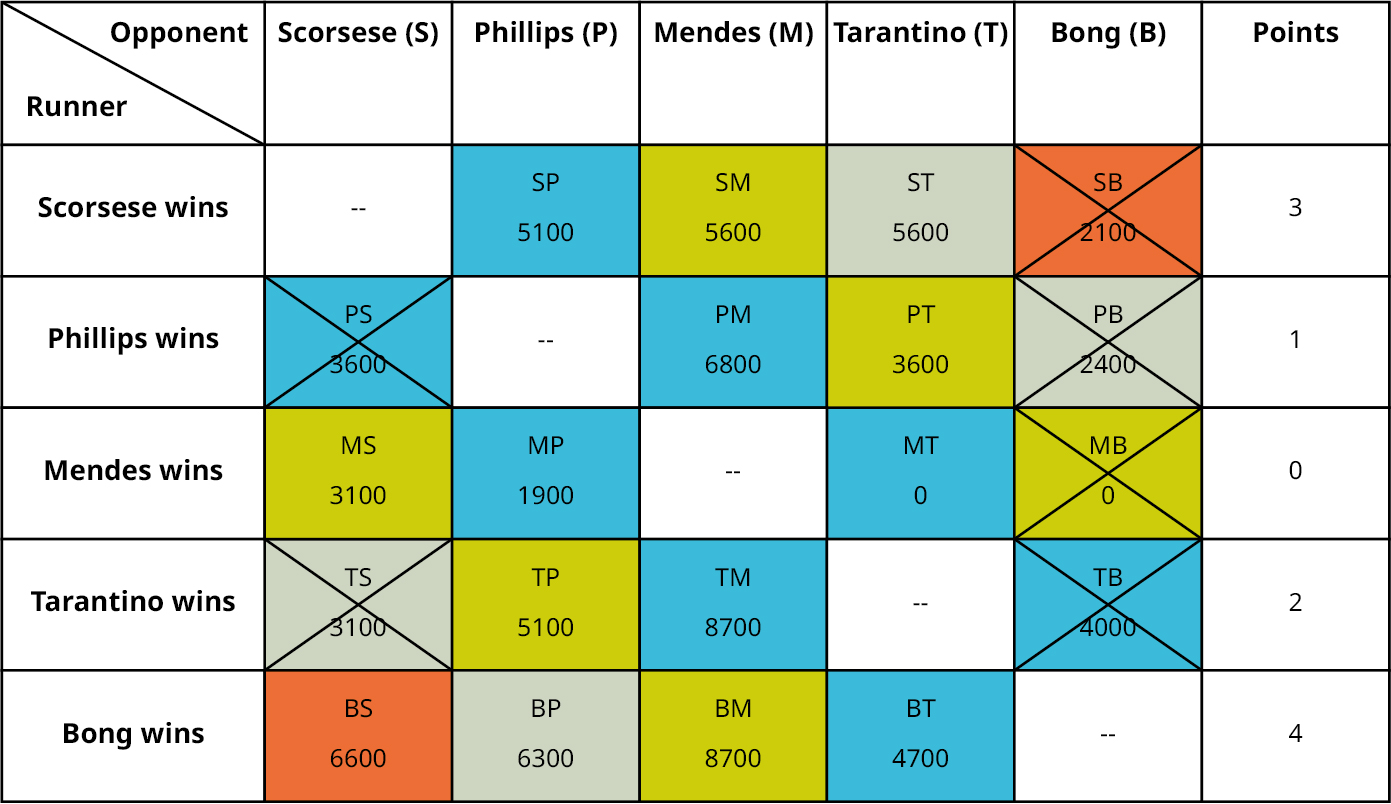
Step 1: Create a grid with each actor on the horizontal and vertical headers. Indicate a win with a cross and a tie with a slash.
For instance, let’s find SP: Add the number of ballots in which Scorsese ranks higher than Phillips:
2,100 + 1,900 + 1,100 = 5,100
To find SM, add the number of ballots in which Scorsese ranks higher than Mendes:
2,400 + 2,100 + 1,100 = 5,600
To find ST, add the number of ballots in which Scorsese ranks higher than Tarantino.
2,400 + 2,100 + 1,100 = 5,600
To find SB, add the number of ballots in which Scorsese ranks higher than Bong.
2,100
To find PS, add the number of ballots in which Phillips ranks higher than Scorsese.
2,400 + 1,200 = 3,600
To find PM, add the number of ballots in which Phillips ranks higher than Mendes.
2,400 + 2,100 + 1,200 + 1,100 = 6,800
To find PT, add the number of ballots in which Phillips ranks higher than Tarantino.
2,400 + 1,200 = 3,600
To find PB, add the number of ballots in which Phillips ranks higher than Bong.
2,400
To find MS, add the number of ballots in which Mendes ranks higher than Scorsese.
1,900 + 1,200 = 3,100
To find MP, add the number of ballots in which Mendes ranks higher than Phillips.
1,900
To find MT, add the number of ballots in which Mendes ranks higher than Tarantino.
It does not happen, so record a zero.
To find MB, add the number of ballots in which MB ranks higher than Bong.
Again, it does not happen, so record a zero.
Continue to fill in the rest of the table.
It should look like this.
| Opponent Runner | Scorsese (S) | Phillips (P) | Mendes (M) | Tarantino (T) | Bong (B) | Points |
|---|---|---|---|---|---|---|
| Scorsese wins | SP 5100 | SM 5600 | ST 5600 | SB 2100 | ||
| Phillips wins | PS 3600 | PM 6800 | PT 3600 | PB 2400 | ||
| Mendes wins | MS 3100 | MP 1900 | MT 0 | MB 0 | ||
| Tarantino wins | TS 3100 | TP 5100 | TM 8700 | TB 4000 | ||
| Bong wins | BS 6600 | BP 6300 | BM 8700 | BT 4700 |
Step 2: Add the total number of ballots: 2,400 + 2,100 + 1,900 + 1,200 + 1,100 = 8,700
Half of that is 4,350.
Anyone who did win over 4,350 votes is a loser. Put an X on the losers. Put a slash on the ties, who have exactly 4,350 (there are not any).
Each win (X) is one point. Each tie (slash) is a half point. Each loss is zero points.
| Opponent Runner | Scorsese (S) | Phillips (P) | Mendes (M) | Tarantino (T) | Bong (B) | Points |
|---|---|---|---|---|---|---|
| Scorsese wins | SP 5100 | SM 5600 | ST 5600 | SB 2100 Cross out SB 2100 | 3 | |
| Phillips wins | PS 3600 Cross out PS 3600 | PM 6800 | PT 3600 Cross out PT 3600 | PB 2400 Cross out PB 2400 | 1 | |
| Mendes wins | MS 3100 Cross out MS 3100 | MP 1900 Cross out MP 1900 | MT 0 Cross out MT 0 | MB 0 Cross out MB 0 | 0 | |
| Tarantino wins | TS 3100 Cross out TS 3100 | TP 5100 | TM 8700 | TB 4000 Cross out TB 4000 | 2 | |
| Bong wins | BS 6600 | BP 6300 | BM 8700 | BT 4700 | 4 |
Step 3: The winner is the one with the most points. Bong Joon-ho has 4 points.
Your Turn 11.9 (b) §11.1 source ↗
According to Variety magazine, there were 8,469 eligible Oscar voters in 2020. To make our matrix easier to work with, we've rounded this number up to 8,700. We'd never do this in a real voting situation. Suppose that the voter preferences for the ballot for Best Director had been as shown in the table below.
| Number of Ballots | 2,400 | 2,100 | 1,900 | 1,200 | 1,100 |
|---|---|---|---|---|---|
| Martin Scorsese, The Irishman | 3 | 1 | 4 | 5 | 2 |
| Todd Phillips, Joker | 1 | 4 | 5 | 2 | 4 |
| Sam Mendes, 1917 | 5 | 5 | 3 | 4 | 5 |
| Quentin Tarantino, Once Upon a Time in Hollywood | 4 | 2 | 1 | 3 | 3 |
| Bong Joon-ho, Parasite | 2 | 3 | 2 | 1 | 1 |
Refer to the table to answer each question.
Who is the “Best Director” according to the pairwise comparison method?Answer
Your Turn 11.9 (c) §11.1 source ↗
According to Variety magazine, there were 8,469 eligible Oscar voters in 2020. To make our matrix easier to work with, we've rounded this number up to 8,700. We'd never do this in a real voting situation. Suppose that the voter preferences for the ballot for Best Director had been as shown in the table below.
| Number of Ballots | 2,400 | 2,100 | 1,900 | 1,200 | 1,100 |
|---|---|---|---|---|---|
| Martin Scorsese, The Irishman | 3 | 1 | 4 | 5 | 2 |
| Todd Phillips, Joker | 1 | 4 | 5 | 2 | 4 |
| Sam Mendes, 1917 | 5 | 5 | 3 | 4 | 5 |
| Quentin Tarantino, Once Upon a Time in Hollywood | 4 | 2 | 1 | 3 | 3 |
| Bong Joon-ho, Parasite | 2 | 3 | 2 | 1 | 1 |
Refer to the table to answer each question.
Is the winner a Condorcet candidate?Answer
Your Turn 11.10 §11.1 source ↗
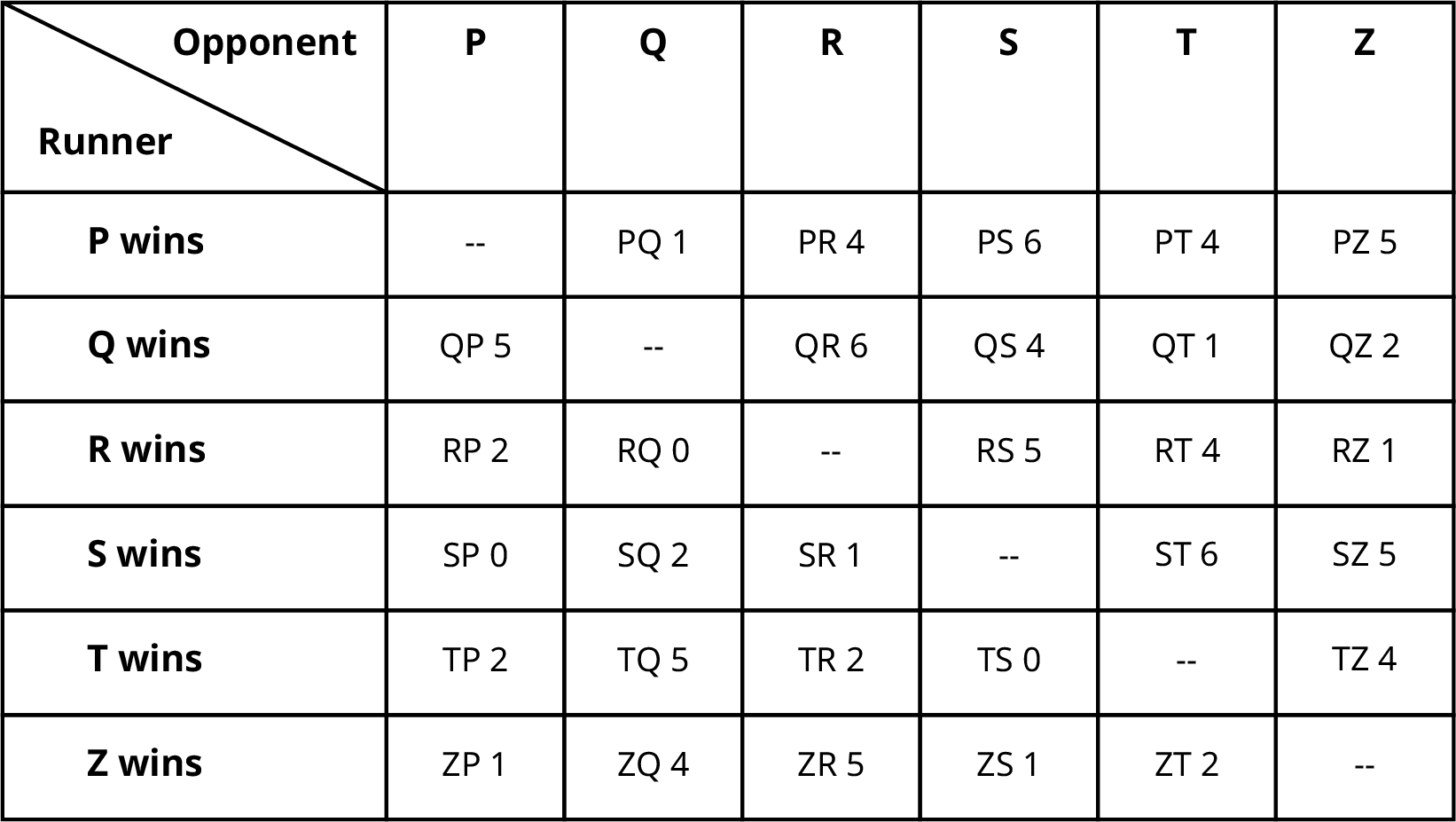 A Pairwise Comparison Matrix
Answer
Compare PQ 1 to QP 5. Because 1 is less than 5, PQ 1 is the loser. Cross out PQ 1.
Compare PR 4 to RP 2. Because 2 is less than 4, RP 2 is the loser. Cross out RP 2.
Compare PS 6 to SP 0. Because 0 is less than 6, SP 0 is the loser. Cross it out.
Continue comparing in this manner until you have completed the table. Because there are no 3s in the table, there will be no ties.
A win earns 1 point, a tie earns a half point, and a loss earns nothing.
P has 4 wins (1 point each) for 4 points.
Q has 3 wins (1 point each) for 3 points.
R has 2 wins (1 point each) for 2 points.
S has 2 wins (1 point each) for 2 points.
T has 2 wins (1 point each) for 2 points.
Z has 2 wins (1 point each) for 2 points.
Candidate P wins with 4 points. P is not a Condorcet winner because P lost to Q.
Candidate P wins. Candidate P is not a Condorcet candidate because P lost to Candidate Q.Your Turn 11.11 §11.1 source ↗
Suppose there is an election with 26 candidates, A through Z, and that Candidate C is a Condorcet candidate.
How many points did Candidate C win?Answer
Your Turn 11.11 (b) §11.1 source ↗
Suppose there is an election with 26 candidates, A through Z, and that Candidate C is a Condorcet candidate.
What is the greatest number of points that any one of the other candidates could win?Answer
Your Turn 11.11 (c) §11.1 source ↗
Suppose there is an election with 26 candidates, A through Z, and that Candidate C is a Condorcet candidate.
Is it possible for Candidate C to lose or tie?Answer
Your Turn 11.12 §11.1 source ↗
The Chionilis family is trying to decide on a restaurant again, but now they don’t want to deal with multiple runoffs or even ranking. They will use the approval voting method shown in the following table. Each family member will approve their top two choices. Rainbow China won when multiple runoffs were used. Find the winner for tonight’s dinner.
| Options | A | R | S | T | G | E | M | D |
|---|---|---|---|---|---|---|---|---|
| Rainbow China | Yes | No | No | Yes | No | No | Yes | Yes |
| Dough Boys Pizza | Yes | Yes | Yes | Yes | No | Yes | No | Yes |
| Taco City | No | No | Yes | No | Yes | Yes | No | No |
| Caribbean Flavor | No | Yes | No | No | Yes | No | Yes | No |
Answer
Count the number of Yes votes earned by each option.
Rainbow China: 4
Dough Boys Pizza: 6
Taco City: 3
Caribbean Flavor: 3
The option with the most Yes votes wins.
Dough Boys Pizza wins with the most points.
Dough Boys Pizza is the winner for dinner.Your Turn 11.13 §11.1 source ↗
| Options | A | R | S | T | G |
|---|---|---|---|---|---|
| Rainbow China | 1 | 3 | 3 | 1 | 3 |
| Dough Boys Pizza | 2 | 2 | 1 | 2 | 1 |
| Taco City | 3 | 4 | 2 | 4 | 2 |
| Caribbean Flavor | 4 | 1 | 4 | 3 | 4 |
Answer
Count the number of Yes votes earned by each option. Anything with a score of 1, 2, or 3 counts as a Yes.
Rainbow China: 5
Dough Boys Pizza: 5
Taco City: 3
Caribbean Flavor: 2
The option with the most Yes votes wins.
Rainbow China and Dough Boys Pizza have a tie this time.
There is a tie between Rainbow China and Dough Boys Pizza.Your Turn 11.14 §11.1 source ↗
| Candidate | Party | Votes | Percentage |
|---|---|---|---|
| (G) George W. Bush | Republican | 2,912,790 | 48.85% |
| (A) Al Gore | Democrat | 2,912,253 | 48.84% |
| (R) Ralph Nader | Green | 97,488 | 1.63% |
| (P) Pat Buchanan | Reform | 17,484 | 0.29% |
| (H) Harry Brown | Libertarian | 16,415 | 0.28% |
| (O) 7 Other Candidates | Other | 6,680 | 0.11% |
| Total | 5,963,110 |
Answer
| Candidate | Party | Votes | Percentage |
|---|---|---|---|
| (G) George W. Bush | Republican | 2,912,790 | 48.85% |
| (A) Al Gore | Democrat | 2,912,253 | 48.84% |
| (R) Ralph Nader | Green | 97,488 | 1.63% |
| (P) Pat Buchanan | Reform | 17,484 | 0.29% |
| (H) Harry Brown | Libertarian | 16,415 | 0.28% |
| (O) 7 Other Candidates | Other | 6,680 | 0.11% |
100 percent of Pat Buchanan supporters would approve of George W. Bush.
100 percent of Ralph Nader supporters would approve Al Gore.
72 percent of Libertarians would approve of George W. Bush.
28 percent of Libertarians would approve Al Gore (as was roughly the known percentage at the time according to the Cato Institute).
50 percent of the supporters of other candidates would approve of George Bush, whereas 50 percent would approve of Al Gore.
100 percent of Al Gore supporters would approve of Ralph Nader.
50 percent of George Bush supporters would approve of Pat Buchanan.
50 percent of 2,912,790 is 1,456,395.
50 percent of George Bush supporters would approve of Harry Brown.
George W. Bush: 2,912,790 + 17,484 + 11,819 + 3340 = 2,945,433
Al Gore: 2,912,253 + 97,488 + 4,596 + 3,340 = 3,017,677
Ralph Nader: 97,488 + 2,912,253 = 3,009,741
Pat Buchanan: 17,484 + 1,456,395 = 1,473,879
Harry Brown: 11,819 + 4,596 + 1,456,395 = 1,472,810
Other Candidates: 6,680
Al Gore would win.
Al Gore is the winner.Your Turn 11.15 §11.1 source ↗
| Percentage of Voters | 35% | 25% | 30% |
|---|---|---|---|
| Animal Kingdom | 1 | 3 | 4 |
| Magic Kingdom | 2 | 1 | 3 |
| Epcot Center | 3 | 4 | 1 |
| Hollywood Studios | 4 | 2 | 2 |
Determine the outcome of the vote by each of the given voting methods. Plurality
Answer
Plurality considers only the top choice of each voter. The percentages for first-place votes show that the Animal Kingdom wins.
Animal Kingdom: 35%
Magic Kingdom: 25%
Epcot: 30%
Hollywood Studios: no first-place votes
Animal KingdomYour Turn 11.15 (b) §11.1 source ↗
| Percentage of Voters | 35% | 25% | 30% |
|---|---|---|---|
| Animal Kingdom | 1 | 3 | 4 |
| Magic Kingdom | 2 | 1 | 3 |
| Epcot Center | 3 | 4 | 1 |
| Hollywood Studios | 4 | 2 | 2 |
Determine the outcome of the vote by each of the given voting methods. Ranked-choice method
Answer
A park needs more than 50 percent of the first-place votes to win in the ranked-choice method.
Animal Kingdom: 35%
Magic Kingdom: 25%
Epcot: 30%
Hollywood Studios: no first-place votes
No one wins the first round. Eliminate Hollywood Studios and redo the ranks.
Second Round:
| Percentage of Voters | 35% | 25% | 30% |
|---|---|---|---|
| Animal Kingdom | 1 | 2 | 3 |
| Magic Kingdom | 2 | 1 | 2 |
| Epcot Center | 3 | 3 | 1 |
Animal Kingdom: 35%
Magic Kingdom: 25%
Epcot: 30%
No one wins. Eliminate Magic Kingdom and redo the ranks.
Third Round:
| Percentage of Voters | 35% | 25% | 30% |
|---|---|---|---|
| Animal Kingdom | 1 | 1 | 2 |
| Epcot Center | 2 | 2 | 1 |
Animal Kingdom: 35% + 25% = 60%
Epcot: 30%
Animal Kingdom wins.
Animal KingdomYour Turn 11.15 (c) §11.1 source ↗
| Percentage of Voters | 35% | 25% | 30% |
|---|---|---|---|
| Animal Kingdom | 1 | 3 | 4 |
| Magic Kingdom | 2 | 1 | 3 |
| Epcot Center | 3 | 4 | 1 |
| Hollywood Studios | 4 | 2 | 2 |
Determine the outcome of the vote by each of the given voting methods. Borda count
Answer
| Percentage of Voters | 35% | 25% | 30% |
|---|---|---|---|
| Animal Kingdom | 1 | 3 | 4 |
| Magic Kingdom | 2 | 1 | 3 |
| Epcot Center | 3 | 4 | 1 |
| Hollywood Studios | 4 | 2 | 2 |
First place gets (4 – 1) = 3 points, second place gets 2 points, third place gets 1 point, and fourth place gets 0 points.
Animal Kingdom: 35(3) + 25(1) + 30(0) = 130
Magic Kingdom: 35(2) + 25(3) + 30(1) = 175
Epcot Center: 35(1) + 25(0) + 30(3) = 125
Hollywood Studios: 35(0) + 25(3) + 30(3) = 165
Magic Kingdom wins.
Magic KingdomCheck Your Understanding 11.1.1 §11.1 source ↗
Answer
Check Your Understanding 11.1.2 §11.1 source ↗
Answer
Check Your Understanding 11.1.3 §11.1 source ↗
Answer
Check Your Understanding 11.1.4 §11.1 source ↗
Answer
Check Your Understanding 11.1.5 §11.1 source ↗
Answer
Check Your Understanding 11.1.6 §11.1 source ↗
Answer
Check Your Understanding 11.1.7 §11.1 source ↗
Answer
Your Turn 11.16 §11.2 source ↗
Use the information in the table to answer the following questions.
| Voters | L | M | N | O | P |
|---|---|---|---|---|---|
| Option A | 2 | 2 | 3 | 2 | 1 |
| Option B | 1 | 4 | 1 | 4 | 2 |
| Option C | 3 | 1 | 4 | 1 | 3 |
| Option D | 4 | 1 | 2 | 3 | 4 |
Answer
Option A: 1 vote
Option B: 2 votes
Option C: 2 votes
Option D: 1 vote
There is a tie between Options B and C.
Using the plurality voting method, there would be a tie between Option B and Option C.Your Turn 11.16 (b) §11.2 source ↗
Use the information in the table to answer the following questions.
| Voters | L | M | N | O | P |
|---|---|---|---|---|---|
| Option A | 2 | 2 | 3 | 2 | 1 |
| Option B | 1 | 4 | 1 | 4 | 2 |
| Option C | 3 | 1 | 4 | 1 | 3 |
| Option D | 4 | 1 | 2 | 3 | 4 |
Answer
There are five voters.
50 percent of 5 is 2.5.
The majority is 3 votes or more.
First Round:
| Voters | L | M | N | O | P |
|---|---|---|---|---|---|
| Option A | 2 | 2 | 3 | 2 | 1 |
| Option B | 1 | 4 | 1 | 4 | 2 |
| Option C | 3 | 1 | 4 | 1 | 3 |
| Option D | 4 | 1 | 2 | 3 | 4 |
Option A: 1 vote
Option B: 2 votes
Option C: 2 votes
Option D: 1 vote
No one wins. Eliminate A and D.
Second Round:
| Voters | L | M | N | O | P |
|---|---|---|---|---|---|
| Option B | 1 | 2 | 1 | 2 | 1 |
| Option C | 2 | 1 | 2 | 1 | 2 |
Option B: 3 votes
Option C: 2 votes
Option B wins.
Using the ranked-choice voting method, Option B would be the winner.Your Turn 11.16 (c) §11.2 source ↗
Use the information in the table to answer the following questions.
| Voters | L | M | N | O | P |
|---|---|---|---|---|---|
| Option A | 2 | 2 | 3 | 2 | 1 |
| Option B | 1 | 4 | 1 | 4 | 2 |
| Option C | 3 | 1 | 4 | 1 | 3 |
| Option D | 4 | 1 | 2 | 3 | 4 |
Answer
Your Turn 11.17 §11.2 source ↗
Use the information in the following table to find the winner using each of the voting methods in parts 1 and 2, then answer the question in part 3.
| Voters | L | M | N | O | P |
|---|---|---|---|---|---|
| Option A | 2 | 2 | 3 | 2 | 2 |
| Option B | 1 | 4 | 1 | 4 | 1 |
| Option C | 3 | 1 | 4 | 1 | 3 |
| Option D | 4 | 3 | 2 | 3 | 4 |
Answer
AB 2 vs BA 3. BA wins, so cross out AB.
AC 3 vs CA 2. AC wins, so cross out CA.
AD 4 vs DA 1. AD wins, so cross out DA
BC 3 vs CB 2. BC wins, so cross out CB.
BD 3 vs DB 2. BD wins, so cross out DB.
CD 3 vs DC 2. CD wins, so cross out DC.
| Opponent Runner | A | B | C | D | POINTS |
|---|---|---|---|---|---|
| A | AB 2 Cross out AB 2 | AC 3 wins | AD 4 wins | 2 | |
| B | BA 3 wins | BC 3 wins | BD 3 wins | 3 | |
| C | CA 2 Cross out CA 2 | CB 2 Cross out CB 2 | CD 3 wins | 1 | |
| D | DA 1 Cross out DA 1 | DB 2 Cross out DB 2 | DC 2 Cross out DC 2 | 0 |
B wins.
Using the pairwise comparison voting method, Option B wins.Your Turn 11.17 (b) §11.2 source ↗
Use the information in the following table to find the winner using each of the voting methods in parts 1 and 2, then answer the question in part 3.
| Voters | L | M | N | O | P |
|---|---|---|---|---|---|
| Option A | 2 | 2 | 3 | 2 | 2 |
| Option B | 1 | 4 | 1 | 4 | 1 |
| Option C | 3 | 1 | 4 | 1 | 3 |
| Option D | 4 | 3 | 2 | 3 | 4 |
Answer
First place earns (4 – 1) or 3 points.
Second place earns (4 – 2) or 2 points.
Third place earns (4 – 3) or 1 point.
Fourth place earns (4 – 4) or 0 points.
| Voters | L | M | N | O | P |
|---|---|---|---|---|---|
| Option A | 2 | 2 | 3 | 2 | 2 |
| Option B | 1 | 4 | 1 | 4 | 1 |
| Option C | 3 | 1 | 4 | 1 | 3 |
| Option D | 4 | 3 | 2 | 3 | 4 |
Option A: 2 + 2 + 1 + 2 + 2 = 9
Option B: 3 + 0 + 3 + 0 + 3 = 9
Option C: 1 + 3 + 0 + 3 + 1 = 8
Option D: 0 + 1 + 2 + 1 + 0 = 4
Option A and B tie.
Using the Borda count method, Option A and Option B tie.Your Turn 11.17 (c) §11.2 source ↗
Use the information in the following table to find the winner using each of the voting methods in parts 1 and 2, then answer the question in part 3.
| Voters | L | M | N | O | P |
|---|---|---|---|---|---|
| Option A | 2 | 2 | 3 | 2 | 2 |
| Option B | 1 | 4 | 1 | 4 | 1 |
| Option C | 3 | 1 | 4 | 1 | 3 |
| Option D | 4 | 3 | 2 | 3 | 4 |
Answer
There are five votes.
50 percent of five is 2.5.
A majority would need 3 first-place votes.
In a simple ballot, Option B would win the majority criterion because Option B had 3 first-place votes. The majority criterion would fail in the Borda count method because Options A and B tied.
Yes. The majority criterion fails for Borda count.Your Turn 11.18 §11.2 source ↗
| Votes | 3 | 2 |
|---|---|---|
| Option A | 1 | 3 |
| Option B | 2 | 1 |
| Option C | 3 | 2 |
Answer
An X represents crossing out a cell.
| Opponent Runner | A | B | C | Points |
|---|---|---|---|---|
| A | AB 3 wins | AC 2 wins | 2 | |
| B | BA 2 Cross out BA 2 | BC 5 wins | 1 | |
| C | CA 2 Cross out CA 2 | CB 0 Cross out CB 0 | 0 |
Option A is a Condorcet candidate because Option A won every matchup.
Yes, because Option A is a Condorcet candidate.Your Turn 11.19 §11.2 source ↗
| Votes | 3 | 2 |
|---|---|---|
| Option A | 1 | 3 |
| Option B | 2 | 1 |
| Option C | 3 | 2 |
Answer
Option A: 3 votes
Option B: 2 votes
Option C: 0 votes
Option A wins by having the most votes. The Condorcet criterion is satisfied.
The pairwise comparison had already shown that Option A was a Condorcet candidate.
| Opponent Runner | A | B | C | Points |
|---|---|---|---|---|
| A | AB 3 wins | AC 2 wins | 2 | |
| B | BA 2 Cross out BA 2 | BC 5 wins | 1 | |
| C | CA 2 Cross out CA 2 | CB 0 CB 0 | 0 |
Your Turn 11.19 (b) §11.2 source ↗
| Votes | 3 | 2 |
|---|---|---|
| Option A | 1 | 3 |
| Option B | 2 | 1 |
| Option C | 3 | 2 |
Answer
First Round:
Total votes: 5
50 percent of 5 is 2.5.
To win the majority, an option needs 3 votes or more.
| Votes | 3 | 2 |
|---|---|---|
| Option A | 1 | 3 |
| Option B | 2 | 1 |
| Option C | 3 | 2 |
Option A: 3 votes
Option B: 2 votes
Option C: 0 votes
Option A has enough votes to satisfy winning by a majority. The Condorcet criterion is satisfied.
Option A. Yes, the Condorcet criterion is satisfied.Your Turn 11.19 (c) §11.2 source ↗
| Votes | 3 | 2 |
|---|---|---|
| Option A | 1 | 3 |
| Option B | 2 | 1 |
| Option C | 3 | 2 |
Answer
In Borda count, the first place out of three earns (3 – 1) or 2 points.
Second place earns (3 – 2) or 1 point.
Third place earns (3 – 3) or 0 points.
| Votes | 3 | 2 |
|---|---|---|
| Option A | 1 | 3 |
| Option B | 2 | 1 |
| Option C | 3 | 2 |
Option A: 3(2) + 2(0) = 6
Option B: 3(1) + 2(2) = 7
Option C: 3(0) + 2(1) = 2
Option B wins. No, the Condorcet criterion is not satisfied. The Condorcet candidate did not win.
Option B. No, the Condorcet criterion is not satisfied.Your Turn 11.20 §11.2 source ↗
Use the Favorite Large Dog Breed Ballot Summary to answer each question.
Determine the winner of the election by Borda count.Answer
Your Turn 11.20 (b) §11.2 source ↗
Use the Favorite Large Dog Breed Ballot Summary to answer each question.
Suppose that the 61 voters in the third column increased their ranking of the winner by 1. Determine the winner by Borda count with the new rankings.Answer
Your Turn 11.20 (c) §11.2 source ↗
Use the Favorite Large Dog Breed Ballot Summary to answer each question.
Does this election violate the monotonicity criterion?Answer
Your Turn 11.20 (d) §11.2 source ↗
Use the Favorite Large Dog Breed Ballot Summary to answer each question.
Do you think the result of part 3 is true for Borda count and the monotonicity criterion in general? Why or why not?Answer
Your Turn 11.21 §11.2 source ↗
Use the Favorite Large Dog Breed Ballot Summary to answer each question.
Determine the winner of the election by the ranked-choice method.Answer
Your Turn 11.21 (b) §11.2 source ↗
Use the Favorite Large Dog Breed Ballot Summary to answer each question.
Suppose that the 24 voters in the last column of the table increased their ranking of the winner by 1. Determine the winner by the ranked-choice method with the new rankings.Answer
Your Turn 11.21 (c) §11.2 source ↗
Use the Favorite Large Dog Breed Ballot Summary to answer each question.
Does this election violate the monotonicity criterion?Answer
Your Turn 11.21 (d) §11.2 source ↗
Use the Favorite Large Dog Breed Ballot Summary to answer each question.
Do you think the result in question 3 is true for the ranked-choice method and the monotonicity criterion in general? Why or why not?Answer
Your Turn 11.22 §11.2 source ↗
The local animal shelter is having another vote-by-donation charity event! This time, for a $10 donation, an individual can complete a ranked ballot indicating their favorite small dog breed, miniature, from the ones provided: miniature poodle, Yorkshire terrier, or Chihuahua. Use the summary of ballots below to answer each question.
| Votes | 53 | 42 | 24 | 11 |
|---|---|---|---|---|
| (P) Miniature Poodle | 1 | 3 | 3 | 2 |
| (Y) Yorkshire Terrier | 2 | 2 | 1 | 1 |
| (C) Chihuahua | 3 | 1 | 2 | 3 |
Answer
The total number of votes: 130.
50 percent of 130 is 65.
To win the majority, you need at least one more than 65, which is 66.
First Round:
| Votes | 53 | 42 | 24 | 11 |
|---|---|---|---|---|
| (M) Miniature Poodle | 1 | 3 | 3 | 2 |
| (Y) Yorkshire Terrier | 2 | 2 | 1 | 1 |
| (C) Chihuahua | 3 | 1 | 2 | 3 |
Miniature Poodle: 53
Yorkshire Terrier: 24 + 11 = 35
Chihuahua: 42
No one has 66, so eliminate the Yorkshire Terrier.
Second Round:
| Votes | 53 | 42 | 24 | 11 |
|---|---|---|---|---|
| (M) Miniature Poodle | 1 | 2 | 2 | 1 |
| (C) Chihuahua | 2 | 1 | 1 | 2 |
Miniature Poodle: 53 + 11 = 64
Chihuahua: 42 + 24 = 66
The Chihuahua wins.
Chihuahua.Your Turn 11.22 (b) §11.2 source ↗
The local animal shelter is having another vote-by-donation charity event! This time, for a $10 donation, an individual can complete a ranked ballot indicating their favorite small dog breed, miniature, from the ones provided: miniature poodle, Yorkshire terrier, or Chihuahua. Use the summary of ballots below to answer each question.
| Votes | 53 | 42 | 24 | 11 |
|---|---|---|---|---|
| (P) Miniature Poodle | 1 | 3 | 3 | 2 |
| (Y) Yorkshire Terrier | 2 | 2 | 1 | 1 |
| (C) Chihuahua | 3 | 1 | 2 | 3 |
Answer
The total number of votes: 130.
50 percent of 130 is 65.
To win the majority, you need at least one more than 65, which is 66.
First Round:
| Votes | 53 | 42 | 24 | 11 |
|---|---|---|---|---|
| (Y) Yorkshire Terrier | 1 | 2 | 1 | 1 |
| (C) Chihuahua | 2 | 1 | 2 | 2 |
Yorkshire Terrier: 53 + 24 + 11 = 88
Chihuahua: 42
The Yorkshire Terrier wins.
Yorkshire Terrier.Your Turn 11.22 (c) §11.2 source ↗
The local animal shelter is having another vote-by-donation charity event! This time, for a $10 donation, an individual can complete a ranked ballot indicating their favorite small dog breed, miniature, from the ones provided: miniature poodle, Yorkshire terrier, or Chihuahua. Use the summary of ballots below to answer each question.
| Votes | 53 | 42 | 24 | 11 |
|---|---|---|---|---|
| (P) Miniature Poodle | 1 | 3 | 3 | 2 |
| (Y) Yorkshire Terrier | 2 | 2 | 1 | 1 |
| (C) Chihuahua | 3 | 1 | 2 | 3 |
Answer
Your Turn 11.23 §11.2 source ↗
Use the initial ballot summary from Example 11.23 to answer the questions.
Determine the winner of the election by the Borda count method.Answer
First place earns (4 – 1) or 3 points.
Second place earns (4 – 2) or 2 points.
Third place earns (4 – 3) or 1 point.
Fourth place earns (4 – 4) or 0 points.
| Number of Ballots | 9 | 11 | 7 | 6 | 3 |
|---|---|---|---|---|---|
| (J) Jim Halpert (John Krasinski) | 1 | 2 | 4 | 2 | 4 |
| (P) Pam Beesly-Halpert (Jenna Fischer) | 4 | 1 | 2 | 4 | 3 |
| (D) Dwight Schrute (Rainn Wilson) | 2 | 3 | 3 | 1 | 2 |
| (M) Michael Scott (Steve Carell) | 3 | 4 | 1 | 3 | 1 |
Jim Halpert: 9(3) + 11(2) + 7(0) + 6(2) + 3(0) = 61
Pam Beesley-Halpert: 9(0) + 11(3) + 7(2) + 6(0) + 3(1) = 50
Dwight Schrute: 9(2) + 11(1) + 7(1) + 6(3) + 3(2) = 60
Michael Scott: 9(1) + 11(0) + 7(3) + 6(1) + 3(3) = 45
Jim Halpert wins.
Jim wins.Your Turn 11.23 (b) §11.2 source ↗
Use the initial ballot summary from Example 11.23 to answer the questions.
Determine the winner of the election by the Borda count method if Michael Scott is removed from the ballot.Answer
Your Turn 11.23 (c) §11.2 source ↗
Use the initial ballot summary from Example 11.23 to answer the questions.
Does this election violate IIA?Answer
Check Your Understanding 11.2.8 §11.2 source ↗
Answer
Check Your Understanding 11.2.9 §11.2 source ↗
Answer
Check Your Understanding 11.2.10 §11.2 source ↗
Answer
Check Your Understanding 11.2.11 §11.2 source ↗
Answer
Check Your Understanding 11.2.12 §11.2 source ↗
Answer
Check Your Understanding 11.2.13 §11.2 source ↗
Answer
Check Your Understanding 11.2.14 §11.2 source ↗
Answer
Check Your Understanding 11.2.15 §11.2 source ↗
Answer
Check Your Understanding 11.2.16 §11.2 source ↗
Determine whether each statement is true or false. Explain your reasoning.
Arrow’s Impossibility Theorem guarantees that ranked voting systems always lead to unfair elections.Answer
Check Your Understanding 11.2.17 §11.2 source ↗
Determine whether each statement is true or false. Explain your reasoning.
Approval voting is in the class of voting systems called Cardinal Voting systems.Answer
Your Turn 11.24 §11.3 source ↗
The SAT is to be administered at a high school. In preparation, pencils have been distributed to each of the classrooms based on the room capacity. Use the information in the following table to answer each question.
| Room Number | B | C | D | E |
| Room Capacity (number of student desks) | 24 | 18 | 32 | 22 |
| Number of Pencils | 36 | 27 | 48 | 33 |
Answer
Divide the first quantity by the second quantity.
| B | C | D | E | |
|---|---|---|---|---|
| Desks to Pencils |
Your Turn 11.24 (b) §11.3 source ↗
The SAT is to be administered at a high school. In preparation, pencils have been distributed to each of the classrooms based on the room capacity. Use the information in the following table to answer each question.
| Room Number | B | C | D | E |
| Room Capacity (number of student desks) | 24 | 18 | 32 | 22 |
| Number of Pencils | 36 | 27 | 48 | 33 |
Answer
| B | C | D | E | |
|---|---|---|---|---|
| Pencils to Desks |
Your Turn 11.24 (c) §11.3 source ↗
The SAT is to be administered at a high school. In preparation, pencils have been distributed to each of the classrooms based on the room capacity. Use the information in the following table to answer each question.
| Room Number | B | C | D | E |
| Room Capacity (number of student desks) | 24 | 18 | 32 | 22 |
| Number of Pencils | 36 | 27 | 48 | 33 |
Answer
Your Turn 11.25 §11.3 source ↗
Refer again to the table providing information on classroom capacities and pencil distribution.
| Room Number | B | C | D | E |
| Room Capacity (number of student desks) | 24 | 18 | 32 | 22 |
| Number of Pencils | 36 | 27 | 48 | 33 |
Answer
You need to allocate 42 pencils.
42 pencils would be allocated.Your Turn 11.25 (b) §11.3 source ↗
Refer again to the table providing information on classroom capacities and pencil distribution.
| Room Number | B | C | D | E |
| Room Capacity (number of student desks) | 24 | 18 | 32 | 22 |
| Number of Pencils | 36 | 27 | 48 | 33 |
Answer
You need to allocate 42 pencils.
42 pencils would be allocated.Your Turn 11.25 (c) §11.3 source ↗
Refer again to the table providing information on classroom capacities and pencil distribution.
| Room Number | B | C | D | E |
| Room Capacity (number of student desks) | 24 | 18 | 32 | 22 |
| Number of Pencils | 36 | 27 | 48 | 33 |
Answer
You need to allocate 34 desks.
34 desksYour Turn 11.26 §11.3 source ↗
| State | Representative Seats | State Population |
|---|---|---|
| (IL) Illinois | 18 | 12,804,100 |
| (OH) Ohio | 16 | 11,714,600 |
| (MI) Michigan | 14 | 9,992,430 |
| (GA) Georgia | 14 | 10,830,000 |
| (NC) North Carolina | 13 | 10,701,000 |
Answer
Make a ratio of for each state to the nearest hundred thousand.
| State | |
|---|---|
| IL | |
| OH | |
| MI | |
| GA | |
| NC |
Your Turn 11.26 (b) §11.3 source ↗
| State | Representative Seats | State Population |
|---|---|---|
| (IL) Illinois | 18 | 12,804,100 |
| (OH) Ohio | 16 | 11,714,600 |
| (MI) Michigan | 14 | 9,992,430 |
| (GA) Georgia | 14 | 10,830,000 |
| (NC) North Carolina | 13 | 10,701,000 |
Answer
| State | |
|---|---|
| IL | |
| OH | |
| MI | |
| GA | |
| NC |
Your Turn 11.26 (c) §11.3 source ↗
| State | Representative Seats | State Population |
|---|---|---|
| (IL) Illinois | 18 | 12,804,100 |
| (OH) Ohio | 16 | 11,714,600 |
| (MI) Michigan | 14 | 9,992,430 |
| (GA) Georgia | 14 | 10,830,000 |
| (NC) North Carolina | 13 | 10,701,000 |
Answer
| State | |
|---|---|
| IL | |
| OH | |
| MI | |
| GA | |
| NC |
Your Turn 11.26 (d) §11.3 source ↗
| State | Representative Seats | State Population |
|---|---|---|
| (IL) Illinois | 18 | 12,804,100 |
| (OH) Ohio | 16 | 11,714,600 |
| (MI) Michigan | 14 | 9,992,430 |
| (GA) Georgia | 14 | 10,830,000 |
| (NC) North Carolina | 13 | 10,701,000 |
Answer
Your Turn 11.27 §11.3 source ↗
Answer
The standard divisor is the total population divided by the house size. Divide the population by the 65 representative seats.
60,449.4
Your Turn 11.28 §11.3 source ↗
The Hernandez family and the Higgins family went trick-or-treating together for Halloween last year. They returned with 313 pieces of candy, which they will now apportion to the families. The Hernandez family has three children and the Higgins family has four children.
Identify the states, seats, house size, state population, and total population in this apportionment scenario.Answer
The states are the recipients of the apportioned resource (the Hernandez family and the Higgins family).
The seats are the units of the resource being apportioned (the pieces of candy).
The house size is the total number of seats to be apportioned (the 313 pieces of candy).
The state population is the measurement of the state’s size (the size of the two families, which is three in the Hernandez family and four in the Higgins family).
The total population is the sum of the state populations .
The states are the Hernandez family and the Higgins family. The seats are the pieces of candy. The house size is 313. The state populations are three in the Hernandez family and four in the Higgins family. The total population is 7.Your Turn 11.28 (b) §11.3 source ↗
The Hernandez family and the Higgins family went trick-or-treating together for Halloween last year. They returned with 313 pieces of candy, which they will now apportion to the families. The Hernandez family has three children and the Higgins family has four children.
Describe the ratio the standard divisor represents in this scenario and calculate the standard divisor to four decimal places.Answer
The standard divisor is the total population divided by the house size.
In this scenario, the total population is the number of children in the two families (7).
The house size is the number of pieces of candy (313).
children per piece of candy.
The standard divisor is the ratio of the number of children to the number of pieces of candy. 0.0224 children per piece of candy.Your Turn 11.29 §11.3 source ↗
Answer
The standard divisor is the total population divided by the house size.
Standard Divisor:
Standard Quota:
0.98Your Turn 11.30 §11.3 source ↗
Answer
The standard divisor is the total population divided by the house size.
In this scenario, the total population is the number of children in the two families .
The house size is the number of pieces of candy (527).
children per piece of candy.
| Family | |
|---|---|
| Hernandez | |
| Higgins | |
| Ho |
Add the three standard quotas:
This sum is 527. Even if you round to whole numbers, which any parent would when counting candy, the sum is 527.
| Family | Family’s Standard Quota |
|---|---|
| Hernandez | 175.6667 candies |
| Higgins | 234.2222 candies |
| Ho | 117.1111 candies |
| Total | 527 |
The sum is very close to 527.
Check Your Understanding 11.3.18 §11.3 source ↗
In the following questions, assume there is a constant ratio between units of A and units of B. Two students are having a discussion. Determine who is correct: Student 1, Student 2, both, or neither.
Student 1 says that the number of units of A is the product of the number of units of B times the ratio of A to B.Student 2 says that the number of units of A is the quotient of the number of units of B divided by the ratio of A to B.
Answer
Student 1:
| This is true because the right side simplifies to A. |
Student 2:
This is the same as
| This is not true because the left side does not equal the right side. |
Student 1 is correct.
Student 1 is correct.Check Your Understanding 11.3.19 §11.3 source ↗
In the following questions, assume there is a constant ratio between units of A and units of B. Two students are having a discussion. Determine who is correct: Student 1, Student 2, both, or neither.
Student 1 says that the number of units of A is the quotient of the number of units of B divided by the ratio of B to A.Student 2 says that the number of units of B is the quotient of the number of units of A divided by the ratio of A to B.
Answer
Student 1:
This is the same as
| This is true because the right side simplifies to A. |
Student 2:
This is the same as
| This is true because the right side simplifies to B. |
Both students are correct.
Both are correct.Check Your Understanding 11.3.20 §11.3 source ↗
In the following questions, assume there is a constant ratio between units of A and units of B. Two students are having a discussion. Determine who is correct: Student 1, Student 2, both, or neither.
Suppose there are 110 of item A and 55 of item B.Student 1 says the ratio of A to B is Student 2 says the ratio of B to A is .
Answer
Student 1:
Student 1 is wrong.
Student 2:
Student 2 is wrong.
Both students are incorrect.
Neither are correct.Check Your Understanding 11.3.21 §11.3 source ↗
In the following questions, assume there is a constant ratio between units of A and units of B. Two students are having a discussion. Determine who is correct: Student 1, Student 2, both, or neither.
Suppose the constant ratio of A to B is 0.75. Student 1 says the ratio of A to B is Student 2 says the ratio of B to A is .Answer
Given:
Student 1:
Student 1 is wrong.
Student 2:
B to A should be .
Student 2 says B to A is .
Student 2 is wrong.
Both students are wrong.
Neither are correct.Check Your Understanding 11.3.22 §11.3 source ↗
In the following questions, assume there is a constant ratio between units of A and units of B. Two students are having a discussion. Determine who is correct: Student 1, Student 2, both, or neither.
Student 1 says that . Student 2 says that .Answer
Student 1 is incorrect.
Student 2 is correct. . The total population is the sum of the state populations. The house size is the total number of seats available.
Student 2 is correct.Check Your Understanding 11.3.23 §11.3 source ↗
In the following questions, assume there is a constant ratio between units of A and units of B. Two students are having a discussion. Determine who is correct: Student 1, Student 2, both, or neither.
Student 1 says that .Student 2 says that .
Answer
Student 1 is incorrect. The House Size should be in the denominator.
Student 2 is correct.
Student 2 is correct.Check Your Understanding 11.3.24 §11.3 source ↗
In the following questions, assume there is a constant ratio between units of A and units of B. Two students are having a discussion. Determine who is correct: Student 1, Student 2, both, or neither.
Student 1 says that .Student 2 says that
Answer
Because the Standard Quota = and the ,
both students are correct. Student 1 substituted the Standard Divisor expression into the Standard Quota formula.
Both are correct.Your Turn 11.31 §11.4 source ↗
| Room | Room Capacity | Room’s Standard Quota |
|---|---|---|
| A | 30 | laptops |
| B | 25 | laptops |
| C | 28 | laptops |
| D | 32 | laptops |
| E | 24 | laptops |
| F | 27 | laptops |
Answer
The total population of students: students.
| Room | Rounded Laptops | |
|---|---|---|
| A | 6 | |
| B | 5 | |
| C | 6 | |
| D | 7 | |
| E | 5 | |
| F | 6 |
Your Turn 11.31 (b) §11.4 source ↗
| Room | Room Capacity | Room’s Standard Quota |
|---|---|---|
| A | 30 | laptops |
| B | 25 | laptops |
| C | 28 | laptops |
| D | 32 | laptops |
| E | 24 | laptops |
| F | 27 | laptops |
Answer
The total population of students: students.
| Room | Rounded Laptops | |
|---|---|---|
| A | 6 | |
| B | 5 | |
| C | 6 | |
| D | 7 | |
| E | 5 | |
| F | 6 |
Sum of last column:
35Your Turn 11.31 (c) §11.4 source ↗
| Room | Room Capacity | Room’s Standard Quota |
|---|---|---|
| A | 30 | laptops |
| B | 25 | laptops |
| C | 28 | laptops |
| D | 32 | laptops |
| E | 24 | laptops |
| F | 27 | laptops |
Answer
The total population of students: students.
| Room | Rounded Laptops | |
|---|---|---|
| A | 6 | |
| B | 5 | |
| C | 6 | |
| D | 7 | |
| E | 5 | |
| F | 6 |
Sum of last column:
No. The rounded values added up to 35. There are only 34 available laptops. This is a problem.
No.Your Turn 11.32 §11.4 source ↗
Answer
You cannot give out fractional gift cards. Round the gift card amounts using traditional rounding and add the results.
There are 13 cards. This leaves out one gift card.
It is not possible to give a fractional part of a gift card. Also, traditional rounding to the nearest integer results in 4 gift cards for each student, which leaves one extra gift card.Your Turn 11.33 §11.4 source ↗
| Lot | Acres | Lot’s Standard Quota |
|---|---|---|
| A | 15 | emergency blue lights |
| B | 9 | emergency blue lights |
| C | 10 | emergency blue lights |
Answer
The total population acres
Hamilton’s method is to always round down, which results in the lower quota.
| Lot | Lower Quota | |
|---|---|---|
| A | 30 | |
| B | 18 | |
| C | 20 |
Your Turn 11.33 (b) §11.4 source ↗
| Lot | Acres | Lot’s Standard Quota |
|---|---|---|
| A | 15 | emergency blue lights |
| B | 9 | emergency blue lights |
| C | 10 | emergency blue lights |
Answer
Your Turn 11.33 (c) §11.4 source ↗
| Lot | Acres | Lot’s Standard Quota |
|---|---|---|
| A | 15 | emergency blue lights |
| B | 9 | emergency blue lights |
| C | 10 | emergency blue lights |
Answer
Add the lower quotas: .
There are 70 lights available.
This is a difference of 2.
Your Turn 11.34 §11.4 source ↗
| Fictionville | Pretendstead | Illusionham | Mythbury | Total | |
|---|---|---|---|---|---|
| Population | 71,000 | 117,000 | 211,000 | 1,194,000 | 1,593,000 |
Answer
Use Hamilton’s method.
Step 1: Find the standard divisor.
Step 2: Find each state’s standard quota.
| Town | |
|---|---|
| Fictionville | |
| Pretendstead | |
| Illusionham | |
| Mythbury |
Step 3: Give each state the state’s lower quota (with each state receiving at least 1 seat). The lower quota always rounds down.
| Town | Lower Quota | |
|---|---|---|
| Fictionville | 1 | |
| Pretendstead | 2 | |
| Illusionham | 4 | |
| Mythbury | 26 |
Step 4: Give each remaining seat one at a time to the states with the largest fractional parts of their standard quotas until no seats remain.
Add up the lower quotas: .
There are two more seats to allot. The largest fraction parts are 0.64 for Illusionham and 0.57 for Pretendstead. Give them the extra seats.
Fictionville: 1
Pretendstead: 3
Illusionham: 5
Mythbury: 26
Step 5: Check the solution by confirming that the sum of the modified quotas equals the house size.
The final apportionment:
Fictionville: 1
Pretendstead: 3
Illusionham: 5
Mythbury: 26
The final Hamilton apportionment is Fictionville as follows: 1, Pretendstead 3, Illusionham 5, and Mythbury 26.Your Turn 11.35 §11.4 source ↗
| State A | State B | State C | State D | State E | State F | State G | |
|---|---|---|---|---|---|---|---|
| Standard Quota | 41.26 | 10.70 | 16.00 | 13.11 | 17.00 | 5.77 | 2.64 |
| Lower Quota | 41 | 10 | 16 | 13 | 17 | 5 | 2 |
| Upper Quota | 42 | 11 | 17 | 14 | 18 | 6 | 3 |
| Method V | 42 | 11 | 17 | 13 | 18 | 4 | 2 |
Answer
If a scenario exists in which a particular apportionment allocates a value greater than the upper quota or less than the lower quota, then that apportionment violates the quota rule and the apportionment method that was used violates the quota rule.
State F’s lower quota is 5 and upper quota is 6.
State F violates the quota rule because it receives 4 seats.
4 is lower than the lower quota of 5.
The other states are compliant with the quota rule.
Method V violates the quota rule because State F receives 4 seats instead of 5 or 6.Your Turn 11.36 §11.4 source ↗
Suppose the population of a state is 12 and the standard divisor is 0.225.
Find the state’s standard quota.Answer
Your Turn 11.36 (b) §11.4 source ↗
Suppose the population of a state is 12 and the standard divisor is 0.225.
Decrease the standard divisor by 0.200 units and use the modified divisor to determine the modified quota for the state.Answer
Decrease 0.225 by 0.2:
0.225 – 0.2 = 0.025, the new standard divisor
480
Your Turn 11.36 (c) §11.4 source ↗
Suppose the population of a state is 12 and the standard divisor is 0.225.
Increase the modified divisor from part 2 by 0.100 units and use the new modified divisor to determine the modified quota for the state.Answer
Increase 0.025 by 0.10.
0.025 + 0.10 = 0.125, the new standard divisor
96
Your Turn 11.36 (d) §11.4 source ↗
Suppose the population of a state is 12 and the standard divisor is 0.225.
Choose any value of divisor between the value of the modified divisor from part 2 and the value of the modified divisor from part 3 and use it to determine the modified quota for the state.Answer
Your Turn 11.36 (e) §11.4 source ↗
Suppose the population of a state is 12 and the standard divisor is 0.225.
Which modified quota was the smallest, the modified quota from part 2, from part 3, or from part 4? Explain why.Answer
Your Turn 11.37 §11.4 source ↗
| Fictionville | Pretendstead | Illusionham | Mythbury | Total | |
|---|---|---|---|---|---|
| Population | 71,000 | 117,000 | 211,000 | 1,194,000 | 1,593,000 |
Answer
Step 1: Find the standard divisor.
Step 2: Find each state’s standard quota.
| Town | |
|---|---|
| Fictionville | |
| Pretendstead | |
| Illusionham | |
| Mythbury |
Step 3: Give each state the state’s lower quota (with each state receiving at least 1 seat). The lower quota always rounds down. Find the sum, too.
| Town | Lower Quota | |
|---|---|---|
| Fictionville | 1 | |
| Pretendstead | 2 | |
| Illusionham | 4 | |
| Mythbury | 26 |
Add up the lower quotas: .
Step 4: If the sum of the lower quotas equals the number of seats, you are done. If the sum of the lower quotas is less than the number of seats, reduce the standard divisor. If the sum is greater, increase the standard divisor. Return to Step 2 using the modified divisor.
Step 5: Repeat the process of finding the quotas. Find each state’s modified quota, lower quota, and the sum of the lower quotas based on the modified divisor.
Second Round:
Find each state’s standard quota using 43,000 people per seat.
| Town | |
|---|---|
| Fictionville | |
| Pretendstead | |
| Illusionham | |
| Mythbury |
Give each state the state’s lower quota (with each state receiving at least 1 seat). The lower quota always rounds down. Find the sum, too.
| Town | Lower Quota | |
|---|---|---|
| Fictionville | 1 | |
| Pretendstead | 2 | |
| Illusionham | 4 | |
| Mythbury | 27 |
Because the sum (34) is still lower than the number of seats (35), reduce the standard divisor again.
Third Round:
Find each state’s standard quota using 42,500 people per seat.
| Town | |
|---|---|
| Fictionville | |
| Pretendstead | |
| Illusionham | |
| Mythbury |
Give each state the state’s lower quota (with each state receiving at least 1 seat). The lower quota always rounds down. Find the sum, too.
| Town | Lower Quota | |
|---|---|---|
| Fictionville | 1 | |
| Pretendstead | 2 | |
| Illusionham | 4 | |
| Mythbury | 28 |
Now the sum of the lower quotas is equal to the number of seats.
Step 6: The new sum of the lower quotas equals the house size. The apportionment is complete.
Fictionville: 1
Pretendstead: 2
Illusionham: 4
Mythbury: 28
The modified divisor you chose may be different, but the final apportionment seat numbers will be the same for everyone who uses Jefferson’s method.
Each state would receive the following seats: Fictionville 1, Pretendstead 2, Illusionham 4, and Mythbury 28.
Your Turn 11.38 §11.4 source ↗
| Fictionville | Pretendstead | Illusionham | Mythbury | Total | |
|---|---|---|---|---|---|
| Population | 71,000 | 117,000 | 211,000 | 1,194,000 | 1,593,000 |
Answer
Use Adams’s method.
Step 1: Find the standard divisor.
Step 2: Find each state’s standard quota.
| Town | |
|---|---|
| Fictionville | |
| Pretendstead | |
| Illusionham | |
| Mythbury |
Step 3: Give each state the state’s upper quota (with each state receiving at least 1 seat). The upper quota always rounds up. Find the sum, too.
| Town | Upper Quota | |
|---|---|---|
| Fictionville | 2 | |
| Pretendstead | 3 | |
| Illusionham | 5 | |
| Mythbury | 27 |
Add up the upper quotas:
Step 4: If the sum of the upper quotas equals the number of seats, you are done. If the sum of the upper quotas is less than the number of seats, reduce the standard divisor. If the sum is greater, increase the standard divisor. Return to Step 2 using the modified divisor.
Step 5: Repeat the process of finding the quotas. Find each state’s modified quota, upper quota, and the sum of the upper quotas based on the modified divisor.
Second Round:
Find each state’s standard quota using 48,000 people per seat.
| Town | |
|---|---|
| Fictionville | |
| Pretendstead | |
| Illusionham | |
| Mythbury |
Give each state the state’s upper quota (with each state receiving at least 1 seat). The upper quota always rounds up. Find the sum, too.
| Town | Upper Quota | |
|---|---|---|
| Fictionville | 2 | |
| Pretendstead | 3 | |
| Illusionham | 5 | |
| Mythbury | 25 |
Now the sum of the upper quotas is equal to the number of seats.
Step 6: The new sum of the upper quotas equals the house size. The apportionment is complete.
Fictionville: 2
Pretendstead: 3
Illusionham: 5
Mythbury: 25
The modified divisor you chose may be different, but the final apportionment seat numbers will be the same for everyone who uses Adams’s method.
Fictionville 2, Pretendstead 3, Illusionham 5, and Mythbury 25.Your Turn 11.39 §11.4 source ↗
If you use Webster’s method to apportion 35 legislative seats to the 4 states of Imaginaria, Fictionville, Pretendstead, Illusionham, and Mythbury, with the populations given in the table below, what is the resulting apportionment?
| Fictionville | Pretendstead | Illusionham | Mythbury | Total | |
|---|---|---|---|---|---|
| Population | 71,000 | 117,000 | 211,000 | 1,194,000 | 1,593,000 |
Answer
Use Webster’s method.
Step 1: Find the standard divisor.
Step 2: Find each state’s standard quota.
| Town | |
|---|---|
| Fictionville | |
| Pretendstead | |
| Illusionham | |
| Mythbury |
Step 3: Round each state’s quota to the nearest whole number (with each state receiving at least 1 seat). Use traditional rounding. Find the sum, too.
| Town | Rounded Quota | |
|---|---|---|
| Fictionville | 2 | |
| Pretendstead | 3 | |
| Illusionham | 5 | |
| Mythbury | 26 |
Add up the rounded quotas: .
Step 4: If the sum of the rounded quotas equals the number of seats, you are done. If the sum of the rounded quotas is less than the number of seats, reduce the standard divisor. If the sum is greater, increase the standard divisor. Return to Step 2 using the modified divisor.
Step 5: Repeat the process of finding the quotas. Find each state’s modified quota, rounded quota, and the sum of the rounded quotas based on the modified divisor.
Second Round:
Find each state’s standard quota using 46,820 people per seat.
| Town | |
|---|---|
| Fictionville | |
| Pretendstead | |
| Illusionham | |
| Mythbury |
Give each state the state’s rounded quota (with each state receiving at least 1 seat). Use traditional rounding. Find the sum, too.
| Town | Rounded Quota | |
|---|---|---|
| Fictionville | 2 | |
| Pretendstead | 2 | |
| Illusionham | 5 | |
| Mythbury | 26 |
Now the sum of the rounded quotas is equal to the number of seats.
Step 6: The new sum of the rounded quotas equals the house size. The apportionment is complete.
Fictionville: 2
Pretendstead: 2
Illusionham: 5
Mythbury: 26
The modified divisor you chose may be different, but the final apportionment seat numbers will be the same for everyone who uses Webster’s method.
The apportionment is Fictionville 2, Pretendstead 2, Illusionham 5, and Mythbury 26.
Your Turn 11.40 §11.4 source ↗
In Your Turn 11.34, 11.37, 11.38, and 11.39, you apportioned 35 legislative seats among the four states of Imaginaria using the Hamilton, Jefferson, Adams, and Webster methods of apportionment. To understand how the differences in the apportionments might affect Imaginarians, answer these questions.
Which apportionment method would the citizens of the largest state likely favor most and least? Justify your answer.Answer
| Town | Jefferson’s Method | Adams’s Method | Webster’s Method |
|---|---|---|---|
| Fictionville | 1 | 2 | 2 |
| Pretendstead | 2 | 3 | 2 |
| Illusionham | 4 | 5 | 5 |
| Mythbury | 28 | 25 | 26 |
The largest state is Mythbury. Their citizens would likely favor Jefferson’s method of apportionment most because they received the most seats by that method. They would likely favor Adams’s and Webster’s methods the least because they received the least number of seats by those methods.
The largest state is Mythbury. The citizens would likely favor the Jefferson method of apportionment most since they received the most seats by that method. They would likely favor the Adams and Webster methods of apportionment least because they received the least number of seats by those method.Your Turn 11.40 (b) §11.4 source ↗
In Your Turn 11.34, 11.37, 11.38, and 11.39, you apportioned 35 legislative seats among the four states of Imaginaria using the Hamilton, Jefferson, Adams, and Webster methods of apportionment. To understand how the differences in the apportionments might affect Imaginarians, answer these questions.
As a group, which apportionment method would the citizens of the other three states likely favor most and least? Justify your answer.Answer
Your Turn 11.41 §11.4 source ↗
The following table displays the effect of increasing the size of the divisor. Observe the effect this has on the modified quotas of smaller states versus larger states and use the table to answer each question.
| Modified Quotas | ||||
|---|---|---|---|---|
| State | Population | Divisor: 11,500 | Divisor: 12,000 | Divisor: 12,500 |
| A | 10,000 | 0.87 | 0.83 | 0.8 |
| B | 100,000 | 8.7 | 8.33 | 8 |
| C | 1,000,000 | 86.96 | 83.33 | 80 |
Answer
| Modified Quota (Divisor: 11,500) | Upper Quota | Modified Quota (Divisor: 12,000) | Upper Quota | |
|---|---|---|---|---|
| A | 0.87 | 1 | 0.83 | 1 |
| B | 8.7 | 9 | 8.33 | 9 |
| C | 86.96 | 87 | 83.33 | 84 |
States A and B had no change.
State C lost 3.
State A loses 0, seats State B loses 0, and State C loses 3.Your Turn 11.41 (b) §11.4 source ↗
The following table displays the effect of increasing the size of the divisor. Observe the effect this has on the modified quotas of smaller states versus larger states and use the table to answer each question.
| Modified Quotas | ||||
|---|---|---|---|---|
| State | Population | Divisor: 11,500 | Divisor: 12,000 | Divisor: 12,500 |
| A | 10,000 | 0.87 | 0.83 | 0.8 |
| B | 100,000 | 8.7 | 8.33 | 8 |
| C | 1,000,000 | 86.96 | 83.33 | 80 |
Answer
| Modified Quota (Divisor: 12,000) | Upper Quota | Modified Quota (Divisor: 12,500) | Upper Quota | |
|---|---|---|---|---|
| A | 0.83 | 1 | 0.8 | 1 |
| B | 8.33 | 9 | 8 | 8 |
| C | 83.33 | 84 | 80 | 80 |
State A lost nothing.
State B lost 1.
State C lost 4.
Your Turn 11.41 (c) §11.4 source ↗
The following table displays the effect of increasing the size of the divisor. Observe the effect this has on the modified quotas of smaller states versus larger states and use the table to answer each question.
| Modified Quotas | ||||
|---|---|---|---|---|
| State | Population | Divisor: 11,500 | Divisor: 12,000 | Divisor: 12,500 |
| A | 10,000 | 0.87 | 0.83 | 0.8 |
| B | 100,000 | 8.7 | 8.33 | 8 |
| C | 1,000,000 | 86.96 | 83.33 | 80 |
Answer
| Modified Quota (Divisor: 11,500) | Upper Quota | Modified Quota (Divisor: 12,000) | Upper Quota | Modified Quota (Divisor: 12,500) | Upper Quota | |
|---|---|---|---|---|---|---|
| A | 0.87 | 1 | 0.83 | 1 | 0.8 | 1 |
| B | 8.7 | 9 | 8.33 | 9 | 8 | 8 |
| C | 86.96 | 87 | 83.33 | 84 | 80 | 80 |
The switch from 11,500 to 12,000:
States A and B had no change.
State C lost 3.
The switch from 12,000 to 12,500:
State A lost nothing.
State B lost 1.
State C lost 4.
Overall, state C had the greatest losses each time the divisor was increased.
Check Your Understanding 11.4.25 §11.4 source ↗
Answer
Check Your Understanding 11.4.26 §11.4 source ↗
Answer
Check Your Understanding 11.4.27 §11.4 source ↗
Answer
Check Your Understanding 11.4.28 §11.4 source ↗
Answer
The Adams method.
Adams’s method favors smaller states. One of the Your Turn exercises showed this tendency. Here is a reminder:
| Standard Divisor: 11,500 | Divisor: 12,000 | Divisor: 12,500 | ||||
|---|---|---|---|---|---|---|
| Modified Quota | Upper Quota | Modified Quota | Upper Quota | Modified Quota | Upper Quota | |
| A | 0.87 | 1 | 0.83 | 1 | 0.8 | 1 |
| B | 8.7 | 9 | 8.33 | 9 | 8 | 8 |
| C | 86.96 | 87 | 83.33 | 84 | 80 | 80 |
The first change from 11,500 to 12,000:
States A and B had no change.
State C lost 3.
The second change from 12,000 to 12,500:
State A lost nothing.
State B lost 1.
State C lost 4.
Overall, state C had the greatest losses each time the divisor was increased.
Check Your Understanding 11.4.29 §11.4 source ↗
Answer
Check Your Understanding 11.4.30 §11.4 source ↗
Answer
Check Your Understanding 11.4.31 §11.4 source ↗
Answer
Check Your Understanding 11.4.32 §11.4 source ↗
Answer
Your Turn 11.42 §11.5 source ↗
The 1900 census recorded the population of Colorado as 539,700 and that of the U.S. as 76,212,168.
Calculate the standard divisor and standard quota for the State of Colorado based on a house size of 356.Answer
The standard divisor is 214,079.1236 citizens per seat. The standard quota for Colorado is 2.5210 seats.
Your Turn 11.42 (b) §11.5 source ↗
The 1900 census recorded the population of Colorado as 539,700 and that of the U.S. as 76,212,168.
Calculate the standard divisor and standard quota for the State of Colorado based on a house size of 357.Answer
The standard divisor is 213,479.4622 citizens per seat. The standard quota for Colorado is 2.5281 seats.
Your Turn 11.42 (c) §11.5 source ↗
The 1900 census recorded the population of Colorado as 539,700 and that of the U.S. as 76,212,168.
Did the standard quota increase or decrease when the house size increased?Answer
Your Turn 11.42 (d) §11.5 source ↗
The 1900 census recorded the population of Colorado as 539,700 and that of the U.S. as 76,212,168.
Consider the Hamilton method of apportionment. Explain how Colorado’s final quota could be smaller with a larger standard quota.Answer
Your Turn 11.43 §11.5 source ↗
Suppose that the founders of Imaginaria decide to have a parliament that apportions seats to four political parties based on the portion of the vote each party has earned. Also, suppose that Party A has 56.7 thousand votes, Party B has 38.5 thousand votes, Party C has 4.2 thousand votes, and Party D has 0.6 thousand votes.
Use the Hamilton method to apportion 323 seats.Answer
Use Hamilton’s method for 323 seats.
Step 1: Find the standard divisor.
Total population:
Step 2: Find each state’s standard quota.
| Party | |
|---|---|
| Party A | |
| Party B | |
| Party C | |
| Party D |
Step 3: Give each state the state’s lower quota (with each state receiving at least 1 seat). The lower quota always rounds down.
| Party | Modified Quota | |
|---|---|---|
| Party A | 183 | |
| Party B | 124 | |
| Party C | ||
| Party D |
Step 4: Give each remaining seat one at a time to the states with the largest fractional parts of their standard quotas until no seats remain.
Add up the lower quotas: .
Remaining seats to allot: 2
The largest fractional part is 0.938 for Party D and 0.566 for C. Give the seats to Party C and D.
| Party | Modified Quota |
|---|---|
| Party A | 183 |
| Party B | 124 |
| Party C | |
| Party D |
Step 5: Check the solution by confirming that the sum of the modified quotas equals the house size.
The final apportionment is: A 183, B 124, C 14, and D 2, which sums to 323.
Your Turn 11.43 (b) §11.5 source ↗
Suppose that the founders of Imaginaria decide to have a parliament that apportions seats to four political parties based on the portion of the vote each party has earned. Also, suppose that Party A has 56.7 thousand votes, Party B has 38.5 thousand votes, Party C has 4.2 thousand votes, and Party D has 0.6 thousand votes.
Use the Hamilton method to apportion 324 seats.Answer
Use Hamilton’s method for 323 seats.
Step 1: Find the standard divisor.
Total population:
Step 2: Find each state’s standard quota.
| Party | |
|---|---|
| Party A | |
| Party B | |
| Party C | |
| Party D |
Step 3: Give each state the state’s lower quota (with each state receiving at least 1 seat). The lower quota always rounds down.
| Party | Lower Quota | |
|---|---|---|
| Party A | ||
| Party B | ||
| Party C | 13 | |
| Party D |
Step 4: Give each remaining seat one at a time to the states with the largest fractional parts of their standard quotas until no seats remain.
Add up the lower quotas: .
Remaining seats to allot: 3
The largest fractional part is 0.944 for D, 0.740 for B, 0.708 for A. Give A, B, and D a seat.
| Party | Lower Quota |
|---|---|
| Party A | 184 |
| Party B | 125 |
| Party C | 13 |
| Party D | 2 |
Step 5: Check the solution by confirming that the sum of the modified quotas equals the house size.
The final apportionment is: A 184, B 125, C 13, and D 2, which sums to 324.
Your Turn 11.43 (c) §11.5 source ↗
Suppose that the founders of Imaginaria decide to have a parliament that apportions seats to four political parties based on the portion of the vote each party has earned. Also, suppose that Party A has 56.7 thousand votes, Party B has 38.5 thousand votes, Party C has 4.2 thousand votes, and Party D has 0.6 thousand votes.
Does this example demonstrate the Alabama paradox? If so, how?Answer
| Party | Seat Size of 323 | Seat Size of 324 | Difference |
|---|---|---|---|
| Party A | 183 | 184 | 1 |
| Party B | 124 | 125 | 1 |
| Party C | 14 | 13 | –1 |
| Party D | 2 | 2 | 0 |
The Alabama paradox occurs when an increase in the house size reduces a state’s quota. Party C lost a seat despite an increase in the house size.
Yes, this demonstrates the Alabama paradox because State C receives 14 seats if the house size is 323, but only 13 seats if the house size is 324.Your Turn 11.44 §11.5 source ↗
| Hospital | Capacity in 2020 | Respirators in 2020 | Change in Capacity | Growth Rate | Capacity in 2021 | Respirators in 2021 |
|---|---|---|---|---|---|---|
| A | 237 | 5 | 6 | 243 | 6 | |
| B | 889 | 21 | 69 | 958 | 21 | |
| C | 674 | 16 | 18 | 692 | 15 |
Answer
Hospital C lost a respirator while hospital A gained a seat, but hospital C has a higher growth rate than hospital A.
The population paradox occurs when a state with an increasing population loses a seat while a state with a decreasing population either retains or gains seats. More generally, the population paradox occurs when a state with a higher population growth rate loses seats while a state with a lower population growth rate retains or gains seats.
Hospital C lost a respirator while hospital A gained a seat, but hospital C has a higher growth rate than hospital A.Your Turn 11.45 §11.5 source ↗
Answer
Use Hamilton’s method.
Step 1: Find the standard divisor.
Total population:
Step 2: Find each state’s standard quota.
| State | |
|---|---|
| Mudston | |
| WallaWalla | |
| Dilberta |
Step 3: Give each state the state’s lower quota (with each state receiving at least 1 seat). The lower quota always rounds down.
| State | Lower Quota | |
|---|---|---|
| Mudston | 18 | |
| WallaWalla | 13 | |
| Dilberta | 5 |
Step 4: Give each remaining seat one at a time to the states with the largest fractional parts of their standard quotas until no seats remain.
Add up the lower quotas: .
There are two more seats to allot. The largest fractional parts are 0.825 for Mudstown and 0.608 for WallaWalla. Give them the extra seats.
| State | Lower Quota |
|---|---|
| Mudston | |
| WallaWalla | |
| Dilberta | 5 |
Step 5: Check the solution by confirming that the sum of the modified quotas equals the house size.
Now, redo for the changed population:
Step 1: Find the standard divisor.
Total population:
| State | Lower Quota | |
|---|---|---|
| Mudston | 19 | |
| WallaWalla | 13 | |
| Dilberta | 5 |
Step 2: Give each remaining seat one at a time to the states with the largest fractional parts of their standard quotas until no seats remain.
Add up the lower quotas: .
There is one more seat to allot. The largest fractional part is 0.426 for Dilberta. Give Dilberta the extra seat.
| State | Lower Quota |
|---|---|
| Mudston | 19 |
| WallaWalla | 13 |
| Dilberta |
Step 3: Check the solution by confirming that the sum of the modified quotas equals the house size.
| State | Original Population | New Population | Difference | Difference | Percentage Difference |
|---|---|---|---|---|---|
| Mudston | 866,000 | 921,000 | 921,000 – 866,000 | 55,000 | 6.35% |
| Walla Walla | 626,000 | 640,000 | 640,000 – 626,000 | 14,000 | 2.24% |
| Dilberta | 256,000 | 260,000 | 260,000 – 256,000 | 4,000 | 1.56% |
With the original population numbers, WallaWalla had 14 seats. Even though WallaWalla had a higher growth rate than Dilberta, Dilberta gained a seat and WallaWalla lost a seat.
| State | Original Population | Increased Population |
|---|---|---|
| Mudston | 19 | |
| WallaWalla | 13 | |
| Dilberta | 5 |
This violates the population paradox.
The population paradox occurs when a state with an increasing population loses a seat while a state with a decreasing population either retains or gains seats.
The Hamilton reapportionment is: 19 for Mudston, 13 for WallaWalla, and 6 for Dilberta. This is an example of the population paradox because WallaWalla lost a seat to Dilberta, even though WallaWalla’s population grew by 2.24 percent while Dilberta’s only grew by 1.56 percent.Your Turn 11.46 §11.5 source ↗
| State | Population (in hundreds) | Original Apportionment | Reapportionment |
|---|---|---|---|
| Beruna | 7600 | 39 | 40 |
| Beaversdam | 9720 | 51 | 50 |
| Chippingford | 1000 | Not Applicable | 5 |
Answer
The house size is the number of seats.
seats
The original house size is 90 seats.
90Your Turn 11.46 (b) §11.5 source ↗
| State | Population (in hundreds) | Original Apportionment | Reapportionment |
|---|---|---|---|
| Beruna | 7600 | 39 | 40 |
| Beaversdam | 9720 | 51 | 50 |
| Chippingford | 1000 | Not Applicable | 5 |
Answer
The house size is the number of seats.
The new house size is 95 seats.
95Your Turn 11.46 (c) §11.5 source ↗
| State | Population (in hundreds) | Original Apportionment | Reapportionment |
|---|---|---|---|
| Beruna | 7600 | 39 | 40 |
| Beaversdam | 9720 | 51 | 50 |
| Chippingford | 1000 | Not Applicable | 5 |
Answer
The existing state of Beaversdam lost a seat to the existing state of Beruna when the new state of Chippingford was added.
This is an example of the new-state paradox, which occurs when the addition of a new state is accompanied by an increase in seats to maintain the standard ratio of population to seats, but one of the existing states loses a seat in the resulting reapportionment.
The original state of Beaversdam lost a seat to the original state of Beruna when the new state of Chippingford was added.Your Turn 11.47 §11.5 source ↗
Answer
Use Hamilton’s method for the inclusion of the new state.
Step 1: Find the standard divisor.
Total population:
| State | Lower Quota | |
|---|---|---|
| Neverwood | 37 | |
| Mermaids Lagoon | 46 | |
| Marooners Rock | 9 |
Step 2: Give each remaining seat one at a time to the states with the largest fractional parts of their standard quotas until no seats remain.
Add up the lower quotas: .
There is one more seat to allot. The largest fractional part is 0.338 for Neverwood. Give Neverwood the extra seat.
| State | Lower Quota |
|---|---|
| Neverwood | |
| Mermaids Lagoon | 46 |
| Marooners Rock | 9 |
Step 3: Check the solution by confirming that the sum of the modified quotas equals the house size.
, the same as the new house size.
| State | Original Seats | New Seats |
|---|---|---|
| Neverwood | 37 | 38 |
| Mermaids Lagoon | 47 | 46 |
| Marooners Rock | N/A | 9 |
This violates the new state paradox. The existing state of Neverwood lost a seat to the existing state of Mermaids Lagoon when the state of Marooners Rock was added.
This is an example of the new-state paradox, which occurs when the addition of a new state is accompanied by an increase in seats to maintain the standard ratio of population to seats, but one of the existing states loses a seat in the resulting reapportionment.
The reapportionment gives 38 seats to Neverwood, 46 seats to Mermaids Lagoon, and 9 seats to Marooners Rock. This is an example of the new-states paradox because the original state Mermaids Lagoon lost a seat to the original state Neverwood when the new state was added to the union.Your Turn 11.48 §11.5 source ↗
Answer
There are new seats to be apportioned to New Mexico.
New total population people.
To estimate the new house size, rearrange the equation for the standard divisor.
| Multiply. | |
| Divide. |
New House Size – Old House Size = 392 – 391 = 1 new seat to be apportioned to New Mexico.
The original standard divisor:
The new population: 76,300,000 people
The new house size: 392 seats
The number of seats New Mexico should receive: 1 seat
Your Turn 11.49 §11.5 source ↗
Answer
Check Your Understanding 11.5.33 §11.5 source ↗
In the following questions, a scenario is given. Determine whether the scenario is an example of a quota rule violation, the Alabama paradox, the population paradox, the new-states paradox, or none of these.
A city purchased five new firetrucks and apportioned them among the existing fire stations. Although your neighborhood fire station has the same proportion of the city’s firetrucks as before the new ones were purchased, it now has one fewer.Answer
Check Your Understanding 11.5.34 §11.5 source ↗
In the following questions, a scenario is given. Determine whether the scenario is an example of a quota rule violation, the Alabama paradox, the population paradox, the new-states paradox, or none of these.
The school resources officers in a county were reapportioned based on the most recent census. The number of students at Chapel Run Elementary went up while the number of students at Panther Trail Elementary went down. However, Chapel Run now has one fewer resources officer while Panther Trail has one more than it did previously.Answer
The population paradox occurs when a state with an increasing population loses a seat while a state with a decreasing population either retains or gains seats. More generally, the population paradox occurs when a state with a higher population growth rate loses seats while a state with a lower population growth rate retains or gains seats.
This is a violation of the population paradox because the Chapel Run school numbers went up, but they lost resources.
Population paradoxCheck Your Understanding 11.5.35 §11.5 source ↗
In the following questions, a scenario is given. Determine whether the scenario is an example of a quota rule violation, the Alabama paradox, the population paradox, the new-states paradox, or none of these.
The standard quota for States A, B, and C are 1.19, 2.73, and 5.71 respectively. State A received 1 seat, State B received 3 seats, and State C received 4 seats.Answer
Check Your Understanding 11.5.36 §11.5 source ↗
In the following questions, a scenario is given. Determine whether the scenario is an example of a quota rule violation, the Alabama paradox, the population paradox, the new-states paradox, or none of these.
A corporation that owns several hospitals purchased an additional hospital, causing the doctor to patient ratio to decrease.Answer
Check Your Understanding 11.5.37 §11.5 source ↗
In the following questions, a scenario is given. Determine whether the scenario is an example of a quota rule violation, the Alabama paradox, the population paradox, the new-states paradox, or none of these.
When the city of Cocoa annexed an adjacent unincorporated community, the number of seats on the city council was increased to maintain the standard ratio of citizens to seats, but one existing community of Cocoa still lost a seat on the city council to another existing community of Cocoa when the new community was added.Answer
This is an example of the new-state paradox, which occurs when the addition of a new state is accompanied by an increase in seats to maintain the standard ratio of population to seats, but one of the existing states loses a seat in the resulting reapportionment.
An existing community of Cocoa lost a seat to another existing community when a new community was added.
New-states paradoxCheck Your Understanding 11.5.38 §11.5 source ↗
In the following questions, a type of scenario is described. Indicate which paradox could arise in a scenario of this kind.
A reapportionment occurs because the populations of the states change, and the house size remains the same.Answer
Check Your Understanding 11.5.39 §11.5 source ↗
In the following questions, a type of scenario is described. Indicate which paradox could arise in a scenario of this kind.
A reapportionment occurs because the house size increases, and the populations of the states remain the same.Answer
Check Your Understanding 11.5.40 §11.5 source ↗
In the following questions, a type of scenario is described. Indicate which paradox could arise in a scenario of this kind.
A reapportionment occurs because an additional state is added to the union, the populations of the original states remain the same, and the house size is increased to correspond to the population of the new state.Answer
Loading chapter 12…
Problems and answers are adapted from Contemporary Mathematics by Donna Kirk, OpenStax, and are used under the CC BY-NC-SA 4.0 licence. Access for free at https://openstax.org/books/contemporary-mathematics/pages/1-introduction. Illustrations: Copyright Rice University, OpenStax, under CC BY-NC-SA 4.0 license. This adaptation is released under the same licence, is non-commercial, and is neither affiliated with nor endorsed by OpenStax or Rice University.