Every problem in the chapter beside the book’s answer, a chapter at a time as you scroll.
Chapter 9: Metric Measurement
91 problems · 2 figuresYour Turn 9.1 §9.1 source ↗
Determine the correct base measurement for each of the following.
weight of a laptopAnswer
Your Turn 9.1 (b) §9.1 source ↗
Determine the correct base measurement for each of the following.
width of a tableAnswer
Your Turn 9.1 (c) §9.1 source ↗
Determine the correct base measurement for each of the following.
amount of soda in a pitcherAnswer
Your Turn 9.2 §9.1 source ↗
hectogram, decagram, kilogram
Answer
If you are learning the meaning of the prefixes, it would be a good idea to write them on an index card or in your notebook.
| Prefix | kilo- | hecto- | deca- | base | deci- | centi- | milli- |
| Abbreviation | k | h | d | d | c | m | |
| Magnitude | 103 | 102 | 101 | 1 | 10−1 | 10−2 | 10−3 |
To order the measures, look at the exponents in their magnitudes. Of the measures in the table, positive 3 is the largest power, so kilogram is the largest measure. Positive 2 is the next largest power, so hectogram is the next largest measure. Last comes decagram.
Ordered from largest to smallest: kilogram, hectogram, decagram
The lesson suggested a mnemonic for remembering the order of the prefixes: King Henry Died from Drinking Chocolate Milk (“from” does not have a prefix).
kilogram, hectogram, decagramYour Turn 9.3 §9.1 source ↗
Answer
Think of a yardstick, which is roughly the length of a meter. A short hallway could be 2.5 meters long.
A kilometer is not a reasonable length for a hallway. Even one kilometer would be one thousand meters long. A 2.5-kilometer hallway would be 2,500 meters long.
The ruler you used in elementary school probably had 12 inches on one side and 30 centimeters on the other side. A 2.5-centimeter hallway would be shorter than your 12-inch ruler. This is not a reasonable length.
2.5 mYour Turn 9.4 §9.1 source ↗
Answer
| Prefix | kilo- | hecto- | deca- | base | deci- | centi- | milli- |
| Abbreviation | k | h | d | d | c | m | |
| Magnitude | 103 | 102 | 101 | 1 | 10−1 | 10−2 | 10−3 |
245 cm
Your Turn 9.5 §9.1 source ↗
Answer
| Prefix | kilo- | hecto- | deca- | base | deci- | centi- | milli- |
| Abbreviation | k | h | d | d | c | m | |
| Magnitude | 103 | 102 | 101 | 1 | 10−1 | 10−2 | 10−3 |
0.76 daL
Your Turn 9.6 §9.1 source ↗
Answer
| Prefix | kilo- | hecto- | deca- | base | deci- | centi- | milli- |
| Abbreviation | k | h | d | d | c | m | |
| Magnitude | 103 | 102 | 101 | 1 | 10−1 | 10−2 | 10−3 |
145.7 cg
Your Turn 9.7 §9.1 source ↗
Answer
Hint: You can make conversion factors out of any quantities that are equivalent, such as 1 dose being equivalent to 5 mL of amoxicillin.
| Prefix | kilo- | hecto- | deca- | base | deci- | centi- | milli- |
| Abbreviation | k | h | d | d | c | m | |
| Magnitude | 103 | 102 | 101 | 1 | 10−1 | 10−2 | 10−3 |
1.25 L
Your Turn 9.8 §9.1 source ↗
Answer
Multiply the caffeine in each drink times the number of drinks you consume. Then add the results.
Twice the caffeine in coffee + three times the caffeine in soda = your daily intake
FDA recommended maximum = 0.5 grams
Your daily intake of 0.352 grams is less than the recommended maximum of 0.5 grams.
Yes, 352 mg of caffeine is equal to 0.352 g, which is less than 0.5 g.Your Turn 9.9 §9.1 source ↗
Answer
| Prefix | kilo- | hecto- | deca- | base | deci- | centi- | milli- |
| Abbreviation | k | h | d | d | c | m | |
| Magnitude | 103 | 102 | 101 | 1 | 10−1 | 10−2 | 10−3 |
Since 3,810 meters is 3.81 km, Kyrie’s skydive was a greater altitude than his friend’s jump at 3.2 km.
Since 3,810 m is 3.81 km, Kyrie’s skydive was at a greater altitude.Check Your Understanding 9.1.1 §9.1 source ↗
Answer
Check Your Understanding 9.1.2 §9.1 source ↗
Answer
Check Your Understanding 9.1.3 §9.1 source ↗
Answer
| Prefix | kilo- | hecto- | deca- | base | deci- | centi- | milli- |
| Abbreviation | k | h | d | d | c | m | |
| Magnitude | 103 | 102 | 101 | 1 | 10−1 | 10−2 | 10−3 |
Since hecto- has a magnitude of 2 and centi- has a magnitude of −2, you know that 12 hectoliters have a greater volume than 12 centiliters.
12 hectolitersCheck Your Understanding 9.1.4 §9.1 source ↗
Answer
| Prefix | kilo- | hecto- | deca- | base | deci- | centi- | milli- |
| Abbreviation | k | h | d | d | c | m | |
| Magnitude | 103 | 102 | 101 | 1 | 10−1 | 10−2 | 10−3 |
15.20 m or 15.2 m
Check Your Understanding 9.1.5 §9.1 source ↗
Answer
| Prefix | kilo- | hecto- | deca- | base | deci- | centi- | milli- |
| Abbreviation | k | h | d | d | c | m | |
| Magnitude | 103 | 102 | 101 | 1 | 10−1 | 10−2 | 10−3 |
It can be easier sometimes to make conversion factors to base units instead of trying to figure out how many factors of 10 to use.
134 dam
Check Your Understanding 9.1.6 §9.1 source ↗
Answer
| Prefix | kilo- | hecto- | deca- | base | deci- | centi- | milli- |
| Abbreviation | k | h | d | d | c | m | |
| Magnitude | 103 | 102 | 101 | 1 | 10−1 | 10−2 | 10−3 |
It can be easier sometimes to make conversion factors to base units instead of trying to figure out how many factors of 10 to use.
1.27 hg
Check Your Understanding 9.1.7 §9.1 source ↗
Answer
| Prefix | kilo- | hecto- | deca- | base | deci- | centi- | milli- |
| Abbreviation | k | h | d | d | c | m | |
| Magnitude | 103 | 102 | 101 | 1 | 10−1 | 10−2 | 10−3 |
750,000,000 mm
Check Your Understanding 9.1.8 §9.1 source ↗
Answer
| Prefix | kilo- | hecto- | deca- | base | deci- | centi- | milli- |
| Abbreviation | k | h | d | d | c | m | |
| Magnitude | 103 | 102 | 101 | 1 | 10−1 | 10−2 | 10−3 |
Convert them both to meters.
They are equal in size.
They are equal in size.Your Turn 9.10 §9.2 source ↗
Answer
Your Turn 9.11 §9.2 source ↗
Answer
A meter is roughly the length of a yardstick. An area of 1,800 square meters would be larger than many homes. Now decide between the other measurements.
Suppose it was a square table. Find the measure of one side.
This would be less than the width of your hand.
The 42.4 cm table would work.
The 1,800 square centimeter table is the best choice.
1,800 cm2Your Turn 9.12 §9.2 source ↗
Answer
A typical sheet of paper is 8.5 inches by 11 inches. They cut up four sheets of this paper to make their mosaic. Eleven inches is a little bit less than the length of a ruler, which is around 30 cm. So, you know the upper limit in 30 by 30 times 4, which is way overestimating since 8 is far less than 11.
Since their calculation is 2,412.80 square centimeters, their calculation does make sense.
Yes. The unit of value, cm2, is appropriate given the size of a sheet of paper. Because the total area of 2,412.89 cm2 represents four sheets of paper, each sheet is approximately 600 cm2, which seems reasonable for a sheet of letter-size paper.Your Turn 9.13 §9.2 source ↗
Answer
| Prefix | kilo- | hecto- | deca- | base | deci- | centi- | milli- |
| Abbreviation | k | h | da | d | c | m | |
| Magnitude | 103 | 102 | 101 | 1 | 10−1 | 10−2 | 10−3 |
153.29 m2
Your Turn 9.14 §9.2 source ↗
Answer
| Prefix | kilo- | hecto- | deca- | base | deci- | centi- | milli- |
| Abbreviation | k | h | da | d | c | m | |
| Magnitude | 103 | 102 | 101 | 1 | 10−1 | 10−2 | 10−3 |
1,365,000 cm2
Your Turn 9.15 §9.2 source ↗
Answer
| Prefix | kilo- | hecto- | deca- | base | deci- | centi- | milli- |
| Abbreviation | k | h | da | d | c | m | |
| Magnitude | 103 | 102 | 101 | 1 | 10−1 | 10−2 | 10−3 |
Convert the measures to meters.
Use the area formula to determine the area of the fabric.
1.06 m2
Your Turn 9.16 §9.2 source ↗
Answer
Step 1: Determine the area of the garden.
Step 2: Determine the area of the sidewalk.
Step 3: Subtract the area of the sidewalk from the garden to find how much topsoil you need.
You need to purchase 34 square meters of topsoil.
34 m2Your Turn 9.17 §9.2 source ↗
Answer
| Prefix | kilo- | hecto- | deca- | base | deci- | centi- | milli- |
| Abbreviation | k | h | da | d | c | m | |
| Magnitude | 103 | 102 | 101 | 1 | 10−1 | 10−2 | 10−3 |
Step 1: Convert 2,500 cm to meters.
Step 2. Find the surface area of the pool.
The surface area of the pool is 1,250 square meters.
1,250 m2Your Turn 9.18 §9.2 source ↗
Answer
Step 1: Convert the dimensions of the living room to meters.
Step 2. Find the area of the living room.
Step 3: Add the result to the provided area of the bedroom.
You need to buy 70 square meters of carpet.
70 m2Check Your Understanding 9.2.9 §9.2 source ↗
For the following exercises, determine the most reasonable value for each area.
bedroom wall: 12 km2, 12 m2, 12 cm2, or 12 mm2Answer
A kilometer is a little farther than half a mile. Square kilometers are not practical for measuring walls.
Square centimeters are around the size of your fingerprint. This is too small for measuring your wall. Square millimeters are even smaller.
A meter is roughly the length of a yardstick. 12 square meters is a good measure for your wall.
12 m2Check Your Understanding 9.2.10 §9.2 source ↗
For the following exercises, determine the most reasonable value for each area.
city park: 1,200 km2, 1,200 m2, 1,200 cm2, or 1,200 mm2Answer
Square centimeters are around the size of your fingerprint. This is too small for measuring your park. Square millimeters are even smaller.
A meter is roughly the length of a yardstick. 1,200 square meters would be good for a city park.
A kilometer is a little farther than half a mile. 1,200 square kilometers is too large for a city park.
1,200 m2Check Your Understanding 9.2.11 §9.2 source ↗
For the following exercises, determine the most reasonable value for each area.
kitchen table: 2.5 km2, 2.5 m2, 2.5 cm2, or 2.5 mm2Answer
Square centimeters are around the size of your fingerprint. This is too small for measuring your table. Square millimeters are even smaller.
A meter is roughly the length of a yardstick. 2.5 square meters would be good for a table.
A kilometer is a little farther than half a mile. 2.5 square kilometers is far too large for a table.
2.5 m2Check Your Understanding 9.2.12 §9.2 source ↗
For the following exercises, convert the given area to the units shown.
20,000 cm2 = __________ m2Answer
| Prefix | kilo- | hecto- | deca- | base | deci- | centi- | milli- |
| Abbreviation | k | h | da | d | c | m | |
| Magnitude | 103 | 102 | 101 | 1 | 10−1 | 10−2 | 10−3 |
2
Check Your Understanding 9.2.13 §9.2 source ↗
For the following exercises, convert the given area to the units shown.
5.7 m2 = __________ cm2Answer
| Prefix | kilo- | hecto- | deca- | base | deci- | centi- | milli- |
| Abbreviation | k | h | da | d | c | m | |
| Magnitude | 103 | 102 | 101 | 1 | 10−1 | 10−2 | 10−3 |
57,000
Check Your Understanding 9.2.14 §9.2 source ↗
For the following exercises, convert the given area to the units shown.
217 cm2 = __________ mm2Answer
| Prefix | kilo- | hecto- | deca- | base | deci- | centi- | milli- |
| Abbreviation | k | h | da | d | c | m | |
| Magnitude | 103 | 102 | 101 | 1 | 10−1 | 10−2 | 10−3 |
21,700
Your Turn 9.19 §9.3 source ↗
8 m3, 8 cm3, or 8 mm3?
Answer
Your Turn 9.20 §9.3 source ↗
40,000 mm3, 40,000 cm3, or 40,000 m3?
Answer
Your Turn 9.21 §9.3 source ↗
Answer
Your Turn 9.22 §9.3 source ↗
Answer
Your Turn 9.23 §9.3 source ↗
Answer
Your Turn 9.24 §9.3 source ↗
Answer
Your Turn 9.25 §9.3 source ↗
Answer
Your Turn 9.26 §9.3 source ↗
Answer
37,854 L
Your Turn 9.27 §9.3 source ↗
Answer
Your Turn 9.28 §9.3 source ↗
Answer
Step 1: Convert the dimensions of the box to meters.
Step 2: Find the volume of one box.
Step 3: Divide the flour milled by the volume of a box to find the number of boxes produced each day.
The factory can produce 100,000 boxes per day.
100,000 boxesYour Turn 9.29 §9.3 source ↗
Answer
Step 1: Find the volume of a box.
Step 2: Convert the volume of a box into liters.
Step 3: Convert the factory production into boxes.
They produce 6,000 boxes per day.
6,000 boxesYour Turn 9.30 §9.3 source ↗
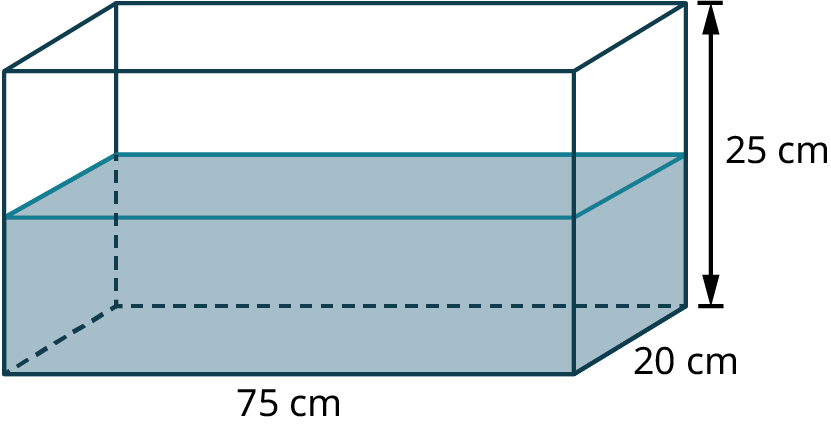
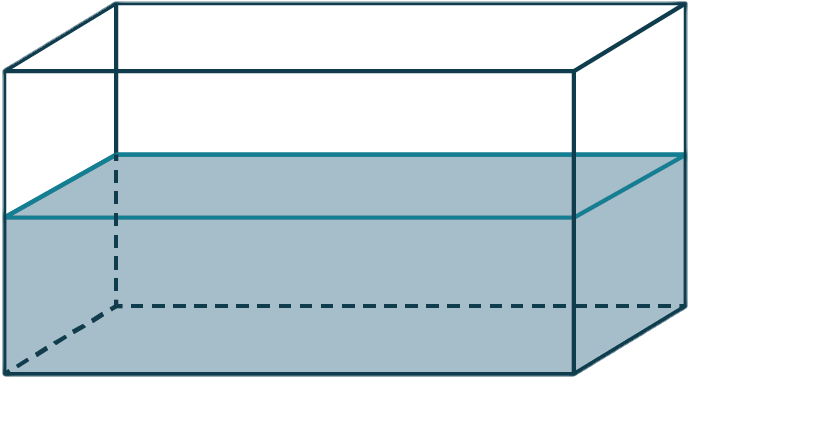
Answer
Step 1: Find the volume of the tank.
Step 2: Convert the volume into liters.
Step 3: You only want half a tank of water, so divide the volume by two.
You need 18.75 liters of water.
18.75 LCheck Your Understanding 9.3.16 §9.3 source ↗
For the following exercises, determine the most reasonable value for each volume.
Terrarium: 50,000 km3, 50,000 m3, 50,000 cm3, or 50,000 mm3Answer
Check Your Understanding 9.3.17 §9.3 source ↗
For the following exercises, determine the most reasonable value for each volume.
Milk carton: 236,000 L, 236 L, 236,000 mL, or 236 mLAnswer
Check Your Understanding 9.3.18 §9.3 source ↗
For the following exercises, determine the most reasonable value for each volume.
Box of crackers: 1,500 km3, 1,500 m3, 1,500 cm3, or 1,500 mm3Answer
Check Your Understanding 9.3.19 §9.3 source ↗
For the following exercises, Convert the given volume to the units shown.
42,500 mm3 = __________ cm3Answer
Check Your Understanding 9.3.20 §9.3 source ↗
For the following exercises, Convert the given volume to the units shown.
1.5 dm3 = __________ mLAnswer
Note: You often have more than one conversion from which to choose. You might have chosen to convert one cubic decimeter conversion to one liter, and then convert liters to milliliters.
Check Your Understanding 9.3.21 §9.3 source ↗
For the following exercises, Convert the given volume to the units shown.
6.75 cm3 = __________ mm3Answer
Check Your Understanding 9.3.22 §9.3 source ↗
For the following exercises, determine the volume of objects with the dimensions shown.
________ L
Answer
Step 1: Convert 20 meters to centimeters.
Step 2: Find the volume of a box.
Step 3: Convert the volume of a box into liters.
Check Your Understanding 9.3.23 §9.3 source ↗
For the following exercises, determine the volume of objects with the dimensions shown.
________ mL
Answer
Step 1: Convert all the units to centimeters.
Step 2: Find the volume of a box.
Step 3: Convert the volume of a box into milliliters.
10.2
Check Your Understanding 9.3.24 §9.3 source ↗
For the following exercises, determine the volume of objects with the dimensions shown.
________ m3
Answer
Step 1: Find the volume of a box.
Your Turn 9.31 §9.4 source ↗
2.5 g or 2.5 kg
Answer
Your Turn 9.32 §9.4 source ↗
1,300 g, 130 kg, or 1,300 kg?
Answer
Your Turn 9.33 §9.4 source ↗
Answer
Your Turn 9.34 §9.4 source ↗
Answer
| Prefix | kilo- | hecto- | deca- | base | deci- | centi- | milli- |
| Abbreviation | k | h | da | d | c | m | |
| Magnitude | 103 | 102 | 101 | 1 | 10−1 | 10−2 | 10−3 |
0.175 kg
Your Turn 9.35 §9.4 source ↗
Answer
| Prefix | kilo- | hecto- | deca- | base | deci- | centi- | milli- |
| Abbreviation | k | h | da | d | c | m | |
| Magnitude | 103 | 102 | 101 | 1 | 10−1 | 10−2 | 10−3 |
4,869 g
Your Turn 9.36 §9.4 source ↗
Answer
| Prefix | kilo- | hecto- | deca- | base | deci- | centi- | milli- |
| Abbreviation | k | h | da | d | c | m | |
| Magnitude | 103 | 102 | 101 | 1 | 10−1 | 10−2 | 10−3 |
1,230,000 mg
Your Turn 9.37 §9.4 source ↗
| Weight | Dosage |
|---|---|
| 11 kg to 15 kg | 5 mL |
| 16 kg to 21 kg | 7.5 mL |
| 22 kg to 27 kg | 10 mL |
Answer
| Prefix | kilo- | hecto- | deca- | base | deci- | centi- | milli- |
| Abbreviation | k | h | da | d | c | m | |
| Magnitude | 103 | 102 | 101 | 1 | 10−1 | 10−2 | 10−3 |
Step 1: Convert the grams to kilograms.
Step 2: Use the chart to identify the dosage.
The child fits within the 16 to 21 kg range.
The correct dosage is 7.5 mL.
Your Turn 9.38 §9.4 source ↗
Answer
| Prefix | kilo- | hecto- | deca- | base | deci- | centi- | milli- |
| Abbreviation | k | h | da | d | c | m | |
| Magnitude | 103 | 102 | 101 | 1 | 10−1 | 10−2 | 10−3 |
Step 1: Convert the grams to kilograms.
Step 2: Multiply by 10 to find the amount of flour needed.
Five kilograms of flour are needed to make 10 batches of croissants.
5 kgYour Turn 9.39 §9.4 source ↗
Answer
| Prefix | kilo- | hecto- | deca- | base | deci- | centi- | milli- |
| Abbreviation | k | h | da | d | c | m | |
| Magnitude | 103 | 102 | 101 | 1 | 10−1 | 10−2 | 10−3 |
Step 1: Convert 225 grams to kilograms to find the weight of one potato in kilograms.
Step 2: Use equivalences to create conversion factors. Writing the units helps you understand.
111,111 potatoes
Check Your Understanding 9.4.25 §9.4 source ↗
For the following exercises, determine the most reasonable value for each weight.
Candy bar:50 kg, 50 g, or 50 mg
Answer
Check Your Understanding 9.4.26 §9.4 source ↗
For the following exercises, determine the most reasonable value for each weight.
Lion:180 kg, 180 g, or 180 mg
Answer
Check Your Understanding 9.4.27 §9.4 source ↗
For the following exercises, determine the most reasonable value for each weight.
Basketball:624 kg, 624 g, or 624 mg
Answer
Check Your Understanding 9.4.28 §9.4 source ↗
For the following exercises, convert the given weight to the units shown.
8,900 g = __________ kgAnswer
| Prefix | kilo- | hecto- | deca- | base | deci- | centi- | milli- |
| Abbreviation | k | h | da | d | c | m | |
| Magnitude | 103 | 102 | 101 | 1 | 10−1 | 10−2 | 10−3 |
8.9
Check Your Understanding 9.4.29 §9.4 source ↗
For the following exercises, convert the given weight to the units shown.
17 g = __________ mgAnswer
| Prefix | kilo- | hecto- | deca- | base | deci- | centi- | milli- |
| Abbreviation | k | h | da | d | c | m | |
| Magnitude | 103 | 102 | 101 | 1 | 10−1 | 10−2 | 10−3 |
17,000
Check Your Understanding 9.4.30 §9.4 source ↗
For the following exercises, convert the given weight to the units shown.
0.07 kg = __________ gAnswer
| Prefix | kilo- | hecto- | deca- | base | deci- | centi- | milli- |
| Abbreviation | k | h | da | d | c | m | |
| Magnitude | 103 | 102 | 101 | 1 | 10−1 | 10−2 | 10−3 |
70
Check Your Understanding 9.4.31 §9.4 source ↗
For the following exercises, determine the total weight in the units shown.
three 48 g granola bars ________ kgAnswer
| Prefix | kilo- | hecto- | deca- | base | deci- | centi- | milli- |
| Abbreviation | k | h | da | d | c | m | |
| Magnitude | 103 | 102 | 101 | 1 | 10−1 | 10−2 | 10−3 |
Step 1: Convert the grams to kilograms.
Step 2: Multiply by 3.
0.144
Check Your Understanding 9.4.32 §9.4 source ↗
For the following exercises, determine the total weight in the units shown.
seven 28 g cheese slices ________ mgAnswer
| Prefix | kilo- | hecto- | deca- | base | deci- | centi- | milli- |
| Abbreviation | k | h | da | d | c | m | |
| Magnitude | 103 | 102 | 101 | 1 | 10−1 | 10−2 | 10−3 |
Step 1: Convert the grams to milligrams.
Step 2: Multiply by 7.
196,000
Check Your Understanding 9.4.33 §9.4 source ↗
For the following exercises, determine the total weight in the units shown.
six 15 mg tea bags ________ gAnswer
| Prefix | kilo- | hecto- | deca- | base | deci- | centi- | milli- |
| Abbreviation | k | h | da | d | c | m | |
| Magnitude | 103 | 102 | 101 | 1 | 10−1 | 10−2 | 10−3 |
Step 1: Convert the milligrams to grams.
Step 2: Multiply by 6.
0.09
Your Turn 9.40 §9.5 source ↗
Answer
250 °C
Your Turn 9.41 §9.5 source ↗
Answer
167 °F
Your Turn 9.42 §9.5 source ↗
Answer
Step 1: Convert Toronto’s Fahrenheit temperature to Celsius.
Approximately
Step 2: Subtract the two temperatures.
Madrid has the higher temperature by approximately .
Since Toronto has a temperature of 14.1 °C, Madrid has the higher temperature by 2.6 °C.Your Turn 9.43 §9.5 source ↗
• 48 °C or
• 148 °C?
Answer
Your Turn 9.44 §9.5 source ↗
• 102 °C,
• 37 °C, or
• 20 °C?
Answer
Your Turn 9.45 §9.5 source ↗
• 240 °C,
• 60 °C, or
• 6 °C?
Answer
Your Turn 9.46 §9.5 source ↗
Answer
A fall in the temperature means it is lower. Subtract 6° from 4°C.
The temperature at 6 AM was −2°C.
–2 °CYour Turn 9.47 §9.5 source ↗
Answer
An increase in the temperature means it is higher. Add 59° to 4°C.
The temperature of the cooked hot dog was 63°C.
63 °CYour Turn 9.48 §9.5 source ↗
Answer
Step 1: Convert the Fahrenheit temperature to Celsius.
Step 2: Find the temperature difference between and .
Step 3: Use the fact that the temperature decreases every 6 minutes.
It will take 180 minutes for the temperature to decrease the required amount.
Note: You could also have expressed your answer as three hours.
180 minutes, or 1 hour and 30 minutesCheck Your Understanding 9.5.34 §9.5 source ↗
For the following exercises, determine the most reasonable value for each temperature.
Popsicle:28.5 °C or
28.5 °F
Answer
Check Your Understanding 9.5.35 §9.5 source ↗
For the following exercises, determine the most reasonable value for each temperature.
Room temperature:20 °F or
20 °C
Answer
Check Your Understanding 9.5.36 §9.5 source ↗
For the following exercises, determine the most reasonable value for each temperature.
Hot coffee:71.1 °C or
71.1 °F
Answer
Check Your Understanding 9.5.37 §9.5 source ↗
For the following exercises, use mental math to approximate the temperature.
450 °F = __________ °CAnswer
210
Check Your Understanding 9.5.38 §9.5 source ↗
For the following exercises, use mental math to approximate the temperature.
35 °C = __________ °FAnswer
100
Check Your Understanding 9.5.39 §9.5 source ↗
For the following exercises, use mental math to approximate the temperature.
100 °F = __________ °CAnswer
35
Check Your Understanding 9.5.40 §9.5 source ↗
For the following exercises, convert the temperatures to the nearest degree.
225 °F = __________ °CAnswer
107
Check Your Understanding 9.5.41 §9.5 source ↗
For the following exercises, convert the temperatures to the nearest degree.
27 °C = __________ °FAnswer
81
Check Your Understanding 9.5.42 §9.5 source ↗
For the following exercises, convert the temperatures to the nearest degree.
750 °F = __________ °CAnswer
399
Loading chapter 10…
Problems and answers are adapted from Contemporary Mathematics by Donna Kirk, OpenStax, and are used under the CC BY-NC-SA 4.0 licence. Access for free at https://openstax.org/books/contemporary-mathematics/pages/1-introduction. Illustrations: Copyright Rice University, OpenStax, under CC BY-NC-SA 4.0 license. This adaptation is released under the same licence, is non-commercial, and is neither affiliated with nor endorsed by OpenStax or Rice University.