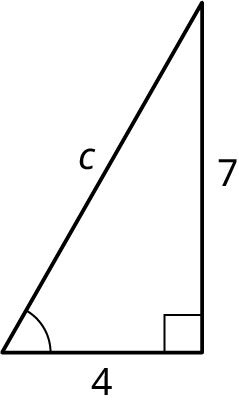
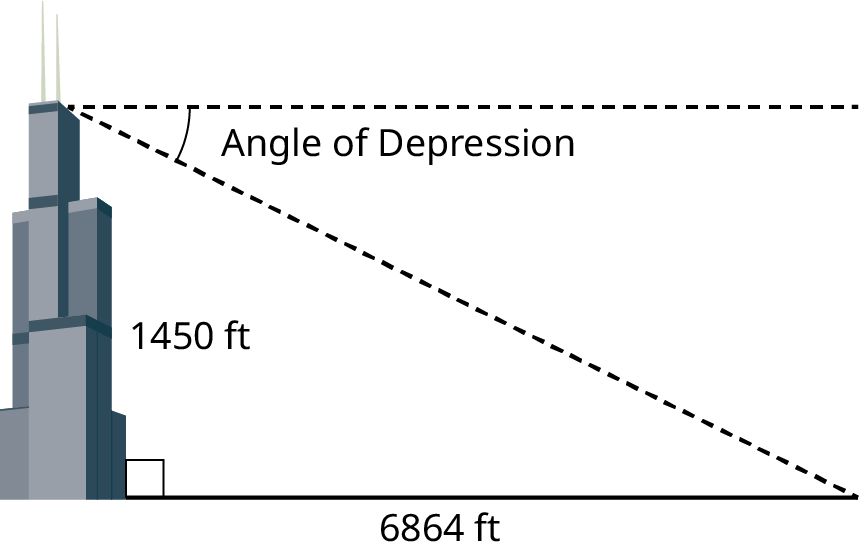
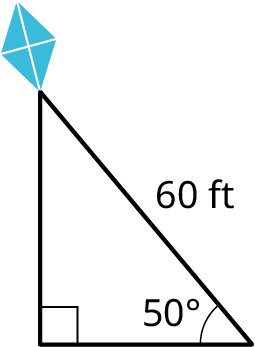
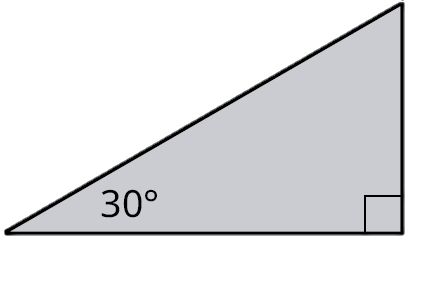
Every problem in the chapter beside the book’s answer, a chapter at a time as you scroll.

Chapter 10: Geometry

140 problems · 122 figures

Your Turn 10.1 §10.1 source ↗

For the following exercises, use this line.
A line with four points, A, B, C, and D marked on it. Define B D →

Answer

The letters BD, with an arrow pointing from B towards D, represent a ray that starts at B and extends infinitely in the direction of point D. B D → is the ray that starts at point B and extends infinitely in the direction of point D .

Your Turn 10.1 (b) §10.1 source ↗

For the following exercises, use this line.
A line with four points, A, B, C, and D marked on it. Define A B ¯

Answer

The letters AB, with a straight line above, represent a line segment that starts at point A and ends at point B. A B ¯ represents the line segment that starts at point A and ends at point B .

Your Turn 10.1 (c) §10.1 source ↗

For the following exercises, use this line.
A line with four points, A, B, C, and D marked on it. B A ←

Answer

The letters BA, with an arrow pointing from A towards B, represent a ray that starts at A and extends infinitely in the direction of point B. B A ← represents the ray that starts at point A and extends infinitely in the direction of point B .

Your Turn 10.1 (d) §10.1 source ↗

For the following exercises, use this line.
A line with four points, A, B, C, and D marked on it. A D ↔

Answer

The letters AD, with a double arrow above, represent a line that contains the points A and D. The line extends infinitely in both directions. A D ↔ represents a line that contains the points A and D . Notice the arrowheads on both ends of the line above A D , which means that the line continues infinitely in both directions.

Your Turn 10.2 §10.1 source ↗

Using the street map in Figure 10.6, find two ways you would stop at the dry cleaners and the grocery store after school on your way home.
Figure 10.6 in the book ↗
Street Map

Answer

Answers will vary. One way A E ¯ , E I ¯ , I E ¯ , E B ¯ , B C ¯ , C D ¯ , D G ¯ ; Second way A H ¯ , H I ¯ , I E ¯ , E B ¯ , B C ¯ , C F ¯ , F G ¯ .

Your Turn 10.3 §10.1 source ↗

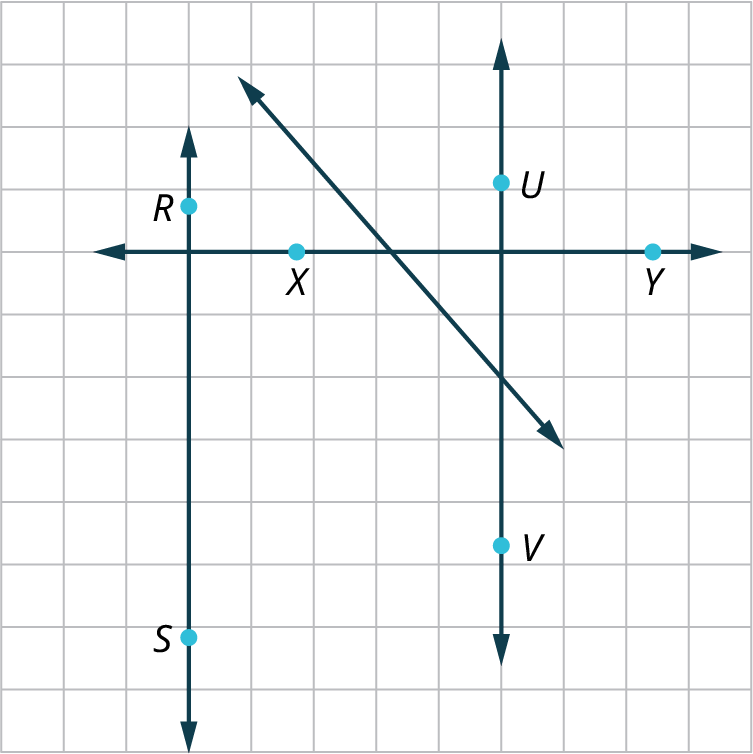
Identify the sets of parallel and perpendicular lines in the given figure.
Four lines are graphed on a square grid. The lines, R S and U V are vertical and parallel. The lines, R S and X Y are perpendicular. The lines, U V and X Y are perpendicular. A decreasing line intersects X Y and U V at two different points.

Answer

R S ↔ ∥ U V ↔
R S ↔ ⊥ X Y ↔
U V ↔ ⊥ X Y ↔

Your Turn 10.4 §10.1 source ↗

For the following exercises, use the line shown to identify and draw the union or intersection of sets.
A line with three points, A, B, and C marked on it. A B ¯ ∩ B C ¯

Answer

You are looking for the intersection of line segment A B ¯ and line segment B C ¯ .

Sketch the two line segments separately above the line.

Intersection includes only the elements that are common to both drawings.

For this intersection, only point B is in common.

A B ¯ ∩ B C ¯ = B

A B ¯ ∩ B C ¯ = B

Your Turn 10.4 (b) §10.1 source ↗

For the following exercises, use the line shown to identify and draw the union or intersection of sets.
A line with three points, A, B, and C marked on it. B C → ∪ C A ←

Answer

You are looking for the union of ray B C → and the ray C A ← .

Be careful. They listed the points of the second ray looking backwards!

Sketch the two rays separately above the line.

Union includes all the elements that are in either drawing.

For this union, the rays cover the entire line.

B C → ∪ C A ← = A C ↔

B C → ∪ C A ← = A C ↔

Your Turn 10.4 (c) §10.1 source ↗

For the following exercises, use the line shown to identify and draw the union or intersection of sets.
A line with three points, A, B, and C marked on it. B C ¯ ∩ A C ¯

Answer

You are looking for the intersection of line segment B C ¯ and line segment A C ¯ .

Sketch the two line segments separately above the line.

Intersection includes only the elements that are common to both drawings.

For this intersection, they have the line segment B C ¯ in common.

B C ¯ ∩ A C ¯ = B C ¯

B C ¯ ∩ A C ¯ = B C ¯

Your Turn 10.5 §10.1 source ↗

For the following exercises, refer to the given figure.
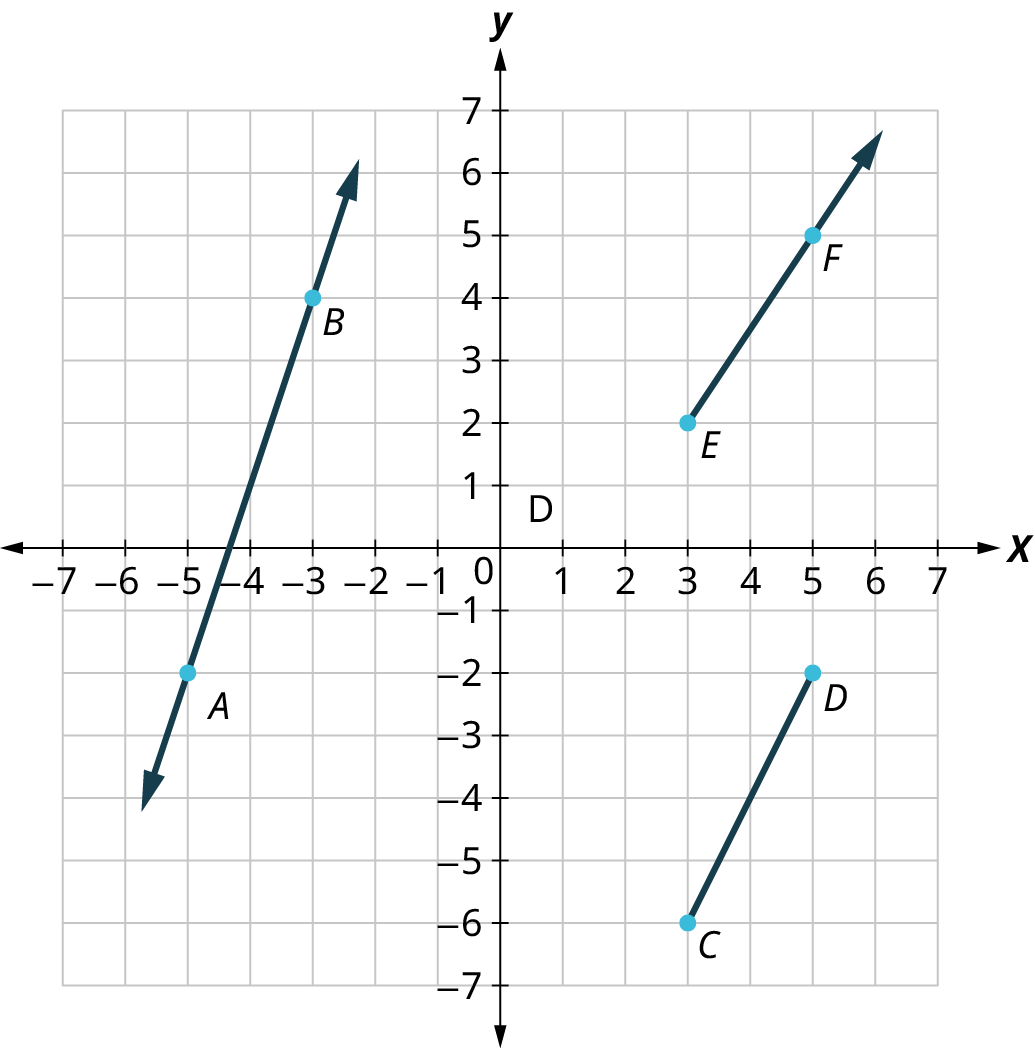
A line, a ray, and a line segment are graphed on an x y coordinate plane. The x and y axes range from negative 7 to 7, in increments of 1. The line segment, C D begins at C (3, negative 6) and D (5, negative 2). The ray, EF passes through the points, E (3, 2) and F (5, 5). The line, A B passes through the points, A (negative 5, negative 2) and B (negative 3, 4). Identify the location of points A , B , C , D , E , and F .

Answer

Point A is located at ( − 5 , − 2 ) ; Point B is located at ( − 3 , 4 ) ; Point C is located at ( 3 , − 6 ) ; Point D is located at ( 5 , − 2 ) ; Point E is located at ( 3 , 2 ) ; Point F is located at ( 5 , 5 ) .

Your Turn 10.5 (b) §10.1 source ↗

For the following exercises, refer to the given figure.
A line, a ray, and a line segment are graphed on an x y coordinate plane. The x and y axes range from negative 7 to 7, in increments of 1. The line segment, C D begins at C (3, negative 6) and D (5, negative 2). The ray, EF passes through the points, E (3, 2) and F (5, 5). The line, A B passes through the points, A (negative 5, negative 2) and B (negative 3, 4). Describe the line that includes point A and point B .

Answer

Points A and B are on the straight line A B ↔ .

Your Turn 10.5 (c) §10.1 source ↗

For the following exercises, refer to the given figure.
A line, a ray, and a line segment are graphed on an x y coordinate plane. The x and y axes range from negative 7 to 7, in increments of 1. The line segment, C D begins at C (3, negative 6) and D (5, negative 2). The ray, EF passes through the points, E (3, 2) and F (5, 5). The line, A B passes through the points, A (negative 5, negative 2) and B (negative 3, 4). Describe the line from E to point F .

Answer

The line that begins at point E in the direction of point F is a ray, E F → .

Your Turn 10.5 (d) §10.1 source ↗

For the following exercises, refer to the given figure.
A line, a ray, and a line segment are graphed on an x y coordinate plane. The x and y axes range from negative 7 to 7, in increments of 1. The line segment, C D begins at C (3, negative 6) and D (5, negative 2). The ray, EF passes through the points, E (3, 2) and F (5, 5). The line, A B passes through the points, A (negative 5, negative 2) and B (negative 3, 4). Describe the line from C to point D .

Answer

The line from point C to point D is a line segment C D ¯ .

Your Turn 10.5 (e) §10.1 source ↗

For the following exercises, refer to the given figure.
A line, a ray, and a line segment are graphed on an x y coordinate plane. The x and y axes range from negative 7 to 7, in increments of 1. The line segment, C D begins at C (3, negative 6) and D (5, negative 2). The ray, EF passes through the points, E (3, 2) and F (5, 5). The line, A B passes through the points, A (negative 5, negative 2) and B (negative 3, 4). Does this figure represent a plane?

Answer

Yes, this represents a plane. One reason is that the figure contains four points that are not on the line A B ↔ .

Your Turn 10.6 §10.1 source ↗

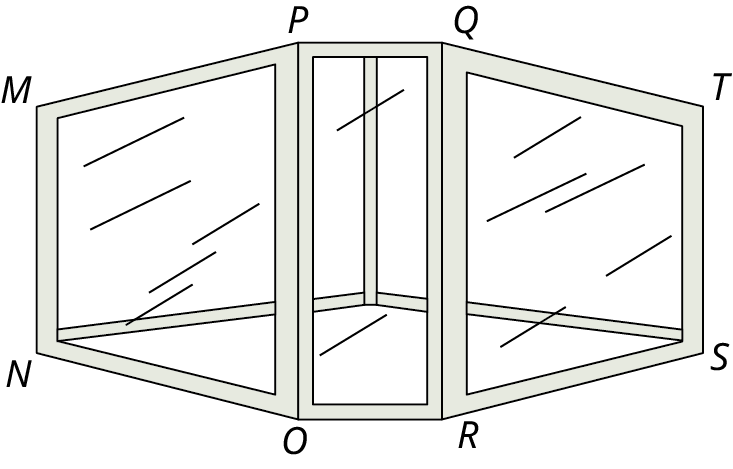
Name two pairs of intersecting planes on the shower enclosure shown.
An illustration shows three planes, M N O P, O P Q R, and Q R S T. The planes are placed next to each other.

Answer

Plane M N O P intersects with plane O P Q R , and plane O P Q R intersects with plane Q R S T .

Check Your Understanding 10.1.1 §10.1 source ↗

Use the graph for the following exercises.
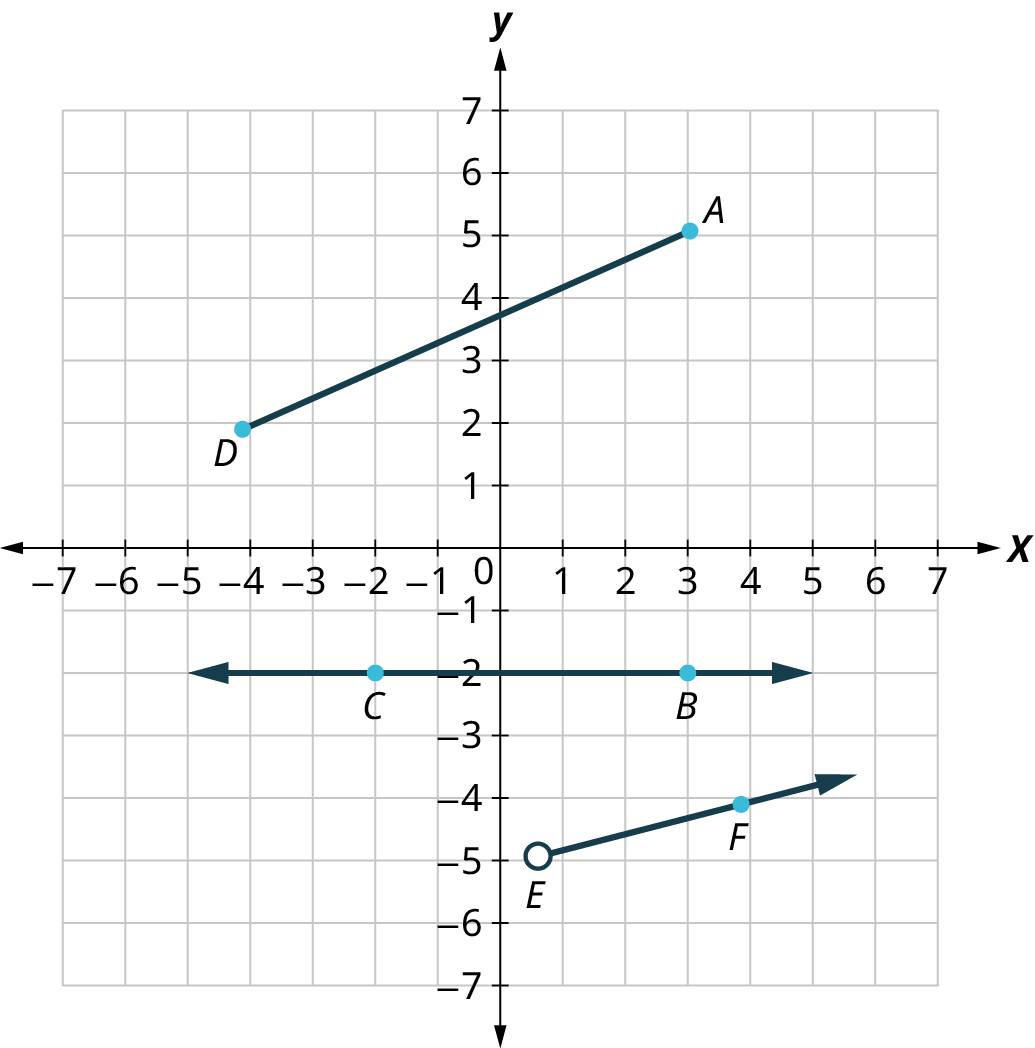
A line, a ray, and a line segment are graphed on an x y coordinate plane. The x and y axes range from negative 6 to 6, in increments of 1. The line segment, A D begins at A (3, 5) and D (negative 4, 2). The ray, EF passes through the points, E (0.5, negative 5) and F (4, negative 4). The line, C B passes through the points, C (negative 2, negative 2) and B (3, negative 2).

Identify the type of line containing point D and point A .

Answer

The line containing point D and point A is a line segment from point D to point A , D A ¯ , or from point A to point D , A D ¯ .

Check Your Understanding 10.1.2 §10.1 source ↗

Use the graph for the following exercises.
A line, a ray, and a line segment are graphed on an x y coordinate plane. The x and y axes range from negative 6 to 6, in increments of 1. The line segment, A D begins at A (3, 5) and D (negative 4, 2). The ray, EF passes through the points, E (0.5, negative 5) and F (4, negative 4). The line, C B passes through the points, C (negative 2, negative 2) and B (3, negative 2).

Identify the type of line containing points C and B .

Answer

The line containing points C and B is C B ↔ , or you could label it B C ↔ . The line containing points C and B is a straight line that extends infinitely in both directions and contains points C and B .

Check Your Understanding 10.1.3 §10.1 source ↗

Use the graph for the following exercises.
A line, a ray, and a line segment are graphed on an x y coordinate plane. The x and y axes range from negative 6 to 6, in increments of 1. The line segment, A D begins at A (3, 5) and D (negative 4, 2). The ray, EF passes through the points, E (0.5, negative 5) and F (4, negative 4). The line, C B passes through the points, C (negative 2, negative 2) and B (3, negative 2).

Identify the type of line that references point E and contains point F .

Answer

This is a ray that begins at point E , although it does not contain point E , and extends in the direction of point F .

Check Your Understanding 10.1.4 §10.1 source ↗

Use the line for the following exercises.

A line with four points, A, B, C, and D marked on it.

Determine A B ¯ ∪ B D ¯ .

Answer

You are looking for the union of line segment A B ¯ and line segment B D ¯ .

Sketch the two parts separately above the line.

Union includes all the elements that are in both drawings.

The union is the line segment A D ¯ .

A B ¯ ∪ B D ¯ = A D ¯

A B ¯ ∪ B D ¯ = A D ¯ . The union of line segment A B ¯ and the line segment B D ¯ contains all points in each line segment combined.

Check Your Understanding 10.1.5 §10.1 source ↗

Use the line for the following exercises.

A line with four points, A, B, C, and D marked on it.

Determine B D ← ∩ B C ¯ .

Answer

You are looking for the intersection of ray B D ← and line segment B C ¯ .

Sketch the two parts separately above the line.

Intersection includes only the elements that are common to both drawings.

The intersection includes only line segment B C ¯ .

B D ← ∩ B C ¯ = B C ¯

B D → ∩ B C ¯ = B C ¯ . The intersection of the ray B D → and the line segment B C ¯ contains only the points common to each set, B C ¯ .

Check Your Understanding 10.1.6 §10.1 source ↗

Use the line for the following exercises.

A line with four points, A, B, C, and D marked on it.

Determine B A ← ∪ B D → .

Answer

B A → ∪ B D → = A D ↔ . The union of the ray starting at point B and extending infinitely in the direction of A and the ray starting at point B and extending infinitely in the direction of D is the straight line extending infinitely in both directions containing points A , B , C , and D .

Check Your Understanding 10.1.7 §10.1 source ↗

How can you determine whether two lines are parallel?

Answer

Two lines are parallel if the distance between the lines is constant implying that the lines cannot intersect.

Check Your Understanding 10.1.8 §10.1 source ↗

How can you determine whether two lines are perpendicular?

Answer

Perpendicular lines intersect forming a 90 ∘ angle between them.

Check Your Understanding 10.1.9 §10.1 source ↗
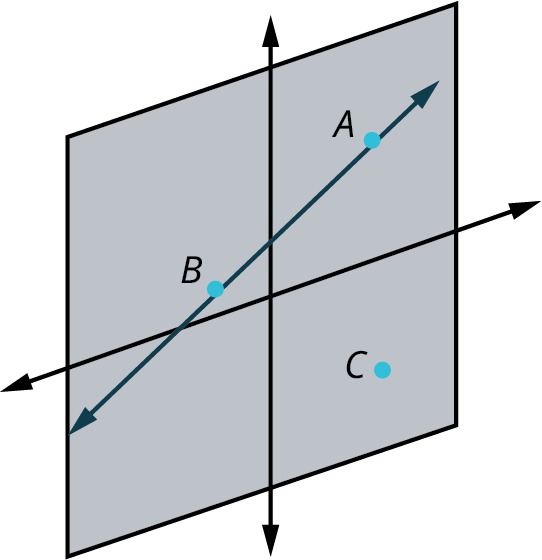
Determine if the illustration represents a plane.
A plane with a horizontal axis and a vertical axis. Two points, A and B lie on a line. A point, C is out of the line.

Answer

Yes, because it contains a line and a point not on the line.

Your Turn 10.7 §10.2 source ↗

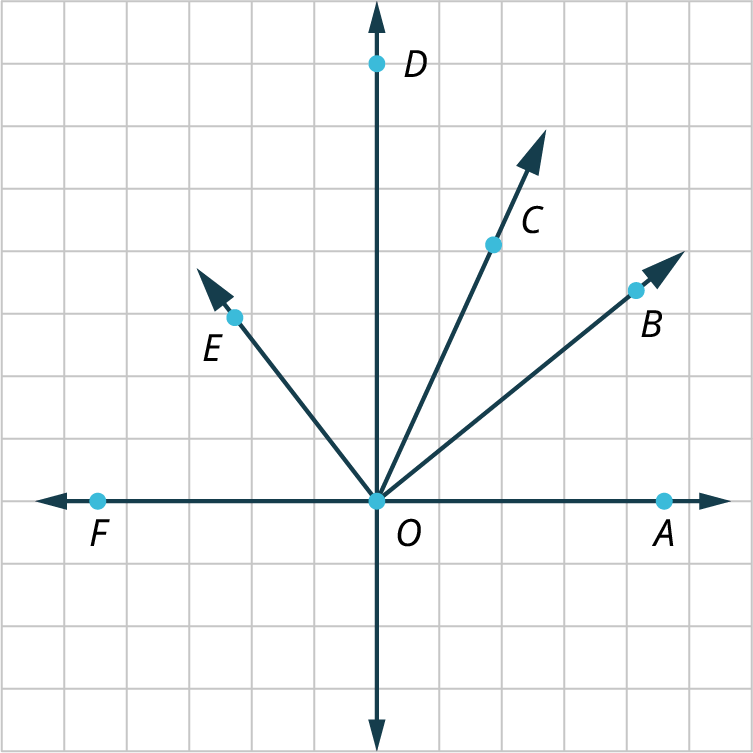
Determine which angles are acute, obtuse, right, and straight in the graph.
Seven rays are graphed on a squared grid. All the rays originate from the same point, O. The rays, O F and O A are horizontal. The ray, O D is vertical. The ray, O E makes an acute angle with O F. The ray, O E makes an acute angle with O D. The ray, O C makes an acute angle with O D. The ray, O B makes an acute angle with O C. The rays, O B, and O A make an acute angle. The seventh ray is perpendicular to O F and O A.

Answer

Acute angles have a measure between 0° and 90°, not including 90°.

Acute angles: ∠AOB, ∠AOC, ∠BOC, ∠BOD, ∠COD, ∠DOE, ∠FOE

Obtuse angles have a measure between 90° and 180°, not inclusively.

Obtuse angles: ∠AOE, ∠BOF, ∠COF

Right angles measure exactly 90°.

Right angles: ∠AOD, ∠BOE, ∠DOF

Straight angles measure exactly 180°.

Straight angles: ∠AOF

Acute Angles Obtuse Angles Right Angles Straight Angles
∠ A O B
∠ A O C
∠ B O C
∠ B O D
∠ C O D
∠ D O E
∠ F O E
∠ A O E
∠ B O F
∠ C O F
∠ A O D
∠ B O E
∠ D O F
∠ A O F

Your Turn 10.8 §10.2 source ↗

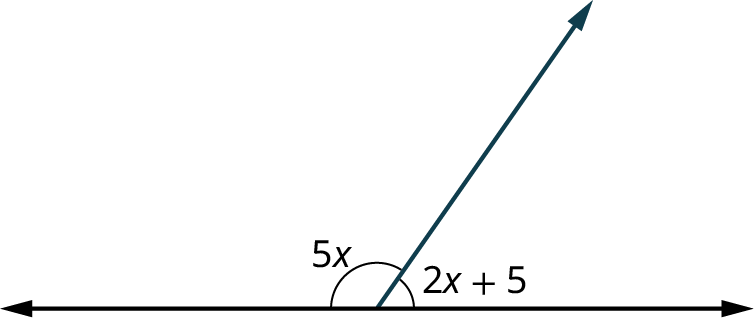
Solve for the angle measurements in the figure shown.
A horizontal line with a ray originating from its center. The line makes an acute angle, 2 x plus 5 with the ray, and an obtuse angle, 5 x with the ray.

Answer

Straight angles measure exactly 180°.

5 x + 2 x + 5 = 180

7 x = 175

x = 25 ∘

2 x + 5 = 2 ( 25 ) + 5 = 50 + 5 = 55 ∘

5 x = 5 ( 25 ) = 125 ∘

The angles measure 125° and 55°.

5 x = 125 ∘ 2 x + 5 = 55 ∘

Your Turn 10.9 §10.2 source ↗

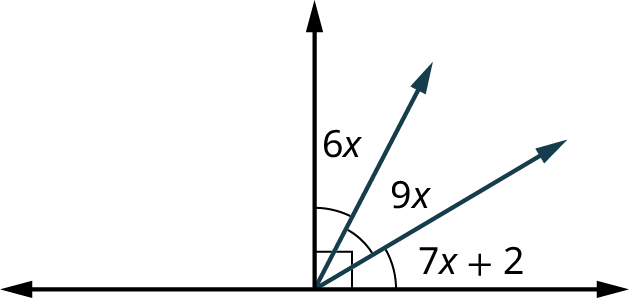
Find the measure of each angle in the illustration.
Two lines intersect each other forming a right angle. A ray makes an acute angle, 7 x plus 2 with the horizontal line. Another ray originating from the intersection point of the lines makes an acute angle, 6 x with the vertical line. An acute angle of 9 x is formed by these two rays.

Answer

Right angles measure exactly 90°.

6 x + 9 x + 7 x + 2 = 90

22 x = 88

x = 4

6 x = 6 ( 4 ) = 24 ∘

9 x = ( 4 ) = 36 ∘

7 x + 2 = 7 ( 4 ) + 2 = 28 + 2 = 30 ∘

The angles measure 24°, 36°, and 30°.

m ∡ ( 6 x ) = 24 ∘ , m ∡ ( 9 x ) = 36 ∘ , m ∡ ( 7 x + 2 ) = 30 ∘

Your Turn 10.10 §10.2 source ↗

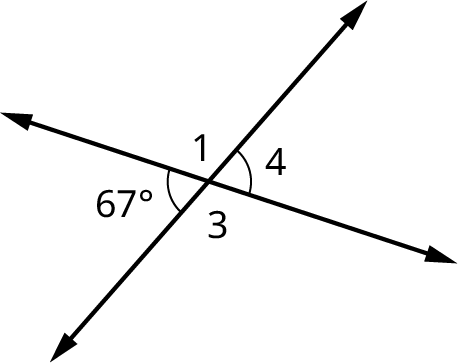
Given the two intersecting lines in the figure shown and m ∡ 2 = 67 ∘ , find the measure of the remaining angles. Two lines intersect each other. One set of opposite angles is labeled 1 and 3. The other set of opposite angles is labeled 4 and 67 degrees.

Answer

Vertical angles have equal measures. The measure of angle 4 is 67°.

Angles 3 and 4 are supplementary, so sum of the measures is180°.

The measure of angle 3 = 180° – 67° = 113°

Since vertical angles have equal measures, angles 3 and 1 have the same measure.

m∡3 = m∡1 = 113°

m∡4 = 67°

m ∡ 4 = 67 ∘ , m ∡ 1 = 113 ∘ , m ∡ 3 = 113 ∘

Your Turn 10.11 §10.2 source ↗

Suppose you have a similar property to the one in Figure 10.53, but the angle that corresponds to the garden corner is 50 ∘ . What is the measure between the two cross streets?
Figure 10.53 in the book ↗

Answer

The two angles form a straight angle. To find the supplementary angle, subtract it from 180.

180 − 50 = 130

The angle measures 130°.

130 ∘

Your Turn 10.12 §10.2 source ↗

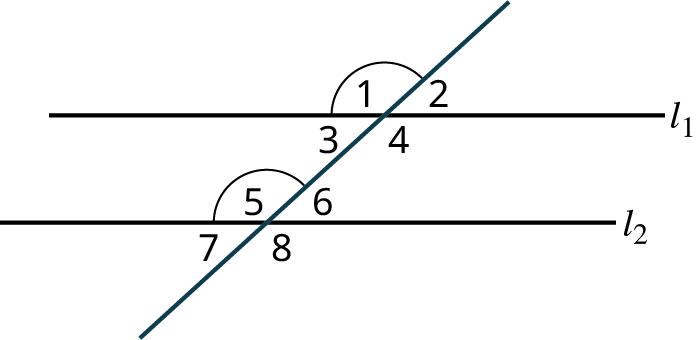
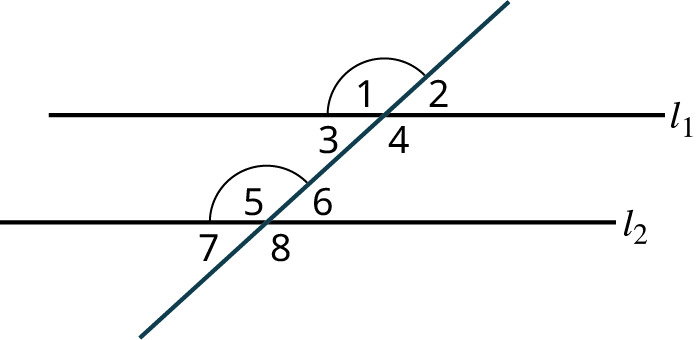
In the given figure if m ∡ 1 = 120 ∘ , find the m ∡ 5 , m ∡ 4 , and m ∡ 8 .
Two parallel lines, l subscript 1 and l subscript 2 are intersected by a transversal. The transversal makes four angles numbered 1, 2, 3, and 4 with the line, l subscript 1. The transversal makes four angles numbered 5, 6, 7, and 8 with the line, l subscript 2. 1, 2, 7, and 8 are exterior angles. 3, 4, 5, and 6 are interior angles. The corresponding angles, 1 and 5 are highlighted.

Answer

Angle 1 and angle 5 are corresponding. Corresponding angles have equal measures.

m∡5 = 120°

Angle 1 and angle 4 are vertical angles. Vertical angles have equal measures.

m∡4 = 120°

Angle 5 and angle 8 are vertical angles. Vertical angles have equal measures.

m∡8 = 120°

m ∡ 5 = 120 ∘ , m ∡ 4 = 120 ∘ , m ∡ 8 = 120 ∘

Your Turn 10.13 §10.2 source ↗

In the provided figure given that the m ∡ 2 = 48 ∘ , find m ∡ 1 , and m ∡ 5.
Two parallel lines, l subscript 1 and l subscript 2 are intersected by a transversal. The transversal makes four angles numbered 1, 2, 3, and 4 with the line, l subscript 1. The transversal makes four angles numbered 5, 6, 7, and 8 with the line, l subscript 2. 1, 2, 7, and 8 are exterior angles. 3, 4, 5, and 6 are interior angles. The corresponding angles, 1 and 5 are highlighted.

Answer

Angle 1 and angle 2 are supplementary. The sum of the measures of supplementary angles is 180°

180° – 48° = 132°

m∡1 = 132°

Angle 1 and angle 5 are corresponding. Corresponding angles have equal measures.

m∡5 = 132°

m ∡ 1 = 132 ∘ , m ∡ 5 = 132 ∘

Your Turn 10.14 §10.2 source ↗

Using Figure 10.58, find the measures of angles 5, 6, 7, 8, and 9.
Figure 10.58 in the book ↗

Answer

m ∡ 5 = 56 ∘
m ∡ 6 = 62 ∘
m ∡ 7 = 118 ∘
m ∡ 8 = 62 ∘
m ∡ 9 = 118 ∘

Check Your Understanding 10.2.10 §10.2 source ↗

Classify the following angles as acute, right, obtuse, or straight.

m ∡ = 180 ∘

Answer

Straight angles measure exactly 180°.

This is a straight angle.

straight

Check Your Understanding 10.2.11 §10.2 source ↗

Classify the following angles as acute, right, obtuse, or straight.

m ∡ = 176 ∘

Answer

Obtuse angles have a measure between 90° and 180°, not inclusively.

This angle is obtuse.

obtuse

Check Your Understanding 10.2.12 §10.2 source ↗

Classify the following angles as acute, right, obtuse, or straight.

m ∡ = 90 ∘

Answer

Right angles measure exactly 90°.

This angle is a right angle.

right

Check Your Understanding 10.2.13 §10.2 source ↗

Classify the following angles as acute, right, obtuse, or straight.

m ∡ = 37 ∘

Answer

Acute angles have a measure between 0° and 90°, not including 90°.

This angle is acute.

acute

Check Your Understanding 10.2.14 §10.2 source ↗

For the following exercises, determine the measure of the angles in the given figure.
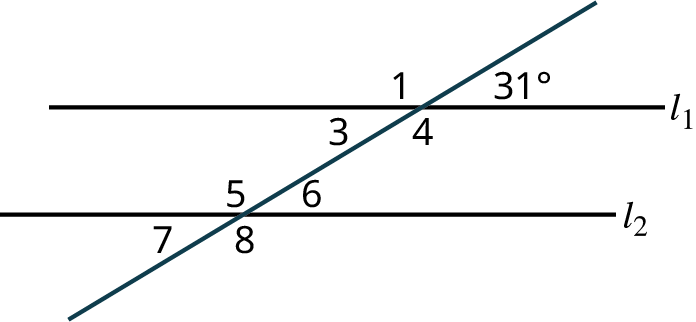
Two parallel lines, l subscript 1 and l subscript 2 are intersected by a transversal. The transversal makes four angles labeled 1, 31 degrees, 3, and 4 with the line, l subscript 1. The transversal makes four angles numbered 5, 6, 7, and 8 with the line, l subscript 2. 1, 31 degrees, 7, and 8 are exterior angles. 3, 4, 5, and 6 are interior angles.

Find the measure of ∡ 1 and state the reason for your solution.

Answer

Angle 1 and the 31° angle are supplementary, so their measures add up to 180°.

m∡1 = 180° – 31° = 149°

m ∡ 1 = 149 ∘ by supplementary angles with ∡ 31 ∘ .

Check Your Understanding 10.2.15 §10.2 source ↗

For the following exercises, determine the measure of the angles in the given figure.
Two parallel lines, l subscript 1 and l subscript 2 are intersected by a transversal. The transversal makes four angles labeled 1, 31 degrees, 3, and 4 with the line, l subscript 1. The transversal makes four angles numbered 5, 6, 7, and 8 with the line, l subscript 2. 1, 31 degrees, 7, and 8 are exterior angles. 3, 4, 5, and 6 are interior angles.

Find the measure of ∡ 3 and state the reason for your solution.

Answer

Angle 3 and the 31° angle are vertical angles. Vertical angles have equal measures.

m∡3 = 31°

m ∡ 3 = 31 ∘ by vertical angles with the angle measuring 31 ∘ .

Check Your Understanding 10.2.16 §10.2 source ↗

For the following exercises, determine the measure of the angles in the given figure.
Two parallel lines, l subscript 1 and l subscript 2 are intersected by a transversal. The transversal makes four angles labeled 1, 31 degrees, 3, and 4 with the line, l subscript 1. The transversal makes four angles numbered 5, 6, 7, and 8 with the line, l subscript 2. 1, 31 degrees, 7, and 8 are exterior angles. 3, 4, 5, and 6 are interior angles.

Find the measure of ∡ 5 and state the reason for your solution.

Answer

Angle 1 and the 31° angle are supplementary, so their measures add up to 180°.

The measure of angle 1 = 180° – 31° = 149°

Angle 5 and angle 1 are corresponding angles, so they have equal measures.

m∡5 = 149°

m ∡ 5 = 149 ∘ by corresponding angles with ∡ 1.

Your Turn 10.15 §10.3 source ↗

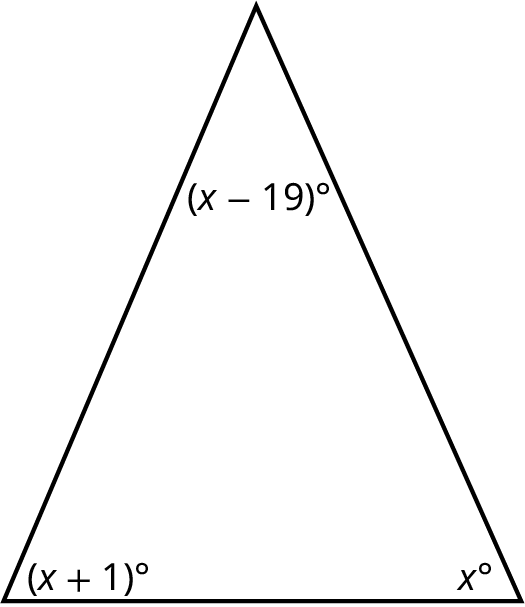
Find the measures of each angle in the triangle shown. A triangle with its angles marked x degrees, (x plus 1) degrees, and (x minus 19) degrees.

Answer

m ∡ x = 66 ∘ , m ∡ ( x + 1 ) = 67 ∘ , m ∡ ( x − 19 ) = 47 ∘

The sum of the angle measures of a triangle must be 180°.

x − 19 + x + 1 + x = 180 Combine like terms.
3 x − 18 = 180 Subtract.
3 x = 198 Divide.
x = 66 Evaluate the expressions for the angles.
x − 19 = 66 − 19 = 47
x + 1 = 66 + 1 = 67
x = 66

The angles measure 47°, 67°, and 66°.

Your Turn 10.16 §10.3 source ↗
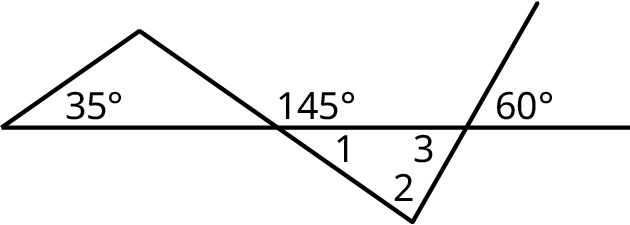
Find the measure of angles 1, 2, and 3 in the figure shown. Two triangles and a line lie on a horizontal line. The first triangle lies above the line and the second triangle lies below the line. The interior angles of the first triangle are labeled 35 degrees, unknown, and unknown. The exterior angle made by this triangle with the line is labeled 145 degrees. The interior angles of the second triangle measure 1, 2, and 3. An increasing line arises from the endpoint of the second triangle and it makes an angle of 60 degrees with the horizontal line.

Answer

Angle 1 and the 145° angle are supplementary. The sum of the measures of supplementary angles is 180°.

180° – 145° = 35°

m∡1 = 35°

Angle 3 and the 60° are vertical angles. Vertical angles have equal measures.

m∡3 = 60°

The sum of the angle measures of a triangle must be 180°. The sum of measures of angles 1, 2, and 3 must be 180°. Subtract the sum of 35 and 60 from 180 to get the measure of angle 2.

180° – (35° + 60°) = 85°

m∡2 = 85°

m ∡ 1 = 35 ∘ ; m ∡ 2 = 2 = 85 ∘ ; m ∡ 3 = 60 ∘

Your Turn 10.17 §10.3 source ↗

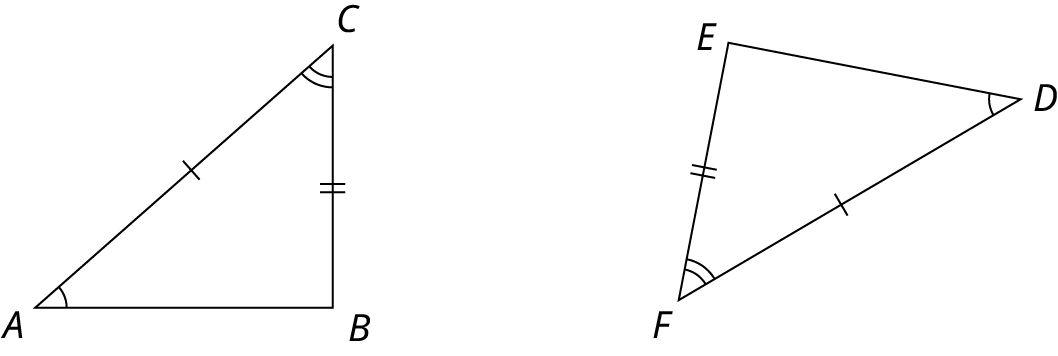
In the figure shown, is triangle A B C congruent to triangle D E F ? Two triangles, A B C and D E F. Angles A is congruent to angle D. Angle C is congruent to angle F. The side, A C is congruent to the side, D F. The side, B C is congruent to the side, E F.

Answer

The sum of the angle measures of a triangle must be 180°. Since two of the angles in triangle ABC have equal measures to two of the angles in triangle DEF, you know the third pair of angles are also of equal measure. The sides are also equal. These are congruent triangles. Triangle A B C is congruent to triangle D E F .

Your Turn 10.18 §10.3 source ↗

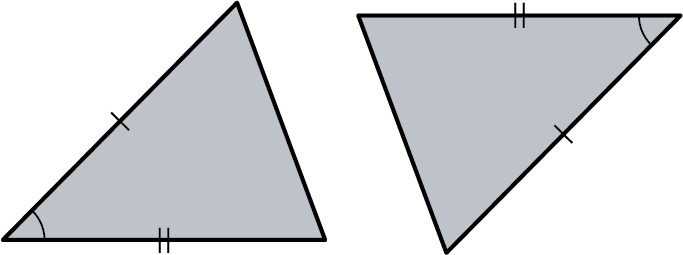
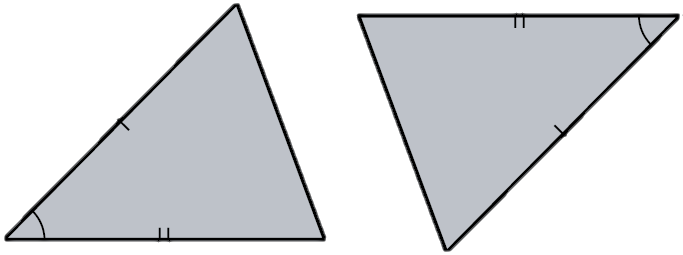
Identify the congruence theorem being illustrated in the figure shown. Two triangles. The bottom-left of the first triangle is congruent with the top-right angle of the second triangle. The left side of the first triangle is congruent with the right side of the second triangle. The bottom side of the first triangle is congruent with the top side of the second triangle.Two triangles. The bottom-left of the first triangle is congruent with the top-right angle of the second triangle. The left side of the first triangle is congruent with the right side of the second triangle. The bottom side of the first triangle is congruent with the top side of the second triangle.

Answer

Two sides are marked as congruent. The angle between the two sides is marked as congruent. This is the Side-Angle-Side (SAS) congruence theorem. If two sides of a triangle and the angle between them are equal to the corresponding two sides and included angle of the second triangle, then the triangles are congruent. SAS

Your Turn 10.19 §10.3 source ↗

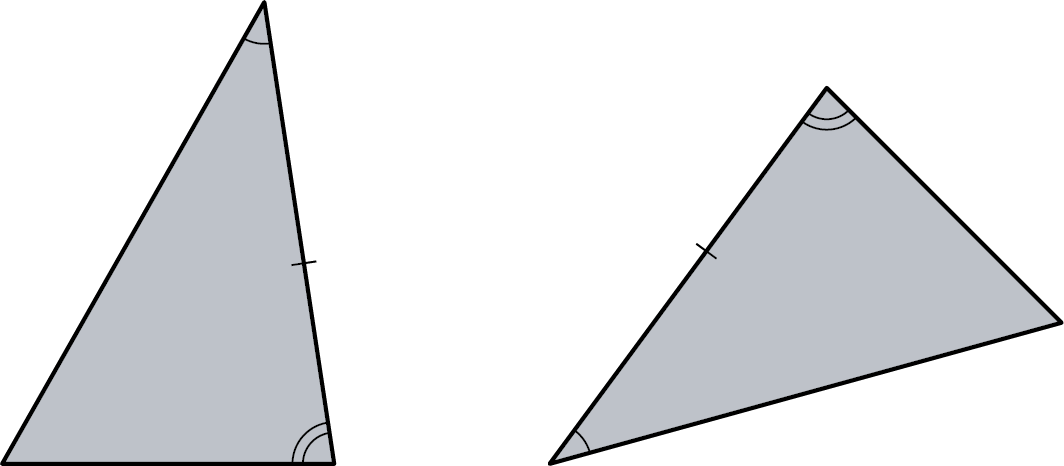
What congruence theorem is being illustrated in the figure shown? Two triangles. The top angle of the first triangle and the bottom-left angle of the second triangle are congruent. The bottom-right angle of the first triangle is congruent to the top angle of the second triangle. The right side of the first triangle is congruent with the left side of the second triangle.Two triangles. The top angle of the first triangle and the bottom-left angle of the second triangle are congruent. The bottom-right angle of the first triangle is congruent to the top angle of the second triangle. The right side of the first triangle is congruent with the left side of the second triangle.

Answer

Two angles are marked as congruent as well as the side between the two angles. This is the Angle-Side-Angle (ASA) congruence theorem. If two angles and the side between them in one triangle are congruent to the two corresponding angles and the side between them in a second triangle, then the two triangles are congruent. ASA

Your Turn 10.20 §10.3 source ↗

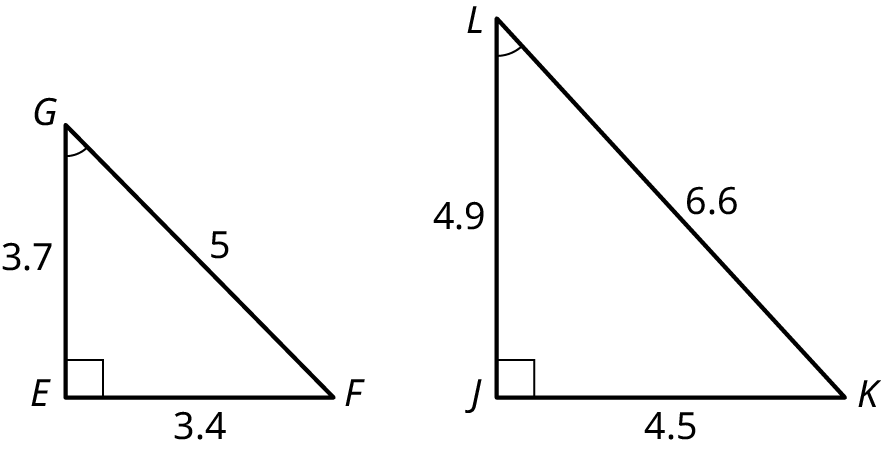
Is triangle E F G similar to triangle J K L in the figure shown? Two right triangles, E F G and J K L. In the first triangle E F G, the legs G E and E F measure 3.7 and 3.4. The hypotenuse G F measures 5. In the second triangle J K L, the legs L J and J K measure 4.9 and 4.5. The hypotenuse L K measures 6.6. The angles, G and L are congruent.

Answer

Step 1: You know the corresponding angles have equal measures from the drawings. That is enough to determine similarity.

Step 2: Set up proportions between the triangles to see if they have the same scaling factor. If they are the same, the triangles are similar.

3.7 4.9 ≈ 0.76

5 6.6 ≈ 0.76

3.4 4.5 ≈ 0.76

The scale factor is approximately the same. The triangles are similar.

The triangles are similar.

Your Turn 10.21 §10.3 source ↗

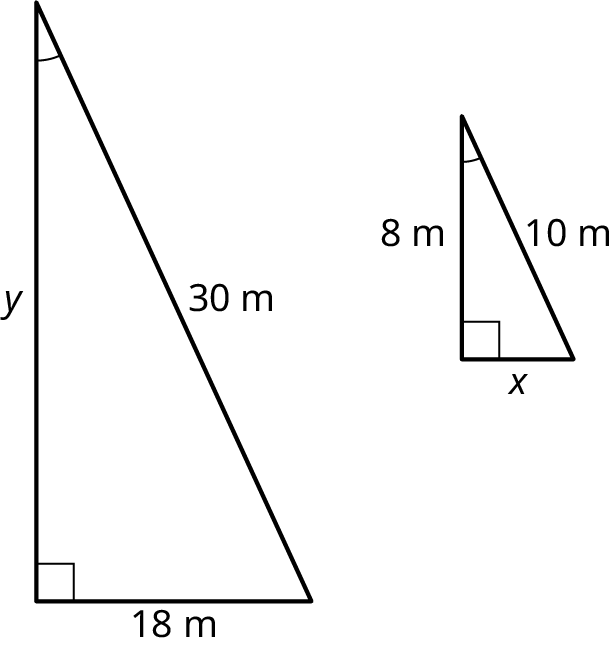
Are these triangles similar? Find the lengths of sides x and y to prove your answer. Two right triangles. In the first triangle, the legs measure y and 18 meters. The hypotenuse measures 30 meters. In the second triangle, the legs measure 8 meters and x. The hypotenuse measures 10 meters. The top angles in both triangles are congruent.

Answer

Step 1: You know the corresponding angles have equal measures from the drawings. That is enough to determine similarity.

Step 2: Set up proportions to find the missing values.

10 30 = x 18 Multiply.
30 x = 180 Divide.
x = 6   m
y 8 = 30 10 Multiply.
10 y = 240 Divide.
y = 24   m
x = 6 , y = 24

Your Turn 10.22 §10.3 source ↗

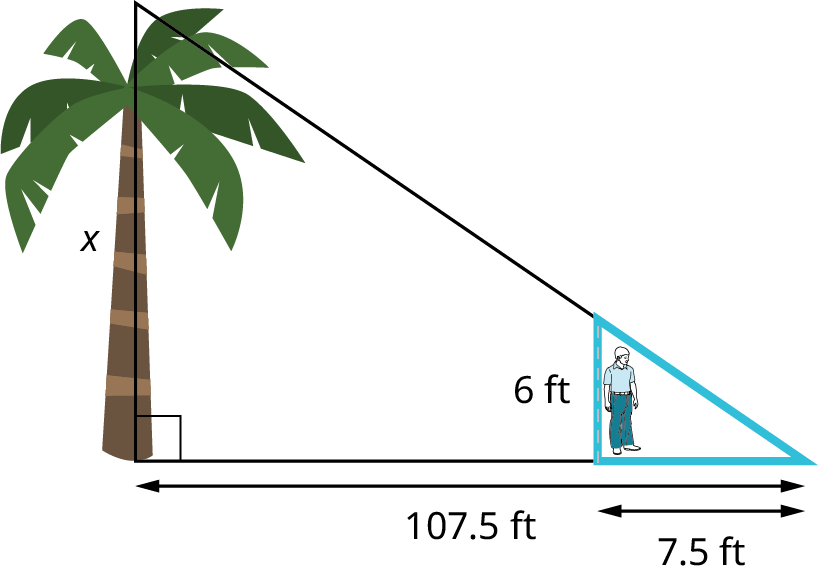
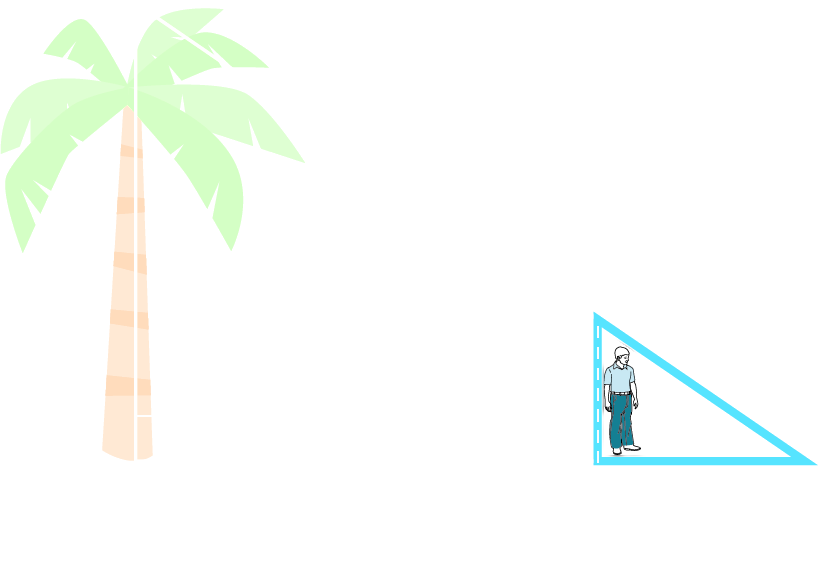
A person who is 6 feet tall is standing 100 feet away from the base of a tree. The tree casts a shadow 107.5-foot shadow. The person’s shadow is 7.5 feet long. How tall is the tree? An illustration of a palm tree and a stick figure person shows a right triangle. The vertical leg shows a tree. The hypotenuse is unknown. The horizontal leg measures 107.5 feet. A boy who is 6 feet tall is standing 100 feet away from the base of the tree. The boy casts a shadow of 7.5 feet.An illustration of a palm tree and a stick figure person shows a right triangle. The vertical leg shows a tree. The hypotenuse is unknown. The horizontal leg measures 107.5 feet. A boy who is 6 feet tall is standing 100 feet away from the base of the tree. The boy casts a shadow of 7.5 feet.

Answer

Set up a proportion to find the missing value. It helps some students to draw two separate triangles.

6 7.5 = x 107.5 Multiply.
7.5 x = 645 Divide.
x = 86   f e e t
The tree is 86 feet high.

Your Turn 10.23 §10.3 source ↗

A tree casts a shadow of 180 feet early in the morning. A 10-foot high garage casts a shadow of 30 feet at the same time in the morning. What is the height of the tree?

Answer

Set up a proportion to find the missing value. It helps some students to draw two separate triangles. Let x be the height of the tree in feet.

x 180 = 10 30 Multiply.
30 x = 1 , 800 Divide.
x = 60   f e e t
60 ft

Check Your Understanding 10.3.17 §10.3 source ↗
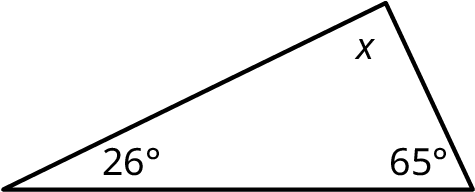
Find the measure of the missing angle in the given figure.
A triangle with its interior angles marked x, 26 degrees, and 65 degrees.

Answer

The sum of the angle measures must be 180°.

26 + 65 + x = 180 Add.
x + 91 = 180 Subtract.
x = 89

The angle measures 89°.

x = 89 ∘

Check Your Understanding 10.3.18 §10.3 source ↗
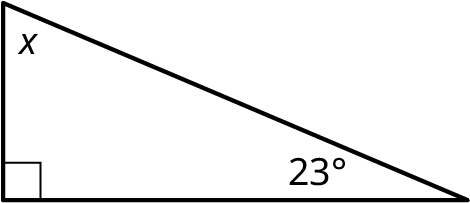
Find the measure of the missing angle in the given figure.
A right triangle with its interior angles marked x, 90 degrees, and 23 degrees.

Answer

The sum of the angle measures must be 180°. A right angle measures 90°.

x + 23 + 90 = 180 Add.
x + 113 = 180 Subtract.
x = 67

The angle measures 67°.

x = 67 ∘

Check Your Understanding 10.3.19 §10.3 source ↗
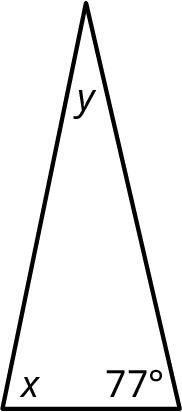
In the isosceles triangle shown, find the missing angles.
A triangle with its interior angles marked x, y, and 77 degrees.

Answer

In an isosceles triangle, at least two angles have equal measures. You know the angles at the bottom have equal measure.

x = 77 ∘

The sum of the angle measures must be 180°. A right angle measures 90°.

y + 77 + 77 = 180 Add.
y + 154 = 180 Subtract.
y = 26 ∘
x = 77 ∘ and y = 26 ∘

Check Your Understanding 10.3.20 §10.3 source ↗
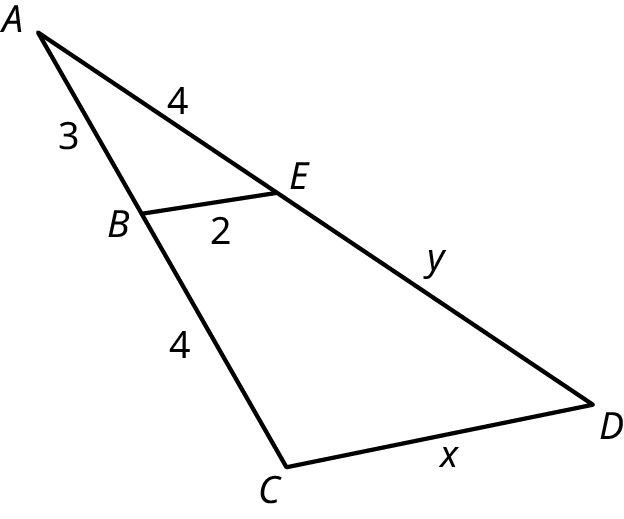
In the figure shown given B E ¯ is parallel to C D ¯ , find x and y .
A triangle, A C D with a horizontal line, B E at its center. A B measures 3. A E measures 4. B C measures 4. E D measures y. C D measures x. B E measures 2.

Answer

Decide which triangle’s side to put in the numerator. It does not matter which you pick to go where, if you are consistent.

In this exercise, let’s always put the smaller triangle in the numerator.

Triangle ABE is similar to triangle ACD.

To help you set up your proportions, you can use the order of the letters in the triangles. For instance, make a proportion of the first two letters in each triangle.

A B A C = 3 3 + 4

Make a proportion of the second and third letters.

B E C D = 2 x

Because these are similar triangles, the proportions are equal.

3 3 + 4 = 2 x Add.
3 7 = 2 x Multiply.
3 x = 14 Divide.
x = 14 3

Make a proportion of the first and third letters.

A E A D = 4 4 + y

Because these are similar triangles, the proportions are equal. Use one of the early proportions.

4 4 + y = 3 3 + 4 Add.
4 4 + y = 3 7 Multiply.
12 + 3 y = 28 Subtract.
3 y = 16 Divide.
y = 16 3
These are similar triangles, so we can solve using proportions.
3 2 = ( 3 + 4 ) x 3 x = 14 x = 14 3 4 2 = 4 + y 14 3 14 3 ( 4 ) = 2 ( 4 + y ) 56 3 = 8 + 2 y 56 = 3 ( 8 + 2 y ) 56 = 24 + 6 y 32 = 6 y 16 3 = y
Then, x = 14 3 and y = 16 3 .

Check Your Understanding 10.3.21 §10.3 source ↗
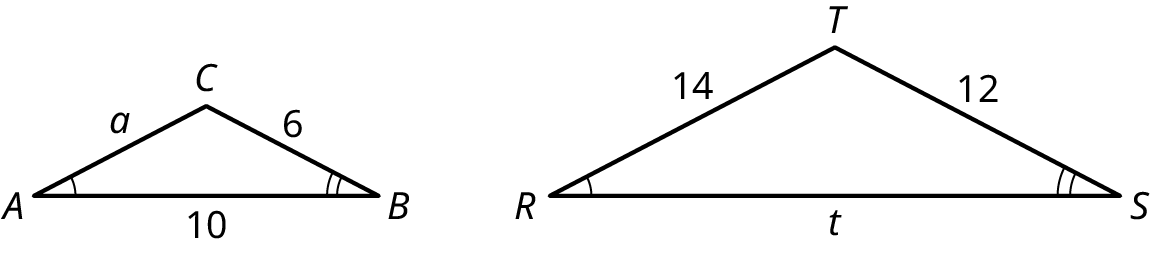
Find a and t in the given figure.
Two triangles, A B C and R S T. In the triangle A B C, the side A C measures a, the side B C measures 6, and the side A B measures 10. In the triangle R S T, the side R T measures 14, the side T S measures 12, and the side R S measures t. The angles, A and R are congruent. The angles, B and S are congruent.

Answer

Decide which triangle’s side to put in the numerator. It does not matter which you pick to go where, if you are consistent.

In this exercise, let’s always put the smaller triangle in the numerator.

Triangle ABC is similar to triangle RST.

To help you set up your proportions, you can use the order of the letters in the triangles. For instance, make a proportion of the first two letters in each triangle.

A B R S = 10 t

Make a proportion of the second and third letters.

B C S T = 6 12

Because these are similar triangles, the proportions are equal.

10 t = 6 12 Multiply.
6 t = 120 Divide.
t = 20

Make a proportion of the first and third letters.

A C R T = a 14

Because these are similar triangles, the proportions are equal. Use the proportion that has just numbers.

a 14 = 6 12 Multiply.
12 a = 84 Divide.
a = 7
Set up the proportions.
6 a = 12 14 6 ( 14 ) = 12 a 84 = 12 a 7 = a
Thus, t = 20 and a = 7.

Your Turn 10.24 §10.4 source ↗

Identify the shape.
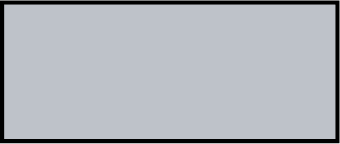

A rectangle.

Answer

A rectangle is a parallelogram with four right angles and two sets of parallel sides. rectangle

Your Turn 10.24 (b) §10.4 source ↗

Identify the shape.
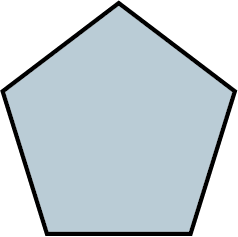

A

Answer

A pentagon is a polygon with five sides. pentagon

Your Turn 10.24 (c) §10.4 source ↗

Identify the shape.
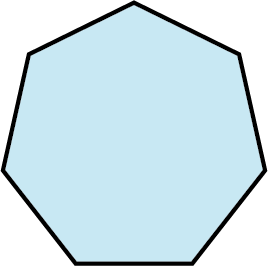

A heptagon.

Answer

A heptagon is a polygon with seven sides. heptagon

Your Turn 10.24 (d) §10.4 source ↗

Identify the shape.
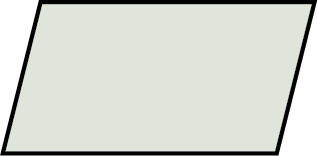

A parallelogram.

Answer

A parallelogram is a quadrilateral with two sets of parallel sides. parallelogram

Your Turn 10.25 §10.4 source ↗

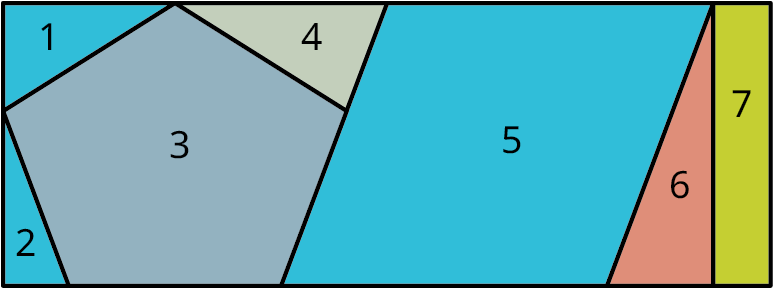
What polygons make up the figure shown?
A rectangle is made up of 7 polygons. Polygons 1, 2, 4, and 6 are triangles. Polygon 3 is a pentagon. Polygon 5 is a parallelogram. Polygon 7 is a rectangle.

Answer

Shapes 1, 2, 4, and 6 are triangles since they have three sides.

Shape 3 is a pentagon since it has five sides.

Shape 5 is a parallelogram. A parallelogram is a quadrilateral with two sets of parallel sides.

Shape 7 is a rectangle. A rectangle is a parallelogram with four right angles and two sets of parallel sides.

Shapes 1, 2, 4, and 6 are triangles; shape 3 is a pentagon; shape 5 is a parallelogram; and shape 7 is a rectangle.

Your Turn 10.26 §10.4 source ↗

Find the perimeter of a square table that measures 30 inches across from one side to its opposite side.

Answer

The formula for the perimeter P for a rectangle with length L and width W is P = 2 L + 2 W .

A square is a rectangle whose length and width have equal measures.

P = 2 L + 2 W = 2 ( 30   i n ) + 2 ( 30   i n ) = 60   i n + 60 i n = 120   i n

The perimeter is 120 inches.

120 in

Your Turn 10.27 §10.4 source ↗

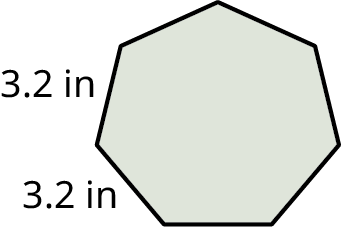
Find the perimeter of a regular heptagon with a side length of 3.2 as shown in the figure.
A heptagon with its sides marked 3.2 inches.

Answer

A regular heptagon has seven sides of equal length. Therefore, the perimeter of a regular heptagon with a side length of 3.2 inches is:

P = 7 ( 3.2   i n ) = 22 .4   i n c h e s

22.4 in

Your Turn 10.28 §10.4 source ↗

Find the measure of each interior angle of a regular pentagon and then find the sum of the interior angles.

Answer

A pentagon has five sides, so n = 5 .

The measure of each interior angle of a regular polygon with n sides is given by a = ( n − 2 ) 180 ∘ n .

a = ( n − 2 ) 180 ∘ n = ( 5 − 2 ) 180 ∘ 5 = ( 3 ) 180 ∘ 5 = 540 5 = 108 ∘

The sum of the interior angles of a polygon with n sides is S = ( n − 2 ) 180 ∘ .

S = ( n − 2 ) 180 ∘ = ( 5 − 2 ) 180 ∘ = ( 3 ) 180 ∘ = 540 ∘

Each interior angle of a pentagon is 108°. The sum of the interior angles of a pentagon is 540°.

a = 108 ∘
The sum of the interior angles is 540 ∘ .

Your Turn 10.29 §10.4 source ↗

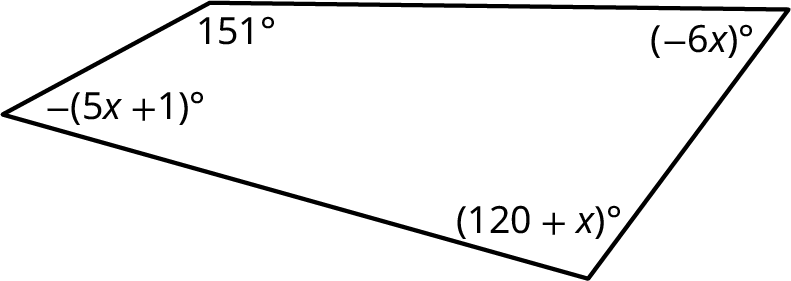
Find the sum of the measures of the interior angles and then find the measure of each interior angle in the figure shown.
A four-sided polygon. The interior angles measure 151 degrees, (negative 6 x) degrees, (120 plus x) degrees, and negative (5 x plus 1) degrees.

Answer

Step 1: Find the sum of the interior angles. This is a quadrilateral, so n = 4 .

The sum of the interior angles of a polygon with n sides is S = ( n − 2 ) 180 ∘ .

S = ( n − 2 ) 180 ∘ = ( 4 − 2 ) 180 ∘ = ( 2 ) 180 ∘ = 360 ∘

Step 2: Add up the angles and set it equal to the sum of the angles. Then solve for the unknowns.

151 − ( 5 x + 1 ) + ( − 6 x ) + ( 120 + x ) = 360 Distribute.
151 − 5 x − 1 − 6 x + 120 + x = 360 Combine like terms.
− 10 x + 270 = 360 Subtract.
− 10 x = 90 Divide.
x = − 9 Evaluate the expressions for each angle.

− ( 5 x + 1 ) = − ( 5 ( − 9 ) + 1 ) = − ( − 45 + 1 ) = − ( − 44 ) = 44 ∘

− 6 x = − 6 ( − 9 ) = 54 ∘

120 + x = 120 + ( − 9 ) = 111 ∘

The interior angles measure 44°, 54°, and 111°.

We have the sum of interior angles is 360 ∘ . Then, x = − 9. The other angles measure 54 ∘ , 111 ∘ , 44 ∘ .

Your Turn 10.30 §10.4 source ↗

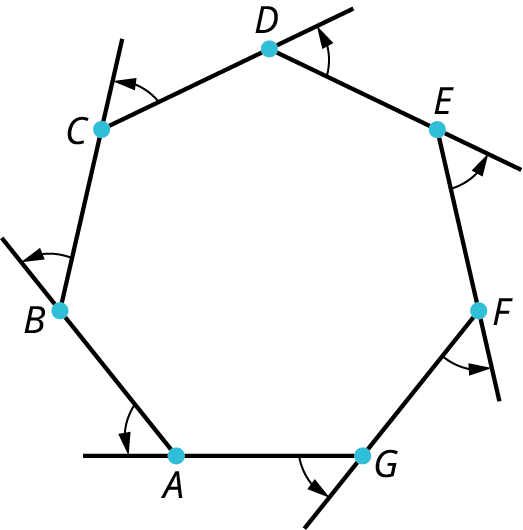
Find the sum of the measures of the exterior angles in the figure shown. A heptagon, A B C D E F G. The exterior angles are marked at each vertex.

Answer

The sum of the measures of the exterior angles of a regular polygon with n sides equals 360°.

You could stop there. The measure of each of a regular polygon with n sides is b = 360 ∘ n .

A heptagon has seven sides, so n = 7.

b = 360 ∘ n = 360 ∘ 7 ≈ 51.43 ∘

To get back to the sum of all the exterior angles, multiply by 7.

7(51.43) is approximately 360°.

7 ( 51.43 ) = 360 ∘

Your Turn 10.31 §10.4 source ↗

Find the circumference of a circle with a radius of 2.25 cm.

Answer

The circumference of a circle is C = 2 π r where r is the radius.

C = 2 π r = 2 π ( 2.25   c m ) = 4.5   c m ≈ 14.14   c m

C = 2 ( 2.25 ) π = 14.14  cm

Your Turn 10.32 §10.4 source ↗

Find the radius of a circle with a circumference of 15.71 cm.

Answer

The circumference of a circle is C = 2 π r where r is the radius.

15.71   c m = 2 π r Divide to find the radius.
15.71   c m 2 π = r
r ≈ 2.5 cm
r = 2.5 cm

Your Turn 10.33 §10.4 source ↗

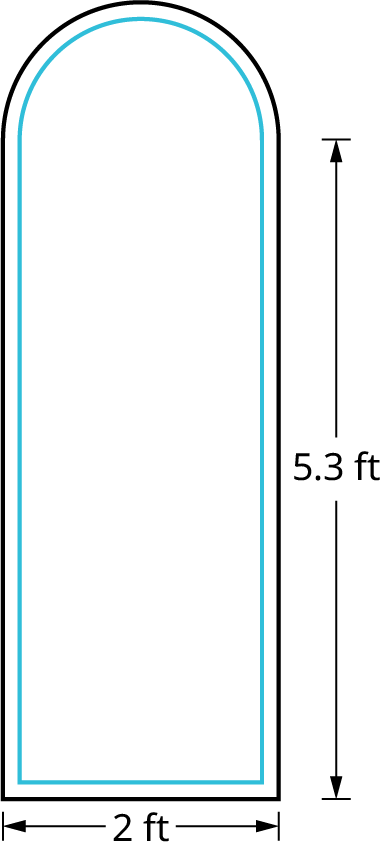
To make a trim for the window in the figure shown, you need the perimeter. How many feet of trim do you need to buy? A polygon shows a semicircle resting on top of a rectangle. The length and width of the rectangle measure 5.3 and 2. The radius of the semicircle measures 2.

Answer

The trim will cover 2 feet along the bottom as well as the 5.3-foot sides, plus the semicircle at the top. The semicircle has a diameter of 2 feet.

The circumference of a circle with diameter d is C = π d .

The distance around the semicircle would be half of that.

s e m i c i r c l e = 1 2 π ( 2   f e e t ) ≈ 3.14   f t

The total trim needed: 2   f t + ( 5.3     f t ) ( 2 ) + 3.14   f t = 15.74   f t

You need 15.74 feet of trim.

You need to buy 15.74 feet of trim.

Check Your Understanding 10.4.22 §10.4 source ↗

In the following exercises, identify the regular polygons.
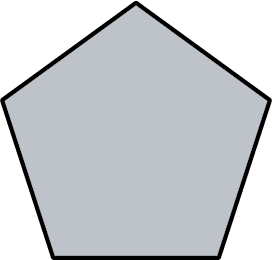
A polygon with five sides.

Answer

A pentagon is a polygon with five sides. pentagon

Check Your Understanding 10.4.23 §10.4 source ↗

In the following exercises, identify the regular polygons.
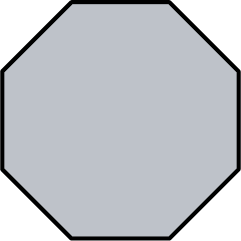
A polygon with eight sides.

Answer

An octagon is a polygon with eight sides. octagon

Check Your Understanding 10.4.24 §10.4 source ↗

In the following exercises, identify the regular polygons.
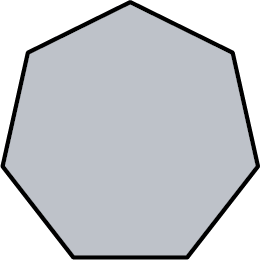
A polygon with seven sides.

Answer

A heptagon is a polygon with seven sides. heptagon

Check Your Understanding 10.4.25 §10.4 source ↗

Find the perimeter of the regular pentagon with side length of 6 cm.

Answer

A regular pentagon has five sides of equal length. Therefore, the perimeter of a regular pentagon with a side length of 6 cm is:

P = 5 ( 6   c m ) = 30   c m

6 ( 5 ) = 30  cm

Check Your Understanding 10.4.26 §10.4 source ↗

Find the sum of the interior angles of a regular hexagon.

Answer

A hexagon has six sides, so n = 6 .

The sum of the interior angles of a polygon with n sides is S = ( n − 2 ) 180 ∘ .

S = ( n − 2 ) 180 ∘ = ( 6 − 2 ) 180 ∘ = ( 4 ) 180 ∘ = 720 ∘

S = ( 6 − 2 ) 180 ∘ = 720 ∘

Check Your Understanding 10.4.27 §10.4 source ↗

Find the measure of each interior angle of a regular hexagon.

Answer

A regular hexagon has six sides, so n = 6 .

The measure of each interior angle of a regular polygon with n sides is given by a = ( n − 2 ) 180 ∘ n .

a = ( n − 2 ) 180 ∘ n = ( 6 − 2 ) 180 ∘ 6 = ( 4 ) 180 ∘ 6 = 720 6 = 120 ∘

120 ∘

Check Your Understanding 10.4.28 §10.4 source ↗

Find the measurements of each angle in the given figure.
A four-sided polygon. The interior angles measure 152 degrees, (5 x plus 1) degrees, (x plus 12) degrees, and (9 x) degrees.

Answer

Step 1: Find the sum of the interior angles. This is a quadrilateral, so n = 4 .

The sum of the interior angles of a polygon with n sides is S = ( n − 2 ) 180 ∘ .

S = ( n − 2 ) 180 ∘ = ( 4 − 2 ) 180 ∘ = ( 2 ) 180 ∘ = 360 ∘

Step 2: Add up the angles and set it equal to the sum of the angles. Then solve for the unknowns.

152 + ( 5 x + 1 ) + ( x + 12 ) + ( 9 x ) = 360 Combine like terms.
15 x + 165 = 360 Subtract.
15 x = 195 Divide.
x = 13 Evaluate the expressions for each angle.

5 x + 1 = 5 ( 13 ) + 1 = 65 + 1 = 66 ∘

9 x = 9 ( 13 ) = 117 ∘

x + 12 = 13 + 12 = 25 ∘

The interior angles measure 66°, 117°, and 25°.

360 = 152 + 9 x + ( 5 x + 1 ) + ( x + 12 ) = 15 x + 165 195 = 15 x 13 = x x + 12 = 25 ∘ , 9 x = 117 ∘ , 5 x + 1 = 66 ∘

Check Your Understanding 10.4.29 §10.4 source ↗

Find the circumference of the circle with radius equal to 3 cm.

Answer

The circumference of a circle is C = 2 π r where r is the radius.

C = 2 π r = 2 π ( 3   c m ) = 6   c m ≈ 18.85   c m

C = 2 π ( 3 ) = 6 π = 18.85  cm

Your Turn 10.34 §10.5 source ↗

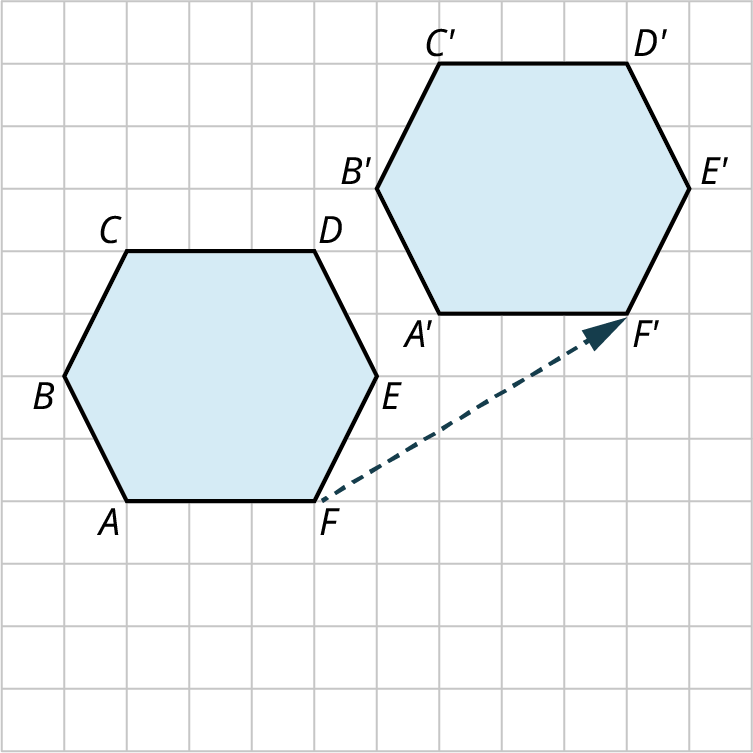
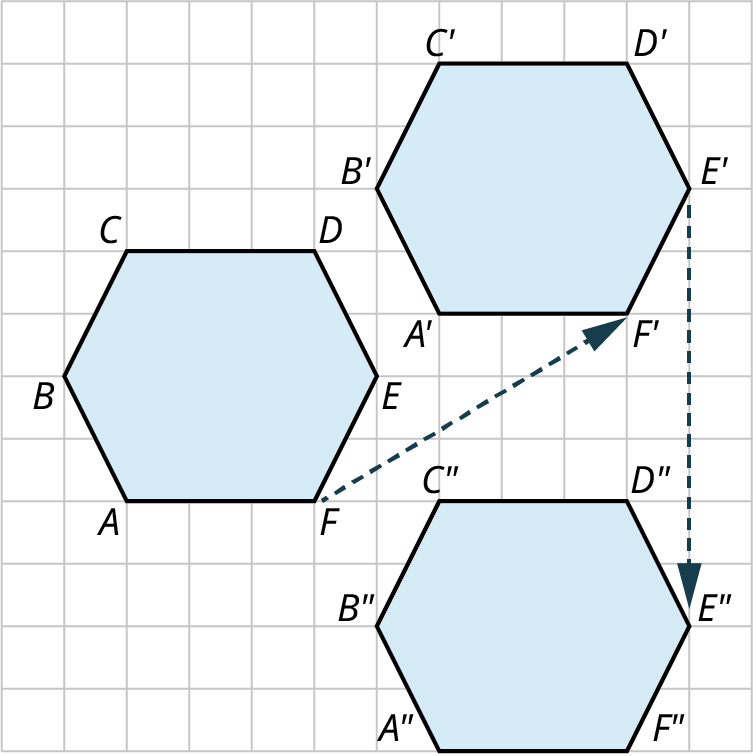
Translate the hexagon with points A ′ , B ′ , C ′ , D ′ , E ′ , F ′ 6 units down. Two hexagons are plotted on a grid. Hexagon, A B C D E F is plotted. The bottom and top sides, A F and C D measure 3 units, each. The other sides, C B, B A, D E, and E F measure 2 units, each. The hexagon is translated 5 units to the right and 3 units up. The vertices of the translated hexagon are A prime, B prime, C prime, D prime, E prime, and F prime.

Answer

The translated hexagon has labels A ″ , B ″ , C ″ , D ″ , E ″ , F ″ .
Three hexagons are graphed on a grid. Hexagon, A B C D E F is plotted. The bottom and top sides, A F and C D measure 3 units, each. The other sides, C B, B A, D E, and E F measure 2 units, each. The hexagon is translated 5 units to the right and 3 units up. The vertices of the translated hexagon are A prime, B prime, C prime, D prime, E prime, and F prime. The translated hexagon is again translated 7 units down. The vertices of the newly translated hexagon are A double prime, B double prime, C double prime, D double prime, E double prime, and F double prime.

Your Turn 10.35 §10.5 source ↗

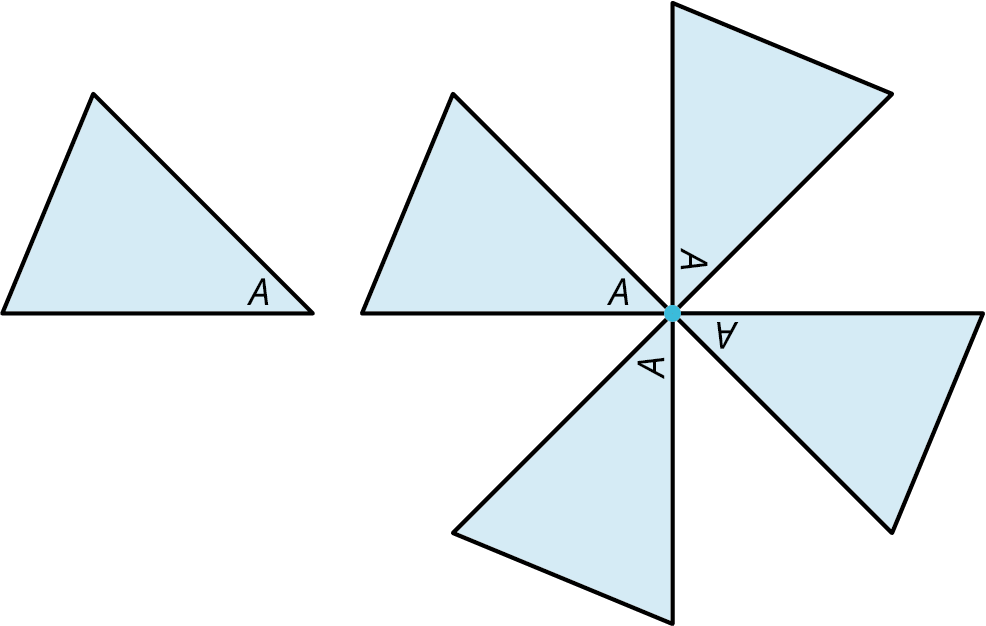
Starting with the triangle in the figure shown, explain how the pattern on the right was achieved.
A triangle with one of its vertices labeled A. A pattern is made of connecting one of the vertices of four triangles. In each triangle, the connected vertices are labeled A.

Answer

Rotate the triangle about the rotation point 90 ∘ to the right three times.

Your Turn 10.36 §10.5 source ↗

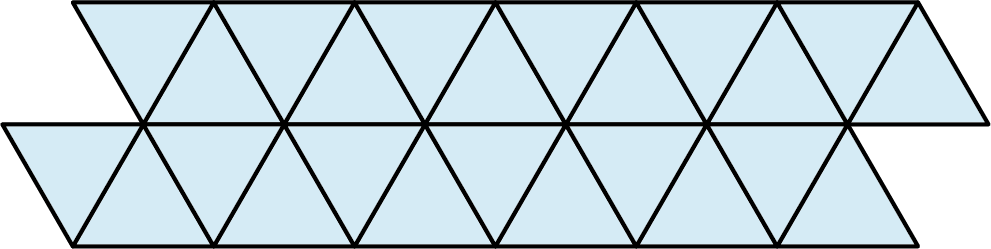
Explain how this tessellation of equilateral triangles could be produced.
A tessellation pattern is made up of two rows of equilateral triangles. Each row has 6 triangles and 6 inverted triangles.

Answer

This tessellation could be produced with a reflection of the triangle vertically, then each triangle is rotated 180 ∘ and translated to the right.

Your Turn 10.37 §10.5 source ↗

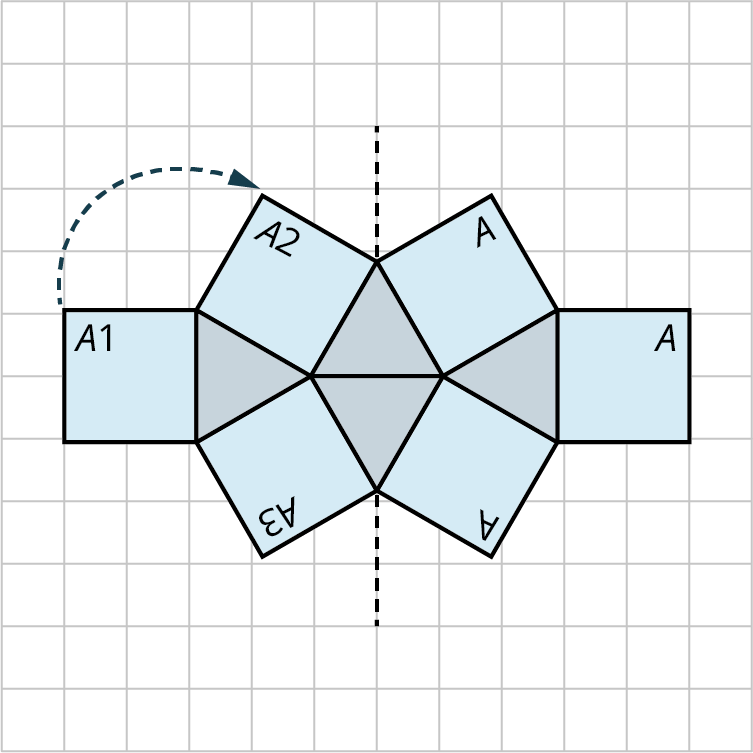
How does this tessellation of the squares come about?
A tessellation pattern is made up of six squares and four equilateral triangles. The sides of each square measure 2 units. The sides of each equilateral triangle measure 2 units. The square A 1 is rotated 30 degrees to the right to form a new square A 2. The new square is reflected horizontally to form a new square A 3. These 3 squares are reflected vertically along a dashed line. The spaces in between the squares resemble triangles.

Answer

From the first square on the left, rotate the square 30 ∘ to the right, or A 1 → A 2 . Then, reflect the square over the horizontal, or A 2 → A 3 . Next, reflect all three squares over the vertical line. The lavender triangles comprise another pattern that tessellates, fits in with the squares, and fills the gaps.

Your Turn 10.38 §10.5 source ↗

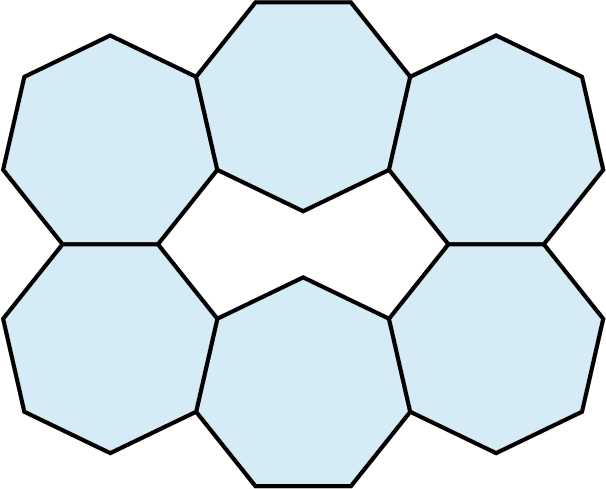
Do regular heptagons tessellate the plane by themselves?
A tessellation pattern is made up of six heptagons.

Answer

For regular polygons to be able to tesselate, the shapes must meet at a vertex so that the interior angles have a sum of 360°.

A heptagon has seven sides, so n = 7 .

The measure of each interior angle of a regular polygon with n sides is given by a = ( n − 2 ) 180 ∘ n .

a = ( n − 2 ) 180 ∘ n = ( 7 − 2 ) 180 ∘ 7 = ( 5 ) 180 ∘ 7 = 900 7 ≈ 127.57 ∘

Since the interior angles of a heptagon are not integer factors of 360°, it is impossible to tesselate with heptagons by themselves.

No

Your Turn 10.39 §10.5 source ↗

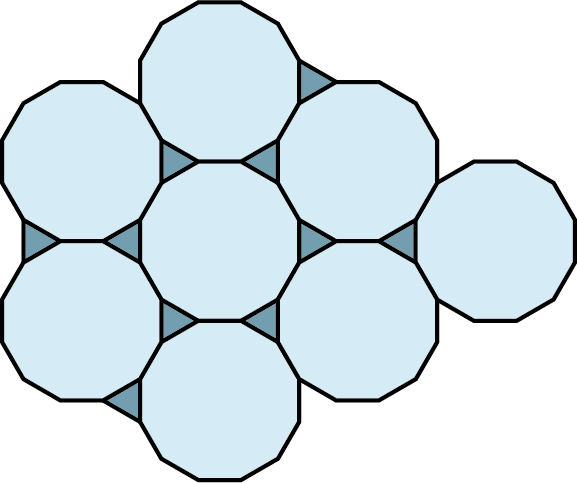
Do regular dodecagons (12-sided regular polygons) tessellate the plane by themselves?
A tessellation pattern is made up of eight dodecagons and ten equilateral triangles.

Answer

For regular polygons to be able to tesselate, the shapes must meet at a vertex so that the interior angles have a sum of 360°.

A dodecagons has 12 sides, so n = 12 .

The measure of each interior angle of a regular polygon with n sides is given by a = ( n − 2 ) 180 ∘ n .

a = ( n − 2 ) 180 ∘ n = ( 12 − 2 ) 180 ∘ 12 = ( 10 ) 180 ∘ 12 = 1 , 080 ∘ 12 = 90 ∘

Since the interior angles of a dodecagon are integer factors of 360°, it makes tessellations within reach. However, dodecagons by themselves cannot tesselate. If you add equilateral triangles between them, they can fill the gaps.

Not by themselves, but by adding an equilateral triangle, the two regular polygons do tessellate the plane without gaps.

Your Turn 10.40 §10.5 source ↗

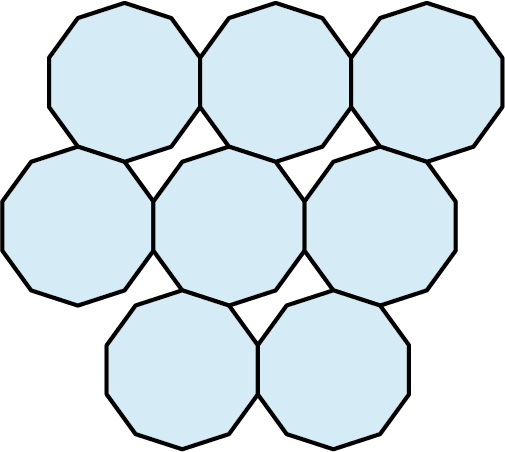
Create a tessellation using polygons, regular or irregular.

Answer

We made a tessellation with a regular decagon (10 sides) and an irregular hexagon. We see that the regular decagon will not fill the plane by itself. The gap is filled, however, with an irregular hexagon. These two shapes together will fill the plane.

Check Your Understanding 10.5.30 §10.5 source ↗

What are the properties of repeated patterns that let them be classified as tessellations?

Answer

The patterns are repeated shapes that can be transformed in such a way as to fill the plane with no gaps or overlaps.

Check Your Understanding 10.5.31 §10.5 source ↗
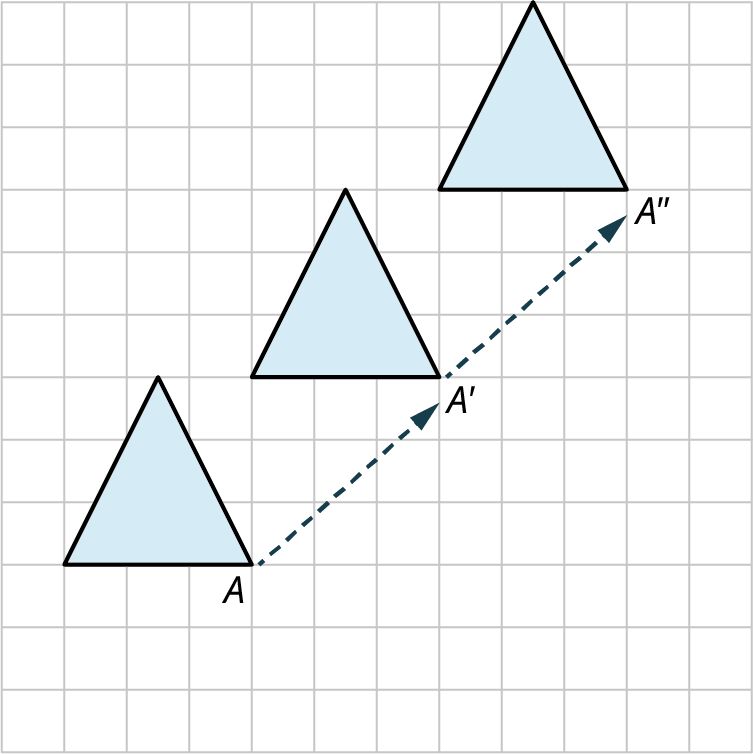
Explain how the using the transformation of a translation is applied to the movement of this shape starting with point A .
Three triangles are graphed on a rectangular grid. In each triangle, the sides measure 3 units. The bottom-left vertex of the first triangle is marked A. The bottom-left vertex of the second triangle is marked A prime. The bottom-left vertex of the third triangle is marked A double prime. The first triangle is moved 3 units to the right and 3 units up from A to A prime. The second triangle is moved 3 units to the right and 3 units up from A prime to A double prime.

Answer

Starting with the triangle with the point labeled A , the triangle is translated point by point 3 units to the right and 3 units up to point A ′ . Then, the triangle labeled A ′ is translated 3 units to the right and 3 units up to point A ″ .

Check Your Understanding 10.5.32 §10.5 source ↗
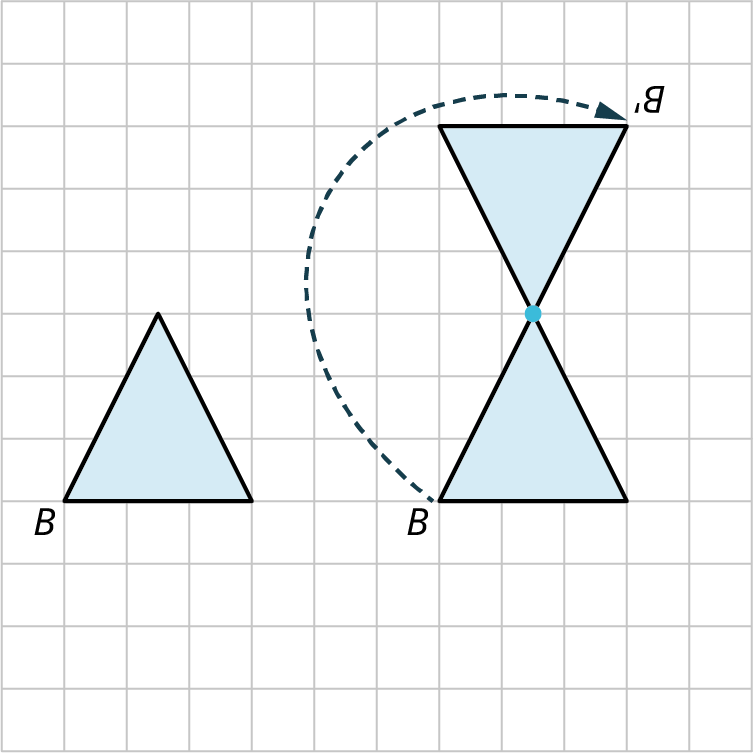
Starting with the triangle with vertex B , describe how the transformation in this drawing is achieved.
Two figures are plotted on a rectangular grid. The first figure is a triangle with its bottom-left vertex marked B. Each side measures 3 units. The second figure is a triangle with its bottom-left vertex marked B. Each side measures 3 units. A point is marked at the top vertex. The triangle is rotated 180 degrees about point B and in the new triangle, the vertex is marked B prime.

Answer

The triangle is rotated about the rotation point 180 ∘ to vertex B ′ .

Check Your Understanding 10.5.33 §10.5 source ↗
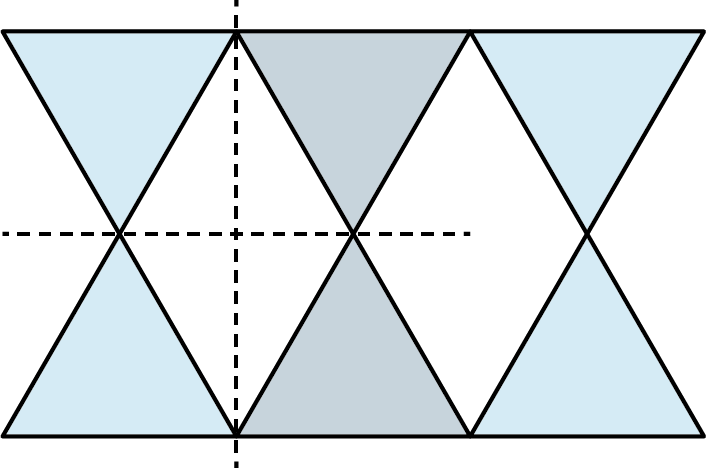
Starting with a triangle with a darker face and a lighter back, describe how this pattern came about.
A figure made up of six triangles. The first two and last two triangles are red. The remaining two triangles are lavender. The triangles are arranged in two rows. The triangles in the top row are inverted.

Answer

The dark triangle is reflected about the vertical line showing the light back, and then reflected about the horizontal line. The pattern is repeated leaving a white diamond between the shapes.

Check Your Understanding 10.5.34 §10.5 source ↗
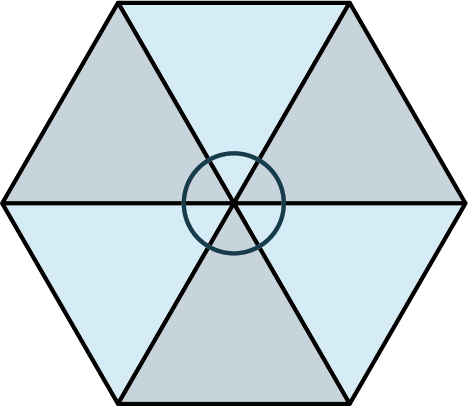
Name the tessellation in the figure shown.
A hexagon is made of six triangles. 3 triangles are shaded dark and 3 triangles are shaded light. A circle is drawn at the center of the hexagon where the triangles meet.

Answer

Step 1: Choose a vertex. This does NOT change while you are counting.

Use the middle vertex that has a circle around it.

Step 2: Count the number of sides in the shapes that touch the vertex. Separate your counts by periods. There are six shapes that touch the chosen vertex. They are all triangles with three sides.

3.3.3.3.3.3

3.3.3.3.3.3

Your Turn 10.41 §10.6 source ↗

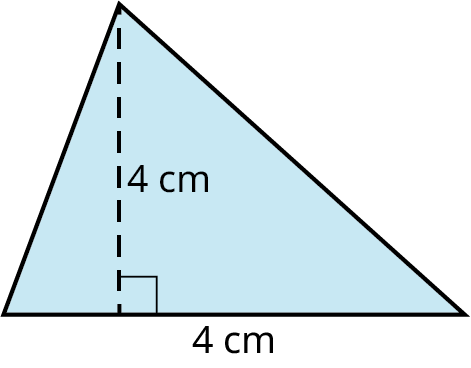
Find the area of the triangle with a base equal to 4 cm and the height equal to 4 cm. A triangle with its base marked 4 centimeters and height marked 4 centimeters.A triangle with its base marked 4 centimeters and height marked 4 centimeters.

Answer

8 cm 2

The area of a triangle is A = 1 2 b h , where b represents the base and h represents the height.

A = 1 2 b h = 1 2 ( 4   c m ) ( 4   c m ) = 8   c m 2

The area is 8 square centimeters.

Your Turn 10.42 §10.6 source ↗

Find the area of a rectangular region with a length of 18 feet and a width 1/3 of the length.

Answer

The area of a rectangle is A = L W where L represents the length and W represents the width.

The length is 18 feet.

Break the width expression into its components.

The width is one third of the length
width = 1 3 ( 18  ft )

width = 1 3 ( 18   f t ) = 6   f t

A = L W = ( 18   f t ) ( 6   f t ) = 108   f t 2

The area is 108 square feet.

108 ft2

Your Turn 10.43 §10.6 source ↗

You remodel your kitchen and decide to change out the tile floor. The floor measures 30 ft by 15 ft. One box of tile costs $45 and covers 10 ft2. How many boxes of tile should you buy, and what will it cost?

Answer

45 boxes at a cost of $2,025.00

The area of a rectangle is A = L W where L represents the length and W represents the width.

A = L W = ( 30   f t ) ( 15   f t ) = 450   f t 2

Make conversion factors out of the equivalences of one box costing $45 and covering 10 square feet to answer the questions.

450   f t 2 ( 1   b o x 10   f t 2 ) = 45   b o x e s

45   b o x e s ( $ 45 10   b o x e s ) = $ 2 , 025

You need 45 boxes of tiles. It will cost you $2,025.

Your Turn 10.44 §10.6 source ↗
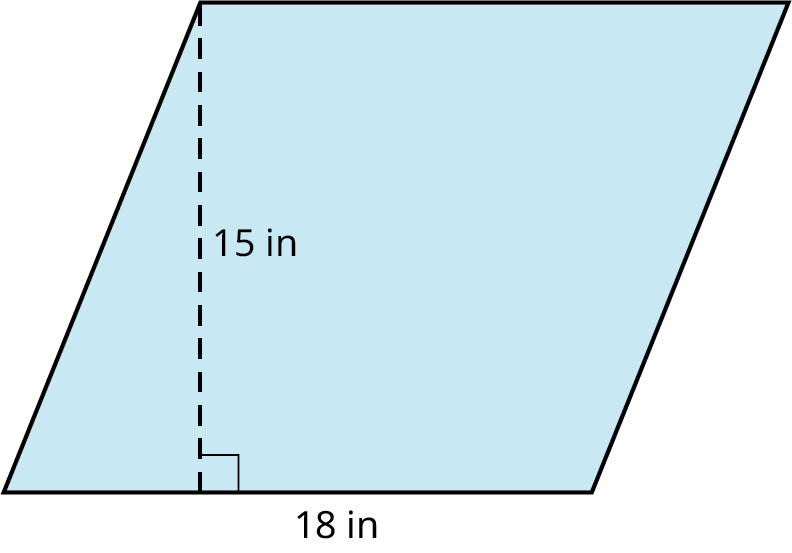
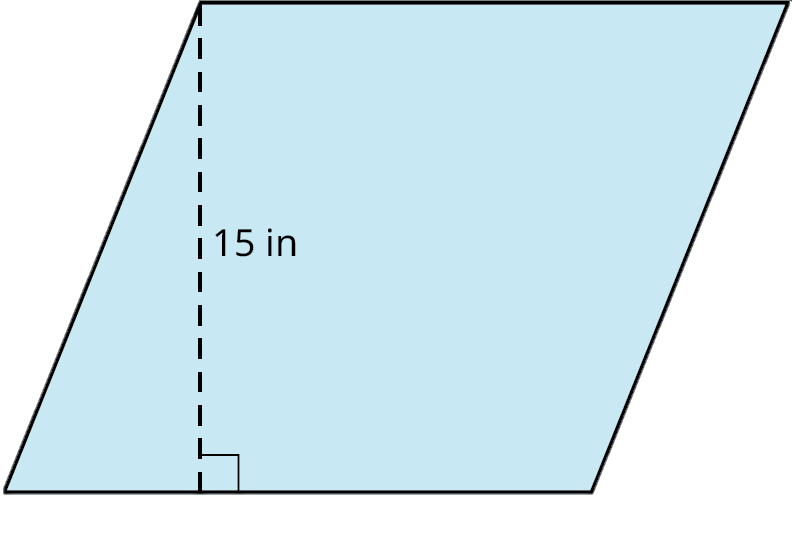
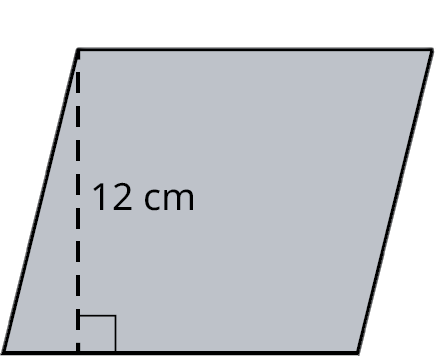
Find the area of the parallelogram. A parallelogram with its base marked 18 inches and height marked 15 inches.A parallelogram with its base marked 18 inches and height marked 15 inches.

Answer

The area of a parallelogram with base b and height h is A = b h .

A = b h = ( 15   i n ) ( 18   i n ) = 270   i n 2

The area of the parallelogram is 270 square inches.

270 i n 2

Your Turn 10.45 §10.6 source ↗

Suppose your city has a park just like the one in Example 10.45. The length of each street is 49 yd, and the perpendicular distance between streets is 31 yd. How much sod, sold by the square foot at $0.45 per square foot plus $1.00 per square foot for installation, and a flat $50 fee for equipment, should be purchased and what will the cost be?

Answer

13,671 square feet; cost is $19,872.95.

First, convert the dimensions to feet. There are 3 feet in one yard.

31   y a r d ( 3   f e e t 1   y a r d ) = 93   f e e t

49   y a r d ( 3   f e e t 1   y a r d ) = 147   f e e t

The area of a parallelogram with base b and height h is A = b h .

A = b h = ( 93   f e e t ) ( 147   f e e t ) = 13 , 671   f t 2

There are two charges per square foot: $0.45 and $1.00, for a total of $1.45 per square foot.

13 , 671 f t 2 ( $ 1.45 1   f t 2 ) = $ 19 , 822

Add the $50 flat fee for equipment.

$19,822 + $50 = $19,872 .95

You will buy 13,671 square feet of sod. The total cost is $19,872.95.

Your Turn 10.46 §10.6 source ↗
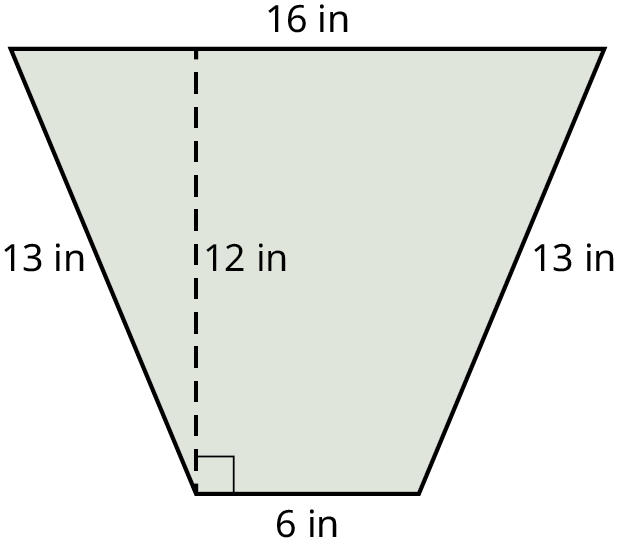
Find the area of the trapezoid shown.
A trapezoid with its top and bottom sides marked 16 inches and 6 inches. The left and right sides are marked 13 inches. The height is marked 12 inches.

Answer

The area of a trapezoid with height h and parallel bases a and b is A = 1 2 h ( a + b ) .

A = 1 2 h ( a + b ) = A = 1 2 ( 12   i n ) ( 6   i n + 16   i n ) = ( 6   i n ) ( 22   i n ) = 132   i n 2

The area is 132 square inches.

132 in 2

Your Turn 10.47 §10.6 source ↗

A rhombus has an area of 40  in 2 , the measure of d 1 = 8 . Find the measure of d 2 .

Answer

The area of a rhombus with diagonals d 1 and d 2 is A = d 1 d 2 2 .

40 = 8 d 2 2 Simplify the right side.
40 = 4 d 2 Divide both sides.
10 = d 2  

The measure of d 2 is 10 inches.

d 2 = 10

Your Turn 10.48 §10.6 source ↗

You have a kite that measures 500 i n 2 . If one of the diagonals measures 25 in, what is the length of the other diagonal?

Answer

A kite is a rhombus. The area of a rhombus with diagonals d 1 and d 2 is A = d 1 d 2 2 .

500 = 25 d 2 2 Simplify the right side.
500 = 12.5 d 2 Divide both sides.
40 = d 2  

The measure of d 2 is 40 inches.

40 in

Your Turn 10.49 §10.6 source ↗

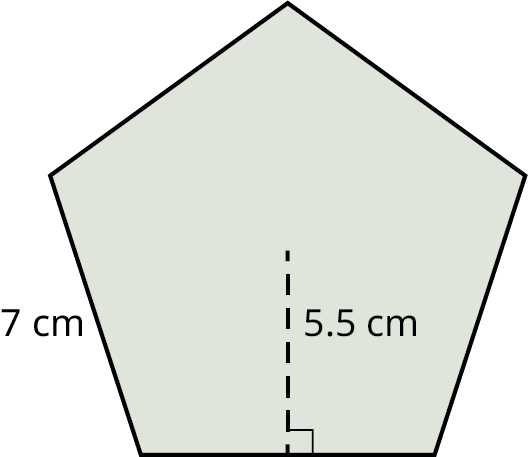
Find the area of the regular pentagon with the apothem equal to 5.5 cm and the side length equal to 7 cm. A pentagon. Each side measures 7 centimeters. The apothem is marked 5.5 centimeters.

Answer

The apothem of a regular polygon is a line segment that starts at the center and is perpendicular to a side. The area of a regular polygon with apothem a and perimeter p is A = 1 2 a p .

A regular pentagon has five sides of equal length. Therefore, the perimeter of a regular pentagon with a side length of 7 cm is:

p = 5 ( 7   c m ) = 35   c m

A = 1 2 a p = 1 2 ( 5.5   c m ) ( 35   c m ) = 96.25   c m 2

The area is 96.25 square centimeters.

A = 96.25 c m 2

Your Turn 10.50 §10.6 source ↗

You want to carpet your bedroom, which measures 15 ft wide by 18 ft long. Carpeting is sold by the square yard, so you must convert your measurements to yards. How much carpeting do you buy?

Answer

First, convert the dimensions to yards. There are 3 feet in one yard.

15   feet ( 1 yard 3  feet ) = 5  yards

18   feet ( 1 yard 3  feet ) = 6  yards

The area of a rectangle is A = L W where L represents the length and W represents the width.

A = L W = ( 5  yd ) ( 6 yd ) = 30  y d 2

You need 30 square yards of carpet.

30 y d 2

Your Turn 10.51 §10.6 source ↗

Find the area of the circle with a radius of 3 cm.

Answer

The area of a circle with radius r is A = π r 2 .

A = π r 2 = π ( 3  cm ) 2 = 9 π  c m 2 ≈ 28.3  c m 2

The area of the circle is approximately 28.3 square centimeters.

28.3 c m 2

Your Turn 10.52 §10.6 source ↗

You can buy a 9-inch diameter pizza for $10.99, or a 15-inch diameter pizza for $14.99. Which pizza is the better value?

Answer

Find the cost of one square inch of pizza for both pizzas. To do that, divide the cost of each pizza by the area of each pizza. The area of a circle with radius r is A = π r 2 .

If the diameter is 9 inches, the radius is 4.5 inches.

If the diameter is 15 inches, the radius is 7.5 inches.

The area of a circle with radius r is A = π r 2 .

  9-inch Pizza 15-inch Pizza
Diameter 9 inches 15-inches
Radius 4.5 inches 7.5 inches
Area π ( 4 .5 in ) 2 ≈ 63.62  i n 2 π ( 7 .5 in ) 2 ≈ 176.71  i n 2
Cost $10.99 $14.99
Cost per Square Inch $ 10.99 63 .62 i n 2 ≈ $ 0.17  i n 2 $ 14.99 176.71  i n 2 ≈ $ 0.08  i n 2

The 15-inch pizza is cheaper at roughly $0.08 per square inch compared to the smaller pizza at roughly $0.17 per square inch.

the 15-inch pizza

Your Turn 10.53 §10.6 source ↗

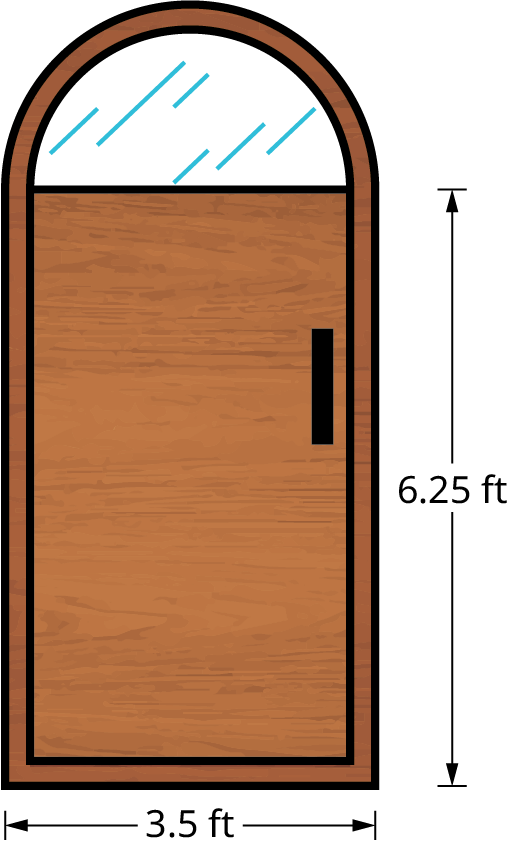
You decide to install a new front door with a semicircle top as shown in the figure. How much area will the new door occupy?
A door resembles a semicircle placed on top of a rectangle. The length and width of the rectangle are 6.25 feet and 3.5 feet. The diameter of the semicircle is 3.5 feet.A door resembles a semicircle placed on top of a rectangle. The length and width of the rectangle are 6.25 feet and 3.5 feet. The diameter of the semicircle is 3.5 feet.

Answer

The door is a rectangle plus a semicircle.

The rectangular area is:

A = L W = ( 3 .5 ft ) ( 6 .25 ft ) = 21.875  f t 2

The area of a circle with radius r is A = π r 2 , but you want half of that.

1 2 A = 1 2 π r 2 = 1 2 π ( 3.5 2  ft ) 2 ≈ 4.8105  f t 2

Add the two results: (21 .875 + 4 .8105) square feet

The total area is approximately 26.7 square feet.

A = 21.875 + 4.8 = 26.7 f t 2

Your Turn 10.54 §10.6 source ↗

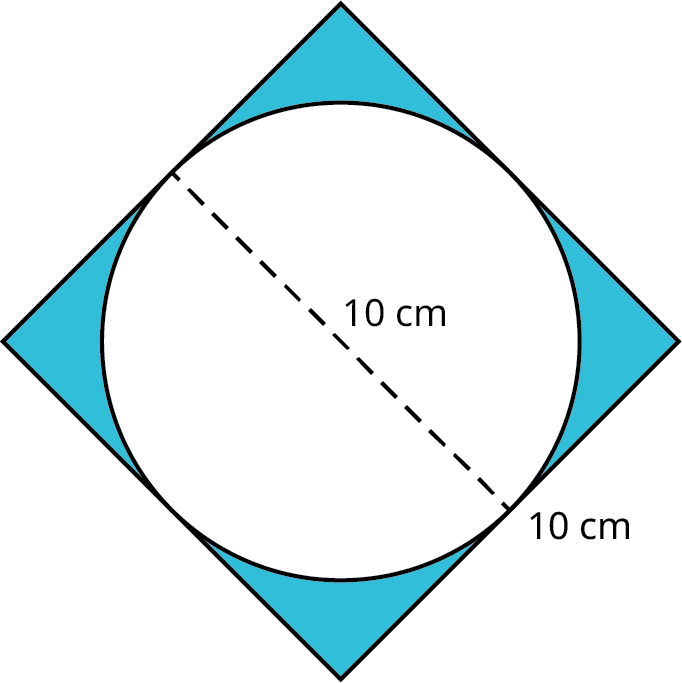
Find the area of the shaded region in the given figure.
A square is circumscribed about a circle. The diameter of the circle is marked 10 centimeters. Each side of the square measures 10 centimeters. The region outside the circle is shaded.

Answer

Step 1: Find the area of the square.

The area of a square with side s is A = s 2

A = s 2 = ( 10  cm ) 2 = 100  c m 2

Step 2: Find the area of the circle.

The area of a circle with radius r is A = π r 2 .

A = π r 2 = π ( 5 cm ) 2 = 25 π  c m 2 (Keeping this exact makes your final answer more accurate.)

Step 3: Subtract the area of the circle from the area of the square.

100  c m 2 − 25 π  c m 2 = 21.46  c m 2

The shaded area is approximately 21.46 square centimeters.

21.46 c m 2

Your Turn 10.55 §10.6 source ↗

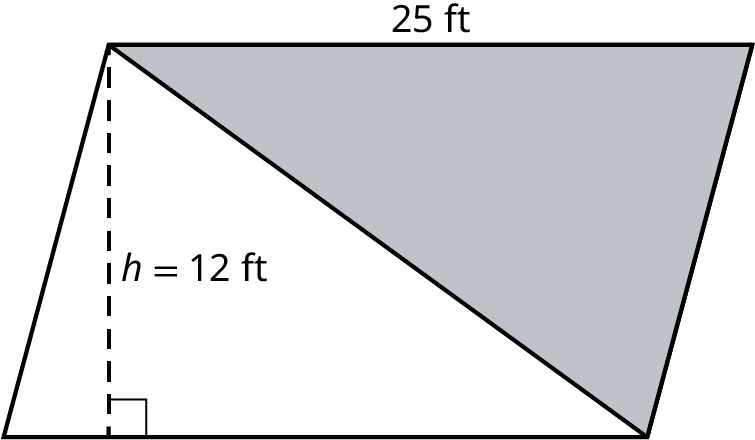
You want to install sod on one-half of your parallelogram-shaped backyard as shown. The patio covers the other half. Sod costs $50 a bag and covers 25 f t 2 . How much will it cost to buy the sod? A parallelogram with a diagonal running from the top-left vertex to the bottom-right vertex. The region above the diagonal is shaded. The length and height of the parallelogram measure 25 feet and h equals 12 feet.

Answer

The area of a parallelogram with base b and height h is A = b h .

A = b h = ( 25 feet ) ( 12 feet ) = 300  f t 2

You are only covering half of the parallelogram, so you only need 150 square foot of sod.

Make a conversion factor that uses the fact that sod costs $50 a bag and one bag covers 25 square feet.

150 f t 2 ( $ 50 25  f t 2 ) = $ 300

The sod will cost $300.

$300

Check Your Understanding 10.6.35 §10.6 source ↗

Find the area of the triangle with base equal to 3 cm and height equal to 5 cm.

Answer

The area of a triangle is A = 1 2 b h , where b represents the base and h represents the height.

A = 1 2 b h = 1 2 ( 3 cm ) ( 5 cm ) =  7 .5 c m 2

7.5 cm2

Check Your Understanding 10.6.36 §10.6 source ↗
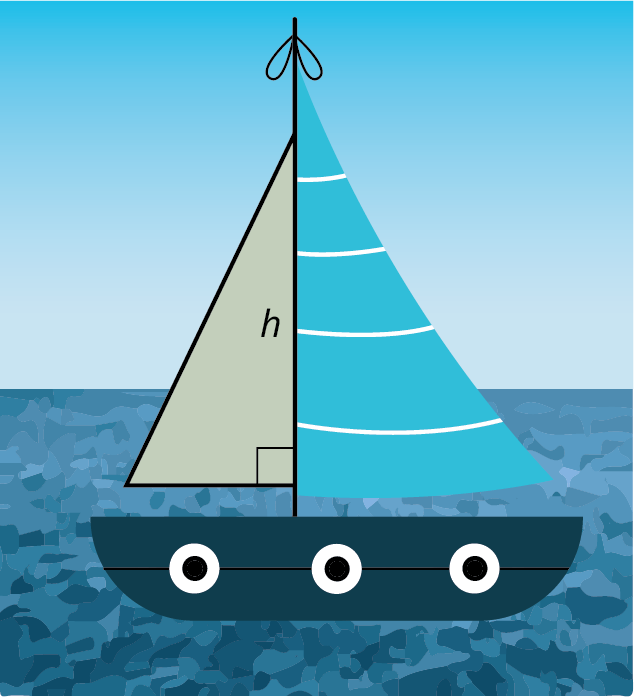
The area of the sail in the sailboat is 125 f t 2 . The shortest length is 10 ft. What is the height of the sail?
A sailboat with the mainsail resembling a right triangle. The height of the mainsail is marked h.

Answer

The area of a triangle is A = 1 2 b h , where b represents the base and h represents the height.

1 2 ( 10 ) h =  125  Simplify on the left.
5 h =  125  Divide.
h = 25  

The height of the sail is 25 feet.

25 ft

Check Your Understanding 10.6.37 §10.6 source ↗
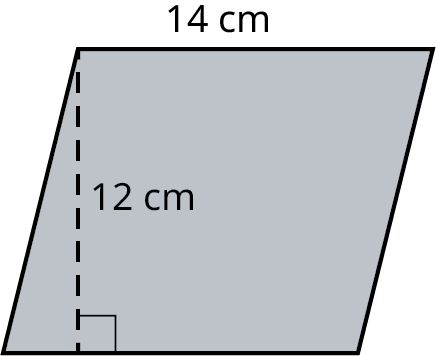
Find the area of this parallelogram.
A parallelogram with its base marked 14 centimeters and height marked 12 centimeters.A parallelogram with its base marked 14 centimeters and height marked 12 centimeters.

Answer

The area of a parallelogram with base b and height h is A = b h .

A = b h = ( 14 cm ) ( 12 cm ) = 168  c m 2

The area of the parallelogram is 168 square centimeters.

168 c m 2

Check Your Understanding 10.6.38 §10.6 source ↗
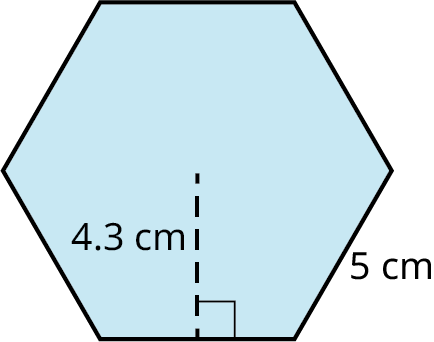
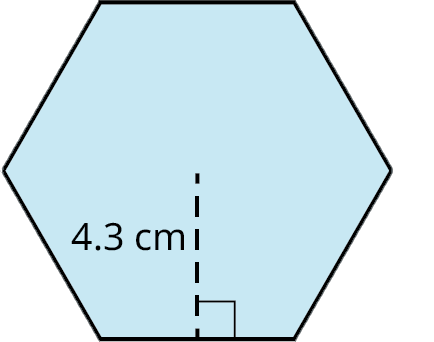
Find the area of a regular hexagon with side length of 5 and apothem equal to 4.3.
A hexagon. Each side measures 5 centimeters. The apothem is marked 4.3 centimeters.A hexagon. Each side measures 5 centimeters. The apothem is marked 4.3 centimeters.

Answer

The apothem of a regular polygon is a line segment that starts at the center and is perpendicular to a side. The area of a regular polygon with apothem a and perimeter p is A = 1 2 a p .

A regular hexagon has six sides of equal length. Therefore, the perimeter is:

p = 6 ( 5  cm) = 30 cm

A = 1 2 a p = 1 2 ( 4.3  cm ) ( 30 cm ) = 64.5  c m 2

The area is 64.5 square centimeters.

64.5 c m 2

Check Your Understanding 10.6.39 §10.6 source ↗

Find the area of circle with a diameter of 16 in.

Answer

The area of a circle with radius r is A = π r 2 .

If the diameter is 16 inches, the radius is 8 inches.

A = π r 2 = π ( 8  in ) 2 = 64 π  in ≈ 201.1  i n 2

The area of the circle is approximately 201.1 square inches.

201.1 in2

Check Your Understanding 10.6.40 §10.6 source ↗
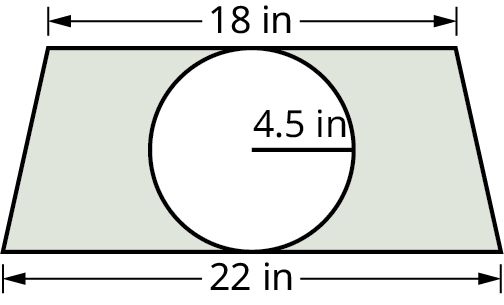
Find the area of the shaded region in the given figure.
A circle is drawn with a trapezoid. The top and bottom bases of the trapezoid measure 18 inches and 22 inches. The radius of the circle is marked 4.5 inches. The circle touches the top and bottom bases of the trapezoid. The region outside the circle is shaded.

Answer

Step 1: Find the area of the trapezoid.

The area of a trapezoid with height h and parallel bases a and b is A = 1 2 h ( a + b ) .

The height of the trapezoid is twice the radius of the circle, so the height is 9 inches.

A = 1 2 h ( a + b ) = A = 1 2 ( 9 in ) ( 18  in + 22  in ) = ( 4 .5 in ) ( 40 in ) = 180  i n 2

Step 2: Find the area of the circle.

The area of a circle with radius r is A = π r 2 .

A = π r 2 = π ( 4 .5 in ) 2 = 20.25 π  i n 2

Step 3: Subtract the area of the circle from the area of the trapezoid.

180  i n 2 − 20.25 π  i n 2 ≈ 116.38  i n 2

The shaded area is approximately 116.38 square inches.

116.38 i n 2

Check Your Understanding 10.6.41 §10.6 source ↗

A round tray sits on top of the dining room table. The radius of the tray is 15 in. What is the area taken up by the tray?

Answer

The area of a circle with radius r is A = π r 2 .

A = π r 2 = π ( 15 in ) 2 = 225 π  i n 2 ≈ 706.89  i n 2

The area of a circle is 706.86 square inches.

706.86 i n 2

Your Turn 10.56 §10.7 source ↗

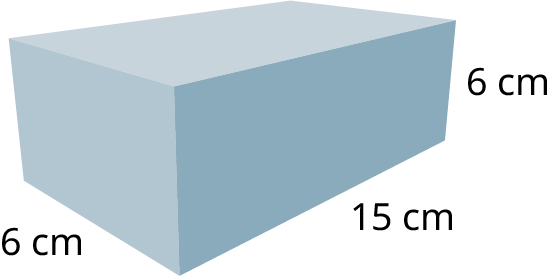
A rectangular solid has a width of 6 cm, length of 15 cm, and height or depth of 6 cm. Find the surface area and the volume.
A rectangular prism with its length, width, and height marked 15 centimeters, 6 centimeters, and 6 centimeters.

Answer

S A = 432  cm 2 V = 540  cm 3

The surface area of a right prism where B is the area of the base, p is the perimeter of the base, and h is the height is S A = 2 B + p h .

The rectangular base has an area  = LW = (6 cm) (15 cm) = 90 c m 2 .

The perimeter of the base  =  p  = 2(6 cm) + 2(15 cm) = 42 cm .

The surface area =   2 B + p h =   2 ( 90  c m 2 )   +   ( 42  cm ) ( 6  cm )   =   180  c m 2 +   252  c m 2 =   432  c m 2 .

The surface area is 432 square centimeters.

The volume of a right prism is V = B h   =   ( 90  c m 2 ) ( 6  cm )   =   540  c m 3 .

The volume is 540 cubic centimeters.

Your Turn 10.57 §10.7 source ↗
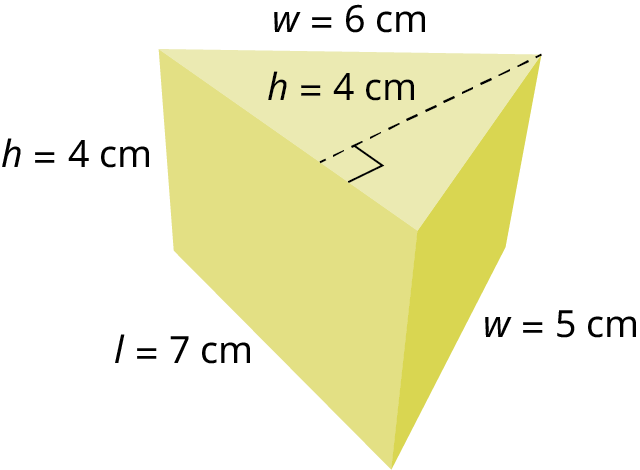
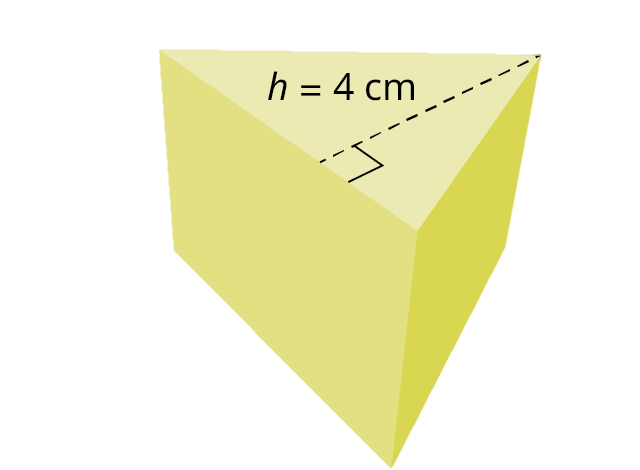
Find the surface area of the triangular prism shown.
A triangular prism. The sides of the triangle are labeled l equals 7 centimeters, w equals 6 centimeters, and w equals 5 centimeters. The height of the triangle is labeled h equals 4 centimeters. The height of the prism is labeled h equals 4 centimeters.A triangular prism. The sides of the triangle are labeled l equals 7 centimeters, w equals 6 centimeters, and w equals 5 centimeters. The height of the triangle is labeled h equals 4 centimeters. The height of the prism is labeled h equals 4 centimeters.

Answer

The surface area of a right prism where B is the area of the base, p is the perimeter of the base, and h is the height is S A = 2 B + p h .

The area of the triangular base is A = 1 2 b h , where b represents the base and h represents the height.

A = 1 2 b h = 1 2 ( 7 cm ) ( 4 cm ) =  14 c m 2

The perimeter of the base = p =   6  cm  +   7  cm  +   5  cm  =   18  cm .

The surface area =   2 B + p h =   2 ( 14  c m 2 )   +   ( 18  cm ) ( 4  cm )   =   28  c m 2 +   72  c m 2 =   100  c m 2 .

The surface area is 100 square centimeters.

100 cm 2

Your Turn 10.58 §10.7 source ↗

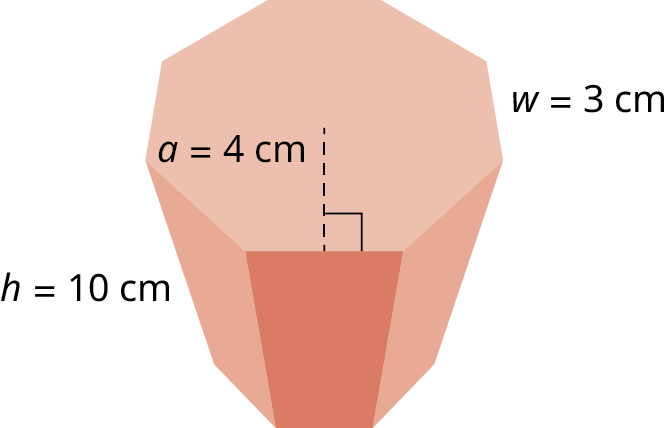
Find the surface area and the volume of the octagonal figure shown.
An octagonal prism. One of the sides of the octagon is labeled w equals 3 centimeters. The apothem is labeled a equals 4 centimeters. The height of the prism is labeled h equals 10 centimeters.An octagonal prism. One of the sides of the octagon is labeled w equals 3 centimeters. The apothem is labeled a equals 4 centimeters. The height of the prism is labeled h equals 10 centimeters.

Answer

The surface area of a right prism where B is the area of the base, p is the perimeter of the base, and h is the height is S A = 2 B + p h .

The apothem of a regular polygon is a line segment that starts at the center and is perpendicular to a side. The area of a regular polygon with apothem a and perimeter p is A = 1 2 a p .

A regular octagon has eight sides of equal length. Therefore, the perimeter is:

p = 8 ( 3  cm) = 24 cm .

A = 1 2 a p = 1 2 ( 4  cm ) ( 24 cm ) = 48  c m 2 , which in the surface area formula is B.

The surface area =   2 B + p h =   2 ( 48  c m 2 )   +   ( 24  cm ) ( 10  cm )   =   96  c m 2 +   240  c m 2 =   336  c m 2 .

The surface area is 336 square centimeters.

The volume of a right prism is V = B h =   ( 48  c m 2 ) (   10  cm )   =   480  c m 3 .

The volume is 480 cubic centimeters.

S A = 336  cm 2 V = 480  cm 3

Your Turn 10.59 §10.7 source ↗

Calculate the surface area of a greenhouse with a flat roof measuring 12 ft wide, 25 ft long, and 8 ft high.

Answer

The surface area of a right prism where B is the area of the base, p is the perimeter of the base, and h is the height is S A = 2 B + p h .

The rectangular base has an area  = LW = (12 ft) (25 ft) = 300 f t 2 .

The perimeter of the base  =  p  = 2(12 ft) + 2(25 ft) = 74 ft .

The surface area =   2 B + p h =   2 ( 300  f t 2 )   +   ( 74  ft ) ( 8  ft )   =   600  f t 2 +   592  f t 2 =   1 , 192  f t 2 .

The surface area is 1,192 square feet.

1,192  ft 2

Your Turn 10.60 §10.7 source ↗

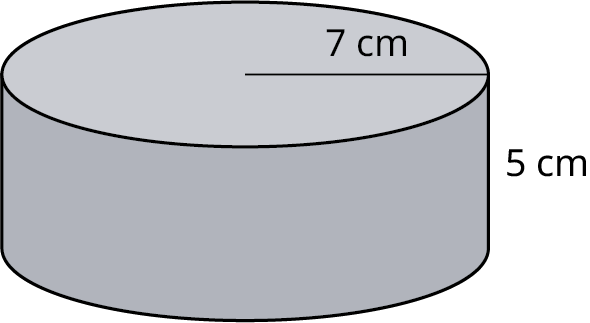
Find the surface area and volume of the cylinder with a radius of 7cm and a height of 5 cm.
A cylinder with its radius and height marked 7 centimeters and 5 centimeters.A cylinder with its radius and height marked 7 centimeters and 5 centimeters.

Answer

The surface area of a right cylinder with radius r and height h is S A = 2 π r 2 + 2 π r h .

S A = 2 π r 2 + 2 π r h = 2 π ( 7  cm ) 2 + 2 π ( 7  cm ) ( 5 cm ) ≈ 527.78  c m 2

The surface area is 527.78 square centimeters.

The volume of a right cylinder with radius r and height h is V = π r 2 h .

V = π r 2 h = π ( 7  cm ) 2 ( 5 cm ) ≈ 769.69  c m 3

The volume is 769.69 cubic centimeters.

S A = 527.78  cm 2 V = 769.69  cm 3

Your Turn 10.61 §10.7 source ↗

You are making a casserole that includes vegetable soup and pasta. The size of your cylindrical casserole dish has a diameter of 10 inches and is 4 inches high. The pasta will consume the bottom portion of the casserole dish about 1 inch high. The soup can has a diameter of 3 inches and is 4 inches high. After the pasta is added, how many cans of soup can you add?

Answer

The volume of a right cylinder with radius r and height h is V = π r 2 h .

Step 1: Find the volume of the casserole dish available.

The depth of the dish is 4 inches, but one inch is filled with pasta. Use 3 inches for the height of the cylinder. The diameter is 10 inches, so the radius is 5 inches.

V = π r 2 h = π ( 5 in ) 2 ( 3 in ) = 75 π  i n 3

Step 2: Find the volume of a can. The diameter is 3 inches, so the radius is 1.5 inches.

V = π r 2 h = π ( 1 .5 in ) 2 ( 4 in ) = 9 π  i n 3

Step 3: Make a conversion factor using the volume of a can.

75 π  inche s 3 ( 1  can 9 π   inche s 3 ) = 25 3  cans = 8 1 3  cans

You can add 8 1 3 cans of soup.

approximately 8 1/3 cans of soup

Your Turn 10.62 §10.7 source ↗

You have 25 ft of rope to section off a rectangular-shaped garden. What dimensions give the maximum area that can be roped off?

Answer

While we do not have the tools to truly answer this question, we can look at several examples and pick the best choice.

Shape (feet) Perimeter (feet) Area (square feet)
Rectangle: 10 by 2.5 2 ( 10 )   +   2 ( 2.5 )   =   25 feet 10 ( 2.5 ) =   25
Square: 6.25 each side 4 ( 6.25 )   =   25 6.25 ( 6.25 )   =   39.0625
Circle with circumference of 25 feet. Find the radius.
25  ft = 2 π r    Divide.
25 ft 2 π = r
r ≈   3.9789  ft
25 feet = π ( 3.9789  ft ) 2 ≈ 49.74  f t 2
Rectangle: 8 by 4.5 feet 2 ( 8 )   +   2 ( 4.5 )   =   25 feet 8 ( 4.5 ) =   36

The circle gives the maximum area, but the question asks for the shape to be rectangular. Of the rectangular shapes, the square has the largest area at 6.25 feet by 6.25 feet.

6.25 ft by 6.25 ft

Your Turn 10.63 §10.7 source ↗

Suppose you want to a build a container to hold 2 cubic feet of fabric swatches. You want to cover the container in laminate costing $10 per square foot. What are the dimensions of the container that is the most economical? What is the cost?

Answer

If all six sides are the same, then the ideal volume is V = s 3 .

2  f t 3 = s 3 Find the cube root of both sides.
1.26  ft  = s  
Find the surface area.

The rectangular base has an area B = LW = (1 .26 ft)(1 .26 ft) = 1 .59 f t 2 .

The perimeter of the base  =  p  = 2(1 .26 ft) + 2(1  .26 ft) = 5 .04 ft .

The surface area =   2 B + p h =   2 ( 1.59  f t 2 )   +   ( 5.04  ft ) ( 1.26  ft )   =   9.5304  f t 2 .

Make a conversion factor out of the cost of laminate.

9.5304   sq ft ( $ 10 1   sq ft ) ≈ $ 95.30

The ideal dimensions are 1.26 feet wide by 1.26 feet long by 1.26 feet high at a cost of $95.30.

1.26 ft wide × 1.26 ft long × 1.26 ft high , $95.26

Check Your Understanding 10.7.42 §10.7 source ↗
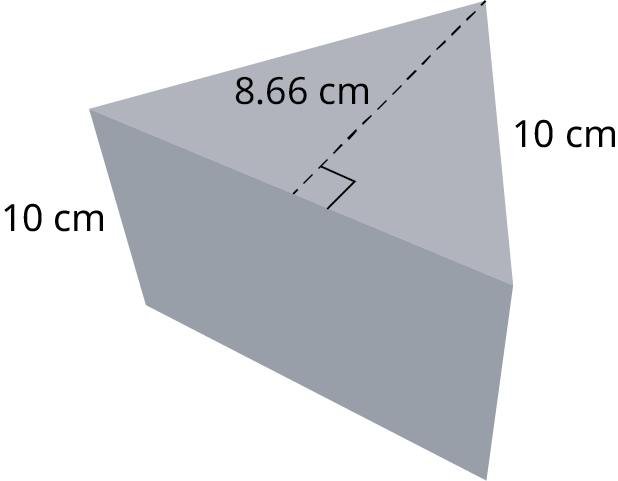
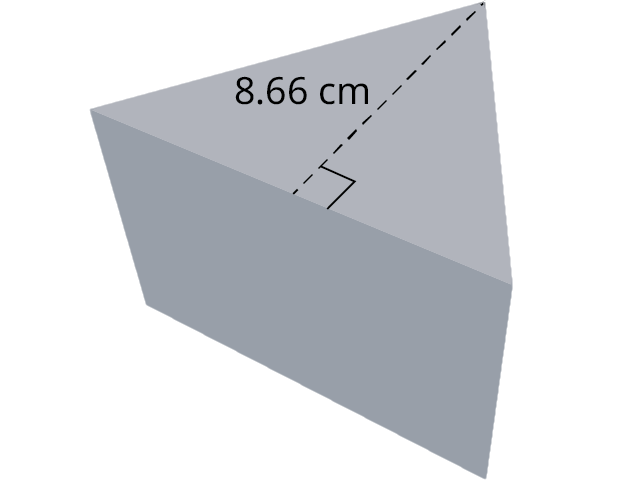
Find the surface area of the equilateral triangular prism shown.
An equilateral triangular prism. The sides of the triangle measure 10 centimeters. The height of the triangle measures 8.66 centimeters. The length of the prism measures 10 centimeters.An equilateral triangular prism. The sides of the triangle measure 10 centimeters. The height of the triangle measures 8.66 centimeters. The length of the prism measures 10 centimeters.

Answer

The surface area of a right prism where B is the area of the base, p is the perimeter of the base, and h is the height is S A = 2 B + p h .

The area of the triangular base is A = 1 2 b h , where b represents the base and h represents the height.

A = 1 2 b h = 1 2 ( 10 cm ) ( 8 .66 cm ) =  43 .3 c m 2

The perimeter of the base  =  p  = 10 cm + 10 cm + 10 cm = 30 cm .

The surface area =   2 B + p h =   2 ( 43.3  c m 2 )   +   ( 30  cm ) ( 10  cm )   =   86.6  c m 2 +   300  c m 2 =   386.6  c m 2 .

The surface area is 386.6 square centimeters.

386.6 cm 2

Check Your Understanding 10.7.43 §10.7 source ↗
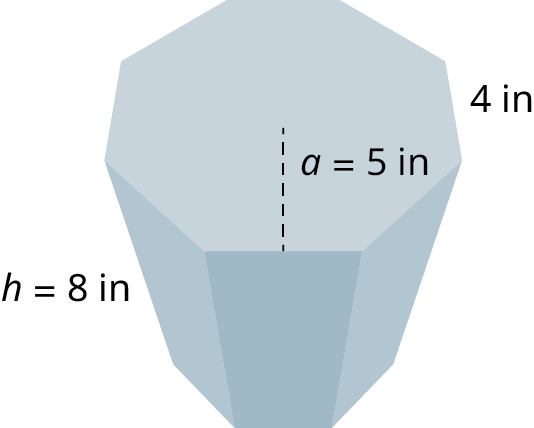
Find the surface area of the octagonal prism shown.
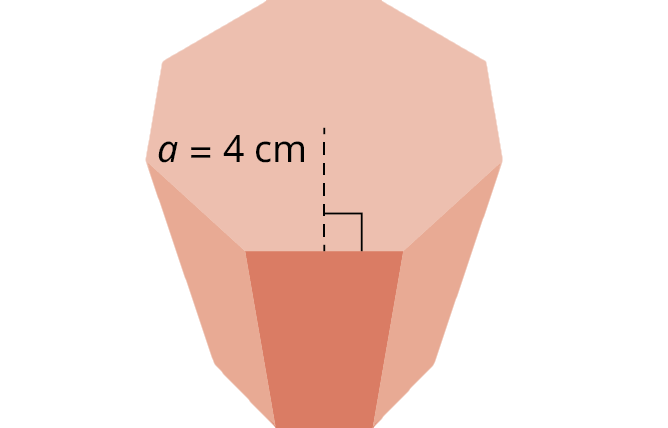
An octagonal prism. Each side of the octagon measures 4 inches. The height of the prism measures h equals 8 inches. The apothem is marked a equals 5 inches.

Answer

416 in 2

The surface area of a right prism where B is the area of the base, p is the perimeter of the base, and h is the height is S A = 2 B + p h .

The apothem of a regular polygon is a line segment that starts at the center and is perpendicular to a side. The area of a regular polygon with apothem a and perimeter p is A = 1 2 a p .

A regular octagon has eight sides of equal length. Therefore, the perimeter is:

p = 8 ( 4  in) = 32 in

A = 1 2 a p = 1 2 ( 5 in ) ( 32 in ) = 80  i n 2 , which in the surface area formula is B.

The surface area =   2 B + p h =   2 ( 80  i n 2 )   +   ( 32  in ) ( 8  in )   =   160  i n 2 +   256  i n 2 =   416  i n 2 .

The surface area is 416 square inches.

Check Your Understanding 10.7.44 §10.7 source ↗

Find the volume of the octagonal prism shown with the apothem equal to 5 in , the side length equal to 4 in , and the height equal to 8 in .

Answer

The volume of a right prism is V = B h =   ( 80  i n 2 ) (   8  in )   =   640  i n 3 .

The volume is 640 cubic inches.

640 in 3

Check Your Understanding 10.7.45 §10.7 source ↗

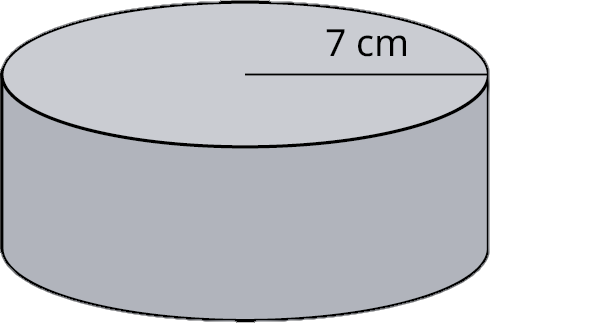
Determine the surface area of the right cylinder where the radius of the base is 10 cm , and the height is 5 cm .

Answer

The surface area of a right cylinder with radius r and height h is S A = 2 π r 2 + 2 π r h .

S A = 2 π r 2 + 2 π r h = 2 π ( 10  cm ) 2 + 2 π ( 10  cm ) ( 5 cm ) ≈ 942.48  c m 2

The surface area is approximately 942.48 square centimeters.

942.48 cm 2

Check Your Understanding 10.7.46 §10.7 source ↗

Find the volume of the cylinder where the radius of the base is 10 cm , and the height is 5 cm .

Answer

The volume of a right cylinder with radius r and height h is V = π r 2 h .

V = π r 2 h = π ( 10 cm ) 2 ( 5 cm ) ≈ 1 , 571  c m 3

The volume is approximately 1,571 cubic centimeters.

1 , 570 cm 3

Check Your Understanding 10.7.47 §10.7 source ↗
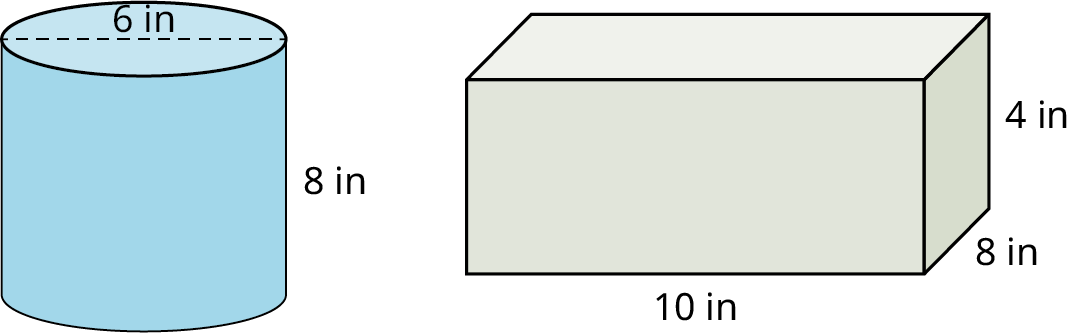
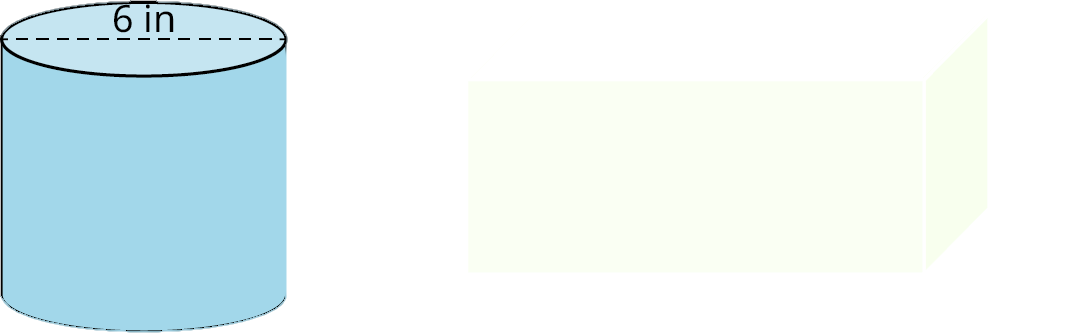
As an artist, you want to design a cylindrical container for your colored art pencils and another rectangular container for some other tools. The cylindrical container will be 8 inches high with a diameter of 6 inches. The rectangular container measures 10 inches wide by 8 inches deep by 4 inches high and has a lid. You found some beautiful patterned paper to use to wrap both pieces. How much paper will you need?
A cylinder and a prism. The diameter and height of the cylinder are marked 6 inches and 8 inches. The length, width, and height of the rectangular prism are marked 10 inches, 8 inches, and 4 inches.A cylinder and a prism. The diameter and height of the cylinder are marked 6 inches and 8 inches. The length, width, and height of the rectangular prism are marked 10 inches, 8 inches, and 4 inches.

Answer

Step 1: Find the surface area of the cylinder.

The surface area of a right cylinder with radius r and height h is S A = 2 π r 2 + 2 π r h .

S A = 2 π r 2 + 2 π r h = 2 π ( 3 in ) 2 + 2 π ( 3 in ) ( 8 in ) ≈ 207.345  i n 2

Step 2: Find the surface area of the right prism.

The surface area of a right prism where B is the area of the base, p is the perimeter of the base, and h is the height is S A = 2 B + p h .

The rectangular base has an area  = LW = (10 in) (8 in) = 80 i n 2 .

The perimeter of the base  =  p  = 2(10 in) + 2(8 in) = 36 cm .

The surface area =   2 B + p h =   2 ( 80  i n 2 )   +   ( 36  in ) ( 4  in )   =   160  i n 2 +   144  i n 2 =   304  i n 2 .

Step 3: Add the results of the previous two steps.

207.35  i n 2 +   304  i n 2 =   511.35  i n 2

The total area is 511.35 square inches.

511.35 in 2

Your Turn 10.64 §10.8 source ↗

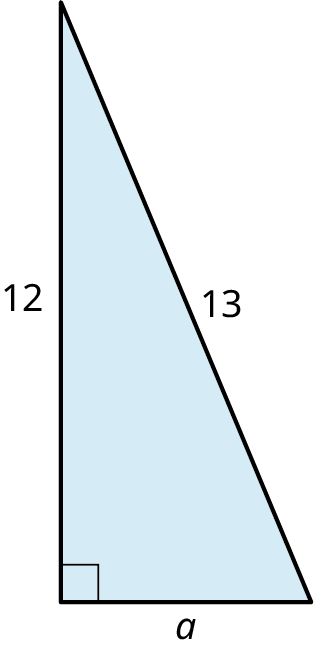
Use the Pythagorean Theorem to find the missing side of the right triangle shown.
A right triangle with its legs marked 12 and a. The hypotenuse is marked 13.

Answer

The Pythagorean Theorem states a 2 + b 2 = c 2 where a and b are two sides (legs) of a right triangle and c is the hypotenuse.

a 2 + 12 2 = 13 2  
a 2 + 144 = 169 Simplify.
a 2 = 25 Subtract.
a = ± 25 Use the Square Root Property.
a = 5 Simplify. Lengths cannot be negative.
a = 5

Your Turn 10.65 §10.8 source ↗

How far is it to your workplace (as the crow flies) if the blocks in the previous example measure 100 ft by 100 ft?

Answer

1,140 ft

The distance from point ( x 1 , y 1 ) to point ( x 2 , y 2 ) is d = ( x 2 − x 1 ) 2 + ( y 2 − y 1 ) 2 .

You go 7 south and 9 blocks west, where each block is 100 feet.

If (0,0) is where you end up, you are looking for the distance from (0,0) to (900, 700).

d = ( 900 − 0 ) 2 + ( 700 − 0 ) 2

d = 810 , 000 + 490 , 000

d = 1 , 300 , 000

d ≈   1 , 140   feet

The distance is approximately 1,140 feet.

Your Turn 10.66 §10.8 source ↗

If 10 in is the maximum possible vertical rise as shown in the figure, how long would the ramp have to be to pass the building code rule of 12 horizontal inches to 1 vertical inch?
A right triangle with its legs marked 10 inches and 120 inches. The hypotenuse is marked c.

Answer

The Pythagorean Theorem states a 2 + b 2 = c 2 where a and b are two sides (legs) of a right triangle and c is the hypotenuse.

10 2 + 120 2 = c 2  
100 + 14 , 400 = c 2 Simplify.
14 , 500 = c 2 Use the Square Root Property.
c = ± 14 , 500 Use the Square Root Property.
c =   120.4   inches Simplify. Lengths cannot be negative.

The slanted ramp must be at least 120.42 inches.

The slanted distance will be 120.4 inches.

Your Turn 10.67 §10.8 source ↗

Find the lengths of the missing sides in the given figure.
A right triangle with its legs marked b and 15. The hypotenuse is marked c. The angles at the bottom-left and bottom-right are labeled 90 degrees and 60 degrees.

Answer

The side lengths are 15 , 15 3 , 30.

The set of ratios in a 30°-60°-90° triangle are 1 : 3 : 2 , or x : x 3 : 2 x .

Since you are shown the right angle and the 60° angle, you know the unmarked angle is a 30° angle.

The side opposite the 30° angle is the shortest side, a = x =   15 .

2 x =   2 ( 15 )   =   30

x 3 = 15 3

The side lengths are 15, 30, 15 3 .

Your Turn 10.68 §10.8 source ↗

You want to repair a window on the second floor of your home. If you place the ladder at a 30 ∘ angle to the ground, the ladder just about reaches the window. How far from the wall should you place the ladder? How far up will the ladder reach? Make a sketch as an aid.
An illustration shows a 34-foot ladder placed against a building at an angle of 30 degrees. The vertical distance from the ladder to the ground is marked b. The horizontal distance from the base of the building to the base of the ladder is a.

Answer

The set of ratios in a 30°-60°-90° triangle are 1 : 3 : 2 , or x : x 3 : 2 x .

Since you are shown the right angle are told about the 30° angle at the ground, you know the other angle is a 60° angle.

The ladder is the longest side, so 2 x =   24 feet.

If 2 x =   24 , then x =   12 and b =   12 feet since it is the shorter leg, opposite the 30° angle

x 3 = 12 3 ≈ 20.8  feet , the distance from the wall.

The ladder is 20.8 feet (or 12 3 feet) from the wall and reaches 12 feet up the wall.

The ladder reaches 12 feet up the wall and sits 12 3  feet from the wall.

Your Turn 10.69 §10.8 source ↗

Find the measures of the unknown sides in the given figure. A right triangle, A B C. The legs, C A, and A B measure x and x. The hypotenuse, C B measures 8. The angles, C and B are congruent. Angle A is a right angle.

Answer

The set of ratios in a 45°-45°-90° triangle are 1 : 1 : 2 , or x : x : x 2 .

They show the 90° angle and two other angles of equal measure. That means the other two angles have a measure of 45° each.

Since 8 is the longest side, 8 = x 2 .

x = 8 2 Divide.
x = 8 2 ( 2 2 ) Rationalize the denominator.
x = 8 2 2  
x = 4 2 or approximately 5.66.  
Each side x equals x = 4 2 = 5.66.

Your Turn 10.70 §10.8 source ↗

Find the lengths of the missing sides in the given figure.
A ray is plotted on an x y coordinate plane. The ray lies in the first quadrant and a vertical dashed line is extended from a point on the ray to meet the x-axis and it makes a right angle. The horizontal distance from the origin to the line is marked 5. The angle made by the ray with the x-axis is marked 40 degrees. The distance from the origin to the point along the ray is labeled r.

Answer

Find y.

The tangent of an angle is the opposite divided by the adjacent side: tan ⁡ 40 ∘ = opp adj .

tan ⁡ 40 ∘ = y 5

y = 5 tan ⁡ 40 ∘ ≈ 4.2

Find r.

The cosine of an angle is the adjacent side divided by the hypotenuse: cos ⁡ 40 ∘ = adj hyp .

cos ⁡ 40 ∘ = 5 r

r cos ⁡ 40 ∘ = 5

r = 5 cos ⁡ 40 ∘ ≈ 6.53

Note: You could have used the Pythagorean Theorem to find the second side. You can also use the Pythagorean Theorem to check your work. That is left to you.

r = 6.53 y = 4.2

Your Turn 10.71 §10.8 source ↗

Find the missing side and angles in the figure shown. A ray is plotted on an x y coordinate plane. The ray lies in the first quadrant and a vertical dashed line is extended from a point on the ray to meet the x-axis and it makes a right angle. This dashed line measures 6. The horizontal distance from the origin to the line is marked x. The angle made by the ray with the x-axis is marked alpha. The distance from the origin to the point along the ray is labeled 8.3. The angle made by the ray and the dashed line is marked beta.

Answer

Find α .

The sine of an angle is the opposite side divided by the hypotenuse: sin ⁡ α = opp hyp .

sin ⁡ α = 6 8.3

α = sin − 1 ( 6 8.3 )

Note: The inverse of the sine function is not 1 divided by the sine function. There is probably a second function associated with the sine key on your calculator. You might be entering something like this: [2nd] [sine button] [left parentheses] [6] [÷] [8] [.] [3] [right parentheses] [EXE]

α ≈ 46.3 ∘

Find β .

Since this is a right triangle, you know α and β add up to 90°.

90   −   46.3   =   43.7 ∘ .

β   ≈   43.7 ∘ .

Find x.

The Pythagorean Theorem states a 2 + b 2 = c 2 where a and b are two sides (legs) of a right triangle and c is the hypotenuse.

x 2 + 6 2 = 8.3 2  
x 2 + 36 = 68.89 Simplify.
x 2 = 32.89 Subtract.
x = ± 32.89 Use the Square Root Property.
x ≈   5.73 Simplify. Lengths cannot be negative.
α = 46.3 ∘ , β = 43.7 ∘ , x = 5.73

Your Turn 10.72 §10.8 source ↗

Suppose that the plane takes off at a 23 ∘ angle, and 1 mile from the airport is a 1,500-foot peak. At what altitude will the plane pass over the peak?

Answer

First, convert one mile to 5,280 feet.

The sine of an angle is the opposite side divided by the hypotenuse: sin ⁡ α = opp hyp .

sin ⁡ 23 ∘ = y 5 , 280

y = 5 , 280 ( sin ⁡ 23 ∘ )

y   ≈   2 , 241 feet

The plane is approximately 2,241 feet in the airport when it passes over the peak.

Note: 2 , 241   −   1 , 500   =   741 feet, so the plane is 741 feet over the peak.

2,241 ft

Your Turn 10.73 §10.8 source ↗

You know the lengths of two sides and the right angle as shown in the figure. Find the length of the third side and the other angles. A right triangle with its legs marked 7 and 4. The hypotenuse is marked c. The angle made by the hypotenuse and the horizontal leg is marked.

Answer

Find c.

The Pythagorean Theorem states a 2 + b 2 = c 2 where a and b are two sides (legs) of a right triangle and c is the hypotenuse.

4 2 + 7 2 = c 2  
16 + 49 = c 2 Simplify.
65 = c 2 Use the Square Root Property.
c ≈   8.06 Simplify. Lengths cannot be negative.

Find the angle opposite 7.

The tangent of an angle is the opposite divided by the adjacent side: tan ⁡ θ = opp adj .

tan ⁡ θ = 7 4  
θ = tan 1 ( 7 4 ) Remember to use the inverse function and parentheses.
θ ≈ 60.3 ∘  

Find the angle opposite 4.

Since this is a right triangle, you know the sum of the measure of the other two angles adds up to 90°.

90   −   60.3   =   29.7 ∘ .

The angle opposite the 4 side has a measure of 29.7°.

The side c has a measure of 8.06. The angles have measures of 60.3° and 29.7°.

c = 8.06 , one angle is 60 ∘ , and the other angle is 30 ∘ .

Your Turn 10.74 §10.8 source ↗

You travel to Chicago and visit the observation deck at Willis Tower, 1,450 ft above ground. You can see the Magnificent Mile to the northeast 6,864 ft away. What is the angle of depression from the observation deck to the Magnificent Mile?
An illustration shows a right triangle. The vertical leg of the triangle represents the height of the Willis Tower and it measures 1450 feet. The horizontal leg measures 6864 feet. A horizontal dashed line is drawn from the top of the triangle. The angle between the hypotenuse and the horizontal dashed line represents the angle of depression.

Answer

The angle at the ground in the drawing will have the same measure as the angle of depression since alternate interior angles have the same measure.

The tangent of an angle is the opposite divided by the adjacent side: tan ⁡ α = opp adj .

tan ⁡ θ = 1,450 6 , 864  
θ = tan − 1 ( 1,450 6 , 864 ) Remember to use the inverse function and parentheses.
θ ≈ 11.9 ∘  
11.9 ∘

Your Turn 10.75 §10.8 source ↗

You are flying a kite on a 60-foot string. The angle of elevation from the ground to the kite is 50 ∘ . How high above the ground is the kite?
A right triangle. A kite is placed at the top of the triangle. The hypotenuse measures 60 feet. The angle made by the hypotenuse and the horizontal leg measures 50 degrees.

Answer

The sine of an angle is the opposite side divided by the hypotenuse: sin ⁡ α = opp hyp .

sin ⁡ 50 ∘ = y 60

y = 60 ( sin ⁡ 50 ∘ )

y ≈   46 feet

The kite is approximately 46 feet above the ground.

46 ft

Check Your Understanding 10.8.48 §10.8 source ↗
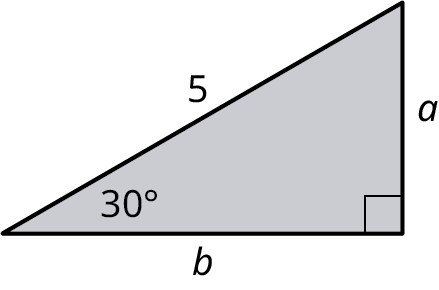
Find the lengths of the unknown sides of the 30 ∘ - 60 ∘ - 90 ∘ triangle shown..
A right triangle. The legs are labeled a and b. The hypotenuse is labeled 5. The angles at the bottom-left and bottom-right are labeled 30 degrees and 90 degrees.A right triangle. The legs are labeled a and b. The hypotenuse is labeled 5. The angles at the bottom-left and bottom-right are labeled 30 degrees and 90 degrees.

Answer

The set of ratios in a 30°-60°-90° triangle are 1 : 3 : 2 , or x : x 3 : 2 x .

Since you are shown the right angle and the 30° angle, you know the unmarked angle is a 60° angle.

The longest side is 5, so 2 x =   5 .

x =   2.5

x 3 = 2.5 3

The missing side lengths are a =   2.5 and b = 2.5 3 .

a = 2.5 b = 2.5 3

Check Your Understanding 10.8.49 §10.8 source ↗
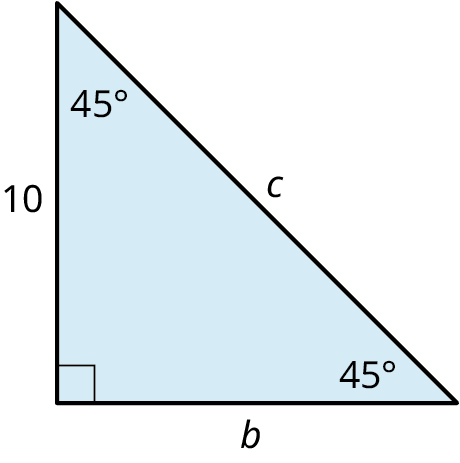
Find the missing lengths of the 45 ∘ - 45 ∘ - 90 ∘ triangle shown.
A right triangle. The legs are labeled 10 and b. The hypotenuse is labeled c. The angles at the top, bottom-left, and bottom-right are labeled 45 degrees, 90 degrees, and 45 degrees.

Answer

b = 10 c = 10 2

The set of ratios in a 45 ∘ - 45 ∘ - 90 ∘ triangle are 1 : 1 : 2 , or x : x : x 2 .

10 is x.

That means b = x =   10 .

c = x 2 = 10 2

The missing lengths are 10 and 10 2 .

Check Your Understanding 10.8.50 §10.8 source ↗
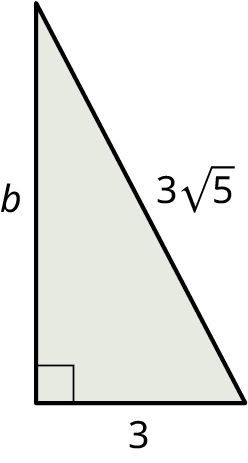
Use the Pythagorean theorem to find the missing length in the triangle shown.
A right triangle. The legs are labeled b and 3. The hypotenuse is labeled 3 times square root of 5.

Answer

The Pythagorean Theorem states a 2 + b 2 = c 2 where a and b are two sides (legs) of a right triangle and c is the hypotenuse.

3 2 + b 2 = ( 3 5 ) 2  
9 + b 2 = 45 Simplify.
b 2 = 36 Subtract.
b = 6 Use the Square Root Property. Lengths cannot be negative.
b = 6

Check Your Understanding 10.8.51 §10.8 source ↗
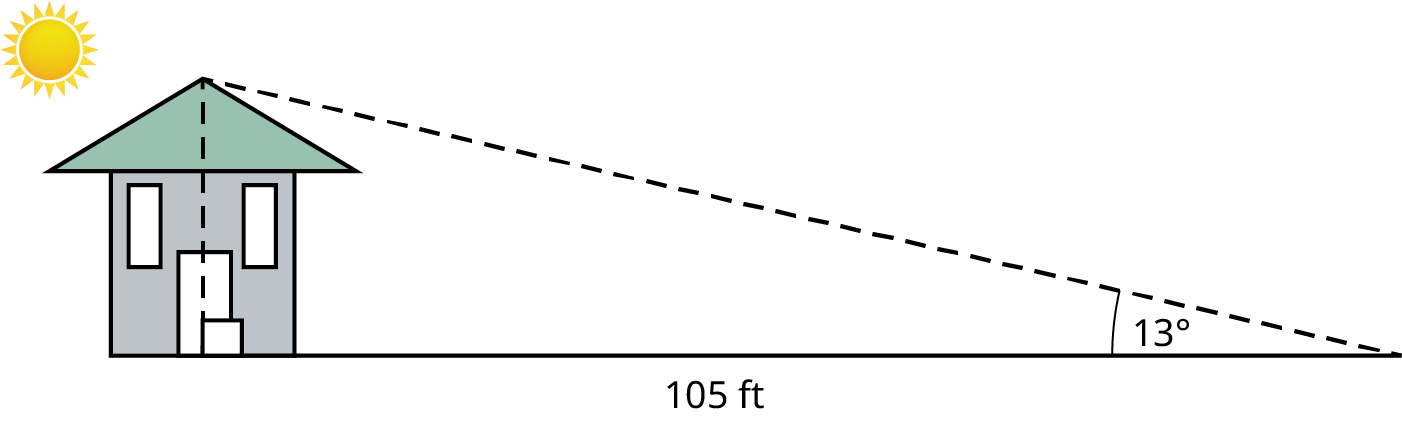
The sun casts a shadow over the roof of a house that ends 105 ft from the front door as shown in the figure. How high is the house to the tip of the roof?
An illustration shows a right triangle. The vertical leg represents the height of a house. The sun is above the house. The horizontal leg measures 105 feet. The angle formed by the hypotenuse and the horizontal leg measures 13 degrees.An illustration shows a right triangle. The vertical leg represents the height of a house. The sun is above the house. The horizontal leg measures 105 feet. The angle formed by the hypotenuse and the horizontal leg measures 13 degrees.

Answer

The tangent of an angle is the opposite divided by the adjacent side: tan ⁡ α = opp adj .

tan ⁡ 13 ∘ = y 105  
y = 105 tan ⁡ 13 ∘ Remember to use the inverse function and parentheses.
y ≈ 24.2  ft  

The height to the tip of the roof is approximately 24.2 feet.

24.2 ft

Check Your Understanding 10.8.52 §10.8 source ↗
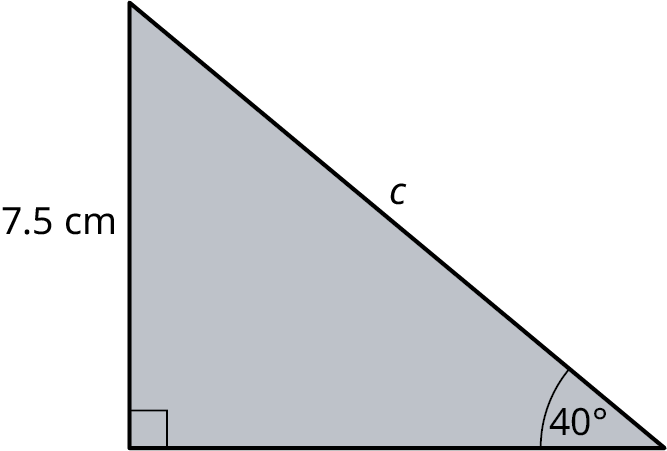
Find the measure of side c in the given figure.
A right triangle. The legs are labeled 7.5 centimeters and unknown. The hypotenuse is labeled c. The angles at the bottom-left and bottom-right are 90 degrees and 40 degrees.A right triangle. The legs are labeled 7.5 centimeters and unknown. The hypotenuse is labeled c. The angles at the bottom-left and bottom-right are 90 degrees and 40 degrees.

Answer

c = 11.7  cm

The sine of an angle is the opposite side divided by the hypotenuse: sin ⁡ θ = opp hyp .

sin ⁡ 40 ∘ = 75 c

c ( sin ⁡ 40 ∘ ) = 7.5

c = 7.5 sin ⁡ 40 ∘

c ≈   11.7  cm

Check Your Understanding 10.8.53 §10.8 source ↗
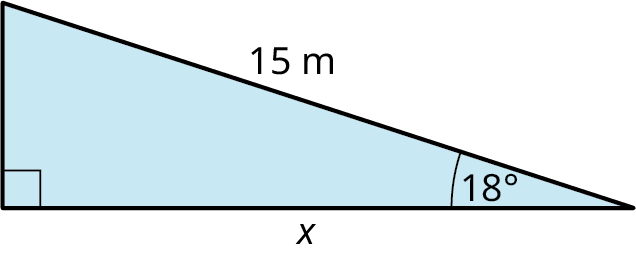
Find the measure of side x in the given figure.
A right triangle. The legs are labeled unknown and x. The hypotenuse is labeled 15 meters. The angles at the bottom-left and bottom-right are 90 degrees and 18 degrees.A right triangle. The legs are labeled unknown and x. The hypotenuse is labeled 15 meters. The angles at the bottom-left and bottom-right are 90 degrees and 18 degrees.

Answer

The cosine of an angle is the adjacent side divided by the hypotenuse: cos ⁡ θ = adj hyp .

cos ⁡ 18 ∘ = x 15

x = 15 ( cos ⁡ 18 ∘ )

x ≈ 14.3  meters

x = 14.3  m

Loading chapter 11…

Problems and answers are adapted from Contemporary Mathematics by Donna Kirk, OpenStax, and are used under the CC BY-NC-SA 4.0 licence. Access for free at https://openstax.org/books/contemporary-mathematics/pages/1-introduction. Illustrations: Copyright Rice University, OpenStax, under CC BY-NC-SA 4.0 license. This adaptation is released under the same licence, is non-commercial, and is neither affiliated with nor endorsed by OpenStax or Rice University.