Every problem in the chapter beside the book’s answer, a chapter at a time as you scroll.
Chapter 12: Graph Theory
181 problems · 88 figuresYour Turn 12.1 §12.1 source ↗
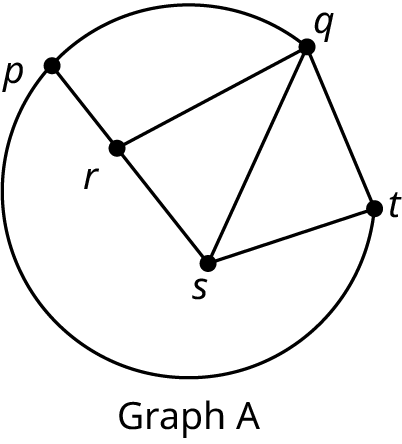 Graph A
Answer
Your Turn 12.2 §12.1 source ↗
Answer
Your Turn 12.3 §12.1 source ↗
Answer
Your Turn 12.4 §12.1 source ↗
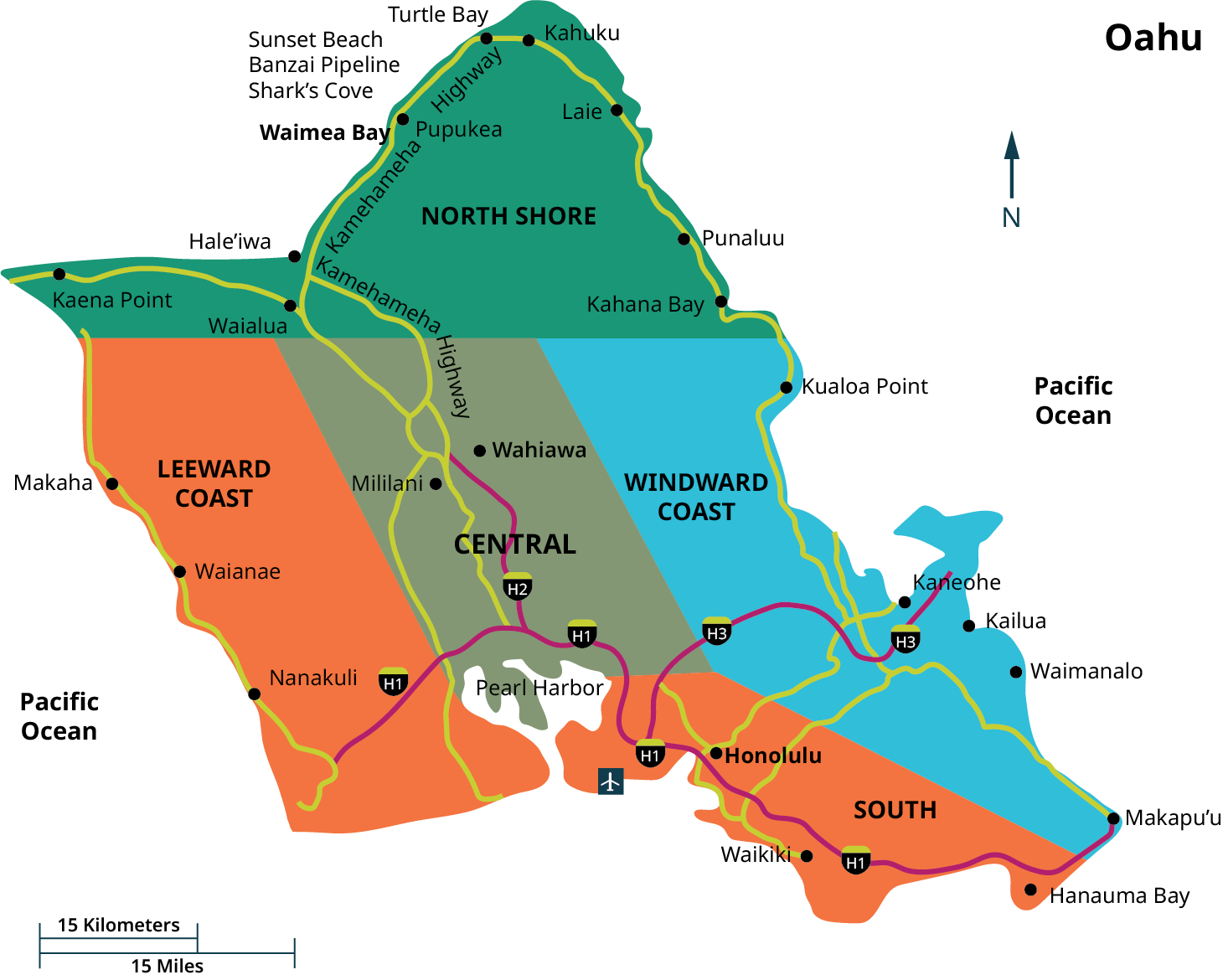
 Map of Oahu
Answer
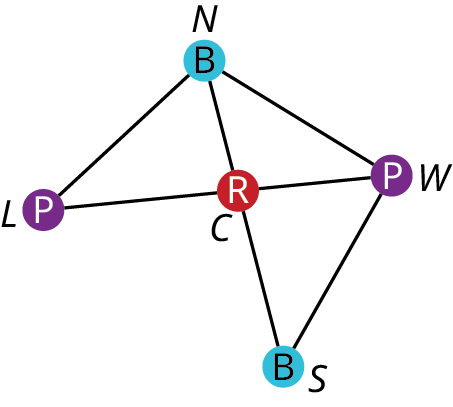
Draw a vertex to represent each region. Label each with the initial of the region (N for North Shore, L for Leeward Coast, C for Central, S for South, and W for Windward Coast). Draw edges to connect vertices that share a common border. The North Shore region shares a border with Leeward Coast, Central, and Windward Coast, so draw an edge from N to L, C, and W.
Leeward Coast shares a border with North Shore and Central. You already have the edge between N and L, so all you need to add is the edge between N and C.
Central shares a border with all the other four regions. You need to add an edge to W and S.
Windward shares a border with North Shore, Central, and South. You already have the edge to N and C, so add the edge to S.
South shares a border with Central and Windward. You already have both of those. You are done.
Go back over your drawing and the map. Count the degree of your vertices and compare it to the “degree” of each region on the map.
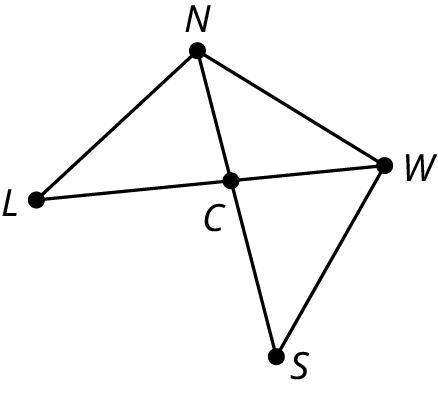 Graph Representing Common Boundaries Between Regions of Oahu
Your Turn 12.5 §12.1 source ↗
Answer
Check Your Understanding 12.1.1 §12.1 source ↗
- a.True
- b.False
Answer
Check Your Understanding 12.1.2 §12.1 source ↗
- a.True
- b.False
Answer
Check Your Understanding 12.1.3 §12.1 source ↗
- a.True
- b.False
Answer
Check Your Understanding 12.1.4 §12.1 source ↗
- a.True
- b.False
Answer
Check Your Understanding 12.1.5 §12.1 source ↗
- a.True
- b.False
Answer
Your Turn 12.6 §12.2 source ↗
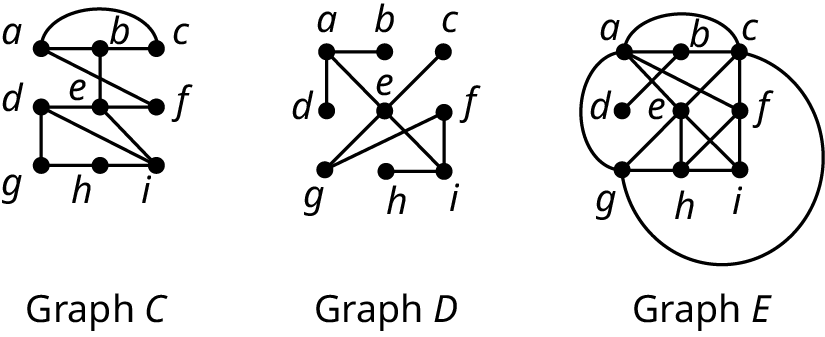 Models of Communities Which graph do you think represents the most resilient community? What is the sum of the degrees of all the vertices in this graph?
Answer
Scientists consider communities with more connections more resistant to failure because they have more options. A graph of such a community will have a higher sum of its degrees.
| Degree | Graph | ||
|---|---|---|---|
| Vertex | C | D | E |
| a | 3 | 3 | 5 |
| b | 3 | 1 | 3 |
| c | 2 | 1 | 5 |
| d | 3 | 1 | 1 |
| e | 3 | 4 | 5 |
| f | 2 | 2 | 4 |
| g | 2 | 2 | 4 |
| h | 2 | 1 | 4 |
| i | 3 | 3 | 3 |
| Sum | 23 | 18 | 34 |
The graph with the highest degree is graph E. The sum of the degree of its vertices is 34.
Graph E, 34Your Turn 12.6 (b) §12.2 source ↗
Models of Communities Which graph do you think represents the community that is least likely to stay connected over time? What is the sum of the degrees of all the vertices in this graph?Answer
Scientists consider communities with more connections more resistant to failure because they have more options. A graph of such a community will have a higher sum of its degrees.
| Degree | Graph | ||
|---|---|---|---|
| Vertex | C | D | E |
| a | 3 | 3 | 5 |
| b | 3 | 1 | 3 |
| c | 2 | 1 | 5 |
| d | 3 | 1 | 1 |
| e | 3 | 4 | 5 |
| f | 2 | 2 | 4 |
| g | 2 | 2 | 4 |
| h | 2 | 1 | 4 |
| i | 3 | 3 | 3 |
| Sum | 23 | 18 | 34 |
The graph with the least degree is graph D. The sum of the degree of its vertices is 18.
Graph D, 18Your Turn 12.6 (c) §12.2 source ↗
Models of Communities Is the sum of the degrees higher or lower in a more resilient community?Answer
Your Turn 12.7 §12.2 source ↗
Suppose that the sum of the degrees of a graph is six.
Find the number of edges.Answer
The number of edges is half the number of the sum of degrees. If the sum of degrees is 6, then there are 3 edges.
3Your Turn 12.7 (b) §12.2 source ↗
Suppose that the sum of the degrees of a graph is six.
Draw two graphs that demonstrate your conclusion.Answer
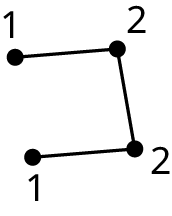 or
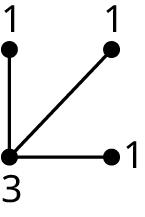 Answers may vary. Two possible graphs are shown.
Graph 1:
Graph 2:
Your Turn 12.8 §12.2 source ↗
Answer
There are 500 vertices. Each individual must meet 499 other strangers, so there are 499 edges meeting at each vertex. Since there are 500 vertices of degree 499, the sum of degrees is 500(499) = 249,500.
By the Sum of Degrees Theorem, .
124,750 introductionsYour Turn 12.9 §12.2 source ↗
Answer
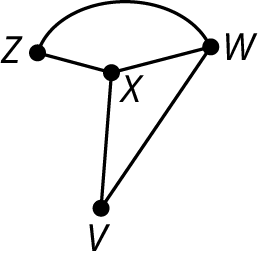
Your Turn 12.10 §12.2 source ↗
Answer
A cycle is a series of connected edges that begins and ends at the same vertex but otherwise never repeats any vertex. When cycles appear as subgraphs within a larger graph, they are called cyclic subgraphs and are named by listing their vertices sequentially. It helps you keep track by naming them by starting with the letter that comes earliest in the alphabet. They are named based on the number of edges they have. A triangle has three sides. A quadrilateral has four sides. A pentagon has five sides.
| Triangle: (a, b, e) | Alternate answer option for Triangle: (a, d, e) |
| Quadrilateral (a, b, e, d) | Alternate answer option for Quadrilateral: (b, c, d, e) |
| Pentagon (a, b, c, d, e) |
Quadrilateral: (b, c, d, e or a, b, e, d)
Pentagon: (a, b, c, d, e)
Your Turn 12.11 §12.2 source ↗
• Aria is friends with no one else in Chloe’s network.
• Benicio is friends with Dakshayani, Eun-ah, and Fukashi.
• Dakshayani is friends with Benicio.
• Eun-ah is friends with Benicio and Fukashi.
• Fukashi is friends with Benicio and Eun-ah.
Answer
A cycle is a series of connected edges that begin and end at the same vertex but otherwise never repeats any vertex. When cycles appear as subgraphs within a larger graph, they are called cyclic subgraphs and are named by listing their vertices sequentially. It helps you keep track by naming them by starting with the letter that comes earliest in the alphabet. They are named based on the number of edges they have.
A pentagon has five sides. If the vertices are named by the person’s initial, then there is a pentagon cycle (B, D, C, E, F).
Alternate answer option: You could also have gone around the cycle in the other direction.
(B, F, E, C, D). Your answers are more likely to match the solutions if you choose the next vertex that comes first in alphabetical order.
(B, D, C, E, F)Your Turn 12.12 §12.2 source ↗
Answer
You need Entry 3 in Row 13, but there is no Row 13 in the Pascal triangle provided. You need to make one. You do not need to make the whole row. The entries in the new row are the sum of the entries sitting on its “shoulders.”
| Row 10 | 1 | 10 | 45 | 120 | 210 | … | ||||||||
| Row 11 | 1 | 11 | 55 | 165 | 330 | … | ||||||||
| Row 12 | 1 | 12 | 66 | 220 | 495 | … | ||||||||
| Row 13 | 1 | 13 | 78 | 286 | 781 | … | ||||||||
| ENTRY | 0 | 1 | 2 | 3 |
Entry 3 in Row 13 is 286.
286Check Your Understanding 12.2.6 §12.2 source ↗
- a.True
- b.False
Answer
Check Your Understanding 12.2.7 §12.2 source ↗
- a.True
- b.False
Answer
Check Your Understanding 12.2.8 §12.2 source ↗
- a.True
- b.False
Answer
Check Your Understanding 12.2.9 §12.2 source ↗
- a.True
- b.False
Answer
Check Your Understanding 12.2.10 §12.2 source ↗
- a.True
- b.False
Answer
Check Your Understanding 12.2.11 §12.2 source ↗
- a.True
- b.False
Answer
Check Your Understanding 12.2.12 §12.2 source ↗
Answer
Check Your Understanding 12.2.13 §12.2 source ↗
Answer
If n is the number of vertices in a complete graph, then each vertex is connected to n – 1 other vertices (i.e., has degree n – 1).
The total number of degrees for the graph is thus .
By the Sum of Degrees Theorem, .
The last expression is equivalent to what the student said.
Yes. If n is the number of vertices in a complete graph, the number of edges is which is half the number of vertices times one less than the number of vertices.Your Turn 12.13 §12.3 source ↗
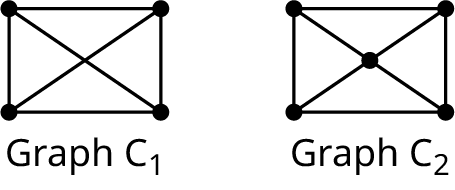 Two Distinct Graphs
Answer
Two graphs are isomorphic if either one of these conditions holds:
• One graph can be transformed into the other without breaking existing connections or adding new ones.
• There is a correspondence between their vertices in such a way that any adjacent pair in one graph corresponds to an adjacent pair in the other graph.
Graph C1 has 6 edges, but Graph C2 has 8.
Graph C1 has 4 vertices, and Graph C2 has 5.
Graph C1 has no vertex of degree 4, but Graph C2 has one vertex of degree 4.
They do not have the same cycles. For example, Graph C2 has a pentagon cycle, but Graph C1 does not.
Graph C1 has 6 edges, but Graph C2 has 8.Graph C1 has 4 vertices and Graph C2 has 5.
Graph C1 has no vertex of degree 4, but Graph C2 has one vertex of degree 4.
They do not have the same cycles. For example, Graph C2 has a pentagon cycle, but Graph C1 does not.
Your Turn 12.14 §12.3 source ↗
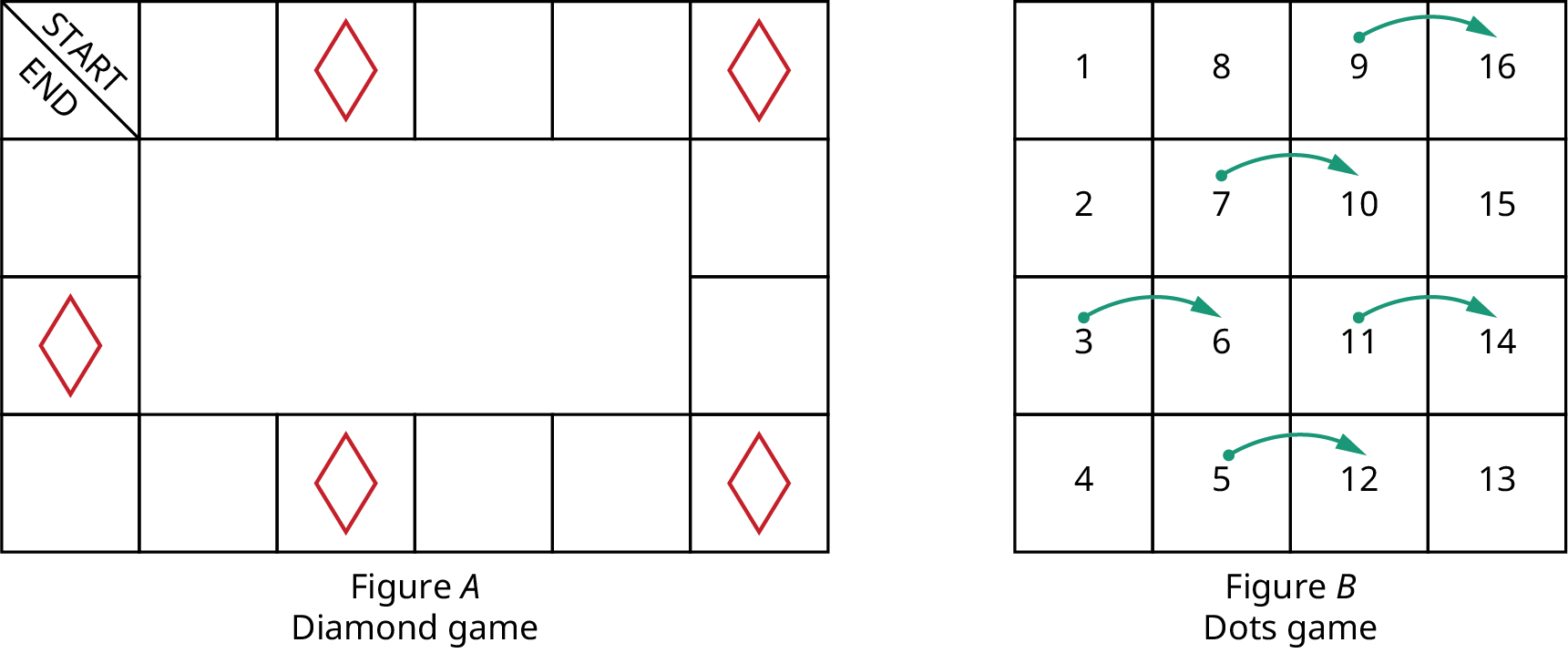 Two Game Boards
Answer
• The total number of vertices in each graph is different. The Diamonds graph has 17 vertices while Dots graph has only 16.
• The degrees of vertices differ. The Diamonds graph has vertices of degrees 4 while the Dots graph does not.
• The graphs have different sizes of cyclic subgraphs. The Diamonds graph has 4 squares (4-cycles), while the Dots graph has 3 squares. Also, the Dots graph has 8-cycles while the Diamonds graph does not.
Your Turn 12.15 §12.3 source ↗
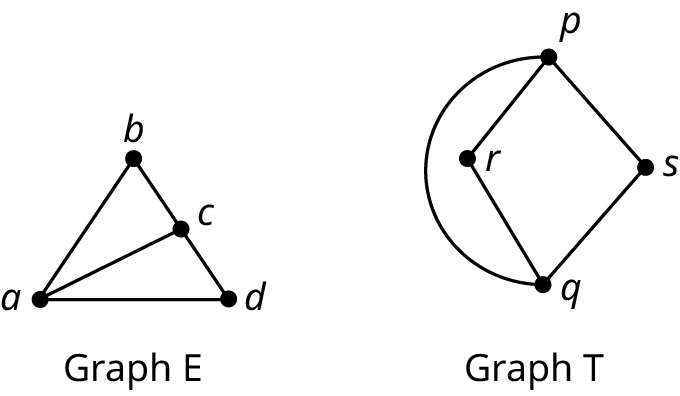 Graph E and Graph T
Answer
• a − q, d − s, c − p, and b − r.
• a − p, d − s, c − q, and b − r.
• a − q, d − r, c − p, and b − s.
• a − p, d − r, c − q, and b − s.
Your Turn 12.16 §12.3 source ↗
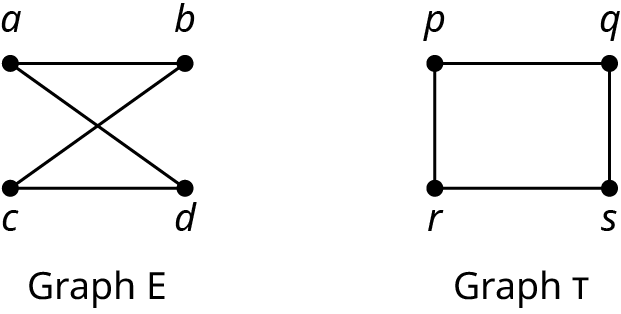 Graph E and Graph T
Javier believes that Graphs E and T are not isomorphic because Graph E contains a triangle cycle and Graph T does not. He supports his conclusion with the graphs shown.
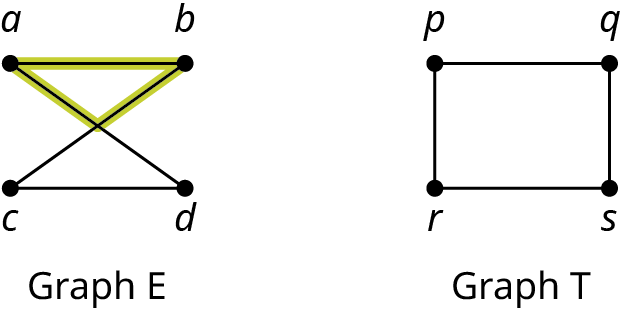 Javier’s Highlighted Cycle Maubi also believes that Graphs E and T are not isomorphic, but says that it is because Graph T has a quadrilateral cycle (p, q, r, s) while Graph E does not. Caden believes that Graphs E and T are isomorphic. She said one isomorphism is a-p, b-q, c-s, and d-r. Determine who is correct, who is incorrect, and explain how you know.
Answer
Be careful you do not do what Javier did. Javier highlighted a crossover where there is no vertex. There is no cyclic subgraph in graph E.
Maubi is incorrect because you can trace your finger around Graph E from vertex a back to a. Graph E is a quadrilateral, a four-sided cycle (a, b, c, d). Graph T also is a four-sided cycle (p, q, r, s).
Both graphs have 4 vertices, 4 edges, and no cyclic subgraphs. All the vertices have degree 2.
By flipping vertex d around c, you can transform Graph E into visual facsimile of Graph T.
Caden is correct because Graph E could be untangled so that d is to the left of c and the edges bc and ad are no longer crossed. Maubi is incorrect because (a, b, c, d) is a quadrilateral in Graph E. Javier is incorrect because the portion of the graph he highlighted does not have 3 vertices and is not a triangle.Your Turn 12.17 §12.3 source ↗
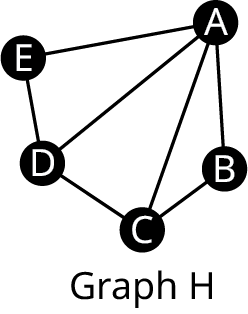
Answer
One way to find the complement of a graph is to draw the complete graph with the same number of vertices and remove all the edges that were in the original graph.
Vertex A has a degree of 0.
The other vertices will be connected in a line, C to E to B to D. Each will have a degree of 2.
The edges are BD, CE, EB.
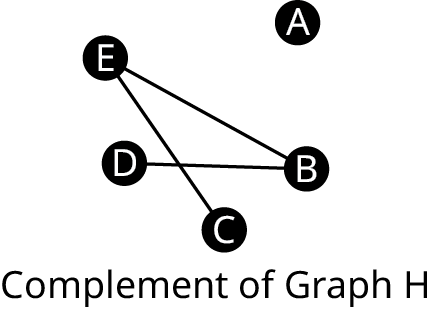
Your Turn 12.18 §12.3 source ↗
Answer
You know the degrees will be 0.
One way to find the complement of a graph is to draw the complete graph with the same number of vertices and remove all the edges that were in the original graph. Since the original graph is a complete graph, the complement will have no edges.
The degrees are 0. There are no adjacent vertices in Graph N since all vertices are adjacent in Graph M.Check Your Understanding 12.3.14 §12.3 source ↗
For the following exercises, determine whether each statement is always true, sometimes true, or never true.
Two graphs are isomorphic, and the graphs have the same structure.Answer
Two graphs are isomorphic if either one of these conditions holds:
• One graph can be transformed into the other without breaking existing connections or adding new ones.
• There is a correspondence between their vertices in such a way that any adjacent pair in one graph corresponds to an adjacent pair in the other graph.
always trueCheck Your Understanding 12.3.15 §12.3 source ↗
For the following exercises, determine whether each statement is always true, sometimes true, or never true.
A graph with four vertices is isomorphic to a graph with five vertices.Answer
There can be no complete correspondence between vertices.
Two graphs are isomorphic if either one of these conditions holds:
• One graph can be transformed into the other without breaking existing connections or adding new ones.
• There is a correspondence between their vertices in such a way that any adjacent pair in one graph corresponds to an adjacent pair in the other graph.
never trueCheck Your Understanding 12.3.16 §12.3 source ↗
For the following exercises, determine whether each statement is always true, sometimes true, or never true.
The sums of the degrees of the vertices of two graphs are equal, but the two graphs are not isomorphic.Answer
Check Your Understanding 12.3.17 §12.3 source ↗
For the following exercises, determine whether each statement is always true, sometimes true, or never true.
Two graphs are isomorphic, but the graphs have a different number of edges.Answer
There can be no complete correspondence between the edges.
Two graphs are isomorphic if either one of these conditions holds:
• One graph can be transformed into the other without breaking existing connections or adding new ones.
• There is a correspondence between their vertices in such a way that any adjacent pair in one graph corresponds to an adjacent pair in the other graph.
never trueCheck Your Understanding 12.3.18 §12.3 source ↗
For the following exercises, determine whether each statement is always true, sometimes true, or never true.
One graph can be transformed to look like a second graph without removing or adding any connections, and the two graphs are isomorphic.Answer
Two graphs are isomorphic if either one of these conditions holds:
• One graph can be transformed into the other without breaking existing connections or adding new ones.
• There is a correspondence between their vertices in such a way that any adjacent pair in one graph corresponds to an adjacent pair in the other graph.
always trueCheck Your Understanding 12.3.19 §12.3 source ↗
For the following exercises, determine whether each statement is always true, sometimes true, or never true.
Two graphs are isomorphic, and there is more than one isomorphism between the two graphs.Answer
Check Your Understanding 12.3.20 §12.3 source ↗
For the following exercises, determine whether each statement is always true, sometimes true, or never true.
Two graphs have the same number of vertices, but there is no isomorphism between them.Answer
They could be isomorphic, but not always. This is an example of when they are not isomorphic.
You could have two vertices in Graph 1 and two vertices in Graph 2. In Graph 1, the vertices share one edge. In Graph 2, the vertices share two edges. The vertices in Graph 1 have degree one, and the vertices in Graph 2 have degree 2. The graphs are not isomorphic.
sometimes trueCheck Your Understanding 12.3.21 §12.3 source ↗
For the following exercises, determine whether each statement is always true, sometimes true, or never true.
There is a correspondence between the vertices of Graph A and the vertices of Graph B such that the adjacent vertices in Graph A always correspond to vertices of Graph B, but the two graphs are not isomorphicAnswer
This is opposed to the definition of isomorphism.
Two graphs are isomorphic if either one of these conditions holds:
• One graph can be transformed into the other without breaking existing connections or adding new ones.
• There is a correspondence between their vertices in such a way that any adjacent pair in one graph corresponds to an adjacent pair in the other graph.
never trueCheck Your Understanding 12.3.22 §12.3 source ↗
For the following exercises, determine whether each statement is always true, sometimes true, or never true.
Two graphs have the same number of edges, the same number of vertices, vertices of the same degree, and have all the same subgraphs, but they are not isomorphicAnswer
Check Your Understanding 12.3.23 §12.3 source ↗
For the following exercises, determine whether each statement is always true, sometimes true, or never true.
Two graphs are isomorphic, and the sum of the degrees of the vertices of one equals the sum of the degrees of the other graph.Answer
The correspondence between their vertices ensures that the sum of their degrees will be the same.
Two graphs are isomorphic if either one of these conditions holds:
• One graph can be transformed into the other without breaking existing connections or adding new ones.
• There is a correspondence between their vertices in such a way that any adjacent pair in one graph corresponds to an adjacent pair in the other graph.
always trueCheck Your Understanding 12.3.24 §12.3 source ↗
For the following exercises, determine whether each statement is always true, sometimes true, or never true.
If two graphs are isomorphic, then their complements are isomorphic.Answer
Your Turn 12.19 §12.4 source ↗
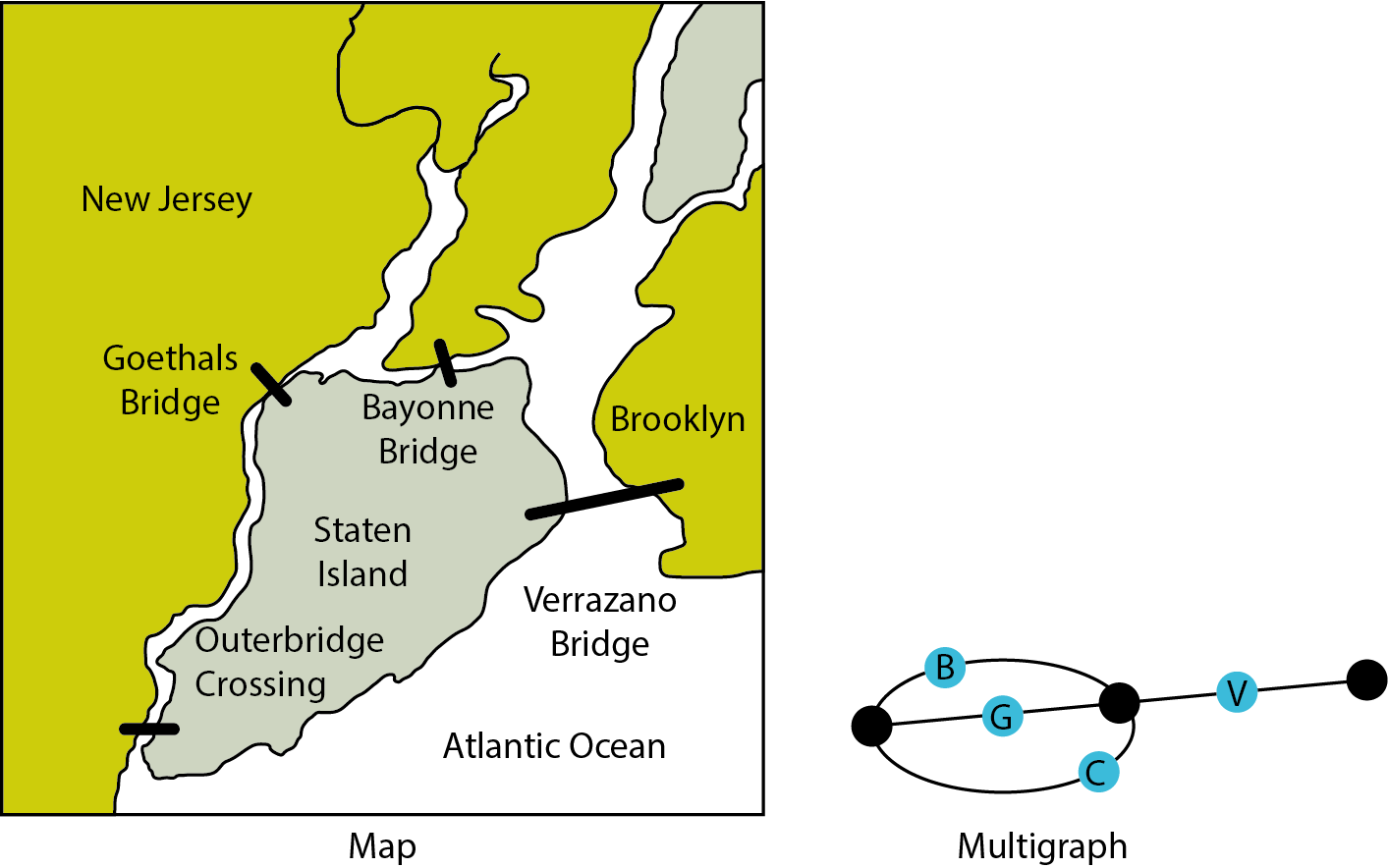
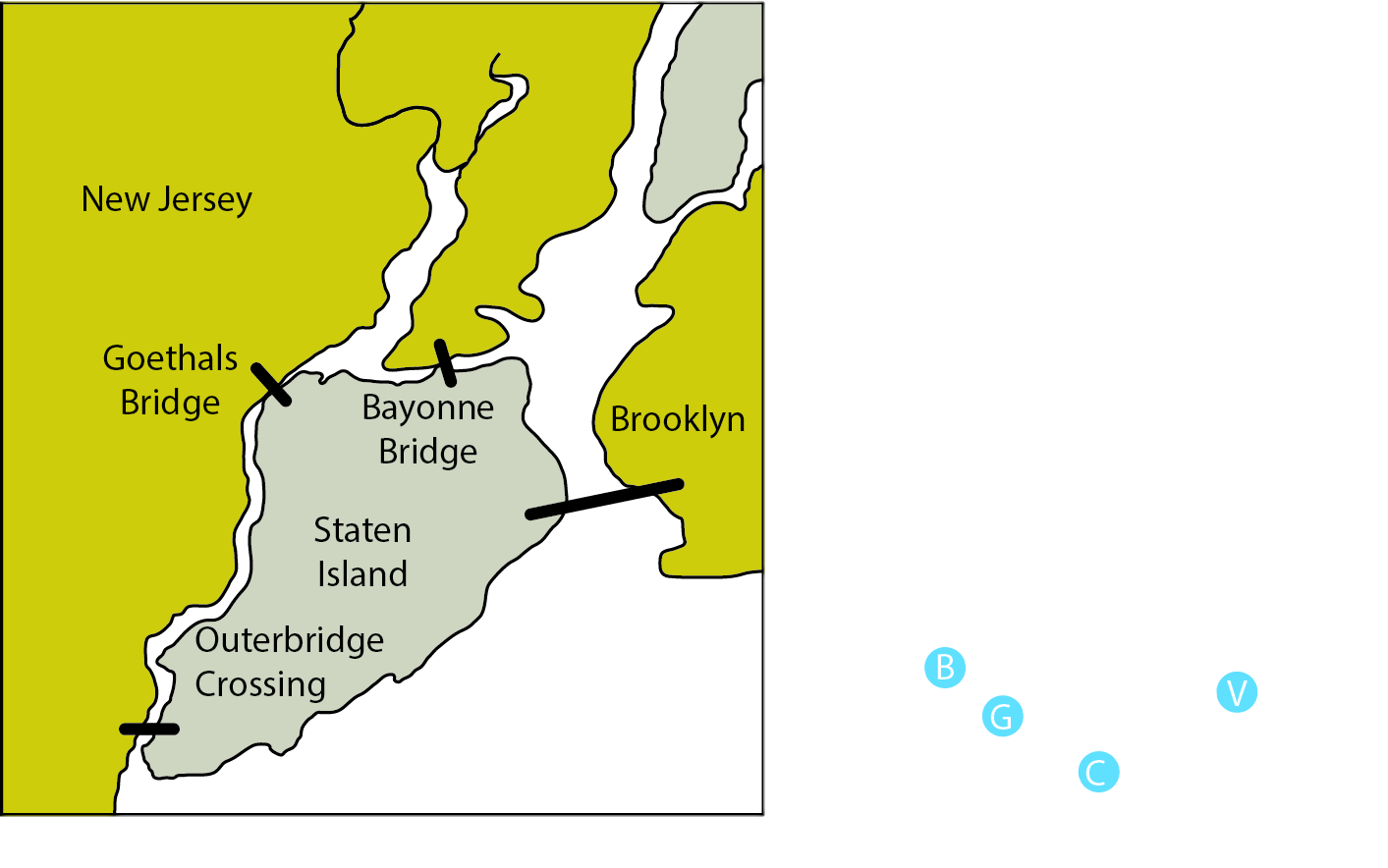 Map and Multigraph of Staten Island Bridges A walk can be named by a sequence of edges instead of a sequence of vertices. Determine which of the following sequences of edges is a walk.
- a.B → V → C → G → C
- b.V → C → B → G → C
- c.C → V → G → B → B
- d.G → V → B → V → C
Answer
a) If you follow B to V, you are in Brooklyn and end up at a dead end.
b) This walk takes you through all the bridges exactly once.
c) When you follow C to V, you are in Brooklyn and end up at a dead end.
d) When you follow G to V, you are in Brooklyn and end up at a dead end.
Only V → C → B → G → C is a walk.Your Turn 12.20 §12.4 source ↗
Consider each sequence of vertices from Graph K in Figure 12.79. Determine if it is only a walk, both a walk and a path, both a walk and a trail, all three, or none of these.
n → q → o → pAnswer
To make sure it is a walk, check to see if the vertices are consecutive.
The vertices are consecutive, so it is a walk.
A trail has no repeated edges.
A path has no repeated vertices.
Since there are no repeated edges or vertices, this is a walk, path, and a trail.
walk, path, and trailYour Turn 12.20 (b) §12.4 source ↗
Consider each sequence of vertices from Graph K in Figure 12.79. Determine if it is only a walk, both a walk and a path, both a walk and a trail, all three, or none of these.
p → n → q → o → n → mAnswer
To make sure it is a walk, check to see if the vertices are consecutive.
The vertices are consecutive, so it is a walk.
A trail has no repeated edges. Draw the graph on paper. Then trace the path with another color. You will see that you have no repeated edges. This is a trail.
A path has no repeated vertices. The vertex n is used twice, so this is not a path. This is a walk and a trail, but not a path.
walk and a trail, but not a pathYour Turn 12.20 (c) §12.4 source ↗
Consider each sequence of vertices from Graph K in Figure 12.79. Determine if it is only a walk, both a walk and a path, both a walk and a trail, all three, or none of these.
m → n → o → p → qAnswer
Your Turn 12.21 §12.4 source ↗
Suppose that you want to travel from Palm Beach (PBI) to any other city listed in Figure 12.86 and then return to Palm Beach.
Why is it impossible to find an itinerary that is a circuit?Answer
Your Turn 12.21 (b) §12.4 source ↗
Suppose that you want to travel from Palm Beach (PBI) to any other city listed in Figure 12.86 and then return to Palm Beach.
How is this related to the degree of the vertex PBI?Answer
Your Turn 12.22 §12.4 source ↗
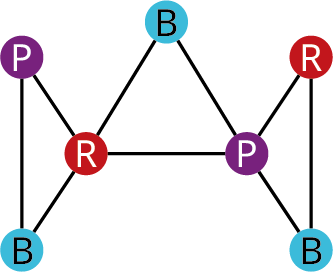
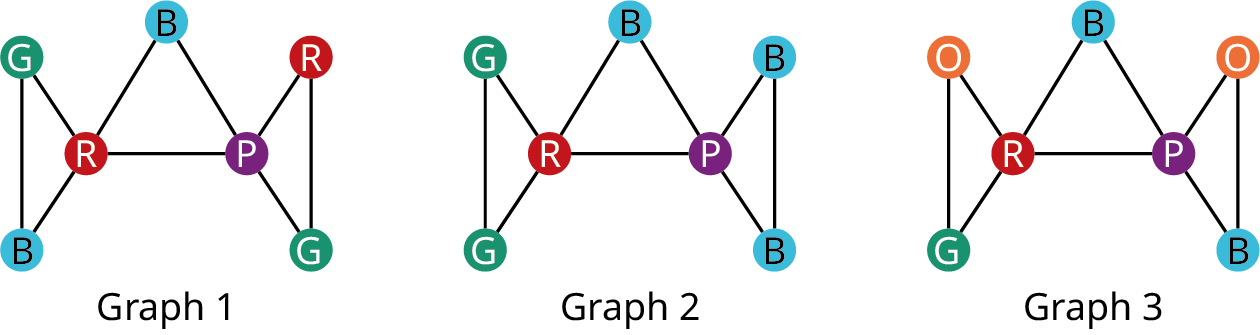 Possible Colorings of the Same Graph Is the graph planar? What does your answer tell you about the chromatic number?
Answer
Your Turn 12.22 (b) §12.4 source ↗
Possible Colorings of the Same Graph What is the lowest possible chromatic number of this graph based on the size of any cliques?Answer
Your Turn 12.22 (c) §12.4 source ↗
Possible Colorings of the Same Graph What are the possible chromatic numbers?Answer
Your Turn 12.22 (d) §12.4 source ↗
Possible Colorings of the Same Graph Which graph or graphs meet the definition of a valid graph coloring?Answer
Your Turn 12.22 (e) §12.4 source ↗
Possible Colorings of the Same Graph Draw an -coloring for the graph where is the answer to Exercise 2.Answer
Your Turn 12.23 §12.4 source ↗
Map of Oahu 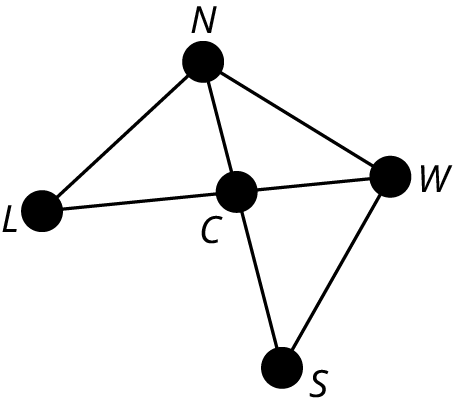 Graph Representing Common Boundaries between Regions of Oahu
Answer
Check Your Understanding 12.4.25 §12.4 source ↗
For the following exercises, determine whether each statement is always true or sometimes true.
A trail is a path.Answer
Check Your Understanding 12.4.26 §12.4 source ↗
For the following exercises, determine whether each statement is always true or sometimes true.
A trail is a walk.Answer
Check Your Understanding 12.4.27 §12.4 source ↗
For the following exercises, determine whether each statement is always true or sometimes true.
A walk is a path.Answer
Check Your Understanding 12.4.28 §12.4 source ↗
For the following exercises, determine whether each statement is always true or sometimes true.
A circuit is a trail.Answer
Check Your Understanding 12.4.29 §12.4 source ↗
For the following exercises, determine whether each statement is always true or sometimes true.
A directed cycle is a path.Answer
Check Your Understanding 12.4.30 §12.4 source ↗
For the following exercises, determine whether each statement is always true or sometimes true.
A circuit is a directed cycle.Answer
By definition, a directed cycle is a path that begins and ends at the same vertex. A circuit begins and ends at the same vertex.
A directed cycle does not necessarily start and end at the same vertex, so not all directed cycles are circuits.
sometimes trueCheck Your Understanding 12.4.31 §12.4 source ↗
For the following exercises, determine whether each statement is always true or sometimes true.
A directed cycle is a circuit.Answer
By definition, a directed cycle is a path that begins and ends at the same vertex.
A circuit is a trail that begins and ends at the same vertex. Thus, a directed cycle is a circuit.
always trueCheck Your Understanding 12.4.32 §12.4 source ↗
For the following exercises, determine whether each statement is always true or sometimes true.
If a graph has an -coloring, then its chromatic number is .Answer
Check Your Understanding 12.4.33 §12.4 source ↗
For the following exercises, determine whether each statement is always true or sometimes true.
If the chromatic number of a graph is , then it has an -coloring.Answer
Check Your Understanding 12.4.34 §12.4 source ↗
For the following exercises, determine whether each statement is always true or sometimes true.
If a graph is planar, then it has a chromatic number of at most four.Answer
Check Your Understanding 12.4.35 §12.4 source ↗
For the following exercise, fill in the blanks to make the statement true.
A walk that ____________ is a trail.Answer
Check Your Understanding 12.4.36 §12.4 source ↗
For the following exercise, fill in the blanks to make the statement true.
A trail that ____________ is a circuit.Answer
Check Your Understanding 12.4.37 §12.4 source ↗
For the following exercise, fill in the blanks to make the statement true.
A circuit that ___________ is a directed cycle.Answer
Check Your Understanding 12.4.38 §12.4 source ↗
For the following exercise, fill in the blanks to make the statement true.
A closed walk that ____________ is a circuit.Answer
Check Your Understanding 12.4.39 §12.4 source ↗
For the following exercise, fill in the blanks to make the statement true.
A complete graph with vertices has a chromatic number of_____.Answer
Check Your Understanding 12.4.40 §12.4 source ↗
For the following exercise, fill in the blanks to make the statement true.
A graph with a clique with -vertices has a chromatic number of _________ .Answer
Your Turn 12.24 §12.5 source ↗
Answer
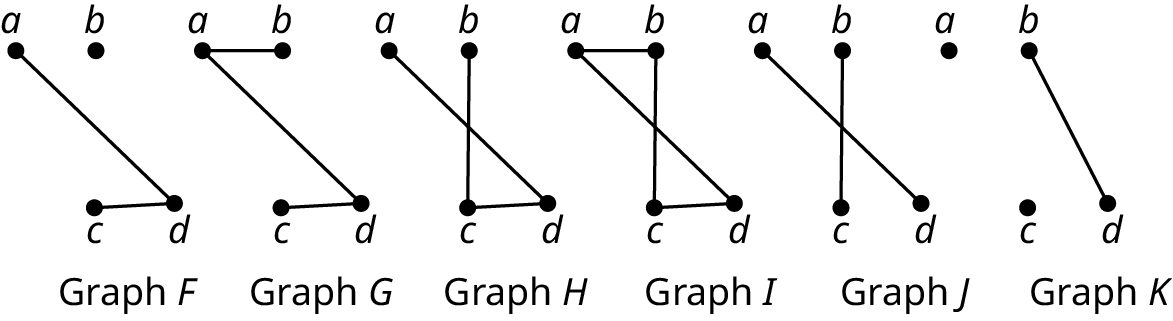
A graph is connected if it has only one component. Graphs G, H, and I are connected; so, they each have a single component with the vertices {a, b, c, d}.
A graph is disconnected if it has more than one component. Graph F is disconnected with two components: {a, c, d} and {b}. Graph J is disconnected with two components: {a, d} and {b, c}. Graph K is disconnected with three components: {a}, {b, d}, and {c}.
Graphs G, H, and I are connected; so, they each have a single component with the vertices {a, b, c, d}. Graph F is disconnected with two components, {a, c, d} and {b}. Graph J is disconnected with two components, {a, d} and {b, c}. Graph K is disconnected with three components, {a}, {b, d}, and {c}.Your Turn 12.25 §12.5 source ↗
Answer
Your Turn 12.26 §12.5 source ↗
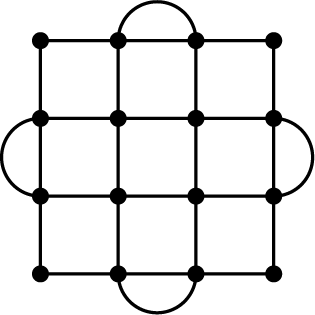
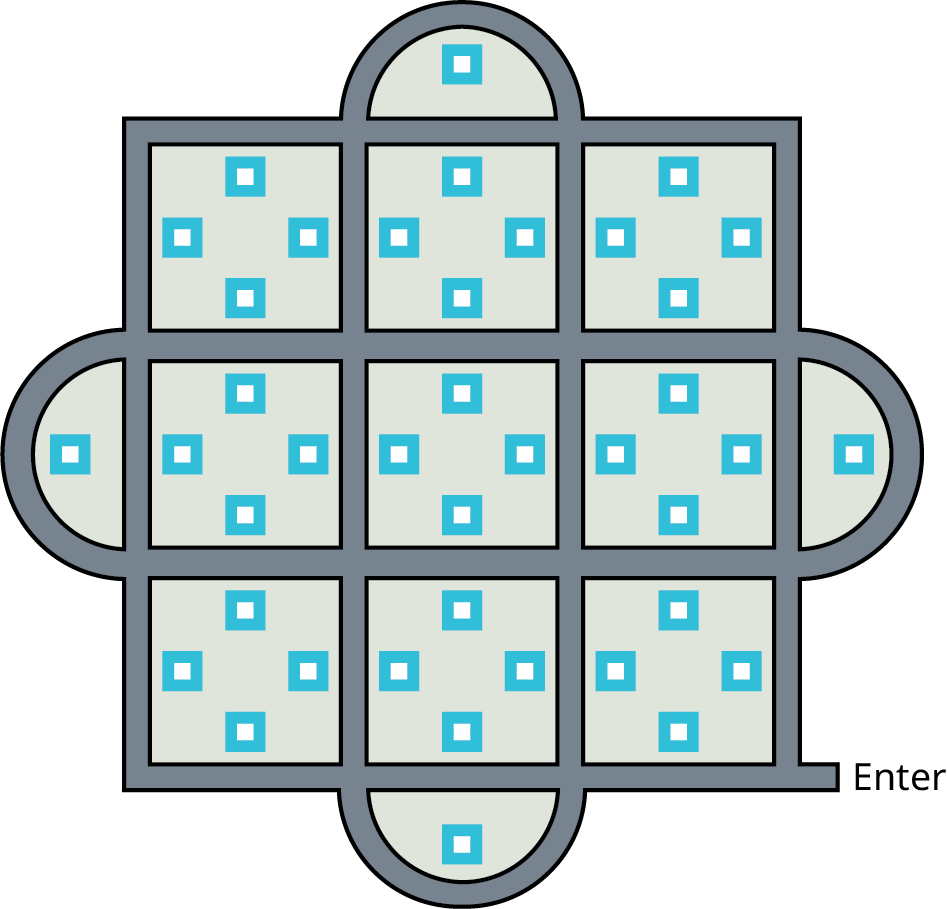 Map of Neighborhood Draw a graph or multigraph of the neighborhood in which the vertices represent intersections, and the edges represent the streets between them.
Answer
Your Turn 12.26 (b) §12.5 source ↗
Map of Neighborhood Is your graph connected? Explain how you know.Answer
Your Turn 12.26 (c) §12.5 source ↗
Map of Neighborhood Determine the degrees of the vertices in the graph.Answer
Your Turn 12.26 (d) §12.5 source ↗
Map of Neighborhood Is your graph an Eulerian graph?Answer
Your Turn 12.26 (e) §12.5 source ↗
Map of Neighborhood Is it possible for the postal delivery person to visit each block on each street exactly once and start and end at the same position? Justify your answer.Answer
Your Turn 12.27 §12.5 source ↗
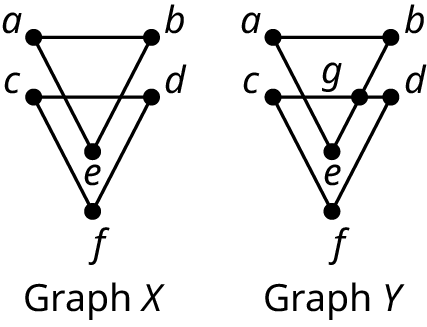 Which graph does not have an Euler circuit? Explain how you know.
Answer
Your Turn 12.27 (b) §12.5 source ↗
Find an Euler circuit in the other graph.Answer
Your Turn 12.28 §12.5 source ↗
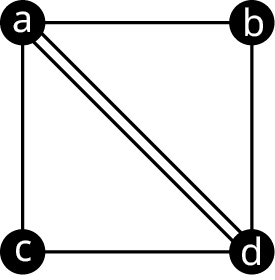
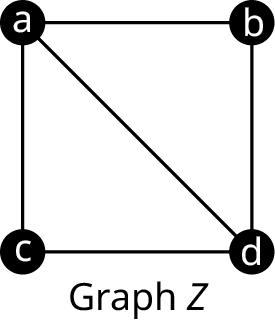 Graph Z
Answer
Check Your Understanding 12.5.41 §12.5 source ↗
For the following exercises, determine whether each statement is always true, sometimes true, or never true.
A disconnected graph has only one component.Answer
Check Your Understanding 12.5.42 §12.5 source ↗
For the following exercises, determine whether each statement is always true, sometimes true, or never true.
A graph that has all vertices of even degree is connected.Answer
Check Your Understanding 12.5.43 §12.5 source ↗
For the following exercises, determine whether each statement is always true, sometimes true, or never true.
There is a route through the city of Konigsberg that a person may pass over each bridge exactly once and return to the starting point.Answer
Check Your Understanding 12.5.44 §12.5 source ↗
For the following exercises, determine whether each statement is always true, sometimes true, or never true.
A graph with vertices of all even degree is Eulerian.Answer
Check Your Understanding 12.5.45 §12.5 source ↗
For the following exercises, determine whether each statement is always true, sometimes true, or never true.
An Eulerian graph has all vertices of even degree.Answer
Check Your Understanding 12.5.46 §12.5 source ↗
For the following exercises, determine whether each statement is always true, sometimes true, or never true.
An Euler circuit is a closed trail.Answer
Check Your Understanding 12.5.47 §12.5 source ↗
For the following exercises, determine whether each statement is always true, sometimes true, or never true.
An Euler circuit is a closed pathAnswer
Check Your Understanding 12.5.48 §12.5 source ↗
For the following exercises, determine whether each statement is always true, sometimes true, or never true.
To eulerize a graph, add new edges between previously nonadjacent vertices until no vertices have odd degree.Answer
Check Your Understanding 12.5.49 §12.5 source ↗
For the following exercises, determine whether each statement is always true, sometimes true, or never true.
To eulerize a graph, add duplicate edges between adjacent vertices until no vertices have odd degree.Answer
Check Your Understanding 12.5.50 §12.5 source ↗
For the following exercises, determine whether each statement is always true, sometimes true, or never true.
The number of duplicate edges required to eulerize a graph is half the number of vertices of odd degree.Answer
Your Turn 12.29 §12.6 source ↗
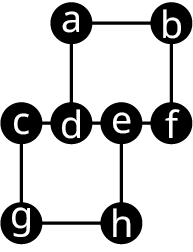 Graph I e → f → b → a → d → c → g → h → e → d
Answer
Your Turn 12.29 (b) §12.6 source ↗
Graph I d → a → b → f → e → h → g → cAnswer
Your Turn 12.29 (c) §12.6 source ↗
Graph I d → a → b → e → f → b → e → d → c → g → h → eAnswer
Your Turn 12.30 §12.6 source ↗
Answer
Your Turn 12.31 §12.6 source ↗
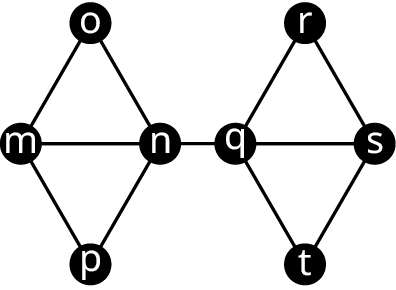 Graph L The two vertices that can be used as the starting vertex are ____ and s.
Answer
Step 1: If there are two odd vertices, begin at one odd vertex and end at the other.
There are two odd vertices, m and s. Fill the blank with m.
mYour Turn 12.31 (b) §12.6 source ↗
Graph L If sq is the first edge removed, the three options for the second edge to be removed are qr, ___, and ___; however, ___ cannot be chosen because it is a ________________.Answer
Step 1: If there are two odd vertices, begin at one and end at the other.
You began at s.
Step 2: Remove an edge between the vertex and any adjacent vertex that is not a bridge, unless there is no other choice, making a note of the edge you removed. Repeat this step until all the edges are removed.
You removed sq. You are now at vertex q. The edges that leave from this vertex are qr, qt, and qn. Fill in the first two blanks with qn and qt (in any order). You cannot choose qn because it is a bridge. Write “qn” in the third blank. Write “bridge” in the last blank.
qn, qt; qn bridgeYour Turn 12.31 (c) §12.6 source ↗
Graph L If qr is the second edge removed, the next four edges to be removed must be ___, ___, ___, and ___, in that order.Answer
Step 1: If there are two odd vertices, begin at one and end at the other.
Step 2: Remove an edge between the vertex and any adjacent vertex that is not a bridge, unless there is no other choice, making a note of the edge you removed. Repeat this step until all the edges are removed.
You are still working on the right half of the figure. You need to remove the remaining edges in the right half. Draw the figure and color the edges as you remove them to help you keep track of what you have removed.
So far, you have removed sq and qr.
Now you can go around the right half of the graph. Remember, do everything possible before you cross a bridge.
sq, qr, rs, st, tq
Now you are ready to cross the bridge.
nq
rs, st, tq, qnYour Turn 12.31 (d) §12.6 source ↗
Graph L After qn is removed, the three options for the next edge to be removed are no, ___, and ___.Answer
Step 1: If there are two odd vertices, begin at one and end at the other.
Step 2: Remove an edge between the vertex and any adjacent vertex that is not a bridge, unless there is no other choice, making a note of the edge you removed. Repeat this step until all the edges are removed.
Now you have polished off the right half of the figure. You need to remove the remaining edges in the left half. Draw the figure and color the edges as you remove them to help you keep track of what you have removed.
What you have already done: sq, qr, rs, st, tq, nq
You are at vertex n.
You have three options now: no, nm, or np.
nm, npYour Turn 12.31 (e) §12.6 source ↗
Graph L If no is the next edge removed, the last four edges removed will be ___, ___, ___, and ___, in that order.Answer
Step 1: If there are two odd vertices, begin at one and end at the other.
Step 2: Remove an edge between the vertex and any adjacent vertex that is not a bridge, unless there is no other choice, making a note of the edge you removed. Repeat this step until all the edges are removed.
Now you have polished off the right half of the figure. You need to remove the remaining edges in the left half. Draw the figure and color the edges as you remove them to help you keep track of what you have removed.
What you have already done: sq, qr, rs, st, tq, nq, no
The only edge away from o that you have used is om.
From this point, you can go around the triangle to n and p in either direction to come back to m.
om, mp, pn, nm.
Alternate answer option:
om, mn, np, pm
om, mp, pn, nmYour Turn 12.31 (f) §12.6 source ↗
Graph L The final Euler trail using the answers to parts 1 through 5 is _________________________.Answer
Step 1: If there are two odd vertices, begin at one and end at the other.
Step 2: Remove an edge between the vertex and any adjacent vertex that is not a bridge, unless there is no other choice, making a note of the edge you removed. Repeat this step until all the edges are removed.
Now you have polished off the right half of the figure. You need to remove the remaining edges in the left half. Draw the figure and color the edges as you remove them to help you keep track of what you have removed.
What you have already done: sq, qr, rs, st, tq, nq, no
The only edge away from o that you have used is om.
From this point, you can go around the triangle to n and p in either direction to come back to m.
om, mp, pn, nm.
Alternate answer option:
om, mn, np, pm
Step 3: Write out the Euler trail using the sequence of vertices and edges you found.
s → q → r → s → t → q → n → o → m → p → n → m
Alternate answer options are possible.
s → q → r → s → t → q → n → o → m → p → n → mYour Turn 12.32 §12.6 source ↗
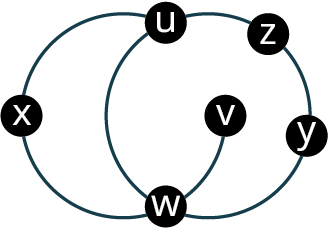 Graph T
Answer
Step 1: If there are two odd vertices, begin at one odd vertex and end at the other.
Vertices u and v are odd, so you must begin at one and end at the other. It doesn’t matter which you choose as the beginning as which you choose as the end.
Step 2: Remove an edge between the vertex and any adjacent vertex that is not a bridge, unless there is no other choice, making a note of the edge you removed. Repeat this step until all the edges are removed.
Step 3: Write out the Euler trail using the sequence of vertices and edges you found.
v → w → x → u → z → y → w → u
Other variations are possible.
The graph has Euler trails. They must begin and end at vertices u and v. An example isv → w → x → u → z → y → w → u
Check Your Understanding 12.6.51 §12.6 source ↗
Fill in the blank to make the statement true.
An Euler trail is a trail that visits each ___________ exactly once.Answer
Check Your Understanding 12.6.52 §12.6 source ↗
Fill in the blank to make the statement true.
__________ algorithm is a procedure for finding an Euler trail or circuit.Answer
Check Your Understanding 12.6.53 §12.6 source ↗
Fill in the blank to make the statement true.
An Euler _____ always begins and ends at the same vertex, but an Euler _____ does not.Answer
Check Your Understanding 12.6.54 §12.6 source ↗
Fill in the blank to make the statement true.
When a bridge is removed from a graph, the number of ________ is increased by one.Answer
Check Your Understanding 12.6.55 §12.6 source ↗
Fill in the blank to make the statement true.
When a __________ is removed from a graph, the shortest path between its vertices will be greater than two.Answer
Check Your Understanding 12.6.56 §12.6 source ↗
Fill in the blank to make the statement true.
When using Fleury’s algorithm to find an Euler trail, never remove a _________ unless it is the only option.Answer
Your Turn 12.33 §12.7 source ↗
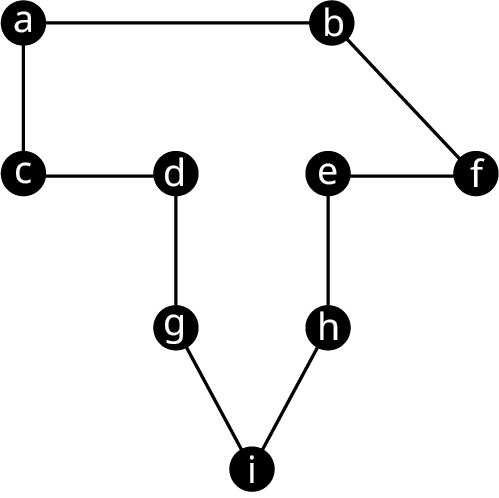 Graph T
Answer
Your Turn 12.34 §12.7 source ↗
Answer
Your Turn 12.35 §12.7 source ↗
Answer
The number of ways to arrange n distinct objects is n!.
There are 5 letters, so there are 5! ways to arrange them.
Your Turn 12.36 §12.7 source ↗
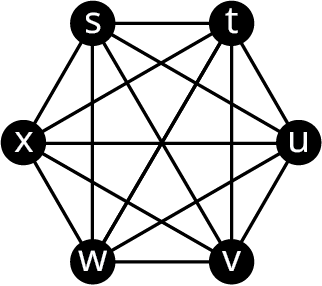 Complete Graph R
Answer
The number of distinct Hamilton cycles in a complete graph with n vertices is (n – 1)!.
This graph has six vertices, so it has (6 – 1)! distinct Hamilton cycles.
120
Your Turn 12.37 §12.7 source ↗
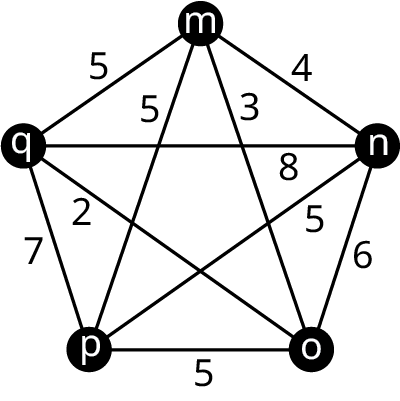 Weighted Complete Graph with Five Vertices
Answer
Add the weights of the individual edges.
| mo | op | pn | nq | qm | Sum |
| 3 | 5 | 5 | 8 | 5 | 26 |
The total weight of the Hamilton cycle is 26.
26Check Your Understanding 12.7.57 §12.7 source ↗
For the following exercises, fill in the blank to make the statement true.
A Hamilton cycle is a circuit that visits each ___________ exactly once.Answer
Check Your Understanding 12.7.58 §12.7 source ↗
For the following exercises, fill in the blank to make the statement true.
A __________ graph with vertices has Hamilton cycles.Answer
Check Your Understanding 12.7.59 §12.7 source ↗
For the following exercises, fill in the blank with is or is not to make the statement true.
A Hamilton cycle ________ a circuit.Answer
Check Your Understanding 12.7.60 §12.7 source ↗
For the following exercises, fill in the blank with is or is not to make the statement true.
A Hamilton cycle that visits every edge ________ an Euler circuit.Answer
Check Your Understanding 12.7.61 §12.7 source ↗
For the following exercises, fill in the blank with is or is not to make the statement true.
A Hamilton cycle ________ different from a Hamilton circuit.Answer
Check Your Understanding 12.7.62 §12.7 source ↗
For the following exercises, fill in the blank with is or is not to make the statement true.
An Euler circuit that visits every vertex ________ a Hamilton cycle.Answer
Check Your Understanding 12.7.63 §12.7 source ↗
For the following exercises, fill in the blank with is or is not to make the statement true.
The total weight of a trail _______ the sum of the weights of the edges visited by the trail.Answer
Check Your Understanding 12.7.64 §12.7 source ↗
For the following exercises, fill in the blank with is or is not to make the statement true.
A weighted graph _______ always a complete graph.Answer
Check Your Understanding 12.7.65 §12.7 source ↗
For the following exercises, fill in the blank with is or is not to make the statement true.
The number of ways to arrange n objects _______Answer
Check Your Understanding 12.7.66 §12.7 source ↗
For the following exercises, fill in the blank with is or is not to make the statement true.
Every cycle ____ a circuit.Answer
Your Turn 12.38 §12.8 source ↗
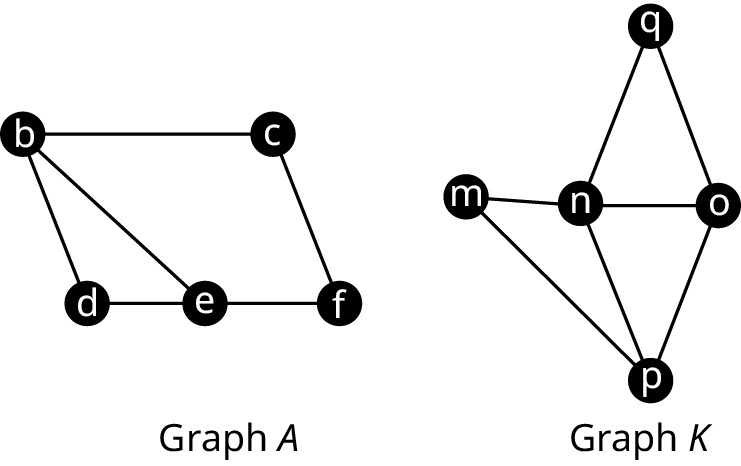 Graphs A and K Graph A, b → c → d → e → f
Answer
A path that visits each vertex exactly once is a Hamilton path. Recall that a path is a walk that has no repeated vertices or edges. It does not need to start and end on the same vertex.
This sequence is impossible since c and d are not adjacent.
NoYour Turn 12.38 (b) §12.8 source ↗
Graphs A and K Graph A, b → e → f → c → b → dAnswer
A path that visits each vertex exactly once is a Hamilton path. Recall that a path is a walk that has no repeated vertices or edges. It does not need to start and end on the same vertex.
This sequence is not a Hamilton path since vertex b is visited in the midst of the path, as well as being the start and ending vertex.
NoYour Turn 12.38 (c) §12.8 source ↗
Graphs A and K Graph K, n → q → o → p → mAnswer
A path that visits each vertex exactly once is a Hamilton path. Recall that a path is a walk that has no repeated vertices or edges. It does not need to start and end on the same vertex.
This sequence is a Hamilton path.
YesYour Turn 12.39 §12.8 source ↗
Answer
A path that visits each vertex exactly once is a Hamilton path. Recall that a path is a walk that has no repeated vertices or edges. It does not need to start and end on the same vertex.
Since you start at C, A must be next. So far you have:
C → A
If you then went to F, you would have no way to get to B without visiting F twice. So, you must go from A to B. Then from B to F.
C → A → B → F
You need to end at E, so visit D next.
C → A → B → F → D
Finally, end at E.
C → A → B → F → D → E
C → A → B → F → D → EYour Turn 12.40 §12.8 source ↗
Graph L p to rAnswer
A path that visits each vertex exactly once is a Hamilton path. Recall that a path is a walk that has no repeated vertices or edges. It does not need to start and end on the same vertex.
To find a bridge, avoid the bridges until you must cross them. This graph has a bridge (nq), so stay as far away from it as you can.
Since you start at p, avoid being near the bridge and choose m. So far you have:
p → m
Since you are staying away from the bridge, go to o.
p → m → o
Time to go over the bridge.
p → m → o → n → q
You need to end at r, so go around the vertices to end at r.
p → m → o → n → q → t → s → r
p → m → o → n → q → t → s → rYour Turn 12.40 (b) §12.8 source ↗
Graph L m to pAnswer
Your Turn 12.40 (c) §12.8 source ↗
Graph L o to qAnswer
Your Turn 12.41 §12.8 source ↗
Use Figure 12.185 to determine if the given sequence of vertices is a Hamilton path, an Euler trail, both, or neither.
Graph A, a → b → e → d → cAnswer
A path that visits each vertex exactly once is a Hamilton path. Recall that a path is a walk that has no repeated vertices or edges. An Euler trail uses every edge exactly once.
It does not need to start and end on the same vertex.
This is a Hamilton path. It is not an Euler trail because it does not use every edge. It does not use bc or ae.
Hamilton pathYour Turn 12.41 (b) §12.8 source ↗
Use Figure 12.185 to determine if the given sequence of vertices is a Hamilton path, an Euler trail, both, or neither.
Graph F, g → h → i → j → h → f → g → j → f → iAnswer
A path that visits each vertex exactly once is a Hamilton path. Recall that a path is a walk that has no repeated vertices or edges. An Euler trail uses every edge exactly once.
This is an Euler trail since it visits every edge exactly once. It is not a Hamilton path since it visits vertices more than once.
Euler trailYour Turn 12.41 (c) §12.8 source ↗
Use Figure 12.185 to determine if the given sequence of vertices is a Hamilton path, an Euler trail, both, or neither.
Graph K, o → n → m → lAnswer
A path that visits each vertex exactly once is a Hamilton path. Recall that a path is a walk that has no repeated vertices or edges. An Euler trail uses every edge exactly once.
This is neither. It does not visit every edge nor does it visit every vertex.
neitherCheck Your Understanding 12.8.67 §12.8 source ↗
For the following exercises, fill in the blank with the same as or different from to make the statement true.
Unlike in a Hamilton cycle, the vertex where the Hamilton path begins is _________ the vertex where the Hamilton path ends.Answer
Check Your Understanding 12.8.68 §12.8 source ↗
For the following exercises, fill in the blank with the same as or different from to make the statement true.
If a sequence of vertices represents a Hamilton path, the number of vertices listed should be _______ the number of vertices in the whole graph.Answer
Check Your Understanding 12.8.69 §12.8 source ↗
For the following exercises, fill in the blank with the same as or different from to make the statement true.
To determine if a graph has a Hamilton path, use a method that is _________ the method used to determine if a graph has an Euler trail.Answer
Check Your Understanding 12.8.70 §12.8 source ↗
For the following exercises, fill in the blank with the same as or different from to make the statement true.
If a graph with a bridge has a Hamilton path, the starting vertex should be on the side of the bridge that is ________ the side of the bridge with the ending vertex.Answer
Check Your Understanding 12.8.71 §12.8 source ↗
- a.True
- b.False
Answer
Check Your Understanding 12.8.72 §12.8 source ↗
- a.True
- b.False
Answer
Check Your Understanding 12.8.73 §12.8 source ↗
- a.True
- b.False
Answer
Check Your Understanding 12.8.74 §12.8 source ↗
- a.True
- b.False
Answer
Your Turn 12.42 §12.9 source ↗
Answer
A brute force algorithm lists every possible solution and then compares them to find the best possible solution. This scenario is an example of the brute force algorithm.
The greedy algorithm chooses the best choice at every branch of the path, continuing to make the best choice at each stage and finally linking those choices together into an overall solution. The greedy algorithm can miss the best choice, but sometimes does find it.
Since you used the brute force algorithm, you are sure to find the best solution, but it does take a long time.
brute force algorithmYour Turn 12.43 §12.9 source ↗
Answer
1. V → W → X → Y → Z → V
2. V → W → X → Z → Y → V
3. V → W → Y → X → Z → V
4. V → W → Y → Z → X → V
5. V → W → Z → X → Y → V
6. V → W → Z → Y → X → V
7. V → X → W → Y → Z → V
8. V → X → W → Z → Y → V
9. V → X → Y → W → Z → V
10. V → X → Y → Z → W → V (reverse of 6)
11. V → X → Z → W → Y → V
12. V → X → Z → Y → W → V (reverse of 4)
13. V → Y → X → W → Z → V
14. V → Y → X → Z → W → V (reverse of 5)
15. V → Y → W → X → Z → V
16. V → Y → W → Z → X → V (reverse of 11)
17. V → Y → Z → X → W → V (reverse of 2)
18. V → Y → Z → W → X → V (reverse of 8)
19. V → Z → X → Y → W → V (reverse of 3)
20. V → Z → X → W → Y → V (reverse of 15)
21. V → Z → Y → X → W → V (reverse of 1)
22. V → Z → Y → W → X → V (reverse of 7)
23. V → Z → W → X → Y → V (reverse of 13)
24. V → Z → W → Y → X → V (reverse of 9)
Your Turn 12.44 §12.9 source ↗
Answer
To be sure you find the shortest route, you need to find the length of all possible routes.
Since there are 4 vertices, there are possible cycles, but half of them will be the reverse of the others.
T = Travis, B = Beal, E = Edwards, L = Los Angeles
| Route | TB | BE | EL | LT | Sum |
| Distance | 84 | 410 | 106 | 396 | 996 |
| Route | TE | EB | BL | LT | Sum |
| Distance | 370 | 410 | 439 | 396 | 1,615 |
| Route | TB | BL | LE | ET | Sum |
| Distance | 84 | 439 | 106 | 370 | 999 |
The other three routes are the reverse of these three cycles.
The shortest route is from Travis to Beal to Edwards to Los Angeles Air Force Bases, and then return to Travis.
The officer should travel from Travis Air Force Base to Beal Air Force Base, to Edwards Air Force Base, to Los Angeles Air Force Base, and return to Travis.Your Turn 12.45 §12.9 source ↗
Answer
Check Your Understanding 12.9.75 §12.9 source ↗
- a.True
- b.False
Answer
A brute force algorithm lists every possible solution and then compares them to find the best possible solution. This can take a lot of time when in the real world there can be many choices.
The greedy algorithm chooses the best choice at every branch of the path, continuing to make the best choice at each stage and finally linking those choices together into an overall solution. This might miss the best possible solution overall but is much faster than the brute force algorithm.
TrueCheck Your Understanding 12.9.76 §12.9 source ↗
- a.True
- b.False
Answer
Check Your Understanding 12.9.77 §12.9 source ↗
- a.True
- b.False
Answer
A brute force algorithm lists every possible solution and then compares them to find the best possible solution. This can take a lot of time when in the real world there can be many choices.
The nearest neighbor algorithm chooses the best choice at every branch of the path, continuing to make the best choice at each stage and finally linking those choices together into an overall solution. This might miss the best possible solution overall but is much faster than the brute force algorithm.
FalseCheck Your Understanding 12.9.78 §12.9 source ↗
- a.True
- b.False
Answer
A brute force algorithm lists every possible solution and then compares them to find the best possible solution. This can take a lot of time when in the real world there can be many choices.
The greedy algorithm chooses the best choice at every branch of the path, continuing to make the best choice at each stage and finally linking those choices together into an overall solution. This might miss the best possible solution overall but is much faster than the brute force algorithm.
FalseCheck Your Understanding 12.9.79 §12.9 source ↗
- a.True
- b.False
Answer
Check Your Understanding 12.9.80 §12.9 source ↗
- a.True
- b.False
Answer
Check Your Understanding 12.9.81 §12.9 source ↗
- a.True
- b.False
Answer
Check Your Understanding 12.9.82 §12.9 source ↗
- a.True
- b.False
Answer
Check Your Understanding 12.9.83 §12.9 source ↗
- a.True
- b.False
Answer
Check Your Understanding 12.9.84 §12.9 source ↗
- a.True
- b.False
Answer
The number of distinct Hamilton cycles of a complete graph with n vertices is !.
Since half of those cycles are the reverse of the others, there are only distinct weighted cycles.
FalseYour Turn 12.46 §12.10 source ↗
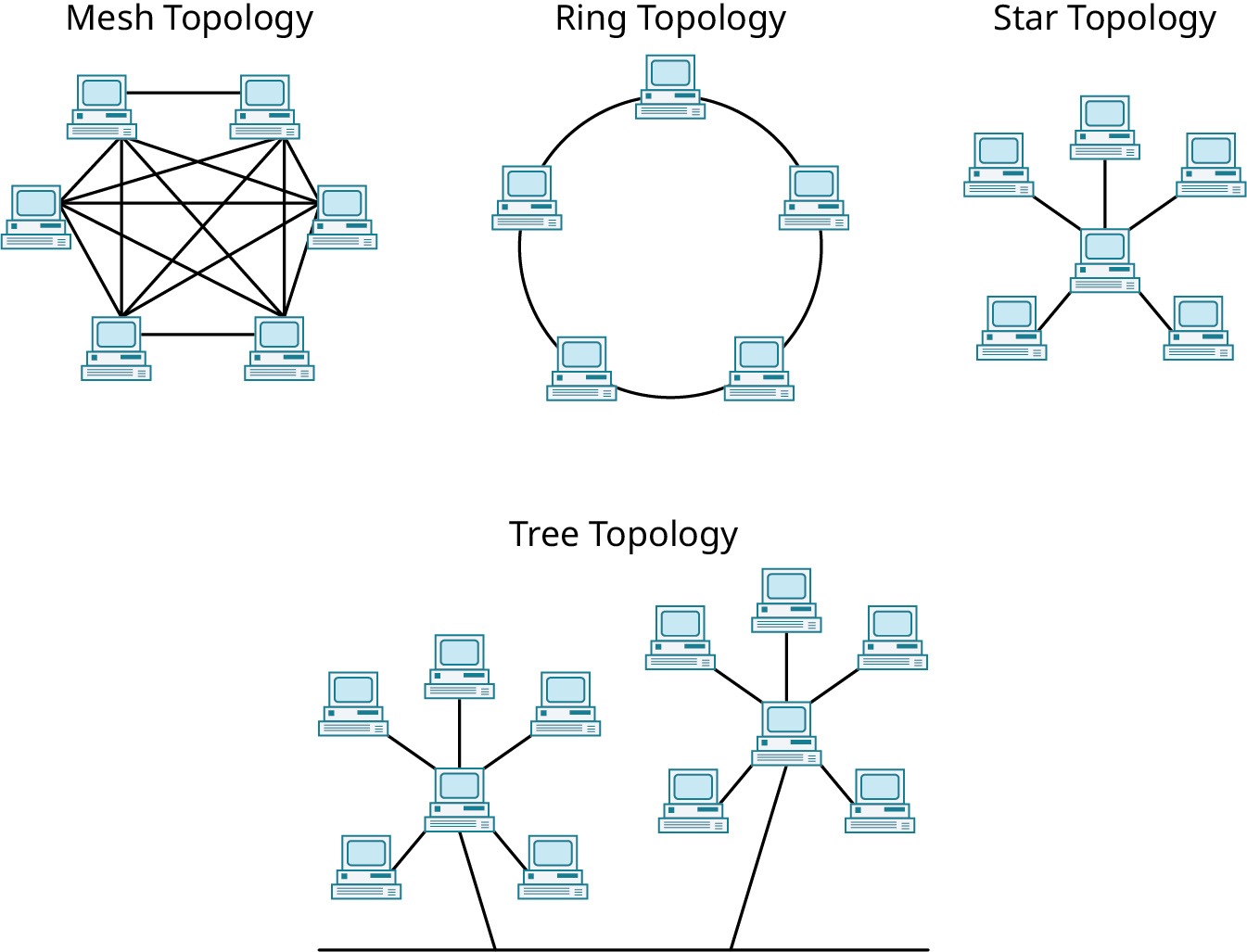 Common Network Configurations
Answer
The star topology and the tree topology are trees. They are connected and have no cyclic subgraphs.
The ring topology is not a tree. It forms a cycle.
The mesh topology is not a tree. It has cyclic subgraphs.
The star topology is a tree, and the tree topology is a tree. The ring topology and the mesh topology are not trees because they contain cycles.Your Turn 12.47 §12.10 source ↗
Of the network configurations from Your Turn 12.46, which, if any, has the characteristics of a
Star tree?Answer
The star topology is a star tree.
A star tree is a tree that has exactly one vertex of degree greater than 1 called a root, and all other vertices are adjacent to it.
star topologyYour Turn 12.47 (b) §12.10 source ↗
Of the network configurations from Your Turn 12.46, which, if any, has the characteristics of a
Caterpillar tree?Answer
The tree topology is a caterpillar tree.
A caterpillar tree is a tree that has a central path that can have vertices of any degree, with each vertex not on the central path being adjacent to a vertex on the central path and having a degree of one.
tree topologyYour Turn 12.47 (c) §12.10 source ↗
Of the network configurations from Your Turn 12.46, which, if any, has the characteristics of a
Path graph?Answer
Your Turn 12.48 §12.10 source ↗
Use Graphs I and J in Figure 12.212 to answer each question.
Which vertices are in each of the components that remain when edge jl is removed from Graph J?Answer
Removing ji breaks the tree into two separate components so that it is no longer a tree.
One component: g, h, i, j
The other component: k, l, m
Vertices k, l, and m are in one component, and vertices g, h, i, and j are in the other.Your Turn 12.48 (b) §12.10 source ↗
Use Graphs I and J in Figure 12.212 to answer each question.
Determine the number of edges and the number of vertices in Graph I. Explain how this confirms that Graph I is a tree.Answer
The number of edges in a tree graph with n vertices is n – 1.
This graph has 6 vertices and 5 edges. This is what the formula predicts for a tree graph with 6 vertices. If n is 6, then n – 1 is 5.
There are 6 vertices and 5 edges, which confirms Graph I is a tree, because the number of edges is one less than the number of vertices.Your Turn 12.48 (c) §12.10 source ↗
Use Graphs I and J in Figure 12.212 to answer each question.
What kind of cycle is created if edge cf is added to Graph I?Answer
Your Turn 12.49 §12.10 source ↗
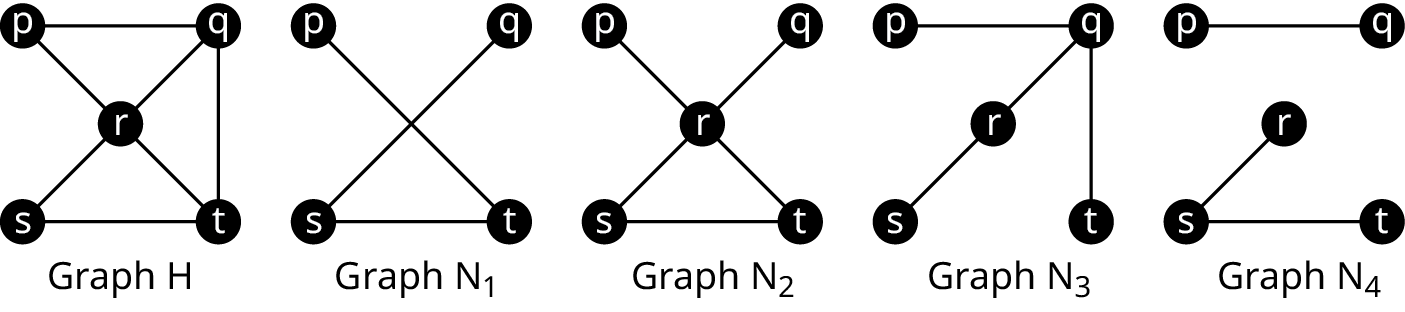 Since sq is not an edge in Graph H, Graph N1 cannot be a spanning tree of H.
- a.True
- b.False
Answer
Your Turn 12.49 (b) §12.10 source ↗
Graph N2 is a spanning tree of Graph H.- a.True
- b.False
Answer
Your Turn 12.49 (c) §12.10 source ↗
Graph N3 is a spanning tree of Graph H.- a.True
- b.False
Answer
Your Turn 12.49 (d) §12.10 source ↗
Since there is no path between p and t in Graph N4, it cannot be a spanning tree of any graph.- a.True
- b.False
Answer
Your Turn 12.50 §12.10 source ↗
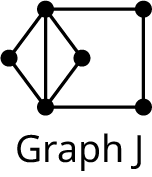 Graph J
Answer
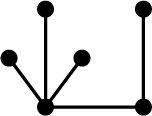
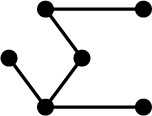
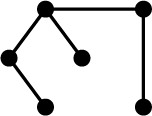
Your Turn 12.51 §12.10 source ↗
Answer
Remember that the number of edges in a tree graph with n vertices is n – 1.
Graph V has 9 vertices and 11 edges. The associated spanning tree will have 8 edges. You need to remove 3 edges from Graph V.
The example removed ac, cf, and be.
You want to form a spanning tree by removing three edges. Keep in mind that you have to break up the three cycles, since a spanning tree cannot have any cycles.
The three edges must include one edge from list A and a pair of edges from list B.
List A: be, eh, hi, gi, bg
List B: ac and ad, ac and af, ac and cd, ac and cf, ad and af, ad and cd, ad and cf, af and cd, af and cf, or cd and cf
The three edges must include one edge from list A and one pair of edges from list B.List A: be, eh, hi, gi, bg
List B: ac and ad, ac and af, ac and cd, ac and cf, ad and af, ad and cd, ad and cf, af and cd, af and cf, or cd and cf.
Your Turn 12.52 §12.10 source ↗
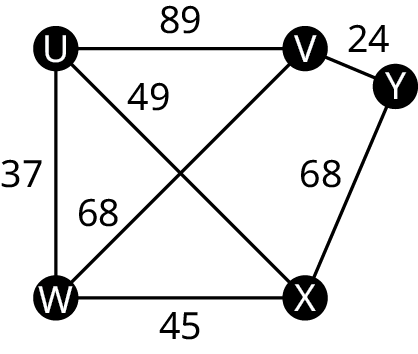 Weighted Graph
Answer
Rank the weights: 24, 37, 45, 49, 68, 68, 89
Step 1: Choose the edge with the minimum weight of all the edges.
VY has a weight of 24.
Step 2: Choose another edge of minimum weight from the remaining edges. The second edge does not have to be connected to the first edge.
UW has a weight of 37.
Step 3: Choose another edge of minimum weight from the remaining edges, but do not select any edge that creates a cycle in the subgraph you are creating.
WX has a weight of 45.
Step 4: Repeat Step 3 until all the vertices of the original graph are included and you have a spanning tree.
UX has a weight of 48. UX would create a cycle, so do not use it.
Repeat Step 3: Choose another edge of minimum weight from the remaining edges, but do not select any edge that creates a cycle in the subgraph you are creating.
There are two edges with a weight of 68. You can put either in your graph. VW or YX (not both)
You are done. You now have five vertices in your graph.
Add the weights:
The weight of your spanning tree is 174.
There are two possible minimum spanning trees, each with a total weight of 174: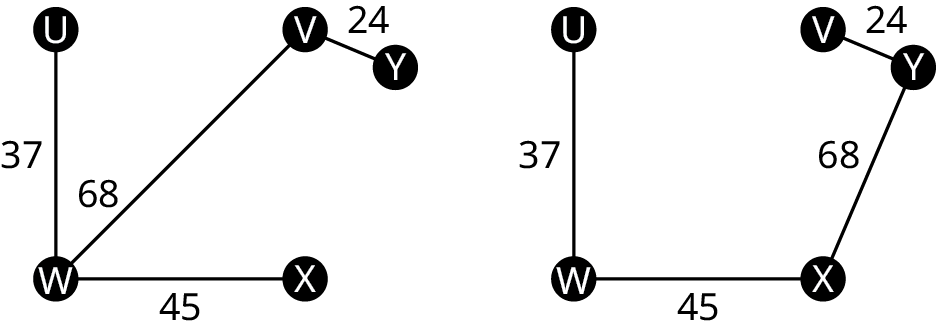
Check Your Understanding 12.10.85 §12.10 source ↗
- a.True
- b.False
Answer
Check Your Understanding 12.10.86 §12.10 source ↗
- a.True
- b.False
Answer
Check Your Understanding 12.10.87 §12.10 source ↗
- a.True
- b.False
Answer
Check Your Understanding 12.10.88 §12.10 source ↗
- a.True
- b.False
Answer
Check Your Understanding 12.10.89 §12.10 source ↗
- a.True
- b.False
Answer
Check Your Understanding 12.10.90 §12.10 source ↗
- a.True
- b.False
Answer
Check Your Understanding 12.10.91 §12.10 source ↗
- a.True
- b.False
Answer
Check Your Understanding 12.10.92 §12.10 source ↗
- a.True
- b.False
Answer
Check Your Understanding 12.10.93 §12.10 source ↗
- a.True
- b.False
Answer
Check Your Understanding 12.10.94 §12.10 source ↗
- a.True
- b.False
Answer
Loading chapter 13…
Problems and answers are adapted from Contemporary Mathematics by Donna Kirk, OpenStax, and are used under the CC BY-NC-SA 4.0 licence. Access for free at https://openstax.org/books/contemporary-mathematics/pages/1-introduction. Illustrations: Copyright Rice University, OpenStax, under CC BY-NC-SA 4.0 license. This adaptation is released under the same licence, is non-commercial, and is neither affiliated with nor endorsed by OpenStax or Rice University.