Every problem in the chapter beside the book’s answer, a chapter at a time as you scroll.
Chapter 7: Probability
153 problems · 1 figureYour Turn 7.1 §7.1 source ↗
Answer
The Multiplication Rule of Counting says that if there are n ways to accomplish one task and m ways to accomplish a second task, then there are ways to accomplish both tasks. You can tack on additional tasks by multiplying the number of ways to accomplish those tasks to your previous product.
Your Turn 7.2 §7.1 source ↗
Answer
The Multiplication Rule of Counting says that if there are n ways to accomplish one task and m ways to accomplish a second task, then there are ways to accomplish both tasks. You can tack on additional tasks by multiplying the number of ways to accomplish those tasks to your previous product.
Your Turn 7.3 §7.1 source ↗
Answer
The Multiplication Rule of Counting says that if there are n ways to accomplish one task and m ways to accomplish a second task, then there are ways to accomplish both tasks. You can tack on additional tasks by multiplying the number of ways to accomplish those tasks to your previous product.
You have 3 choices for letters, 10 choices each time you choose a digit, and 26 choices for each time you choose a letter.
Check Your Understanding 7.1.1 §7.1 source ↗
Answer
The Multiplication Rule of Counting says that if there are n ways to accomplish one task and m ways to accomplish a second task, then there are ways to accomplish both tasks. You can tack on additional tasks by multiplying the number of ways to accomplish those tasks to your previous product.
540
Check Your Understanding 7.1.2 §7.1 source ↗
Answer
The Multiplication Rule of Counting says that if there are n ways to accomplish one task and m ways to accomplish a second task, then there are ways to accomplish both tasks. You can tack on additional tasks by multiplying the number of ways to accomplish those tasks to your previous product.
You have two choices of how many chicken strips you get (three or five).
You have 7 choices of side dishes.
14
Check Your Understanding 7.1.3 §7.1 source ↗
Answer
The Multiplication Rule of Counting says that if there are n ways to accomplish one task and m ways to accomplish a second task, then there are ways to accomplish both tasks. You can tack on additional tasks by multiplying the number of ways to accomplish those tasks to your previous product.
Each time you flip, you have two choices.
You flip ten times, so you have two choices each flip.
1,024
Check Your Understanding 7.1.4 §7.1 source ↗
Answer
The Multiplication Rule of Counting says that if there are n ways to accomplish one task and m ways to accomplish a second task, then there are ways to accomplish both tasks. You can tack on additional tasks by multiplying the number of ways to accomplish those tasks to your previous product.
800
Check Your Understanding 7.1.5 §7.1 source ↗
Answer
The Multiplication Rule of Counting says that if there are n ways to accomplish one task and m ways to accomplish a second task, then there are ways to accomplish both tasks. You can tack on additional tasks by multiplying the number of ways to accomplish those tasks to your previous product.
Multiply the choices during each class period.
25,920
Your Turn 7.4 §7.2 source ↗
Answer
The Multiplication Rule of Counting says that if there are n ways to accomplish one task and m ways to accomplish a second task, then there are ways to accomplish both tasks. You can tack on additional tasks by multiplying the number of ways to accomplish those tasks to your previous product.
| Choosing… | You choose a card for the first position | You choose a card for the second position | You choose a card for the third position | You choose a card for the second position | You choose a card for the last position |
| Number of Choices | You have 5 choices | You have 4 cards left from which to choose | You have 3 cards left from which to choose | You have 2 cards left from which to choose | You have 1 card left from which to choose |
The number of ways you can make your choices is .
120Your Turn 7.5 §7.2 source ↗
Compute the following:
Answer
A factorial for any positive whole number n (denoted n!) is the product of every whole number less than or equal to n. We define 0! to be equal to one.
720
Your Turn 7.5 (b) §7.2 source ↗
Compute the following:
Answer
A factorial for any positive whole number n (denoted n!) is the product of every whole number less than or equal to n. We define 0! to be equal to one.
Instead of writing out all the factors, you could have written this expression an easier way.
132
Your Turn 7.5 (c) §7.2 source ↗
Compute the following:
Answer
A factorial for any positive whole number n (denoted n!) is the product of every whole number less than or equal to n. We define 0! to be equal to one.
70
Your Turn 7.6 §7.2 source ↗
Find the following numbers:
The number of permutations of 6 objects taken 2 at a timeAnswer
The permutation of n objects taken r at a time is where 1 ≤ r ≤ n.
30
Your Turn 7.6 (b) §7.2 source ↗
Find the following numbers:
The number of permutations of 14 objects taken 4 at a timeAnswer
The permutation of n objects taken r at a time is where 1 ≤ r ≤ n.
Your Turn 7.6 (c) §7.2 source ↗
Find the following numbers:
The number of permutations of 19 objects taken 3 at a timeAnswer
The permutation of n objects taken r at a time is where 1 ≤ r ≤ n.
Your Turn 7.7 §7.2 source ↗
Answer
The permutation of n objects taken r at a time is where 1 ≤ r ≤ n.
There are 2,730 ways to pick the top three finishers.
Check Your Understanding 7.2.6 §7.2 source ↗
Answer
A factorial for any positive whole number n (denoted n!) is the product of every whole number less than or equal to n. We define 0! to be equal to one.
120
Check Your Understanding 7.2.7 §7.2 source ↗
Answer
A factorial for any positive whole number n (denoted n!) is the product of every whole number less than or equal to n. We define 0! to be equal to one.
120
Check Your Understanding 7.2.8 §7.2 source ↗
Answer
The permutation of n objects taken r at a time is where 1 ≤ r ≤ n.
1,320
Check Your Understanding 7.2.9 §7.2 source ↗
Answer
The permutation of n objects taken r at a time is where 1 ≤ r ≤ n.
Check Your Understanding 7.2.10 §7.2 source ↗
Answer
The permutation of n objects taken r at a time is where 1 ≤ r ≤ n.
Your Turn 7.8 §7.3 source ↗
Decide whether the following represent permutations or combinations:
On Halloween, you give each kid who comes to your door 3 pieces of candy, taken randomly from a candy dish.Answer
Your Turn 7.8 (b) §7.3 source ↗
Decide whether the following represent permutations or combinations:
Your class is going on a field trip, but there are too many people for one vehicle. Your instructor chooses half the class to take the first vehicle.Answer
Your Turn 7.9 §7.3 source ↗
Compute the following:
Answer
The number of combinations of n objects taken r at a time is .
The answer will always be an integer, so check your math if you get a fraction.
15
Your Turn 7.9 (b) §7.3 source ↗
Compute the following:
Answer
The number of combinations of n objects taken r at a time is .
The answer will always be an integer, so check your math if you get a fraction.
45
Your Turn 7.9 (c) §7.3 source ↗
Compute the following:
Answer
The number of combinations of n objects taken r at a time is .
The answer will always be an integer, so check your math if you get a fraction.
2,002
Your Turn 7.10 §7.3 source ↗
Answer
Since they all receive the same prize, it does not matter what order they call the names. This is a combination, choosing 3 names from 58.
30,856
Your Turn 7.10 (b) §7.3 source ↗
Answer
Since they all have equal responsibility, it does not matter in which order you name the members. This is a combination, choosing 4 members from 42 members.
111,930
Your Turn 7.11 §7.3 source ↗
Answer
It does not matter in which order the cards are dealt to you. For each requirement, it is a combination. There are 13 cards in each suit.
| Requirement | 3 spades | 2 hearts | 1 club |
| Formula | 13C3 | 13C2 | 13C1 |
Then, use the Multiplication Rule of Counting. The Multiplication Rule of Counting says that if there are n ways to accomplish one task and m ways to accomplish a second task, then there are ways to accomplish both tasks. You can tack on additional tasks by multiplying the number of ways to accomplish those tasks to your previous product.
The number of ways to have the required hand is .
Evaluate each combination separately.
Now you can evaluate .
290,004Check Your Understanding 7.3.11 §7.3 source ↗
Answer
Check Your Understanding 7.3.12 §7.3 source ↗
Answer
Check Your Understanding 7.3.13 §7.3 source ↗
Answer
The number of combinations of n objects taken r at a time is .
The answer will always be an integer, so check your math if you get a fraction.
66
Check Your Understanding 7.3.14 §7.3 source ↗
Answer
The number of combinations of n objects taken r at a time is .
The answer will always be an integer, so check your math if you get a fraction.
560
Check Your Understanding 7.3.15 §7.3 source ↗
Answer
This is a combination. It doesn’t matter which order you choose the 3 friends out of 6 friends.
The number of combinations of n objects taken r at a time is .
There are 20 ways to pick three other people.
20Check Your Understanding 7.3.16 §7.3 source ↗
Answer
It does not matter in which order you pack the shirts and skirts. They will all be with you on the trip.
| Choices | 3 shirts from 8 shirts | 3 skirts from 5 skirts |
| Formula | 8C3 | 5C3 |
Then, use the Multiplication Rule of Counting. The Multiplication Rule of Counting says that if there are n ways to accomplish one task and m ways to accomplish a second task, then there are ways to accomplish both tasks. You can tack on additional tasks by multiplying the number of ways to accomplish those tasks to your previous product.
The number of ways to have the required hand is .
Evaluate each combination separately.
Now you can evaluate .
There are 560 ways to choose 3 shirts and 3 skirts.
560Your Turn 7.12 §7.4 source ↗
Identify the sample space of each experiment.
You draw a card from a standard deck and note its suit.Answer
The sample space is the set of all possible outcomes.
{hearts, spades, clubs, diamonds}
Your Turn 7.12 (b) §7.4 source ↗
Identify the sample space of each experiment.
You draw a card from a standard deck and note its rank.Answer
The sample space is the set of all possible outcomes.
A represents an Ace, J for Jack, Q for Queen, and K for King.
{A, 2, 3, 4, 5, 6, 7, 8, 9, 10, J, Q, K}
{A, 2, 3, 4, 5, 6, 7, 8, 9, 10, J, Q, K}Your Turn 7.12 (c) §7.4 source ↗
Identify the sample space of each experiment.
You roll a 4-sided die and note the number on the bottom. (A 4-sided die is shaped like a pyramid, so when it comes to rest, there’s no single side facing up.)Answer
The sample space is the set of all possible outcomes. There are four possible outcomes.
{1, 2, 3, 4}
{1, 2, 3, 4}Your Turn 7.12 (d) §7.4 source ↗
Identify the sample space of each experiment.
You roll three 4-sided dice and note the sum of the numbers on the bottom.Answer
The sample space is the set of all possible outcomes. The possible outcomes are the possible sums from adding the choice from {1, 2, 3, 4} on three dice.
| Die 1 Roll | Die 2 Roll | Die 3 Roll | Sum | |
| Smallest possible roll | 1 | 1 | 1 | 3 |
| Largest possible roll | 4 | 4 | 4 | 12 |
Every number between 3 and 12 is possible, too.
Sample space: {3, 4, 5, 6, 7, 8, 9, 10, 11, 12}.
{3, 4, 5, 6, 7, 8, 9, 10, 11, 12}Your Turn 7.13 §7.4 source ↗
Decide whether the two stages in these experiments are dependent or independent.
You’re getting dressed to go to a party, and you plan to wear a blouse and a skirt. You choose the blouse first, then the skirt (assume that you’d be comfortable wearing any of your skirts with any of your blouses).Answer
Independent stages do not affect each other. Dependent stages do affect each other.
If you do not care which colors go together, the choices of blouse and skirt are independent.
IndependentYour Turn 7.13 (b) §7.4 source ↗
Decide whether the two stages in these experiments are dependent or independent.
On further reflection, you realize that some of your skirts clash with some of your blouses. So, you choose the blouse first, and then choose a skirt that goes with your chosen blouse.Answer
Independent stages do not affect each other. Dependent stages do affect each other.
Once you decide that if you choose the blue shirt, you will not wear the orange skirt (or something like that), the choices of blouse and skirt are dependent.
DependentYour Turn 7.14 §7.4 source ↗
Answer
| DIE | |||||||
| Choices | 1 | 2 | 3 | 4 | 5 | 6 | |
| COIN TOSS | H | (H, 1) | (H, 2) | (H, 3) | (H, 4) | (H, 5) | (H, 6) |
| T | (T, 1) | (T, 2) | (T, 3) | (T, 4) | (T, 5) | (T, 6) |
The sample space: {(H, 1), (H, 2), (H, 3), (H, 4), (H, 5), (H, 6), (T, 1), (T, 2), (T, 3), (T, 4), (T, 5), (T, 6) }
{H1, H2, H3, H4, H5, H6, T1, T2, T3, T4, T5, T6}Your Turn 7.15 §7.4 source ↗
Answer
Due to the limitations of graphics in the solution area, the “tree” will be simulated with a table.
| The root | ||||||
| 1st Draw | J | Q | K | |||
| 2nd Draw | Q | K | J | K | J | Q |
Sample space: {((J, Q), (J, K),(Q, J),(Q, K),(K, J),(K, Q)}
{J Q, J K, Q J, Q K, K J, K Q}Check Your Understanding 7.4.17 §7.4 source ↗
Answer
The minimum number of heads is none. The maximum number of heads is 6. Every number between 0 and 6 is possible.
The sample space: {0, 1, 2, 3, 4, 5, 6}
{0, 1, 2, 3, 4, 5, 6}Check Your Understanding 7.4.18 §7.4 source ↗
Answer
| Crinkle Fries | Curly Fries | Onion Rings | |
|---|---|---|---|
| 8 Nuggets | 8 nuggets with crinkle fries | 8 nuggets with curly fries | 8 nuggets with onion rings |
| 12 Nuggets | 12 nuggets with crinkle fries | 12 nuggets with curly fries | 12 nuggets with onion rings |
Check Your Understanding 7.4.19 §7.4 source ↗
Answer
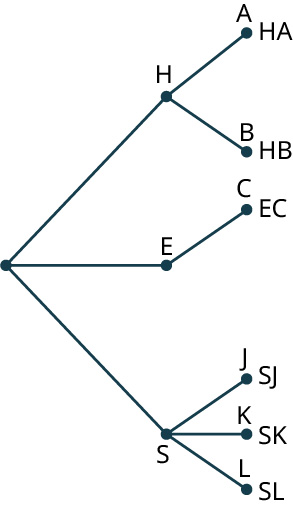
Check Your Understanding 7.4.20 §7.4 source ↗
Answer
Check Your Understanding 7.4.21 §7.4 source ↗
Answer
Your Turn 7.16 §7.5 source ↗
Jorge is about to conduct an experiment that consists of flipping a coin 4 times and recording the number of heads . Decide if these probabilities are equal to zero, equal to one, or somewhere in between.
Answer
Your Turn 7.16 (b) §7.5 source ↗
Jorge is about to conduct an experiment that consists of flipping a coin 4 times and recording the number of heads . Decide if these probabilities are equal to zero, equal to one, or somewhere in between.
Answer
Your Turn 7.16 (c) §7.5 source ↗
Jorge is about to conduct an experiment that consists of flipping a coin 4 times and recording the number of heads . Decide if these probabilities are equal to zero, equal to one, or somewhere in between.
Answer
Your Turn 7.17 §7.5 source ↗
You are about to roll a fair (meaning that each face has an equal chance of landing up) 6-sided die, whose faces are labeled with the numbers 1 through 6. Find the theoretical probabilities of each outcome.
You roll a 4.Answer
For an experiment whose sample space S consists of equally likely outcomes, the theoretical probability of the event E is , where n(E) and n(S) denote the number of outcomes in the event and in the sample space, respectively.
Your Turn 7.17 (b) §7.5 source ↗
You are about to roll a fair (meaning that each face has an equal chance of landing up) 6-sided die, whose faces are labeled with the numbers 1 through 6. Find the theoretical probabilities of each outcome.
You roll a number greater than 2.Answer
For an experiment whose sample space S consists of equally likely outcomes, the theoretical probability of the event E is , where n(E) and n(S) denote the number of outcomes in the event and in the sample space, respectively.
Your Turn 7.17 (c) §7.5 source ↗
You are about to roll a fair (meaning that each face has an equal chance of landing up) 6-sided die, whose faces are labeled with the numbers 1 through 6. Find the theoretical probabilities of each outcome.
You roll an odd number.Answer
For an experiment whose sample space S consists of equally likely outcomes, the theoretical probability of the event E is , where n(E) and n(S) denote the number of outcomes in the event and in the sample space, respectively.
Your Turn 7.18 §7.5 source ↗
Answer
| Sums | 2nd roll | ||||
| 1st roll | Choices | 1 | 2 | 3 | 4 |
| 1 | 2 | 3 | 4 | 5 | |
| 2 | 3 | 4 | 5 | 6 | |
| 3 | 4 | 5 | 6 | 7 | |
| 4 | 5 | 6 | 7 | 8 |
Of the 16 possible sums, five of them are 6 or 7.
For an experiment whose sample space S consists of equally likely outcomes, the theoretical probability of the event E is , where n(E) and n(S) denote the number of outcomes in the event and in the sample space, respectively.
Your Turn 7.19 §7.5 source ↗
You have a modified deck of cards containing only 3, 4, and 5. You draw 2 two cards without replacing them (where order matters). What is the probability of each event?
The first card drawn is 3.Answer
The “tree” as a table: These are all hearts, so only the number of the card is in the table.
| Root | 1st Draw | 2nd Draw | Results |
| 3 | 4 | 34 | |
| 5 | 35 | ||
| 4 | 3 | 43 | |
| 5 | 45 | ||
| 5 | 3 | 53 | |
| 4 | 54 |
There are six possible results.
P(the first card is a 3 heart) = .
Your Turn 7.19 (b) §7.5 source ↗
You have a modified deck of cards containing only 3, 4, and 5. You draw 2 two cards without replacing them (where order matters). What is the probability of each event?
The first card drawn has a lower number than the second card.Answer
The “tree” as a table: These are all hearts, so only the number of the card is in the table.
| Root | 1st Draw | 2nd Draw | Results |
| 3 | 4 | 34 | |
| 5 | 35 | ||
| 4 | 3 | 43 | |
| 5 | 45 | ||
| 5 | 3 | 53 | |
| 4 | 54 |
There are six possible results. The ones that satisfy the requirement are 34, 35, and 45.
P(the first card drawn has a lower number than the second card) .
Your Turn 7.19 (c) §7.5 source ↗
You have a modified deck of cards containing only 3, 4, and 5. You draw 2 two cards without replacing them (where order matters). What is the probability of each event?
One of the cards drawn is 4.Answer
The “tree” as a table: These are all hearts, so only the number of the card is in the table.
| Root | 1st Draw | 2nd Draw | Results |
| 3 | 4 | 34 | |
| 5 | 35 | ||
| 4 | 3 | 43 | |
| 5 | 45 | ||
| 5 | 3 | 53 | |
| 4 | 54 |
There are six possible results. The ones that satisfy the requirement are 34, 43, 45, and 54.
P(one of the cards drawn is the 4 hearts) = .
Your Turn 7.20 §7.5 source ↗
Answer
The empirical probability is .
P(bad placement) .
Your Turn 7.21 §7.5 source ↗
Classify each of the following probabilities as theoretical, empirical, or subjective.
You have entered a raffle with 500 entrants. Your probability of winning is 0.2%.Answer
This is theoretical. You know that 500 people have tickets.
For an experiment whose sample space S consists of equally likely outcomes, the theoretical probability of the event E is , where n(E) and n(S) denote the number of outcomes in the event and in the sample space, respectively.
Your Turn 7.21 (b) §7.5 source ↗
Classify each of the following probabilities as theoretical, empirical, or subjective.
Your little brother takes the bus to school each morning. On the first day of school, you believe that the probability that the bus arrives between 7:15 AM and 7:30 AM is about 80%.Answer
Your Turn 7.21 (c) §7.5 source ↗
Classify each of the following probabilities as theoretical, empirical, or subjective.
Your little brother takes the bus to school each morning. On the last day of school, you believe that the probability that the bus arrives between 7:15 AM and 7:30 AM is about 73%.Answer
Your Turn 7.22 §7.5 source ↗
Answer
| Sums | 2nd roll | ||||
| Choices | 1 | 2 | 3 | 4 | |
| 1st roll | 1 | 2 | 3 | 4 | 5 |
| 2 | 3 | 4 | 5 | 6 | |
| 3 | 4 | 5 | 6 | 7 | |
| 4 | 5 | 6 | 7 | 8 |
Of the 16 possible sums, 13 of them are greater than 3.
For an experiment whose sample space S consists of equally likely outcomes, the theoretical probability of the event E is , where n(E) and n(S) denote the number of outcomes in the event and in the sample space, respectively.
Check Your Understanding 7.5.22 §7.5 source ↗
You have two coins: a nickel and a quarter. You flip them both. Find the probabilities of these events:
Both come up heads.Answer
| Nickel | Quarter |
| H | H |
| H | T |
| T | H |
| T | T |
Check Your Understanding 7.5.23 §7.5 source ↗
You have two coins: a nickel and a quarter. You flip them both. Find the probabilities of these events:
The quarter comes up heads.Answer
| Nickel | Quarter |
| H | H |
| H | T |
| T | H |
| T | T |
Check Your Understanding 7.5.24 §7.5 source ↗
You have two coins: a nickel and a quarter. You flip them both. Find the probabilities of these events:
You get one heads and one tails.Answer
| Nickel | Quarter |
| H | H |
| H | T |
| T | H |
| T | T |
Check Your Understanding 7.5.25 §7.5 source ↗
You have two coins: a nickel and a quarter. You flip them both. Find the probabilities of these events:
You get three tails.Answer
| Nickel | Quarter |
| H | H |
| H | T |
| T | H |
| T | T |
There are only two tosses.
0Check Your Understanding 7.5.26 §7.5 source ↗
Decide whether the given probabilities were most likely derived theoretically, empirically, or subjectively.
A poker player has a 16% chance of making a hand called a flush on the next card.Answer
Check Your Understanding 7.5.27 §7.5 source ↗
Decide whether the given probabilities were most likely derived theoretically, empirically, or subjectively.
Your friend Jacob tells you that there’s a 20% chance he’ll get married in the next 5 years.Answer
Check Your Understanding 7.5.28 §7.5 source ↗
Decide whether the given probabilities were most likely derived theoretically, empirically, or subjectively.
Ashley has a coin that they think might not be fair, so they flip it 100 times and note that the result was heads 58 times. So, Ashley says the probability of flipping heads on that coin is about 58%.Answer
Check Your Understanding 7.5.29 §7.5 source ↗
If you flip a fair coin 50 times, the probability of getting 20 or fewer heads is about 10.1% (a fact we’ll learn how to verify later).
If is the event “number of heads is 20 or fewer”, describe the event using an inequality.Answer
The complement of E is the collection of all the outcomes that are not in E.
E is 20 or fewer heads.
The complement of E is the number of heads is > 20.
Check Your Understanding 7.5.30 §7.5 source ↗
If you flip a fair coin 50 times, the probability of getting 20 or fewer heads is about 10.1% (a fact we’ll learn how to verify later).
Find .Answer
Your Turn 7.23 §7.6 source ↗
Answer
Your Turn 7.24 §7.6 source ↗
Answer
Your Turn 7.24 (b) §7.6 source ↗
Answer
The number of possible five-card hands out of a 52-card deck is .
There are 13 cards in each suit.
The number of ways to draw 2 spades out of 13 spades is .
The number of ways to draw 3 hearts out of 13 hearts is .
Use the Multiplication Rule of Counting to count the ways to draw 2 spades and 3 hearts:
P(drawing 2 spades and 3 hearts) = .
Check Your Understanding 7.6.31 §7.6 source ↗
For the following exercises, you are drawing Scrabble tiles without replacement from a bag containing the letters A, C, E, E, I, N, N, S, S, W.
What is the probability that you draw (in order) the letters W-I-N?Answer
Check Your Understanding 7.6.32 §7.6 source ↗
For the following exercises, you are drawing Scrabble tiles without replacement from a bag containing the letters A, C, E, E, I, N, N, S, S, W.
What is the probability that you draw (in order) the letters W-I-S-E?Answer
Check Your Understanding 7.6.33 §7.6 source ↗
For the following exercises, you are drawing Scrabble tiles without replacement from a bag containing the letters A, C, E, E, I, N, N, S, S, W.
What is the probability that you draw (in order) the letters S-E-E-N?Answer
Check Your Understanding 7.6.34 §7.6 source ↗
For the following exercises, you are drawing Scrabble tiles without replacement from a bag containing the letters A, C, E, E, I, N, N, S, S, W.
What is the probability that you draw (in any order) the letters W-I-N?Answer
Check Your Understanding 7.6.35 §7.6 source ↗
For the following exercises, you are drawing Scrabble tiles without replacement from a bag containing the letters A, C, E, E, I, N, N, S, S, W.
What is the probability that you draw (in any order) the letters W-I-S-E?Answer
Check Your Understanding 7.6.36 §7.6 source ↗
For the following exercises, you are drawing Scrabble tiles without replacement from a bag containing the letters A, C, E, E, I, N, N, S, S, W.
What is the probability that you draw (in any order) the letters S-E-E-N?Answer
Your Turn 7.25 §7.7 source ↗
You roll a pair of 4-sided dice with faces labeled 1 through 4.
What are the odds for rolling a sum greater than 3?Answer
The sample space:
| Sums | 2nd roll | ||||
| 1st roll | Choices | 1 | 2 | 3 | 4 |
| 1 | 2 | 3 | 4 | 5 | |
| 2 | 3 | 4 | 5 | 6 | |
| 3 | 4 | 5 | 6 | 7 | |
| 4 | 5 | 6 | 7 | 8 |
The total number of outcomes: 16.
The outcomes greater than three: 13.
The number of outcomes not in the desired event is .
The ratio of the number of equally likely outcomes in an event to the number of equally likely outcomes not in the event is called the odds for (or odds in favor of) the event.
The odds in favor of your event are .
Your Turn 7.25 (b) §7.7 source ↗
You roll a pair of 4-sided dice with faces labeled 1 through 4.
What are the odds against both dice giving the same number?Answer
The sample space:
| Both Rolls | 2nd roll | ||||
| 1st roll | Choices | 1 | 2 | 3 | 4 |
| 1 | 1,1 | 1,2 | 1,3 | 1,4 | |
| 2 | 2,1 | 2.2 | 2,3 | 2,4 | |
| 3 | 3,1 | 3,2 | 3,3 | 3,4 | |
| 4 | 4,1 | 4,2 | 4,3 | 4,4 |
The total number of outcomes: 16.
The outcomes with both dice giving the same number: 4.
The number of outcomes not in the desired event is .
The ratio of the number of equally likely outcomes in an event to the number of equally likely outcomes not in the event is called the odds for (or odds in favor of) the event.
The odds against your event are or .
Your Turn 7.26 §7.7 source ↗
Answer
Odds for:
If the probability is 80%, then the odds for the event are .
You can simplify the ratio by dividing both numbers by 0.8.
You can multiply again by 4 to get rid of decimals.
Odds against: (reverse the numbers).
The odds for are and the odds against are .
Your Turn 7.27 §7.7 source ↗
Find if :
The odds of are againstAnswer
The odds in favor of are .
If the odds in favor of are , then
.
Your Turn 7.27 (b) §7.7 source ↗
Find if :
The odds of are in favorAnswer
The odds in favor of are .
If the odds in favor of are , then
.
Check Your Understanding 7.7.37 §7.7 source ↗
For the following exercises, you are rolling a 6-sided die with 3 orange faces, 2 green faces, and 1 blue face.
What are the odds in favor of rolling a green face?Answer
The total number of outcomes: 6.
The outcomes with a green face: 2.
The number of outcomes not in the desired event is .
The odds in favor of rolling a green face are or .
Check Your Understanding 7.7.38 §7.7 source ↗
For the following exercises, you are rolling a 6-sided die with 3 orange faces, 2 green faces, and 1 blue face.
What are the odds against rolling a blue face?Answer
The total number of outcomes is 6.
The number of outcomes with a blue face is 1.
The number of outcomes not in the desired event is .
The odds against rolling a blue face are .
Check Your Understanding 7.7.39 §7.7 source ↗
For the following exercises, you are rolling a 6-sided die with 3 orange faces, 2 green faces, and 1 blue face.
What are the odds in favor of rolling an orange face?Answer
The total number of outcomes is 6.
The number of outcomes with an orange face is 3.
The number of outcomes not in the desired event is .
The odds in favor of rolling an orange face is or .
Check Your Understanding 7.7.40 §7.7 source ↗
Answer
Odds for:
If the probability is then the odds for the event are .
Multiply both numbers by 8 to clear fractions.
Check Your Understanding 7.7.41 §7.7 source ↗
Answer
Odds for:
If the probability is then the odds for the event are .
Multiply both numbers by 13 to clear fractions.
Reverse the ratio to find the odds against the event.
Check Your Understanding 7.7.42 §7.7 source ↗
Answer
The odds in favor of are .
If the odds in favor of are , then
.
Check Your Understanding 7.7.43 §7.7 source ↗
Answer
The odds in favor of are .
If the odds in favor of are , then
.
Your Turn 7.28 §7.8 source ↗
Suppose you’re about to draw one card from a deck containing only these 10 cards: , , , , , , , , , . Decide whether these events are mutually exclusive:
is the event “the card is an ace” and is the event “the card is a king.”Answer
= {A hearts, A spades, A clubs, A diamonds}
= {K hearts, K spades, K clubs, K diamonds}
There are no outcomes in common.
These are mutually exclusive.
Mutually exclusiveYour Turn 7.28 (b) §7.8 source ↗
Suppose you’re about to draw one card from a deck containing only these 10 cards: , , , , , , , , , . Decide whether these events are mutually exclusive:
is the event “the card is a ” and is the event “the card is an ace.”Answer
They have the Ace of hearts in common.
They are not mutually exclusive.
Not mutually exclusiveYour Turn 7.28 (c) §7.8 source ↗
Suppose you’re about to draw one card from a deck containing only these 10 cards: , , , , , , , , , . Decide whether these events are mutually exclusive:
is the event “the card is a ” and is the event “the card is a king.”Answer
Your Turn 7.29 §7.8 source ↗
Suppose you’re about to draw one card from a deck containing only these 10 cards:
, , , , , , , , , . If appropriate, use the Addition Rule to find the probability that one or the other of these events occurs:
Answer
Sample Space:
| A heart | A spade | A club | A diamond | K spade | K club | Q heart | Q spade | J heart | J spade |
There are 10 cards, 4 of which are Aces and 2 are kings.
The Addition Rule for Mutually Exclusive Events:
If and are mutually exclusive events, then .
P(Ace or King) = .
Your Turn 7.29 (b) §7.8 source ↗
Suppose you’re about to draw one card from a deck containing only these 10 cards:
, , , , , , , , , . If appropriate, use the Addition Rule to find the probability that one or the other of these events occurs:
Answer
Sample Space:
| A heart | A spade | A club | A diamond | K spade | K club | Q heart | Q spade | J heart | J spade |
There are 10 cards.
These are not mutually exclusive events. There is only one card that is both a heart and an Ace, and that is the Ace of hearts. It is not appropriate to use the Addition Rule, so we do not continue this exercise.
Your Turn 7.29 (c) §7.8 source ↗
Suppose you’re about to draw one card from a deck containing only these 10 cards:
, , , , , , , , , . If appropriate, use the Addition Rule to find the probability that one or the other of these events occurs:
Answer
Sample Space:
| A heart | A spade | A club | A diamond | K spade | K club | Q heart | Q spade | J heart | J spade |
There are 10 cards, three of which are hearts and two of which are kings.
(Note, the kings are a spade and a club.)
The Addition Rule for Mutually Exclusive Events:
If and are mutually exclusive events, then .
P(heart or king) = .
Your Turn 7.30 §7.8 source ↗
You are about to roll a special 6-sided die that has both a colored letter and a colored number on each face. The faces are labeled with: a red 1 and a blue A, a red 1 and a green A, an orange 1 and a green B, an orange 2 and a red C, a purple 3 and a brown D, an orange 4 and a blue E. Find the probabilities of these events:
The number is orange or even.Answer
Sample Space:
| Letter side | Red 1 | Red 1 | Orange 1 | Orange 2 | Purple 3 | Orange 4 |
| Number side | Blue A | Green A | Green B | Red C | Brown D | Blue E |
Orange: Orange 1, Orange 2. This is 2 outcomes.
Even: Orange 2, Orange 4. This is 2 outcomes.
Outcomes in common: Orange 2. This is 1 outcome in common.
You can use the Inclusion/Exclusion Principle. If and are not mutually exclusive, then
( and ).
P(orange or even) = P(orange) + P(even) – P(orange and even) = .
Your Turn 7.30 (b) §7.8 source ↗
You are about to roll a special 6-sided die that has both a colored letter and a colored number on each face. The faces are labeled with: a red 1 and a blue A, a red 1 and a green A, an orange 1 and a green B, an orange 2 and a red C, a purple 3 and a brown D, an orange 4 and a blue E. Find the probabilities of these events:
The letter is green or an A.Answer
Sample Space:
| Letter side | Red 1 | Red 1 | Orange 1 | Orange 2 | Purple 3 | Orange 4 |
| Number side | Blue A | Green A | Green B | Red C | Brown D | Blue E |
Green: Green A, Green B. This is 2 outcomes.
A: Blue A, Green A. This is 2 outcomes.
Common: Green A. This is 1 outcome in common.
They are not mutually exclusive.
You can use the Inclusion/Exclusion Principle. If and are not mutually exclusive, then
( and ).
P(green or A) = P(green) + P(A) – P(green and A) = .
Your Turn 7.30 (c) §7.8 source ↗
You are about to roll a special 6-sided die that has both a colored letter and a colored number on each face. The faces are labeled with: a red 1 and a blue A, a red 1 and a green A, an orange 1 and a green B, an orange 2 and a red C, a purple 3 and a brown D, an orange 4 and a blue E. Find the probabilities of these events:
The number is even or the letter is green.Answer
Sample Space:
| Letter side | Red 1 | Red 1 | Orange 1 | Orange 2 | Purple 3 | Orange 4 |
| Number side | Blue A | Green A | Green B | Red C | Brown D | Blue E |
Even: Orange 2, Orange 4, which makes 2 outcomes.
Green: Green A, Green B, which makes 2 outcomes.
They are mutually exclusive.
You can use the Addition Rule for Mutually Exclusive Events:
If and are mutually exclusive events, then .
P(even or green) = .
Check Your Understanding 7.8.44 §7.8 source ↗
You are about to draw a card at random from a deck containing only these 10 cards: , , , , , , , , , . Compute the following probabilities:
You draw an ace or a king.Answer
Sample Space:
| A heart | A spade | A club | A diamond | K spade | K club | Q heart | Q spade | J heart | J spade |
These are mutually exclusive.
There are 10 cards.
You can use the Addition Rule for Mutually Exclusive Events:
If and are mutually exclusive events, then .
There are 4 Aces and 2 kings.
P(A or K) = .
Check Your Understanding 7.8.45 §7.8 source ↗
You are about to draw a card at random from a deck containing only these 10 cards: , , , , , , , , , . Compute the following probabilities:
You draw a or a .Answer
Sample Space:
| A heart | A spade | A club | A diamond | K spade | K club | Q heart | Q spade | J heart | J spade |
These are mutually exclusive.
There are 10 cards.
You can use the Addition Rule for Mutually Exclusive Events:
If and are mutually exclusive events, then .
There are 4 spades and 2 clubs.
P(spade or club) = .
Check Your Understanding 7.8.46 §7.8 source ↗
You are about to draw a card at random from a deck containing only these 10 cards: , , , , , , , , , . Compute the following probabilities:
You draw an ace or a .Answer
Sample Space:
| A heart | A spade | A club | A diamond | K spade | K club | Q heart | Q spade | J heart | J spade |
Ace or heart are not mutually exclusive.
Aces: A heart, A spade, A club, A diamond.
Hearts: Q heart, J heart.
In common: Ace of hearts.
There are not mutually exclusive events.
There are 10 cards.
You can use the Inclusion/Exclusion Principle. If and are not mutually exclusive, then
( and ).
P(Ace or heart) = P(A) + P(heart) – P(A and heart) = .
Check Your Understanding 7.8.47 §7.8 source ↗
You are about to draw a card at random from a deck containing only these 10 cards: , , , , , , , , , . Compute the following probabilities:
You draw a jack or a .Answer
Sample Space:
| A heart | A spade | A club | A diamond | K spade | K club | Q heart | Q spade | J heart | J spade |
Jacks: Jack heart, Jack spade.
Hearts: Ace hearts, Queen hearts, Jack hearts.
Jack and Heart: J heart.
These are not mutually exclusive.
There are 10 cards.
You can use the Inclusion/Exclusion Principle. If and are not mutually exclusive, then
( and ).
P(Jack or heart) = P(J) + P(heart) – P(J and heart) = .
Check Your Understanding 7.8.48 §7.8 source ↗
You are about to draw a card at random from a deck containing only these 10 cards: , , , , , , , , , . Compute the following probabilities:
You draw a jack or a .Answer
Sample Space:
| A heart | A spade | A club | A diamond | K spade | K club | Q heart | Q spade | J heart | J spade |
Jacks: Jack heart, Jack spade.
Clubs: Ace club, King club.
These are mutually exclusive.
There are 10 cards.
If and are not mutually exclusive events, then .
P(jack or club) = .
Check Your Understanding 7.8.49 §7.8 source ↗
You are about to draw a card at random from a deck containing only these 10 cards: , , , , , , , , , . Compute the following probabilities:
You draw a king or a .Answer
Sample Space:
| A heart | A spade | A club | A diamond | K spade | K club | Q heart | Q spade | J heart | J spade |
Kings: King spade, King club.
Diamonds: Ace diamond.
These are mutually exclusive.
There are 10 cards.
You can use the Addition Rule for Mutually Exclusive Events:
If and are mutually exclusive events, then .
P(King or diamond) = .
Your Turn 7.31 §7.9 source ↗
You are about to roll a special 6-sided die that has both a colored letter and a colored number on each face. The faces are labeled with: a red 1 and a blue A, a red 1 and a green A, an orange 1 and a green B, an orange 2 and a red C, a purple 3 and a brown D, an orange 4 and a blue E. Find the given conditional probabilities:
Answer
Sample space:
| Letter side | Red 1 | Red 1 | Orange 1 | Orange 2 | Purple 3 | Orange 4 |
| Number side | Blue A | Green A | Green B | Red C | Brown D | Blue E |
What is the probability of a vowel given that an orange has been rolled?
An orange has been rolled, which means that one of these sides is the result.
| Orange 1 | Orange 2 | Orange 4 |
| Green B | Red C | Blue E |
Vowels: E.
From these choices, .
Your Turn 7.31 (b) §7.9 source ↗
You are about to roll a special 6-sided die that has both a colored letter and a colored number on each face. The faces are labeled with: a red 1 and a blue A, a red 1 and a green A, an orange 1 and a green B, an orange 2 and a red C, a purple 3 and a brown D, an orange 4 and a blue E. Find the given conditional probabilities:
Answer
Sample space:
| Letter side | Red 1 | Red 1 | Orange 1 | Orange 2 | Purple 3 | Orange 4 |
| Number side | Blue A | Green A | Green B | Red C | Brown D | Blue E |
What is the probability of a 1 given that a red has been rolled?
A red has been rolled, meaning that one of these sides is the result.
| Red 1 | Red 1 |
| Blue A | Green A |
Both sides have a 1.
From these choices, .
Your Turn 7.31 (c) §7.9 source ↗
You are about to roll a special 6-sided die that has both a colored letter and a colored number on each face. The faces are labeled with: a red 1 and a blue A, a red 1 and a green A, an orange 1 and a green B, an orange 2 and a red C, a purple 3 and a brown D, an orange 4 and a blue E. Find the given conditional probabilities:
Answer
Sample space:
| Letter side | Red 1 | Red 1 | Orange 1 | Orange 2 | Purple 3 | Orange 4 |
| Number side | Blue A | Green A | Green B | Red C | Brown D | Blue E |
What is the probability of a red given that a 1 has been rolled?
A red has been rolled, which means that one of these sides is the result.
| Red 1 | Red 1 | Orange 1 |
| Blue A | Green A | Green B |
Two of these sides are red.
From these choices, .
Your Turn 7.32 §7.9 source ↗
You’re drawing 2 cards in order from a deck containing only the cards , , , , , , , and . Compute the following:
Answer
Sample space:
| A heart | A club | K spade | 10 heart | 9 heart | 9 spade | 9 diamond | 6 club |
The Multiplication Rule for Probability: If and are events associated with the first and second stages of an experiment, then .
There are 3 hearts to be drawn first out of 8 cards.
There are two spades to be drawn second out of 7 cards.
.
Your Turn 7.32 (b) §7.9 source ↗
You’re drawing 2 cards in order from a deck containing only the cards , , , , , , , and . Compute the following:
Answer
Sample space:
| A heart | A club | K spade | 10 heart | 9 heart | 9 spade | 9 diamond | 6 club |
The Multiplication Rule for Probability: If and are events associated with the first and second stages of an experiment, then .
There are 3 hearts to be drawn first out of 8 cards.
For the second draw, there are 2 remaining hearts to be drawn out of the remaining 7 cards.
.
Your Turn 7.32 (c) §7.9 source ↗
You’re drawing 2 cards in order from a deck containing only the cards , , , , , , , and . Compute the following:
Answer
Sample space:
| A heart | A club | K spade | 10 heart | 9 heart | 9 spade | 9 diamond | 6 club |
The Multiplication Rule for Probability: If and are events associated with the first and second stages of an experiment, then .
There are 3 nines to be drawn first out of 8 cards.
There is 1 six be drawn second out of 7 cards.
.
Your Turn 7.33 §7.9 source ↗
Answer
A table will be used to represent the tree.
| Flip | H | T | ||||||||||
| Roll | 1 | 2 | 3 | 4 | 5 | 6 | 1 | 1 | 1 | 2 | 2 | 3 |
| Result | H1 | H2 | H3 | H4 | H5 | H6 | T1 | T1 | T1 | T2 | T2 | T3 |
There are 12 total outcomes. The probabilities are in the last column of the table.
| Number | Number of Outcomes | Probability |
| 1 | 4 | |
| 2 | 2 | |
| 3 | 2 | |
| 4 | 1 | |
| 5 | 1 | |
| 6 | 1 |
| Roll | Probability |
|---|---|
| 1 | |
| 2 | |
| 3 | |
| 4 | |
| 5 | |
| 6 |
Check Your Understanding 7.9.50 §7.9 source ↗
For the following exercises, you are rolling two 6-sided dice, each of which has 3 orange faces, 2 green faces, and 1 blue face.
What is the probability of rolling 2 orange faces?Answer
Sample space:
| Orange | Orange | Orange | Green | Green | Blue |
On both rolls, you have 3 orange sides out of 6 sides.
The Multiplication Rule for Probability: If and are events associated with the first and second stages of an experiment, then .
P(orange and orange) = .
Check Your Understanding 7.9.51 §7.9 source ↗
For the following exercises, you are rolling two 6-sided dice, each of which has 3 orange faces, 2 green faces, and 1 blue face.
What is the probability of rolling 2 green faces?Answer
Sample space:
| Orange | Orange | Orange | Green | Green | Blue |
On both rolls, you have 2 green faces out of 6 sides.
The Multiplication Rule for Probability: If and are events associated with the first and second stages of an experiment, then .
P(green and green) = .
Check Your Understanding 7.9.52 §7.9 source ↗
For the following exercises, you are rolling two 6-sided dice, each of which has 3 orange faces, 2 green faces, and 1 blue face.
What is the probability of rolling 1 orange and 1 green face (in any order)?Answer
Sample space:
| Orange | Orange | Orange | Green | Green | Blue |
You have 3 orange sides out of 6 sides.
You have 2 green faces out of 6 sides.
The Multiplication Rule for Probability: If and are events associated with the first and second stages of an experiment, then .
P(orange and green) = .
Check Your Understanding 7.9.53 §7.9 source ↗
For the following exercises, you are about to draw 2 cards at random (without replacement) from a deck containing only these 10 cards: , , , , , , , , , .
What is the probability of drawing 2 aces?Answer
Sample space:
| A heart | A spade | A club | A diamond | K spade | K club | Q heart | Q spade | J heart | J spade |
For the first card, you have 4 Aces out of 10 cards.
For the second card, you have 3 Aces and 9 cards.
The Multiplication Rule for Probability: If and are events associated with the first and second stages of an experiment, then .
P(Ace, Ace) = .
Check Your Understanding 7.9.54 §7.9 source ↗
For the following exercises, you are about to draw 2 cards at random (without replacement) from a deck containing only these 10 cards: , , , , , , , , , .
What is the probability of drawing an ace first and a king second?Answer
Sample space:
| A heart | A spade | A club | A diamond | K spade | K club | Q heart | Q spade | J heart | J spade |
For the first card, you have 4 Aces out of 10 cards.
For the second card, you have 2 kings and 9 cards.
The Multiplication Rule for Probability: If and are events associated with the first and second stages of an experiment, then .
P(Ace, Ace) = .
Check Your Understanding 7.9.55 §7.9 source ↗
For the following exercises, you are about to draw 2 cards at random (without replacement) from a deck containing only these 10 cards: , , , , , , , , , .
What is the probability of drawing a and a (in any order)?Answer
Your Turn 7.34 §7.10 source ↗
Decide whether the following experiments are binomial experiments:
Draw a card from a well-shuffled deck, note its suit, and replace it. Repeat this process 5 times.Answer
A binomial trial has two outcomes. A binomial experiment is an experiment with a fixed number of repeated binomial trials, where each trial has the same probability of success.
This is not binomial because it has more than two outcomes.
Not binomial (more than two outcomes)Your Turn 7.34 (b) §7.10 source ↗
Decide whether the following experiments are binomial experiments:
Draw 5 cards from a well-shuffled deck and count the number of .Answer
A binomial trial has two outcomes. A binomial experiment is an experiment with a fixed number of repeated binomial trials, where each trial has the same probability of success.
This is not binomial because there are more than two outcomes.
Not binomial (not independent)Your Turn 7.34 (c) §7.10 source ↗
Decide whether the following experiments are binomial experiments:
Draw a card from a well-shuffled deck, note whether it is a or not, and replace it. Repeat this process 5 times.Answer
A binomial trial has two outcomes. A binomial experiment is an experiment with a fixed number of repeated binomial trials, where each trial has the same probability of success.
This is binomial because there are two outcomes (club or not club) and a fixed number of trials.
BinomialYour Turn 7.34 (d) §7.10 source ↗
Decide whether the following experiments are binomial experiments:
Draw cards from a well-shuffled deck until you get a .Answer
A binomial trial has two outcomes. A binomial experiment is an experiment with a fixed number of repeated binomial trials, where each trial has the same probability of success.
This is not binomial because the number of trials was not determined ahead of time.
Not binomial (number of trials isn’t fixed)Your Turn 7.35 §7.10 source ↗
Compute the probabilities (rounded to 3 decimal places) of the following events related to rolling a standard 4-sided die (with faces labeled 1, 2, 3, and 4):
You roll the die 10 times and get exactly four 2s.Answer
Binomial formula: For a binomial experiment with n trials and p probability of success in each trial, then P(number of a successes) = .
There is one 2 out of 4 sides, so p is .
P(exactly four 2s in 10 rolls) =.
0.146
Your Turn 7.35 (b) §7.10 source ↗
Compute the probabilities (rounded to 3 decimal places) of the following events related to rolling a standard 4-sided die (with faces labeled 1, 2, 3, and 4):
You roll the die 20 times and get exactly four 2s.Answer
Binomial formula: For a binomial experiment with n trials and p probability of success in each trial, then P(number of a successes) = .
There is one 2 out of 4 sides, so p is .
P(exactly four 2s in 20 rolls) =.
0.190
Your Turn 7.35 (c) §7.10 source ↗
Compute the probabilities (rounded to 3 decimal places) of the following events related to rolling a standard 4-sided die (with faces labeled 1, 2, 3, and 4):
You roll the die 30 times and get exactly four 2s.Answer
Binomial formula: For a binomial experiment with n trials and p probability of success in each trial, then P(number of a successes) = .
There is one 2 out of 4 sides, so p is .
P(exactly four 2s in 20 rolls) =.
0.060
Your Turn 7.36 §7.10 source ↗
You are about to roll a standard 6-sided die 20 times. Let denote a success, which will be rolling a number greater than 4. Find the probabilities of the following events, rounded to 4 decimal places:
Answer
Google Sheets can be used to compute cumulative binomial distributions. The event is sides less than or equal to 5.
There are two sides greater than 4: 5 and 6. The probability is .
In Google Sheets, enter “=BINOMDIST(5, 20, 0.33333, TRUE)” to get your answer: 0.02972.
0.2972Your Turn 7.36 (b) §7.10 source ↗
You are about to roll a standard 6-sided die 20 times. Let denote a success, which will be rolling a number greater than 4. Find the probabilities of the following events, rounded to 4 decimal places:
Answer
This uses the wrong inequality. Instead of S < 8, you want S ≤ 7.
There are two sides greater than 4: 5 and 6. The probability is .
In Google Sheets, enter “=BINOMDIST(7, 20, 0.33333, TRUE)” to get your answer: 0.6615.
0.6615Your Turn 7.36 (c) §7.10 source ↗
You are about to roll a standard 6-sided die 20 times. Let denote a success, which will be rolling a number greater than 4. Find the probabilities of the following events, rounded to 4 decimal places:
Answer
Your Turn 7.36 (d) §7.10 source ↗
You are about to roll a standard 6-sided die 20 times. Let denote a success, which will be rolling a number greater than 4. Find the probabilities of the following events, rounded to 4 decimal places:
Answer
This goes in the wrong direction, so you will use complements. First find S ≤ 6.
In Google Sheets, enter “=BINOMDIST(6, 20, 0.33333, TRUE)” to get the answer.0.4793554…
Your answer is .
0.5207Your Turn 7.36 (e) §7.10 source ↗
You are about to roll a standard 6-sided die 20 times. Let denote a success, which will be rolling a number greater than 4. Find the probabilities of the following events, rounded to 4 decimal places:
Answer
You are looking for the outcome {6,7}.
To do this, you will find S ≤ 7 and subtract S ≤ 5.
In Google Sheets, enter “=BINOMDIST(7, 20, 0.33333, TRUE)” to get the answer 0.66148…
In Google Sheets, enter “=BINOMDIST(5, 20, 0.33333, TRUE)” to get the answer 0.2972248…
Subtract the two answers to find the chance of 5 < S < 8 is approximately 0.3643.
0.3643Check Your Understanding 7.10.56 §7.10 source ↗
You are rolling a 6-sided die with 3 orange faces, 2 green faces, and 1 blue face.
If you roll the die 5 times and note the color showing on each roll, is this a binomial experiment?Answer
A binomial trial has two outcomes. A binomial experiment is an experiment with a fixed number of repeated binomial trials, where each trial has the same probability of success.
This is not binomial because it has more than two outcomes.
No (more than two outcomes)Check Your Understanding 7.10.57 §7.10 source ↗
You are rolling a 6-sided die with 3 orange faces, 2 green faces, and 1 blue face.
If you roll the die 5 times and count the number times you roll a green face, is this a binomial experiment?Answer
A binomial trial has two outcomes. A binomial experiment is an experiment with a fixed number of repeated binomial trials, where each trial has the same probability of success.
This is binomial because it has two outcomes: a green face or no green face.
YesCheck Your Understanding 7.10.58 §7.10 source ↗
You are rolling a 6-sided die with 3 orange faces, 2 green faces, and 1 blue face.
If you count how many times you roll the die until you get a blue face, is this a binomial experiment?Answer
A binomial trial has two outcomes. A binomial experiment is an experiment with a fixed number of repeated binomial trials, where each trial has the same probability of success.
It is not binomial, because you did not determine the number of trials before you started.
No (number of trials is not fixed)Check Your Understanding 7.10.59 §7.10 source ↗
Suppose you’re rolling the same colored 6-sided die 10 times. Let , , and represent the number of times the die lands with an orange, green, and blue side up, respectively. Find these probabilities (round to 4 decimal places):
Answer
The 6-sided die has 3 orange faces, 2 green faces, and 1 blue face.
There are 3 orange faces out of 6 sides, so p is .
in 10 tries.
Google Sheets can be used to compute cumulative binomial distributions. The event is sides less than or equal to 5.
In Google Sheets, enter “=BINOMDIST(7, 10, 0.5, TRUE)” to get your answer: 0.9453.
0.9453Check Your Understanding 7.10.60 §7.10 source ↗
Suppose you’re rolling the same colored 6-sided die 10 times. Let , , and represent the number of times the die lands with an orange, green, and blue side up, respectively. Find these probabilities (round to 4 decimal places):
Answer
The 6-sided die has 3 orange faces, 2 green faces, and 1 blue face.
Binomial formula: For a binomial experiment with n trials and p probability of success in each trial, then P(number of a successes) = .
There are 2 green faces out of 6 sides, so p is .
P(exactly 5 greens in10 rolls) =.
0.1366
Check Your Understanding 7.10.61 §7.10 source ↗
Suppose you’re rolling the same colored 6-sided die 10 times. Let , , and represent the number of times the die lands with an orange, green, and blue side up, respectively. Find these probabilities (round to 4 decimal places):
Answer
You are looking for the outcome {1, 2, 3, 4}.
To do this, you will find and subtract .
The 6-sided die has 3 orange faces, 2 green faces, and 1 blue face.
The probability of a blue side is 1/6.
In Google Sheets, enter “=BINOMDIST(4,10, 0.1666666, TRUE)” to get the answer 0.98454.
In Google Sheets, enter “=BINOMDIST(0,10, 0.1666666, TRUE)” to get the answer 0.16151.
Subtracting the two, you get 0.8230.
0.8230Your Turn 7.37 §7.11 source ↗
Answer
If O represents an outcome of an experiment and n(O) the value of that outcome, then the expected value of the experiment is .
The sides of the die each has a probability of . Multiply the value showing on each face times the probability of each side. Do not simplify the fractions because it makes it easier to add the fractions to keep this way.
| Value | Probability | |
| 1 | ||
| 1 | ||
| 2 | ||
| 3 | ||
| 5 | ||
| 8 |
The sum of the numbers in the last column is the expected value = .
The expected value is .
Your Turn 7.37 (b) §7.11 source ↗
Answer
| # Heads | Probability | ||
| HHH | 3 | ||
| HHT | 2 | ||
| HTH | 2 | ||
| HTT | 1 | ||
| THH | 2 | ||
| THT | 1 | ||
| TTH | 1 | ||
| TTT | 0 | 0 |
The sum of the numbers in the last column is the expected value = .
Your Turn 7.37 (c) §7.11 source ↗
Answer
| # Heads | Probability | Value | Probability × Value | |
| HHH | 3 | $20 | ||
| HHT | 2 | $10 | ||
| HTH | 2 | $10 | ||
| HTT | 1 | 0 | 0 | |
| THH | 2 | $10 | ||
| THT | 1 | 0 | 0 | |
| TTH | 1 | 0 | 0 | |
| TTT | 0 | 0 | 0 |
The sum of the numbers in the last column is the expected value = = $6.25.
Your Turn 7.38 §7.11 source ↗
Answer
Your Turn 7.38 (b) §7.11 source ↗
Answer
Your Turn 7.38 (c) §7.11 source ↗
Answer
Your Turn 7.39 §7.11 source ↗
The casino game craps involves rolling 2 standard 6-sided dice. While the main game involves repeated rolls of the dice, players can also bet on the outcomes of single rolls. Find the expected values of the following three $1 bets. Then decide which bet is the best for the player and which bet is the best for the casino.
Players can bet on the next roll of the dice being a sum of 7. Winners get $4 and losers lose $1.Answer
Possible sums when rolling two dice:
| 2nd roll | |||||||
| SUM | Choices | 1 | 2 | 3 | 4 | 5 | 6 |
| 1st roll | 1 | 2 | 3 | 4 | 5 | 6 | 7 |
| 2 | 3 | 4 | 5 | 6 | 7 | 8 | |
| 3 | 4 | 5 | 6 | 7 | 8 | 9 | |
| 4 | 5 | 6 | 7 | 8 | 9 | 10 | |
| 5 | 6 | 7 | 8 | 9 | 10 | 11 | |
| 6 | 7 | 8 | 9 | 10 | 11 | 12 |
There are 36 possible outcomes. Six of those outcomes have a sum of 7.
30 outcomes do not have a sum of 7.
| Roll result | Value | Probability | Value × Probability |
| Sum of 7 | Win $4 | ||
| Sum not 7 | Lose $1 | ||
| Sum: |
The expected value of a bet on 7 is or a loss of $0.17.
If the player bets on 7, the expected value is .Your Turn 7.39 (b) §7.11 source ↗
The casino game craps involves rolling 2 standard 6-sided dice. While the main game involves repeated rolls of the dice, players can also bet on the outcomes of single rolls. Find the expected values of the following three $1 bets. Then decide which bet is the best for the player and which bet is the best for the casino.
Players can bet on the next roll of the dice being a sum of 12. Winners get $30 and losers lose $1Answer
Possible sums when rolling two dice:
| 2nd roll | |||||||
| SUM | Choices | 1 | 2 | 3 | 4 | 5 | 6 |
| 1st roll | 1 | 2 | 3 | 4 | 5 | 6 | 7 |
| 2 | 3 | 4 | 5 | 6 | 7 | 8 | |
| 3 | 4 | 5 | 6 | 7 | 8 | 9 | |
| 4 | 5 | 6 | 7 | 8 | 9 | 10 | |
| 5 | 6 | 7 | 8 | 9 | 10 | 11 | |
| 6 | 7 | 8 | 9 | 10 | 11 | 12 |
There are 36 possible outcomes. Only one of those outcomes has a sum of 12.
35 outcomes do not have a sum of 12.
| Roll result | Value | Probability | Value × Probability |
| Sum of 12 | Win $30 | ||
| Sum not 12 | Lose $1 | ||
| Sum: |
The expected value of a bet on 12 is or a loss of $0.14.
If the player bets on 12, the expected value is .Your Turn 7.39 (c) §7.11 source ↗
The casino game craps involves rolling 2 standard 6-sided dice. While the main game involves repeated rolls of the dice, players can also bet on the outcomes of single rolls. Find the expected values of the following three $1 bets. Then decide which bet is the best for the player and which bet is the best for the casino.
Players can bet that the next roll of the dice will be “any craps” (a sum of 2, 3, or 12). Winners get $7 and losers lose $1.Answer
Possible sums when rolling two dice:
| 2nd roll | |||||||
| SUM | Choices | 1 | 2 | 3 | 4 | 5 | 6 |
| 1st roll | 1 | 2 | 3 | 4 | 5 | 6 | 7 |
| 2 | 3 | 4 | 5 | 6 | 7 | 8 | |
| 3 | 4 | 5 | 6 | 7 | 8 | 9 | |
| 4 | 5 | 6 | 7 | 8 | 9 | 10 | |
| 5 | 6 | 7 | 8 | 9 | 10 | 11 | |
| 6 | 7 | 8 | 9 | 10 | 11 | 12 |
There are 36 possible outcomes. Four of those outcomes have a sum of 2, 3, or 12.
32 outcomes do not have a sum of 12.
| Roll result | Value | Probability | Value × Probability |
| Sum of 2, 3, or 12 | Win $7 | ||
| Sum not 2, 3, or 12 | Lose $1 | ||
| Sum: |
The expected value of a bet on 2, 3, or 12 is or a loss of $0.11.
With all the bets, you lose money over the long run. You are better off not betting at all. If you must bet, you lose money at the slowest rate with the last bet. The “any craps” bet loses $0.11 on average per bet. Regarding the casino’s interests, the casino is better off with the bet on 7, since players lose the most with that bet.
If the player bets on any craps, the expected value is .The best bet for the player is any craps; the best bet for the casino is the bet on 7.
Check Your Understanding 7.11.62 §7.11 source ↗
You are about to roll a 20-sided die with faces labeled as follows: 5 faces have a 1, 6 faces have a 3, 4 faces have a 5, 3 faces have a 7, and 2 faces have a 9.
What is the expected value of the number showing on the die after it’s rolled?Answer
| Value | Probability | |
| 1 | ||
| 3 | ||
| 5 | ||
| 7 | ||
| 9 | ||
| Sum |
The sum of the numbers in the last column is the expected value = .
Check Your Understanding 7.11.63 §7.11 source ↗
You are about to roll a 20-sided die with faces labeled as follows: 5 faces have a 1, 6 faces have a 3, 4 faces have a 5, 3 faces have a 7, and 2 faces have a 9.
Interpret your answer.Answer
Check Your Understanding 7.11.64 §7.11 source ↗
You are about to play a game in which you draw 3 ping-pong balls without replacement from a barrel. The barrel contains 6 green balls and 4 red balls. If all 3 of your selections are green, you win $5. If 2 of the 3 are green, you win $1. If 2 or more of your selections are red, you lose $5.
What is the expected value of this game?Answer
Check Your Understanding 7.11.65 §7.11 source ↗
You are about to play a game in which you draw 3 ping-pong balls without replacement from a barrel. The barrel contains 6 green balls and 4 red balls. If all 3 of your selections are green, you win $5. If 2 of the 3 are green, you win $1. If 2 or more of your selections are red, you lose $5.
Interpret your answer.Answer
Check Your Understanding 7.11.66 §7.11 source ↗
You are about to play a game in which you draw 3 ping-pong balls without replacement from a barrel. The barrel contains 6 green balls and 4 red balls. If all 3 of your selections are green, you win $5. If 2 of the 3 are green, you win $1. If 2 or more of your selections are red, you lose $5.
Is it advantageous to you to play the game? How do you know?Answer
Loading chapter 8…
Problems and answers are adapted from Contemporary Mathematics by Donna Kirk, OpenStax, and are used under the CC BY-NC-SA 4.0 licence. Access for free at https://openstax.org/books/contemporary-mathematics/pages/1-introduction. Illustrations: Copyright Rice University, OpenStax, under CC BY-NC-SA 4.0 license. This adaptation is released under the same licence, is non-commercial, and is neither affiliated with nor endorsed by OpenStax or Rice University.