Every problem in the chapter beside the book’s answer, a chapter at a time as you scroll.
Chapter 3: Real Number Systems and Number Theory
258 problems · 8 figuresYour Turn 3.1 §3.1 source ↗
Answer
You can test if the number is divisible by 9. Add the digits together. If that sum is divisible by 9, then so is the original number.
5 + 4 = 9, so 54 is divisible by 9.
Yes. When 54 is divided by 9, the result is 6 with no remainder. Also, 54 can be written as the product of 9 and 6.Your Turn 3.2 §3.1 source ↗
Answer
Your Turn 3.3 §3.1 source ↗
Answer
Your Turn 3.4 §3.1 source ↗
Answer
Your Turn 3.5 §3.1 source ↗
Answer
Your Turn 3.6 §3.1 source ↗
Answer
Your Turn 3.7 §3.1 source ↗
Answer
You only need to check numbers up to the square root of 1,429, which is approximately 37.80.
Step 1: Use the known rules of divisibility.
2: The last digit is even.
The last digit is not even.
3: Add the digits of the number together. If that sum is divisible by 3, then so is the original number.
1 + 4 + 2 + 9 = 16
16 is not divisible by 3.
5: If the last digit is 5 or 0, then the original number is divisible by 5.
The last digit is not 5 or 0, so the number is not divisible by 5.
Step 2:
Use a calculator to test the primes up to 37.
7, 11, 13, 17, 19, 23, 29, 31, 37
For instance, 1,429 ÷ 7 ≈ 178.4285714.
None of these primes result in an integer quotient. They all have a decimal part.
The conclusion is that 1,429 is a prime number.
Yes, 1,429 is prime.Your Turn 3.8 §3.1 source ↗
Answer
You only need to check numbers up to the square root of 859, which is approximately 29.308.
Step 1: Use the known rules of divisibility.
2: The last digit is even.
The last digit is not even.
3: Add the digits of the number together. If that sum is divisible by 3, then so is the original number.
8 + 5 = 13
13 is not divisible by 3.
5: If the last digit is 5 or 0, then the original number is divisible by 5.
The last digit is not 5 or 0, so the number is not divisible by 5.
Step 2:
Use a calculator to test the primes up to 29.
7, 11, 13, 17, 19, 23, 29
For instance, 859 ÷ 7 ≈ 122.7142857.
None of these primes result in an integer quotient. They all have a decimal part.
The conclusion is that 859 is a prime number.
Yes, 859 is a prime number.Your Turn 3.9 §3.1 source ↗
Answer
You only need to check numbers up to the square root of 5,067,322, which is approximately 2251.071301.
Step 1: Use the known rules of divisibility.
2: The last digit is even.
The last digit is even.
5,067,322 = 2 × 2,533,661
The conclusion is that 5,067,322 is a composite number.
5,067,322 is a composite number.Your Turn 3.10 §3.1 source ↗
Answer
You only need to check numbers up to the square root of 1,477, which is approximately 38.4317577.
Step 1: Use the known rules of divisibility.
2: The last digit is even.
The last digit is not even.
3: Add the digits of the number together. If that sum is divisible by 3, then so is the original number.
1 + 4 + 7 + 7 = 19
19 is not divisible by 3.
5: If the last digit is 5 or 0, then the original number is divisible by 5.
The last digit is not 5 or 0, so the number is not divisible by 5.
Step 2:
Use a calculator to test the primes up to 38.
7, 11, 13, 17, 19, 23, 29, 31, 37
For instance, 1,477 ÷ 7 = 211.
7 is an integer factor, so the conclusion is that 1,477 is a composite number.
No, 1,477 is composite.Your Turn 3.11 §3.1 source ↗
Answer
Use the divisibility rules for the primes, starting from the smallest: 2, 3, 5, 7, 11, 13, 17, 19.
Because 90 is even, you know it is divisible by 2.
Because 45 ends in 5, you know it is divisible by 5.
Your Turn 3.12 §3.1 source ↗
Answer
You know 85 has a factor of 5 because it ends in 5.
Because 17 is a prime number, you are done.
Your Turn 3.13 §3.1 source ↗
Answer
Because 280 ends in 0, you know it has a factor of 10, which is 2 times 5. Factor out 2 and 5.
28 is divisible by 2, so factor out 2 again.
14 is even, so factor out 2 again.
Or you can write the factorization: .
Your Turn 3.14 §3.1 source ↗
Answer
Because 180 ends in 0, you know it has a factor of 10, which is 2 times 5. Factor out 2 and 5.
18 is divisible by 2, so factor out 2 again.
Factor 9.
180 has three prime factors (2, 3, and 5).
The number 180 has three prime factors.Your Turn 3.15 §3.1 source ↗
Answer
| Number | Factors | |||||
| 270 | 2 | 3 | 3 | 3 | 5 | |
| 99 | 3 | 3 | 11 | |||
| Common | 3 | 3 | ||||
Your Turn 3.16 §3.1 source ↗
Answer
| Number | Factors | ||||||||
| 36 | 2 | 2 | 3 | 3 | |||||
| 128 | 2 | 2 | 2 | 2 | 2 | 2 | 2 | ||
| Common | 2 | 2 | |||||||
Your Turn 3.17 §3.1 source ↗
Answer
| Number | Factors | |||||
| 120 | 2 | 2 | 2 | 3 | 5 | |
| 200 | 2 | 2 | 2 | 5 | 5 | |
| Common | 2 | 2 | 2 | 5 | ||
Your Turn 3.18 §3.1 source ↗
Answer
You need the GCD of the width and length: 400 cm by 540 cm
| Number | Factors | ||||||||
| 400 | 2 | 2 | 2 | 2 | 5 | 5 | |||
| 540 | 2 | 2 | 3 | 3 | 3 | 5 | |||
| Common | 2 | 2 | 5 | ||||||
Greatest common divisor =
The largest square bricks that can be used are 20 cm by 20 cm.
The largest square bricks that can be used are 20 cm by 20 cm.Your Turn 3.19 §3.1 source ↗
Answer
Find the GCD of 21, 35, and 28.
| Number | Factors | ||||
| 21 | 3 | 7 | |||
| 35 | 5 | 7 | |||
| 28 | 2 | 2 | 7 | ||
| Common | 7 |
Greatest common divisor = 7
The largest team size is 7 students.
The largest team size that can be formed is 7 students.Your Turn 3.20 §3.1 source ↗
Answer
Multiples of 12: 12, 24, 36, 48, 60
Multiples of 15: 15, 30, 45, 60
The first number common to both lists is 60.
The LCM is 60.
60Your Turn 3.21 §3.1 source ↗
Answer
Find the prime factorization of each number.
Make a table of each prime and the largest exponent for each prime.
| Prime | 2 | 5 | 7 |
| Exponent | 2 | 1 | 1 |
The LCM is the product of each prime raised to the powers identified in the table.
The LCM is .
140Your Turn 3.22 §3.1 source ↗
Answer
Find the prime factorization of each number.
Make a table of each prime and the largest exponent for each prime.
| Prime | 2 | 3 | 5 | 7 | 11 |
| Exponent | 4 | 1 | 2 | 1 | 1 |
The LCM is the product of each prime raised to the powers identified in the table.
The LCM is .
92,400Your Turn 3.23 §3.1 source ↗
Answer
Using lists:
List multiples of each number until you find a common number.
18: 18, 36, 54, 72, 90, 108, 126, 144, 162, 180, 198, 216, 234, 252, 270, 288, 306, 324, 342, 360
24: 24, 48, 72, 120, 144, 168, 192, 216, 240, 264, 288, 312, 336, 360
40: 40, 80, 120, 160, 200, 240, 280, 320, 360
The first common number is 360. The LCM is 360.
Using prime factorization:
Find the prime factorization of each number.
Make a table of each prime and the largest exponent for each prime.
| Prime | 2 | 3 | 5 |
| Exponent | 3 | 2 | 1 |
The LCM is the product of each prime raised to the powers identified in the table.
The LCM is .
360Your Turn 3.24 §3.1 source ↗
Answer
Find the LCM of 255 and 4,330.
Find the prime factorization of each number.
Make a table of each prime and the largest exponent for each prime.
| Prime | 2 | 3 | 5 | 17 | 433 |
| Exponent | 1 | 1 | 1 | 1 | 1 |
The LCM is the product of each prime raised to the powers identified in the table.
The LCM i .
The sun, Venus, and Jupiter will align in 220,830 days.
The sun, Venus, and Jupiter will line up again in 220,830 days.Your Turn 3.25 §3.1 source ↗
Answer
Find the LCM of 130 and 900.
Find the prime factorization of each number.
Make a table of each prime and the largest exponent for each prime.
| Prime | 2 | 3 | 5 | 13 |
| Exponent | 2 | 2 | 2 | 1 |
The LCM is the product of each prime raised to the powers identified in the table.
The LCM is .
The prize winner is the one who submits the 11,700th submission.
The first person to receive both giveaways would be the person who submits the 11,700th submission.Check Your Understanding 3.1.1 §3.1 source ↗
31, 56, 213, 48, 701
Answer
31 and 701 are prime.
The rest are composite: 56, 213, 48.
31 and 701 are prime. 56, 213 and 48 are composite.
Check Your Understanding 3.1.2 §3.1 source ↗
Answer
4,570 ends in 0, so it has a factor of 10. Divide out 2 and 5.
The square root of 457 is approximately 21.37.
457 is not divisible by 2, 3, 5, 7, 11, 13, 17, or 19, the primes less than 21.
Thus, you are done and .
Check Your Understanding 3.1.3 §3.1 source ↗
Answer
| Number | Factors | |||||||
| 410 | 2 | 5 | 41 | |||||
| 144 | 2 | 2 | 2 | 2 | 3 | 3 | ||
| Common | 2 | |||||||
The greatest common divisor is the product of the common factors. There is only one common factor: 2.
2Check Your Understanding 3.1.4 §3.1 source ↗
Answer
Find the LCM of 45 and 70.
Find the prime factorization of each number.
Make a table of each prime and the largest exponent for each prime.
| Prime | 2 | 3 | 5 | 7 |
| Exponent | 1 | 2 | 1 | 7 |
The LCM is the product of each prime raised to the powers identified in the table.
The LCM is .
630Check Your Understanding 3.1.5 §3.1 source ↗
Answer
Find the GCD of 30, 20, and 70.
| Number | Factors | ||||
| 30 | 2 | 3 | 5 | ||
| 20 | 2 | 2 | 5 | ||
| 70 | 2 | 5 | 7 | ||
| Common | 2 | 5 |
Greatest common divisor =
The maximum number of bags is 10.
The maximum number of bags that can be filled in this way is 10.Your Turn 3.26 §3.2 source ↗
Which of the following are integers?
−214Answer
Your Turn 3.26 (b) §3.2 source ↗
Which of the following are integers?
38/11Answer
Your Turn 3.26 (c) §3.2 source ↗
Which of the following are integers?
Answer
Your Turn 3.26 (d) §3.2 source ↗
Which of the following are integers?
Answer
Your Turn 3.26 (e) §3.2 source ↗
Which of the following are integers?
420/35Answer
Your Turn 3.27 §3.2 source ↗
Graph the following numbers on the number line:
−10Answer

Your Turn 3.27 (b) §3.2 source ↗
Graph the following numbers on the number line:
4Answer

Your Turn 3.27 (c) §3.2 source ↗
Graph the following numbers on the number line:
0Answer

Your Turn 3.28 §3.2 source ↗
Answer

and
Consider a number line with one tick mark for every integer. To graph –38, you move 38 tick marks to the left of zero. To graph 27, you move 27 tick marks to the right of zero.
–38 is farther left than 27, so –38 is less than 27.
Your Turn 3.29 §3.2 source ↗
Answer
Consider a number line with one tick mark for every integer. To graph –213, you move 213 tick marks to the left of zero. To graph –63, you move 63 tick marks to the left of zero.
–213 is farther left than –63, so –213 is less than –63.
 and
Your Turn 3.30 §3.2 source ↗
Answer
Your Turn 3.31 §3.2 source ↗
Answer
Because the value inside the absolute value is positive, the absolute value is just the number itself.
Your Turn 3.32 §3.2 source ↗
Answer
Because the value inside the absolute value bars is negative, the absolute value removes the negative sign.
|–81| = 81
81Your Turn 3.33 §3.2 source ↗
Answer
Your Turn 3.34 §3.2 source ↗
Answer
Use your calculator to find that 38 – 100 is –62.
Because 100 is larger than 38, you expect the difference to be negative.
−62. Since a larger positive number was subtracted from a smaller positive number, a negative result was expected.Your Turn 3.35 §3.2 source ↗
Answer
Your Turn 3.36 §3.2 source ↗
Answer
Use your calculator to find that 19 + (–36) is –17.
Because you are adding numbers with opposite signs, the sign of the answer matches the sign of the integer with the larger absolute value. Because |–36| > |19|, the sign of the answer matches the sign of –36.
−17. Since |19| < |−36|, the sign of the answer matches the sign of −36, which is negative.Your Turn 3.37 §3.2 source ↗
Answer
Chanel owes Chrisian money, so represent $180 as a positive number. Christian owes Jeff money, so subtract 91 from 180.
Christian’s net worth is $89.
Your Turn 3.38 §3.2 source ↗
Answer
.
Because 81 and 26 are both positive, the product is positive.
Your Turn 3.39 §3.2 source ↗
Answer
.
Because –18 and 13 have opposite signs, the product is negative.
Your Turn 3.40 §3.2 source ↗
Answer
.
Because –116 and 4 have opposite signs, the quotient is negative.
Your Turn 3.41 §3.2 source ↗
Answer
.
Because –77 and –11 have the same sign, the quotient is positive.
Your Turn 3.42 §3.2 source ↗
Answer
Add the seven account balances, then divide by 7.
Sum:
Divide the sum by 7:
The average balance is $529.
Check Your Understanding 3.2.6 §3.2 source ↗
−4, 15.2, , , 430
Answer
–4 is an integer because it is the negative of a counting number.
15.2 is not an integer as it has a decimal part. It is between two integers, 15 and 16.
The square root of 2 is not an integer. It is approximately 1.414, which is between two integers, 1 and 2.
The fraction 3 divided by 20 is not an integer. It is equal to 0.15, which is between two integers, 1 and 2.
430 is an integer. It is a counting number.
−4, 430Check Your Understanding 3.2.7 §3.2 source ↗
Answer
Use a number line marked with tick marks to represent every integer.
4: Place a solid dot four tick marks to the right of zero.
–2: Place a solid dot two tick marks to the left of zero.
7: Place a solid dot seven tick marks to the right of zero.

Check Your Understanding 3.2.8 §3.2 source ↗
Answer
Consider a number line marked with tick marks to represent every integer. The farther a number is to the left, the less its value.
The negative numbers are on the left of zero.
The number farthest to the left is –13, then –7, then –2.
The positive numbers are to the right of zero.
Of the positive numbers, 4 is left of 10.
In increasing order: –13, –7, –2, 4, 10
−13, −7, −2, 4, 10Check Your Understanding 3.2.9 §3.2 source ↗
Answer
Because the value inside the absolute value bars is negative, the absolute value removes the negative sign.
Check Your Understanding 3.2.10 §3.2 source ↗
Answer
Check Your Understanding 3.2.11 §3.2 source ↗
Answer
Because –3 and –12 have the same sign, the product is positive.
Section 3.2 Exercises
Your Turn 3.43 §3.3 source ↗
Answer
Use PEMDAS. The highest order operation in this expression is multiplication.
| Multiply. | |
| Add. |
Your Turn 3.44 §3.3 source ↗
Answer
Use PEMDAS.
| Calculate the exponent. | |
| Divide. |
Your Turn 3.45 §3.3 source ↗
Answer
Use PEMDAS.
| Calculate the exponent. | |
| Multiply. | |
| Subtract. |
Your Turn 3.46 §3.3 source ↗
Correctly apply the order of operations to compute the following:
.
Answer
Use PEMDAS.
| Calculate the exponents. | |
| Multiply times 8. | |
| Divide by 6. | |
| Multiply by 25. | |
| Multiply by 4. | |
| Add. | |
| Subtract. |
Your Turn 3.47 §3.3 source ↗
Correctly apply the rules for the order of operations to accurately compute the following:
.
Answer
Use PEMDAS.
| Calculate the exponent. | |
| Divide by –4. | |
| Multiply by 9. | |
| Divide by 12. | |
| Multiply by 8. | |
| Multiply by 25. | |
| Divide by 10. | |
| Add. | |
| Subtract. |
Your Turn 3.48 §3.3 source ↗
Correctly apply the rules for the order of operations to accurately compute the following:
.
Answer
Use PEMDAS.
| Calculate the exponents. | |
| Multiply times 64. | |
| Multiply times 7. | |
| Divide by 6. | |
| Multiply by 49. | |
| Divide by 3. | |
| Multiply by 8. | |
| Add. | |
| Subtract. |
Your Turn 3.49 §3.3 source ↗
Correctly apply the rules for the order of operations to accurately compute the following:
.
Answer
Use PEMDAS.
Evaluate the operations inside the parentheses first.
| Calculate the exponent. | |
| Subtract inside the parentheses. | |
| Divide by 7. | |
| Subtract. |
Your Turn 3.50 §3.3 source ↗
Correctly apply the rules for the order of operations to accurately compute the following:
.
Answer
Use PEMDAS.
Evaluate the operations inside the parentheses first.
| Subtract inside the first parentheses. | |
| Divide by 6 inside the inner parentheses. | |
| Subtract inside the inner parentheses. | |
| Evaluate the exponent inside the second parentheses. | |
| Multiply by 7 inside the second parentheses. | |
| Subtract inside the second parentheses. | |
| Evaluate the exponent. | |
| Multiply by 100. | |
| Subtract. |
Check Your Understanding 3.3.12 §3.3 source ↗
Answer
Parentheses have the highest precedence.
Order of Operations (PEMDAS)
Parentheses
Exponents
Multiplication/Division
Addition/Subtraction
For same order operations, work left to right.
parenthesesCheck Your Understanding 3.3.13 §3.3 source ↗
Answer
Exponents are performed before addition.
Order of Operations (PEMDAS)
Parentheses
Exponents
Multiplication/Division
Addition/Subtraction
For same order operations, work left to right.
exponentsCheck Your Understanding 3.3.14 §3.3 source ↗
Answer
Use PEMDAS.
| Evaluate the exponent. | |
| Multiply by 9. | |
| Multiply by 8. | |
| Subtract. |
Check Your Understanding 3.3.15 §3.3 source ↗
Answer
Check Your Understanding 3.3.16 §3.3 source ↗
Answer
Use PEMDAS.
| Subtract inside the parentheses. | |
| Calculate the exponents. | |
| Multiply by 64. | |
| Divide by 36. | |
| Add. |
Your Turn 3.51 §3.4 source ↗
Determine if the following are perfect squares:
94Answer
94 is not a perfect square.
The prime factorization of 94 is . None of the factors is a pair.
94 is not a perfect square.Your Turn 3.51 (b) §3.4 source ↗
Determine if the following are perfect squares:
441Answer
Your Turn 3.52 §3.4 source ↗
Determine which of the following are rational numbers:
Answer
Not rational
. There is no repeating pattern, so this is not a rational number.
not a rational numberYour Turn 3.52 (b) §3.4 source ↗
Determine which of the following are rational numbers:
Answer
Your Turn 3.52 (c) §3.4 source ↗
Determine which of the following are rational numbers:
Answer
Your Turn 3.52 (d) §3.4 source ↗
Determine which of the following are rational numbers:
Answer
Your Turn 3.52 (e) §3.4 source ↗
Determine which of the following are rational numbers:
Answer
Your Turn 3.53 §3.4 source ↗
Answer
Two fractions, and are equivalent if .
Because the products are not the same, the fractions are not equivalent.
and . The fractions are not equivalent.Your Turn 3.54 §3.4 source ↗
Answer
| Write the fraction in factored form. | |
| Divide out the common factors. | |
| Simplify. |
Your Turn 3.55 §3.4 source ↗
Answer
Enter the fractions in Desmos (desmos.com) using “/” for the fraction bar.
What you enter:
You see a fraction in the workspace and a decimal in the answer area.
Arrow out of the fraction and press
Enter the second fraction:
The answer area shows
Click on the “convert to fraction button.” It looks like .
You will see the final answer, .
Your Turn 3.56 §3.4 source ↗
Answer
When two fractions have the same denominator, add the numerators.
There are no common factors to divide out.
Your Turn 3.57 §3.4 source ↗
Answer
When two fractions have the same denominator, subtract the numerators.
There are no common factors to divide out.
Your Turn 3.58 §3.4 source ↗
Answer
Find the LCM of 9 and 12. (You can use Desmos to do this.)
| Number | Factors | |||
| 9 | 3 | 3 | ||
| 12 | 2 | 2 | 3 | |
| LCM | 2 | 2 | 3 | 3 |
Rewrite the fractions with 36 as the denominator.
Now, you can add the fractions by adding the numerators.
There are no common factors to divide out.
Alternative answer:
Your Turn 3.59 §3.4 source ↗
Answer
Find the LCM of 99 and 300. (You can use Desmos to do this.)
| Number | Factors | ||||||
| 99 | 3 | 3 | 11 | ||||
| 300 | 2 | 2 | 3 | 5 | 5 | ||
| LCM | 2 | 2 | 3 | 3 | 5 | 5 | 11 |
Rewrite the fractions with 9,900 as the denominator.
Now, you can subtract the fractions by subtracting the numerators.
There are no common factors to divide out.
Your Turn 3.60 §3.4 source ↗
Answer
is 3 with a remainder. What is that remainder?
The remainder is 17.
So, write as .
Your Turn 3.61 §3.4 source ↗
Answer
| Multiply the integer part by the denominator. | |
| Add the product to the numerator. | |
| Write the sum divided by the denominator. |
Your Turn 3.62 §3.4 source ↗
Answer
The third decimal digit is 8. The next digit is 2, so round down.
5.108
5.108Your Turn 3.63 §3.4 source ↗
Answer
The second decimal digit is 2. The next digit is 9, so round up. Change the 2 to 3.
18.63
18.63Your Turn 3.64 §3.4 source ↗
Answer
Use a calculator to divide 48 by 30 to get 1.6.
Or because you can simplify to have 10 in the denominator, you can also find the decimal this way.
1.6
Your Turn 3.65 §3.4 source ↗
Answer
There are five decimal places, so raise 10 to the fifth power.
Your Turn 3.66 §3.4 source ↗
Answer
Multiply the numerators and place that in the numerator.
Multiply the denominators and place that in the denominator.
Simplify. The GCF of 1,260 and 6,600 is 60.
Your Turn 3.67 §3.4 source ↗
Answer
is approximately 2.663747 . . . .
The third decimal place is 3. The next digit is 7, so round up. Change the 3 to 4.
2.664
2.664Your Turn 3.68 §3.4 source ↗
Answer
Multiply the first fraction by the reciprocal of the second fraction.
Simplify.
Your Turn 3.68 (b) §3.4 source ↗
Answer
Multiply the first fraction by the reciprocal of the second fraction.
Simplify.
Your Turn 3.69 §3.4 source ↗
Answer
Use PEMDAS.
| Add the fractions inside the parentheses. | |
| Simplify. | |
| Evaluate the exponent. | |
| Divide. Multiply by the reciprocal. | |
| Add. The LCM is 192. | |
| Alternate correct answer: |
Your Turn 3.70 §3.4 source ↗
Answer
Use PEMDAS.
| Add the numbers inside the parentheses. | |
| Subtract the fractions inside the parentheses. | |
| Calculate the exponent. | |
| Multiply. | |
| Divide. Multiply by the reciprocal. | |
Optional decimal form:
, or in decimal form,Your Turn 3.71 §3.4 source ↗
Answer
The density property process:
Step 1: Add the two rational numbers.
Step 2: Divide that result by 2. Dividing by 2 is the same as multiplying by one-half.
There are other numbers, but this is the one found using this process.
The process used above yields .Your Turn 3.72 §3.4 source ↗
Answer
Math: half the on math
History: a quarter of the on history
Writing: an eighth of the on writing
Physics: an eighth of the on physics
Studying math: 5 hours
Studying history: 2.5 hours
Studying writing: 1.25 hours
Studying physics: 1.25 hours
Your Turn 3.73 §3.4 source ↗
Answer
30% of 2,400 calories
Callum should consume 720 calories of protein.
720 calories of proteinYour Turn 3.74 §3.4 source ↗
Answer
Your Turn 3.75 §3.4 source ↗
Answer
Your Turn 3.76 §3.4 source ↗
Rewrite the following as fractions:
4%Answer
A percent is a specific rational number and is literally per 100. percent, denoted , is the fraction
Alternate correct answer:
Your Turn 3.76 (b) §3.4 source ↗
Rewrite the following as fractions:
50%Answer
A percent is a specific rational number and is literally per 100. percent, denoted , is the fraction
Alternate correct answer:
Your Turn 3.77 §3.4 source ↗
Rewrite the following percentages in decimal form:
14%Answer
A percent is a specific rational number and is literally per 100. percent, denoted , is the fraction
In decimal form: 0.14
0.14Your Turn 3.77 (b) §3.4 source ↗
Rewrite the following percentages in decimal form:
7%Answer
A percent is a specific rational number and is literally per 100. percent, denoted , is the fraction
In decimal form: 0.07
0.07Your Turn 3.78 §3.4 source ↗
Answer
25% of 1,200
| Rewrite “of” as multiplication. | |
| Simplify. | |
Your Turn 3.78 (b) §3.4 source ↗
Answer
53% of 1,588
| Rewrite “of” as multiplication. | |
| Use your calculator. |
Your Turn 3.79 §3.4 source ↗
Answer
25% of the total is 30.
| Rewrite “of” as multiplication. | |
| Use your calculator. |
Your Turn 3.79 (b) §3.4 source ↗
Answer
45% of the total is 360.
of items is .
| Rewrite “of” as multiplication and “is” as equals. | |
| Multiply both sides by . | |
Your Turn 3.80 §3.4 source ↗
Find the percentage in the following:
Total is 1,000, percentage of the total is 70.Answer
percent, denoted , is the fraction
70 is what percentage of 1,000?
Rewrite “is” as equals and “percentage of” as
| Divide by 10. |
The answer is 7%.
7%Your Turn 3.80 (b) §3.4 source ↗
Find the percentage in the following:
Total is 500, percentage of the total is 425.Answer
percent, denoted , is the fraction
425 is what percentage of 500?
Rewrite “is” as equals and “percentage of” as
| Divide by 5. |
The answer is 85%.
85%Your Turn 3.81 §3.4 source ↗
Answer
What is 20% of 2,200?
percent, denoted , is the fraction
| Rewrite “of” as multiplication. | |
| Use your calculator. |
Rily should eat 440 calories of protein.
440 calories of proteinYour Turn 3.82 §3.4 source ↗
Answer
percent, denoted , is the fraction
54 is what percentage of 450?
Rewrite “is” as equals and “percentage of” as
| Divide by 4.5. |
The answer is 12% of registered voters voted in the primaries.
12% of registered voters in the small town voted in the primaries.Your Turn 3.83 §3.4 source ↗
Answer
40% of the total is $30.
of items is .
| Rewrite “of” as multiplication and “is” as equals. | |
| Multiply both sides by . | |
The original price was $75.
We want the original price of the item, which is the total. We know the percent, 40, and the percentage of the total, $30. To find the original cost, use , with and . Calculating with those values yields . So, the original was $75.Check Your Understanding 3.4.17 §3.4 source ↗
Answer
is a rational number as it is an integer. You can write an integer as a fraction over 1.
is a rational number as it is a ratio of two integers.
2.75 is a rational number as it equals a ratio of two integers. For instance, you can see it is equal to 275 divided by 100.
is a rational number because repeating decimals are rational numbers.
The square root of 13 is not a rational number because it approximates to a decimal that does not repeat.
are rational; is not.Check Your Understanding 3.4.18 §3.4 source ↗
Answer
Check Your Understanding 3.4.19 §3.4 source ↗
Answer
What is the LCM of 8 and 12?
| Number | Factors | |||
| 8 | 2 | 2 | 2 | |
| 12 | 2 | 2 | 3 | |
| LCM | 2 | 2 | 2 | 3 |
The LCM of 8 and 12 is 24.
Rewrite both fractions with 24 as a denominator.
Add the numerators now that the denominators are the same.
Check Your Understanding 3.4.20 §3.4 source ↗
Answer
Step 1: Because 0.34 has two decimal places, write 10 to the second power: 100.
Step 2: Remove the decimal point from the original number: 34.
Step 3: Write a fraction with the result from Step 2 in the numerator and the result from Step 1 in the denominator.
Alternate answer in lowest terms:
Check Your Understanding 3.4.21 §3.4 source ↗
Answer
is 3 with a remainder. What is that remainder?
The remainder is 11.
So, as a mixed number is .
Check Your Understanding 3.4.22 §3.4 source ↗
Answer
Multiply the numerators and denominators, dividing out common factors.
Check Your Understanding 3.4.23 §3.4 source ↗
Answer
Use PEMDAS. Do the division first by multiplying by the reciprocal.
Multiply the numerators and denominators, dividing out common factors.
Rewrite the first fraction to have 6 in the denominator.
Add the numerators.
Divide out common factors.
Check Your Understanding 3.4.24 §3.4 source ↗
Answer
You can use the density property process:
Step 1: Add the two rational numbers.
Step 2: Divide that result by 2. Dividing by 2 is the same as multiplying by one-half.
There are other numbers, but this is the one found using this process.
Using the process from the chapter, , and there are other answers.Check Your Understanding 3.4.25 §3.4 source ↗
Answer
| Multiply the integer part by the denominator. | |
| Add the product to the numerator. | |
| Write the sum divided by the denominator. |
Check Your Understanding 3.4.26 §3.4 source ↗
Answer
Find one-eighth of $882.
Divide 882 by 8.
Lina will save $110.25.
$110.25Check Your Understanding 3.4.27 §3.4 source ↗
Answer
What is 38% of 600?
percent, denoted , is the fraction
| Rewrite “of” as multiplication. | |
| Use your calculator. |
Check Your Understanding 3.4.28 §3.4 source ↗
Answer
What is 10% of 70?
percent, denoted , is the fraction
| Rewrite “of” as multiplication. | |
| Use your calculator. |
The company will hire 7 new employees.
7 new employees will be hired.Your Turn 3.84 §3.5 source ↗
Determine which of the following are perfect squares.
36Answer
Your Turn 3.84 (b) §3.5 source ↗
Determine which of the following are perfect squares.
27Answer
Your Turn 3.84 (c) §3.5 source ↗
Determine which of the following are perfect squares.
Answer
This is a perfect square.
perfect squareYour Turn 3.84 (d) §3.5 source ↗
Determine which of the following are perfect squares.
Answer
This is not a perfect square as you do not have pairs of prime factors.
not a perfect squareYour Turn 3.85 §3.5 source ↗
Identify which of the following numbers are irrational.
Answer
This is not irrational because you can write 15 as the ratio of two integers.
Your Turn 3.85 (b) §3.5 source ↗
Identify which of the following numbers are irrational.
Answer
Your Turn 3.85 (c) §3.5 source ↗
Identify which of the following numbers are irrational.
Answer
Your Turn 3.85 (d) §3.5 source ↗
Identify which of the following numbers are irrational.
Answer
Your Turn 3.86 §3.5 source ↗
Answer
The rational part is 5.
The irrational part is .
. The rational part is 5, and the irrational part is .Your Turn 3.87 §3.5 source ↗
Answer
773 is a prime number, so this cannot be further simplified.
The rational part is 1. (You can always have a factor of 1.)
The irrational part is .
. The rational part is 1, and the irrational part is .Your Turn 3.88 §3.5 source ↗
Answer
The rational part is 11.
The irrational part is .
. The rational part is 11, and the irrational part is .Your Turn 3.89 §3.5 source ↗
If possible, subtract the following irrational numbers without using a calculator. If this is not possible, state why.
Answer
Because they have the same irrational part, you can subtract without using a calculator.
The formula uses the distributive property: .
Subtract.
Your Turn 3.90 §3.5 source ↗
Answer
Because they have the same irrational part, you can add without using a calculator.
The formula uses the distributive property: .
Add.
Your Turn 3.91 §3.5 source ↗
Answer
Your Turn 3.92 §3.5 source ↗
Perform the following operations without a calculator. Simplify if possible.
Answer
Step 1: Divide the rational part.
Step 2: If necessary, reduce the result of Step 1 to lowest terms.
Not necessary.
Step 3: Divide the irrational parts.
Step 4: If necessary, reduce the result from Step 3 to lowest terms.
Step 5: The result is the product of the rational and the irrational parts.
Your Turn 3.92 (b) §3.5 source ↗
Perform the following operations without a calculator. Simplify if possible.
Answer
Step 1: Divide the rational part.
Step 2: If necessary, reduce the result of Step 1 to lowest terms.
Not necessary.
Step 3: Divide the irrational parts.
Step 4: If necessary, reduce the result from Step 3 to lowest terms.
Step 5: The result is the product of the rational and the irrational parts.
Your Turn 3.93 §3.5 source ↗
Perform the following operations without a calculator. Simplify if possible.
Answer
Step 1: Multiply the rational part.
Step 2: If necessary, reduce the result of Step 1 to lowest terms.
Not necessary.
Step 3: Multiply the irrational parts.
Step 4: If necessary, reduce the result from Step 3 to lowest terms.
Step 5: The result is the product of the rational and the irrational parts.
Your Turn 3.93 (b) §3.5 source ↗
Perform the following operations without a calculator. Simplify if possible.
Answer
Step 1: Divide the rational part.
Step 2: If necessary, reduce the result of Step 1 to lowest terms.
Not necessary.
Step 3: Divide the irrational parts.
Step 4: If necessary, reduce the result from Step 3 to lowest terms.
Not necessary.
Step 5: The result is the product of the rational and the irrational parts.
19
Your Turn 3.94 §3.5 source ↗
Rationalize the denominator of the following:
Answer
Multiply the numerator and denominator by .
Simplify.
Divide out 3.
Your Turn 3.94 (b) §3.5 source ↗
Rationalize the denominator of the following:
Answer
Multiply the numerator and denominator by .
Simplify.
Divide out 3.
Your Turn 3.95 §3.5 source ↗
Answer
Step 1: Recognize that the denominator is the sum or difference of two numbers, one or both involving square roots. This means the conjugate can be used to remove the square root from the denominator.
Step 2: Multiply the numerator and denominator by the conjugate of the denominator: .
Step 3: In the denominator, remember that a sum times a difference is a difference of squares.
Step 4: In the numerator, apply the distributive property.
Step 5: You can write the answer as two separate numbers by recalling that .
Simplify.
Check Your Understanding
Check Your Understanding 3.5.29 §3.5 source ↗
Answer
Check Your Understanding 3.5.30 §3.5 source ↗
Answer
Because they have the same irrational part, you can subtract without using a calculator.
The formula uses the distributive property: .
Subtract.
Check Your Understanding 3.5.31 §3.5 source ↗
Answer
Step 1: Multiply the rational part.
Step 2: If necessary, reduce the result of Step 1 to lowest terms.
Not necessary.
Step 3: Multiply the irrational parts.
Step 4: If necessary, reduce the result from Step 3 to lowest terms.
Step 5: The result is the product of the rational and the irrational parts.
Check Your Understanding 3.5.32 §3.5 source ↗
Answer
Multiply the numerator and denominator by .
Simplify.
Section 3.5 Exercises
Your Turn 3.96 §3.6 source ↗
Determine if each of the following are real numbers:
Answer
Your Turn 3.96 (b) §3.6 source ↗
Determine if each of the following are real numbers:
Answer
Your Turn 3.96 (c) §3.6 source ↗
Determine if each of the following are real numbers:
Answer
Your Turn 3.97 §3.6 source ↗
Identify all subsets of the real numbers to which the following real numbers belong:
Answer
Your Turn 3.97 (b) §3.6 source ↗
Identify all subsets of the real numbers to which the following real numbers belong:
Answer
Your Turn 3.97 (c) §3.6 source ↗
Identify all subsets of the real numbers to which the following real numbers belong:
Answer
Your Turn 3.98 §3.6 source ↗
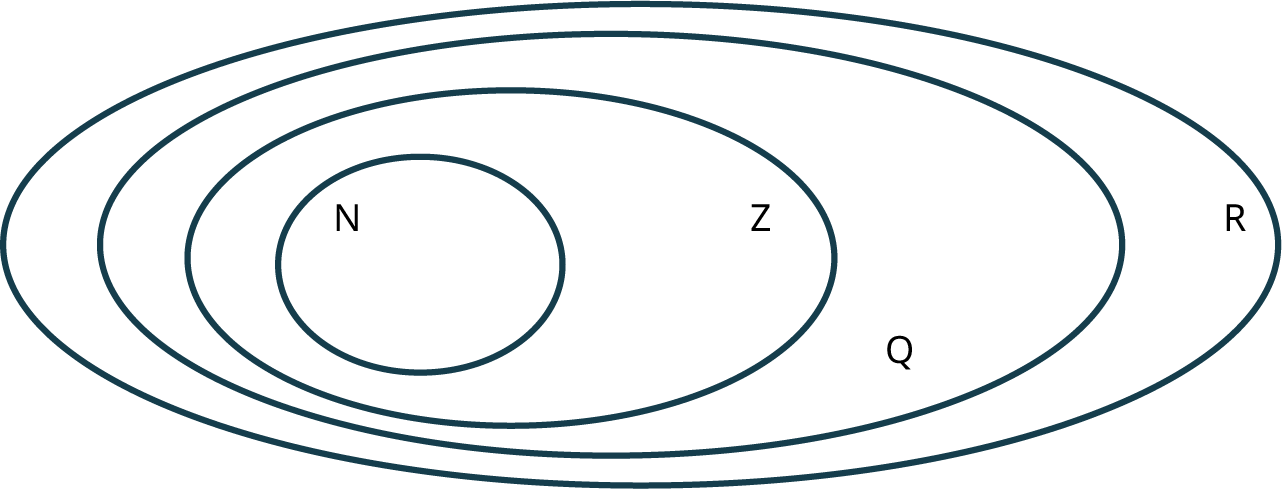
Answer
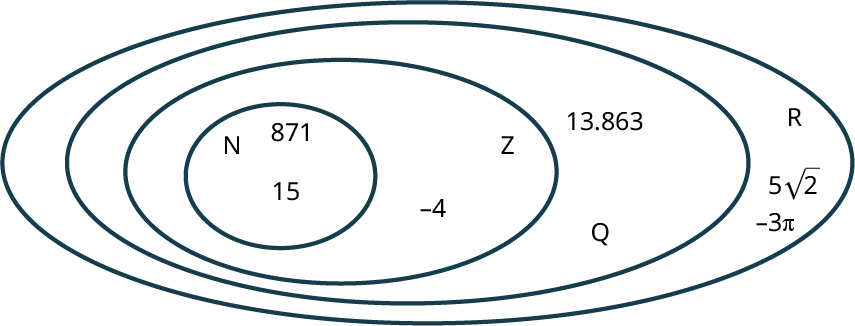
–4 belongs in the Z area as it is an integer.
13.863 belongs in the Q area as it is a rational number. Terminating decimals can be written as the ratio of two integers.
15 and 871 belong in the N area as they are natural numbers.
and belong in the R area as they are real numbers. They are irrational and belong in none of the other areas.
Your Turn 3.99 §3.6 source ↗
In each of the following, identify which property of the real numbers is being applied.
Answer
When using the distributive property, multiplication distributes across addition.
dstributive property
Your Turn 3.99 (b) §3.6 source ↗
In each of the following, identify which property of the real numbers is being applied.
Answer
The additive inverse property tells you that every number plus its negative results in zero.
additive inverse property
Your Turn 3.100 §3.6 source ↗
Use properties of real numbers and mental math to calculate the following:
Answer
Check Your Understanding 3.6.33 §3.6 source ↗
Answer
Real numbers:
Not real: is not real because any number that contains i is not a real number.
Check Your Understanding 3.6.34 §3.6 source ↗
Answer
Check Your Understanding 3.6.35 §3.6 source ↗
Answer
When using the distributive property, multiplication distributes across addition.
The rule can be written in the other direction.
distributive property
Your Turn 3.101 §3.7 source ↗
Find the value of the following numbers modulo 12.
93Answer
Determine the remainder when 93 is divided by 12.
93 ÷ 12 = 7 and a remainder. What is that remainder?
Subtract 84 from 93.
The remainder is 9.
The remainder is the solution to 93 mod 12.
93 mod 12 ≡ 9
93 = 9 (mod 12)Your Turn 3.101 (b) §3.7 source ↗
Find the value of the following numbers modulo 12.
387Answer
Determine the remainder when 387 is divided by 12.
387 ÷ 12 = 32 and a remainder. What is that remainder?
Subtract 384 from 387.
The remainder is 3.
The remainder is the solution to 387 mod 12.
387 mod 12 ≡ 3
387 = 3 (mod 12)Your Turn 3.102 §3.7 source ↗
Answer
First, find 43 mod 12.
Determine the remainder when 43 is divided by 12.
43 ÷ 12 = 3 and a remainder. What is that remainder?
Subtract 36 from 43.
The remainder is 7.
The remainder is the solution to 43 mod 12.
43 mod 12 ≡ 7
Now, add 7 hours to 9:00.
The time 7 hours after 9:00 is 4:00.
4:00Your Turn 3.103 §3.7 source ↗
Answer
First, find 34 mod 12.
Determine the remainder when 34 is divided by 12.
34 ÷ 12 = 2 and a remainder. What is that remainder?
Subtract 24 from 34.
The remainder is 10.
The remainder is the solution to 34 mod 12.
34 mod 12 ≡ 10
Now, subtract 10 hours from 7:00.
The time 10 hours before 7:00 was 9:00.
9:00Your Turn 3.104 §3.7 source ↗
Answer
First, multiply 4 and 19 to get 76.
Now, find 76 mod 12.
Determine the remainder when 76 is divided by 12.
76 ÷ 12 = 6 and a remainder. What is that remainder?
Subtract 72 from 76.
The remainder is 4.
The remainder is the solution to 76 mod 12.
76 mod 12 ≡ 4
The product of 4 and 19 modulo 12 is 4.
4Your Turn 3.105 §3.7 source ↗
Answer
You text every three hours for 15 times. You texted for 45 hours.
You need to find 45 modulo 12.
45 ÷ 12 = 3 and a remainder. What is that remainder?
Subtract 36 from 45.
The remainder is 9.
The remainder is the solution to 45 modulo 12.
45 modulo 12 ≡ 9
Nine hours after 8 AM is 5 PM.
5:00Your Turn 3.106 §3.7 source ↗
Answer
If you prepared the meal 20 more times and you do it every 5 days, then 100 days have passed.
To find what day it is, you need to find 100 modulo 7.
100 ÷ 7 = 14 and a remainder. What is that remainder?
Subtract 98 from 100.
The remainder is 2.
The remainder is the solution to 100 modulo 7.
100 modulo 7 ≡ 2
Two days after Tuesday is Thursday.
It will be Thursday after you have prepared the meals 20 more times.
ThursdayCheck Your Understanding 3.7.36 §3.7 source ↗
For the following exercises, use clock arithmetic to perform the following:
Answer
Find 23 mod 12.
Determine the remainder when 26 is divided by 12.
26 ÷ 12 = 2 and a remainder. What is that remainder?
Subtract 24 from 26.
The remainder is 2.
The remainder is the solution to 26 mod 12.
26 mod 12 ≡ 2
2Check Your Understanding 3.7.37 §3.7 source ↗
For the following exercises, use clock arithmetic to perform the following:
Answer
Find –23 mod 12.
It is easier to think about modulo problems when the number is positive. The hand is in the same position every 12 hours, so you can always add any multiple of 12 hours. Add 24 hours to make the number positive.
Now, find 1 mod 12.
Determine the remainder when 1 is divided by 12.
1 ÷ 12 = 0 and a remainder. What is that remainder?
The remainder is 1.
The remainder is the solution to 1 mod 12.
1 mod 12 ≡ 1
–23 mod 12 = 1
The answer to 8 – 31 is 1.
1Check Your Understanding 3.7.38 §3.7 source ↗
For the following exercises, use clock arithmetic to perform the following:
Answer
Find 185 mod 12.
Determine the remainder when 185 is divided by 12.
185 ÷ 12 = 15 and a remainder. What is that remainder?
Subtract 180 from 185.
The remainder is 5.
The remainder is the solution to 185 mod 12.
185 mod 12 ≡ 5
5Check Your Understanding 3.7.39 §3.7 source ↗
Answer
If Calene calls every fourth day and she calls eight times, then 32 days have passed.
Find 32 mod 7.
To find what day it is, you need to find 32 modulo 7.
32 ÷ 7 = 4 and a remainder. What is that remainder?
Subtract 28 from 32.
The remainder is 4.
The remainder is the solution to 32 modulo 7.
32 modulo 7 ≡ 4
Four days after Monday is Friday.
It will be Friday when Calene calls her mother again.
FridayYour Turn 3.107 §3.8 source ↗
If possible, use the product rule to simplify the following:
Answer
Use the product rule: .
Your Turn 3.107 (b) §3.8 source ↗
If possible, use the product rule to simplify the following:
Answer
Your Turn 3.108 §3.8 source ↗
Answer
Use the product rule: .
Your Turn 3.109 §3.8 source ↗
Answer
Use the quotient rule: .
Your Turn 3.110 §3.8 source ↗
Answer
Use the distributive rule for exponents: .
Your Turn 3.111 §3.8 source ↗
Answer
Use the distributive rule for exponents: .
Your Turn 3.112 §3.8 source ↗
Use the exponent distributive rule to expand the following:
Answer
Use the exponent distributive rule. When you have a fraction, , raised to an exponent, n, then .
Your Turn 3.112 (b) §3.8 source ↗
Use the exponent distributive rule to expand the following:
Answer
Use the exponent distributive rule. When you have a fraction, , raised to an exponent, n, then .
Your Turn 3.113 §3.8 source ↗
Expand the following:
Answer
Use the power rule. If you raise a non-zero base to an exponent n, and raise that to another exponent, m, you get the base raised to the product of the exponents, which is .
Your Turn 3.113 (b) §3.8 source ↗
Expand the following:
Answer
Use the power rule. If you raise a non-zero base to an exponent n, and raise that to another exponent, m, you get the base raised to the product of the exponents, which is .
Your Turn 3.114 §3.8 source ↗
Convert the following to expressions with no negative exponent:
Answer
Use the negative exponent rule. provided that a ≠ 0.
Your Turn 3.114 (b) §3.8 source ↗
Convert the following to expressions with no negative exponent:
Answer
Use the negative exponent rule. provided that a ≠ 0.
Your Turn 3.115 §3.8 source ↗
Use negative exponents to rewrite the following expressions with no denominator:
Answer
Use the negative exponent rule. provided that a ≠ 0.
The negative exponent rule lets you say is equal to .
Your Turn 3.115 (b) §3.8 source ↗
Use negative exponents to rewrite the following expressions with no denominator:
Answer
Use the negative exponent rule. provided that a ≠ 0.
The negative exponent rule lets you say is equal to .
Your Turn 3.116 §3.8 source ↗
Simplify the following:
Answer
Use the exponent distributive rule. When you have a fraction, , raised to an exponent, n, then .
Use the distributive rule for exponents in the denominator: .
Use the power rule. If you raise a non-zero base to an exponent n, and raise that to another exponent, m, you get the base raised to the product of the exponents.
Your Turn 3.116 (b) §3.8 source ↗
Simplify the following:
Answer
Use the exponent distributive rule. When you have a fraction, , raised to an exponent, n, then .
Use the distributive rule for exponents in the denominator: .
Use the power rule. If you raise a non-zero base to an exponent n, and raise that to another exponent, m, you get the base raised to the product of the exponents.
Check Your Understanding 3.8.40 §3.8 source ↗
Answer
Use the product rule: .
Check Your Understanding 3.8.41 §3.8 source ↗
Answer
Use the quotient rule: .
Alternate answer option:
Use the negative exponent rule. provided that a ≠ 0.
or
Check Your Understanding 3.8.42 §3.8 source ↗
Answer
Use the distributive rule for exponents: .
Check Your Understanding 3.8.43 §3.8 source ↗
Answer
Use the exponent distributive rule. When you have a fraction, , raised to an exponent, n, then .
Check Your Understanding 3.8.44 §3.8 source ↗
Answer
Use the exponent distributive rule. When you have a fraction, , raised to an exponent, n, then .
Use the distributive rule for exponents: .
Use the power rule. If you raise a non-zero base to an exponent n, and raise that to another exponent, m, you get the base raised to the product of the exponents.
Your Turn 3.117 §3.9 source ↗
Which of the following numbers are in scientific notation? If the number is not in scientific notation, explain why it is not.
Answer
This is not a product of a number between 1 and 9 multiplied by 10 raised to an integer power.
42.67 is bigger than 9.
Is not written in scientific notation; 42.67 is not at least 1 and less than 10.Your Turn 3.117 (b) §3.9 source ↗
Which of the following numbers are in scientific notation? If the number is not in scientific notation, explain why it is not.
Answer
Your Turn 3.117 (c) §3.9 source ↗
Which of the following numbers are in scientific notation? If the number is not in scientific notation, explain why it is not.
Answer
This is not a product of a number between 1 and 9 multiplied by 10 raised to an integer power.
is bigger than 9.
Is not written in scientific notation; The absolute value of –80.91 is not at least 1 and less than 10.Your Turn 3.118 §3.9 source ↗
Write the following numbers in scientific notation form:
−38300Answer
–38300
Case 3: The absolute value of the number is 10 or larger.
Step 1: Count the number of digits that are to the left of the decimal point. Label this n.
Step 2: Write the digits of the number without the decimal place, if one was present. If the number was negative, include the sign.
–38300
Step 3: If there is more than one digit, place the decimal point after the first digit.
–3.8300
Step 4: Multiply the number from Step 3 by .
Your Turn 3.118 (b) §3.9 source ↗
Write the following numbers in scientific notation form:
0.0045Answer
0.0045
Case 2: The absolute value of the number is less than 1.
Step 1: Count the number of digits between the decimal and the first non-zero digit. Label this n.
Step 2: Starting with the first non-zero digit of the number, write the digits. If the number was negative, include the negative sign.
45
Step 3: If there is more than one digit, place the decimal after the first digit from Step 2.
4.5
Step 4: Multiply the number from 3 by .
Your Turn 3.118 (c) §3.9 source ↗
Write the following numbers in scientific notation form:
1Answer
1
Case 1: The number is a single-digit integer.
In this case, the scientific notation form of the number is .
Your Turn 3.119 §3.9 source ↗
Answer
When you move the decimal point four places to the left, 46.113 becomes
0.0046113, or .
To keep the number the same, you need to multiply by 104. Increase the exponent by 4 to make up for moving the decimal place four places to the left.
Your Turn 3.120 §3.9 source ↗
Answer
When you move the decimal point two places to the right, 149.11 becomes 14,911. Because the number became larger, you need to decrease the exponent by 2. Change the exponent from –4 to –6.
Your Turn 3.121 §3.9 source ↗
Convert the following into standard form:
Answer
Because the exponent is positive, move the decimal point six places to the right. (Think of a number line. The positive end is to the right.)
1,020,000
1,020,000Your Turn 3.121 (b) §3.9 source ↗
Convert the following into standard form:
Answer
Because the exponent is negative, move the decimal point six places to the left. (Think of a number line. The negative end is to the left.)
0.0000409
0.0000409Your Turn 3.122 §3.9 source ↗
Calculate the following:
Answer
Because the powers of 10 match, use the distributive property to factor the power of 10 from the numbers. Then, add the other part of the numbers separately.
Your Turn 3.122 (b) §3.9 source ↗
Calculate the following:
Answer
Because the powers of 10 match, use the distributive property to factor the power of 10 from the numbers. Then, subtract the other part of the numbers separately.
Your Turn 3.123 §3.9 source ↗
Calculate the following:
Answer
Because the powers of 10 match, use the distributive property to factor the power of 10 from the numbers. Then, add the other part of the numbers separately.
Your Turn 3.123 (b) §3.9 source ↗
Calculate the following:
Answer
Because the powers of 10 match, use the distributive property to factor the power of 10 from the numbers. Then, subtract the other part of the numbers separately.
Your Turn 3.124 §3.9 source ↗
Answer
First, you need the two numbers to have the same power of 10.
Make them both have an exponent of –43. Move the decimal point three places to the left for the second number.
Because the powers of 10 match, use the distributive property to factor the power of 10 from the numbers. Then, add the other part of the numbers separately.
Your Turn 3.125 §3.9 source ↗
Answer
First, you need the two numbers to have the same power of 10.
Make them both have an exponent of 28. Move the decimal point two places to the left for the second number.
Because the powers of 10 match, use the distributive property to factor the power of 10 from the numbers. Then, subtract the other part of the numbers separately.
Your Turn 3.126 §3.9 source ↗
Calculate the following:
Answer
Step 1: Multiply the number parts.
Step 2: Add the exponents of the 10s.
Step 3: The result is the answer from Step 1 times 10 raised to the answer from Step 2.
Step 4: If the answer is not in scientific notation, adjust it.
Not necessary.
Your Turn 3.126 (b) §3.9 source ↗
Calculate the following:
Answer
Step 1: Multiply the number parts.
Step 2: Add the exponents of the 10s.
Step 3: The result is the answer from Step 1 times 10 raised to the answer from Step 2.
Step 4: If the answer is not in scientific notation, adjust it.
Your Turn 3.127 §3.9 source ↗
Calculate the following:
Answer
Step 1: Divide the number parts.
Step 2: Subtract the exponents of the 10s.
Step 3: The result is the answer from Step 1 times 10 raised to the answer from Step 2.
Step 4: If the answer is not in scientific notation, adjust it.
Your Turn 3.127 (b) §3.9 source ↗
Calculate the following:
Answer
Step 1: Divide the number parts.
Step 2: Subtract the exponents of the 10s.
Step 3: The result is the answer from Step 1 times 10 raised to the answer from Step 2.
Step 4: If the answer is not in scientific notation, adjust it.
Your Turn 3.128 §3.9 source ↗
Answer
Subtract from .
First, you need to make the powers of 10 match.
Make them both have an exponent of –8. Move the decimal point two places to the left for the first number.
Because the powers of 10 match, use the distributive property to factor the power of 10 from the numbers. Then, subtract the other part of the numbers separately.
The transistor is meters larger than the diameter of an atom.
The transistor is m larger than the diameter of an atom.Your Turn 3.129 §3.9 source ↗
Answer
Step 1: Divide the number parts.
Step 2: Subtract the exponents of the 10s.
Step 3: The result is the answer from Step 1 times 10 raised to the answer from Step 2.
Step 4: If the answer is not in scientific notation, adjust it.
Neptune is approximately , or 89.3, times farther from the sun than Mercury.
Neptune is , or 89.3, times further from the sun that Mercury.Your Turn 3.130 §3.9 source ↗
Answer
Divide by .
Step 1: Divide the number parts.
Step 2: Subtract the exponents of the 10s.
Step 3: The result is the answer from Step 1 times 10 raised to the answer from Step 2.
Step 4: If the answer is not in scientific notation, adjust it.
There are cubic meters of sand on the Australian coastline.
cubic metersYour Turn 3.131 §3.9 source ↗
Answer
Divide by .
Step 1: Divide the number parts.
Step 2: Subtract the exponents of the 10s.
Step 3: The result is the answer from Step 1 times 10 raised to the answer from Step 2.
Step 4: If the answer is not in scientific notation, adjust it.
A human exhales approximately pounds of carbon dioxide per year.
A person exhales, on average, , or 840 pounds of carbon dioxide per year.Check Your Understanding 3.9.45 §3.9 source ↗
Answer
0.00456
Case 2: The absolute value of the number is less than 1.
Step 1: Count the number of digits between the decimal and the first non-zero digit. Label this n.
Step 2: Starting with the first non-zero digit of the number, write the digits. If the number was negative, include the negative sign.
456
Step 3: If there is more than one digit, place the decimal after the first digit from Step 2.
4.56
Step 4: Multiply the number from 3 by .
Check Your Understanding 3.9.46 §3.9 source ↗
Answer
Because the exponent is positive, move the decimal point eight places to the right. (Think of a number line. The positive end is to the right.)
567,000,000
Check Your Understanding 3.9.47 §3.9 source ↗
Answer
First, you need to make the powers of 10 match.
Make them both have an exponent of 3. Move the decimal point one place to the left on the second number.
Because the powers of 10 match, use the distributive property to factor the power of 10 from the numbers. Then, add the other part of the numbers separately.
Check Your Understanding 3.9.48 §3.9 source ↗
Answer
First, you need to make the powers of 10 match.
Make them both have an exponent of 6. Move the decimal point one place to the left on the first number.
Because the powers of 10 match, use the distributive property to factor the power of 10 from the numbers. Then, subtract the other part of the numbers separately.
Check Your Understanding 3.9.49 §3.9 source ↗
Answer
Step 1: Multiply the number parts.
Step 2: Add the exponents of the 10s.
Step 3: The result is the answer from Step 1 times 10 raised to the answer from Step 2.
Step 4: If the answer is not in scientific notation, adjust it.
Check Your Understanding 3.9.50 §3.9 source ↗
Answer
Step 1: Divide the number parts.
Step 2: Subtract the exponents of the 10s.
Step 3: The result is the answer from Step 1 times 10 raised to the answer from Step 2.
Step 4: If the answer is not in scientific notation, adjust it.
Check Your Understanding 3.9.51 §3.9 source ↗
Answer
Divide to find the answer: .
Step 1: Divide the number parts.
Step 2: Subtract the exponents of the 10s.
Step 3: The result is the answer from Step 1 times 10 raised to the answer from Step 2.
Step 4: If the answer is not in scientific notation, adjust it.
A pile of dollar bills that reaches the moon would contain approximately dollar bills.
A pile of dollar bills that reaches the moon would contain bills.Your Turn 3.132 §3.10 source ↗
Determine if the following sequences are arithmetic sequences. Explain your reasoning.
Answer
All the terms follow this pattern, so this is an arithmetic sequence.
This is an arithmetic sequence. Every term is the previous term minus 2.2.Your Turn 3.132 (b) §3.10 source ↗
Determine if the following sequences are arithmetic sequences. Explain your reasoning.
Answer
but that is not the next term.
This is not an arithmetic sequence.
This is not an arithmetic sequence. The difference between terms 1 and 2 is 2, but between terms 3 and 4 the difference is 4. The differences are not the same.Your Turn 3.132 (c) §3.10 source ↗
Determine if the following sequences are arithmetic sequences. Explain your reasoning.
Answer
This pattern continues for all the terms shown. This is an infinite arithmetic sequence.
This is an (infinite) arithmetic sequence. Every term is the previous term plus 6. The ellipsis indicates the pattern continues.Your Turn 3.133 §3.10 source ↗
Identify and for the following arithmetic sequence. Use this information to determine the term.
Answer
The term is the first term in a sequence. In this sequence, .
The term, , represents the constant difference. Subtract the first term from the second term.
You can find any term by using the formula: .
, ,
Your Turn 3.134 §3.10 source ↗
Answer
When you know two terms, you can find the constant difference using this formula: .
The first term in the sequence can be found using this formula: and .
The 151st term can be found using this formula: .
The constant difference is 5, the first term is and the 151st term is 726.
, , andYour Turn 3.135 §3.10 source ↗
Answer
The sum of the first terms of an arithmetic sequence is: .
You do not know the last term, so first use to find the 101st term.
Now, you can use the sum formula.
12,675.5
Your Turn 3.136 §3.10 source ↗
Answer
First week: $10
Second week: $15
Third week: $20
This is an arithmetic sequence where the first term is 10 and the constant difference is 5.
Use this formula to find the 52nd term: .
Christina will save $265 in the 52nd week.
Christina will save $265 in week 52.Your Turn 3.137 §3.10 source ↗
Answer
This is an arithmetic sequence where the first term is 24 and the constant difference is 2.
You want to know the sum of the first 40 terms.
You first need to know the 40th term to use the sum formula.
You can find the 40th term by using the formula: .
Find the sum of the first 40 rows: .
The theater has 2,520 seats in the first 40 rows.
There are 2,520 seats in the theater.Check Your Understanding 3.10.52 §3.10 source ↗
{3, 6, 9, 15, 25, 39, 90}
Answer
but the next term is not 12. It’s 15. This is not an arithmetic sequence.
No. The difference from term 1 to term 2 is different than the difference from term 4 to term 5.Check Your Understanding 3.10.53 §3.10 source ↗
{1, 5, 7, 100, 4, -17, 8, 100, 19, 7.6, 345}
Answer
Count to the seventh term in the sequence.
1st term: 1
2nd term: 5
3rd term: 7
4th term: 100
5th term: 4
6th term: –17
7th term: 8
8Check Your Understanding 3.10.54 §3.10 source ↗
Answer
You can find any term by using the formula: .
613
Check Your Understanding 3.10.55 §3.10 source ↗
Answer
When you know two terms, you can find the constant difference using this formula: .
The first term in the sequence can be found using this formula: and .
The constant difference is 3 and the first term is 14.
,Check Your Understanding 3.10.56 §3.10 source ↗
Answer
You need to know the 100th term.
You can find any term by using the formula: .
The sum of the first terms of an arithmetic sequence is: .
35050
Check Your Understanding 3.10.57 §3.10 source ↗
Answer
This is an arithmetic sequence with a first term of 30 and a constant difference of 4. The answer to the question is the 100th term.
You can find any term by using the formula: .
There will be 426 people in the group on the 100th day.
There will be 426 people in their survey group after 100 days.Your Turn 3.138 §3.11 source ↗
For each sequence, determine if the sequence is a geometric sequence. If so, identify the common ratio.
Answer
Try 5.
The pattern continues to work, so this is a geometric sequence. The common ratio is 5.
It is a geometric sequence; common ratio is 5.Your Turn 3.138 (b) §3.11 source ↗
For each sequence, determine if the sequence is a geometric sequence. If so, identify the common ratio.
Answer
Try –2.
, which is not the next term. This is not a geometric sequence.
It is not a common ratio; term 2 is the first term multiplied by −2, but the sixth term is the fifth term multiplied by 3.Your Turn 3.138 (c) §3.11 source ↗
For each sequence, determine if the sequence is a geometric sequence. If so, identify the common ratio.
Answer
Try –0.1.
The pattern continues to work. This is a geometric sequence. The common ratio is –0.1 or .
It is a geometric sequence; common ratio is .Your Turn 3.139 §3.11 source ↗
In the following geometric sequences, determine the indicated term of the geometric sequence with a given first term and common ratio.
Determine the term of the geometric sequence with and .Answer
The nth term of a geometric sequence, , with first term and common ratio r, is .
Alternate answer option: 1.5
Your Turn 3.139 (b) §3.11 source ↗
In the following geometric sequences, determine the indicated term of the geometric sequence with a given first term and common ratio.
Determine the term of the geometric sequence with and .Answer
The nth term of a geometric sequence, , with first term and common ratio r, is .
2,048
Your Turn 3.140 §3.11 source ↗
Answer
The sum of the first n terms of a geometric sequence, with first term and common ratio r, is
, provided that .
84,652,645
Your Turn 3.140 (b) §3.11 source ↗
Answer
The sum of the first n terms of a geometric sequence, with first term and common ratio r, is
, provided that .
40.444444
Your Turn 3.141 §3.11 source ↗
Answer
If you deposit P dollars in an account that earns interest compounded yearly, then the amount in the account, A, after t years is calculated with the formula: . This is a geometric sequence with constant ratio (1 + r) and first term .
The amount in the account was $11,671.03 (rounded to two decimal places).
Your Turn 3.142 §3.11 source ↗
Answer
You can use geometric sequences to interpret exponential growth when numbers double every 30 minutes. The common ratio is 2. The first term is 15. The time interval is 30 minutes. In 20 hours, there are 40 of your 30-minute intervals.
bacteria
There are organisms after 20 hours.Your Turn 3.143 §3.11 source ↗
Answer
First term: 0.5 of square is blue, 0.5 is not blue.
Second term: You’ve colored half of the remaining area, so 0.75 is blue. 0.25 is not blue.
Third term: You’ve colored half of the remaining area. 0.875 is blue; 0.125 is not blue.
Fourth term: You’ve colored half of the remaining area. 0.9375 is blue; 0.0625 is not blue.
The common ratio for what is not blue is 0.5.
The blue numbers are not a geometric sequence, but the not blue numbers are. You can find the 15th term of the not blue numbers and subtract that from 1.
0. 99996948242188
Check Your Understanding 3.11.58 §3.11 source ↗
{3, 6, 12, 24, 48, 96, 192}
Answer
Try 2.
The pattern continues for each term. Each term is 2 times the previous term. This is a geometric sequence.
Yes, each term is the previous term multiplied by 2.Check Your Understanding 3.11.59 §3.11 source ↗
Answer
To find the common ratio, divide a term by the previous term.
The common ratio is −10.
Check Your Understanding 3.11.60 §3.11 source ↗
Answer
The nth term of a geometric sequence, , with first term and common ratio r, is .
(rounded to three decimal places)
2,919.293 (rounded off to three decimal places)Check Your Understanding 3.11.61 §3.11 source ↗
Answer
The sum of the first n terms of a geometric sequence, with first term and common ratio r, is
, provided that .
(rounded to three decimal places)
5.714 (rounded to three decimal places)Check Your Understanding 3.11.62 §3.11 source ↗
Answer
If you deposit P dollars in an account that earns interest compounded yearly, then the amount in the account, A, after t years is calculated with the formula: . This is a geometric sequence with constant ratio (1 + r) and first term .
(rounded to two decimal places)
$30,188.57 (rounded off to two decimal places)Loading chapter 4…
Problems and answers are adapted from Contemporary Mathematics by Donna Kirk, OpenStax, and are used under the CC BY-NC-SA 4.0 licence. Access for free at https://openstax.org/books/contemporary-mathematics/pages/1-introduction. Illustrations: Copyright Rice University, OpenStax, under CC BY-NC-SA 4.0 license. This adaptation is released under the same licence, is non-commercial, and is neither affiliated with nor endorsed by OpenStax or Rice University.