Every problem in the chapter beside the book’s answer, a chapter at a time as you scroll.
Chapter 10: Fixed-Axis Rotation
71 problems · 23 figuresCheck Your Understanding 10.1 §10.1 source ↗
The fan blades on a turbofan jet engine (shown below) accelerate from rest up to a rotation rate of 40.0 rev/s in 20 s. The increase in angular velocity of the fan is constant in time. (The GE90-110B1 turbofan engine mounted on a Boeing 777, as shown, is currently the largest turbofan engine in the world, capable of thrusts of 330–510 kN.)
(a) What is the average angular acceleration?
(b) What is the instantaneous angular acceleration at any time during the first 20 s?
Answer
Check Your Understanding 10.2 §10.2 source ↗
Answer
;
b. Using Equation 10.13, we have
Check Your Understanding 10.3 §10.3 source ↗
Answer
.
Thus, we calculate
.
Check Your Understanding 10.4 §10.4 source ↗
Answer
.
At 5.0 s the new rotational kinetic energy of the propeller is
.
and the new angular velocity is
which is 3.58 rev/s.
Check Your Understanding 10.5 §10.5 source ↗
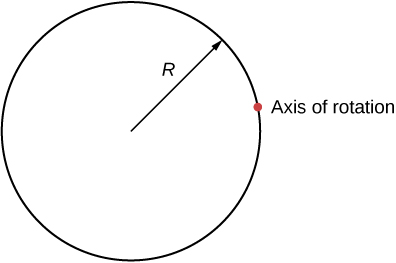
What is the moment of inertia of a cylinder of radius R and mass m about an axis through a point on the surface, as shown below?
Answer
Check Your Understanding 10.6 §10.6 source ↗
Answer
The angle between the lever arm and the force vector is therefore, .
The cross product gives a negative or clockwise torque.
The torque is then .
Check Your Understanding 10.7 §10.7 source ↗
Answer
Check Your Understanding 10.8 §10.8 source ↗
Answer
10-1 §10.1 source ↗
Answer
10-3 §10.1 source ↗
Answer
10-5 §10.2 source ↗
Answer
10-7 §10.2 source ↗
Answer
10-9 §10.3 source ↗
Answer
10-11 §10.3 source ↗
Answer
10-13 §10.4 source ↗
Answer
10-15 §10.5 source ↗
Answer
10-17 §10.5 source ↗
Answer
10-19 §10.6 source ↗
Answer
10-21 §10.6 source ↗
Answer
10-23 §10.6 source ↗
Answer
10-25 §10.6 source ↗
Answer
10-27 §10.7 source ↗
Answer
10-29 §10.1 source ↗
Answer
10-31 §10.1 source ↗
Answer
10-33 §10.1 source ↗
Answer
10-35 §10.1 source ↗
Answer
10-37 §10.2 source ↗
Answer
b.
10-39 §10.2 source ↗
Answer
b.
10-41 §10.2 source ↗
Answer
b. ; c.
10-43 §10.2 source ↗
Answer
b. ; c.
10-45 §10.2 source ↗
Answer
10-47 §10.3 source ↗
Answer
10-49 §10.3 source ↗
Answer
b. ; c.
in the counterclockwise direction from the centripetal acceleration vector
10-51 §10.3 source ↗
Answer
The maximum friction force is so the child does not fall off yet.
10-53 §10.3 source ↗
Answer
Plotting both accelerations gives
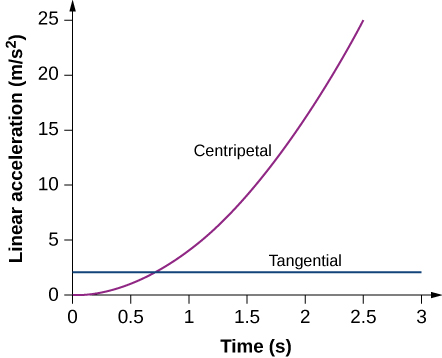
The tangential acceleration is constant, while the centripetal acceleration is time dependent, and increases with time to values much greater than the tangential acceleration after t = 1s. For times less than 0.7 s and approaching zero the centripetal acceleration is much less than the tangential acceleration.
10-55 §10.4 source ↗
Answer
b.
10-57 §10.4 source ↗
Answer
10-59 §10.4 source ↗
Answer
b. The rotational rate of the propeller stays the same at 20 rev/s.
10-61 §10.4 source ↗
Answer
10-63 §10.4 source ↗
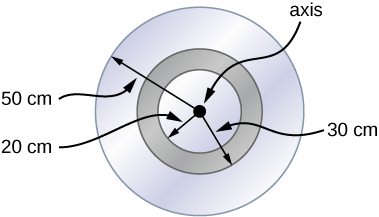
A system consists of a disk of mass 2.0 kg and radius 50 cm upon which is mounted an annular cylinder of mass 1.0 kg with inner radius 20 cm and outer radius 30 cm (see below). The system rotates about an axis through the center of the disk and annular cylinder at 10 rev/s. (a) What is the moment of inertia of the system? (b) What is its rotational kinetic energy?
Answer
b.
10-65 §10.5 source ↗
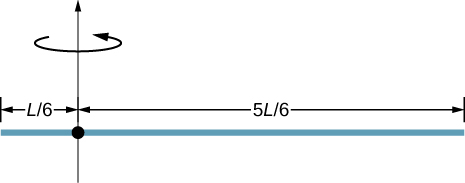
Using the parallel axis theorem, what is the moment of inertia of the rod of mass m about the axis shown below?
Answer
10-67 §10.5 source ↗
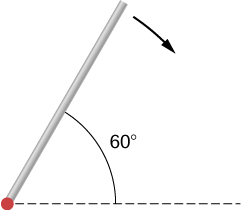
A uniform rod of mass 1.0 kg and length 2.0 m is free to rotate about one end (see the following figure). If the rod is released from rest at an angle of with respect to the horizontal, what is the speed of the tip of the rod as it passes the horizontal position?
Answer
10-69 §10.5 source ↗
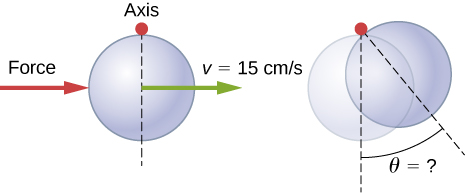
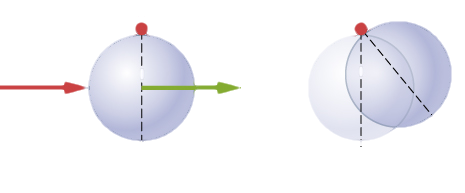
A solid sphere of radius 10 cm is allowed to rotate freely about an axis. The sphere is given a sharp blow so that its center of mass starts from the position shown in the following figure with speed 15 cm/s. What is the maximum angle that the diameter makes with the vertical?
Answer
10-71 §10.6 source ↗
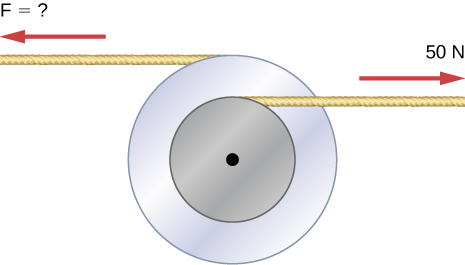
Two flywheels of negligible mass and different radii are bonded together and rotate about a common axis (see below). The smaller flywheel of radius 30 cm has a cord that has a pulling force of 50 N on it. What pulling force needs to be applied to the cord connecting the larger flywheel of radius 50 cm such that the combination does not rotate?
Answer
10-73 §10.6 source ↗
Answer
10-75 §10.6 source ↗
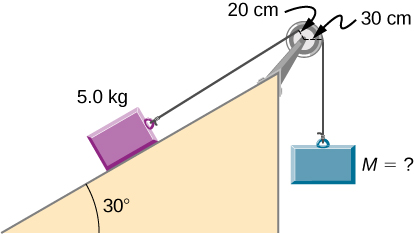
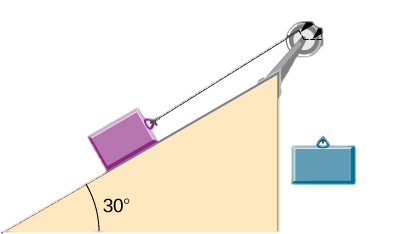
What hanging mass must be placed on the cord to keep the pulley from rotating (see the following figure)? The mass on the frictionless plane is 5.0 kg. The mass on the plane is connected to a cord that wraps around the pulley’s inner radius of 20 cm. The hanging mass is connected to a cord that wraps around the pulley’s outer radius of 30 cm.
Answer
10-77 §10.6 source ↗
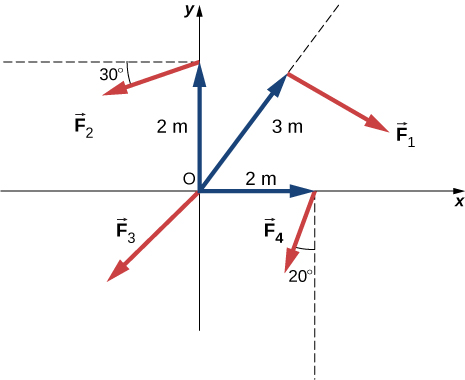
Calculate the torque about the z-axis that is out of the page at the origin in the following figure, given that .
Answer
10-79 §10.6 source ↗
Answer
10-81 §10.6 source ↗
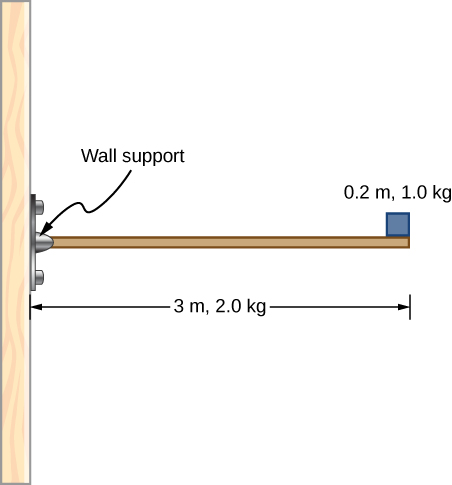
A horizontal beam of length 3 m and mass 2.0 kg has a mass of 1.0 kg and width 0.2 m sitting at the end of the beam (see the following figure). What is the torque of the system about the support at the wall?
Answer
10-83 §10.6 source ↗
Answer
10-85 §10.7 source ↗
Answer
c.
10-87 §10.7 source ↗
Answer
10-89 §10.7 source ↗
Answer
10-91 §10.7 source ↗
Answer
b. ; c.
10-93 §10.7 source ↗
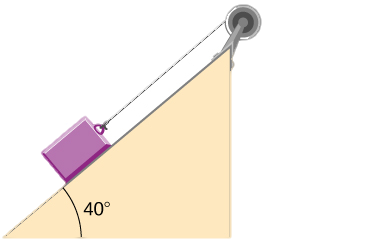
A block of mass 3 kg slides down an inclined plane at an angle of with a massless tether attached to a pulley with mass 1 kg and radius 0.5 m at the top of the incline (see the following figure). The pulley can be approximated as a disk. The coefficient of kinetic friction on the plane is 0.4. What is the acceleration of the block?
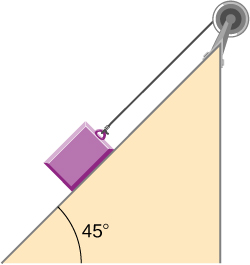
Answer
10-95 §10.7 source ↗
A uniform rod of mass and length is held vertically by two strings of negligible mass, as shown below. (a) Immediately after the string is cut, what is the linear acceleration of the free end of the stick? (b) Of the middle of the stick?
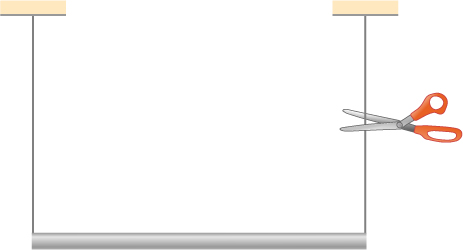
Answer
10-97 §10.8 source ↗
Answer
10-99 §10.8 source ↗
Answer
b.
10-101 §10.8 source ↗
Answer
b.
10-103 §10.8 source ↗
A uniform rod of length L and mass M is held vertically with one end resting on the floor as shown below. When the rod is released, it rotates around its lower end until it hits the floor. Assuming the lower end of the rod does not slip, what is the linear velocity of the upper end when it hits the floor?
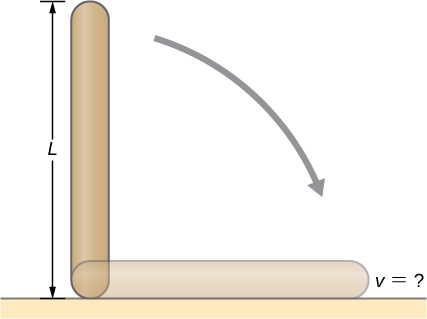
Answer
10-105 §10.8 source ↗
A 2-kg block on a frictionless inclined plane at has a cord attached to a pulley of mass 1 kg and radius 20 cm (see the following figure). The block slides a distance of 0.50 m. (a) What is the acceleration of the block down the plane? (b) What is the work done by the cord on the pulley?
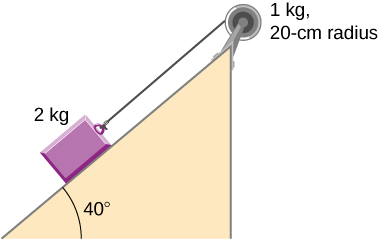
Answer
10-107 §10.AP source ↗
Answer
10-109 §10.AP source ↗
Answer
10-111 §10.AP source ↗
Answer
10-113 §10.AP source ↗
Answer
b.
10-115 §10.AP source ↗
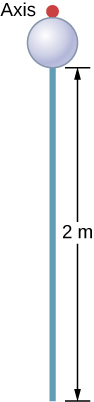
A pendulum consists of a rod of length 2 m and mass 3 kg with a solid sphere of mass 1 kg and radius 0.3 m attached at one end. The axis of rotation is as shown below. What is the angular velocity of the pendulum at its lowest point if it is released from rest at an angle of
Answer
10-117 §10.AP source ↗
Answer
10-119 §10.AP source ↗
Answer
10-121 §10.CP source ↗
Answer
10-123 §10.CP source ↗
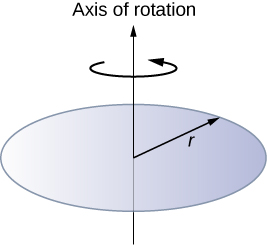
A disk of mass m, radius R, and area A has a surface mass density (see the following figure). What is the moment of inertia of the disk about an axis through the center?
Answer
10-125 §10.CP source ↗
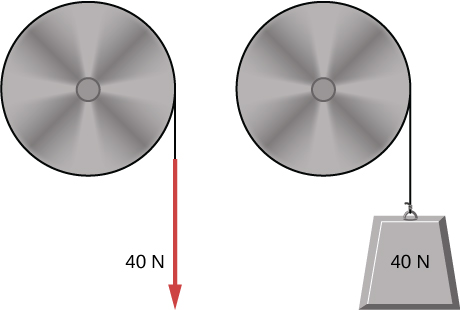
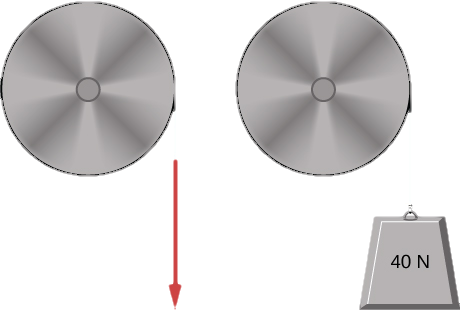
A cord is wrapped around the rim of a solid cylinder of radius 0.25 m, and a constant force of 40 N is exerted on the cord shown, as shown in the following figure. The cylinder is mounted on frictionless bearings, and its moment of inertia is . (a) Use the work energy theorem to calculate the angular velocity of the cylinder after 5.0 m of cord have been removed. (b) If the 40-N force is replaced by a 40-N weight, what is the angular velocity of the cylinder after 5.0 m of cord have unwound?
Answer
Loading chapter 11…
Problems and answers are adapted from University Physics Volume 1 by Samuel J. Ling, Jeff Sanny and William Moebs, OpenStax, and are used under the CC BY-NC-SA 4.0 licence. Access for free at https://openstax.org/books/university-physics-volume-1/pages/1-introduction. Illustrations: Copyright Rice University, OpenStax, under CC BY-NC-SA 4.0 license. This adaptation is released under the same licence, is non-commercial, and is neither affiliated with nor endorsed by OpenStax or Rice University.