Every problem in the chapter beside the book’s answer, a chapter at a time as you scroll.

Chapter 16: Waves

82 problems · 10 figures

Check Your Understanding 16.1 §16.1 source ↗

When a guitar string is plucked, the guitar string oscillates as a result of waves moving through the string. The vibrations of the string cause the air molecules to oscillate, forming sound waves. The frequency of the sound waves is equal to the frequency of the vibrating string. Is the wavelength of the sound wave always equal to the wavelength of the waves on the string?

Answer

The wavelength of the waves depends on the frequency and the velocity of the wave. The frequency of the sound wave is equal to the frequency of the wave on the string. The wavelengths of the sound waves and the waves on the string are equal only if the velocities of the waves are the same, which is not always the case. If the speed of the sound wave is different from the speed of the wave on the string, the wavelengths are different. This velocity of sound waves will be discussed in Sound.

Check Your Understanding 16.2 §16.1 source ↗

The propagation velocity of a transverse or longitudinal mechanical wave may be constant as the wave disturbance moves through the medium. Consider a transverse mechanical wave: Is the velocity of the medium also constant?

Answer

In a transverse wave, the wave may move at a constant propagation velocity through the medium, but the medium oscillates perpendicular to the motion of the wave. If the wave moves in the positive x-direction, the medium oscillates up and down in the y-direction. The velocity of the medium is therefore not constant, but the medium’s velocity and acceleration are similar to that of the simple harmonic motion of a mass on a spring.

Check Your Understanding 16.3 §16.2 source ↗

The wave function above is derived using a sine function. Can a cosine function be used instead?

Answer

Yes, a cosine function is equal to a sine function with a phase shift, and either function can be used in a wave function. Which function is more convenient to use depends on the initial conditions. In Figure 16.11, the wave has an initial height of y(0.00,0.00)= 0 and then the wave height increases to the maximum height at the crest. If the initial height at the initial time was equal to the amplitude of the wave y(0.00,0.00)= +A, then it might be more convenient to model the wave with a cosine function.
Figure 16.11 in the book ↗
A graph of height of the wave y as a function of position x for snapshots of the wave at two times. The dotted line represents the wave at time t=0.00s and the solid line represents the wave at t=0.80s. Since the wave velocity is constant, the distance the wave travels is the wave velocity times the time interval. The black dots indicate the points used to measure the displacement of the wave. The medium moves up and down, whereas the wave moves to the right.

Check Your Understanding 16.4 §16.2 source ↗

The wave equation ∂2y(x,t)∂x2= 1v2∂2y(x,t)∂t2 works for any wave of the form y(x,t)= f(x∓vt). In the previous section, we stated that a cosine function could also be used to model a simple harmonic mechanical wave. Check if the wave

y(x,t)=0.50mcos(0.20πm−1x−4.00πs−1t+π10)

is a solution to the wave equation.

Answer

This wave, with amplitude A=0.5m, wavelength λ=10.00m, period T=0.50s, is a solution to the wave equation with a wave velocity v=20.00m/s.

Check Your Understanding 16.5 §16.3 source ↗

The wave speed of a wave on a string depends on the tension and the linear mass density. If the tension is doubled, what happens to the speed of the waves on the string?

Answer

Since the speed of a wave on a taunt string is proportional to the square root of the tension divided by the linear density, the wave speed would increase by 2.

Check Your Understanding 16.6 §16.4 source ↗

Is the time-averaged power of a sinusoidal wave on a string proportional to the linear density of the string?

Answer

At first glance, the time-averaged power of a sinusoidal wave on a string may look proportional to the linear density of the string because P=12μA2ω2v; however, the speed of the wave depends on the linear density. Replacing the wave speed with FTμ shows that the power is proportional to the square root of tension and proportional to the square root of the linear mass density:
P= 12μA2ω2v= 12μA2ω2FTμ= 12A2ω2μFT.

Check Your Understanding 16.7 §16.6 source ↗

The equations for the wavelengths and the frequencies of the modes of a wave produced on a string:

λn=2nLn=1,2,3,4,5...andfn=nv2L=nf1n=1,2,3,4,5...

were derived by considering a wave on a string where there were symmetric boundary conditions of a node at each end. These modes resulted from two sinusoidal waves with identical characteristics except they were moving in opposite directions, confined to a region L with nodes required at both ends. Will the same equations work if there were symmetric boundary conditions with antinodes at each end? What would the normal modes look like for a medium that was free to oscillate on each end? Don’t worry for now if you cannot imagine such a medium, just consider two sinusoidal wave functions in a region of length L, with antinodes on each end.

Answer

Yes, the equations would work equally well for symmetric boundary conditions of a medium free to oscillate on each end where there was an antinode on each end. The normal modes of the first three modes are shown below. The dotted line shows the equilibrium position of the medium.
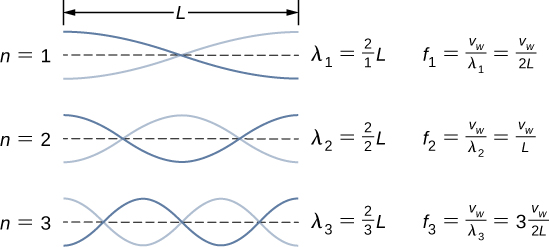
Three figures of a string of length L are shown. Each has two waves. The first one has 1 node. It is labeled lambda 1 = 2 by 1 times L, f1 = vw by lambda 1 = vw by 2L. The second figure has 2 nodes. It is labeled lambda 2 = 2 by 2 times L, f2 = vw by lambda 2 = vw by L. The third figure has three nodes. It is labeled lambda 3 = 2 by 3 times L, f3 = vw by lambda 3 equal to 3 times vw by 2L.

Note that the first mode is two quarters, or one half, of a wavelength. The second mode is one quarter of a wavelength, followed by one half of a wavelength, followed by one quarter of a wavelength, or one full wavelength. The third mode is one and a half wavelengths. These are the same result as the string with a node on each end. The equations for symmetrical boundary conditions work equally well for fixed boundary conditions and free boundary conditions. These results will be revisited in the next chapter when discussing sound wave in an open tube.

16-1 §16.1 source ↗

Give one example of a transverse wave and one example of a longitudinal wave, being careful to note the relative directions of the disturbance and wave propagation in each.

Answer

A wave on a guitar string is an example of a transverse wave. The disturbance of the string moves perpendicular to the propagation of the wave. The sound produced by the string is a longitudinal wave where the disturbance of the air moves parallel to the propagation of the wave.

16-3 §16.1 source ↗

What is the difference between propagation speed and the frequency of a mechanical wave? Does one or both affect wavelength? If so, how?

Answer

Propagation speed is the speed of the wave propagating through the medium. If the wave speed is constant, the speed can be found by v=λT=λf. The frequency is the number of wave that pass a point per unit time. The wavelength is directly proportional to the wave speed and inversely proportional to the frequency.

16-5 §16.1 source ↗

Consider a wave produced on a stretched spring by holding one end and shaking it up and down. Does the wavelength depend on the distance you move your hand up and down?

Answer

No, the distance you move your hand up and down will determine the amplitude of the wave. The wavelength will depend on the frequency you move your hand up and down, and the speed of the wave through the spring.

16-7 §16.1 source ↗

An electromagnetic wave, such as light, does not require a medium. Can you think of an example that would support this claim?

Answer

Light from the Sun and stars reach Earth through empty space where there is no medium present.

16-9 §16.2 source ↗

If you shake the end of a stretched spring up and down with a frequency f, you can produce a sinusoidal, transverse wave propagating down the spring. Does the wave number depend on the frequency you are shaking the spring?

Answer

The wavelength is equal to the velocity of the wave times the frequency and the wave number is equal to k=2πλ, so yes, the wave number will depend on the frequency and also depend on the velocity of the wave propagating through the spring.

16-11 §16.2 source ↗

In this section, we have considered waves that move at a constant wave speed. Does the medium accelerate?

Answer

The medium moves in simple harmonic motion as the wave propagates through the medium, continuously changing speed, therefore it accelerates. The acceleration of the medium is due to the restoring force of the medium, which acts in the opposite direction of the displacement.

16-13 §16.3 source ↗

If the tension in a string were increased by a factor of four, by what factor would the wave speed of a wave on the string increase?

Answer

The wave speed is proportional to the square root of the tension, so the speed is doubled.

16-15 §16.3 source ↗

Guitars have strings of different linear mass density. If the lowest density string and the highest density string are under the same tension, which string would support waves with the higher wave speed?

Answer

Since the speed of a wave on a string is inversely proportional to the square root of the linear mass density, the speed would be higher in the low linear mass density of the string.

16-17 §16.3 source ↗

Electrical power lines connected by two utility poles are sometimes heard to hum when driven into oscillation by the wind. The speed of the waves on the power lines depend on the tension. What provides the tension in the power lines?

Answer

The tension in the wire is due to the weight of the electrical power cable.

16-19 §16.4 source ↗

Consider a string with under tension with a constant linear mass density. A sinusoidal wave is produced by some external driving force. If the frequency, keeping the wave amplitude as it was originally, how is the time-averaged power of the wave affected? If the amplitude of the wave is decreased by half, keeping the wave frequency as it was originally, how is the time-averaged power affected? Explain your answer.

Answer

The time averaged power is P= EλT= 12μA2ω2λT= 12μA2ω2v. If the frequency or amplitude is halved, the power decreases by a factor of 4.

16-21 §16.4 source ↗

In a transverse wave on a string, the motion of the string is perpendicular to the motion of the wave. If this is so, how is possible to move energy along the length of the string?

Answer

As a portion on the string moves vertically, it exerts a force on the neighboring portion of the string, doing work on the portion and transferring the energy.

16-23 §16.4 source ↗

The intensity of a spherical waves decreases as the wave moves away from the source. If the intensity of the wave at the source is I0, how far from the source will the intensity decrease by a factor of nine?

Answer

The intensity of a spherical wave is I=P4πr2, if no energy is dissipated the intensity will decrease by a factor of nine at three meters.

16-25 §16.5 source ↗

A string of a length of 2.00 m with a linear mass density of μ=0.006kg/m is attached to the end of a 2.00-m-long string with a linear mass density of μ= 0.012kg/m. The free end of the higher-density string is fixed to the wall, and a student holds the free end of the low-density string, keeping the tension constant in both strings. The student sends a pulse down the string. Describe what happens at the interface between the two strings.

Answer

At the interface, the incident pulse produces a reflected pulse and a transmitted pulse. The reflected pulse would be out of phase with respect to the incident pulse, and would move at the same propagation speed as the incident pulse, but would move in the opposite direction. The transmitted pulse would travel in the same direction as the incident pulse, but at half the speed. The transmitted pulse would be in phase with the incident pulse. Both the reflected pulse and the transmitted pulse would have amplitudes less than the amplitude of the incident pulse.

16-27 §16.5 source ↗

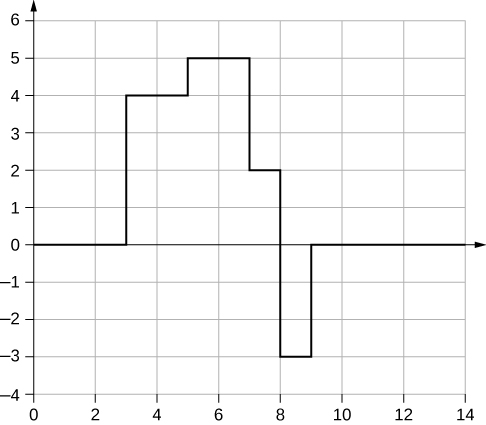
Many of the topics discussed in this chapter are useful beyond the topics of mechanical waves. It is hard to conceive of a mechanical wave with sharp corners, but you could encounter such a wave form in your digital electronics class, as shown below. This could be a signal from a device known as an analog to digital converter, in which a continuous voltage signal is converted into a discrete signal or a digital recording of sound. What is the result of the superposition of the two signals?
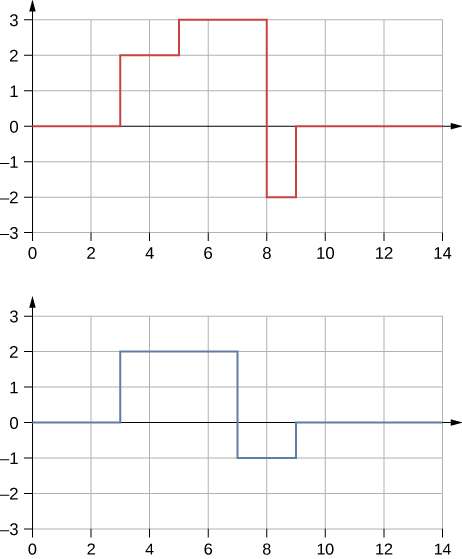
Figure a shows the graph of a red wave with sharp corners. The y value is 0 at x=0. At x=3, the y value rises to 2 and stays constant till x=5. Here, it rises to 3 and stays constant till x=8. Here, it dips down to -2 and stays constant till x=9. Here it rises to 0 and stays constant. Figure b shows the graph of a blue wave with sharp corners. The y value is 0 at x=0. At x=3, the y value rises to 2 and stays constant till x=7. Here it dips to -1 and stays constant till x=9. Here it rises to 0 and stays constant.

Answer

Figure shows the graph of a wave. Its y value is 0 at x=0. At x=3, the y value rises to 4 and stays constant till x=5. Here, it rises to 5 and stays constant till x=7. Here, it dips to 2 and stays constant till x=8. Here, it dips to -3 and stays constant till x=9. Here, it rises to 0 and stays constant.

16-29 §16.6 source ↗

A truck manufacturer finds that a strut in the engine is failing prematurely. A sound engineer determines that the strut resonates at the frequency of the engine and suspects that this could be the problem. What are two possible characteristics of the strut can be modified to correct the problem?

Answer

It may be as easy as changing the length and/or the density a small amount so that the parts do not resonate at the frequency of the motor.

16-31 §16.6 source ↗

Wine glasses can be set into resonance by moistening your finger and rubbing it around the rim of the glass. Why?

Answer

Energy is supplied to the glass by the work done by the force of your finger on the glass. When supplied at the right frequency, standing waves form. The glass resonates and the vibrations produce sound.

16-33 §16.6 source ↗

Consider a standing wave modeled as y(x,t)= 4.00cmsin(3m−1x)cos(4s−1t). Is there a node or an antinode at x=0.00m? What about a standing wave modeled as y(x,t)= 4.00cmsin(3m−1x+π2)cos(4s−1t)? Is there a node or an antinode at the x=0.00m position?

Answer

For the equation y(x,t)= 4.00cmsin(3m−1x)cos(4s−1t), there is a node because when x=0.00m, sin(3m−1(0.00m))= 0.00, so y(0.00m,t)= 0.00m for all time. For the equation y(x,t)= 4.00cmsin(3m−1x+π2)cos(4s−1t), there is an antinode because when x=0.00m, sin(3m−1(0.00m)+π2)= + 1.00, so y(0.00m,t) oscillates between +A and −A as the cosine term oscillates between +1 and -1.

16-35 §16.1 source ↗

Waves on a swimming pool propagate at 0.75 m/s. You splash the water at one end of the pool and observe the wave go to the opposite end, reflect, and return in 30.00 s. How far away is the other end of the pool?

Answer

2d= vt⇒d= 11.25m

16-37 §16.1 source ↗

How many times a minute does a boat bob up and down on ocean waves that have a wavelength of 40.0 m and a propagation speed of 5.00 m/s?

Answer

v = f λ , so that f = 0.125 Hz, so that N = 7.50 times

16-39 §16.1 source ↗

What is the wavelength of the waves you create in a swimming pool if you splash your hand at a rate of 2.00 Hz and the waves propagate at a wave speed of 0.800 m/s?

Answer

v= fλ⇒λ= 0.400m

16-41 §16.1 source ↗

Radio waves transmitted through empty space at the speed of light (v=c=3.00×10⁸m/s) by the Voyager spacecraft have a wavelength of 0.120 m. What is their frequency?

Answer

v= fλ⇒f= 2.50× 10 9 Hz

16-43 §16.1 source ↗

(a) Seismographs measure the arrival times of earthquakes with a precision of 0.100 s. To get the distance to the epicenter of the quake, geologists compare the arrival times of S- and P-waves, which travel at different speeds. If S- and P-waves arrive at 4.00 and 7.20 km/s, respectively, in the region considered, how precisely can the distance to the source of the earthquake be determined? (b) Seismic waves from underground detonations of nuclear bombs can be used to locate the test site and detect violations of test bans. Discuss whether your answer to (a) implies a serious limit to such detection. (Note also that the uncertainty is greater if there is an uncertainty in the propagation speeds of the S- and P-waves.)

Answer

a. The P-waves outrun the S-waves by a speed of v=3.20km/s; therefore, Δd=0.320km. b. Since the uncertainty in the distance is less than a kilometer, our answer to part (a) does not seem to limit the detection of nuclear bomb detonations. However, if the velocities are uncertain, then the uncertainty in the distance would increase and could then make it difficult to identify the source of the seismic waves.

16-45 §16.1 source ↗

A quality assurance engineer at a frying pan company is asked to qualify a new line of nonstick-coated frying pans. The coating needs to be 1.00 mm thick. One method to test the thickness is for the engineer to pick a percentage of the pans manufactured, strip off the coating, and measure the thickness using a micrometer. This method is a destructive testing method. Instead, the engineer decides that every frying pan will be tested using a nondestructive method. An ultrasonic transducer is used that produces sound waves with a frequency of f=25kHz. The sound waves are sent through the coating and are reflected by the interface between the coating and the metal pan, and the time is recorded. The wavelength of the ultrasonic waves in the coating is 0.076 m. What should be the time recorded if the coating is the correct thickness (1.00 mm)?

Answer

v = 1900 m/s Δ t = 1.05 μ s

16-47 §16.2 source ↗

A transverse wave on a string is modeled with the wave function y(x,t)= (0.20cm)sin(2.00m−1x−3.00s−1t+π16). What is the height of the string with respect to the equilibrium position at a position x=4.00m and a time t=10.00s?

Answer

y(x,t)= −0.037cm

16-49 §16.2 source ↗

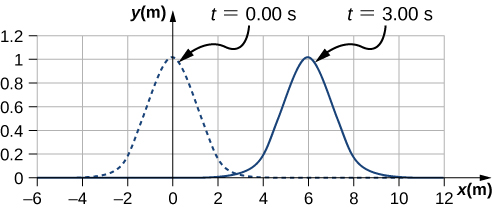
A pulse is defined as y(x,t)= e−2.77(2.00(x−2.00m/s(t))5.00m)2. Use a spreadsheet, or other computer program, to plot the pulse as the height of medium y as a function of position x. Plot the pulse at times t=0.00s and t=3.00s on the same graph. Where is the pulse centered at time t=3.00s? Use your spreadsheet to check your answer.

Answer

Figure shows two pulse waves. Both have y values varying from 0 to 1. The first wave, shown as a dotted line is marked t=0 seconds. The crest of the wave is at x=0. The second wave, shown as a solid line is marked t= 3 seconds. The crest of the wave is at x=6.


The pulse will move Δx=6.00m.

16-51 §16.2 source ↗

A wave is modeled with the function y(x,t)= (0.25m)cos(0.30m−1x−0.90s−1t+π3). Find the (a) amplitude, (b) wave number, (c) angular frequency, (d) wave speed, (e) initial phase shift, (f) wavelength, and (g) period of the wave.

Answer

a. A=0.25m; b. k=0.30m−1; c. ω=0.90s−1; d. v=3.0m/s; e. ϕ=π/3rad; f. λ=20.93m; g. T=6.98s

16-53 §16.2 source ↗

A wave is modeled by the wave function y(x,t)= (0.30m)sin[2π4.50m(x−18.00mst)]. What are the amplitude, wavelength, wave speed, period, and frequency of the wave?

Answer

A= 0.30m, λ= 4.50m, v= 18.00m/s, f= 4.00Hz, T= 0.25s

16-55 §16.2 source ↗

A swimmer in the ocean observes one day that the ocean surface waves are periodic and resemble a sine wave. The swimmer estimates that the vertical distance between the crest and the trough of each wave is approximately 0.45 m, and the distance between each crest is approximately 1.8 m. The swimmer counts that 12 waves pass every two minutes. Determine the simple harmonic wave function that would describes these waves.

Answer

y(x,t)= 0.23msin(3.49 m −1 x−0.63 s −1 t)

16-57 §16.2 source ↗

Consider two waves defined by the wave functions y1(x,t)= 0.50msin(2π3.00mx+2π4.00st) and y2(x,t)= 0.50msin(2π6.00mx−2π4.00st). What are the similarities and differences between the two waves?

Answer

They have the same angular frequency, frequency, and period. They are traveling in opposite directions and y2(x,t) has twice the wavelength as y1(x,t) and is moving at half the wave speed.

16-59 §16.2 source ↗

The speed of a transverse wave on a string is 300.00 m/s, its wavelength is 0.50 m, and the amplitude is 20.00 cm. How much time is required for a particle on the string to move through a distance of 5.00 km?

Answer

Each particle of the medium moves a distance of 4A each period. The period can be found by dividing the velocity by the wavelength: t=10.42s

16-61 §16.3 source ↗

A copper wire has a density of ρ= 8920kg/m3, a radius of 1.20 mm, and a length L. The wire is held under a tension of 10.00 N. Transverse waves are sent down the wire. (a) What is the linear mass density of the wire? (b) What is the speed of the waves through the wire?

Answer

a. μ= 0.040kg/m; b. v=15.75m/s

16-63 §16.3 source ↗

A string with a linear mass density of μ= 0.0060kg/m is tied to the ceiling. A 20-kg mass is tied to the free end of the string. The string is plucked, sending a pulse down the string. Estimate the speed of the pulse as it moves down the string.

Answer

v = 180 m/s

16-65 §16.3 source ↗

A string is 3.00 m long with a mass of 5.00 g. The string is held taut with a tension of 500.00 N applied to the string. A pulse is sent down the string. How long does it take the pulse to travel the 3.00 m of the string?

Answer

v= 547.723m/s, Δt= 5.48ms

16-67 §16.3 source ↗

Two strings are attached to poles, however the first string is twice the linear mass density mu of the second. If both strings have the same tension, what is the ratio of the speed of the pulse of the wave from the first string to the second string?

Answer

0.707

16-69 §16.3 source ↗

Two strings are attached between two poles separated by a distance of 2.00 m as shown below, both under the same tension of 600.00 N. String 1 has a linear density of μ1= 0.0025kg/m and string 2 has a linear mass density of μ2= 0.0035kg/m. Transverse wave pulses are generated simultaneously at opposite ends of the strings. How much time passes before the pulses pass one another?
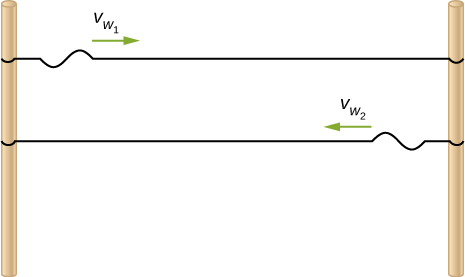
Figure shows two strings attached between two poles. A wave propagates from left to right in the top string with velocity v subscript w1. A wave propagates from right to left in the bottom string with velocity v subscript w2.

Answer

v 1 t+ v 2 t= 2.00m, t= 2.21ms

16-71 §16.3 source ↗

The note E4 is played on a piano and has a frequency of f=393.88. If the linear mass density of this string of the piano is μ=0.012kg/m and the string is under a tension of 1000.00 N, what is the speed of the wave on the string and the wavelength of the wave?

Answer

v= 288.68m/s, λ= 0.73m

16-73 §16.3 source ↗

A sinusoidal wave travels down a taut, horizontal string with a linear mass density of μ=0.060kg/m. The maximum vertical speed of the wave is vymax= 0.30cm/s. The wave is modeled with the wave equation y(x,t)= Asin(6.00m−1x−24.00s−1t). (a) What is the amplitude of the wave? (b) What is the tension in the string?

Answer

a. A=0.0125cm; b. FT=0.96N

16-75 §16.4 source ↗

A string of length 5 m and a mass of 90 g is held under a tension of 100 N. A wave travels down the string that is modeled as y(x,t)= 0.01msin(15.7m−1x−1170.12s−1t). What is the power over one wavelength?

Answer

v=74.54m/s, Pλ=91.85W

16-77 §16.4 source ↗

The low-frequency speaker of a stereo set has a surface area of A=0.05m2 and produces 1 W of acoustical power. (a) What is the intensity at the speaker? (b) If the speaker projects sound uniformly in all directions, at what distance from the speaker is the intensity 0.1W/m2?

Answer

a. I=20.0W/m2; b. I=PA,A=10.0m2A=4πr2,r=0.892m

16-79 §16.4 source ↗

A device called an insolation meter is used to measure the intensity of sunlight. It has an area of 100cm2 and registers 6.50 W. What is the intensity in W/m2?

Answer

I = 650 W/m 2

16-81 §16.4 source ↗

Suppose you have a device that extracts energy from ocean breakers in direct proportion to their intensity. If the device produces 10.0 kW of power on a day when the breakers are 1.20 m high, how much will it produce when they are 0.600 m high?

Answer

P ∝ E ∝ I ∝ X 2 ⇒ P 2 P 1 = ( X 2 X 1 ) 2 P 2 = 2.50 kW

16-83 §16.4 source ↗

A microphone receiving a pure sound tone feeds an oscilloscope, producing a wave on its screen. If the sound intensity is originally 2.00×10⁻⁵W/m2, but is turned up until the amplitude increases by 30.0%, what is the new intensity?

Answer

I ∝ X 2 ⇒ I 1 I 2 = ( X 1 X 2 ) 2 ⇒ I 2 = 3.38 × 10 −5 W/m 2

16-85 §16.4 source ↗

The power versus time for a point on a string (μ=0.05kg/m) in which a sinusoidal traveling wave is induced. The wave is modeled with the wave equation y(x,t)= Asin(20.93m−1x−ωt). What is the frequency and amplitude of the wave?

Answer

f= 100.00Hz, A= 1.10cm

16-87 §16.4 source ↗

A 250-Hz tuning fork is struck and the intensity at the source is I1 at a distance of one meter from the source. (a) What is the intensity at a distance of 4.00 m from the source? (b) How far from the tuning fork is the intensity a tenth of the intensity at the source?

Answer

a. I2=0.063I1; b. I14πr12=I24πr22r2=3.16m

16-89 §16.4 source ↗

The energy of a ripple on a pond is proportional to the amplitude squared. If the amplitude of the ripple is 0.1 cm at a distance from the source of 6.00 meters, what was the amplitude at a distance of 2.00 meters from the source?

Answer

2π r 1 A 1 2 = 2π r 2 A 2 2 , A 1 = ( r 2 r 1 ) 1 / 2 A 1 = 0.17m

16-91 §16.5 source ↗

Consider two sinusoidal sine waves traveling along a string, modeled as y1(x,t)= 0.3msin(4m−1x+3s−1t+π3) and y2(x,t)= 0.6msin(8m−1x−6s−1t). What is the height of the resultant wave formed by the interference of the two waves at the position x=1.0m at time t=3.0s?

Answer

y(x,t)= 0.63m

16-93 §16.5 source ↗

Two sinusoidal waves are moving through a medium in the same direction, both having amplitudes of 3.00 cm, a wavelength of 5.20 m, and a period of 6.52 s, but one has a phase shift of an angle ϕ. What is the phase shift if the resultant wave has an amplitude of 5.00 cm? [Hint: Use the trig identity sinu+ sinv= 2sin(u+v2)cos(u−v2)

Answer

A R = 2Acos( ϕ 2 ), ϕ= 1.17rad

16-95 §16.5 source ↗

Two sinusoidal waves are moving through a medium in the positive x-direction, both having amplitudes of 7.00 cm, a wave number of k=3.00m−1, an angular frequency of ω=2.50s−1, and a period of 6.00 s, but one has a phase shift of an angle ϕ=π12rad. What is the height of the resultant wave at a time t=2.00s and a position x=0.53m?

Answer

y R = 1.90 cm

16-97 §16.5 source ↗

Two sinusoidal waves, which are identical except for a phase shift, travel along in the same direction. The wave equation of the resultant wave is yR(x,t)= 0.70msin(3.00m−1x−6.28s−1t+
π/16rad). What are the angular frequency, wave number, amplitude, and phase shift of the individual waves?

Answer

ω = 6.28 s −1 , k = 3.00 m −1 , ϕ = π 8 rad, A R = 2 A cos ( ϕ 2 ) , A = 0.37 m

16-99 §16.5 source ↗

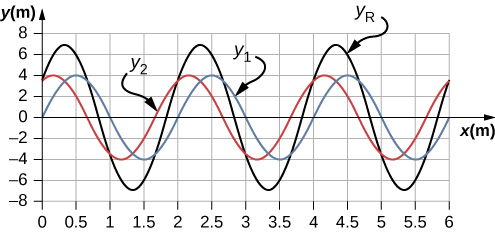
Consider two wave functions, y1(x,t)= 4.00msin(πm−1x−πs−1t) and y2(x,t)= 4.00msin(πm−1x−πs−1t+π3). (a) Using a spreadsheet, plot the two wave functions and the wave that results from the superposition of the two wave functions as a function of position (0.00≤x≤6.00m) for the time t=0.00s. (b) What are the wavelength and amplitude of the two original waves? (c) What are the wavelength and amplitude of the resulting wave?

Answer

a.

Figure shows a blue wave labeled y1, a red wave labeled y2 and a black wave labeled yR on the same graph. The red and the blue waves have the same wavelength and amplitude, but are out of phase. The black wave has the same wavelength as the other two, but is greater in amplitude.

;
b. λ=2.0m,A=4m; c. λR= 2.0m, AR= 6.93m

16-101 §16.5 source ↗

Consider two wave functions that differ only by a phase shift, y1(x,t)= Acos(kx−ωt) and y2(x,t)= Acos(kx−ωt+ϕ). Use the trigonometric identities cosu+ cosv= 2cos(u−v2)cos(u+v2) and cos(−θ)= cos(θ) to find a wave equation for the wave resulting from the superposition of the two waves. Does the resulting wave function come as a surprise to you?

Answer

yR(x,t)= 2Acos(ϕ2)cos(kx−ωt+ϕ2); The result is not surprising because cos(θ)= sin(θ+π2).

16-103 §16.6 source ↗

A 2-m long string is stretched between two supports with a tension that produces a wave speed equal to vw= 50.00m/s. What are the wavelength and frequency of the first three modes that resonate on the string?

Answer

λ n = 2.00 n L , f n = v λ n λ 1 = 4.00 m , f 1 = 12.5 Hz λ 2 = 2.00 m , f 2 = 25.00 Hz λ 3 = 1.33 m , f 3 = 37.59 Hz

16-105 §16.6 source ↗

A cable with a linear density of μ=0.02kg/m is hung from telephone poles. The tension in the cable is 500.00 N. The distance between poles is 20 meters. The wind blows across the line, causing the cable resonate. A standing waves pattern is produced that has 4.5 wavelengths between the two poles. The speed of sound at the current temperature T=20°C is 343.00 m/s. What are the frequency and wavelength of the hum?

Answer

v = 158.11 m/s, λ = 4.44 m, f = 35.61 Hz λ s = 9.63 m

16-107 §16.6 source ↗

Consider two wave functions y(x,t)= 0.30cmsin(3m−1x−4s−1t) and y(x,t)= 0.30cmsin(3m−1x+4s−1t). Write a wave function for the resulting standing wave.

Answer

y(x,t)= [0.60cmsin(3 m −1 x)]cos(4 s −1 t)

16-109 §16.6 source ↗

A string with a linear mass density of 0.0062 kg/m and a length of 3.00 m is set into the n=100 mode of resonance. The tension in the string is 20.00 N. What is the wavelength and frequency of the wave?

Answer

λ 100 = 0.06 m v = 56.8 m/s, f n = n f 1 , n = 1 , 2 , 3 , 4 , 5 ... f 100 = 947 Hz

16-111 §16.6 source ↗

Two sinusoidal waves with identical wavelengths and amplitudes travel in opposite directions along a string producing a standing wave. The linear mass density of the string is μ=0.075kg/m and the tension in the string is FT=5.00N. The time interval between instances of total destructive interference is Δt=0.13s. What is the wavelength of the waves?

Answer

T= 2Δt, v= λ T , λ= 2.12m

16-113 §16.6 source ↗

A string is fixed at both end. The mass of the string is 0.0090 kg and the length is 3.00 m. The string is under a tension of 200.00 N. The string is driven by a variable frequency source to produce standing waves on the string. Find the wavelengths and frequency of the first four modes of standing waves.

Answer

λ 1 = 6.00 m , λ 2 = 3.00 m , λ 3 = 2.00 m , λ 4 = 1.50 m v = 258.20 m/s = λ f f 1 = 43.03 Hz , f 2 = 86.07 Hz , f 3 = 129.10 Hz , f 4 = 172.13 Hz

16-115 §16.6 source ↗

A string is fixed at both ends to supports 3.50 m apart and has a linear mass density of μ= 0.005kg/m. The string is under a tension of 90.00 N. A standing wave is produced on the string with six nodes and five antinodes. What are the wave speed, wavelength, frequency, and period of the standing wave?

Answer

v= 134.16ms, λ= 1.4m, f= 95.83Hz, T= 0.0104s

16-117 §16.AP source ↗

Ultrasound equipment used in the medical profession uses sound waves of a frequency above the range of human hearing. If the frequency of the sound produced by the ultrasound machine is f=30kHz, what is the wavelength of the ultrasound in bone, if the speed of sound in bone is v=3000m/s?

Answer

λ = 0.10 m

16-119 §16.AP source ↗

The speed of light in air is approximately v= 3.00×10⁸m/s and the speed of light in glass is v= 2.00×10⁸m/s. A red laser with a wavelength of λ=633.00nm shines light incident of the glass, and some of the red light is transmitted to the glass. The frequency of the light is the same for the air and the glass. (a) What is the frequency of the light? (b) What is the wavelength of the light in the glass?

Answer

a. f= 4.74×10¹⁴Hz; b. λ=422nm

16-121 §16.AP source ↗

A sunbather stands waist deep in the ocean and observes that six crests of periodic surface waves pass each minute. The crests are 16.00 meters apart. What is the wavelength, frequency, period, and speed of the waves?

Answer

λ= 16.00m, f= 0.10Hz, T= 10.00s, v= 1.6m/s

16-123 §16.AP source ↗

A motorboat is traveling across a lake at a speed of vb= 15.00m/s. The boat bounces up and down every 0.50 s as it travels in the same direction as a wave. It bounces up and down every 0.30 s as it travels in a direction opposite the direction of the waves. What is the speed and wavelength of the wave?

Answer

λ= ( v b +v) t b , v= 3.75m/s, λ= 3.00m

16-125 §16.AP source ↗

Given the wave functions y1(x,t)= Asin(kx−ωt) and y2(x,t)= Asin(kx−ωt+ϕ) with ϕ≠π2, show that y1(x,t)+ y2(x,t) is a solution to the linear wave equation with a wave velocity of v=ωk.

Answer

∂ 2 ( y 1 + y 2 ) ∂ t 2 = − A ω 2 sin ( k x − ω t ) − A ω 2 sin ( k x − ω t + ϕ ) ∂ 2 ( y 1 + y 2 ) ∂ x 2 = − A k 2 sin ( k x − ω t ) − A k 2 sin ( k x − ω t + ϕ ) ∂ 2 y ( x , t ) ∂ x 2 = 1 v 2 ∂ 2 y ( x , t ) ∂ t 2 − A ω 2 sin ( k x − ω t ) − A ω 2 sin ( k x − ω t + ϕ ) = ( 1 v 2 ) ( − A k 2 sin ( k x − ω t ) − A k 2 sin ( k x − ω t + ϕ ) ) v = ω k

16-127 §16.AP source ↗

A sinusoidal wave travels down a taut, horizontal string with a linear mass density of μ= 0.060kg/m. The magnitude of maximum vertical acceleration of the wave is aymax= 0.90m/s2 and the amplitude of the wave is 0.40 m. The string is under a tension of FT=600.00N. The wave moves in the negative x-direction. Write an equation to model the wave.

Answer

y(x,t)= 0.40sin(0.15x+1.5t)

16-129 §16.AP source ↗

A transverse wave on a horizontal string (μ=0.0060kg/m) is described with the equation y(x,t)= 0.30msin(2π4.00m(x−vwt)). The string is under a tension of 300.00 N. What are the wave speed, wave number, and angular frequency of the wave?

Answer

v= 223.61m/s, k= 1.57 m −1 , ω= 351.07 s −1

16-131 §16.AP source ↗

A wave on a string is driven by a string vibrator, which oscillates at a frequency of 100.00 Hz and an amplitude of 1.00 cm. The string vibrator operates at a voltage of 12.00 V and a current of 0.20 A. The power consumed by the string vibrator is P=IV. Assume that the string vibrator is 90% efficient at converting electrical energy into the energy associated with the vibrations of the string. The string is 3.00 m long, and is under a tension of 60.00 N. What is the linear mass density of the string?

Answer

P = 1 2 A 2 ( 2 π f ) 2 μ F T μ = 2.00 × 10 −4 kg/m

16-133 §16.AP source ↗

A transverse wave on a string has a wavelength of 5.0 m, a period of 0.02 s, and an amplitude of 1.5 cm. The average power transferred by the wave is 5.00 W. What is the tension in the string?

Answer

P= 12μA2ω2λT, μ= 0.0018kg/m

FT= v2μ= (λT)2μ= 110N

16-135 §16.AP source ↗

Consider two periodic wave functions, y1(x,t)= Asin(kx−ωt) and y2(x,t)= Asin(kx−ωt+ϕ). (a) For what values of ϕ will the wave that results from a superposition of the wave functions have an amplitude of 2A? (b) For what values of ϕ will the wave that results from a superposition of the wave functions have an amplitude of zero?

Answer

a. AR= 2Acos(ϕ2), cos(ϕ2)= 1, ϕ= 0, 2π, 4π,...; b. AR= 2Acos(ϕ2), cos(ϕ2)= 0, ϕ= 0, π, 3π, 5π...

16-137 §16.AP source ↗

A trough with dimensions 10.00 meters by 0.10 meters by 0.10 meters is partially filled with water. Small-amplitude surface water waves are produced from both ends of the trough by paddles oscillating in simple harmonic motion. The height of the water waves are modeled with two sinusoidal wave equations, y1(x,t)= 0.3msin(4m−1x−3s−1t) and y2(x,t)= 0.3mcos(4m−1x+3s−1t−π2). What is the wave function of the resulting wave after the waves reach one another and before they reach the end of the trough (i.e., assume that there are only two waves in the trough and ignore reflections)? Use a spreadsheet to check your results. (Hint: Use the trig identities sin(u±v)= sinucosv±cosusinv and cos(u±v)= cosucosv∓sinusinv)

Answer

y R (x,t)= 0.6msin(4 m −1 x)cos(3 s −1 t)

16-139 §16.AP source ↗

Consider what is shown below. A 20.00-kg mass rests on a frictionless ramp inclined at 45°. A string with a linear mass density of μ=0.025kg/m is attached to the 20.00-kg mass. The string passes over a frictionless pulley of negligible mass and is attached to a hanging mass (m). The system is in static equilibrium. A wave is induced on the string and travels up the ramp. (a) What is the mass of the hanging mass (m)? (b) At what wave speed does the wave travel up the string?
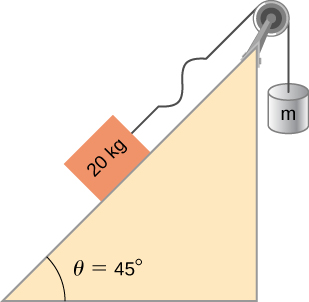
Figure shows a slope of 45 degrees going up and right. A mass of 20 kg rests on it. This is supported by a string, which goes over a pulley at the top of the slope. A mass m hangs from it on the other side. A wave is shown in the string.

Answer

a. (1)FT−20.00kg(9.80m/s2)cos45°=0(2)m(9.80m/s2)−FT=0m=14.14kg; b. FT=138.57Nv=74.45m/s

16-141 §16.AP source ↗

A string has a mass of 150 g and a length of 3.4 m. One end of the string is fixed to a lab stand and the other is attached to a spring with a spring constant of ks=100N/m. The free end of the spring is attached to another lab pole. The tension in the string is maintained by the spring. The lab poles are separated by a distance that stretches the spring 2.00 cm. The string is plucked and a pulse travels along the string. What is the propagation speed of the pulse?

Answer

F T = 2N,v= 6.73m/s

16-143 §16.AP source ↗

A string with a length of 4 m is held under a constant tension. The string has a linear mass density of μ= 0.006kg/m. Two resonant frequencies of the string are 400 Hz and 480 Hz. There are no resonant frequencies between the two frequencies. (a) What are the wavelengths of the two resonant modes? (b) What is the tension in the string?

Answer

a. fn=nv2L,v=2Lfn+1n+1,n+1n=2Lfn+12Lfn,1+1n=1.2,n=5λn=2nL,λ5=1.6m,λ6=1.33m; b. FT=245.76N

16-145 §16.CP source ↗

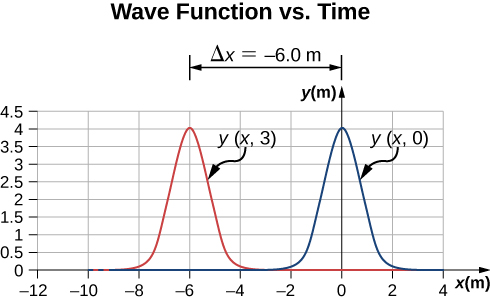
A pulse moving along the x axis can be modeled as the wave function y(x,t)= 4.00me−(x+(2.00m/s)t1.00m)2. (a)What are the direction and propagation speed of the pulse? (b) How far has the wave moved in 3.00 s? (c) Plot the pulse using a spreadsheet at time t=0.00s and t=3.00s to verify your answer in part (b).

Answer

a. Moves in the negative x direction at a propagation speed of v=2.00m/s. b. Δx=−6.00m; c.

Figure shows a graph labeled wave function versus time. Two identical pulse waves are shown on the graph. The red wave, labeled y parentheses x, 3, peaks at x = -6 m. The blue wave, labeled y parentheses x, 0, peaks at x = 0 m. The distance between the two peaks is labeled delta x = -6 m.

16-147 §16.CP source ↗

Consider two wave functions y1(x,t)= Asin(kx−ωt) and y2(x,t)= Asin(kx+ωt+ϕ). What is the wave function resulting from the interference of the two wave? (Hint: sin(α±β)= sinαcosβ±cosαsinβ and ϕ=ϕ2+ϕ2.)

Answer

sin ( k x − ω t ) = sin ( k x + ϕ 2 ) cos ( ω t + ϕ 2 ) − cos ( k x + ϕ 2 ) sin ( ω t + ϕ 2 ) sin ( k x − ω t + ϕ ) = sin ( k x + ϕ 2 ) cos ( ω t + ϕ 2 ) + cos ( k x + ϕ 2 ) sin ( ω t + ϕ 2 ) sin ( k x − ω t ) + sin ( k x + ω t + ϕ ) = 2 sin ( k x + ϕ 2 ) cos ( ω t + ϕ 2 ) y R = 2 A sin ( k x + ϕ 2 ) cos ( ω t + ϕ 2 )

16-149 §16.CP source ↗

Consider two wave functions y1(x,t)= Asin(kx−ωt) and y2(x,t)= Asin(kx+ωt+ϕ). The resultant wave form when you add the two functions is yR= 2Asin(kx+ϕ2)cos(ωt+ϕ2). Consider the case where A=0.03m−1, k=1.26m−1, ω=πs−1, and ϕ=π10. (a) Where are the first three nodes of the standing wave function starting at zero and moving in the positive x direction? (b) Using a spreadsheet, plot the two wave functions and the resulting function at time t=1.00s to verify your answer.

Answer

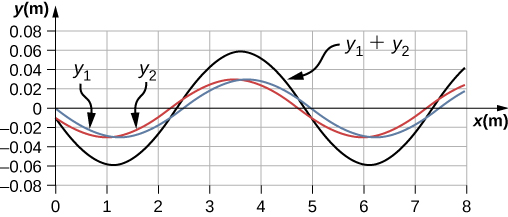
sin(kx+ϕ2)=0,kx+ϕ2=0,π,2π,1.26m−1x+π20=π,2π,3πx=2.37m,4.86m,7.35m;

Figure shows a graph with wave y1 in blue, wave y2 in red and wave y1 plus y2 in black. All three have a wavelength of 5 m. Waves y1 and y2 have the same amplitude and are slightly out of phase with each other. The amplitude of the black wave is almost twice that of the other two.

Loading chapter 17…

Problems and answers are adapted from University Physics Volume 1 by Samuel J. Ling, Jeff Sanny and William Moebs, OpenStax, and are used under the CC BY-NC-SA 4.0 licence. Access for free at https://openstax.org/books/university-physics-volume-1/pages/1-introduction. Illustrations: Copyright Rice University, OpenStax, under CC BY-NC-SA 4.0 license. This adaptation is released under the same licence, is non-commercial, and is neither affiliated with nor endorsed by OpenStax or Rice University.