Every problem in the chapter beside the book’s answer, a chapter at a time as you scroll.
Chapter 9: Linear Momentum and Collisions
73 problems · 15 figuresCheck Your Understanding 9.1 §9.2 source ↗
Answer
required is
Check Your Understanding 9.2 §9.2 source ↗
Answer
Check Your Understanding 9.3 §9.3 source ↗
Answer
Thus, the final velocity is 0.135 m/s to the left.
Check Your Understanding 9.4 §9.3 source ↗
Answer
Check Your Understanding 9.5 §9.3 source ↗
Answer
where is the force due to friction.
Check Your Understanding 9.6 §9.3 source ↗
Answer
Check Your Understanding 9.7 §9.4 source ↗
Answer
Check Your Understanding 9.8 §9.4 source ↗
Answer
Check Your Understanding 9.9 §9.5 source ↗
Answer
Check Your Understanding 9.10 §9.5 source ↗
Answer
The average molecular mass of air is 29 g/mol, so the mass of air contained in the tank is about 2.2 kg. This is about 10 times less than the mass of the tank, so it is safe to neglect it. Also, the initial force of the air pressure is roughly proportional to the surface area of each piece, which is in turn proportional to the mass of each piece (assuming uniform thickness). Thus, the initial acceleration of each piece would change very little if we explicitly consider the air.
Check Your Understanding 9.11 §9.6 source ↗
Answer
Thus, the center of mass of the Sun, Earth, Moon system is 4.6 km from the center of the Sun.
Check Your Understanding 9.12 §9.6 source ↗
Answer
where we sum over the number N of unit cells in the crystal and m is the mass of a unit cell. Because Nm = M, we can write
This is the definition of the geometric center of the crystal, so the center of mass is at the same point as the geometric center.
Check Your Understanding 9.13 §9.6 source ↗
Answer
Check Your Understanding 9.14 §9.7 source ↗
Answer
where we used because the mass of the rocket does not change. Thus, time rate of change of the mass of the rocket is the same as that of the fuel.
9-1 §9.1 source ↗
Answer
9-3 §9.2 source ↗
Answer
9-5 §9.2 source ↗
Answer
9-7 §9.3 source ↗
Answer
9-9 §9.3 source ↗
Answer
9-11 §9.3 source ↗
Answer
9-13 §9.4 source ↗
Answer
9-15 §9.5 source ↗
Answer
9-17 §9.7 source ↗
Answer
9-19 §9.1 source ↗
A skater of mass 40 kg is carrying a box of mass 5 kg. The skater has a speed of 5 m/s with respect to the floor and is gliding without any friction on a smooth surface.
a. Find the momentum of the box with respect to the floor.
b. Find the momentum of the box with respect to the floor after she puts the box down on the frictionless skating surface.
Answer
9-21 §9.1 source ↗
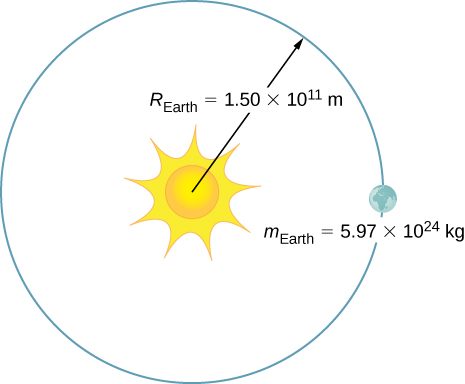
The mass of Earth is and its orbital radius is an average of . Calculate the magnitude of its linear momentum at the location in the diagram.
Answer
9-23 §9.1 source ↗
Answer
9-25 §9.2 source ↗
A 75.0-kg person is riding in a car moving at 20.0 m/s when the car runs into a bridge abutment (see the following figure).
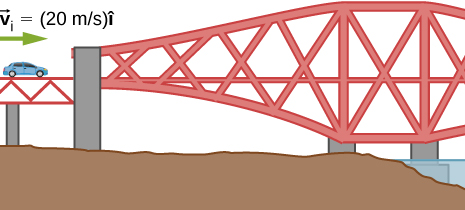
a. Calculate the average force on the person if he is stopped by a padded dashboard that compresses an average of 1.00 cm.
b. Calculate the average force on the person if he is stopped by an air bag that compresses an average of 15.0 cm.
Answer
9-27 §9.2 source ↗
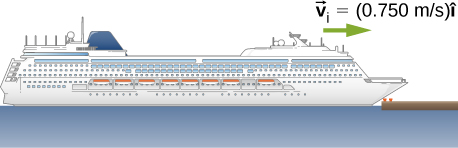
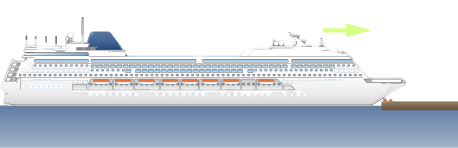
A cruise ship with a mass of strikes a pier at a speed of 0.750 m/s. It comes to rest after traveling 6.00 m, damaging the ship, the pier, and the tugboat captain’s finances. Calculate the average force exerted on the pier using the concept of impulse. (Hint: First calculate the time it took to bring the ship to rest, assuming a constant force.)
Answer
9-29 §9.2 source ↗
Answer
9-31 §9.2 source ↗
Answer
9-33 §9.2 source ↗
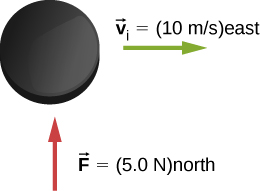
A hockey puck of mass 150 g is sliding due east on a frictionless table with a speed of 10 m/s. Suddenly, a constant force of magnitude 5 N and direction due north is applied to the puck for 1.5 s. Find the north and east components of the momentum at the end of the 1.5-s interval.
Answer
9-35 §9.3 source ↗
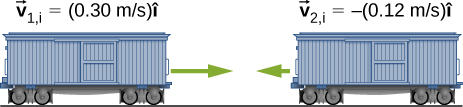
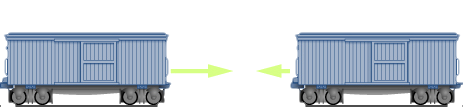
Train cars are coupled together by being bumped into one another. Suppose two loaded train cars are moving toward one another, the first having a mass of and a velocity of , and the second having a mass of and a velocity of . What is their final velocity?
Answer
9-37 §9.3 source ↗
The figure below shows a bullet of mass 200 g traveling horizontally towards the east with speed 400 m/s, which strikes a block of mass 1.5 kg that is initially at rest on a frictionless table.
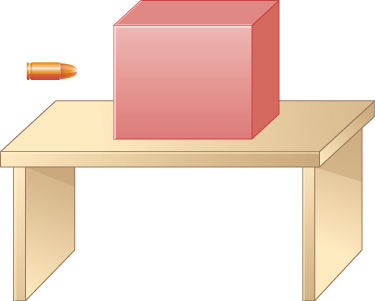
After striking the block, the bullet is embedded in the block and the block and the bullet move together as one unit.
a. What is the magnitude and direction of the velocity of the block/bullet combination immediately after the impact?
b. What is the magnitude and direction of the impulse by the block on the bullet?
c. What is the magnitude and direction of the impulse from the bullet on the block?
d. If it took 3 ms for the bullet to change the speed from 400 m/s to the final speed after impact, what is the average force between the block and the bullet during this time?
Answer
9-39 §9.3 source ↗
Answer
9-41 §9.3 source ↗
Answer
9-43 §9.4 source ↗
A 5.50-kg bowling ball moving at 9.00 m/s collides with a 0.850-kg bowling pin, which is scattered at an angle of 15.8° to the initial direction of the bowling ball and with a speed of 15.0 m/s.
a. Calculate the final velocity (magnitude and direction) of the bowling ball.
b. Is the collision elastic?
Answer
9-45 §9.4 source ↗
Answer
9-47 §9.4 source ↗
Answer
9-49 §9.4 source ↗
Answer
9-51 §9.4 source ↗
Answer
9-53 §9.5 source ↗
Answer
9-55 §9.5 source ↗
A projectile of mass 2.0 kg is fired in the air at an angle of 40.0 to the horizon at a speed of 50.0 m/s. At the highest point in its flight, the projectile breaks into three parts of mass 1.0 kg, 0.7 kg, and 0.3 kg. The 1.0-kg part falls straight down after breakup with an initial speed of 10.0 m/s, the 0.7-kg part moves in the original forward direction, and the 0.3-kg part goes straight up.
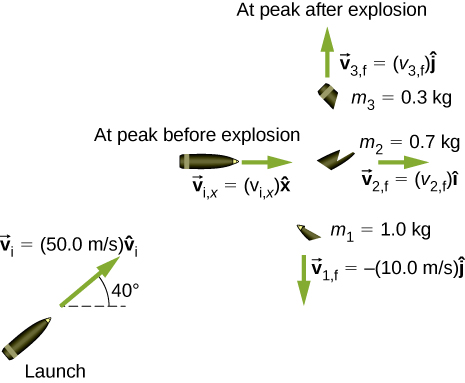
a. Find the speeds of the 0.3-kg and 0.7-kg pieces immediately after the break-up.
b. How high from the break-up point does the 0.3-kg piece go before coming to rest?
c. Where does the 0.7-kg piece land relative to where it was fired from?
Answer
9-57 §9.5 source ↗
Answer
9-59 §9.5 source ↗
Answer
9-61 §9.5 source ↗
Answer
9-63 §9.6 source ↗
Three point masses are placed at the corners of a triangle as shown in the figure below.
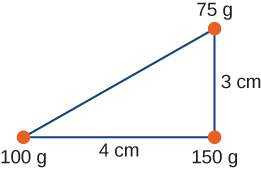
Find the center of mass of the three-mass system.
Answer
9-65 §9.6 source ↗
Answer
9-67 §9.6 source ↗
Two particles of masses and move uniformly in different circles of radii and about the origin in the x, y-plane. The coordinates of the two particles in meters are given as follows ( for both). Here t is in seconds:
a. Find the radii of the circles of motion of both particles.
b. Find the x- and y-coordinates of the center of mass.
c. Decide if the center of mass moves in a circle by plotting its trajectory.
Answer
9-69 §9.6 source ↗
Answer
9-71 §9.6 source ↗
Answer
9-73 §9.6 source ↗
Answer
9-75 §9.6 source ↗
Answer
9-77 §9.7 source ↗
(a) A 5.00-kg squid initially at rest ejects 0.250 kg of fluid with a velocity of 10.0 m/s. What is the recoil velocity of the squid if the ejection is done in 0.100 s and there is a 5.00-N frictional force opposing the squid’s movement?
(b) How much energy is lost to work done against friction?
Answer
9-79 §9.7 source ↗
Answer
9-81 §9.7 source ↗
Answer
9-84 §9.AP source ↗
Answer
9-86 §9.AP source ↗
Answer
9-88 §9.AP source ↗
Answer
9-90 §9.AP source ↗
Answer
9-92 §9.AP source ↗
Answer
9-94 §9.AP source ↗
Answer
9-96 §9.AP source ↗
Answer
9-98 §9.AP source ↗
Answer
9-100 §9.AP source ↗
Answer
9-102 §9.AP source ↗
Answer
9-104 §9.AP source ↗
Answer
9-106 §9.AP source ↗
Answer
9-108 §9.AP source ↗
Answer
9-110 §9.AP source ↗
Answer
9-112 §9.AP source ↗
Answer
9-114 §9.CP source ↗
A 65-kg person jumps from the first floor window of a burning building and lands almost vertically on the ground with a horizontal velocity of 3 m/s and vertical velocity of . Upon impact with the ground he is brought to rest in a short time. The force experienced by his feet depends on whether he keeps his knees stiff or bends them. Find the force on his feet in each case.
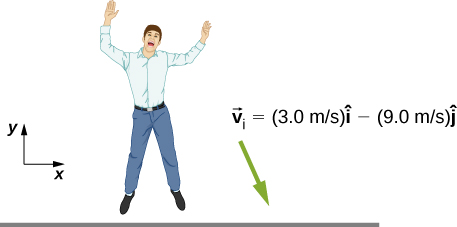
a. First find the impulse on the person from the impact on the ground. Calculate both its magnitude and direction.
b. Find the average force on the feet if the person keeps his leg stiff and straight and his center of mass drops by only 1 cm vertically and 1 cm horizontally during the impact.
c. Find the average force on the feet if the person bends his legs throughout the impact so that his center of mass drops by 50 cm vertically and 5 cm horizontally during the impact.
d. Compare the results of part (b) and (c), and draw conclusions about which way is better.
You will need to find the time the impact lasts by making reasonable assumptions about the acceleration opposite to the motion. Although the force is not constant during the impact, working with constant average force for this problem is acceptable.
Answer
9-116 §9.CP source ↗
Answer
9-118 §9.CP source ↗
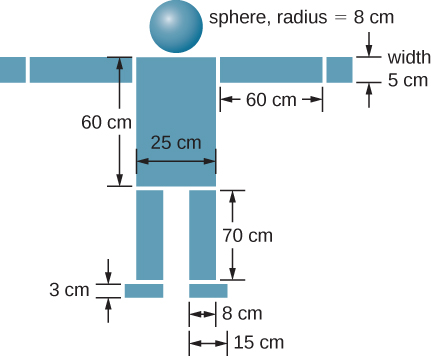
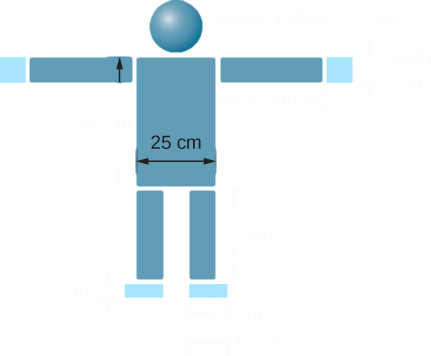
Find the center of mass of the structure given in the figure below. Assume a uniform thickness of 20 cm, and a uniform density of
Answer
Loading chapter 10…
Problems and answers are adapted from University Physics Volume 1 by Samuel J. Ling, Jeff Sanny and William Moebs, OpenStax, and are used under the CC BY-NC-SA 4.0 licence. Access for free at https://openstax.org/books/university-physics-volume-1/pages/1-introduction. Illustrations: Copyright Rice University, OpenStax, under CC BY-NC-SA 4.0 license. This adaptation is released under the same licence, is non-commercial, and is neither affiliated with nor endorsed by OpenStax or Rice University.