Every problem in the chapter beside the book’s answer, a chapter at a time as you scroll.

Chapter 6: Applications of Newton's Laws

79 problems · 25 figures

Check Your Understanding 6.1 §6.1 source ↗

Now calculate the scale reading when the elevator accelerates downward at a rate of 1.20m/s2.

Answer

F s = 645 N

Check Your Understanding 6.2 §6.1 source ↗

Calculate the acceleration of the system, and the tension in the string, when the masses are m1=5.00kg and m2=3.00kg.

Answer

a = 3.68 m/s 2 , T = 18.4 N

Check Your Understanding 6.3 §6.1 source ↗

Determine a general formula in terms of m1,m2 and g for calculating the tension in the string for the Atwood machine shown above.

Answer

T= 2m1m2m1+m2g (This is found by substituting the equation for acceleration in Figure 6.7(a), into the equation for tension in Figure 6.7(b).)
Figure 6.7 in the book ↗
An Atwood machine and free-body diagrams for each of the two blocks.

Check Your Understanding 6.4 §6.1 source ↗

The soccer player stops after completing the play described above, but now notices that the ball is in position to be stolen. If she now experiences a force of 126 N to attempt to steal the ball, which is 2.00 m away from her, how long will it take her to get to the ball?

Answer

1.49 s

Check Your Understanding 6.5 §6.1 source ↗

Find the direction of the resultant for the 1.50-kg model helicopter.

Answer

49.4 degrees

Check Your Understanding 6.6 §6.1 source ↗

If atmospheric resistance is neglected, find the maximum height for the mortar shell. Is calculus required for this solution?

Answer

128 m; no

Check Your Understanding 6.7 §6.2 source ↗

A block of mass 1.0 kg rests on a horizontal surface. The frictional coefficients for the block and surface are μs=0.50 and μk=0.40. (a) What is the minimum horizontal force required to move the block? (b) What is the block’s acceleration when this force is applied?

Answer

a. 4.9 N; b. 0.98 m/s2

Check Your Understanding 6.8 §6.2 source ↗

The snowboarder is now moving down a hill with incline 10.0°. What is the snowboarder's acceleration?

Answer

−0.23m/s2; the negative sign indicates that the snowboarder is slowing down.

Check Your Understanding 6.9 §6.3 source ↗

A car moving at 96.8 km/h travels around a circular curve of radius 182.9 m on a flat country road. What must be the minimum coefficient of static friction to keep the car from slipping?

Answer

0.40

Check Your Understanding 6.10 §6.4 source ↗

Find the terminal velocity of a 50-kg skydiver falling in spread-eagle fashion.

Answer

34 m/s

Check Your Understanding 6.11 §6.4 source ↗

Suppose the resistive force of the air on a skydiver can be approximated by f=−bv2. If the terminal velocity of a 100-kg skydiver is 60 m/s, what is the value of b?

Answer

0.27 kg/m

6-1 §6.1 source ↗

To simulate the apparent weightlessness of space orbit, astronauts are trained in the hold of a cargo aircraft that is accelerating downward at g. Why do they appear to be weightless, as measured by standing on a bathroom scale, in this accelerated frame of reference? Is there any difference between their apparent weightlessness in orbit and in the aircraft?

Answer

The scale is in free fall along with the astronauts, so the reading on the scale would be 0. There is no difference in the apparent weightlessness; in the aircraft and in orbit, free fall is occurring.

6-3 §6.2 source ↗

When you learn to drive, you discover that you need to let up slightly on the brake pedal as you come to a stop or the car will stop with a jerk. Explain this in terms of the relationship between static and kinetic friction.

Answer

If you do not let up on the brake pedal, the car’s wheels will lock so that they are not rolling; sliding friction is now involved and the sudden change (due to the larger force of static friction) causes the jerk.

6-5 §6.2 source ↗

A physics major is cooking breakfast when she notices that the frictional force between her steel spatula and Teflon frying pan is only 0.200 N. Knowing the coefficient of kinetic friction between the two materials, she quickly calculates the normal force. What is it?

Answer

5.00 N

6-7 §6.3 source ↗

Define centripetal force. Can any type of force (for example, tension, gravitational force, friction, and so on) be a centripetal force? Can any combination of forces be a centripetal force?

Answer

Centripetal force is defined as any net force causing uniform circular motion. The centripetal force is not a new kind of force. The label “centripetal” refers to any force that keeps something turning in a circle. That force could be tension, gravity, friction, electrical attraction, the normal force, or any other force. Any combination of these could be the source of centripetal force, for example, the centripetal force at the top of the path of a tetherball swung through a vertical circle is the result of both tension and gravity.

6-9 §6.3 source ↗

Race car drivers routinely cut corners, as shown below (Path 2). Explain how this allows the curve to be taken at the greatest speed.
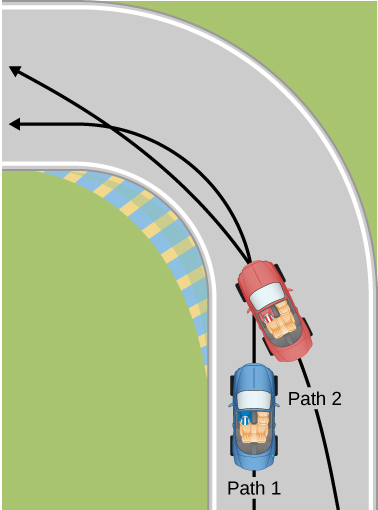
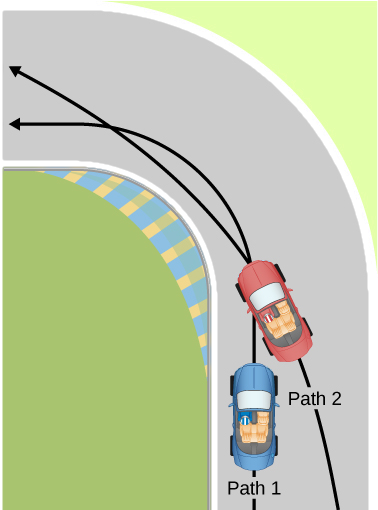
Two paths are shown inside a race track through a ninety degree curve. Two cars, a red and a blue one, and their paths of travel are shown. The blue car is making a tight turn on path one, which is the inside path along the track. The red car is shown overtaking the first car, while taking a wider turn and crossing in front of the blue car into the inside path and then back out of it.Two paths are shown inside a race track through a ninety degree curve. Two cars, a red and a blue one, and their paths of travel are shown. The blue car is making a tight turn on path one, which is the inside path along the track. The red car is shown overtaking the first car, while taking a wider turn and crossing in front of the blue car into the inside path and then back out of it.

Answer

The driver who cuts the corner (on Path 2) has a more gradual curve, with a larger radius. That one will be the better racing line. If the driver goes too fast around a corner using a racing line, he will still slide off the track; the key is to stay at the maximum value of static friction. So, the driver wants maximum possible speed and maximum friction. Consider the equation for centripetal force: Fc=mv2r where v is speed and r is the radius of curvature. So by decreasing the curvature (1/r) of the path that the car takes, we reduce the amount of force the tires have to exert on the road, meaning we can now increase the speed, v. Looking at this from the point of view of the driver on Path 1, we can reason this way: the sharper the turn, the smaller the turning circle; the smaller the turning circle, the larger is the required centripetal force. If this centripetal force is not exerted, the result is a skid.

6-11 §6.3 source ↗

What causes water to be removed from clothes in a spin-dryer?

Answer

The barrel of the dryer provides a centripetal force on the clothes (including the water droplets) to keep them moving in a circular path. As a water droplet comes to one of the holes in the barrel, it will move in a path tangent to the circle.

6-13 §6.3 source ↗

Suppose a child is riding on a merry-go-round at a distance about halfway between its center and edge. She has a lunch box resting on wax paper, so that there is very little friction between it and the merry-go-round. (a) Which path shown below, as viewed from the ground, will the lunch box take when she lets go? (b) The lunch box leaves a trail in the dust on the merry-go-round. What is the shape of the dust trail? Explain your answers.
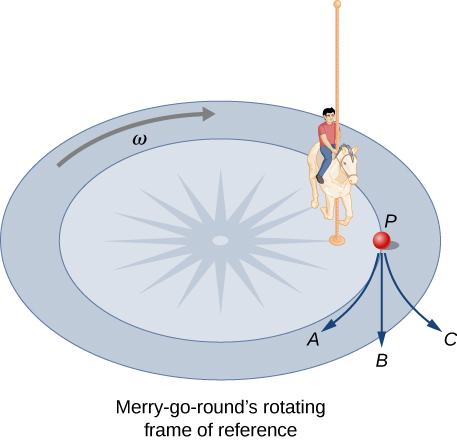
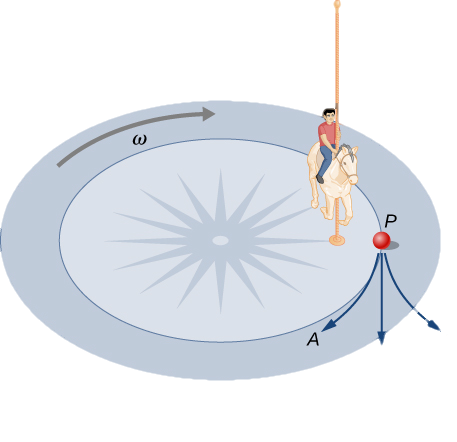
An illustration of the circular base of a merry-go-round with a single horse and child on it. The angular velocity, omega, is clockwise, shown here with an arrow. A point P is shown near the horse, on a circle concentric with the merry-go-round. Three arrows are shown coming out of point P, depicting the three possible path of the lunch box. Path A curves into the circle, to the right from the perspective of the box. Path B is straight, tangent to the circle. Path C curves to the left from the perspective of the box, out of the circle.An illustration of the circular base of a merry-go-round with a single horse and child on it. The angular velocity, omega, is clockwise, shown here with an arrow. A point P is shown near the horse, on a circle concentric with the merry-go-round. Three arrows are shown coming out of point P, depicting the three possible path of the lunch box. Path A curves into the circle, to the right from the perspective of the box. Path B is straight, tangent to the circle. Path C curves to the left from the perspective of the box, out of the circle.

Answer

(a) If there is no friction, then there is no centripetal force. This means that in the inertial frame of the ground, the lunch box will move along a straight path tangent to the circle, and thus follows path B. This is a result of Newton’s first law of motion. (b) The dust trail traces the motion of the box relative to the merry-go-round and will be radially out.

6-15 §6.3 source ↗

Suppose a mass is moving in a circular path on a frictionless table as shown below. In Earth’s frame of reference, there is no centrifugal force pulling the mass away from the center of rotation, yet there is a force stretching the string attaching the mass to the nail. Using concepts related to centripetal force and Newton’s third law, explain what force stretches the string, identifying its physical origin.
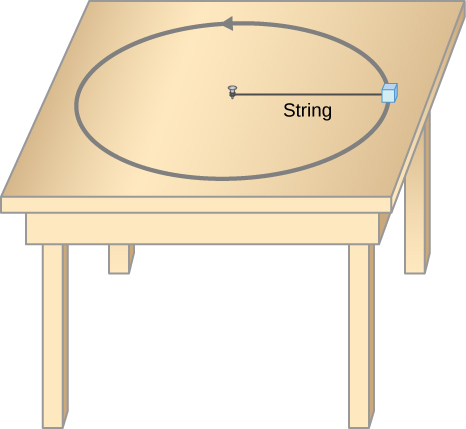
An illustration of a mass moving in a circular path on a table. The mass is attached to a string that is pinned at the center of the circle to the table at the other end.

Answer

There must be a centripetal force to maintain the circular motion; this is provided by the nail at the center. Newton’s third law explains the phenomenon. The action force is the force of the string on the mass; the reaction force is the force of the mass on the string. This reaction force causes the string to stretch.

6-17 §6.3 source ↗

A car rounds a curve and encounters a patch of ice with a very low coefficient of kinetic fiction. The car slides off the road. Describe the path of the car as it leaves the road.

Answer

Since the radial friction with the tires supplies the centripetal force, and friction is nearly 0 when the car encounters the ice, the car will obey Newton’s first law and go off the road in a straight line path, tangent to the curve. A common misconception is that the car will follow a curved path off the road.

6-19 §6.3 source ↗

Two friends are having a conversation. Anna says a satellite in orbit is in free fall because the satellite keeps falling toward Earth. Tom says a satellite in orbit is not in free fall because the acceleration due to gravity is not 9.80m/s2. Who do you agree with and why?

Answer

Anna is correct. The satellite is freely falling toward Earth due to gravity, even though gravity is weaker at the altitude of the satellite, and g is not 9.80m/s2. Free fall does not depend on the value of g; that is, you could experience free fall on Mars if you jumped off Olympus Mons (the tallest volcano in the solar system).

6-21 §6.4 source ↗

Athletes such as swimmers and bicyclists wear body suits in competition. Formulate a list of pros and cons of such suits.

Answer

The pros of wearing body suits include: (1) the body suit reduces the drag force on the swimmer and the athlete can move more easily; (2) the tightness of the suit reduces the surface area of the athlete, and even though this is a small amount, it can make a difference in performance time. The cons of wearing body suits are: (1) The tightness of the suits can induce cramping and breathing problems. (2) Heat will be retained and thus the athlete could overheat during a long period of use.

6-23 §6.4 source ↗

As cars travel, oil and gasoline leaks onto the road surface. If a light rain falls, what does this do to the control of the car? Does a heavy rain make any difference?

Answer

The oil is less dense than the water and so rises to the top when a light rain falls and collects on the road. This creates a dangerous situation in which friction is greatly lowered, and so a car can lose control. In a heavy rain, the oil is dispersed and does not affect the motion of cars as much.

6-25 §6.1 source ↗

A 30.0-kg girl in a swing is pushed to one side and held at rest by a horizontal force F→ so that the swing ropes are 30.0° with respect to the vertical. (a) Calculate the tension in each of the two ropes supporting the swing under these conditions. (b) Calculate the magnitude of F→.

Answer

a. 170 N; b. 170 N

6-27 §6.1 source ↗

Three forces act on an object, considered to be a particle, which moves with constant velocity v= (3i^−2j^)m/s. Two of the forces are F→1= (3i^+5j^)N and F→2= (4i^−7j^)N. Find the third force.

Answer

F → 3 = (−7 i ^ +2 j ^ )N

6-29 §6.1 source ↗

Two muscles in the back of the leg pull upward on the Achilles tendon, as shown below. (These muscles are called the medial and lateral heads of the gastrocnemius muscle.) Find the magnitude and direction of the total force on the Achilles tendon. What type of movement could be caused by this force?
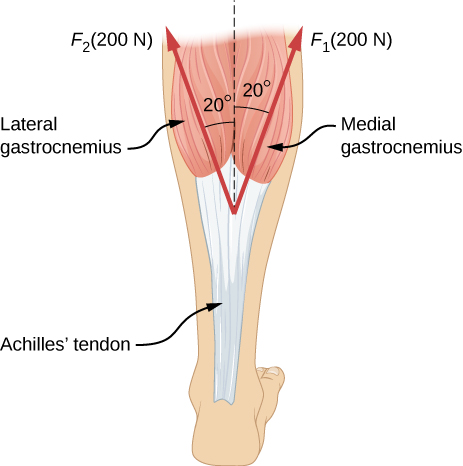
An Achilles tendon is shown in the figure with two forces exerted on it by the lateral and medial heads of the gastrocnemius muscle. F sub one, equal to two hundred Newtons, is shown as a vector making an angle twenty degrees to the right of vertical, and F sub two, equal to two hundred Newtons, is shown making an angle of twenty degrees left of vertical.

Answer

376 N pointing up (along the dashed line in the figure); the force is used to raise the heel of the foot.

6-31 §6.1 source ↗

A 35.0-kg dolphin accelerates opposite to the motion from 12.0 to 7.50 m/s in 2.30 s to join another dolphin in play. What average force was exerted to slow the first dolphin if it was moving horizontally? (The gravitational force is balanced by the buoyant force of the water.)

Answer

−68.5 N

6-33 §6.1 source ↗

A large rocket has a mass of 2.00×10⁶kg at takeoff, and its engines produce a thrust of 3.50×10⁷N. (a) Find its initial acceleration if it takes off vertically. (b) How long does it take to reach a velocity of 120 km/h straight up, assuming constant mass and thrust?

Answer

a. 7.70m/s2; b. 4.33 s

6-35 §6.1 source ↗

A 2.50-kg fireworks shell is fired straight up from a mortar and reaches a height of 110.0 m. (a) Neglecting air resistance (a poor assumption, but we will make it for this example), calculate the shell’s velocity when it leaves the mortar. (b) The mortar itself is a tube 0.450 m long. Calculate the average acceleration of the shell in the tube as it goes from zero to the velocity found in (a). (c) What is the average force on the shell in the mortar? Express your answer in newtons and as a ratio to the weight of the shell.

Answer

a. 46.4 m/s; b. 2.40×10³m/s2; c. 5.99 × 10³ N; ratio of 245

6-37 §6.1 source ↗

An elevator filled with passengers has a mass of 1.70×10³kg. (a) The elevator accelerates upward from rest at a rate of 1.20m/s2 for 1.50 s. Calculate the tension in the cable supporting the elevator. (b) The elevator continues upward at constant velocity for 8.50 s. What is the tension in the cable during this time? (c) The elevator accelerates opposite to the motion at a rate of 0.600m/s2 for 3.00 s. What is the tension in the cable during acceleration opposite to the motion? (d) How high has the elevator moved above its original starting point, and what is its final velocity?

Answer

a. 1.87×10⁴N; b. 1.67×10⁴N; c. 1.56×10⁴N; d. 19.4 m, 0 m/s

6-39 §6.1 source ↗

A student’s backpack, full of textbooks, is hung from a spring scale attached to the ceiling of an elevator. When the elevator is accelerating downward at 3.8m/s2, the scale reads 60 N. (a) What is the mass of the backpack? (b) What does the scale read if the elevator moves upward while speeding up at a rate 3.8m/s2? (c) What does the scale read if the elevator moves upward at constant velocity? (d) If the elevator had no brakes and the cable supporting it were to break loose so that the elevator could fall freely, what would the spring scale read?

Answer

a. 10 kg; b. 140 N; c. 98 N; d. 0

6-41 §6.1 source ↗

A roller coaster car starts from rest at the top of a track 30.0 m long and inclined at 20.0° to the horizontal. Assume that friction can be ignored. (a) What is the acceleration of the car? (b) How much time elapses before it reaches the bottom of the track?

Answer

a. 3.35m/s2; b. 4.2 s

6-43 §6.1 source ↗

Two blocks are connected by a massless rope as shown below. The mass of the block on the table is 4.0 kg and the hanging mass is 1.0 kg. The table and the pulley are frictionless. (a) Find the acceleration of the system. (b) Find the tension in the rope. (c) Find the speed with which the hanging mass hits the floor if it starts from rest and is initially located 1.0 m from the floor.
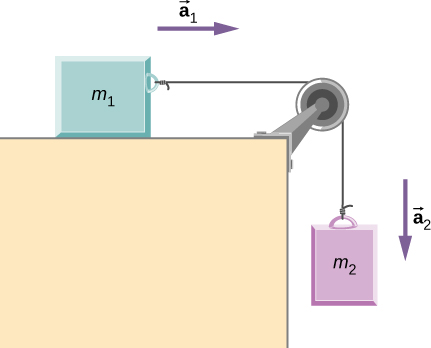
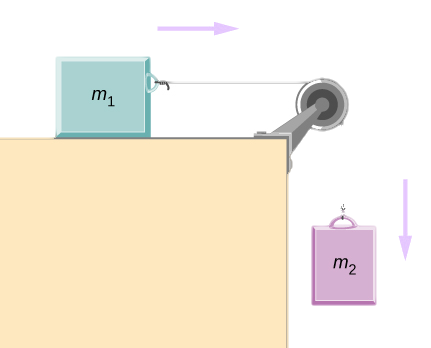
Block m sub 1 is on a horizontal table. It is connected to a string that passes over a pulley at the edge of the table. The string then hangs straight down and connects to block m sub 2, which is not in contact with the table. Block m sub 1 has acceleration a sub 1 directed to the right. Block m sub 2 has acceleration a sub 2 directed downward.Block m sub 1 is on a horizontal table. It is connected to a string that passes over a pulley at the edge of the table. The string then hangs straight down and connects to block m sub 2, which is not in contact with the table. Block m sub 1 has acceleration a sub 1 directed to the right. Block m sub 2 has acceleration a sub 2 directed downward.

Answer

a. 2.0m/s2; b. 7.8 N; c. 2.0 m/s

6-45 §6.1 source ↗

A 2.00 kg block (mass 1) and a 4.00 kg block (mass 2) are connected by a light string as shown; the inclination of the ramp is 40.0°. Friction is negligible. What is (a) the acceleration of each block and (b) the tension in the string?
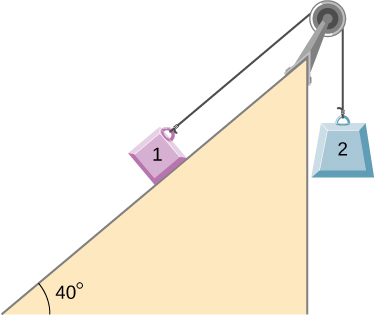
Block 1 is on a ramp inclined up and to the right at an angle of 40 degrees above the horizontal. It is connected to a string that passes over a pulley at the top of the ramp, then hangs straight down and connects to block 2. Block 2 is not in contact with the ramp.

Answer

a. 4.43m/s2 (mass 1 accelerates up the ramp as mass 2 falls with the same acceleration); b. 21.5 N

6-47 §6.2 source ↗

(a) What is the maximum frictional force in the knee joint of a person who supports 66.0 kg of her mass on that knee? (b) During strenuous exercise, it is possible to exert forces to the joints that are easily 10 times greater than the weight being supported. What is the maximum force of friction under such conditions? The frictional forces in joints are relatively small in all circumstances except when the joints deteriorate, such as from injury or arthritis. Increased frictional forces can cause further damage and pain.

Answer

a. 10.0 N; b. 97.0 N

6-49 §6.2 source ↗

(a) If half of the weight of a small 1.00×10³-kg utility truck is supported by its two drive wheels, what is the maximum acceleration it can achieve on dry concrete? (b) Will a metal cabinet lying on the wooden bed of the truck slip if it accelerates at this rate? (c) Solve both problems assuming the truck has four-wheel drive.

Answer

a. 4.9m/s2; b. The cabinet will not slip. c. The cabinet will slip.

6-51 §6.2 source ↗

Consider the 65.0-kg ice skater being pushed by two others shown below. (a) Find the direction and magnitude of Ftot, the total force exerted on her by the others, given that the magnitudes F1 and F2 are 21.4 N and 10.6 N, respectively. (b) What is her initial acceleration if she is initially stationary and wearing steel-bladed skates that point in the direction of Ftot? (c) What is her acceleration assuming she is already moving in the direction of Ftot? (Remember that friction always acts in the direction opposite that of motion or attempted motion between surfaces in contact.)
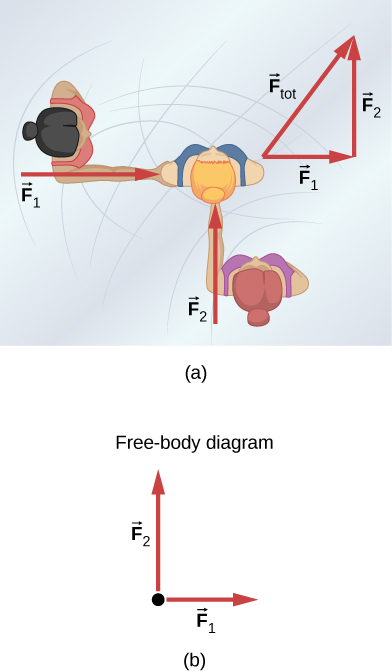
(a) Overhead view of two ice skaters pushing on a third. One skater pushes with a force F one, represented by an arrow pointing to the right, and a second skater pushes with a force F two, represented by an arrow pointing up. Vector F one and vector F two are along the arms of the two skaters acting on the third skater. A vector diagram is shown in the form of a right triangle in which the base is vector F one pointing to the right, and perpendicular to F one is vector F two pointing up. The resultant vector is shown by the hypotenuse pointing up and to the right and is labeled as vector F sub tot. (b) Free body diagram showing only the forces F sub one and F sub 2 acting on the skater.(a) Overhead view of two ice skaters pushing on a third. One skater pushes with a force F one, represented by an arrow pointing to the right, and a second skater pushes with a force F two, represented by an arrow pointing up. Vector F one and vector F two are along the arms of the two skaters acting on the third skater. A vector diagram is shown in the form of a right triangle in which the base is vector F one pointing to the right, and perpendicular to F one is vector F two pointing up. The resultant vector is shown by the hypotenuse pointing up and to the right and is labeled as vector F sub tot. (b) Free body diagram showing only the forces F sub one and F sub 2 acting on the skater.

Answer

a. 23.9 N, 26.4°; b. 0; c. 0.171m/s2 in the direction of F→tot

6-53 §6.2 source ↗

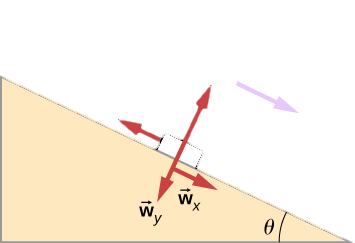
Show that the acceleration of any object down an incline where friction behaves simply (that is, where fk=μkN) is a= g(sinθ−μkcosθ). Note that the acceleration is independent of mass and reduces to the expression found in the previous problem when friction becomes negligibly small (μk=0).
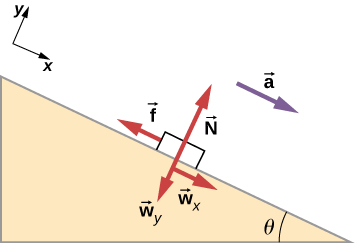
An illustration of block on a slope. The slope angles down and to the right at an angle of theta degrees to the horizontal. The block has an acceleration, a, parallel to the slope, toward its bottom. The following forces are shown: f in a direction parallel to the slope toward its top, N perpendicular to the slope and pointing out of it, w sub x in a direction parallel to the slope toward its bottom, and w sub y perpendicular to the slope and pointing into it. An x y coordinate system is shown tilted so that positive x is downslope, parallel to the surface, and positive y is perpendicular to the slope, pointing out of the surface.An illustration of block on a slope. The slope angles down and to the right at an angle of theta degrees to the horizontal. The block has an acceleration, a, parallel to the slope, toward its bottom. The following forces are shown: f in a direction parallel to the slope toward its top, N perpendicular to the slope and pointing out of it, w sub x in a direction parallel to the slope toward its bottom, and w sub y perpendicular to the slope and pointing into it. An x y coordinate system is shown tilted so that positive x is downslope, parallel to the surface, and positive y is perpendicular to the slope, pointing out of the surface.

Answer

net F y = 0 ⇒ N = m g cos θ net F x = m a a = g ( sin θ − μ k cos θ )

6-55 §6.2 source ↗

A machine at a post office sends packages out a chute and down a ramp to be loaded into delivery vehicles. (a) Calculate the acceleration of a box heading down a 10.0° slope, assuming the coefficient of friction for a parcel on waxed wood is 0.100. (b) Find the angle of the slope down which this box could move at a constant velocity. You can neglect air resistance in both parts.

Answer

a. 0.737m/s2; b. 5.71°

6-57 §6.2 source ↗

Calculate the maximum acceleration of a car that is heading down a 6.00° slope (one that makes an angle of 6.00° with the horizontal) under the following road conditions. You may assume that the weight of the car is evenly distributed on all four tires and that the coefficient of static friction is involved—that is, the tires are not allowed to slip during the acceleration opposite to the motion. (Ignore rolling.) Calculate for a car: (a) On dry concrete. (b) On wet concrete. (c) On ice, assuming that μs=0.100, the same as for shoes on ice.

Answer

a. 10.8m/s2; b. 7.85m/s2; c. 2.00m/s2

6-59 §6.2 source ↗

Repeat the preceding problem for a car with four-wheel drive.

Answer

a. 9.09m/s2; b. 6.16m/s2; c. 0.294m/s2

6-61 §6.2 source ↗

Consider the 52.0-kg mountain climber shown below. (a) Find the tension in the rope and the force that the mountain climber must exert with her feet on the vertical rock face to remain stationary. Assume that the force is exerted parallel to her legs. Also, assume negligible force exerted by her arms. (b) What is the minimum coefficient of friction between her shoes and the cliff?
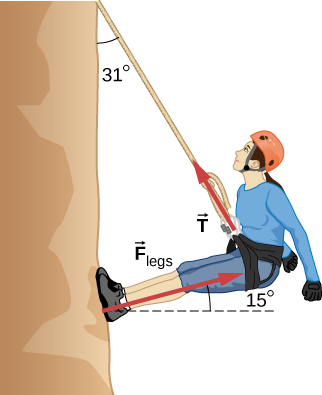
A mountain climber is drawn leaning away from the rock face with her feet against the rock face. The rope extends up from the climber at an angle of 31 degrees to the vertical. The climbers legs are straight and make an angle of fifteen degrees with the rock face. The force vector F sub T starts at the harness and points away from the climber, along the rope. The force vector F sub legs starts at climber’s feet and points away from the rock, parallel to her legs.

Answer

a. 272 N, 512 N; b. 0.268

6-63 §6.2 source ↗

The contestant now pulls the block of ice with a rope over his shoulder at the same angle above the horizontal as shown below. The coefficient of friction of ice can be found in Table 6.1. Calculate the minimum force F he must exert to get the block moving. (b) What is its acceleration once it starts to move, if that force is maintained?
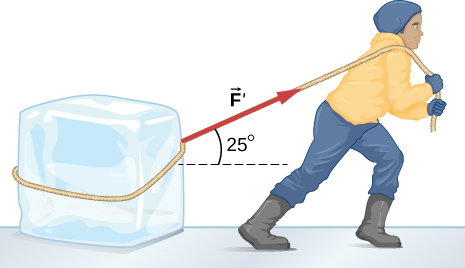
A block of ice is being pulled with a force F that is directed at an angle of twenty five degrees above the horizontal.
Table 6.1 Approximate Coefficients of Static and Kinetic Friction in the book ↗
System Static Friction μs Kinetic Friction μk
Rubber on dry concrete 1.0 0.7
Rubber on wet concrete 0.5-0.7 0.3-0.5
Wood on wood 0.5 0.3
Waxed wood on wet snow 0.14 0.1
Metal on wood 0.5 0.3
Steel on steel (dry) 0.6 0.3
Steel on steel (oiled) 0.05 0.03
Teflon on steel 0.04 0.04
Bone lubricated by synovial fluid 0.016 0.015
Shoes on wood 0.9 0.7
Shoes on ice 0.1 0.05
Ice on ice 0.1 0.03
Steel on ice 0.04 0.02

Answer

a. 46.5 N; b. 0.655m/s2

6-65 §6.3 source ↗

(a) A 22.0-kg child is riding a playground merry-go-round that is rotating at 40.0 rev/min. What centripetal force is exerted if he is 1.25 m from its center? (b) What centripetal force is exerted if the merry-go-round rotates at 3.00 rev/min and he is 8.00 m from its center? (c) Compare each force with his weight.

Answer

a. 483 N; b. 17.4 N; c. 2.24, 0.0807

6-67 §6.3 source ↗

What is the ideal banking angle for a gentle turn of 1.20-km radius on a highway with a 105 km/h speed limit (about 65 mi/h), assuming everyone travels at the limit?

Answer

4.14 °

6-69 §6.3 source ↗

(a) What is the radius of a bobsled turn banked at 75.0° and taken at 30.0 m/s, assuming it is ideally banked? (b) Calculate the centripetal acceleration. (c) Does this acceleration seem large to you?

Answer

a. 24.6 m; b. 36.6m/s2; c. 3.73 times g

6-71 §6.3 source ↗

If a car takes a banked curve at less than the ideal speed, friction is needed to keep it from sliding toward the inside of the curve (a problem on icy mountain roads). (a) Calculate the ideal speed to take a 100.0 m radius curve banked at 15.0°. (b) What is the minimum coefficient of friction needed for a frightened driver to take the same curve at 20.0 km/h?

Answer

a. 16.2 m/s; b. 0.234

6-73 §6.3 source ↗

A child of mass 40.0 kg is in a roller coaster car that travels in a loop of radius 7.00 m. At point A the speed of the car is 10.0 m/s, and at point B, the speed is 10.5 m/s. Assume the child is not holding on and does not wear a seat belt. (a) What is the force of the car seat on the child at point A? (b) What is the force of the car seat on the child at point B? (c) What minimum speed is required to keep the child in his seat at point A?
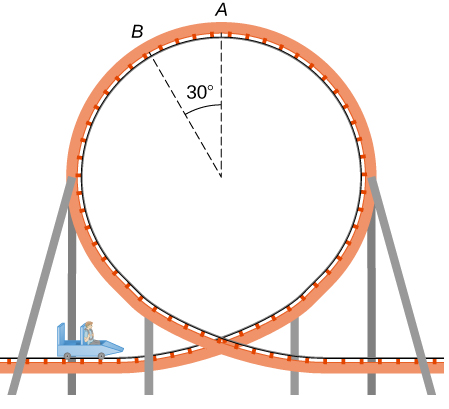
An illustration of a loop of a roller coaster with a child seated in a car approaching the loop. The track is on the inside surface of the loop. Two location on the loop, A and B, are labeled. Point A is at the top of the loop. Point B is down and to the left of A. The angle between the radii to points A and B is thirty degrees.

Answer

a. 179 N; b. 290 N; c. 8.3 m/s

6-75 §6.3 source ↗

Railroad tracks follow a circular curve of radius 500.0 m and are banked at an angle of 5.0°. For trains of what speed are these tracks designed?

Answer

20.7 m/s

6-77 §6.3 source ↗

A car rounds an unbanked curve of radius 65 m. If the coefficient of static friction between the road and car is 0.70, what is the maximum speed at which the car can traverse the curve without slipping?

Answer

21 m/s

6-79 §6.4 source ↗

The terminal velocity of a person falling in air depends upon the weight and the area of the person facing the fluid. Find the terminal velocity (in meters per second and kilometers per hour) of an 80.0-kg skydiver falling in a headfirst position with a surface area of 0.140m2.

Answer

115 m/s or 414 km/h

6-81 §6.4 source ↗

A 560-g squirrel with a surface area of 650cm2 falls from a 5.0-m tree to the ground. Estimate its terminal velocity. (Use a drag coefficient for a skydiver falling feet first.) What will be the velocity of a 56-kg person hitting the ground, assuming no drag contribution in such a short distance?

Answer

v T = 11.8m/s; v 2 = 9.9m/s

6-83 §6.4 source ↗

By what factor does the drag force on a car increase as it goes from 65 to 110 km/h?

Answer

(11065)2= 2.86 times

6-85 §6.4 source ↗

Using Stokes’ law, verify that the units for viscosity are kilograms per meter per second.

Answer

Stokes’ law is Fs=6πrηv. Solving for the viscosity, η=Fs6πrv. Considering only the units, this becomes [η]=kgm·s.

6-87 §6.4 source ↗

Stokes’ law describes sedimentation of particles in liquids and can be used to measure viscosity. Particles in liquids achieve terminal velocity quickly. One can measure the time it takes for a particle to fall a certain distance and then use Stokes’ law to calculate the viscosity of the liquid. Suppose a steel ball bearing (density 7.8×10³kg/m3, diameter 3.0 mm) is dropped in a container of motor oil. It takes 12 s to fall a distance of 0.60 m. Calculate the viscosity of the oil.

Answer

0.76 kg/m · s

6-89 §6.4 source ↗

A small diamond of mass 10.0 g drops from a swimmer’s earring and falls through the water, reaching a terminal velocity of 2.0 m/s. (a) Assuming the frictional force on the diamond obeys f=−bv, what is b? (b) How far does the diamond fall before it reaches 90 percent of its terminal speed?

Answer

a. 0.049 kg/s; b. 0.57 m

6-91 §6.AP source ↗

A 75.0-kg woman stands on a bathroom scale in an elevator that accelerates from rest to 30.0 m/s in 2.00 s. (a) Calculate the scale reading in newtons and compare it with her weight. (The scale exerts an upward force on her equal to its reading.) (b) What is unreasonable about the result? (c) Which premise is unreasonable, or which premises are inconsistent?

Answer

a. 1860 N, 2.53; b. The value (1860 N) is more force than you expect to experience on an elevator. The force of 1860 N is 418 pounds, compared to the force on a typical elevator of 904 N (which is about 203 pounds); this is calculated for a speed from 0 to 10 miles per hour, which is about 4.5 m/s, in 2.00 s). c. The acceleration a=1.53×g is much higher than any standard elevator. The final speed is too large (30.0 m/s is VERY fast)! The time of 2.00 s is not unreasonable for an elevator.

6-93 §6.AP source ↗

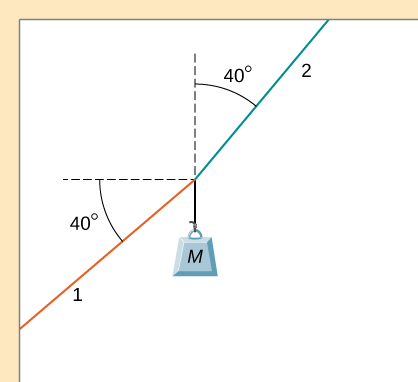
As shown below, if M=5.50kg, what is the tension in string 1?

Mass M is suspended from strings 1 and 2. String 1 connects to a wall at a point below and to the left of the mass. String 1 makes an angle of 40 degrees below the horizontal. String 2 connects to a ceiling at a point above and to the right of the mass. String 2 makes an angle of 40 degrees to the right of vertical.

Answer

199 N

6-95 §6.AP source ↗

As shown below, if M=6.0kg, what is the tension in the connecting string? The pulley and all surfaces are frictionless.
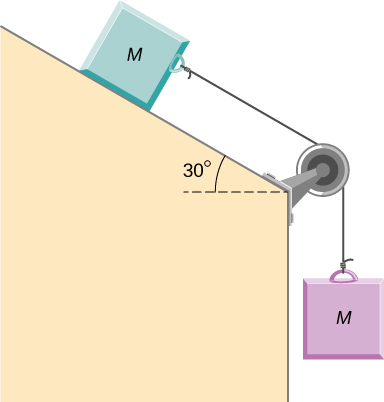
Two blocks, both mass M are connected by a string that passes over a pulley between the blocks. The upper block is on a surface that slopes down and to the right at an angle of 30 degrees to the horizontal. The pulley is attached to the corner at the bottom of the slope, where the surface then bends and goes vertically down. The lower mass hangs straight down. It is not in contact with the surface.

Answer

15 N

6-97 §6.AP source ↗

A half-full recycling bin has mass 3.0 kg and is pushed up a 40.0° incline with constant speed under the action of a 26-N force acting up and parallel to the incline. The incline has friction. What magnitude force must act up and parallel to the incline for the bin to move down the incline at constant velocity?

Answer

12 N

6-99 §6.AP source ↗

The two barges shown here are coupled by a cable of negligible mass. The mass of the front barge is 2.00×10³kg and the mass of the rear barge is 3.00×10³kg. A tugboat pulls the front barge with a horizontal force of magnitude 20.0×10³N, and the frictional forces of the water on the front and rear barges are 8.00×10³N and 10.0×10³N, respectively. Find the horizontal acceleration of the barges and the tension in the connecting cable.
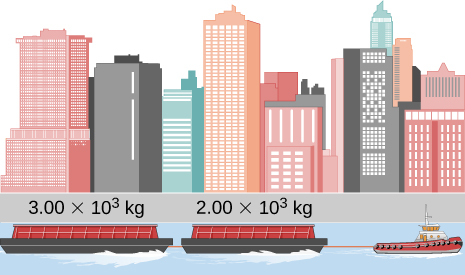
An illustration showing a tug boat pulling two barges. The barge directly attached to the tug boat has mass 2.00 times 10 to the third kilograms. The barge at the end, behind the first barge, has mass 3.00 times 10 to the third kilograms.

Answer

ax=0.40m/s2 and T=11.2×10³N

6-101 §6.AP source ↗

An object with mass m moves along the x-axis. Its position at any time is given by x(t)= pt3+ qt2 where p and q are constants. Find the net force on this object for any time t.

Answer

m(6pt + 2q)

6-103 §6.AP source ↗

Located at the origin, an electric car of mass m is at rest and in equilibrium. A time dependent force of F→(t) is applied at time t=0, and its components are Fx(t)=p+nt and Fy(t)=qt where p, q, and n are constants. Find the position r→(t) and velocity v→(t) as functions of time t.

Answer

v→(t)= (ptm+nt22m)i^+ (qt22m)j^ and r→(t)= (pt22m+nt36m)i^+ (qt36m)j^

6-105 §6.AP source ↗

A 2.0-kg object has a velocity of 4.0i^m/s at t=0. A constant resultant force of (2.0i^+4.0j^)N then acts on the object for 3.0 s. What is the magnitude of the object’s velocity at the end of the 3.0-s interval?

Answer

9.2 m/s

6-107 §6.AP source ↗

A box is dropped onto a conveyor belt moving at 3.4 m/s. If the coefficient of friction between the box and the belt is 0.27, how long will it take before the box moves without slipping?

Answer

1.3 s

6-109 §6.AP source ↗

As shown below, the mass of block 1 is m1=4.0kg, while the mass of block 2 is m2=8.0kg. The coefficient of friction between m1 and the inclined surface is μk=0.40. The blocks are moving, with block 1 sliding up the incline and block 2 moving down. What is the acceleration of the system?
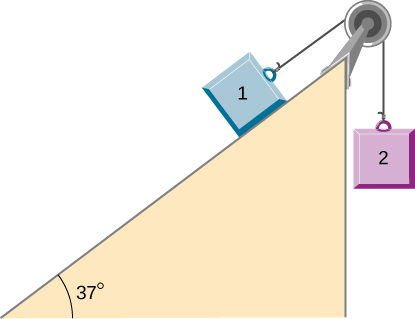
Block 1 is on a ramp inclined up and to the right at an angle of 37 degrees above the horizontal. It is connected to a string that passes over a pulley at the top of the ramp, then hangs straight down and connects to block 2. Block 2 is not in contact with the ramp.

Answer

3.5 m/s 2

6-111 §6.AP source ↗

A crate of mass 100.0 kg rests on a rough surface inclined at an angle of 37.0° with the horizontal. A massless rope to which a force can be applied parallel to the surface is attached to the crate and leads to the top of the incline. In its present state, the crate is just ready to slip and start to move down the plane. The coefficient of friction is 80% of that for the static case. (a) What is the coefficient of static friction? (b) What is the maximum force that can be applied upward along the plane on the rope and not move the block? (c) With a slightly greater applied force, the block will slide up the plane. Once it begins to move, what is its acceleration and what reduced force is necessary to keep it moving upward at constant speed? (d) If the block is given a slight nudge to get it started down the plane, what will be its acceleration in that direction? (e) Once the block begins to slide downward, what upward force on the rope is required to keep the block from accelerating downward?

Answer

a. 0.75; b. 1200 N; c. 1.2m/s2 and 1080 N; d. −1.2m/s2; e. 120 N

6-113 §6.AP source ↗

A crate having mass 50.0 kg falls horizontally off the back of the flatbed truck, which is traveling at 100 km/h. Find the value of the coefficient of kinetic friction between the road and crate if the crate slides 50 m on the road in coming to rest. The initial speed of the crate is the same as the truck, 100 km/h.
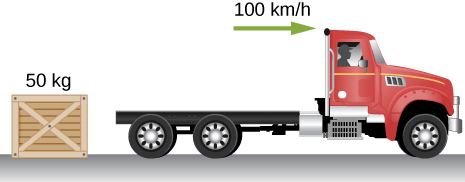
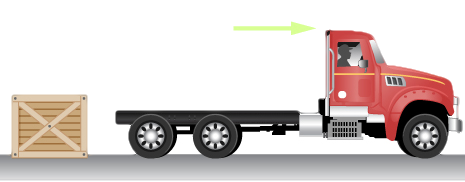
The figure shows a truck moving to the right at 100 kilometers per hour and a 50 kilogram crate on the ground behind the truck.The figure shows a truck moving to the right at 100 kilometers per hour and a 50 kilogram crate on the ground behind the truck.

Answer

0.789

6-115 §6.AP source ↗

A 30.0-g ball at the end of a string is swung in a vertical circle with a radius of 25.0 cm. The tangential velocity is 200.0 cm/s. Find the tension in the string: (a) at the top of the circle, (b) at the bottom of the circle, and (c) at a distance of 12.5 cm from the center of the circle (r=12.5cm).

Answer

a. 0.186 N; b. 0.774 N; c. 0.48 N

6-117 §6.AP source ↗

A stunt cyclist rides on the interior of a cylinder 12 m in radius. The coefficient of static friction between the tires and the wall is 0.68. Find the value of the minimum speed for the cyclist to perform the stunt.

Answer

13 m/s

6-119 §6.AP source ↗

A piece of bacon starts to slide down the pan when one side of a pan is raised up 5.0 cm. If the length of the pan from pivot to the raising point is 23.5 cm, what is the coefficient of static friction between the pan and the bacon?

Answer

0.21

6-121 §6.AP source ↗

An airplane flies at 120.0 m/s and banks at a 30° angle. If its mass is 2.50×10³kg, (a) what is the magnitude of the lift force? (b) what is the radius of the turn?

Answer

a. 28,300 N; b. 2540 m

6-123 §6.AP source ↗

Two blocks connected by a string are pulled across a horizontal surface by a force applied to one of the blocks, as shown below. The coefficient of kinetic friction between the blocks and the surface is 0.25. If each block has an acceleration of 2.0m/s2 to the right, what is the magnitude F of the applied force?
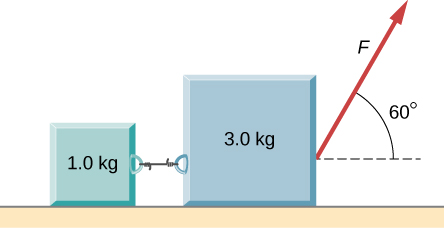
Two blocks, 1.0 kilograms on the left and 3.0 kilograms on the right, are connected by a string and are on a horizontal surface. Force F acts on the 3.0 kilogram mass and points up and to the right at a angle of 60 degrees above the horizontal.

Answer

25 N

6-125 §6.AP source ↗

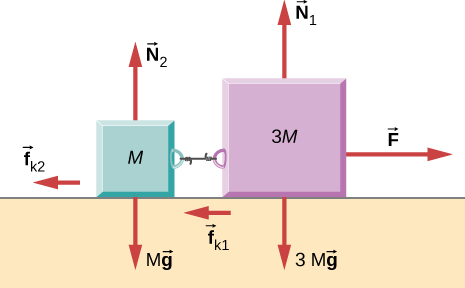
In the figure, the coefficient of kinetic friction between the surface and the blocks is μk. If M=1.0kg, find an expression for the magnitude of the acceleration of either block (in terms of F, μk, and g).

Two blocks, M on the left and 3 M on the right, are connected by a string and are on a horizontal surface. The following forces are indicated: f sub k 2 acting on M and pointing to the right, f sub k 1 acting on 3 M and pointing to the right, F acting on 3 M and pointing to the left, N sub 2 acting on M and pointing up, N sub 1 acting on 3 M and pointing up, M g acting on M and pointing down, , 3 M g acting on 3 M and pointing down.

Answer

a = F 4 − μ k g

6-127 §6.AP source ↗

A box rests on the (horizontal) back of a truck. The coefficient of static friction between the box and the surface on which it rests is 0.24. What maximum distance can the truck travel (starting from rest and moving horizontally with constant acceleration) in 3.0 s without having the box slide?

Answer

11 m

6-129 §6.CP source ↗

In a later chapter, you will find that the weight of a particle varies with altitude such that w=mgr02r2 where r0 is the radius of Earth and r is the distance from Earth’s center. If the particle is fired vertically with velocity v0 from Earth’s surface, determine its velocity as a function of position r. (Hint: use adr=vdv, the rearrangement mentioned in the text.)

Answer

v= v 0 2 − 2 g r 0 ( 1 − r 0 r )

6-131 §6.CP source ↗

A car of mass 1000.0 kg is traveling along a level road at 100.0 km/h when its brakes are applied. Calculate the stopping distance if the coefficient of kinetic friction of the tires is 0.500. Neglect air resistance. (Hint: since the distance traveled is of interest rather than the time, x is the desired independent variable and not t. Use the Chain Rule to change the variable: dvdt= dvdxdxdt= vdvdx.)

Answer

78.7 m

6-133 §6.CP source ↗

A skydiver is at an altitude of 1520 m. After 10.0 seconds of free fall, he opens his parachute and finds that the air resistance, FD, is given by the formula FD=−bv, where b is a constant and v is the velocity. If b=7.50, and the mass of the skydiver is 82.0 kg, first set up differential equations for the velocity and the position, and then find: (a) the speed of the skydiver when the parachute opens, (b) the distance fallen before the parachute opens, (c) the terminal velocity after the parachute opens (find the limiting velocity), and (d) the time the skydiver is in the air after the parachute opens.

Answer

a. 98 m/s; b. 490 m; c. 107 m/s; d. 10.1 s

6-135 §6.CP source ↗

A boater and motor boat are at rest on a lake. Together, they have mass 200.0 kg. If the thrust of the motor is a constant force of 40.0 N in the direction of motion, and if the resistive force of the water is numerically equivalent to 2 times the speed v of the boat, set up and solve the differential equation to find: (a) the velocity of the boat at time t; (b) the limiting velocity (the velocity after a long time has passed).

Answer

a. v= 20.0(1−e−0.01t); b. vlimiting= 20m/s

Loading chapter 7…

Problems and answers are adapted from University Physics Volume 1 by Samuel J. Ling, Jeff Sanny and William Moebs, OpenStax, and are used under the CC BY-NC-SA 4.0 licence. Access for free at https://openstax.org/books/university-physics-volume-1/pages/1-introduction. Illustrations: Copyright Rice University, OpenStax, under CC BY-NC-SA 4.0 license. This adaptation is released under the same licence, is non-commercial, and is neither affiliated with nor endorsed by OpenStax or Rice University.