Every problem in the chapter beside the book’s answer, a chapter at a time as you scroll.

Chapter 5: Newton's Laws of Motion

65 problems · 30 figures

Check Your Understanding 5.1 §5.1 source ↗

Find the magnitude and direction of the net force in the ice skater example just given.

Answer

14 N, 56° measured from the positive x-axis

Check Your Understanding 5.2 §5.2 source ↗

A skydiver opens their parachute, and shortly thereafter, they are moving at constant velocity. (a) What forces are acting on them? (b) Which force is bigger?

Answer

a. Their weight acts downward, and the force of air resistance with the parachute acts upward. b. neither; the forces are equal in magnitude

Check Your Understanding 5.3 §5.3 source ↗

At the time of its launch, the HMS Titanic was the most massive mobile object ever built, with a mass of 6.0×10⁷kg. If a force of 6 MN (6×10⁶N) was applied to the ship, what acceleration would it experience?

Answer

0.1 m/s 2

Check Your Understanding 5.4 §5.3 source ↗

A 550-kg sports car collides with a 2200-kg truck, and during the collision, the net force on each vehicle is the force exerted by the other. If the magnitude of the truck’s acceleration is 10m/s2, what is the magnitude of the sports car’s acceleration?

Answer

40 m/s 2

Check Your Understanding 5.5 §5.3 source ↗

A car has forces acting on it, as shown below. The mass of the car is 1000.0 kg. The road is slick, so friction can be ignored. (a) What is the net force on the car? (b) What is the acceleration of the car?
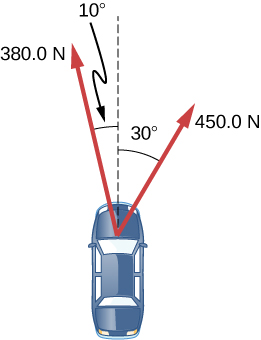
The top view of a car is shown. Two force vectors originate from the car and point upwards and outwards. A force of 450 newtons makes an angle of 30 degrees with the straight line motion of the car, towards the right. Another force of 360 newtons makes an angle of 10 degrees with the straight line motion of the car, towards the left.

Answer

a. Fnet= 159.0i^+ 763.9j^N; b. a= 0.1590i^+ 0.7639j^N

Check Your Understanding 5.6 §5.4 source ↗

For Example 5.8, find the acceleration when the farmer’s applied force is 230.0 N.

Answer

a = 2.78 m/s 2

Check Your Understanding 5.7 §5.5 source ↗

Two blocks are at rest and in contact on a frictionless surface as shown below, with m1=2.0kg, m2=6.0kg, and applied force 24 N. (a) Find the acceleration of the system of blocks. (b) Suppose that the blocks are later separated. What force will give the second block, with the mass of 6.0 kg, the same acceleration as the system of blocks?
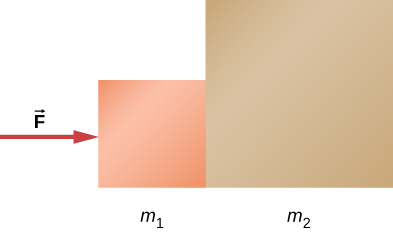
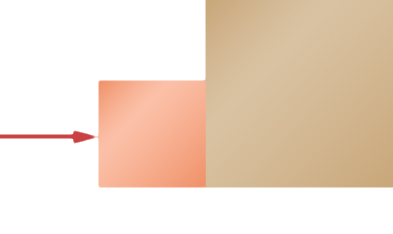
Two squares are shown side by side, touching each other. The left one is smaller and is labeled m1. The one on the right is bigger and is labeled m2. Force F acts on m1 from left to right.Two squares are shown side by side, touching each other. The left one is smaller and is labeled m1. The one on the right is bigger and is labeled m2. Force F acts on m1 from left to right.

Answer

a. 3.0m/s2; b. 18 N

Check Your Understanding 5.8 §5.6 source ↗

A force of 1150 N acts parallel to a ramp to push a 250-kg gun safe into a moving van. The ramp is frictionless and inclined at 17°. (a) What is the acceleration of the safe up the ramp? (b) If we consider friction in this problem, with a friction force of 120 N, what is the acceleration of the safe?

Answer

a. 1.7m/s2; b. 1.3m/s2

Check Your Understanding 5.9 §5.6 source ↗

One end of a 3.0-m rope is tied to a tree; the other end is tied to a car stuck in the mud. The motorist pulls sideways on the midpoint of the rope, displacing it a distance of 0.25 m. If he exerts a force of 200.0 N under these conditions, determine the force exerted on the car.

Answer

6.0×10² N

Check Your Understanding 5.10 §5.7 source ↗

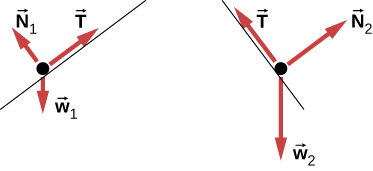
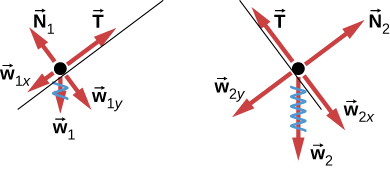
(a) Draw the free-body diagram for the situation shown. (b) Redraw it showing components; use x-axes parallel to the two ramps.
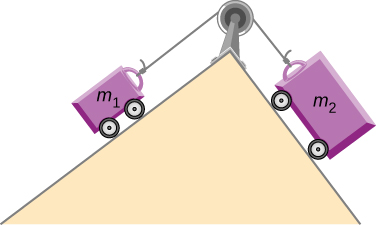
Two carts are tied with a rope which goes over a pulley on top of a hill. Each cart rests on one slope of the hill on either side of the pulley. The cart on the left is labeled m1 and the one on the right is labeled m2.

Answer

Figure a shows a free body diagram of an object on a line that slopes down to the right. Arrow T from the object points right and up, parallel to the slope. Arrow N1 points left and up, perpendicular to the slope. Arrow w1 points vertically down. Figure b shows a free body diagram of an object on a line that slopes down to the left. Arrow N2 from the object points right and up, perpendicular to the slope. Arrow T points left and up, parallel to the slope. Arrow w2 points vertically down.

;

Figure a shows a free body diagram of an object on a line that slopes down to the right. Arrow T from the object points right and up, parallel to the slope. Arrow N1 points left and up, perpendicular to the slope. Arrow w1 points vertically down. Arrow w1x points left and down, parallel to the slope. Arrow w1y points right and down, perpendicular to the slope. Figure b shows a free body diagram of an object on a line that slopes down to the left. Arrow N2 from the object points right and up, perpendicular to the slope. Arrow T points left and up, parallel to the slope. Arrow w2 points vertically down. Arrow w2y points left and down, perpendicular to the slope. Arrow w2x points right and down, parallel to the slope.

5-1 §5.1 source ↗

What properties do forces have that allow us to classify them as vectors?

Answer

Forces are directional and have magnitude.

5-3 §5.2 source ↗

A woman was transporting an open box of cupcakes to a school party. The car in front of her stopped suddenly; she applied her brakes immediately. She was wearing her seat belt and suffered no physical harm (just a great deal of embarrassment), but the cupcakes flew into the dashboard and became “smushcakes.” Explain what happened.

Answer

The cupcake velocity before the braking action was the same as that of the car. Therefore, the cupcakes were unrestricted bodies in motion, and when the car suddenly stopped, the cupcakes kept moving forward according to Newton’s first law.

5-5 §5.3 source ↗

A rock is thrown straight up. At the top of the trajectory, the velocity is momentarily zero. Does this imply that the force acting on the object is zero? Explain your answer.

Answer

No. If the force were zero at this point, then there would be nothing to change the object’s momentary zero velocity. Since we do not observe the object hanging motionless in the air, the force could not be zero.

5-7 §5.4 source ↗

How much does a 70-kg astronaut weight in space, far from any celestial body? What is her mass at this location?

Answer

The astronaut is truly weightless in the location described, because there is no large body (planet or star) nearby to exert a gravitational force. Her mass is 70 kg regardless of where she is located.

5-9 §5.4 source ↗

When you stand on Earth, your feet push against it with a force equal to your weight. Why doesn’t Earth accelerate away from you?

Answer

The force you exert (a contact force equal in magnitude to your weight) is small. Earth is extremely massive by comparison. Thus, the acceleration of Earth would be incredibly small. To see this, use Newton’s second law to calculate the acceleration you would cause if your weight is 600.0 N and the mass of Earth is 6.00×1024kg.

5-11 §5.5 source ↗

Identify the action and reaction forces in the following situations: (a) Earth attracts the Moon, (b) a boy kicks a football, (c) a rocket accelerates upward, (d) a car accelerates forward, (e) a high jumper leaps, and (f) a bullet is shot from a gun.

Answer

a. action: Earth pulls on the Moon, reaction: Moon pulls on Earth; b. action: foot applies force to ball, reaction: ball applies force to foot; c. action: rocket pushes on gas, reaction: gas pushes back on rocket; d. action: car tires push backward on road, reaction: road pushes forward on tires; e. action: jumper pushes down on ground, reaction: ground pushes up on jumper; f. action: gun pushes forward on bullet, reaction: bullet pushes backward on gun.

5-13 §5.5 source ↗

(a) Why does an ordinary rifle recoil (kick backward) when fired? (b) The barrel of a recoilless rifle is open at both ends. Describe how Newton’s third law applies when one is fired. (c) Can you safely stand close behind one when it is fired?

Answer

a. The rifle (the shell supported by the rifle) exerts a force to expel the bullet; the reaction to this force is the force that the bullet exerts on the rifle (shell) in opposite direction. b. In a recoilless rifle, the shell is not secured in the rifle; hence, as the bullet is pushed to move forward, the shell is pushed to eject from the opposite end of the barrel. c. It is not safe to stand behind a recoilless rifle.

5-15 §5.6 source ↗

A particle is moving to the right. (a) Can the force on it be acting to the left? If yes, what would happen? (b) Can that force be acting downward? If yes, why?

Answer

a. Yes, the force can be acting to the left; the particle would experience acceleration opposite to the motion and lose speed. B. Yes, the force can be acting downward because its weight acts downward even as it moves to the right.

5-17 §5.7 source ↗

If a book is located on a table, how many forces should be shown in a free-body diagram of the book? Describe them.

Answer

two forces of different types: weight acting downward and normal force acting upward

5-19 §5.1 source ↗

Two ropes are attached to a tree, and forces of F→1= 2.0i^+ 4.0j^N and F→2= 3.0i^+ 6.0j^N are applied. The forces are coplanar (in the same plane). (a) What is the resultant (net force) of these two force vectors? (b) Find the magnitude and direction of this net force.

Answer

a. F→net= 5.0i^+ 10.0j^N; b. the magnitude is Fnet=11N, and the direction is θ=63°

5-21 §5.1 source ↗

Two teenagers are pulling on ropes attached to a tree. The angle between the ropes is 30.0°. David pulls with a force of 400.0 N and Stephanie pulls with a force of 300.0 N. (a) Find the component form of the net force. (b) Find the magnitude of the resultant (net) force on the tree and the angle it makes with David’s rope.

Answer

a. F→net= 660.0i^+ 150.0j^N; b. Fnet=676.6N at θ=12.8° from David’s rope

5-23 §5.2 source ↗

While sliding a couch across a floor, Andrea and Jennifer exert forces F→A and F→J on the couch. Andrea’s force is due north with a magnitude of 130.0 N and Jennifer’s force is 32° east of north with a magnitude of 180.0 N. (a) Find the net force in component form. (b) Find the magnitude and direction of the net force. (c) If Andrea and Jennifer’s housemates, David and Stephanie, disagree with the move and want to prevent its relocation, with what combined force F→DS should they push so that the couch does not move?

Answer

a. F→net= 95.0i^+ 283j^N; b. 299 N at 71° north of east; c. F→DS= −(95.0i^+283j^)N

5-25 §5.3 source ↗

If the sprinter from the previous problem accelerates at that rate for 20.00 m and then maintains that velocity for the remainder of a 100.00-m dash, what will her time be for the race?

Answer

Running from rest, the sprinter attains a velocity of v=12.96m/s, at end of acceleration. We find the time for acceleration using x= 20.00m= 0+ 0.5at12, or t1=3.086s. For maintained velocity, x2=vt2, or t2= x2/v= 80.00m/12.96m/s= 6.173s. Total time= 9.259s.

5-27 §5.3 source ↗

Astronauts in orbit are apparently weightless. This means that a clever method of measuring the mass of astronauts is needed to monitor their mass gains or losses, and adjust their diet. One way to do this is to exert a known force on an astronaut and measure the acceleration produced. Suppose a net external force of 50.0 N is exerted, and an astronaut’s acceleration is measured to be 0.893m/s2. (a) Calculate her mass. (b) By exerting a force on the astronaut, the vehicle in which she orbits experiences an equal and opposite force. Use this knowledge to find equations for the acceleration of the spaceship and for the apparent acceleration of the spaceship and for the apparent acceleration that would be measured by an observer at rest relative to the spaceship. (c) Discuss how this would affect the measurement of the astronaut’s acceleration. Propose a method by which recoil of the vehicle is avoided.

Answer

a. m=56.0kg; b. ameas= aastro+ aship, whereaship= mastroaastromship; c. If the force could be exerted on the astronaut by another source (other than the spaceship), then the spaceship would not experience a recoil.

5-29 §5.3 source ↗

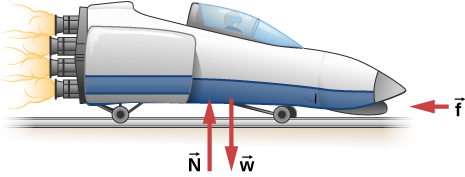
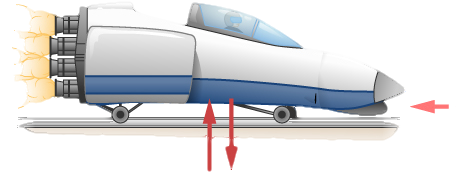
The rocket sled shown below accelerates opposite to the motion at a rate of 196m/s2. What force is necessary to produce this acceleration opposite to the motion? Assume that the rockets are off. The mass of the system is 2.10×10³ kg.

Figure shows a rocket sled pointing right. Frictional force f points left. Upward force N and downward force w are equal in magnitude.Figure shows a rocket sled pointing right. Frictional force f points left. Upward force N and downward force w are equal in magnitude.

Answer

F net = 4.12× 10 5 N

5-31 §5.3 source ↗

What is the acceleration opposite to the motion of the rocket sled if it comes to rest in 1.10 s from a speed of 1000.0 km/h? (Such acceleration opposite to the motion caused one test subject to black out and have temporary blindness.)

Answer

a = 253 m/s 2

5-33 §5.3 source ↗

A powerful motorcycle can produce an acceleration of 3.50m/s2 while traveling at 90.0 km/h. At that speed, the forces resisting motion, including friction and air resistance, total 400.0 N. (Air resistance is analogous to air friction. It always opposes the motion of an object.) What is the magnitude of the force that motorcycle exerts backward on the ground to produce its acceleration if the mass of the motorcycle with rider is 245 kg?

Answer

F net = F− f= ma⇒F= 1.26× 10 3 N

5-35 §5.3 source ↗

The driver in the previous problem applies the brakes when the car is moving at 90.0 km/h, and the car comes to rest after traveling 40.0 m. What is the net force on the car during its acceleration opposite to the motion?

Answer

v 2 = v 0 2 + 2 a x ⇒ a = − 7.80 m/s 2 F net = −7.80 × 10 3 N

5-37 §5.3 source ↗

A particle of mass 2.0 kg is acted on by a single force F→1=18i^N. (a) What is the particle’s acceleration? (b) If the particle starts at rest, how far does it travel in the first 5.0 s?

Answer

a. F→net= ma→⇒a→= 9.0i^m/s2; b. The acceleration has magnitude 9.0m/s2, so x=110m.

5-39 §5.3 source ↗

Find the acceleration of the body of mass 5.0 kg shown below.
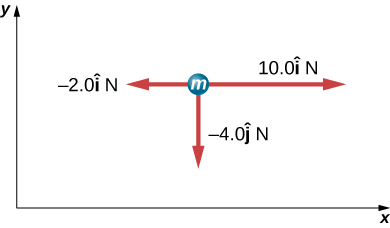
Figure shows a circle labeled m in the xy plane. Three arrows originate from it. One points right and is labeled 10 i newtons. Another points left and is labeled -2 i newtons. The third points downwards and is labeled – 4 j newtons.

Answer

1.6 i ^ − 0.8 j ^ m/s 2

5-41 §5.4 source ↗

The weight of an astronaut plus their space suit on the Moon is only 250 N. (a) How much does the suited astronaut weigh on Earth? (b) What is the mass on the Moon? On Earth?

Answer

a. wMoon=mgMoonm=150kgwEarth=1.5×10³N; b. Mass does not change, so the suited astronaut’s mass on both Earth and the Moon is 150kg.

5-43 §5.4 source ↗

A rocket sled accelerates at a rate of 49.0m/s2. Its passenger has a mass of 75.0 kg. (a) Calculate the horizontal component of the force the seat exerts against his body. Compare this with his weight using a ratio. (b) Calculate the direction and magnitude of the total force the seat exerts against his body.

Answer

a. Fh=3.68×10³N andw=7.35×10²NFhw=5.00times greater than weight;
b. Fnet=3750Nθ=11.3°from horizontal

5-45 §5.4 source ↗

A body of mass 2.00 kg is pushed straight upward by a 25.0 N vertical force. What is its acceleration?

Answer

w = 19.6 N F net = 5.40 N F net = m a ⇒ a = 2.70 m/s 2

5-47 §5.4 source ↗

A body with a mass of 10.0 kg is assumed to be in Earth’s gravitational field with g=9.80m/s2. What is the net force on the body if there are no other external forces acting on the object?

Answer

98 N

5-49 §5.4 source ↗

A baseball catcher is performing a stunt for a television commercial. He will catch a baseball (mass 145 g) dropped from a height of 60.0 m above his glove. His glove stops the ball in 0.0100 s. What is the force exerted by his glove on the ball?

Answer

497 N

5-51 §5.5 source ↗

(a) What net external force is exerted on a 1100.0-kg artillery shell fired from a battleship if the shell is accelerated at 2.40×10⁴m/s2? (b) What is the magnitude of the force exerted on the ship by the artillery shell, and why?

Answer

a. Fnet= 2.64×10⁷N; b. The force exerted on the ship is also 2.64×10⁷N because it is opposite the shell’s direction of motion.

5-53 §5.5 source ↗

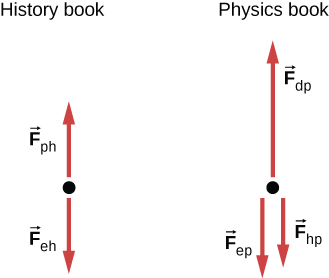
A history book is lying on top of a physics book on a desk, as shown below; a free-body diagram is also shown. The history and physics books weigh 14 N and 18 N, respectively. Identify each force on each book with a double subscript notation (for instance, the contact force of the history book pressing against physics book can be described as F→HP), and determine the value of each of these forces, explaining the process used.
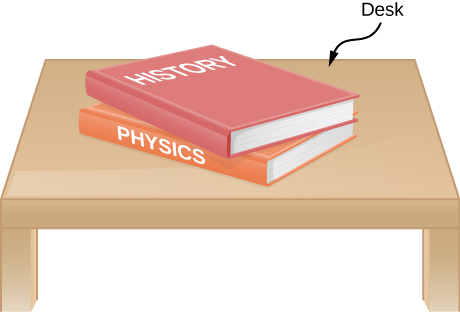
A picture of two books piled on a desk.A picture of two books piled on a desk. Two free body diagrams are shown. The first one has F subscript ph pointing up and F subscript eh pointing down. The second has F subscript dp pointing up and F subscript hp and F subscript ep pointing down.

Answer

Because the weight of the history book is the force exerted by Earth on the history book, we represent it as F→EH= −14j^N. Aside from this, the history book interacts only with the physics book. Because the acceleration of the history book is zero, the net force on it is zero by Newton’s second law: F→PH+ F→EH= 0→, where F→PH is the force exerted by the physics book on the history book. Thus, F→PH= −F→EH= −(−14j^)N= 14j^N. We find that the physics book exerts an upward force of magnitude 14 N on the history book. The physics book has three forces exerted on it: F→EP due to Earth, F→HP due to the history book, and F→DP due to the desktop. Since the physics book weighs 18 N, F→EP= −18j^N. From Newton’s third law, F→HP=−F→PH, so F→HP= −14j^N. Newton’s second law applied to the physics book gives ∑F→=0→, or F→DP+ F→EP+ F→HP= 0→, so F→DP= −(−18j^)− (−14j^)= 32j^N. The desk exerts an upward force of 32 N on the physics book. To arrive at this solution, we apply Newton’s second law twice and Newton’s third law once.

5-55 §5.6 source ↗

A leg is suspended in a traction system, as shown below. (a) Which pulley in the figure is used to calculate the force exerted on the foot? (b) What is the tension in the rope? Here T→ is the tension, w→leg is the weight of the leg, and w→ is the weight of the load that provides the tension. Express answers in terms of the unknown masses and angle.
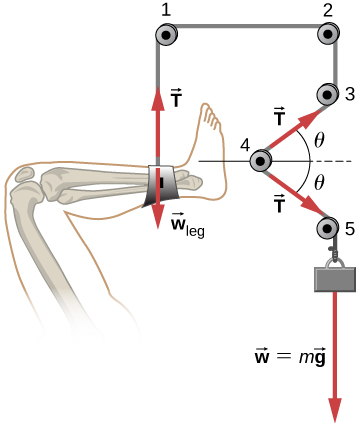
Figure shows a leg on the left. It is attached to a rope at the ankle and suspended from a pulley at the top. The rope continues to a second pulley on the right of the first, a third one to the bottom of the second, a fourth one to the bottom left of the third and a fifth one to the bottom right of the fourth. An object with weight w = mg is attached at the end of the rope. An arrow labeled w subscript leg points downwards from the ankle and an arrow labeled T points upwards from there. An arrow labeled T, from the fourth pulley to the third, forms an angle theta with the horizontal. Another arrow labeled T, from the fourth pulley to the fifth forms an angle minus theta with the horizontal.

Answer

a. The free-body diagram of pulley 4:
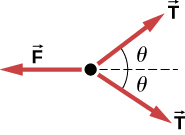
A free body diagram shows vector F pointing left, a vector T pointing right and up, forming an angle theta with the horizontal and another vector T pointing right and down, forming an angle theta with the horizontal.


b. T= mg, F= 2Tcosθ= 2mgcosθ

5-57 §5.6 source ↗

Two teams of nine members each engage in a tug-of-war, pulling in opposite directions on a horizontal rope. Each of the first team’s members has an average mass of 68 kg and exerts an average force of 1350 N horizontally on the ground as they pull on the rope. Each of the second team’s members has an average mass of 73 kg and exerts an average force of 1365 N horizontally on the ground as they pull on the rope in the opposite direction. (a) What is the magnitude of the acceleration of the two teams, and which team wins? (b) What is the tension in the section of rope between the teams?

Answer

a. 65 N
b. 1.22×10⁴m/s2

5-59 §5.6 source ↗

(a) Calculate the tension in a vertical strand of spider web if a spider of mass 2.00×10⁻⁵kg hangs motionless on it. (b) Calculate the tension in a horizontal strand of spider web if the same spider sits motionless in the middle of it much like the tightrope walker in Figure 5.26. The strand sags at an angle of 12° below the horizontal. Compare this with the tension in the vertical strand (find their ratio).
Figure 5.26 in the book ↗
The weight of a tightrope walker causes a wire to sag by 5.0°. The system of interest is the point in the wire at which the tightrope walker is standing.

Answer

a. T= 1.96×10⁻⁴N;
b. T′=4.71×10⁻⁴NT′T=2.40times the tension in the vertical strand

5-61 §5.6 source ↗

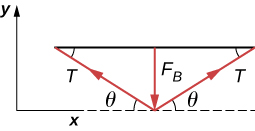
Show that, as explained in the text, a force F⊥ exerted on a flexible medium at its center and perpendicular to its length (such as on the tightrope wire in Figure 5.26) gives rise to a tension of magnitude T= F⊥/2sin(θ).
Figure 5.26 in the book ↗
The weight of a tightrope walker causes a wire to sag by 5.0°. The system of interest is the point in the wire at which the tightrope walker is standing.

Answer

Figure shows a horizontal line parallel to x axis. An arrow F pointing downwards originates from the center of the line, with its tip intersecting x-axis. Two arrows originate from this point of intersection and their tips touch the line on either side. They form the same angle with the x-axis and the line.


Fynet=F⊥−2Tsinθ=0F⊥=2TsinθT=F⊥2sinθ

5-63 §5.6 source ↗

A bird has a mass of 26 g and perches in the middle of a stretched telephone line. (a) Show that the tension in the line can be calculated using the equation T=mg2sinθ. Determine the tension when (b) θ=5° and (c) θ=0.5°. Assume that each half of the line is straight.
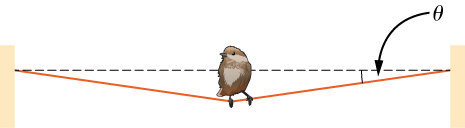
Figure shows a bird sitting on a wire that is fixed at both ends. The wire sags with its weight, forming an angle theta with the horizontal on either side.

Answer

a. see Example 5.13; b. 1.5 N; c. 15 N
Example 5.13 What Is the Tension in a Tightrope? in the book ↗

5-65 §5.6 source ↗

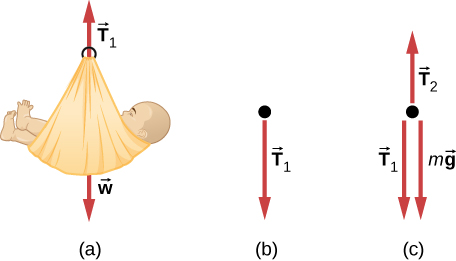
Consider the baby being weighed in the following figure. (a) What is the mass of the infant and basket if a scale reading of 55 N is observed? (b) What is tension T1 in the cord attaching the baby to the scale? (c) What is tension T2 in the cord attaching the scale to the ceiling, if the scale has a mass of 0.500 kg? (d) Sketch the situation, indicating the system of interest used to solve each part. The masses of the cords are negligible.
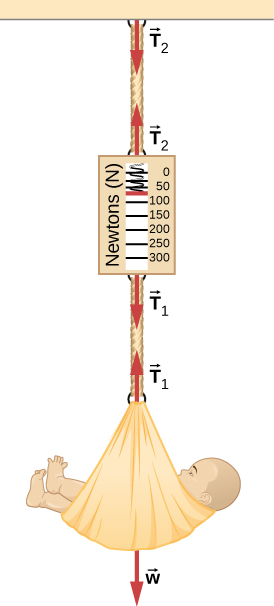
Figure shows a baby in a basket attached to a spring scale, which in turn is fixed from a rigid support. Arrow T2 points down from the support. Another arrow T2 points up from the top of the scale. Arrow T1 points down from the bottom of the scale. Another arrow T1 points up from the basket. Arrow w points down from the basket. The scale has markings from 0 to 300 Newtons.

Answer

a. 5.6 kg; b. 55 N; c. T2=60N;
d.

Figure a shows a baby in a basket, with arrow T1 pointing up and arrow w pointing down. Figure b shows a free body diagram of arrow T1 pointing down. Figure c shows a free body diagram of T1 pointing down, T2 pointing up and mg pointing down.

5-67 §5.6 source ↗

A 2.0-kg block is on a perfectly smooth ramp that makes an angle of 30° with the horizontal. (a) What is the block’s acceleration down the ramp and the force of the ramp on the block? (b) What force applied upward along and parallel to the ramp would allow the block to move with constant velocity?

Answer

a. 4.9m/s2, 17 N; b. 9.8 N

5-69 §5.7 source ↗

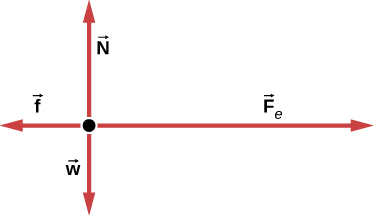
A car moves along a horizontal road. Draw a free-body diagram; be sure to include the friction of the road that opposes the forward motion of the car.

Answer

A free body diagram shows a vector F subscript e pointing right, vector N pointing up, vector f pointing left and arrow w pointing down.

5-71 §5.7 source ↗

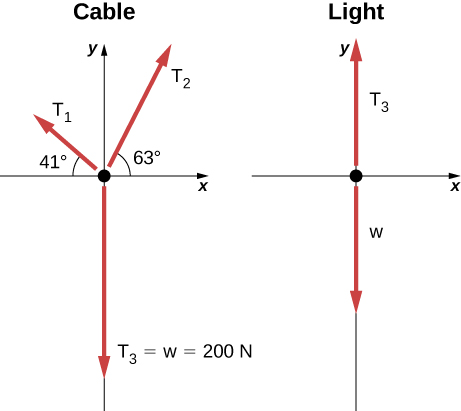
The traffic light hangs from the cables as shown. Draw a free-body diagram on a coordinate plane for this situation.
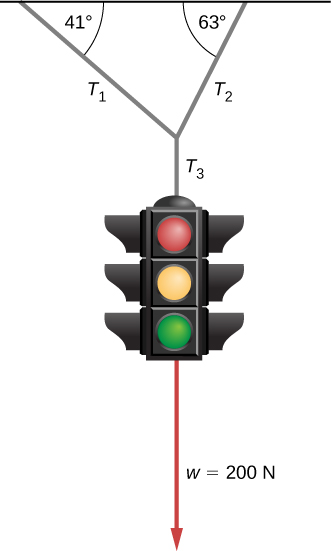
Figure shows a traffic light hanging from a horizontal cable by three other cables, T1, T2 and T3. T1 hangs down and right making an angle of 41 degrees with the horizontal cable. T2 hangs down and left, making an angle of 63 degrees with the horizontal cable. These meet at a point and T3 hangs vertically down from here. The light is attached to T3. A vector pointing down from the light is labeled w equal to 200 newtons.

Answer

Figure shows coordinate axes. Three arrows radiate out from the origin. T1, labeled 41 degrees points up and left. T2, labeled 63 degrees points up and right. T3 equal to w equal to 200 N is along the negative y axis.

5-73 §5.AP source ↗

Two forces of 25 and 45 N act on an object. Their directions differ by 70°. The resulting acceleration has magnitude of 10.0m/s2. What is the mass of the body?

Answer

5.90 kg

5-75 §5.AP source ↗

Draw a free-body diagram of a diver who has entered the water, moved downward, and is acted on by an upward force due to the water which balances the weight (that is, the diver is suspended).

Answer

A free body diagram with arrow F pointing up and arrow w pointing down.

5-77 §5.AP source ↗

(a) Find an equation to determine the magnitude of the net force required to stop a car of mass m, given that the initial speed of the car is v0 and the stopping distance is x. (b) Find the magnitude of the net force if the mass of the car is 1050 kg, the initial speed is 40.0 km/h, and the stopping distance is 25.0 m.

Answer

a. Fnet= m(v2−v02)2x; b. 2590 N

5-79 §5.AP source ↗

Find the acceleration of the body of mass 10.0 kg shown below.
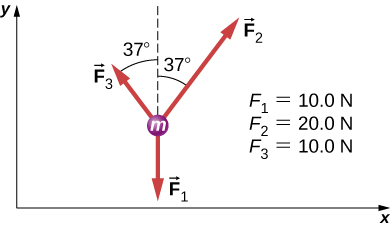
Three arrow radiate outwards from a circle labeled m. F1, equal to 10 N, points vertically down. F2, equal to 20 N, points up and right, making an angle of minus 37 degrees with the positive y axis. F3, equal to 10 N, points up and left, making an angle of 37 degrees with the positive y axis.

Answer

F→net=F→1+F→2+F→3=(6.02i^+14.0j^)N F→net=ma→⇒a→=F→netm=6.02i^+14.0j^N10.0kg= (0.602i^+1.40j^)m/s2

5-81 §5.AP source ↗

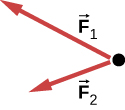
Force F→B has twice the magnitude of force F→A. Find the direction in which the particle accelerates in this figure.
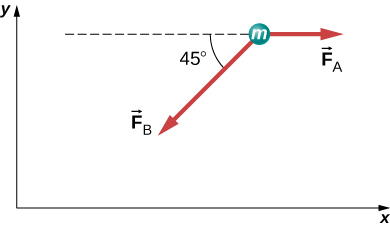
Two arrows radiate outwards from a circle labeled m. F subscript A points right. F subscript B points down and left, making an angle of 45 degrees with the horizontal.

Answer

F→net=F→A+F→BF→net=Ai^+(−1.41Ai^−1.41Aj^)F→net=A(−0.41i^−1.41j^)θ=254°
(We add 180°, because the angle is in quadrant IV.)

5-83 §5.AP source ↗

A force acts on a car of mass m so that the speed v of the car increases with position x as v=kx2, where k is constant and all quantities are in SI units. Find the force acting on the car as a function of position.

Answer

F=2mk2x2; First, take the derivative of the velocity function to obtain a= 2kxv= 2kx(kx2)= 2k2x3. Then apply Newton’s second law F=ma=2mk2x2.

5-85 §5.AP source ↗

Two boxes, A and B, are at rest. Box A is on level ground, while box B rests on an inclined plane tilted at angle θ with the horizontal. (a) Write expressions for the normal force acting on each block. (b) Compare the two forces; that is, tell which one is larger or whether they are equal in magnitude. (c) If the angle of incline is 10°, which force is greater?

Answer

a. For box A, NA=mg and NB=mgcosθ; b. NA>NB because for θ<90°, cosθ<1; c. NA>NB when θ=10°

5-87 §5.AP source ↗

As shown below, two identical springs, each with the spring constant 20 N/m, support a 15.0-N weight. (a) What is the tension in spring A? (b) What is the amount of stretch of spring A from the rest position?
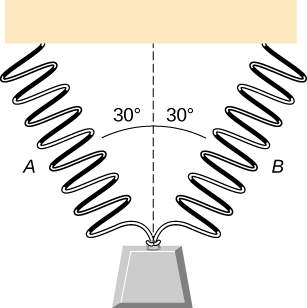
Figure shows two identical springs hanging side by side. Their lower ends are brought together and support a weight. Each spring makes an angle of 30 degrees with the vertical.

Answer

a. 8.66 N; b. 0.433 m

5-89 §5.AP source ↗

In building a house, carpenters use nails from a large box. The box is suspended from a spring twice during the day to measure the usage of nails. At the beginning of the day, the spring stretches 50 cm. At the end of the day, the spring stretches 30 cm. What fraction or percentage of the nails have been used?

Answer

0.40 or 40%

5-91 §5.AP source ↗

Two forces are applied to a 5.0-kg object, and it accelerates at a rate of 2.0m/s2 in the positive y-direction. If one of the forces acts in the positive x-direction with magnitude 12.0 N, find the magnitude of the other force.

Answer

16 N

5-93 §5.CP source ↗

If two tugboats pull on a disabled vessel, as shown here in an overhead view, the disabled vessel will be pulled along the direction indicated by the result of the exerted forces. (a) Draw a free-body diagram for the vessel. Assume no friction or drag forces affect the vessel. (b) Did you include all forces in the overhead view in your free-body diagram? Why or why not?
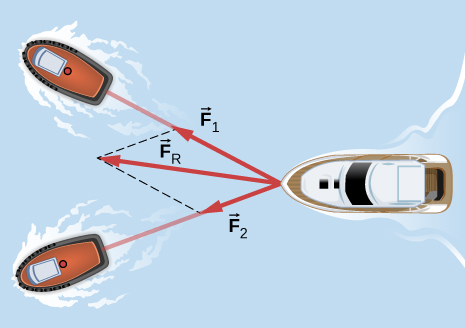
Figure shows the top view of two tugboats pulling a disabled vessel to the left. Arrow F1 is along the line connecting the vessel to the top tugboat. Arrow F2 is along the line connecting the vessel to the bottom tugboat. F1 is longer than F2. Arrow F subscript R shows the combined force. It is in between F1 and F2, pointing left and slightly up.

Answer

a.

Figure shows a free body diagram with F1 pointing up and left and F2 pointing down and left.

; b. No; F→R is not shown, because it would replace F→1 and F→2. (If we want to show it, we could draw it and then place squiggly lines on F→1 and F→2 to show that they are no longer considered.

5-95 §5.CP source ↗

On June 25, 1983, shot-putter Udo Beyer of East Germany threw the 7.26-kg shot 22.22 m, which at that time was a world record. (a) If the shot was released at a height of 2.20 m with a projection angle of 45.0°, what was its initial velocity? (b) If while in Beyer’s hand the shot was accelerated uniformly over a distance of 1.20 m, what was the net force on it?

Answer

a. 14.1 m/s; b. 601 N

5-97 §5.CP source ↗

A body of mass m has initial velocity v0 in the positive x-direction. It is acted on by a constant force F for time t until the velocity becomes zero; the force continues to act on the body until its velocity becomes −v0 in the same amount of time. Write an expression for the total distance the body travels in terms of the variables indicated.

Answer

F m t 2

5-99 §5.CP source ↗

A 120-kg astronaut is riding in a rocket sled that is sliding along an inclined plane. The sled has a horizontal component of acceleration of 5.0m/s2 and a downward component of 3.8m/s2. Calculate the magnitude of the force on the rider by the sled. (Hint: Remember that gravitational acceleration must be considered.)

Answer

936 N

5-101 §5.CP source ↗

Suppose that you are viewing a soccer game from a helicopter above the playing field. Two soccer players simultaneously kick a stationary soccer ball on the flat field; the soccer ball has mass 0.420 kg. The first player kicks with force 162 N at 9.0° north of west. At the same instant, the second player kicks with force 215 N at 15° east of south. Find the acceleration of the ball in i^ and j^ form.

Answer

a → = −248 i ^ − 433 j ^ m/ s 2

5-103 §5.CP source ↗

A 0.0502-kg pair of fuzzy dice is attached to the rearview mirror of a car by a short string. The car accelerates at constant rate, and the dice hang at an angle of 3.20° from the vertical because of the car’s acceleration. What is the magnitude of the acceleration of the car?

Answer

0.548 m/s 2

5-105 §5.CP source ↗

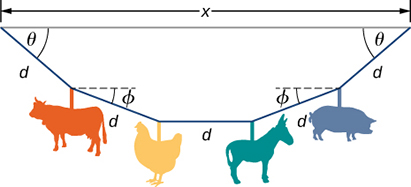
Hanging from the ceiling over a baby bed, well out of baby’s reach, is a string with plastic shapes, as shown here. The string is taut (there is no slack), as shown by the straight segments. Each plastic shape has the same mass m, and they are equally spaced by a distance d, as shown. The angles labeled θ describe the angle formed by the end of the string and the ceiling at each end. The center length of sting is horizontal. The remaining two segments each form an angle with the horizontal, labeled ϕ. Let T1 be the tension in the leftmost section of the string, T2 be the tension in the section adjacent to it, and T3 be the tension in the horizontal segment. (a) Find an equation for the tension in each section of the string in terms of the variables m, g, and θ. (b) Find the angle ϕ in terms of the angle θ. (c) If θ=5.10°, what is the value of ϕ? (d) Find the distance x between the endpoints in terms of d and θ.

Figure shows four shapes hanging on a string that is attached to the ceiling at both ends. The shapes divide the string in five equal segments, each having length d. The middle segment is horizontal. The distance between the two ends of the string is x. The angles between the ceiling and the segments closest to the ceiling are both labeled theta. The angles formed by the first segments from the ceiling with their adjoining segments are both labeled phi.

Answer

a. T1=2mgsinθ, T2= mgsin(arctan(12tanθ)), T3=2mgtanθ; b. ϕ= arctan(12tanθ); c. 2.56°; (d) x= d(2cosθ+2cos(arctan(12tanθ))+1)

5-107 §5.CP source ↗

An object is acted on by three simultaneous forces: F→1= (−3.00i^+2.00j^)N, F→2= (6.00i^−4.00j^)N, and F→3= (2.00i^+5.00j^)N. The object experiences acceleration of 4.23m/s2. (a) Find the acceleration vector in terms of m. (b) Find the mass of the object. (c) If the object begins from rest, find its speed after 5.00 s. (d) Find the components of the velocity of the object after 5.00 s.

Answer

a. a→= (5.00mi^+3.00mj^)m/s2; b. 1.38 kg; c. 21.2 m/s; d. v→= (18.1i^+10.9j^)m/s2

5-109 §5.CP source ↗

A drone is being directed across a frictionless ice-covered lake. The mass of the drone is 1.50 kg, and its velocity is 3.00i^m/s. After 10.0 s, the velocity is 9.00i^+ 4.00j^m/s. If a constant force in the horizontal direction is causing this change in motion, find (a) the components of the force and (b) the magnitude of the force.

Answer

a. 0.900i^+ 0.600j^N; b. 1.08 N

Loading chapter 6…

Problems and answers are adapted from University Physics Volume 1 by Samuel J. Ling, Jeff Sanny and William Moebs, OpenStax, and are used under the CC BY-NC-SA 4.0 licence. Access for free at https://openstax.org/books/university-physics-volume-1/pages/1-introduction. Illustrations: Copyright Rice University, OpenStax, under CC BY-NC-SA 4.0 license. This adaptation is released under the same licence, is non-commercial, and is neither affiliated with nor endorsed by OpenStax or Rice University.