Every problem in the chapter beside the book’s answer, a chapter at a time as you scroll.

Chapter 2: Vectors

61 problems · 13 figures

Check Your Understanding 2.1 §2.1 source ↗

Two motorboats named Alice and Bob are moving on a lake. Given the information about their velocity vectors in each of the following situations, indicate whether their velocity vectors are equal or otherwise. (a) Alice moves north at 6 knots and Bob moves west at 6 knots. (b) Alice moves west at 6 knots and Bob moves west at 3 knots. (c) Alice moves northeast at 6 knots and Bob moves south at 3 knots. (d) Alice moves northeast at 6 knots and Bob moves southwest at 6 knots. (e) Alice moves northeast at 2 knots and Bob moves closer to the shore northeast at 2 knots.

Answer

a. not equal because they are orthogonal; b. not equal because they have different magnitudes; c. not equal because they have different magnitudes and directions; d. not equal because they are antiparallel; e. equal.

Check Your Understanding 2.2 §2.1 source ↗

A cave diver enters a long underwater tunnel. When her displacement with respect to the entry point is 20 m, she accidentally drops her camera, but she doesn’t notice it missing until she is some 6 m farther into the tunnel. She swims back 10 m but cannot find the camera, so she decides to end the dive. How far from the entry point is she? Taking the positive direction out of the tunnel, what is her displacement vector relative to the entry point?

Answer

16 m; D→=−16mu^

Check Your Understanding 2.3 §2.1 source ↗

Using the three displacement vectors A→, B→, and F→ in Figure 2.13, choose a convenient scale, and use a ruler and a protractor to find vector G→ given by the vector equation G→= A→+ 2B→− F→.
Figure 2.13 in the book ↗
Vectors used in Example 2.2 and in the Check Your Understanding feature that follows.

Answer

G = 28.2 cm, θG=291°

Check Your Understanding 2.4 §2.2 source ↗

A blue fly lands on a sheet of graph paper at a point located 10.0 cm to the right of its left edge and 8.0 cm above its bottom edge and walks slowly to a point located 5.0 cm from the left edge and 5.0 cm from the bottom edge. Choose the rectangular coordinate system with the origin at the lower left-side corner of the paper and find the displacement vector of the fly. Illustrate your solution by graphing.

Answer

D→= (−5.0i^−3.0j^)cm; the fly moved 5.0 cm to the left and 3.0 cm down from its landing site.

Check Your Understanding 2.5 §2.2 source ↗

If the displacement vector of a blue fly walking on a sheet of graph paper is D→= (−5.00i^−3.00j^)cm, find its magnitude and direction.

Answer

5.83 cm, 211°

Check Your Understanding 2.6 §2.2 source ↗

If Trooper runs 20 m west before taking a rest, what is his displacement vector?

Answer

D → = ( −20 m ) i ^

Check Your Understanding 2.7 §2.2 source ↗

If the average velocity vector of the drone in the displacement in Example 2.7 is u→= (15.0i^+31.7j^+2.5k^)m/s, what is the magnitude of the drone’s velocity vector?

Answer

35.2 m/s = 126.7 km/h

Check Your Understanding 2.8 §2.3 source ↗

Three displacement vectors A→, B→, and F→ (Figure 2.13) are specified by their magnitudes A = 10.00, B = 7.00, and F = 20.00, respectively, and by their respective direction angles with the horizontal direction α=35°, β=−110°, and φ=110°. The physical units of the magnitudes are centimeters. Use the analytical method to find vector G→= A→+ 2B→− F→. Verify that
G = 28.15 cm and that θG=−68.65°.
Figure 2.13 in the book ↗
Vectors used in Example 2.2 and in the Check Your Understanding feature that follows.

Answer

G → = (10.25 i ^ −26.22 j ^ )cm

Check Your Understanding 2.9 §2.3 source ↗

Suppose that Balto in Example 2.10 leaves the game to attend to more important matters, but Astro, Clifford, and Dug continue playing. Astro and Clifford's pull on the toy does not change, but Dug runs around and bites on the toy in a different place. With how big a force and in what direction must Dug pull on the toy now to balance out the combined pulls from Clifford and Astro? Illustrate this situation by drawing a vector diagram indicating all forces involved.

Answer

D = 55.7 N; direction 65.7° north of east

Check Your Understanding 2.10 §2.3 source ↗

Verify that vector v^ obtained in Example 2.14 is indeed a unit vector by computing its magnitude. If the convoy in Example 2.8 was moving across a desert flatland—that is, if the third component of its velocity was zero—what is the unit vector of its direction of motion? Which geographic direction does it represent?

Answer

v^= 0.8i^+ 0.6j^, 36.87° north of east

Check Your Understanding 2.11 §2.4 source ↗

For the vectors given in Figure 2.13, find the scalar products A→·B→ and F→·C→.
Figure 2.13 in the book ↗
Vectors used in Example 2.2 and in the Check Your Understanding feature that follows.

Answer

A→·B→=−57.3, F→·C→=27.8

Check Your Understanding 2.13 §2.4 source ↗

Find the angle between forces F→1 and F→3 in Example 2.16.

Answer

131.9 °

Check Your Understanding 2.14 §2.4 source ↗

How much work is done by the first dog and by the second dog in Example 2.16 on the displacement in Example 2.17?

Answer

W1=1.5J, W2=0.3J

Check Your Understanding 2.15 §2.4 source ↗

For the vectors given in Figure 2.13, find the vector products A→×B→ and C→×F→.
Figure 2.13 in the book ↗
Vectors used in Example 2.2 and in the Check Your Understanding feature that follows.

Answer

A→×B→= −40.1k^ or, equivalently, |A→×B→|= 40.1, and the direction is into the page; C→×F→= + 157.6k^ or, equivalently, |C→×F→|= 157.6, and the direction is out of the page.

Check Your Understanding 2.16 §2.4 source ↗

Given two vectors A→=−i^+j^ and B→=3i^−j^, find (a) A→×B→, (b) |A→×B→|, (c) the angle between A→ and B→, and (d) the angle between A→×B→ and vector C→=i^+k^.

Answer

a. −2k^, b. 2, c. 153.4°, d. 135°

2-1 §2.1 source ↗

A weather forecast states the temperature is predicted to be −5°C the following day. Is this temperature a vector or a scalar quantity? Explain.

Answer

scalar

2-3 §2.1 source ↗

Give a specific example of a vector, stating its magnitude, units, and direction.

Answer

answers may vary

2-5 §2.1 source ↗

Suppose you add two vectors A→ and B→. What relative direction between them produces the resultant with the greatest magnitude? What is the maximum magnitude? What relative direction between them produces the resultant with the smallest magnitude? What is the minimum magnitude?

Answer

parallel, sum of magnitudes, antiparallel, zero

2-7 §2.1 source ↗

Is it possible for two vectors of different magnitudes to add to zero? Is it possible for three vectors of different magnitudes to add to zero? Explain.

Answer

no, yes

2-9 §2.1 source ↗

When a 10,000-m runner competing on a 400-m track crosses the finish line, what is the runner’s net displacement? Can this displacement be zero? Explain.

Answer

zero, yes

2-11 §2.1 source ↗

Can a magnitude of a vector be negative?

Answer

no

2-13 §2.1 source ↗

If two vectors are equal, what can you say about their components? What can you say about their magnitudes? What can you say about their directions?

Answer

equal, equal, the same

2-15 §2.2 source ↗

Give an example of a nonzero vector that has a component of zero.

Answer

a unit vector of the x-axis

2-17 §2.2 source ↗

If two vectors are equal, what can you say about their components?

Answer

They are equal.

2-19 §2.2 source ↗

If one of the two components of a vector is not zero, can the magnitude of the other vector component of this vector be zero?

Answer

yes

2-21 §2.4 source ↗

What is wrong with the following expressions? How can you correct them? (a) C=A→B→, (b) C→=A→B→, (c) C=A→×B→, (d) C=AB→, (e) C+2A→=B, (f) C→=A×B→, (g) A→·B→=A→×B→, (h) C→=2A→·B→, (i) C=A→/B→, and (j) C=A→/B.

Answer

a. C=A→·B→, b. C→=A→×B→ or C→=A→−B→, c. C→=A→×B→, d. C→=AB→, e. C→+2A→=B→, f. C→=A→×B→, g. left side is a scalar and right side is a vector, h. C→=2A→×B→, i. C→=A→/B, j. C→=A→/B

2-23 §2.4 source ↗

If the dot product of two vectors vanishes, what can you say about their directions?

Answer

They are orthogonal.

2-25 §2.1 source ↗

A scuba diver makes a slow descent into the depths of the ocean. His vertical position with respect to a boat on the surface changes several times. He makes the first stop 9.0 m from the boat but has a problem with equalizing the pressure, so he ascends 3.0 m and then continues descending for another 12.0 m to the second stop. From there, he ascends 4 m and then descends for 18.0 m, ascends again for 7 m and descends again for 24.0 m, where he makes a stop, waiting for his buddy. Assuming the positive direction up to the surface, express his net vertical displacement vector in terms of the unit vector. What is his distance to the boat?

Answer

h→=−49mu^, 49 m

2-27 §2.1 source ↗

Suppose you walk 18.0 m straight west and then 25.0 m straight north. How far are you from your starting point and what is the compass direction of a line connecting your starting point to your final position? Use a graphical method.

Answer

30.8 m, 35.7° west of north (equivalently, 54.2° north of west or 125.7° from east)

2-29 §2.1 source ↗

A delivery driver starts at the post office, drives 40 km north, then 20 km west, then 60 km northeast, and finally 50 km north to stop for lunch. Use a graphical method to find their net displacement vector.

Answer

134 km, 80°

2-31 §2.1 source ↗

In an attempt to escape a desert island, a castaway builds a raft and sets out to sea. The wind shifts a great deal during the day and he is blown along the following directions: 2.50 km and 45.0° north of west, then 4.70 km and 60.0° south of east, then 1.30 km and 25.0° south of west, then 5.10 km straight east, then 1.70 km and 5.00° east of north, then 7.20 km and 55.0° south of west, and finally 2.80 km and 10.0° north of east. Use a graphical method to find the castaway’s final position relative to the island.

Answer

7.34 km, 63.5° south of east

2-33 §2.1 source ↗

A trapper walks a 5.0-km straight-line distance from his cabin to the lake, as shown in the following figure. Use a graphical method (the parallelogram rule) to determine the trapper’s displacement directly to the east and displacement directly to the north that sum up to his resultant displacement vector. If the trapper walked only in directions east and north, zigzagging his way to the lake, how many kilometers would he have to walk to get to the lake?
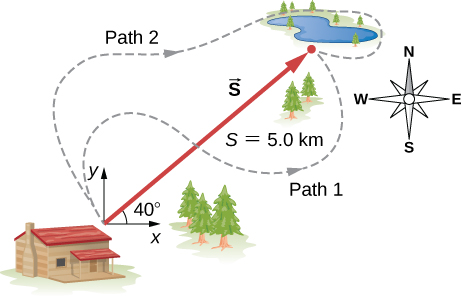
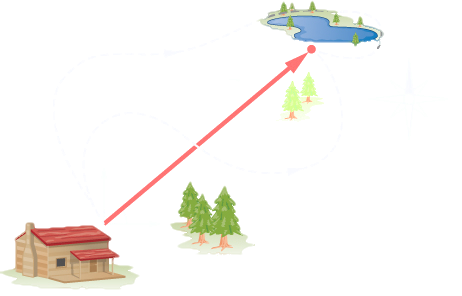
North is up, east is to the right. A house and lake are shown. The x y coordiante system is also shown, with the origin near the house, the positive x direction to the right nad the positive y direction up. The vector from the house to the lake is shown as a straight red arrow, labeled as vector S, magnitude S=5.0 kilometers, and at an angle of 40 degrees above the posiitve x direction. Two meandering paths, path 1 and path 2, from the house to the lake are shown as dashed line.North is up, east is to the right. A house and lake are shown. The x y coordiante system is also shown, with the origin near the house, the positive x direction to the right nad the positive y direction up. The vector from the house to the lake is shown as a straight red arrow, labeled as vector S, magnitude S=5.0 kilometers, and at an angle of 40 degrees above the posiitve x direction. Two meandering paths, path 1 and path 2, from the house to the lake are shown as dashed line.

Answer

3.8 km east, 3.2 km north, 7.0 km

2-35 §2.1 source ↗

A pedestrian walks 6.0 km east and then 13.0 km north. Use a graphical method to find the pedestrian’s resultant displacement and geographic direction.

Answer

14.3 km, 65°

2-37 §2.2 source ↗

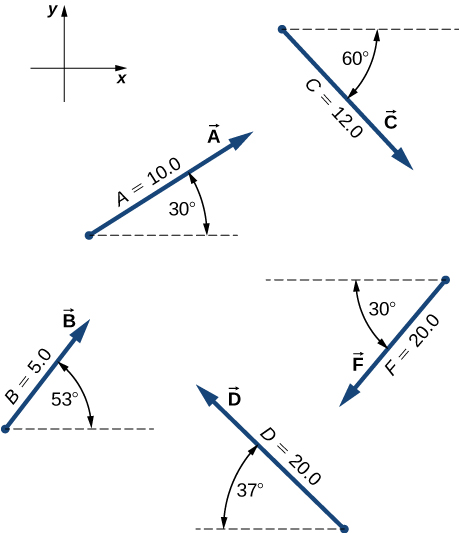
Assuming the +x-axis is horizontal and points to the right, resolve the vectors given in the following figure to their scalar components and express them in vector component form.
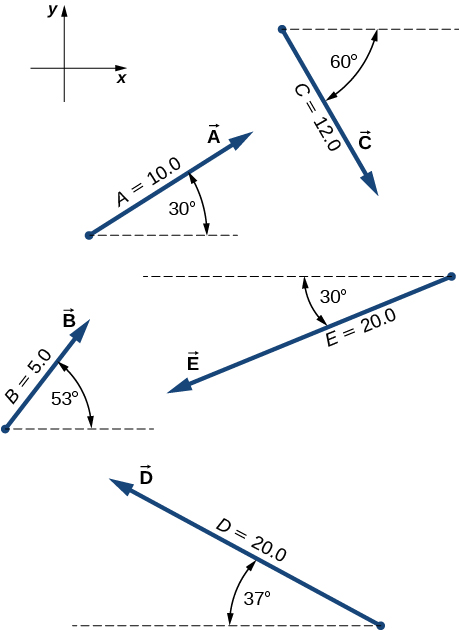
The figure shows an x-y axis in the upper left corner followed by 5 unique vectors drawn on the x-y plane. Vector A has a magnitude of 10.0 and points 30 degrees above the x-axis. Vector B has a magnitude of 5.0 and points 53 degrees above the x-axis. Vector C has a magnitude of 12.0 and points 60 degrees below the x-axis. Vector D has a magnitude of 20.0 and points 37 degrees above the negative x-axis. Vector E has a magnitude of 20.0 and points 30 degrees below the negative x-axis.

Answer

a. A→= + 8.66i^+ 5.00j^, b. B→= + 3.01i^+ 3.99j^, c. C→= + 6.00i^− 10.39j^, d. D→= −15.97i^+ 12.04j^, f. F→= −17.32i^− 10.00j^

The figure shows an x-y axis in the upper left corner followed by 5 unique vectors drawn on the x-y plane. Vector A has a magnitude of 10.0 and points 30 degrees above the x-axis. Vector B has a magnitude of 5.0 and points 53 degrees above the x-axis. Vector C has a magnitude of 12.0 and points 60 degrees below the x-axis. Vector D has a magnitude of 20.0 and points 37 degrees above the negative x-axis. Vector F has a magnitude of 20.0 and points 30 degrees below the negative x-axis.

2-39 §2.2 source ↗

You drive 7.50 km in a straight line in a direction 15° east of north. (a) Find the distances you would have to drive straight east and then straight north to arrive at the same point. (b) Show that you still arrive at the same point if the east and north legs are reversed in order. Assume the +x-axis is to the east.

Answer

a. 1.94 km, 7.24 km; b. proof

2-41 §2.2 source ↗

A trapper walks a 5.0-km straight-line distance from her cabin to the lake, as shown in the following figure. Determine the east and north components of her displacement vector. How many more kilometers would she have to walk if she walked along the component displacements? What is her displacement vector?

The vector from the cabin to the lake is vector S, magnitude 5.0 kilometers and pointing 40 degrees north of east. Two additional meandering paths are shown and labeled path 1 and path 2.The vector from the cabin to the lake is vector S, magnitude 5.0 kilometers and pointing 40 degrees north of east. Two additional meandering paths are shown and labeled path 1 and path 2.

Answer

3.8 km east, 3.2 km north, 2.0 km, D→= (3.8i^+3.2j^)km

2-43 §2.2 source ↗

Two points in a plane have polar coordinates P1(2.500m,π/6) and P2(3.800m,2π/3). Determine their Cartesian coordinates and the distance between them in the Cartesian coordinate system. Round the distance to a nearest centimeter.

Answer

P1(2.165m,1.250m), P2(−1.900m,3.290m), 4.55 m

2-45 §2.2 source ↗

Two points in the Cartesian plane are A(2.00 m, −4.00 m) and B(−3.00 m, 3.00 m). Find the distance between them and their polar coordinates.

Answer

8.60 m, A(25m,1.647π), B(32m,0.75π)

2-47 §2.3 source ↗

For vectors B→=−i^−4j^ and A→=−3i^−2j^, calculate (a) A→+B→ and its magnitude and direction angle, and (b) A→−B→ and its magnitude and direction angle.

Answer

a. A→+ B→= −4i^− 6j^, |A→+ B→|= 7.211, θ= 236°; b. A→− B→= –2i^+ 2j^, |A→− B→|= 22, θ= 135°

2-49 §2.3 source ↗

Given two displacement vectors A→= (3.00i^−4.00j^+4.00k^)m and B→= (2.00i^+3.00j^−7.00k^)m, find the displacements and their magnitudes for (a) C→=A→+B→ and (b) D→=2A→−B→.

Answer

a. C→= (5.0i^−1.0j^−3.0k^)m, C= 5.92m;
b. D→= (4.0i^−11.0j^+15.0k^)m, D= 19.03m

2-51 §2.3 source ↗

In an attempt to escape a desert island, a castaway builds a raft and sets out to sea. The wind shifts a great deal during the day, and she is blown along the following straight lines: 2.50 km and 45.0° north of west, then 4.70 km and 60.0° south of east, then 1.30 km and 25.0° south of west, then 5.10 km due east, then 1.70 km and 5.00° east of north, then 7.20 km and 55.0° south of west, and finally 2.80 km and 10.0° north of east. Use the analytical method to find the resultant vector of all her displacement vectors. What is its magnitude and direction?

Answer

D→= (3.3i^−6.6j^)km, i^ is to the east, 7.34 km, −63.5°

2-53 §2.3 source ↗

Given the vectors in the preceding figure, find vector R→ that solves equations (a) D→+R→=F→ and (b) C→− 2D→+ 5R→= 3F→. Assume the +x-axis is horizontal to the right.

Answer

a. R→= −1.35i^− 22.04j^, b. R→= −17.98i^+ 0.89j^

2-55 §2.3 source ↗

An adventurous dog strays from home, runs three blocks east, two blocks north, and one block east, one block north, and two blocks west. Assuming that each block is about a 100 yd, use the analytical method to find the dog’s net displacement vector, its magnitude, and its direction. Assume the +x-axis is to the east. How would your answer be affected if each block was about 100 m?

Answer

D→= (200i^+300j^)yd, D = 360.5 yd, 56.3° north of east; The numerical answers would stay the same but the physical unit would be meters. The physical meaning and distances would be about the same because 1 yd is comparable with 1 m.

2-57 §2.3 source ↗

Given the displacement vector D→= (3i^−4j^)m, find the displacement vector R→ so that D→+R→=−4Dj^.

Answer

R → = (−3 i ^ −16 j ^ )m

2-59 §2.3 source ↗

At one point in space, the direction of the electric field vector is given in the Cartesian system by the unit vector E^= 1/5i^− 2/5j^. If the magnitude of the electric field vector is E = 400.0 V/m, what are the scalar components Ex, Ey, and Ez of the electric field vector E→ at this point? What is the direction angle θE of the electric field vector at this point?

Answer

E→=EE^, Ex= + 178.9V/m, Ey= −357.8V/m, Ez=0.0V/m, θE= −tan−1(2)

2-61 §2.3 source ↗

In the control tower at a regional airport, an air traffic controller monitors two aircraft that travel in straight paths directly away from the control tower. One plane is a cargo carrier Boeing 747 climbing at 10° above the horizontal, and moving 30° north of west. At some moment in time, the controller notes that the Boeing is at an altitude of 2500 m and the DC-3 is at an altitude of 3000 m. The other plane is a Douglas DC-3 climbing at 5° above the horizontal, and cruising directly west. (a) Find the position vectors of the planes relative to the control tower at this time. (b) What is the distance between the planes at this time?

Answer

a. R→B= (12.278i^+7.089j^+2.500k^)km, R→D= (−34.290i^+3.000k^)km; b. |R→B− R→D|= 23.131km

2-63 §2.4 source ↗

Assuming the +x-axis is horizontal to the right for the vectors in the preceding figure, find (a) the component of vector A→ along vector C→, (b) the component of vector C→ along vector A→, (c) the component of vector i^ along vector F→, and (d) the component of vector F→ along vector i^.

Answer

a. 0, b. 0, c. –0.866, d. –17.32

2-65 §2.4 source ↗

Find the angles that vector D→= (2.0i^−4.0j^+k^)m makes with the x-, y-, and z- axes.

Answer

θ i = 64.12°, θ j = 150.79°, θ k = 77.39°

2-67 §2.4 source ↗

Assuming the +x-axis is horizontal to the right for the vectors in the previous figure, find the following vector products: (a) A→×C→, (b) A→×F→, (c) D→×C→, (d) A→×(F→+2C→), (e) i^×B→, (f) j^×B→, (g) (3i^−j^)×B→, and (h) B^×B→.

Answer

a. −120k^, b. 0k^, c. 94k^, d. –240k^, e. 4.0k^, f. −3.0k^, g. 15k^, h. 0

2-69 §2.4 source ↗

For the vectors in the earlier figure, find (a) (A→×F→)·D→, (b) (A→×F→)·(D→×B→), and (c) (A→·F→)(D→×B→).

Answer

a. 0, b. 0, c. 20,000k^

2-71 §2.AP source ↗

You fly 32.0km in a straight line in still air in the direction 35.0° south of west. (a) Find the distances you would have to fly due south and then due west to arrive at the same point. (b) Find the distances you would have to fly first in a direction 45.0° south of west and then in a direction 45.0° west of north. Note these are the components of the displacement along a different set of axes—namely, the one rotated by 45° with respect to the axes in (a).

Answer

a. 18.4 km and 26.2 km, b. 31.5 km and 5.56 km

2-73 §2.AP source ↗

If the polar coordinates of a point are (r,φ) and its rectangular coordinates are (x,y), determine the polar coordinates of the following points: (a) (−x, y), (b) (−2x, −2y), and (c) (3x, −3y).

Answer

a. (r,π−φ), b. (2r,π+φ), c. (3r,−φ)

2-75 §2.AP source ↗

Starting at the island of Moi in an unknown archipelago, a fishing boat makes a round trip with two stops at the islands of Noi and Poi. It sails from Moi for 4.76 nautical miles (nmi) in a direction 37° north of east to Noi. From Noi, it sails 69° west of north to Poi. On its return leg from Poi, it sails 28° east of south. What distance does the boat sail between Noi and Poi? What distance does it sail between Moi and Poi? Express your answer both in nautical miles and in kilometers. Note: 1 nmi = 1852 m.

Answer

d PM = 6.2nmi= 11.4km, d NP = 7.2nmi= 13.3km

2-77 §2.AP source ↗

Show that when A→+B→=C→, then C2= A2+ B2+ 2ABcosφ, where φ is the angle between vectors A→ and B→.

Answer

proof

2-79 §2.AP source ↗

A skater glides along a circular path of radius 5.00 m in clockwise direction. When he coasts around one-half of the circle, starting from the west point, find (a) the magnitude of his displacement vector and (b) how far he actually skated. (c) What is the magnitude of his displacement vector when he skates all the way around the circle and comes back to the west point?

Answer

a. 10.00 m, b. 5πm, c. 0

2-81 §2.AP source ↗

If the velocity vector of a polar bear is u→= (−18.0i^−13.0j^)km/h, how fast and in what geographic direction is it heading? Here, i^ and j^ are directions to geographic east and north, respectively.

Answer

22.2 km/h, 35.8° south of west

2-83 §2.AP source ↗

A diver explores a shallow reef off the coast of Belize. She initially swims 90.0 m north, makes a turn to the east and continues for 200.0 m, then follows a big grouper for 80.0 m in the direction 30° north of east. In the meantime, a local current displaces her by 150.0 m south. Assuming the current is no longer present, in what direction and how far should she now swim to come back to the point where she started?

Answer

270 m, 4.2° north of west

2-85 §2.AP source ↗

Vectors A→ and B→ are two orthogonal vectors in the xy-plane and they have identical magnitudes. If A→= 3.0i^+ 4.0j^, find B→.

Answer

B→= −4.0i^+ 3.0j^ or B→= 4.0i^− 3.0j^

2-87 §2.AP source ↗

Show that (B→×C→)·A→ is the volume of the parallelepiped, with edges formed by the three vectors in the following figure.
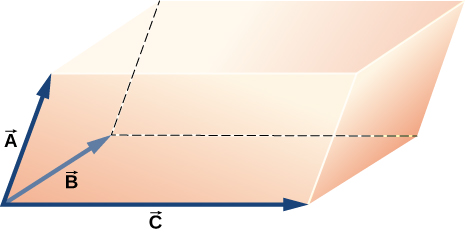
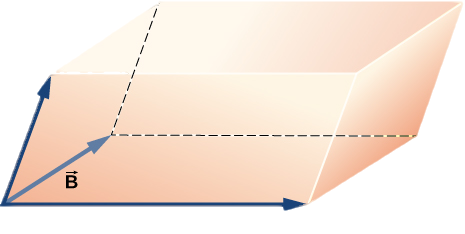
Vector G has magnitude 10.0. Its projection in the x y plane is between the positive x and positive y directions, at an angle of 45 degrees from the positive x direction. The angle between vector G and the positive z direction is 60 degrees. Vector H has magnitude 15.0. Its projection in the x y plane is between the negative x and positive y directions, at an angle of 30 degrees from the positive y direction. The angle between vector H and the positive z direction is 450 degrees.Vector G has magnitude 10.0. Its projection in the x y plane is between the positive x and positive y directions, at an angle of 45 degrees from the positive x direction. The angle between vector G and the positive z direction is 60 degrees. Vector H has magnitude 15.0. Its projection in the x y plane is between the negative x and positive y directions, at an angle of 30 degrees from the positive y direction. The angle between vector H and the positive z direction is 450 degrees.

Answer

proof

2-89 §2.CP source ↗

What is the component of the force vector G→= (3.0i^+4.0j^+10.0k^)N along the force vector H→= (1.0i^+4.0j^)N?

Answer

G H = 19N/ 17 ≈ 4.6N

2-91 §2.CP source ↗

Distances between points in a plane do not change when a coordinate system is rotated. In other words, the magnitude of a vector is invariant under rotations of the coordinate system. Suppose a coordinate system S is rotated about its origin by angle φ to become a new coordinate system S′, as shown in the following figure. A point in a plane has coordinates (x, y) in S and coordinates (x′,y′) in S′.

(a) Show that, during the transformation of rotation, the coordinates in S′ are expressed in terms of the coordinates in S by the following relations:

{ x ′ = x cos φ + y sin φ y ′ = − x sin φ + y cos φ .

(b) Show that the distance of point P to the origin is invariant under rotations of the coordinate system. Here, you have to show that

x 2 + y 2 = x ′ 2 + y ′ 2 .

(c) Show that the distance between points P and Q is invariant under rotations of the coordinate system. Here, you have to show that
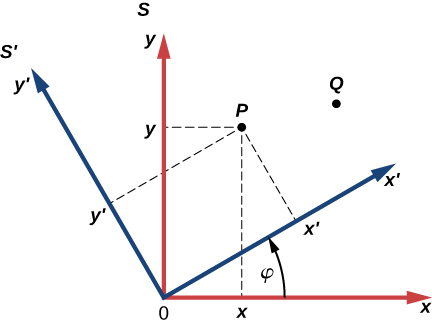
( x P − x Q ) 2 + ( y P − y Q ) 2 = ( x ' P − x ' Q ) 2 + ( y ' P − y ' Q ) 2 . Two coordinate systems are shown. The x y coordinate system S, in red, has positive x to to the right and positive y up. The x prime y prime coordinate system S prime, in blue, shares the same origin as S but is rotated relative to S counterclockwise an angle phi. Two points, P and Q are shown. Point P’s x coordinate in frame S is shown as a dashed line from P to the x axis, drawn parallel to the y axis. Point P’s y coordinate in frame S is shown as a dashed line from P to the y axis, drawn parallel to the x axis. Point P’s x prime coordinate in frame S prime is shown as a dashed line from P to the x prime axis, drawn parallel to the y prime axis. Point P’s y prime coordinate in frame S prime is shown as a dashed line from P to the y prime axis, drawn parallel to the x prime axis.

Answer

proof

Loading chapter 3…

Problems and answers are adapted from University Physics Volume 1 by Samuel J. Ling, Jeff Sanny and William Moebs, OpenStax, and are used under the CC BY-NC-SA 4.0 licence. Access for free at https://openstax.org/books/university-physics-volume-1/pages/1-introduction. Illustrations: Copyright Rice University, OpenStax, under CC BY-NC-SA 4.0 license. This adaptation is released under the same licence, is non-commercial, and is neither affiliated with nor endorsed by OpenStax or Rice University.