Every problem in the chapter beside the book’s answer, a chapter at a time as you scroll.
Chapter 4: Motion in Two and Three Dimensions
57 problems · 11 figuresCheck Your Understanding 4.1 §4.1 source ↗
Answer
which is different from
Check Your Understanding 4.2 §4.2 source ↗
Answer
Check Your Understanding 4.3 §4.3 source ↗
Answer
Check Your Understanding 4.4 §4.3 source ↗
Answer
Check Your Understanding 4.5 §4.4 source ↗
Answer
Check Your Understanding 4.6 §4.5 source ↗
Answer
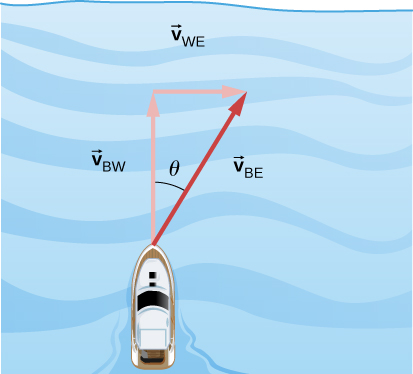
Labeling subscripts for the vector equation, we have B = boat, R = river, and E = Earth. The vector equation becomes We have right triangle geometry shown in Figure 04_05_BoatRiv_img. Solving for , we have
4-1 §4.1 source ↗
Answer
4-3 §4.1 source ↗
Answer
4-5 §4.2 source ↗
Answer
4-7 §4.3 source ↗
Answer
4-9 §4.3 source ↗
Answer
4-11 §4.4 source ↗
Answer
4-13 §4.5 source ↗
Answer
4-15 §4.5 source ↗
Answer
4-17 §4.1 source ↗
Answer
4-19 §4.1 source ↗
Answer
4-21 §4.1 source ↗
Answer
4-23 §4.1 source ↗
Answer
b.
4-25 §4.1 source ↗
Answer
4-27 §4.2 source ↗
Answer
a. ,
b.
4-29 §4.2 source ↗
Answer
b.
c.
d.
,
e. ,
4-31 §4.2 source ↗
Answer
4-33 §4.3 source ↗
Answer
4-35 §4.3 source ↗
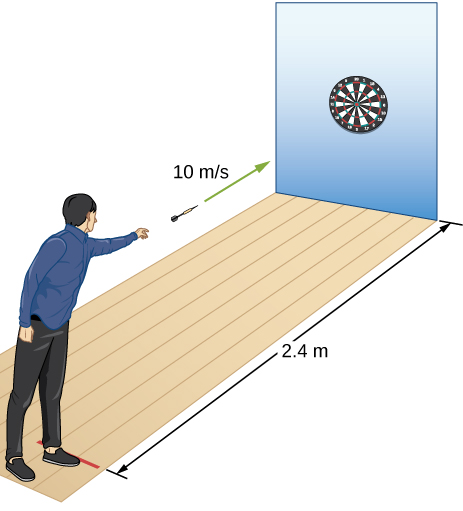
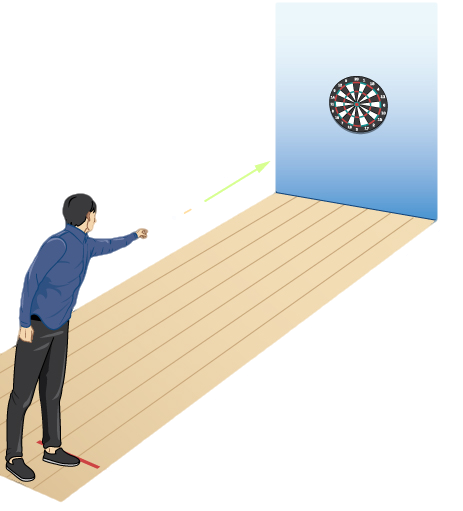
A dart is thrown horizontally at a speed of 10 m/s at the bull’s-eye of a dartboard 2.4 m away, as in the following figure. (a) How far below the intended target does the dart hit? (b) What does your answer tell you about how proficient dart players throw their darts?
Answer
a. , b. They aim high.
4-37 §4.3 source ↗
Answer
4-39 §4.3 source ↗
Answer
b.
c.
d.
4-41 §4.3 source ↗
Answer
4-43 §4.3 source ↗
Answer
4-45 §4.3 source ↗
Answer
b. ,
c. ,
d. ,
e.
4-47 §4.3 source ↗
Answer
So the golfer’s shot lands 13.3 m short of the green.
4-49 §4.3 source ↗
Answer
b.
4-51 §4.3 source ↗
Answer
4-53 §4.3 source ↗
Answer
4-55 §4.3 source ↗
Answer
4-57 §4.3 source ↗
Answer
4-59 §4.3 source ↗
Answer
(b)
Therefore, the ball will be overthrown, and the receiver will not be able to catch it.
4-61 §4.4 source ↗
Answer
4-63 §4.4 source ↗
Answer
which is
4-65 §4.4 source ↗
Answer
4-67 §4.4 source ↗
Answer
4-69 §4.5 source ↗
Answer
b. ,
c. , d. The accelerations are the same.
4-71 §4.5 source ↗
Answer
4-73 §4.5 source ↗
Answer
velocity of seagull with respect to still air
b.
4-75 §4.5 source ↗
Answer
Take the positive direction to be the same direction that the river is flowing, which is east. S = shore/Earth, W = water, and B = boat.
a.
b.
c. west of north
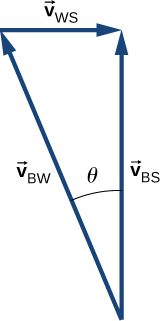
d.
e. but only the component of the velocity straight across the river is used to get the time
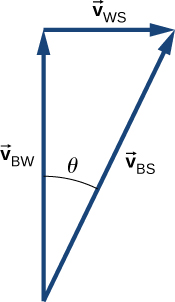
Downstream = 0.3 km
4-77 §4.5 source ↗
Answer
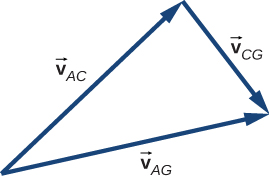
The angle between and is so the direction of the wind is north of east.
4-79 §4.AP source ↗
Answer
4-81 §4.AP source ↗
Answer
4-83 §4.AP source ↗
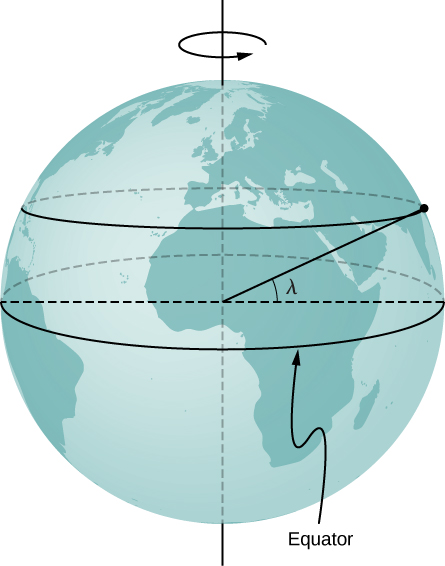
An elephant is located on Earth’s surface at a latitude Calculate the centripetal acceleration of the elephant resulting from the rotation of Earth around its polar axis. Express your answer in terms of the radius of Earth, and time T for one rotation of Earth. Compare your answer with g for
Answer
4-85 §4.AP source ↗
Answer
with respect to the tangent to the circle of revolution directed inward.
4-87 §4.AP source ↗
Answer
4-89 §4.AP source ↗
Answer
4-91 §4.AP source ↗
Answer
4-93 §4.AP source ↗
Answer
4-95 §4.AP source ↗
Answer
4-97 §4.AP source ↗
Answer
4-99 §4.CP source ↗
Answer
, b.
4-101 §4.CP source ↗
Answer
,
b.
Loading chapter 5…
Problems and answers are adapted from University Physics Volume 1 by Samuel J. Ling, Jeff Sanny and William Moebs, OpenStax, and are used under the CC BY-NC-SA 4.0 licence. Access for free at https://openstax.org/books/university-physics-volume-1/pages/1-introduction. Illustrations: Copyright Rice University, OpenStax, under CC BY-NC-SA 4.0 license. This adaptation is released under the same licence, is non-commercial, and is neither affiliated with nor endorsed by OpenStax or Rice University.