Every problem in the chapter beside the book’s answer, a chapter at a time as you scroll.

Chapter 7: Work and Kinetic Energy

62 problems · 6 figures

Check Your Understanding 7.1 §7.1 source ↗

Can kinetic friction ever be a constant force for all paths?

Answer

No, only its magnitude can be constant; its direction must change, to be always opposite the relative displacement along the surface.

Check Your Understanding 7.2 §7.1 source ↗

Can Earth’s gravity ever be a constant force for all paths?

Answer

No, it’s only approximately constant near Earth’s surface.

Check Your Understanding 7.3 §7.1 source ↗

Find the work done by the same force in Example 7.4 over a cubic path, y= (0.25m−2)x3, between the same points A=(0,0) and B=(2m,2m).

Answer

W = 35 J

Check Your Understanding 7.4 §7.1 source ↗

The spring in Example 7.5 is compressed 6 cm from its equilibrium length. (a) Does the spring force do positive or negative work and (b) what is the magnitude?

Answer

a. The spring force is the opposite direction to a compression (as it is for an extension), so the work it does is negative. b. The work done depends on the square of the displacement, which is the same for x=±6cm, so the magnitude is 0.54 J.

Check Your Understanding 7.5 §7.2 source ↗

(a) A car and a truck are each moving with the same kinetic energy. Assume that the truck has more mass than the car. Which has the greater speed? (b) A car and a truck are each moving with the same speed. Which has the greater kinetic energy?

Answer

a. the car; b. the truck

Check Your Understanding 7.6 §7.2 source ↗

You are rowing a boat parallel to the banks of a river. Your kinetic energy relative to the banks is less than your kinetic energy relative to the water. Are you rowing with or against the current?

Answer

against

Check Your Understanding 7.7 §7.3 source ↗

Suppose the radius of the loop-the-loop in Example 7.9 is 15 cm and the toy car starts from rest at a height of 45 cm above the bottom. What is its speed at the top of the loop?

Answer

3 m/s

Check Your Understanding 7.8 §7.4 source ↗

Estimate the power expended by a weightlifter raising a 150-kg barbell 2 m in 3 s.

Answer

980 W

7-1 §7.1 source ↗

Give an example of something we think of as work in everyday circumstances that is not work in the scientific sense. Is energy transferred or changed in form in your example? If so, explain how this is accomplished without doing work.

Answer

When you push on the wall, this “feels” like work; however, there is no displacement so there is no physical work. Energy is consumed, but no energy is transferred.

7-3 §7.1 source ↗

Describe a situation in which a force is exerted for a long time but does no work. Explain.

Answer

If you continue to push on a wall without breaking through the wall, you continue to exert a force with no displacement, so no work is done.

7-5 §7.1 source ↗

Suppose you throw a ball upward and catch it when it returns at the same height. How much work does the gravitational force do on the ball over its entire trip?

Answer

The total displacement of the ball is zero, so no work is done.

7-7 §7.1 source ↗

As a young man, Tarzan climbed up a vine to reach his tree house. As he got older, he decided to build and use a staircase instead. Since the work of the gravitational force mg is path independent, what did the King of the Apes gain in using stairs?

Answer

Both require the same gravitational work, but the stairs allow Tarzan to take this work over a longer time interval and hence gradually exert his energy, rather than dramatically by climbing a vine.

7-9 §7.2 source ↗

One particle has mass m and a second particle has mass 2m. The second particle is moving with speed v and the first with speed 2v. How do their kinetic energies compare?

Answer

The first particle has a kinetic energy of 4(12mv2) whereas the second particle has a kinetic energy of 2(12mv2), so the first particle has twice the kinetic energy of the second particle.

7-11 §7.3 source ↗

The person shown below does work on the lawn mower. Under what conditions would the mower gain energy from the person pushing the mower? Under what conditions would it lose energy?
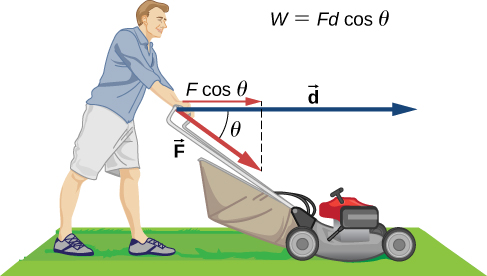
A person pushing a lawn mower with a force F. Force is represented by a vector parallel to the mower handle, making an angle theta below the horizontal. The distance moved by the mower is represented by horizontal vector d. The horizontal component of vector F along vector d is F cosine theta. Work done by the person, W, is equal to F d cosine theta.

Answer

The mower would gain energy if −90°< θ< 90°. It would lose energy if 90°< θ< 270°. The mower may also lose energy due to friction with the grass while pushing; however, we are not concerned with that energy loss for this problem.

7-13 §7.3 source ↗

Two marbles of masses m and 2m are dropped from a height h. Compare their kinetic energies when they reach the ground.

Answer

The second marble has twice the kinetic energy of the first because kinetic energy is directly proportional to mass, like the work done by gravity.

7-15 §7.3 source ↗

Suppose you are jogging at constant velocity. Are you doing any work on the environment and vice versa?

Answer

Unless the environment is nearly frictionless, you are doing some positive work on the environment to cancel out the frictional work against you, resulting in zero total work producing a constant velocity.

7-17 §7.4 source ↗

Most electrical appliances are rated in watts. Does this rating depend on how long the appliance is on? (When off, it is a zero-watt device.) Explain in terms of the definition of power.

Answer

Appliances are rated in terms of the energy consumed in a relatively small time interval. It does not matter how long the appliance is on, only the rate of change of energy per unit time.

7-19 §7.4 source ↗

A spark of static electricity, such as that you might receive from a doorknob on a cold dry day, may carry a few hundred watts of power. Explain why you are not injured by such a spark.

Answer

The spark occurs over a relatively short time span, thereby delivering a very low amount of energy to your body.

7-21 §7.4 source ↗

Can the power expended by a force be negative?

Answer

If the force is antiparallel or points in an opposite direction to the velocity, the power expended can be negative.

7-23 §7.1 source ↗

How much work does a supermarket checkout attendant do on a can of soup he pushes 0.600 m horizontally with a force of 5.00 N?

Answer

3.00 J

7-25 §7.1 source ↗

(a) Calculate the work done on a 1500-kg elevator car by its cable to lift it 40.0 m at constant speed, assuming friction averages 100 N. (b) What is the work done on the elevator car by the gravitational force in this process? (c) What is the total work done on the elevator car?

Answer

a. 592 kJ; b. –588 kJ; c. 0 J

7-27 §7.1 source ↗

An 85.0-kg man who pushes a crate 4.00 m up along a ramp that makes an angle of 20.0° with the horizontal (see below). He exerts a force of 500 N on the crate parallel to the ramp and moves at a constant speed. Find the total work done on the crate and the man.
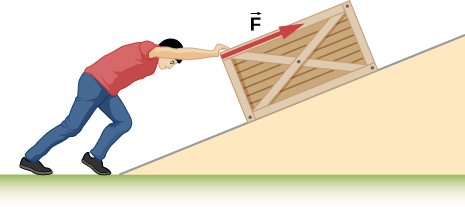
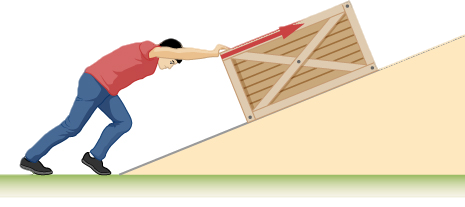
A person is pushing a crate up a ramp. The person is pushing with force F parallel to the ramp.A person is pushing a crate up a ramp. The person is pushing with force F parallel to the ramp.

Answer

3.14 kJ

7-29 §7.1 source ↗

A shopper pushes a grocery cart 20.0 m at constant speed on level ground, against a 35.0 N frictional force. He pushes in a direction 25.0° below the horizontal. (a) What is the work done on the cart by friction? (b) What is the work done on the cart by the gravitational force? (c) What is the work done on the cart by the shopper? (d) Find the force the shopper exerts, using energy considerations. (e) What is the total work done on the cart?

Answer

a. –700 J; b. 0 J; c. 700 J; d. 38.6 N; e. 0 J

7-31 §7.1 source ↗

A constant 20-N force pushes a small ball in the direction of the force over a distance of 5.0 m. What is the work done by the force?

Answer

100 J

7-33 §7.1 source ↗

A 5.0-kg box rests on a horizontal surface. The coefficient of kinetic friction between the box and surface is μK=0.50. A horizontal force pulls the box at constant velocity for 10 cm. Find the work done by (a) the applied horizontal force, (b) the frictional force, and (c) the net force.

Answer

a. 2.45 J; b. – 2.45 J; c. 0 J

7-35 §7.1 source ↗

Suppose that the sled plus passenger of the preceding problem is pushed 20 m across the snow at constant velocity by a force directed 30° below the horizontal. Calculate (a) the work of the applied force, (b) the work of friction, and (c) the total work.

Answer

a. 2.22 kJ; b. −2.22 kJ; c. 0 J

7-37 §7.1 source ↗

How much work is done against the gravitational force on a 5.0-kg briefcase when it is carried from the ground floor to the roof of the Empire State Building, a vertical climb of 380 m?

Answer

18.6 kJ

7-39 §7.1 source ↗

A bungee cord is essentially a very long rubber band that can stretch up to four times its unstretched length. However, its spring constant varies over its stretch [see Menz, P.G. “The Physics of Bungee Jumping.” The Physics Teacher (November 1993) 31: 483-487]. Take the length of the cord to be along the x-direction and define the stretch x as the length of the cord l minus its un-stretched length l0; that is, x=l−l0 (see below). Suppose a particular bungee cord has a spring constant, for 0≤x≤4.88m, of k1=204N/m and for x≥4.88m, of k2=111N/m. (Recall that the spring constant is the slope of the force F(x) versus its stretch x.) (a) What is the tension in the cord when the stretch is 16.7 m (the maximum desired for a given jump)? (b) How much work must be done against the elastic force of the bungee cord to stretch it 16.7 m?
Figure 7.16 in the book ↗
(credit: modification of work by Graeme Churchard)

Answer

a. 2.32 kN; b. 22.0 kJ

7-41 §7.1 source ↗

Engineers desire to model the magnitude of the elastic force of a bungee cord using the equation
F(x)= a[x+9m9m−(9mx+9m)2],
where x is the stretch of the cord along its length and a is a constant. If it takes 22.0 kJ of work to stretch the cord by 16.7 m, determine the value of the constant a.

Answer

835 N

7-43 §7.1 source ↗

A particle moves along a curved path y(x)= (10m){1+cos[(0.1m−1)x]}, from x=0 to x=10πm, subject to a tangential force of variable magnitude F(x)= (10N)sin[(0.1m−1)x]. How much work does the force do? (Hint: Consult a table of integrals or use a numerical integration program.)

Answer

257 J

7-45 §7.2 source ↗

(a) How fast must a 3000-kg elephant move to have the same kinetic energy as a 65.0-kg sprinter running at 10.0 m/s? (b) Discuss how the larger energies needed for the movement of larger animals would relate to metabolic rates.

Answer

a. 1.47 m/s; b. answers may vary

7-47 §7.2 source ↗

Calculate the kinetic energies of (a) a 2000.0-kg automobile moving at 100.0 km/h; (b) an 80.-kg runner sprinting at 10. m/s; and (c) a 9.1×10⁻³¹-kg electron moving at 2.0×10⁷m/s.

Answer

a. 772 kJ; b. 4.0 kJ; c. 1.8×10⁻¹⁶J

7-49 §7.2 source ↗

An 8.0-g bullet has a speed of 800 m/s. (a) What is its kinetic energy? (b) What is its kinetic energy if the speed is halved?

Answer

a. 2.6 kJ; b. 640 J

7-51 §7.3 source ↗

A car’s bumper is designed to withstand a 4.0-km/h (1.1-m/s) collision with an immovable object without damage to the body of the car. The bumper cushions the shock by absorbing the force over a distance. Calculate the magnitude of the average force on a bumper that collapses 0.200 m while bringing a 900-kg car to rest from an initial speed of 1.1 m/s.

Answer

2.72 kN

7-53 §7.3 source ↗

Using energy considerations, calculate the average force a 60.0-kg sprinter exerts backward on the track to accelerate from 2.00 to 8.00 m/s in a distance of 25.0 m, if he encounters a headwind that exerts an average force of 30.0 N against him.

Answer

102 N

7-55 §7.3 source ↗

A constant 10-N horizontal force is applied to a 20-kg cart at rest on a level floor. If friction is negligible, what is the speed of the cart when it has been pushed 8.0 m?

Answer

2.8 m/s

7-57 §7.3 source ↗

Compare the work required to stop a 100-kg crate sliding at 1.0 m/s and an 8.0-g bullet traveling at 500 m/s.

Answer

W(bullet)= 20×W(crate)

7-59 §7.3 source ↗

An 8.0-g bullet with a speed of 800 m/s is shot into a wooden block and penetrates 20 cm before stopping. What is the average force of the wood on the bullet? Assume the block does not move.

Answer

12.8 kN

7-61 §7.3 source ↗

When a 3.0-kg block is pushed against a massless spring of force constant 4.5×10³N/m, the spring is compressed 8.0 cm. The block is released, and it slides 2.0 m (from the point at which it is released) across a horizontal surface before friction stops it. What is the coefficient of kinetic friction between the block and the surface?

Answer

0.25

7-63 §7.3 source ↗

A small object is placed at the top of an incline that is essentially frictionless. The object slides down the incline onto a rough horizontal surface, where it stops in 5.0 s after traveling 60 m. (a) What is the speed of the object at the bottom of the incline and its acceleration along the horizontal surface? (b) What is the height of the incline?

Answer

a. 24 m/s, −4.8 m/s2; b. 29.4 m

7-65 §7.3 source ↗

A 0.22LR-caliber bullet like that mentioned in Example 7.10 is fired into a door made of a single thickness of 1-inch pine boards. How fast would the bullet be traveling after it penetrated through the door?
Example 7.10 Determining a Stopping Force in the book ↗

Answer

313 m/s

7-67 §7.4 source ↗

A person in good physical condition can put out 100 W of useful power for several hours at a stretch, perhaps by pedaling a mechanism that drives an electric generator. Neglecting any problems of generator efficiency and practical considerations such as resting time: (a) How many people would it take to run a 4.00-kW electric clothes dryer? (b) How many people would it take to replace a large electric power plant that generates 800 MW?

Answer

a. 40; b. 8 million

7-69 §7.4 source ↗

A large household air conditioner may consume 15.0 kW of power. What is the cost of operating this air conditioner 3.00 h per day for 30.0 d if the cost of electricity is $0.110 per kW·h?

Answer

$149

7-71 §7.4 source ↗

(a) What is the average useful power output of a person who does 6.00×10⁶J of useful work in 8.00 h? (b) Working at this rate, how long will it take this person to lift 2000 kg of bricks 1.50 m to a platform? (Work done to lift his body can be omitted because it is not considered useful output here.)

Answer

a. 208 W; b. 141 s

7-73 §7.4 source ↗

(a) How long will it take an 850-kg car with a useful power output of 40.0 hp (1 hp equals 746 W) to reach a speed of 15.0 m/s, neglecting friction? (b) How long will this acceleration take if the car also climbs a 3.00-m high hill in the process?

Answer

a. 3.20 s; b. 4.04 s

7-75 §7.4 source ↗

(a) How long would it take a 1.50×10⁵-kg airplane with engines that produce 100 MW of power to reach a speed of 250 m/s and an altitude of 12.0 km if air resistance were negligible? (b) If it actually takes 900 s, what is the power? (c) Given this power, what is the average force of air resistance if the airplane takes 1200 s to reach 250 m/s? (Hint: You must find the distance the plane travels in 1200 s assuming constant acceleration.)

Answer

a. 224 s; b. 24.8 MW; c. 49.7 kN

7-77 §7.4 source ↗

A man of mass 80 kg runs up a flight of stairs 20 m high in 10 s. (a) how much power is used to lift the man? (b) If the man’s body is 25% efficient, how much power does he expend?

Answer

a. 1.57 kW; b. 6.28 kW

7-79 §7.4 source ↗

An electron in a television tube is accelerated uniformly from rest to a speed of 8.4×10⁷m/s over a distance of 2.5 cm. What is the power delivered to the electron at the instant that its displacement is 1.0 cm?

Answer

6.83 μW

7-81 §7.4 source ↗

A girl pulls her 15-kg wagon along a flat sidewalk by applying a 10-N force at 37° to the horizontal. Assume that friction is negligible and that the wagon starts from rest. (a) How much work does the girl do on the wagon in the first 2.0 s. (b) How much instantaneous power does she exert at t=2.0s?

Answer

a. 8.51 J; b. 8.51 W

7-83 §7.4 source ↗

When jogging at 13 km/h on a level surface, a 70-kg man uses energy at a rate of approximately 850 W. Using the facts that the “human engine” is approximately 25% efficient, determine the rate at which this man uses energy when jogging up a 5.0° slope at this same speed. Assume that the frictional retarding force is the same in both cases.

Answer

1.7 kW

7-85 §7.AP source ↗

Consider a particle on which several forces act, one of which is known to be constant in time: F→1= (3N)i^+ (4N)j^. As a result, the particle moves along the x-axis from x=0 to x=5m in some time interval. What is the work done by F→1 ?

Answer

15 N · m

7-87 §7.AP source ↗

Consider a particle on which several forces act, one of which is known to be constant in time: F→1= (3N)i^+ (4N)j^. As a result, the particle moves along a straight path from a Cartesian coordinate of (0 m, 0 m) to (5 m, 6 m). What is the work done by F→1 ?

Answer

39 N · m

7-89 §7.AP source ↗

A boy pulls a 5-kg cart with a 20-N force at an angle of 30° above the horizontal for a length of time. Over this time frame, the cart moves a distance of 12 m on the horizontal floor. (a) Find the work done on the cart by the boy. (b) What will be the work done by the boy if he pulled with the same force horizontally instead of at an angle of 30° above the horizontal over the same distance?

Answer

a. 208N·m; b. 240N·m

7-91 §7.AP source ↗

A hockey puck of mass 0.17 kg is shot across a rough floor with the roughness different at different places, which can be described by a position-dependent coefficient of kinetic friction. For a puck moving along the x-axis, the coefficient of kinetic friction is the following function of x, where x is in m: μ(x)= 0.1+ 0.05x. Find the work done by the kinetic frictional force on the hockey puck when it has moved (a) from x=0 to x=2m, and (b) from x=2m to x=4m.

Answer

a. −0.5N·m; b. −0.83N·m

7-93 §7.AP source ↗

A 7.0-kg box slides along a horizontal frictionless floor at 1.7 m/s and collides with a relatively massless spring that compresses 23 cm before the box comes to a stop. (a) How much kinetic energy does the box have before it collides with the spring? (b) Calculate the work done by the spring. (c) Determine the spring constant of the spring.

Answer

a. 10. J; b. –10. J; c. 380 N/m

7-95 §7.AP source ↗

A crate is being pushed across a rough floor surface. If no force is applied on the crate, the crate will slow down and come to a stop. If the crate of mass 50 kg moving at speed 8 m/s comes to rest in 10 seconds, what is the rate at which the frictional force on the crate takes energy away from the crate?

Answer

160 J/s

7-97 §7.AP source ↗

Grains from a hopper falls at a rate of 10 kg/s vertically onto a conveyor belt that is moving horizontally at a constant speed of 2 m/s. (a) What force is needed to keep the conveyor belt moving at the constant velocity? (b) What is the minimum power of the motor driving the conveyor belt?

Answer

a. 20 N; b. 40 W

7-99 §7.CP source ↗

Shown below is a 40-kg crate that is pushed at constant velocity a distance 8.0 m along a 30° incline by the horizontal force F→. The coefficient of kinetic friction between the crate and the incline is μk=0.40. Calculate the work done by (a) the applied force, (b) the frictional force, (c) the gravitational force, and (d) the net force.
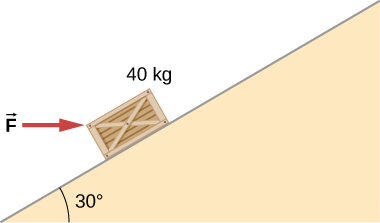
A 40 kilogram block is on a slope that makes an angle of 30 degrees to the horizontal. A force vector F pushes the block horizontally into the slope.

Answer

If crate goes up: a. 3.46 kJ; b. −1.89 kJ; c. −1.57 kJ; d. 0; If crate goes down: a. −0.39 kJ; b. −1.18 kJ; c. 1.57 kJ; d. 0

7-101 §7.CP source ↗

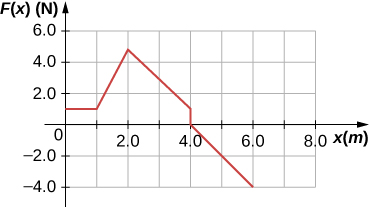
The force F(x) varies with position, as shown below. Find the work done by this force on a particle as it moves from x=1.0m to x=5.0m.

This graph shows the function F(x) in Newtons as a function of x in meters. F(x) is constant at 1.0 N from x = 0 to x=1.0 m. It rises linearly to 5.0 N at x = 2.0 m then decreases linearly to 1.0 N at x = 4.0 m where it then drops instantly to 0 Newtons. F(x) then decreases linearly from 0 N at 4.0 m to -4.0 N at x=6.0 m.

Answer

8.0 J

7-103 §7.CP source ↗

Answer the preceding problem using polar coordinates.

Answer

35.7 J

7-105 §7.CP source ↗

Answer the preceding problem using polar coordinates.

Answer

24.3 J

7-107 §7.CP source ↗

Suppose that the air resistance a car encounters is independent of its speed. When the car travels at 15 m/s, its engine delivers 20 hp to its wheels. (a) What is the power delivered to the wheels when the car travels at 30 m/s? (b) How much energy does the car use in covering 10 km at 15 m/s? At 30 m/s? Assume that the engine is 25% efficient. (c) Answer the same questions if the force of air resistance is proportional to the speed of the automobile. (d) What do these results, plus your experience with gasoline consumption, tell you about air resistance?

Answer

a. 40 hp; b. 39.8 MJ, independent of speed; c. 80 hp, 79.6 MJ at 30 m/s; d. If air resistance is proportional to speed, the car gets about 22 mpg at 34 mph and half that at twice the speed, closer to actual driving experience.

Loading chapter 8…

Problems and answers are adapted from University Physics Volume 1 by Samuel J. Ling, Jeff Sanny and William Moebs, OpenStax, and are used under the CC BY-NC-SA 4.0 licence. Access for free at https://openstax.org/books/university-physics-volume-1/pages/1-introduction. Illustrations: Copyright Rice University, OpenStax, under CC BY-NC-SA 4.0 license. This adaptation is released under the same licence, is non-commercial, and is neither affiliated with nor endorsed by OpenStax or Rice University.