Every problem in the chapter beside the book’s answer, a chapter at a time as you scroll.
Chapter 13: Gravitation
55 problems · 2 figuresCheck Your Understanding 13.1 §13.1 source ↗
Answer
Check Your Understanding 13.2 §13.2 source ↗
Answer
Check Your Understanding 13.3 §13.3 source ↗
Answer
The value of g drops by about 10% over this change in height. So will give too large a value. If we use , then we get
which is about 6% greater than that found with the correct method.
Check Your Understanding 13.4 §13.3 source ↗
Answer
Check Your Understanding 13.5 §13.3 source ↗
Answer
Check Your Understanding 13.6 §13.4 source ↗
Answer
Check Your Understanding 13.7 §13.4 source ↗
Answer
Check Your Understanding 13.8 §13.4 source ↗
Answer
Check Your Understanding 13.9 §13.5 source ↗
Answer
Check Your Understanding 13.10 §13.6 source ↗
Answer
Check Your Understanding 13.11 §13.7 source ↗
Answer
13-1 §13.1 source ↗
Answer
13-3 §13.2 source ↗
Answer
13-5 §13.3 source ↗
Answer
13-7 §13.4 source ↗
Answer
13-9 §13.5 source ↗
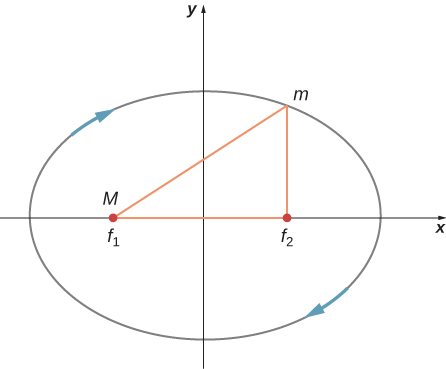
In the diagram below for a satellite in an elliptical orbit about a much larger mass, indicate where its speed is the greatest and where it is the least. What conservation law dictates this behavior? Indicate the directions of the force, acceleration, and velocity at these points. Draw vectors for these same three quantities at the two points where the y-axis intersects (along the semi-minor axis) and from this determine whether the speed is increasing decreasing, or at a max/min.
Answer
13-11 §13.7 source ↗
Answer
13-13 §13.1 source ↗
Answer
13-15 §13.1 source ↗
Answer
13-17 §13.1 source ↗
Answer
13-19 §13.1 source ↗
Answer
13-21 §13.2 source ↗
Answer
13-23 §13.2 source ↗
Answer
13-25 §13.2 source ↗
Answer
13-27 §13.2 source ↗
Answer
13-29 §13.3 source ↗
Answer
13-31 §13.3 source ↗
Answer
13-33 §13.3 source ↗
Answer
13-35 §13.3 source ↗
Answer
13-37 §13.4 source ↗
Answer
13-39 §13.4 source ↗
Answer
13-41 §13.4 source ↗
Answer
13-43 §13.4 source ↗
Answer
13-45 §13.4 source ↗
Answer
13-47 §13.5 source ↗
Answer
13-49 §13.5 source ↗
Answer
13-51 §13.5 source ↗
Answer
13-53 §13.5 source ↗
Answer
13-55 §13.6 source ↗
Answer
13-57 §13.7 source ↗
Answer
13-59 §13.AP source ↗
Answer
13-61 §13.AP source ↗
Answer
13-63 §13.AP source ↗
Answer
13-65 §13.AP source ↗
Answer
13-67 §13.AP source ↗
Answer
13-69 §13.AP source ↗
Answer
13-71 §13.AP source ↗
Answer
13-73 §13.AP source ↗
Answer
13-75 §13.AP source ↗
Answer
13-77 §13.AP source ↗
Answer
13-79 §13.AP source ↗
Answer
13-81 §13.CP source ↗
Answer
13-83 §13.CP source ↗
Answer
13-85 §13.CP source ↗
Answer
where . If , then , and upon substitution, we have
where we recognize the expression with the parenthesis as the definition of g.
13-87 §13.CP source ↗
Answer
;
b. For the case given, using the Schwarzschild radius from a previous problem, we have a tidal force of . This won’t even be noticed!
Loading chapter 14…
Problems and answers are adapted from University Physics Volume 1 by Samuel J. Ling, Jeff Sanny and William Moebs, OpenStax, and are used under the CC BY-NC-SA 4.0 licence. Access for free at https://openstax.org/books/university-physics-volume-1/pages/1-introduction. Illustrations: Copyright Rice University, OpenStax, under CC BY-NC-SA 4.0 license. This adaptation is released under the same licence, is non-commercial, and is neither affiliated with nor endorsed by OpenStax or Rice University.