Every problem in the chapter beside the book’s answer, a chapter at a time as you scroll.
Chapter 3: Motion Along a Straight Line
65 problems · 11 figuresCheck Your Understanding 3.1 §3.1 source ↗
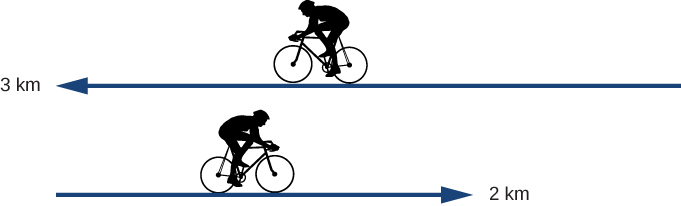
A cyclist rides 3 km west and then turns around and rides 2 km east. (a) What is their displacement? (b) What is the distance traveled? (c) What is the magnitude of their displacement?
Answer
Check Your Understanding 3.2 §3.2 source ↗
Answer
Check Your Understanding 3.3 §3.3 source ↗
Answer
Check Your Understanding 3.4 §3.3 source ↗
Answer
Check Your Understanding 3.5 §3.4 source ↗
Answer
Rearrange to solve for t:
Check Your Understanding 3.6 §3.4 source ↗
Answer
Check Your Understanding 3.7 §3.5 source ↗
Answer
Check Your Understanding 3.8 §3.6 source ↗
Answer
a. The velocity function is the integral of the acceleration function plus a constant of integration. By Equation 3.18,
Since v(0) = 0, we have C1 = 0; so,
b. By Equation 3.19,
.
Since x(0) = 0, we have C2 = 0, and
c. The velocity can be written as v(t) = 5t(1 – t), which equals zero at t = 0, and t = 1 s.
3-1 §3.1 source ↗
Answer
3-3 §3.1 source ↗
Answer
3-5 §3.1 source ↗
Answer
3-7 §3.2 source ↗
Answer
3-9 §3.2 source ↗
Answer
3-11 §3.3 source ↗
Answer
3-13 §3.3 source ↗
Answer
3-15 §3.3 source ↗
Answer
3-17 §3.4 source ↗
Answer
3-19 §3.5 source ↗
Answer
3-21 §3.5 source ↗
Answer
3-25 §3.1 source ↗
Answer
3-27 §3.1 source ↗
Answer
3-29 §3.1 source ↗
Answer
3-31 §3.2 source ↗
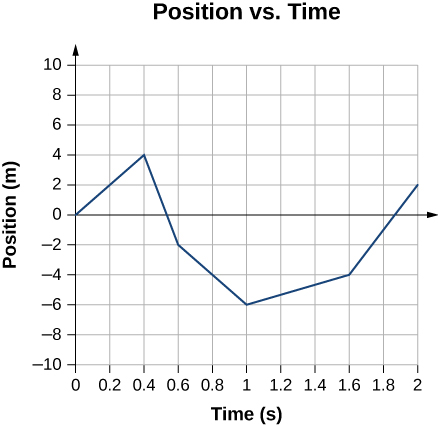
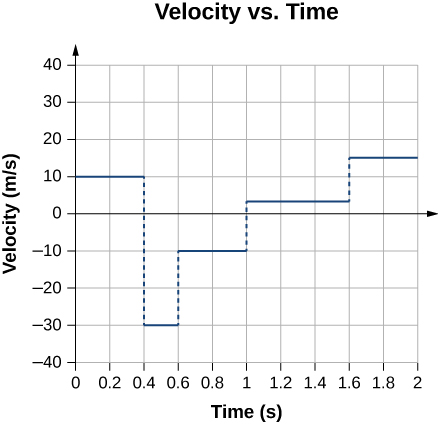
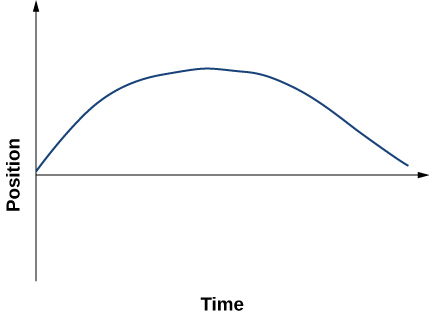
Sketch the velocity-versus-time graph from the following position-versus-time graph.
Answer
3-33 §3.2 source ↗
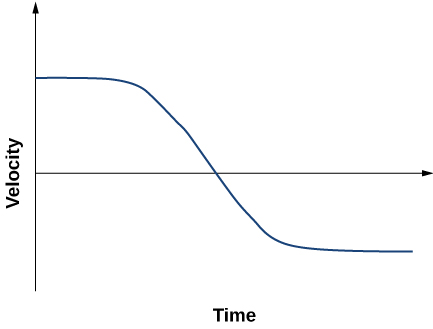
Given the following velocity-versus-time graph, sketch the position-versus-time graph.
Answer
3-35 §3.2 source ↗
Answer
3-37 §3.3 source ↗
Answer
3-39 §3.3 source ↗
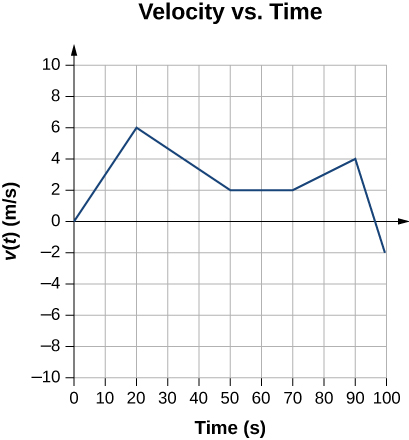
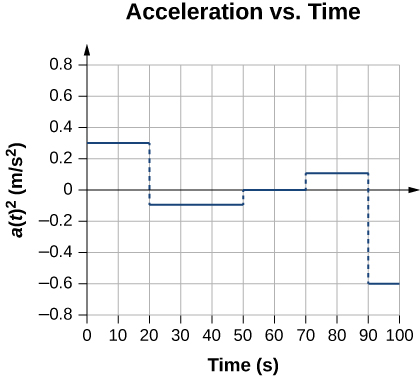
Sketch the acceleration-versus-time graph from the following velocity-versus-time graph.
Answer
3-41 §3.3 source ↗
Answer
3-43 §3.4 source ↗
Answer
3-45 §3.4 source ↗
Answer
b.
3-47 §3.4 source ↗
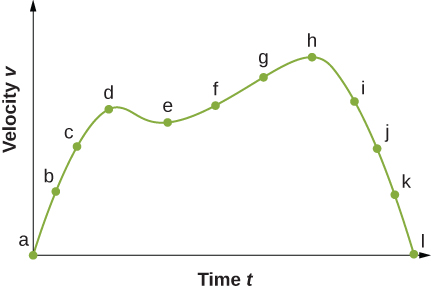
(a) Sketch a graph of acceleration versus time corresponding to the graph of velocity versus time given in the following figure. (b) Identify the time or times (ta, tb, tc, etc.) at which the acceleration has the greatest positive value. (c) At which times is it zero? (d) At which times is it negative?
Answer
a.
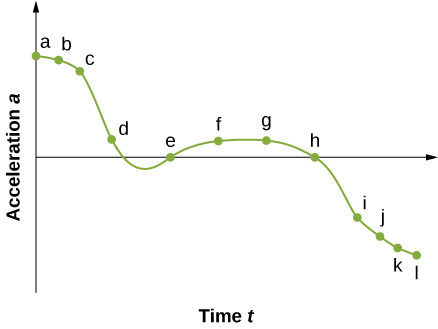
b. The acceleration has the greatest positive value at
c. The acceleration is zero at
d. The acceleration is negative at
3-49 §3.4 source ↗
Answer
b. ;
c.
3-51 §3.4 source ↗
Answer
3-53 §3.4 source ↗
Answer
a.
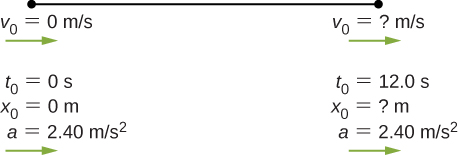
b. Knowns: , and ;
c. , the answer seems reasonable at about 172.8 m; d.
3-55 §3.4 source ↗
Answer
a.
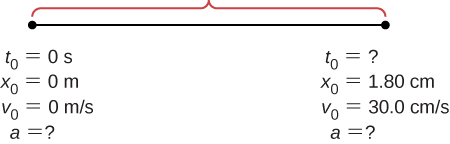
b. Knowns: ;
c. ;
d. yes
3-57 §3.4 source ↗
Answer
3-59 §3.4 source ↗
Answer
b.
3-61 §3.4 source ↗
Answer
b. ;
c.
3-63 §3.4 source ↗
Answer
3-65 §3.4 source ↗
Answer
b. ;
c. , because the assumption of constant acceleration is not valid for a dragster. A dragster changes gears and would have a greater acceleration in first gear than second gear than third gear, and so on. The acceleration would be greatest at the beginning, so it would not be accelerating at during the last few meters, but substantially less, and the final velocity would be less than .
3-67 §3.5 source ↗
Answer
b. ;
c. ;
d. ;
e.
3-69 §3.5 source ↗
Answer
b. and the origin is at the rescuers, who are 18.4 m above the water.
3-71 §3.5 source ↗
Answer
3-73 §3.5 source ↗
Answer
Take the positive root, so the time to go the additional 0.4 m is 0.04 s. Total time is .
3-75 §3.5 source ↗
Answer
3-77 §3.5 source ↗
Answer
3-79 §3.6 source ↗
Answer
b. ;
c.
3-81 §3.6 source ↗
Answer
b.
3-83 §3.AP source ↗
Answer
1st plane:
2nd plane
3-85 §3.AP source ↗
Answer
3-87 §3.AP source ↗
Answer
3-89 §3.AP source ↗
Answer
;
b.
3-91 §3.AP source ↗
Answer
3-93 §3.AP source ↗
Answer
3-95 §3.AP source ↗
Answer
3-97 §3.AP source ↗
Answer
3-99 §3.AP source ↗
Answer
3-101 §3.AP source ↗
Answer
3-103 §3.AP source ↗
Answer
b. ;
c. ;
d.
3-105 §3.AP source ↗
Answer
0.9 s
0.5 s
3-107 §3.AP source ↗
Answer
b.
3-109 §3.AP source ↗
Answer
b. ;
c.
3-111 §3.AP source ↗
Answer
in t – 1 seconds it drops 2/3h
or
t = 5.45 s and h = 145.5 m. Other root is less than 1 s. Check for t = 4.45 s m
3-113 §3.CP source ↗
Answer
b. ; c. The slope of the position function is zero or the velocity is zero. There are two possible solutions: t = 0, which gives x = 0, or t = 10.0/12.0 = 0.83 s, which gives x = 1.16 m. The second answer is the correct choice; d. 0.83 s (e) 1.16 m
3-115 §3.CP source ↗
Answer
distance covered during acceleration
at a constant speed
so total time is .
Loading chapter 4…
Problems and answers are adapted from University Physics Volume 1 by Samuel J. Ling, Jeff Sanny and William Moebs, OpenStax, and are used under the CC BY-NC-SA 4.0 licence. Access for free at https://openstax.org/books/university-physics-volume-1/pages/1-introduction. Illustrations: Copyright Rice University, OpenStax, under CC BY-NC-SA 4.0 license. This adaptation is released under the same licence, is non-commercial, and is neither affiliated with nor endorsed by OpenStax or Rice University.