Every problem in the chapter beside the book’s answer, a chapter at a time as you scroll.
Chapter 14: Fluid Mechanics
69 problems · 8 figuresCheck Your Understanding 14.1 §14.1 source ↗
Answer
Check Your Understanding 14.2 §14.2 source ↗
Answer
Check Your Understanding 14.3 §14.3 source ↗
Answer
14-1 §14.1 source ↗
Answer
14-3 §14.1 source ↗
Answer
14-5 §14.1 source ↗
Answer
14-7 §14.1 source ↗
Answer
14-9 §14.1 source ↗
Answer
14-11 §14.1 source ↗
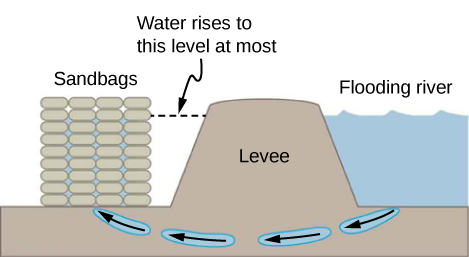
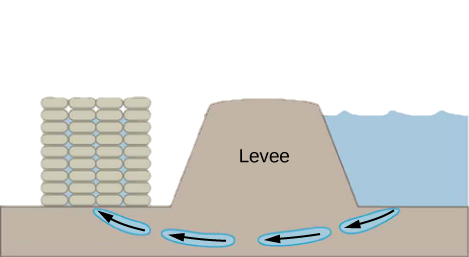
The image shows how sandbags placed around a leak outside a river levee can effectively stop the flow of water under the levee. Explain how the small amount of water inside the column of sandbags is able to balance the much larger body of water behind the levee.
Answer
14-13 §14.1 source ↗
Answer
14-15 §14.2 source ↗
Answer
14-17 §14.4 source ↗
Answer
14-19 §14.4 source ↗
Answer
14-21 §14.5 source ↗
Answer
14-23 §14.6 source ↗
Answer
14-25 §14.6 source ↗
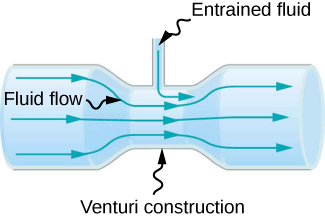
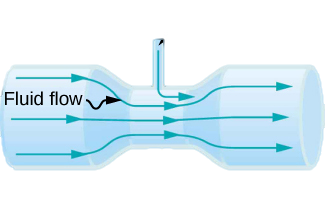
A tube with a narrow segment designed to enhance entrainment is called a Venturi, such as shown below. Venturis are very commonly used in carburetors and aspirators. How does this structure bolster entrainment?
Answer
14-27 §14.6 source ↗
Answer
14-29 §14.6 source ↗
Answer
14-31 §14.6 source ↗
Answer
14-33 §14.6 source ↗
Answer
14-35 §14.6 source ↗
Answer
14-37 §14.7 source ↗
Answer
14-39 §14.7 source ↗
Answer
14-41 §14.1 source ↗
Answer
14-43 §14.1 source ↗
Answer
14-45 §14.1 source ↗
Answer
14-47 §14.1 source ↗
Answer
14-49 §14.1 source ↗
Answer
14-51 §14.1 source ↗
Answer
14-53 §14.1 source ↗
Answer
14-55 §14.1 source ↗
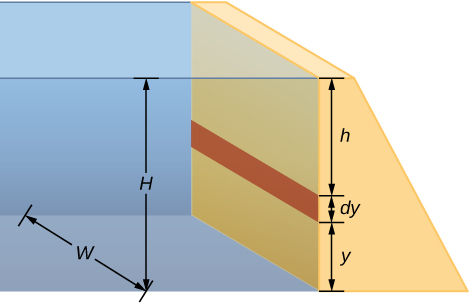
A dam is used to hold back a river. The dam has a height and a width Assume that the density of the water is (a) Determine the net force on the dam. (b) Why does the thickness of the dam increase with depth?
Answer
b. The pressure increases as the depth increases, so the dam must be built thicker toward the bottom to withstand the greater pressure.
14-57 §14.2 source ↗
Answer
14-59 §14.3 source ↗
Answer
14-61 §14.3 source ↗
Answer
14-63 §14.3 source ↗
Answer
14-65 §14.4 source ↗
Answer
14-67 §14.4 source ↗
| Solids () | Liquids () | Gases ( 101.3 kPa) | |||
|---|---|---|---|---|---|
| Substance | Substance | Substance | |||
| Aluminum | Benzene | Air | |||
| Bone | Blood | Carbon dioxide | |||
| Brass | Ethyl alcohol | Carbon monoxide | |||
| Concrete | Gasoline | Helium | |||
| Copper | Glycerin | Hydrogen | |||
| Cork | Mercury | Methane | |||
| Earth’s crust | Olive oil | Nitrogen | |||
| Glass | Nitrous oxide | ||||
| Gold | Oxygen | ||||
| Granite | |||||
| Iron | |||||
| Lead | |||||
| Oak | |||||
| Pine | |||||
| Platinum | |||||
| Polystyrene | |||||
| Tungsten | |||||
| Uranium | |||||
Answer
14-69 §14.4 source ↗
Answer
14-71 §14.4 source ↗
Answer
14-73 §14.4 source ↗
Answer
14-75 §14.5 source ↗
Answer
14-77 §14.5 source ↗
Answer
14-79 §14.5 source ↗
Answer
14-81 §14.5 source ↗
Answer
If the fluid is incompressible, the flow rate through both sides will be equal:
or
14-83 §14.6 source ↗
Answer
14-85 §14.6 source ↗
Answer
14-87 §14.6 source ↗
Answer
14-89 §14.6 source ↗
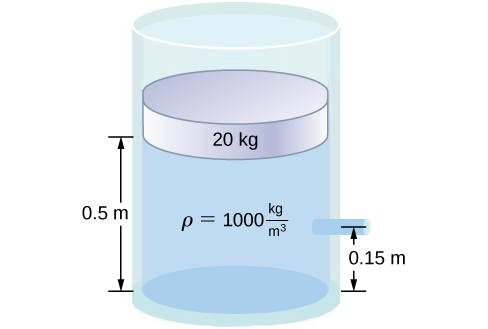
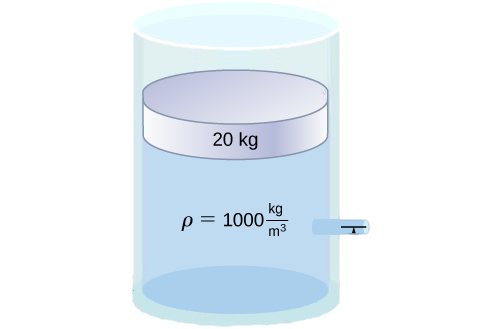
A container of water has a cross-sectional area of . A piston sits on top of the water (see the following figure). There is a spout located 0.15 m from the bottom of the tank, open to the atmosphere, and a stream of water exits the spout. The cross sectional area of the spout is . (a) What is the velocity of the water as it leaves the spout? (b) If the opening of the spout is located 1.5 m above the ground, how far from the spout does the water hit the floor? Ignore all friction and dissipative forces.
Answer
b.
14-91 §14.7 source ↗
Answer
14-93 §14.7 source ↗
Answer
14-95 §14.7 source ↗
Answer
14-97 §14.7 source ↗
Answer
14-99 §14.7 source ↗
Answer
14-101 §14.7 source ↗
Answer
Flow is not laminar.
b. Hose:
Flow is not laminar.
14-103 §14.7 source ↗
Answer
14-105 §14.AP source ↗
Answer
14-107 §14.AP source ↗
Answer
b. Since an infant is only approximately 20 inches tall, while an adult is approximately 70 inches tall, the blood pressure for an infant would be expected to be smaller than that of an adult. The blood only feels a pressure of 20 inches rather than 70 inches, so the pressure should be smaller.
14-109 §14.AP source ↗
Answer
14-111 §14.AP source ↗
Answer
14-113 §14.AP source ↗
Answer
14-115 §14.AP source ↗
Answer
14-117 §14.AP source ↗
Answer
14-119 §14.AP source ↗
Answer
14-121 §14.CP source ↗
Answer
14-123 §14.CP source ↗
Answer
14-125 §14.CP source ↗
Answer
14-127 §14.CP source ↗
Answer
14-129 §14.CP source ↗
Answer
14-131 §14.CP source ↗
Answer
Loading chapter 15…
Problems and answers are adapted from University Physics Volume 1 by Samuel J. Ling, Jeff Sanny and William Moebs, OpenStax, and are used under the CC BY-NC-SA 4.0 licence. Access for free at https://openstax.org/books/university-physics-volume-1/pages/1-introduction. Illustrations: Copyright Rice University, OpenStax, under CC BY-NC-SA 4.0 license. This adaptation is released under the same licence, is non-commercial, and is neither affiliated with nor endorsed by OpenStax or Rice University.