Every problem in the chapter beside the book’s answer, a chapter at a time as you scroll.
Chapter 17: Sound
83 problems · 10 figuresCheck Your Understanding 17.1 §17.2 source ↗
Answer
Check Your Understanding 17.2 §17.3 source ↗
Answer
Check Your Understanding 17.3 §17.3 source ↗
Answer
Check Your Understanding 17.4 §17.4 source ↗
Answer
Check Your Understanding 17.5 §17.4 source ↗
Answer
Check Your Understanding 17.6 §17.4 source ↗
Answer
Check Your Understanding 17.7 §17.4 source ↗
Answer
Check Your Understanding 17.8 §17.6 source ↗
Answer
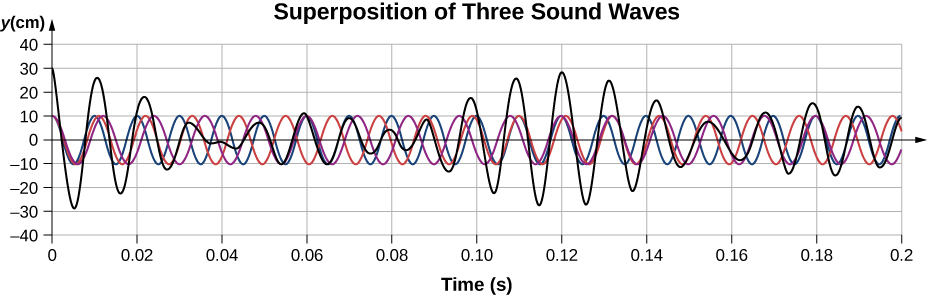
An easy way to understand this event is to use a graph, as shown below. It appears that beats are produced, but with a more complex pattern of interference.
Check Your Understanding 17.9 §17.7 source ↗
Answer
17-1 §17.1 source ↗
Answer
17-3 §17.1 source ↗
Answer
17-5 §17.2 source ↗
Answer
17-7 §17.2 source ↗
Answer
17-9 §17.3 source ↗
Answer
17-11 §17.4 source ↗
Answer
17-13 §17.4 source ↗
Answer
17-15 §17.5 source ↗
Answer
17-17 §17.5 source ↗
Answer
17-19 §17.6 source ↗
Answer
17-21 §17.6 source ↗
Answer
17-23 §17.7 source ↗
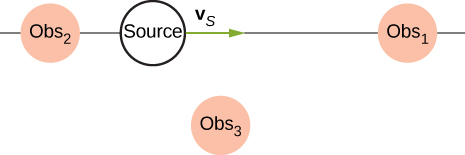
Three stationary observers observe the Doppler shift from a source moving at a constant velocity. The observers are stationed as shown below. Which observer will observe the highest frequency? Which observer will observe the lowest frequency? What can be said about the frequency observed by observer 3?

Answer
17-25 §17.7 source ↗
Answer
17-27 §17.8 source ↗
Answer
17-29 §17.1 source ↗
What is the maximum displacement, the wavelength, the frequency, and the speed of the sound wave?
Answer
17-31 §17.1 source ↗
Answer
17-33 §17.1 source ↗
Answer
b.
17-35 §17.1 source ↗
Answer
17-37 §17.1 source ↗
The transducer is to be used in nondestructive testing to test for fractures in steel beams. The speed of sound in the steel beam is Find the wave function for the sound wave in the steel beam.
Answer
17-39 §17.1 source ↗
Answer
17-41 §17.1 source ↗
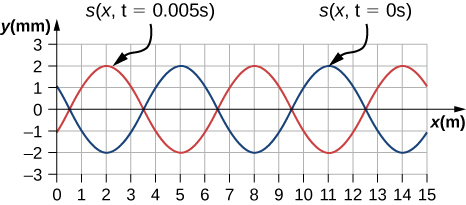
Consider the graph shown below of a compression wave. Shown are snapshots of the wave function for (blue) and (orange), one half of an oscillation later. What are the wavelength, maximum displacement, velocity, and period of the compression wave?
Answer
17-43 §17.1 source ↗
what is the wavelength of the sound wave?
Answer
17-45 §17.2 source ↗
Answer
17-47 §17.2 source ↗
| Medium | v (m/s) |
|---|---|
| Gases at | |
| Air | 331 |
| Carbon dioxide | 259 |
| Oxygen | 316 |
| Helium | 965 |
| Hydrogen | 1290 |
| Liquids at | |
| Ethanol | 1160 |
| Mercury | 1450 |
| Water, fresh | 1480 |
| Sea Water | 1540 |
| Human tissue | 1540 |
| Solids (longitudinal or bulk) | |
| Vulcanized rubber | 54 |
| Polyethylene | 920 |
| Marble | 3810 |
| Glass, Pyrex | 5640 |
| Lead | 1960 |
| Aluminum | 5120 |
| Steel | 5960 |
Answer
17-49 §17.2 source ↗
Answer
17-51 §17.2 source ↗
Answer
17-53 §17.2 source ↗
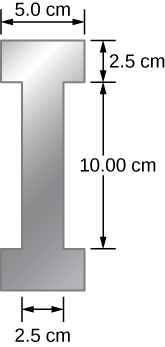
Ultrasonic sound waves are often used in methods of nondestructive testing. For example, this method can be used to find structural faults in a steel I-beams used in building. Consider a 10.00 meter long, steel I-beam with a cross-section shown below. The weight of the I-beam is 3846.50 N. What would be the speed of sound through in the I-beam? .

Answer
17-55 §17.2 source ↗
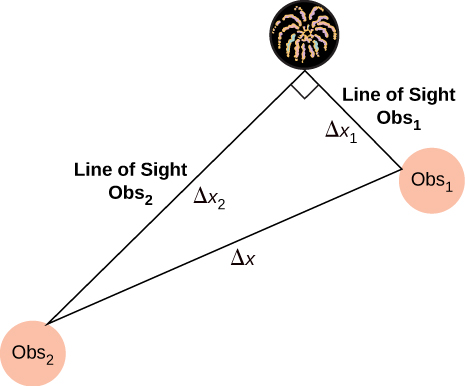
During a 4th of July celebration, an M80 firework explodes on the ground, producing a bright flash and a loud bang. The air temperature of the night air is Two observers see the flash and hear the bang. The first observer notes the time between the flash and the bang as 0.10 second. The second observer notes the difference as 0.15 seconds. The line of sight between the two observers meet at a right angle as shown below. What is the distance between the two observers?
Answer
17-57 §17.2 source ↗
Answer
17-59 §17.3 source ↗
Answer
17-61 §17.3 source ↗
Answer
17-63 §17.3 source ↗
Answer
17-65 §17.3 source ↗
Answer
17-67 §17.3 source ↗
Answer
17-69 §17.3 source ↗
Answer
120 dB corresponds to a factor of increase
17-71 §17.3 source ↗
Answer
17-73 §17.3 source ↗
Answer
17-75 §17.3 source ↗
Answer
17-77 §17.3 source ↗
Answer
17-79 §17.4 source ↗
Answer
17-81 §17.4 source ↗
Answer
17-83 §17.4 source ↗
Answer
b.
17-85 §17.4 source ↗
Answer
17-87 §17.4 source ↗
Answer
17-89 §17.5 source ↗
Answer
17-91 §17.5 source ↗
Answer
17-93 §17.5 source ↗
Answer
17-95 §17.5 source ↗
Answer
17-97 §17.5 source ↗
Answer
17-99 §17.5 source ↗
Answer
17-101 §17.6 source ↗
Answer
17-103 §17.6 source ↗
Answer
17-105 §17.6 source ↗
Answer
The frequency is 1076.83 Hz and the wavelength is 0.14 m.
17-107 §17.6 source ↗
Answer
17-109 §17.6 source ↗
Answer
17-111 §17.7 source ↗
Answer
17-113 §17.7 source ↗
Answer
17-115 §17.7 source ↗
Answer
17-117 §17.7 source ↗
Answer
17-119 §17.7 source ↗
Answer
17-121 §17.7 source ↗
Answer
17-123 §17.8 source ↗
Answer
17-125 §17.8 source ↗
Answer
17-127 §17.8 source ↗
Answer
17-129 §17.AP source ↗
Answer
17-131 §17.AP source ↗
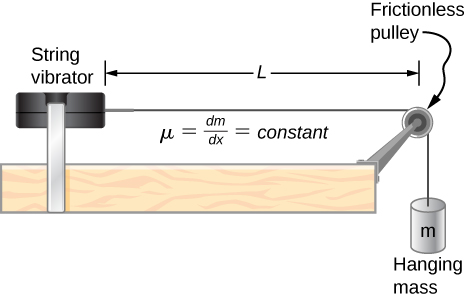
Consider the following figure. The length of the string between the string vibrator and the pulley is The linear density of the string is The string vibrator can oscillate at any frequency. The hanging mass is 2.00 kg. (a)What are the wavelength and frequency of mode? (b) The string oscillates the air around the string. What is the wavelength of the sound if the speed of the sound is ?
Answer
17-133 §17.AP source ↗
Answer
17-135 §17.AP source ↗
Answer
17-137 §17.AP source ↗
Answer
17-139 §17.CP source ↗
Answer
17-141 §17.CP source ↗
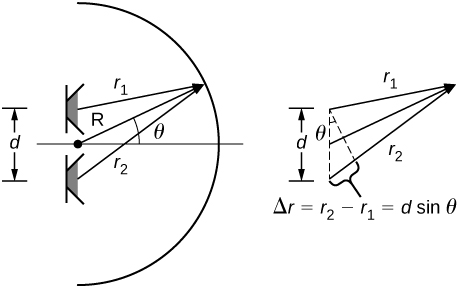
Two speakers producing the same frequency of sound are a distance of d apart. Consider an arc along a circle of radius R, centered at the midpoint of the speakers, as shown below. (a) At what angles will there be maxima? (b) At what angle will there be minima?
Answer
b. For minima,
17-143 §17.CP source ↗
Answer
17-145 §17.CP source ↗
Answer
17-147 §17.CP source ↗
Answer
d. ; e.
End of the book.
Problems and answers are adapted from University Physics Volume 1 by Samuel J. Ling, Jeff Sanny and William Moebs, OpenStax, and are used under the CC BY-NC-SA 4.0 licence. Access for free at https://openstax.org/books/university-physics-volume-1/pages/1-introduction. Illustrations: Copyright Rice University, OpenStax, under CC BY-NC-SA 4.0 license. This adaptation is released under the same licence, is non-commercial, and is neither affiliated with nor endorsed by OpenStax or Rice University.