Every problem in the chapter beside the book’s answer, a chapter at a time as you scroll.
Chapter 11: Angular Momentum
54 problems · 10 figuresCheck Your Understanding 11.1 §11.1 source ↗
Answer
Check Your Understanding 11.2 §11.2 source ↗
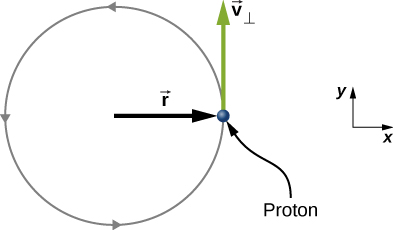
A proton spiraling around a magnetic field executes circular motion in the plane of the paper, as shown below. The circular path has a radius of 0.4 m and the proton has velocity . What is the angular momentum of the proton about the origin?
Answer
Check Your Understanding 11.3 §11.2 source ↗
Answer
. Thus, the cylinder has more angular momentum. This is because the cylinder has more mass distributed farther from the axis of rotation.
Check Your Understanding 11.4 §11.3 source ↗
Answer
Check Your Understanding 11.5 §11.4 source ↗
Answer
11-1 §11.1 source ↗
Answer
11-3 §11.1 source ↗
Answer
11-5 §11.1 source ↗
Answer
11-7 §11.2 source ↗
Answer
11-9 §11.2 source ↗
Answer
11-11 §11.3 source ↗
Answer
11-13 §11.3 source ↗
Answer
11-15 §11.3 source ↗
Answer
11-17 §11.4 source ↗
Answer
11-19 §11.1 source ↗
Answer
11-21 §11.1 source ↗
Answer
11-23 §11.1 source ↗
Answer
11-25 §11.1 source ↗
Answer
,
11-27 §11.1 source ↗
Answer
11-29 §11.1 source ↗
Answer
11-31 §11.1 source ↗
Answer
,
so the distance up the incline is .
11-33 §11.1 source ↗
Answer
,
.
Subtracting the two equations, eliminating the initial translational energy, we have
,
,
The ratio of the height reached by the sphere to the height reached by the cylinder is
So the sphere reaches a lower height of
11-35 §11.2 source ↗
Answer
11-37 §11.2 source ↗
Answer
b.
11-39 §11.2 source ↗
Answer
; b.
11-41 §11.2 source ↗
Answer
11-43 §11.2 source ↗
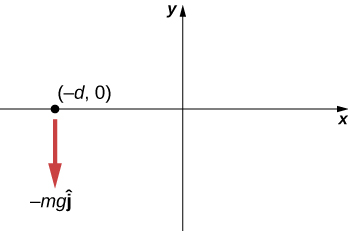
A particle of mass m is dropped at the point and falls vertically in Earth’s gravitational field (a) What is the expression for the angular momentum of the particle around the z-axis, which points directly out of the page as shown below? (b) Calculate the torque on the particle around the z-axis. (c) Is the torque equal to the time rate of change of the angular momentum?
Answer
b. ; c. yes
11-45 §11.2 source ↗
Answer
;
;
b. ;
11-47 §11.2 source ↗
Answer
; ;
;
b.
11-49 §11.2 source ↗
Answer
b.
11-51 §11.2 source ↗
Answer
11-53 §11.3 source ↗
Answer
11-55 §11.3 source ↗
Answer
11-57 §11.3 source ↗
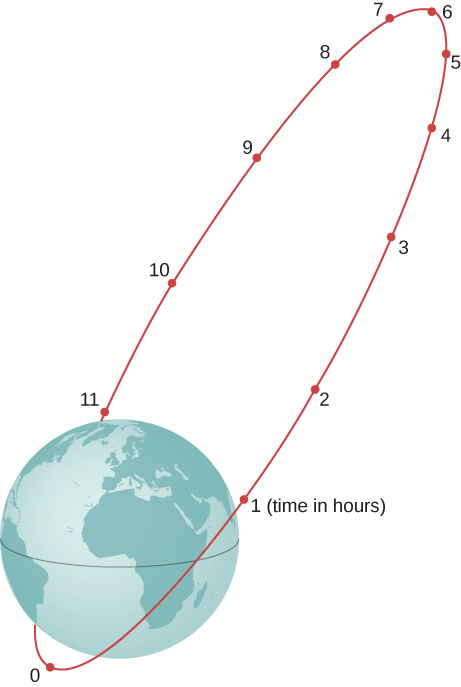
A Molniya orbit is a highly eccentric orbit of a communication satellite so as to provide continuous communications coverage for Scandinavian countries and adjacent Russia. The orbit is positioned so that these countries have the satellite in view for extended periods in time (see below). If a satellite in such an orbit has an apogee at 40,000.0 km as measured from the center of Earth and a velocity of 1.68 km/s, what would be its velocity at perigee measured at 200.0 km altitude?
Answer
11-59 §11.3 source ↗
Answer
,
b. ;
c. back to the original value;
d. back to the original value;
e. work of the bug crawling on the disk
11-61 §11.3 source ↗
Answer
,
11-63 §11.3 source ↗
Answer
,
11-65 §11.3 source ↗
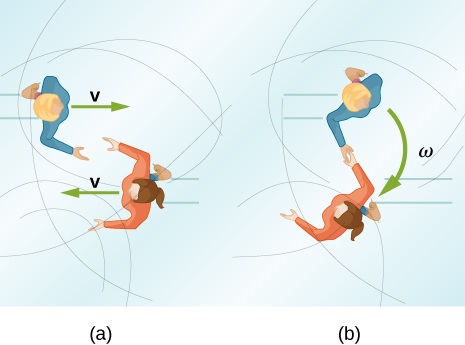
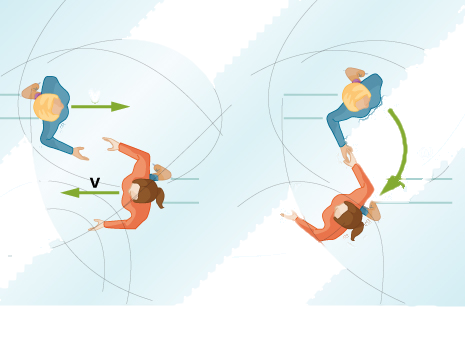
Twin skaters approach one another as shown below and lock hands. (a) Calculate their final angular velocity, given each had an initial speed of 2.50 m/s relative to the ice. Each has a mass of 70.0 kg, and each has a center of mass located 0.800 m from their locked hands. You may approximate their moments of inertia to be that of point masses at this radius. (b) Compare the initial kinetic energy and final kinetic energy.
Answer
,
; b. ,
11-67 §11.3 source ↗
Answer
,
11-69 §11.3 source ↗
Answer
She can do four flips in the air.
11-71 §11.3 source ↗
Answer
;
;
11-73 §11.3 source ↗
Answer
,
11-75 §11.4 source ↗
Answer
11-77 §11.4 source ↗
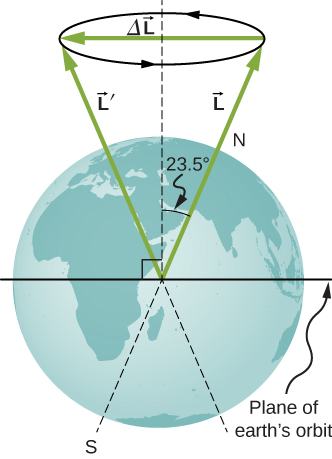
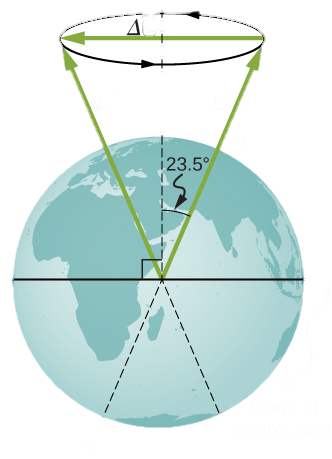
The axis of Earth makes a angle with a direction perpendicular to the plane of Earth’s orbit. As shown below, this axis precesses, making one complete rotation in 25,780 y.
(a) Calculate the change in angular momentum in half this time.
(b) What is the average torque producing this change in angular momentum?
(c) If this torque were created by a pair of forces acting at the most effective point on the equator, what would the magnitude of each force be?
Answer
;
b. ;
c. The two forces at the equator would have the same magnitude but different directions, one in the north direction and the other in the south direction on the opposite side of Earth. The angle between the forces and the lever arms to the center of Earth is , so a given torque would have magnitude . Both would provide a torque in the same direction:
11-79 §11.AP source ↗
Answer
b. ;
The hollow sphere has a larger moment of inertia, and therefore is harder to bring to a rest than the marble, or solid sphere. The distance travelled is larger and the time elapsed is longer.
11-81 §11.AP source ↗
Answer
b. ,
,
;
The moment of inertia is less for the hollow sphere, therefore less work is required to stop it. Likewise it rolls up the incline a shorter distance than the hoop.
11-83 §11.AP source ↗
Answer
b.
11-85 §11.AP source ↗
Answer
;
b. radius of the Moon ; the orbital period is the same as (a): ,
;
The orbital angular momentum is times larger than the rotational angular momentum for the Moon.
11-87 §11.AP source ↗
Answer
,
,
11-89 §11.AP source ↗
Answer
11-91 §11.AP source ↗
Answer
,
,
11-93 §11.AP source ↗
Answer
,
11-95 §11.CP source ↗
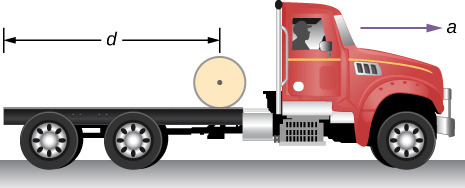
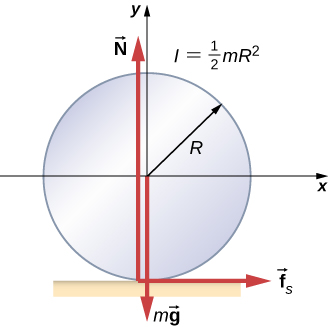
The truck shown below is initially at rest with solid cylindrical roll of paper sitting on its bed. If the truck moves forward with a uniform acceleration a, what distance s does it move before the paper rolls off its back end? (Hint: If the roll accelerates forward with , then is accelerates backward relative to the truck with an acceleration . Also, .)
Answer
Assume the roll accelerates forward with respect to the ground with an acceleration . Then it accelerates backwards relative to the truck with an acceleration .
Also, ,
,
Solving for : ; ,
therefore,
11-97 §11.CP source ↗
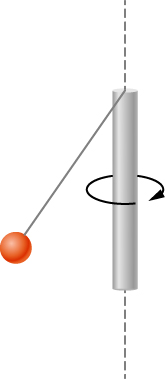
A small ball of mass 0.50 kg is attached by a massless string to a vertical rod that is spinning as shown below. When the rod has an angular velocity of 6.0 rad/s, the string makes an angle of with respect to the vertical. (a) If the angular velocity is increased to 10.0 rad/s, what is the new angle of the string? (b) Calculate the initial and final angular momenta of the ball. (c) Can the rod spin fast enough so that the ball is horizontal?
Answer
At , there is a new angle, tension, and perpendicular radius to the rod. Dividing the two equations involving the tension to eliminate it, we have ;
; b. ,
; c. No, the cosine of the angle is inversely proportional to the square of the angular velocity, therefore in order for . The rod would have to spin infinitely fast.
Loading chapter 12…
Problems and answers are adapted from University Physics Volume 1 by Samuel J. Ling, Jeff Sanny and William Moebs, OpenStax, and are used under the CC BY-NC-SA 4.0 licence. Access for free at https://openstax.org/books/university-physics-volume-1/pages/1-introduction. Illustrations: Copyright Rice University, OpenStax, under CC BY-NC-SA 4.0 license. This adaptation is released under the same licence, is non-commercial, and is neither affiliated with nor endorsed by OpenStax or Rice University.