Every problem in the chapter beside the book’s answer, a chapter at a time as you scroll.

Chapter 8: Potential Energy and Conservation of Energy

56 problems · 11 figures

Check Your Understanding 8.1 §8.1 source ↗

In Example 8.1, what are the potential energies of the particle at x=1m and x=2m with respect to zero at x=1.5m? Verify that the difference of potential energy is still 7 J.

Answer

(4.63J)− (−2.38J)= 7.00J

Check Your Understanding 8.2 §8.1 source ↗

What are the values of the gravitational potential energy of the hiker at the base, summit, and sea level, with respect to a sea-level zero of potential energy?

Answer

35.3 kJ, 143 kJ, 0

Check Your Understanding 8.3 §8.1 source ↗

When the length of the spring in Example 8.3 changes from an initial value of 22.0 cm to a final value, the elastic potential energy it contributes changes by −0.0800J. Find the final length.

Answer

22.8 cm. Using 0.02 m for the initial displacement of the spring (see above), we calculate the final displacement of the spring to be 0.028 m; therefore the length of the spring is the unstretched length plus the displacement, or 22.8 cm.

Check Your Understanding 8.4 §8.1 source ↗

Suppose the mass in Equation 8.6 is doubled while keeping the all other conditions the same. Would the maximum expansion of the spring increase, decrease, or remain the same? Would the speed at point B be larger, smaller, or the same compared to the original mass?

Answer

It increases because you had to exert a downward force, doing positive work, to pull the mass down, and that’s equal to the change in the total potential energy.

Check Your Understanding 8.5 §8.2 source ↗

A two-dimensional, conservative force is zero on the x- and y-axes, and satisfies the condition (dFx/dy)= (dFy/dx)= (4N/m3)xy. What is the magnitude of the force at the point x=y=1m?

Answer

2.83 N

Check Your Understanding 8.6 §8.2 source ↗

Find the forces on the particle in Example 8.6 when its kinetic energy is 1.0 J at x=0.

Answer

F=4.8N, directed toward the origin

Check Your Understanding 8.7 §8.3 source ↗

How high above the bottom of its arc is the particle in the simple pendulum above, when its speed is 0.81m/s?

Answer

0.10 m

Check Your Understanding 8.8 §8.3 source ↗

You probably recall that, neglecting air resistance, if you throw a projectile straight up, the time it takes to reach its maximum height equals the time it takes to fall from the maximum height back to the starting height. Suppose you cannot neglect air resistance, as in Example 8.8. Is the time the projectile takes to go up (a) greater than, (b) less than, or (c) equal to the time it takes to come back down? Explain.

Answer

b. At any given height, the gravitational potential energy is the same going up or down, but the kinetic energy is less going down than going up, since air resistance is dissipative and does negative work. Therefore, at any height, the speed going down is less than the speed going up, so it must take a longer time to go down than to go up.

Check Your Understanding 8.9 §8.3 source ↗

What potential energy U(x) can you substitute in Equation 8.13 that will result in motion with constant velocity of 2 m/s for a particle of mass 1 kg and mechanical energy 1 J?

Answer

constant U(x)=−1J

Check Your Understanding 8.10 §8.4 source ↗

Repeat Example 8.10 when the particle’s mechanical energy is +0.25J.

Answer

a. yes, motion confined to −1.055m≤x≤1.055m; b. same equilibrium points and types as in example

Check Your Understanding 8.11 §8.4 source ↗

Find x(t) for the mass-spring system in Example 8.11 if the particle starts from x0=0 at t=0. What is the particle’s initial velocity?

Answer

x(t)= ± ( 2 E / k ) sin[( k / m )t]and v 0 = ± ( 2 E / m )

8-1 §8.1 source ↗

The kinetic energy of a system must always be positive or zero. Explain whether this is true for the potential energy of a system.

Answer

The potential energy of a system can be negative because its value is relative to a defined point.

8-3 §8.1 source ↗

Describe the gravitational potential energy transfers and transformations for a javelin, starting from the point at which an athlete picks up the javelin and ending when the javelin is stuck into the ground after being thrown.

Answer

If the reference point of the ground is zero gravitational potential energy, the javelin first increases its gravitational potential energy, followed by a decrease in its gravitational potential energy as it is thrown until it hits the ground. The overall change in gravitational potential energy of the javelin is zero unless the center of mass of the javelin is lower than from where it is initially thrown, and therefore would have slightly less gravitational potential energy.

8-5 §8.1 source ↗

What is the dominant factor that affects the speed of an object that started from rest down a frictionless incline if the only work done on the object is from gravitational forces?

Answer

the vertical height from the ground to the object

8-7 §8.2 source ↗

What is the physical meaning of a non-conservative force?

Answer

A force that takes energy away from the system that can’t be recovered if we were to reverse the action.

8-9 §8.2 source ↗

An external force acts on a particle during a trip from one point to another and back to that same point. This particle is only affected by conservative forces. Does this particle’s kinetic energy and potential energy change as a result of this trip?

Answer

The change in kinetic energy is the net work. Since conservative forces are path independent, when you are back to the same point the kinetic and potential energies are exactly the same as the beginning. During the trip the total energy is conserved, but both the potential and kinetic energy change.

8-11 §8.3 source ↗

Consider the following scenario. A car for which friction is not negligible accelerates from rest down a hill, running out of gasoline after a short distance (see below). The driver lets the car coast farther down the hill, then up and over a small crest. He then coasts down that hill into a gas station, where he brakes to a stop and fills the tank with gasoline. Identify the forms of energy the car has, and how they are changed and transferred in this series of events.
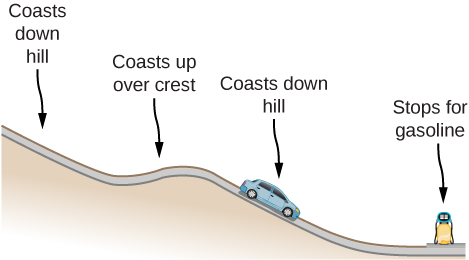
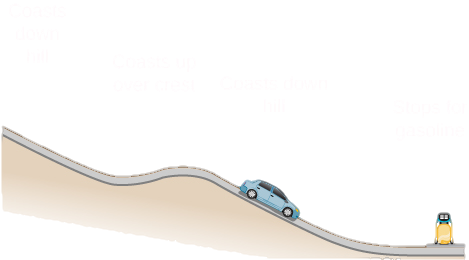
A car coasts down a hill up over a small crest, then down hill. At the bottom of the hill, it stops for gasoline.A car coasts down a hill up over a small crest, then down hill. At the bottom of the hill, it stops for gasoline.

Answer

The car experiences a change in gravitational potential energy as it goes down the hills because the vertical distance is decreasing. Some of this change of gravitational potential energy will be taken away by work done by friction. The rest of the energy results in a kinetic energy increase, making the car go faster. Lastly, the car brakes and will lose its kinetic energy to the work done by braking to a stop.

8-13 §8.3 source ↗

“E=K+U constant is a special case of the work-energy theorem.” Discuss this statement.

Answer

It states that total energy of the system E is conserved as long as there are no non-conservative forces acting on the object.

8-15 §8.3 source ↗

A child jumps up and down on a bed, reaching a higher height after each bounce. Explain how the child can increase his maximum gravitational potential energy with each bounce.

Answer

He puts energy into the system through his legs compressing and expanding.

8-17 §8.3 source ↗

Neglecting air resistance, how much would I have to raise the vertical height if I wanted to double the impact speed of a falling object?

Answer

Four times the original height would double the impact speed.

8-19 §8.1 source ↗

Using values from Table 8.1, how many DNA molecules could be broken by the energy carried by a single electron in the beam of an old-fashioned TV tube? (These electrons were not dangerous in themselves, but they did create dangerous X-rays. Later-model tube TVs had shielding that absorbed X-rays before they escaped and exposed viewers.)
Table 8.1 Energy of Various Objects and Phenomena in the book ↗
Object/phenomenon Energy in joules
Big Bang 1068
Annual world energy use 4.0×10²⁰
Large fusion bomb (9 megaton) 3.8×10¹⁶
Hiroshima-size fission bomb (10 kiloton) 4.2×10¹³
1 barrel crude oil 5.9×10⁹
1 metric ton TNT 4.2×10⁹
1 gallon of gasoline 1.2×10⁸
Daily adult food intake (recommended) 1.2×10⁷
1000-kg car at 90 km/h 3.1×10⁵
Tennis ball at 100 km/h 22
Mosquito (10−2g at 0.5 m/s) 1.3×10⁻⁶
Single electron in a TV tube beam 4.0×10⁻¹⁵
Energy to break one DNA strand 10−19
1 kg hydrogen (fusion to helium) 6.4×10¹⁴
1 kg uranium (nuclear fission) 8.0×10¹³

Answer

40,000

8-21 §8.1 source ↗

A camera weighing 10 N falls from a small drone hovering 20m overhead and enters free fall. What is the gravitational potential energy change of the camera from the drone to the ground if you take a reference point of (a) the ground being zero gravitational potential energy? (b) The drone being zero gravitational potential energy? What is the gravitational potential energy of the camera (c) before it falls from the drone and (d) after the camera lands on the ground if the reference point of zero gravitational potential energy is taken to be a second person looking out of a building 30m from the ground?

Answer

a.−200J; b.−200J; c.−100J; d.−300J

8-23 §8.1 source ↗

A cat’s crinkle ball toy of mass 15g is thrown straight up with an initial speed of 3m/s. Assume in this problem that air drag is negligible. (a) What is the kinetic energy of the ball as it leaves the hand? (b) How much work is done by the gravitational force during the ball’s rise to its peak? (c) What is the change in the gravitational potential energy of the ball during the rise to its peak? (d) If the gravitational potential energy is taken to be zero at the point where it leaves your hand, what is the gravitational potential energy when it reaches the maximum height? (e) What if the gravitational potential energy is taken to be zero at the maximum height the ball reaches, what would the gravitational potential energy be when it leaves the hand? (f) What is the maximum height the ball reaches?

Answer

a.0.068J; b.−0.068J; c.0.068J; d.0.068J; e.−0.068J; f.46cm

8-25 §8.2 source ↗

A force F(x)= (−5.0x2+7.0x)N acts on a particle. How much work does the force do on the particle as it moves from x=2.0m to x=5.0m?

Answer

−120 J

8-27 §8.2 source ↗

The potential energy function for either one of the two atoms in a diatomic molecule is often approximated by U(x)= a/x12− b/x6 where x is the distance between the atoms. (a) At what distance of separation does the potential energy have a local minimum (not at x=∞)? (b) What is the force on an atom at this separation? (c) How does the force vary with the separation distance?

Answer

a. (2ab)1/6; b. 0; c. ∼x6

8-29 §8.2 source ↗

A particle of mass 2.0kg moves under the influence of the force F(x)= (−5x2+7x)N. If its speed at x=−4.0m is v=20.0m/s, what is its speed at x=4.0m?

Answer

14 m / s

8-31 §8.3 source ↗

A boy throws a ball of mass 0.25kg straight upward with an initial speed of 20m/s When the ball returns to the boy, its speed is 17m/s How much much work does air resistance do on the ball during its flight?

Answer

–14 J

8-33 §8.3 source ↗

Using energy considerations and assuming negligible air resistance, show that a rock thrown from a bridge 20.0 m above water with an initial speed of 15.0 m/s strikes the water with a speed of 24.8 m/s independent of the direction thrown. (Hint: show that Ki+ Ui= Kf+ Uf)

Answer

proof

8-35 §8.3 source ↗

Ignoring details associated with friction, extra forces exerted by arm and leg muscles, and other factors, we can consider a pole vault as the conversion of an athlete’s running kinetic energy to gravitational potential energy. If an athlete is to lift their body 4.8 m during a vault, what speed must they have when they plant the pole?

Answer

9.7 m / s

8-37 §8.3 source ↗

Assume that the force of a bow on an arrow behaves like the spring force. In aiming the arrow, an archer pulls the bow back 50 cm and holds it in position with a force of 150N. If the mass of the arrow is 50g and the “spring” is massless, what is the speed of the arrow immediately after it leaves the bow?

Answer

39 m / s

8-39 §8.3 source ↗

A sled of mass 70 kg starts from rest and slides down a 10° incline 80m long. It then travels for 20 m horizontally before starting back up an 8° incline. It travels 80 m along this incline before coming to rest. What is the magnitude of the net work done on the sled by friction?

Answer

1900 J

8-41 §8.3 source ↗

A baseball of mass 0.25 kg is hit at home plate with a speed of 40 m/s. When it lands in a seat in the left-field bleachers a horizontal distance 120 m from home plate, it is moving at 30 m/s. If the ball lands 20 m above the spot where it was hit, how much work is done on it by air resistance?

Answer

–39 J

8-43 §8.3 source ↗

The massless spring of a spring gun has a force constant k=12N/m. When the gun is aimed vertically, a 15-g projectile is shot to a height of 0.50 m above the end of the expanded spring. (See below.) How much was the spring compressed initially?
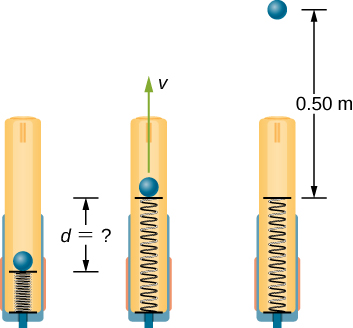
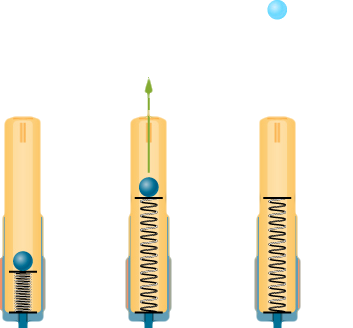
Three drawings of a gun, aimed directly upward, are shown. On the left, the spring is compressed an unknown distance d. The projectile is resting on the top of the spring. In the middle drawing, the spring is expanded. The projectile is still at the top of the spring but now moving upward with velocity v. On the right, the spring is expanded. The projectile is 5.0 meters above the top of the spring. It has zero velocity.Three drawings of a gun, aimed directly upward, are shown. On the left, the spring is compressed an unknown distance d. The projectile is resting on the top of the spring. In the middle drawing, the spring is expanded. The projectile is still at the top of the spring but now moving upward with velocity v. On the right, the spring is expanded. The projectile is 5.0 meters above the top of the spring. It has zero velocity.

Answer

0.12 m

8-45 §8.4 source ↗

A mysterious constant force of 10 N acts horizontally on everything. The direction of the force is found to be always pointed toward a wall in a big hall. Find the potential energy of a particle due to this force when it is at a distance x from the wall, assuming the potential energy at the wall to be zero.

Answer

10x with x-axis pointed away from the wall and origin at the wall

8-47 §8.4 source ↗

A particle of mass 4.0 kg is constrained to move along the x-axis under a single force F(x)=−cx3, where c=8.0N/m3. The particle’s speed at A, where xA=1.0m, is 6.0 m/s. What is its speed at B, where xB=−2.0m?

Answer

4.6 m/s

8-49 §8.4 source ↗

A 4.0-kg particle moving along the x-axis is acted upon by the force whose functional form appears below. The velocity of the particle at x=0 is v=6.0m/s. Find the particle’s speed at x= (a)2.0m, (b)4.0m, (c)10.0m, (d) Does the particle turn around at some point and head back toward the origin? (e) Repeat part (d) if v= 2.0m/satx= 0.
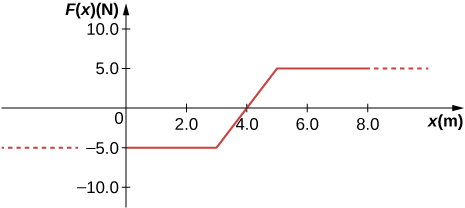
A graph of F of x, measured in Newtons, as a function of x, measured in meters. The horizontal scale runs from 0 to 8.0, and the vertical scale from-10.0 top 10.0. The function is constant at -5.0 N for x less than 3.0 meters. It increases linearly to 5.0 N at 5.0 meters, then remains constant at 5.0 for x larger than 5.0 m.

Answer

a. 5.6 m/s; b. 5.2 m/s; c. 6.4 m/s; d. no; e. yes

8-51 §8.4 source ↗

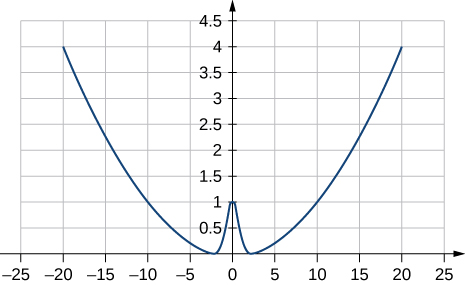
(a) Sketch a graph of the potential energy function U(x)= kx2/2+ Ae−αx2, where k,A,andα are constants. (b) What is the force corresponding to this potential energy? (c) Suppose a particle of mass m moving with this potential energy has a velocity va when its position is x=a. Show that the particle does not pass through the origin unless

A ≤ m v a 2 + k a 2 2 ( 1 − e − α a 2 ) .

Answer

a.

The potential energy function U of x equal to k x squared over two plus A e to the alpha x squared is plotted as a function of x, with k=0.02, A=1, and alpha equal to one. The horizontal scale runs from –25 to 25 and the vertical scale runs from 0 to 4.5. The function is an upward opening parabola with a small Gaussian upward bump at the center. For the parameters chosen in this plot, the bump has a maximum value of one.


where k= 0.02, A= 1, α= 1; b. F(x)= -dU(x)dx= -kx+ 2Aαxe−αx2; c. The potential energy at x=0 must be less than the kinetic plus potential energy at x=a or A≤12mv2+ 12ka2+ Ae−αa2. Solving this for A matches results in the problem.

8-53 §8.5 source ↗

In the reality television show “Amazing Race”, a contestant is firing 3.0-kg watermelons from a slingshot to hit targets down the field. The slingshot is pulled back 2.0 m and the watermelon is considered to be at ground level. The launch point is 0.75 m from the ground and the targets are 10 m horizontally away. Calculate the spring constant of the slingshot.

Answer

490 N/m

8-55 §8.5 source ↗

In the Hunger Games movie, Katniss Everdeen fires a 0.0200-kg arrow from ground level to pierce an apple up on a stage. The spring constant of the bow is 330 N/m and she pulls the arrow back a distance of 0.55 m. The apple on the stage is 5.00 m higher than the launching point of the arrow. At what speed does the arrow (a) leave the bow? (b) strike the apple?

Answer

a. 70.6 m/s; b. 69.9 m/s

8-57 §8.5 source ↗

In a Coyote/Road Runner cartoon clip, a spring expands quickly and sends the coyote into a rock. If the spring extended 5 m and sent the coyote of mass 20 kg to a speed of 15 m/s, (a) what is the spring constant of this spring? (b) If the coyote were sent vertically into the air with the energy given to him by the spring, how high could he go if there were no non-conservative forces?

Answer

a. 180 N/m; b. 11 m

8-59 §8.5 source ↗

In the movie Monty Python and the Holy Grail a cow is catapulted from the top of a castle wall over to the people down below. The gravitational potential energy is set to zero at ground level. The cow is launched from a spring of spring constant 1.1×10⁴N/m that is expanded 0.5 m from equilibrium. If the castle is 9.1 m tall and the mass of the cow is 110 kg, (a) what is the gravitational potential energy of the cow at the top of the castle? (b) What is the elastic spring energy of the cow before the catapult is released? (c) What is the speed of the cow right before it lands on the ground?

Answer

a. 9.8×10³J; b. 1.4×10³J; c. 14 m/s

8-61 §8.5 source ↗

(a) How high a hill can a car coast up (engines disengaged) if work done by friction is negligible and its initial speed is 110 km/h? (b) If, in actuality, a 750-kg car with an initial speed of 110 km/h is observed to coast up a hill to a height 22.0 m above its starting point, how much thermal energy was generated by friction? (c) What is the average force of friction if the hill has a slope of 2.5° above the horizontal?

Answer

a. 47.6 m; b. 1.88×10⁵J; c. 373 N

8-63 §8.5 source ↗

A pogo stick has a spring with a spring constant of 2.5×10⁴N/m, which can be compressed 12.0 cm. To what maximum height from the uncompressed spring can a child jump on the stick using only the energy in the spring, if the child and stick have a total mass of 40 kg?

Answer

33.9 cm

8-65 §8.5 source ↗

A block of mass 200 g is attached at the end of a massless spring at equilibrium length of spring constant 50 N/m. The other end of the spring is attached to the ceiling and the mass is released at a height considered to be where the gravitational potential energy is zero. (a) What is the net potential energy of the block at the instant the block is at the lowest point? (b) What is the net potential energy of the block at the midpoint of its descent? (c) What is the speed of the block at the midpoint of its descent?

Answer

a. Zero, since the total energy of the system is zero and the kinetic energy at the lowest point is zero; b. –0.038 J; c. 0.62 m/s

8-67 §8.5 source ↗

A child (32 kg) jumps up and down on a trampoline. The trampoline exerts a spring restoring force on the child with a constant of 5000 N/m. At the highest point of the bounce, the child is 1.0 m above the level surface of the trampoline. What is the compression distance of the trampoline? Neglect the bending of the legs or any transfer of energy of the child into the trampoline while jumping.

Answer

42 cm

8-69 §8.AP source ↗

A massless spring with force constant k=200N/m hangs from the ceiling. A 2.0-kg block is attached to the free end of the spring and released. If the block falls 17 cm before starting back upwards, how much work is done by friction during its descent?

Answer

–0.44 J

8-71 §8.AP source ↗

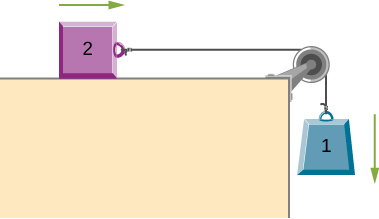
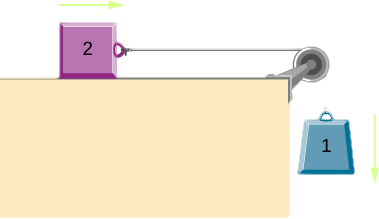
Block 2 shown below slides along a frictionless table as block 1 falls. Both blocks are attached by a frictionless pulley. Find the speed of the blocks after they have each moved 2.0 m. Assume that they start at rest and that the pulley has negligible mass. Use m1=2.0kg and m2=4.0kg.

A block, labeled as block 1, is suspended by a string that goes up, over a pulley, bends 90 degrees to the left, and connects to another block, labeled as block 2. Block 2 is sliding to the right on a horizontal surface. Block 1 is not in contact with any surface and is moving downward.A block, labeled as block 1, is suspended by a string that goes up, over a pulley, bends 90 degrees to the left, and connects to another block, labeled as block 2. Block 2 is sliding to the right on a horizontal surface. Block 1 is not in contact with any surface and is moving downward.

Answer

3.6 m/s

8-73 §8.AP source ↗

A mysterious force acts on all particles along a particular line and always points towards a particular point P on the line. The magnitude of the force on a particle increases as the cube of the distance from that point; that is F∞r3, if the distance from P to the position of the particle is r. Let b be the proportionality constant, and write the magnitude of the force as F=br3. Find the potential energy of a particle subjected to this force when the particle is at a distance D from P, assuming the potential energy to be zero when the particle is at P.

Answer

b D 4 / 4

8-75 §8.AP source ↗

Shown below is a small ball of mass m attached to a string of length a. A small peg is located a distance h below the point where the string is supported. If the ball is released when the string is horizontal, show that h must be greater than 3a/5 if the ball is to swing completely around the peg.
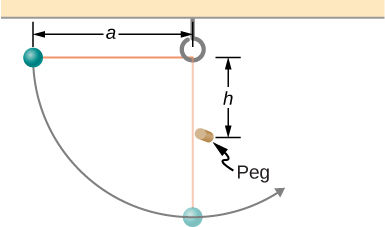
A small ball is shown attached to a string of length a. A small peg is located a distance h below the point where the string is supported. The ball is released when the string is horizontal and swings in a circular arc.

Answer

proof

8-77 §8.AP source ↗

A block of mass m, after sliding down a frictionless incline, strikes another block of mass M that is attached to a spring of spring constant k (see below). The blocks stick together upon impact and travel together. (a) Find the compression of the spring in terms of m, M, h, g, and k when the combination comes to rest. Hint: The speed of the combined blocks m+M(v2) is based on the speed of block m just prior to the collision with the block M (v1) based on the equation v2= (m/m)+ M(v1). This will be discussed further in the chapter on Linear Momentum and Collisions. (b) The loss of kinetic energy as a result of the bonding of the two masses upon impact is stored in the so-called binding energy of the two masses. Calculate the binding energy.
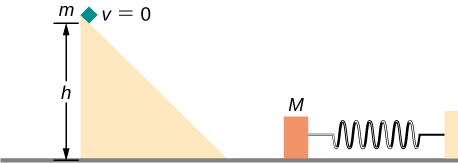
A block of mass m is shown at the top of a downward sloping ramp. The block is a vertical distance h above the ground and is at rest (v=0.) To the right of the ramp, on the horizontal ground, is a mass M attached to a horizontal spring. The far end of the spring is attached to a wall.

Answer

a. 2m2ghk(m+M); b. mMghm+M

8-79 §8.AP source ↗

Consider a block of mass 0.200 kg attached to a spring of spring constant 100 N/m. The block is placed on a frictionless table, and the other end of the spring is attached to the wall so that the spring is level with the table. The block is then pushed in so that the spring is compressed by 10.0 cm. Find the speed of the block as it crosses (a) the point when the spring is not stretched, (b) 5.00 cm to the left of point in (a), and (c) 5.00 cm to the right of point in (a).

Answer

a.2.24m/s; b.1.94m/s; c.1.94m/s

8-81 §8.AP source ↗

Repeat the preceding problem, but this time, suppose that the work done by air resistance cannot be ignored. Let the work done by the air resistance when the skier goes from A to B along the given hilly path be −2000 J. The work done by air resistance is negative since the air resistance acts in the opposite direction to the displacement. Supposing the mass of the skier is 50 kg, what is the speed of the skier at point B?

Answer

18 m/s

8-83 §8.AP source ↗

In an amusement park, a car rolls in a track as shown below. Find the speed of the car at A, B, and C. Note that the work done by the rolling friction is zero since the displacement of the point at which the rolling friction acts on the tires is momentarily at rest and therefore has a zero displacement.
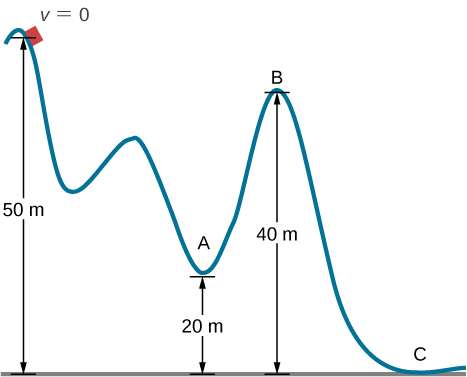
A roller coaster track with three hills is shown. The first hill is the tallest at 50 meters above the ground, the second is the smallest, and the third hill is of intermediate height at 40 meters above the ground. The car starts with v = 0 at the top of the first hill. Point A is the low point between the second and third hill, 20 meters above the ground. Point B is at the top of the third hill, 40 meters above the ground. Point C is at the ground near the end of the track.

Answer

v A = 24m/s; v B = 14m/s; v C = 31m/s

8-85 §8.AP source ↗

A 300 g hockey puck is shot across an ice-covered pond. Before the hockey puck was hit, the puck was at rest. After the hit, the puck has a speed of 40 m/s. The puck comes to rest after going a distance of 30 m. (a) Describe how the energy of the puck changes over time, giving the numerical values of any work or energy involved. (b) Find the magnitude of the net friction force.

Answer

a. Loss of energy is 240N·m; b. F=8N

8-87 §8.AP source ↗

An artillery shell is fired at a target 200 m above the ground. When the shell is 100 m in the air, it has a speed of 100 m/s. What is its speed when it hits its target? Neglect air friction.

Answer

89.7 m/s

8-89 §8.AP source ↗

A box slides on a frictionless surface with a total energy of 50 J. It hits a spring and compresses the spring a distance of 25 cm from equilibrium. If the same box with the same initial energy slides on a rough surface, it only compresses the spring a distance of 15 cm, how much energy must have been lost by sliding on the rough surface?

Answer

32 J

Loading chapter 9…

Problems and answers are adapted from University Physics Volume 1 by Samuel J. Ling, Jeff Sanny and William Moebs, OpenStax, and are used under the CC BY-NC-SA 4.0 licence. Access for free at https://openstax.org/books/university-physics-volume-1/pages/1-introduction. Illustrations: Copyright Rice University, OpenStax, under CC BY-NC-SA 4.0 license. This adaptation is released under the same licence, is non-commercial, and is neither affiliated with nor endorsed by OpenStax or Rice University.