Every problem in the chapter beside the book’s answer, a chapter at a time as you scroll.

Chapter 11: Magnetic Forces and Fields

61 problems · 9 figures

Check Your Understanding 11.1 §11.2 source ↗

Repeat the previous problem with the magnetic field in the x-direction rather than in the z-direction. Check your answers with RHR-1.

Answer

a. 0 N; b. 2.4×10⁻¹⁴k^N; c. 2.4×10⁻¹⁴j^N; d. (7.2j^+2.2k^)×10−15N

Check Your Understanding 11.2 §11.3 source ↗

A uniform magnetic field of magnitude 1.5 T is directed horizontally from west to east. (a) What is the magnetic force on a proton at the instant when it is moving vertically downward in the field with a speed of 4×10⁷m/s? (b) Compare this force with the weight w of a proton.

Answer

a. 9.6×10⁻¹²N toward the south; b. wFm= 1.7×10⁻¹⁵

Check Your Understanding 11.3 §11.4 source ↗

A straight, flexible length of copper wire is immersed in a magnetic field that is directed into the page. (a) If the wire’s current runs in the +x-direction, which way will the wire bend? (b) Which way will the wire bend if the current runs in the –x-direction?

Answer

a. bends upward; b. bends downward

Check Your Understanding 11.4 §11.5 source ↗

Check Your Understanding

In what orientation would a magnetic dipole have to be to produce (a) a maximum torque in a magnetic field? (b) A maximum energy of the dipole?

Answer

a. aligned or anti-aligned; b. perpendicular

Check Your Understanding 11.5 §11.6 source ↗

A Hall probe consists of a copper strip, n=8.5×1028 electrons per cubic meter, which is 2.0 cm wide and 0.10 cm thick. What is the magnetic field when I = 50 A and the Hall potential is (a) 4.0μV and (b) 6.0μV?

Answer

a. 1.1 T; b. 1.6 T

Check Your Understanding 11.6 §11.7 source ↗

A cyclotron is to be designed to accelerate protons to kinetic energies of 20 MeV using a magnetic field of 2.0 T. What is the required radius of the cyclotron?

Answer

0.32 m

11-1 §11.2 source ↗

Discuss the similarities and differences between the electrical force on a charge and the magnetic force on a charge.

Answer

Both are field dependent. Electrical force is dependent on charge, whereas magnetic force is dependent on current or rate of charge flow.

11-3 §11.3 source ↗

At a given instant, an electron and a proton are moving with the same velocity in a constant magnetic field. Compare the magnetic forces on these particles. Compare their accelerations.

Answer

The magnitude of the proton and electron magnetic forces are the same since they have the same amount of charge. The direction of these forces however are opposite of each other. The accelerations are opposite in direction and the electron has a larger acceleration than the proton due to its smaller mass.

11-5 §11.3 source ↗

An electron passes through a magnetic field without being deflected. What do you conclude about the magnetic field?

Answer

The magnetic field must point parallel or anti-parallel to the velocity.

11-7 §11.3 source ↗

How could you determine which pole of an electromagnet is north and which pole is south?

Answer

A compass points toward the north pole of an electromagnet.

11-9 §11.4 source ↗

Considering the magnetic force law, are the velocity and magnetic field always perpendicular? Are the force and velocity always perpendicular? What about the force and magnetic field?

Answer

Velocity and magnetic field can be set together in any direction. If there is a force, the velocity is perpendicular to it. The magnetic field is also perpendicular to the force if it exists.

11-11 §11.4 source ↗

A magnetic field exerts a force on the moving electrons in a current carrying wire. What exerts the force on a wire?

Answer

A force on a wire is exerted by an external magnetic field created by a wire or another magnet.

11-13 §11.6 source ↗

Hall potentials are much larger for poor conductors than for good conductors with the same current. Why?

Answer

Poor conductors have a lower charge carrier density, n, which, based on the Hall effect formula, relates to a higher Hall potential. Good conductors have a higher charge carrier density, thereby a lower Hall potential.

11-15 §11.2 source ↗

What is the direction of the magnetic force on a positive charge that moves as shown in each of the six cases?
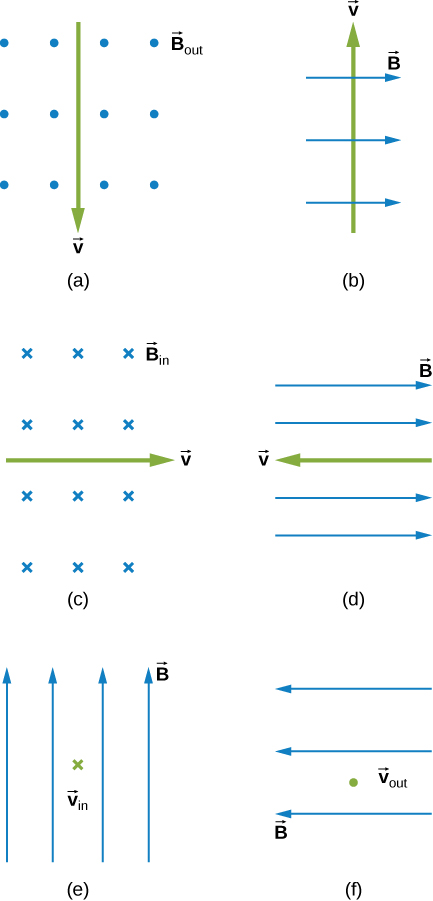
Case a: B is out of the page, v is down. Case b: B is to the right, v is up. Case c: B is in, v is to the right. Case d: B is to the right, v is to the left. Case e: B is up, v is into the page. Case f: B is to the left, v is out of the page.

Answer

a. left; b. into the page; c. up the page; d. no force; e. right; f. down

11-17 §11.2 source ↗

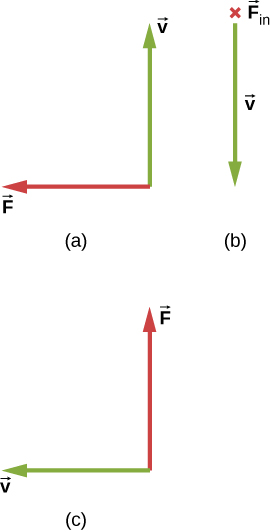
What is the direction of the velocity of a negative charge that experiences the magnetic force shown in each of the three cases, assuming it moves perpendicular to B?
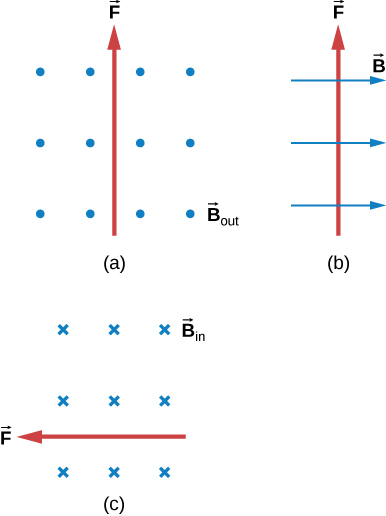
Case a: B is out of the page, F is up. Case b: B is to the right, F is up. Case c: B is into the page, F is to the right.

Answer

a. right; b. into the page; c. down

11-19 §11.2 source ↗

What is the direction of the magnetic field that produces the magnetic force on a positive charge as shown in each of the three cases, assuming B→ is perpendicular to v→?

Case a: v is up, F is to the left. Case b: v is down, F is into the page. Case c: v is to the left, F is up.

Answer

a. into the page; b. left; c. out of the page

11-21 §11.2 source ↗

(a) Aircraft sometimes acquire small static charges. Suppose a supersonic jet has a 0.500-μC charge and flies horizontally at a speed of 660. m/s over Earth’s south magnetic pole (near the north geographic pole), where the 8.00×10⁻⁵−T magnetic field points straight down into the ground. What are the direction and the magnitude of the magnetic force on the plane? (b) Discuss whether the value obtained in part (a) implies this is a significant or negligible effect.

Answer

a. 2.64×10⁻⁸N; north b. The force is very small, so this implies that the effect of static charges on airplanes is negligible.

11-23 §11.2 source ↗

An electron moving at 4.00×10³m/s in a 1.25-T magnetic field experiences a magnetic force of 1.40×10⁻¹⁶N. What angle does the velocity of the electron make with the magnetic field? There are two answers.

Answer

10.1°; 169.9°

11-25 §11.3 source ↗

A cosmic-ray electron moves at 7.5×10⁶m/s perpendicular to Earth’s magnetic field at an altitude where the field strength is 1.0×10⁻⁵T. What is the radius of the circular path the electron follows?

Answer

4.27 m

11-27 §11.3 source ↗

(a) An oxygen-16 ion with a mass of 2.66×10⁻²⁶kg travels at 5.0×10⁶m/s perpendicular to a 1.20-T magnetic field, which makes it move in a circular arc with a 0.231-m radius. What positive charge is on the ion? (b) What is the ratio of this charge to the charge of an electron? (c) Discuss why the ratio found in (b) should be an integer.

Answer

a. 4.80×10⁻¹⁹C; b. 3; c. This ratio must be an integer because charges must be integer numbers of the basic charge of an electron. There are no free charges with values less than this basic charge, and all charges are integer multiples of this basic charge.

11-29 §11.3 source ↗

(a) At what speed will a proton move in a circular path of the same radius as the electron in the previous exercise? (b) What would the radius of the path be if the proton had the same speed as the electron? (c) What would the radius be if the proton had the same kinetic energy as the electron? (d) The same momentum?

Answer

(a) 3.27 x 10³ m/s (b) 1252.5 m (c) 29.2 m (d) 0.683 m.

11-31 §11.3 source ↗

An alpha-particle (m=6.64×10⁻²⁷kg, q= 3.2×10⁻¹⁹C) travels in a circular path of radius 25 cm in a uniform magnetic field of magnitude 1.5 T. (a) What is the speed of the particle? (b) What is the kinetic energy in electron-volts? (c) Through what potential difference must the particle be accelerated in order to give it this kinetic energy?

Answer

a. 1.8×10⁷m/s; b. 6.8×10⁶eV; c. 3.4×10⁶V

11-33 §11.4 source ↗

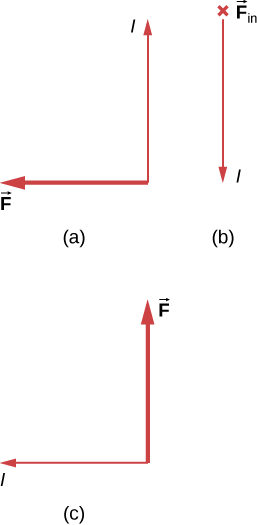
What is the direction of the magnetic force on the current in each of the six cases?
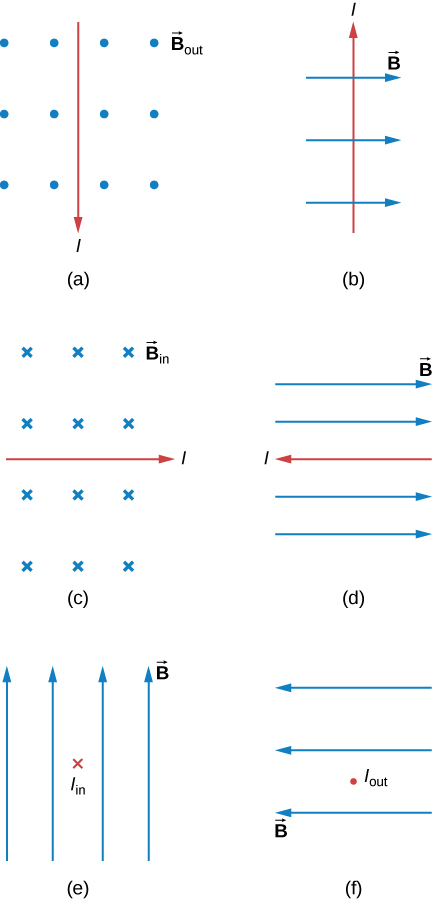
Case a: I is down, B is out of the page. Case b: I is up, B is to the right. Case c: I is to the right, B is into the page. Case d: I is to the left , B is to the right. Case e: I is into the page, B is up. Case f: I is out of the page, B is to the left.

Answer

a. left; b. into the page; c. up; d. no force; e. right; f. down

11-35 §11.4 source ↗

What is the direction of the magnetic field that produces the magnetic force shown on the currents in each of the three cases, assuming B→ is perpendicular to I?

Case a: I is up, F is to the left. Case b: I is down, F is into the page. Case c: I is to the left, F is up.

Answer

a. into the page; b. left; c. out of the page

11-37 §11.4 source ↗

(a) A dc power line for a light-rail system carries 1000 A at an angle of 30.0º to Earth’s 5.0×10⁻⁵T field. What is the force on a 100-m section of this line? (b) Discuss practical concerns this presents, if any.

Answer

a. 2.50 N; b. This means that the light-rail power lines must be attached in order not to be moved by the force caused by Earth’s magnetic field.

11-39 §11.5 source ↗

(a) By how many percent is the torque of a motor decreased if its permanent magnets lose 5.0% of their strength? (b) How many percent would the current need to be increased to return the torque to original values?

Answer

a. τ=NIAB, so τ decreases by 5.00% if B decreases by 5.00%; b. 5.26% increase

11-41 §11.5 source ↗

Find the current through a loop needed to create a maximum torque of 9.0N·m. The loop has 50 square turns that are 15.0 cm on a side and is in a uniform 0.800-T magnetic field.

Answer

10.0 A

11-43 §11.5 source ↗

Since the equation for torque on a current-carrying loop is τ = NIAB sin θ, the units of N ⋅ m must equal units of A ⋅ m2 T. Verify this.

Answer

A· m 2 ·T= A· m 2 . N A · m = N·m

11-45 §11.5 source ↗

A proton has a magnetic field due to its spin. The field is similar to that created by a circular current loop 0.65×10⁻¹⁵m in radius with a current of 1.05×10⁴A. Find the maximum torque on a proton in a 2.50-T field. (This is a significant torque on a small particle.)

Answer

3.48 × 10 −26 N · m

11-47 §11.5 source ↗

Repeat the previous problem, but with the loop lying flat on the ground with its current circulating counterclockwise (when viewed from above) in a location where Earth’s field is north, but at an angle 45.0° below the horizontal and with a strength of 6.0×10⁻⁵T.
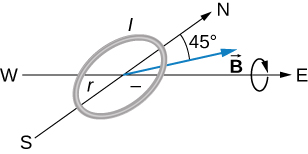
A horizontal circular loop is shown along with the compass directions. The magnetic field points 45 degrees below the horizontal. The loop is shown rotating clockwise as viewed from the east.

Answer

0.666 N · m

11-49 §11.6 source ↗

The cross-sectional dimensions of the copper strip shown are 2.0 cm by 2.0 mm. The strip carries a current of 100 A, and it is placed in a magnetic field of magnitude B = 1.5 T. What are the value and polarity of the Hall potential in the copper strip?
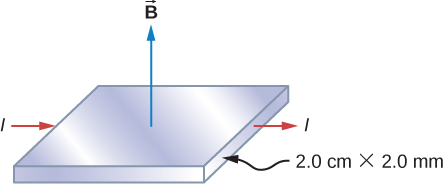
A horizontal 2.0 cm by 2.0 cm square copper strip has current I flowing through it to the right. A magnetic field, B, points up, perpendicular to the face of the strip.

Answer

5.8 × 10 −6 V

11-51 §11.6 source ↗

A charged particle moves through a velocity selector at constant velocity. In the selector, E = 1.0×10⁴N/C and B = 0.250 T. When the electric field is turned off, the charged particle travels in a circular path of radius 3.33 mm. Determine the charge-to-mass ratio of the particle.

Answer

4.8 × 10 7 C/kg

11-53 §11.7 source ↗

A physicist is designing a cyclotron to accelerate protons to one-tenth the speed of light. The magnetic field will have a strength of 1.5 T. Determine (a) the rotational period of the circulating protons and (b) the maximum radius of the protons’ orbit.

Answer

a. 4.4×10⁻⁸s; b. 0.21 m

11-55 §11.7 source ↗

The magnetic field in a cyclotron is 1.25 T, and the maximum orbital radius of the circulating protons is 0.40 m. (a) What is the kinetic energy of the protons when they are ejected from the cyclotron? (b) What is this energy in MeV? (c) Through what potential difference would a proton have to be accelerated to acquire this kinetic energy? (d) What is the period of the voltage source used to accelerate the protons? (e) Repeat the calculations for alpha-particles.

Answer

a. 1.92×10⁻¹²J; b. 12 MeV; c. 12 MV; d. 5.2×10⁻⁸s; e. 1.92×10⁻¹²J, 12 MeV, 12 V, 10.4×10⁻⁸s

11-57 §11.7 source ↗

(a) Triply charged uranium-235 and uranium-238 ions are being separated in a mass spectrometer. (The much rarer uranium-235 is used as reactor fuel.) The masses of the ions are 3.90×10⁻²⁵kg and 3.95×10⁻²⁵kg, respectively, and they travel at 3.0×10⁵m/s in a 0.250-T field. What is the separation between their paths when they hit a target after traversing a semicircle? (b) Discuss whether this distance between their paths seems to be big enough to be practical in the separation of uranium-235 from uranium-238.

Answer

a. 2.50×10⁻²m; b. Yes, this distance between their paths is clearly big enough to separate the U-235 from the U-238, since it is a distance of 2.5 cm.

11-59 §11.AP source ↗

Repeat the previous problem with a new magnetic field of (0.4i^+1.2k^)T.

Answer

−7.2 × 10 −15 N j ^

11-61 §11.AP source ↗

The mass and charge of a water droplet are 1.0×10⁻⁴g and 2.0×10⁻⁸C, respectively. If the droplet is given an initial horizontal velocity of 5.0×10⁵i^m/s, what magnetic field will keep it moving in this direction? Why must gravity be considered here?

Answer

9.8×10⁻⁵j^T; the magnetic and gravitational forces must balance to maintain dynamic equilibrium

11-63 §11.AP source ↗

An electron of kinetic energy 2000 eV passes between parallel plates that are 1.0 cm apart and kept at a potential difference of 300 V. What is the strength of the uniform magnetic field B that will allow the electron to travel undeflected through the plates? Assume E and B are perpendicular.

Answer

1.13 × 10 −3 T

11-65 §11.AP source ↗

An electron moving with a velocity v→= (4.0i^+3.0j^+2.0k^)×106m/s enters a region where there is a uniform electric field and a uniform magnetic field. The magnetic field is given by B→= (1.0i^−2.0j^+4.0k^)×10−2T. If the electron travels through a region without being deflected, what is the electric field?

Answer

( 1.6 i ^ − 1.4 j ^ − 1.1 k ^ ) × 10 5 V/m

11-67 §11.AP source ↗

What is the (a) path of a proton and (b) the magnetic force on the proton that is traveling west to east with a kinetic energy of 10 keV in Earth’s magnetic field that has a horizontal component of 1.8 x 10⁻⁵ T north and a vertical component of 5.0 x 10⁻⁵ T down?

Answer

a. circular motion in a north, down plane; b. (1.61j^−0.58k^)×10−14N

11-69 §11.AP source ↗

An electron and a proton move with the same speed in a plane perpendicular to a uniform magnetic field. Compare the radii and periods of their orbits.

Answer

The proton has more mass than the electron; therefore, its radius and period will be larger.

11-71 §11.AP source ↗

A singly charged ion takes 2.0×10⁻³s to complete eight revolutions in a uniform magnetic field of magnitude 2.0×10⁻²T. What is the mass of the ion?

Answer

1.3 × 10 −25 kg

11-73 §11.AP source ↗

A proton, deuteron, and an alpha-particle are all accelerated from rest through the same potential difference. They then enter the same magnetic field, moving perpendicular to it. Compute the ratios of the radii of their circular paths. Assume that md=2mp and mα=4mp.

Answer

1:0.707:1

11-75 §11.AP source ↗

Two particles have the same linear momentum, but particle A has four times the charge of particle B. If both particles move in a plane perpendicular to a uniform magnetic field, what is the ratio RA/RB of the radii of their circular orbits?

Answer

1/4

11-77 §11.AP source ↗

An electron moving along the +x -axis at 5.0×10⁶m/s enters a magnetic field that makes a 75o angle with the x-axis of magnitude 0.20 T. Calculate the (a) pitch and (b) radius of the trajectory.

Answer

a. 2.3×10⁻⁴m; b. 1.37×10⁻⁴m

11-79 §11.AP source ↗

(a) What is the angle between a wire carrying an 8.00-A current and the 1.20-T field it is in if 50.0 cm of the wire experiences a magnetic force of 2.40 N? (b) What is the force on the wire if it is rotated to make an angle of 90º with the field?

Answer

a. 30.0°; b. 4.80 N

11-81 §11.AP source ↗

A 5.0-m section of a long, straight wire carries a current of 10 A while in a uniform magnetic field of magnitude 8.0×10⁻³T. Calculate the magnitude of the force on the section if the angle between the field and the direction of the current is (a) 45°; (b) 90°; (c) 0°; or (d) 180°.

Answer

a. 0.283 N; b. 0.4 N; c. 0 N; d. 0 N

11-83 §11.AP source ↗

The current loop shown in the accompanying figure lies in the plane of the page, as does the magnetic field. Determine the net force and the net torque on the loop if I = 10 A and B = 1.5 T.
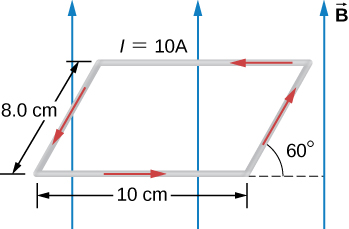
The current loop forms a parallelogram: the top and bottom are horizontal and 10 cm long, the sides are tilted at an angle of 60 degrees up from the +x direction and are 8.0 cm long. A current of 10 A flows counterclockwise. The magnetic field is up.

Answer

0 N and 0.012 Nm

11-85 §11.AP source ↗

A circular coil of wire of radius 5.0 cm has 20 turns and carries a current of 2.0 A. The coil lies in a magnetic field of magnitude 0.50 T that is directed parallel to the plane of the coil. (a) What is the magnetic dipole moment of the coil? (b) What is the torque on the coil?

Answer

a. 0.0157Am2; b. 0.0078 Nm

11-87 §11.AP source ↗

A 4.0-cm by 6.0-cm rectangular current loop carries a current of 10 A. What is the magnetic dipole moment of the loop?

Answer

0.024 Am 2

11-89 §11.AP source ↗

The current through a circular wire loop of radius 10 cm is 5.0 A. (a) Calculate the magnetic dipole moment of the loop. (b) What is the torque on the loop if it is in a uniform 0.20-T magnetic field such that μ and B are directed at 30° to each other? (c) For this position, what is the potential energy of the dipole?

Answer

a. 0.16Am2; b. 0.016 Nm; c. 0.028 J

11-91 §11.AP source ↗

Consider an electron rotating in a circular orbit of radius r. Show that the magnitudes of the magnetic dipole moment μ and the angular momentum L of the electron are related by:

μ L = e 2 m .

Answer

(Proof)

11-93 §11.AP source ↗

The density of charge carriers for copper is 8.47×1028 electrons per cubic meter. What will be the Hall voltage reading from a probe made up of 3cm×2 cm×1 cm(L×W×T) copper plate when a current of 1.5 A is passed through it in a magnetic field of 2.5 T perpendicular to the 3cm×2 cm.

Answer

4.65 × 10 −7 V

11-95 §11.AP source ↗

Show that the Hall voltage across wires made of the same material, carrying identical currents, and subjected to the same magnetic field is inversely proportional to their diameters. (Hint: Consider how drift velocity depends on wire diameter.)

Answer

Since E=Blv, where the width is twice the radius, I=2r, I=nqAvd,
vd= InqA= Inqπr2 so E= B×2r×Inqπr2= 2IBnqπ r∝1r∝1d.
The Hall voltage is inversely proportional to the diameter of the wire.

11-97 §11.AP source ↗

Find the radius of curvature of the path of a 25.0-MeV proton moving perpendicularly to the 1.20-T field of a cyclotron.

Answer

6.92×10⁷m/s; 0.602 m

11-99 §11.AP source ↗

Unreasonable results A charged particle having mass 6.64×10⁻²⁷kg (that of a helium atom) moving at 8.70×10⁵m/s perpendicular to a 1.50-T magnetic field travels in a circular path of radius 16.0 mm. (a) What is the charge of the particle? (b) What is unreasonable about this result? (c) Which assumptions are responsible?

Answer

a. 2.4×10⁻¹⁹C; b. not an integer multiple of e; c. need to assume all charges have multiples of e, could be other forces not accounted for

11-101 §11.AP source ↗

Unreasonable results Frustrated by the small Hall voltage obtained in blood flow measurements, a medical physicist decides to increase the applied magnetic field strength to get a 0.500-V output for blood moving at 30.0 cm/s in a 1.50-cm-diameter vessel. (a) What magnetic field strength is needed? (b) What is unreasonable about this result? (c) Which premise is responsible?

Answer

a. B = 5 T; b. very large magnet; c. applying such a large voltage

11-103 §11.CP source ↗

A proton of speed v = 6×10⁵m/s enters a region of uniform magnetic field of B = 0.5 T at an angle of q=30° to the magnetic field. In the region of magnetic field proton describes a helical path with radius R and pitch p (distance between loops). Find R and p.

Answer

R= (mvsinθ)/qB; p= ( 2 π m e B )vcosθ

11-105 §11.CP source ↗

In a region a non-uniform magnetic field exists such that Bx= 0, By= 0, andBz= ax, where a is a constant. At some time t, a wire of length L is carrying a current I is located along the x-axis from origin to x = L. Find the magnetic force on the wire at this instant in time.

Answer

I a L 2 / 2

11-107 §11.CP source ↗

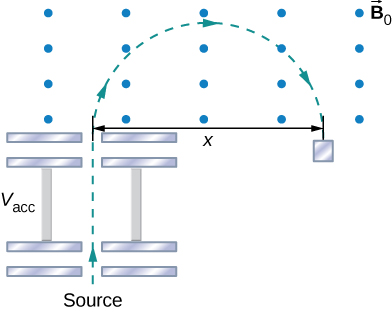
The accompanied figure shows an arrangement for measuring mass of ions by an instrument called the mass spectrometer. An ion of mass m and charge +q is produced essentially at rest in source S, a chamber in which a gas discharge is taking place. The ion is accelerated by a potential difference Vacc and allowed to enter a region of constant magnetic field B→0. In the uniform magnetic field region, the ion moves in a semicircular path striking a photographic plate at a distance x from the entry point. Derive a formula for mass m in terms of B0, q, Vacc, and x.

A schematic of the mass spectrometer. The source is at the bottom. Particles are accelerated by the potential difference V acc, then enter a region in which there is only a uniform magnetic field B naught. In that region, the particles follow a clockwise semicircular trajectory of diameter x.

Answer

m= q B 0 2 8 V acc x 2

11-109 §11.CP source ↗

A long-rigid wire lies along the x-axis and carries a current of 2.5 A in the positive x-direction. Around the wire is the magnetic field B→= 2.0i^+ 5.0x2j^, with x in meters and B in millitesla. Calculate the magnetic force on the segment of wire between x = 2.0 m and x = 4.0 m.

Answer

0.23 N

Loading chapter 12…

Problems and answers are adapted from University Physics Volume 2 by Samuel J. Ling, Jeff Sanny and William Moebs, OpenStax, and are used under the CC BY-NC-SA 4.0 licence. Access for free at https://openstax.org/books/university-physics-volume-2/pages/1-introduction. Illustrations: Copyright Rice University, OpenStax, under CC BY-NC-SA 4.0 license. This adaptation is released under the same licence, is non-commercial, and is neither affiliated with nor endorsed by OpenStax or Rice University.