Every problem in the chapter beside the book’s answer, a chapter at a time as you scroll.
Chapter 5: Electric Charges and Fields
69 problems · 22 figuresCheck Your Understanding 5.1 §5.3 source ↗
Answer
Check Your Understanding 5.2 §5.3 source ↗
Answer
Check Your Understanding 5.3 §5.4 source ↗
Answer
Check Your Understanding 5.4 §5.5 source ↗
Answer
Check Your Understanding 5.5 §5.5 source ↗
Answer
Check Your Understanding 5.6 §5.5 source ↗
Answer
5-1 §5.1 source ↗
Answer
5-3 §5.1 source ↗
Answer
5-5 §5.1 source ↗
Answer
5-7 §5.2 source ↗
Answer
5-9 §5.2 source ↗
Does the uncharged conductor shown below experience a net electric force?
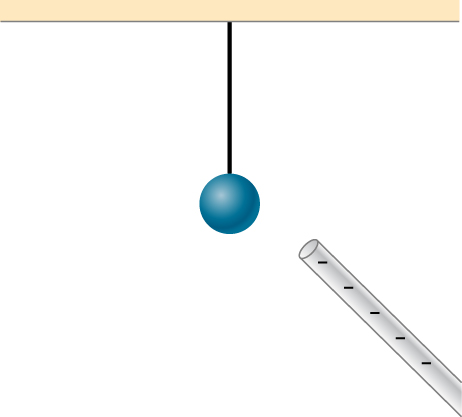
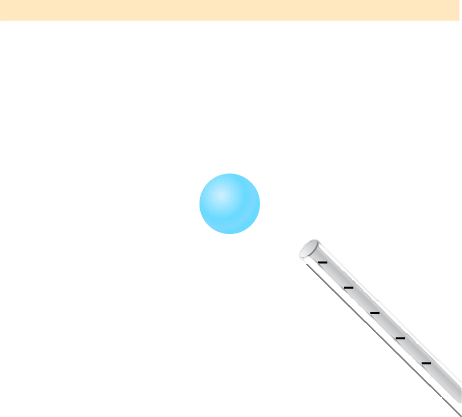
Answer
5-11 §5.2 source ↗
Answer
5-13 §5.2 source ↗
Answer
5-15 §5.2 source ↗
Answer
5-17 §5.2 source ↗
Answer
5-19 §5.2 source ↗
Answer
5-21 §5.3 source ↗
Answer
5-23 §5.4 source ↗
Answer
5-25 §5.4 source ↗
Answer
5-27 §5.5 source ↗
Answer
5-29 §5.5 source ↗
Answer
5-31 §5.6 source ↗
Answer
5-33 §5.6 source ↗
Answer
5-35 §5.6 source ↗
Answer
5-37 §5.1 source ↗
Answer
b.
5-39 §5.1 source ↗
Answer
5-41 §5.1 source ↗
Answer
b.
5-43 §5.2 source ↗
Answer
5-45 §5.2 source ↗
Answer
number of copper atoms ;
number of electrons equals 29 times number of atoms or ;
5-47 §5.2 source ↗
Answer
;
;
5-49 §5.3 source ↗
Answer
a. charge 1 is ; charge 2 is , to the left,
to the right,
to the right;
b. to the right,
to the right,
to the right,
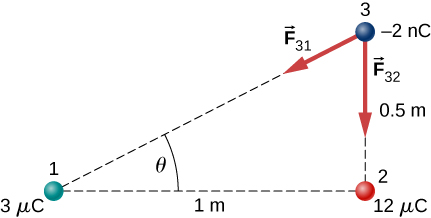
;
c. ,
,
5-51 §5.3 source ↗
Answer
5-53 §5.3 source ↗
Answer
5-55 §5.3 source ↗
Two small balls, each of mass 5.0 g, are attached to silk threads 50 cm long, which are in turn tied to the same point on the ceiling, as shown below. When the balls are given the same charge Q, the threads hang at to the vertical, as shown below. What is the magnitude of Q? What are the signs of the two charges?
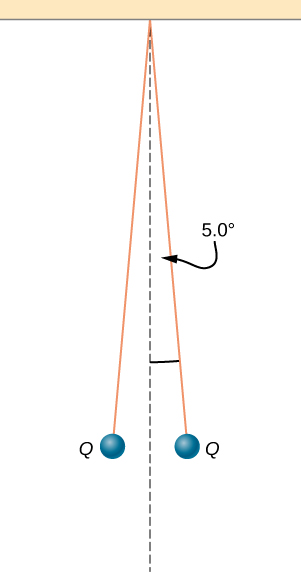
Answer
.
The charges can be positive or negative, but both have to be the same sign.
5-57 §5.3 source ↗
Answer
5-59 §5.3 source ↗
A charge is placed at the point P shown below. What is the force on q?

Answer
5-61 §5.3 source ↗
Answer
in the negative y-direction since the force is attractive. The net force from both charges is .
5-63 §5.3 source ↗
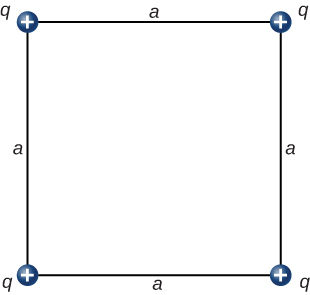
What is the force on the charge q at the lower-right-hand corner of the square shown here?
Answer
5-65 §5.4 source ↗
Answer
b. down
5-67 §5.4 source ↗
Answer
b. ;
c. on alpha particle;
on electron
5-69 §5.4 source ↗
Answer
5-71 §5.4 source ↗
Answer
5-73 §5.4 source ↗
Answer
5-75 §5.4 source ↗
Answer
b.
5-77 §5.4 source ↗
Answer
b.
5-79 §5.4 source ↗
Answer
At the origin we have a a negative charge of magnitide
.
5-81 §5.5 source ↗
Answer
5-83 §5.5 source ↗
The charge per unit length on the thin rod shown below is . What is the electric field at the point P? (Hint: Solve this problem by first considering the electric field at P due to a small segment dx of the rod, which contains charge . Then find the net field by integrating over the length of the rod.)


Answer
5-85 §5.5 source ↗
Answer
5-87 §5.5 source ↗
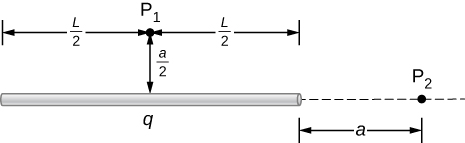
A total charge q is distributed uniformly along a thin, straight rod of length L (see below). What is the electric field at
Answer
At Put the origin at the end of L.
5-89 §5.5 source ↗
Answer
5-91 §5.5 source ↗
Answer
;
b. ,
5-93 §5.5 source ↗
Answer
5-95 §5.5 source ↗
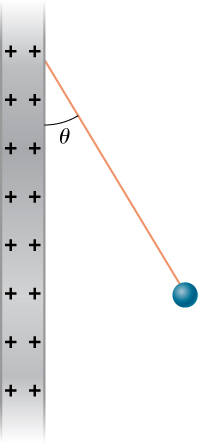
Shown below is a small sphere of mass 0.25 g that carries a charge of The sphere is attached to one end of a very thin silk string 5.0 cm long. The other end of the string is attached to a large vertical conducting plate that has a charge density of What is the angle that the string makes with the vertical?
Answer
,
,
This is independent of the length of the string.
5-97 §5.5 source ↗
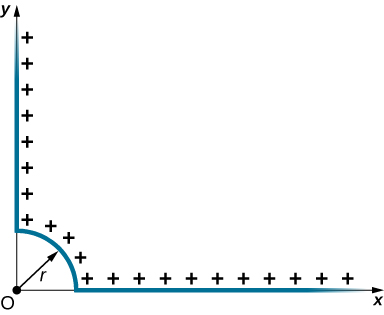
Positive charge is distributed with a uniform density along the positive x-axis from along the positive y-axis from and along a arc of a circle of radius r, as shown below. What is the electric field at O?
Answer
,
,
;
y-axis: ;
x-axis: ,
5-99 §5.5 source ↗
Answer
5-101 §5.6 source ↗
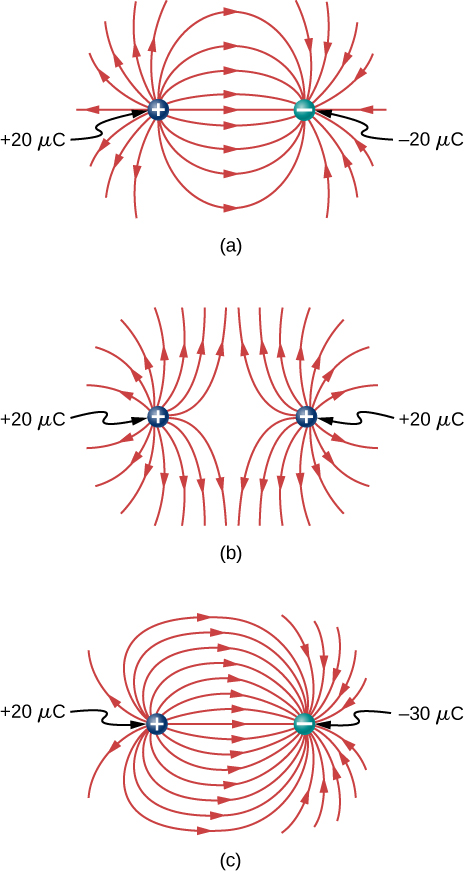
In this exercise, you will practice drawing electric field lines. Make sure you represent both the magnitude and direction of the electric field adequately. Note that the number of lines into or out of charges is proportional to the charges.
(a) Draw the electric field lines map for two charges and situated 5 cm from each other.
(b) Draw the electric field lines map for two charges and situated 5 cm from each other.
(c) Draw the electric field lines map for two charges and situated 5 cm from each other.
Answer
5-103 §5.6 source ↗
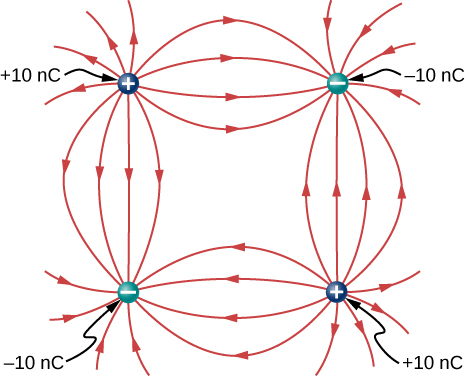
Two charges of equal magnitude but opposite sign make up an electric dipole. A quadrupole consists of two electric dipoles that are placed anti-parallel at two edges of a square as shown.
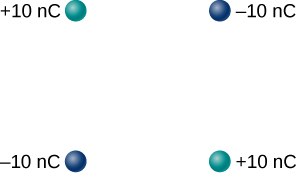
Draw the electric field of the charge distribution.
Answer
5-105 §5.7 source ↗
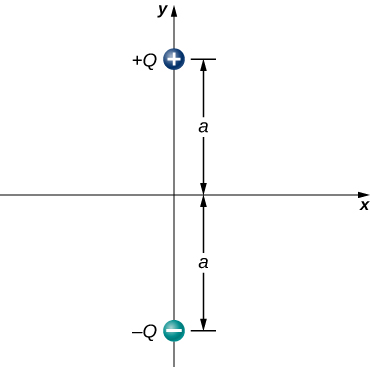
Consider the equal and opposite charges shown below. (a) Show that at all points on the x-axis for which (b) Show that at all points on the y-axis for which
Answer
,
5-107 §5.7 source ↗
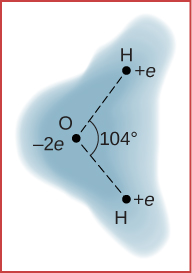
A water molecule consists of two hydrogen atoms bonded with one oxygen atom. The bond angle between the two hydrogen atoms is (see below). Calculate the net dipole moment of a hypothetical water molecule where the charge at the oxygen molecule is −2e and at each hydrogen atom is +e. The net dipole moment of the molecule is the vector sum of the individual dipole moment between the two O-Hs. The separation O-H is 0.9578 angstroms.
Answer
5-109 §5.AP source ↗
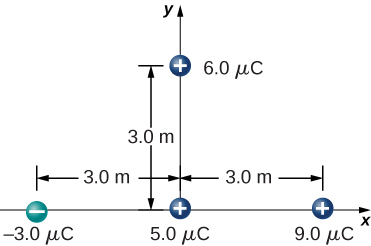
What is the force on the charge shown below?
Answer
5-111 §5.AP source ↗
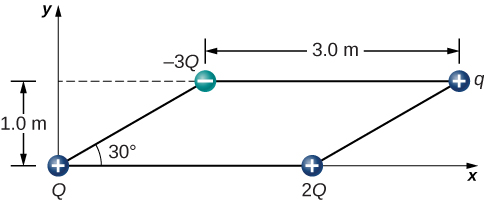
Four charged particles are positioned at the corners of a parallelogram as shown below. If and what is the net force on q?
Answer
,
5-113 §5.AP source ↗
Answer
5-115 §5.AP source ↗
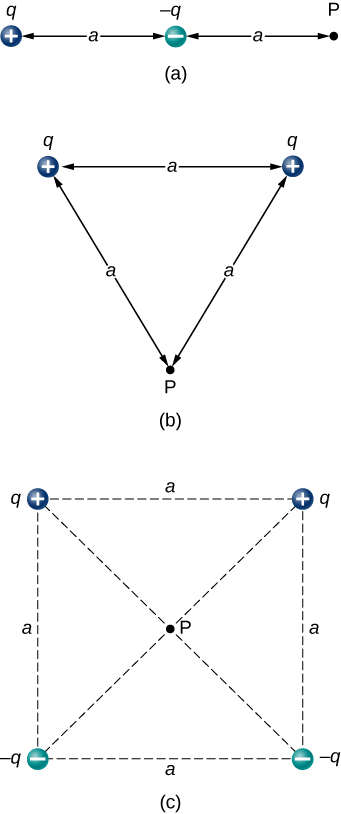
Find the electric field at P for the charge configurations shown below.
Answer
5-117 §5.AP source ↗
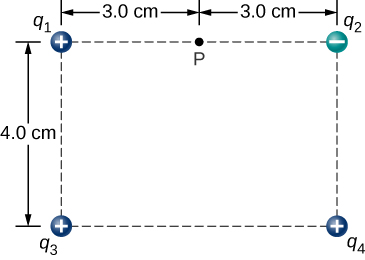
Point charges are placed at the four corners of a rectangle as shown below: and What is the electric field at P?
Answer
5-119 §5.AP source ↗
Answer
5-121 §5.AP source ↗
Answer
5-123 §5.AP source ↗
Answer
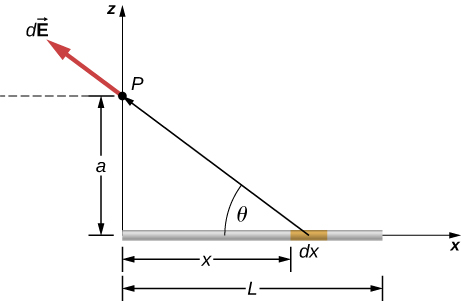
,
,
,
,
Substituting z for a, we have:
5-125 §5.AP source ↗
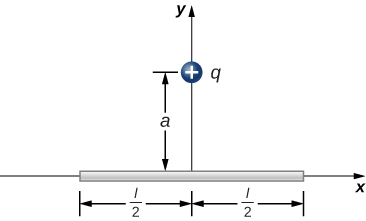
The charge per unit length on the thin rod shown here is What is the electric force on the point charge q? (See the preceding problem.)
Answer
,
Loading chapter 6…
Problems and answers are adapted from University Physics Volume 2 by Samuel J. Ling, Jeff Sanny and William Moebs, OpenStax, and are used under the CC BY-NC-SA 4.0 licence. Access for free at https://openstax.org/books/university-physics-volume-2/pages/1-introduction. Illustrations: Copyright Rice University, OpenStax, under CC BY-NC-SA 4.0 license. This adaptation is released under the same licence, is non-commercial, and is neither affiliated with nor endorsed by OpenStax or Rice University.