Every problem in the chapter beside the book’s answer, a chapter at a time as you scroll.
Chapter 3: The First Law of Thermodynamics
53 problems · 15 figuresCheck Your Understanding 3.1 §3.2 source ↗
Answer
Check Your Understanding 3.2 §3.3 source ↗
| Q (J) | W (J) | |
|---|---|---|
| –80 | –120 | |
| 90 | ||
| 40 | ||
| –40 |
Answer
Check Your Understanding 3.3 §3.3 source ↗
Answer
Check Your Understanding 3.4 §3.3 source ↗
Answer
3-1 §3.1 source ↗
Answer
3-3 §3.2 source ↗
Answer
3-5 §3.2 source ↗
Answer
3-7 §3.3 source ↗
Answer
3-9 §3.4 source ↗
Answer
3-11 §3.4 source ↗
Answer
3-13 §3.5 source ↗
Answer
3-15 §3.6 source ↗
Answer
3-17 §3.6 source ↗
Answer
3-19 §3.1 source ↗
Answer
3-21 §3.1 source ↗
Answer
3-23 §3.2 source ↗
Answer
3-25 §3.2 source ↗
Answer
3-27 §3.2 source ↗
Answer
3-29 §3.2 source ↗
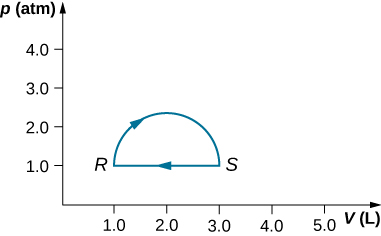
(a) Calculate the work done on the gas along the closed path shown below. The curved section between R and S is semicircular when plotted using the indicated unit. (b) If the process is carried out in the opposite direction, what is the work done on the gas?
Answer
3-31 §3.2 source ↗
Answer
3-33 §3.2 source ↗
Answer
3-35 §3.2 source ↗
Answer
3-37 §3.2 source ↗
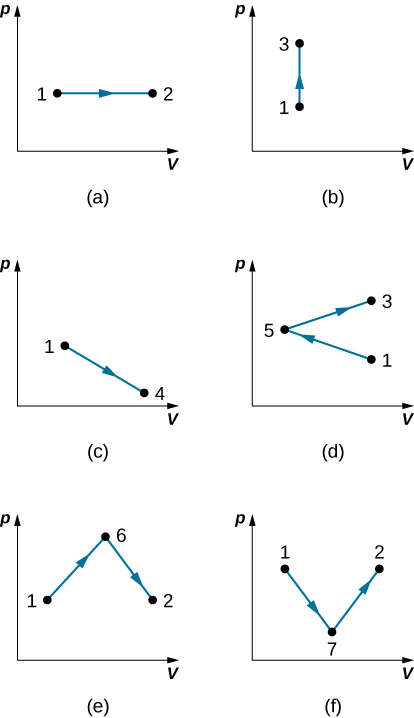
Find the work done in the quasi-static processes shown below. The states are given as (p, V) values for the points in the pV plane: 1 (3 atm, 4 L), 2 (3 atm, 6 L), 3 (5 atm, 4 L), 4 (2 atm, 6 L), 5 (4 atm, 2 L), 6 (5 atm, 5 L), and 7 (2 atm, 5 L).
Answer
3-39 §3.3 source ↗
Answer
3-41 §3.3 source ↗
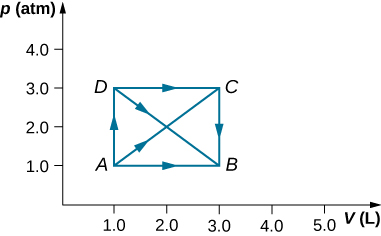
As shown below, if the heat absorbed by the gas along AB is 400 J, determine the quantities of heat absorbed along (a) ADB; (b) ACB; and (c) ADCB.
Answer
3-43 §3.3 source ↗
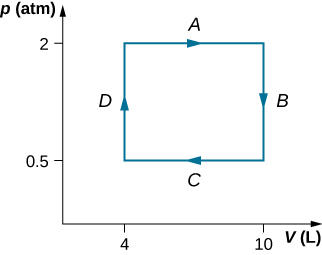
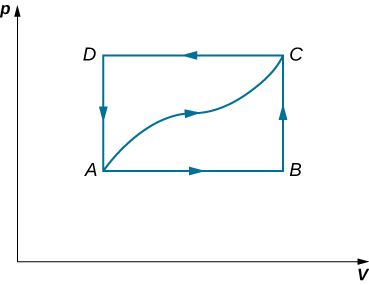
(a) What is the change in internal energy for the process represented by the closed path shown below? (b) How much heat is exchanged? (c) If the path is traversed in the opposite direction, how much heat is exchanged?
Answer
3-45 §3.3 source ↗
When a gas expands along AB (see below), it does 20 J of work and absorbs 30 J of heat. When the gas expands along AC, it does 40 J of work and absorbs 70 J of heat. (a) How much heat does the gas exchange along BC? (b) When the gas makes the transition from C to A along CDA, 60 J of work are done on it from C to D. How much heat does it exchange along CDA?
Answer
3-47 §3.3 source ↗
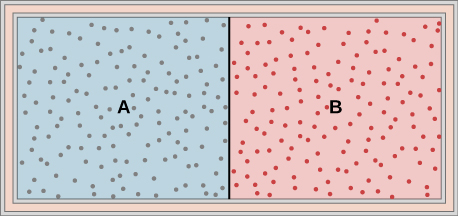
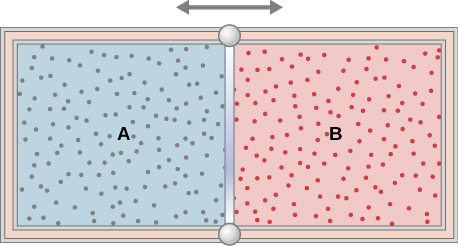
Ideal gases A and B are stored in the left and right chambers of an insulated container, as shown below. The partition is removed and the gases mix. Is any work done in this process? If the temperatures of A and B are initially equal, what happens to their common temperature after they are mixed?
Answer
3-49 §3.3 source ↗
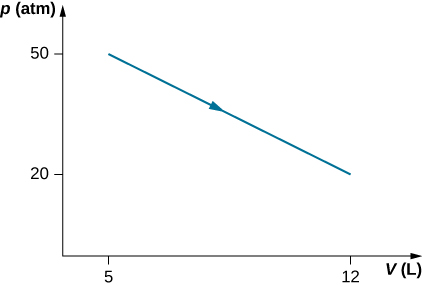
Consider the process for steam in a cylinder shown below. Suppose the change in the internal energy in this process is 30 kJ. Find the heat entering the system.
Answer
3-51 §3.3 source ↗
Answer
3-53 §3.3 source ↗
Answer
a.
;
b.
3-55 §3.4 source ↗
Answer
3-57 §3.4 source ↗
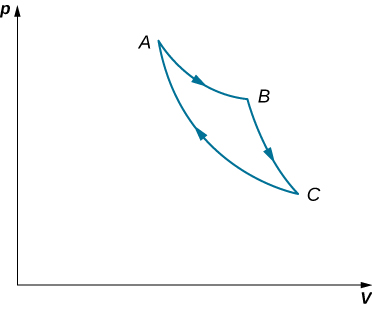
An ideal gas expands isothermally along AB and does 700 J of work (see below). (a) How much heat does the gas exchange along AB? (b) The gas then expands adiabatically along BC and does 400 J of work. When the gas returns to A along CA, it exhausts 100 J of heat to its surroundings. How much work is done on the gas along this path?
Answer
3-59 §3.4 source ↗
Answer
3-61 §3.5 source ↗
Answer
3-63 §3.5 source ↗
Answer
3-65 §3.5 source ↗
Answer
3-67 §3.6 source ↗
Answer
3-69 §3.6 source ↗
Pressure and volume measurements of a dilute gas undergoing a quasi-static adiabatic expansion are shown below. Plot ln p vs. ln V and determine for this gas from your graph.
| P (atm) | V (L) |
|---|---|
| 20.0 | 1.0 |
| 17.0 | 1.1 |
| 14.0 | 1.3 |
| 11.0 | 1.5 |
| 8.0 | 2.0 |
| 5.0 | 2.6 |
| 2.0 | 5.2 |
| 1.0 | 8.4 |
Answer
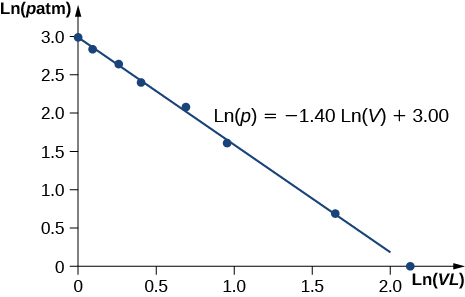
;
3-71 §3.6 source ↗
Answer
3-73 §3.6 source ↗
Answer
3-75 §3.6 source ↗
Answer
3-77 §3.6 source ↗
Answer
3-79 §3.AP source ↗
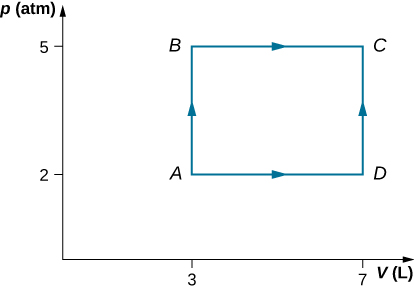
Consider the process shown below. During steps AB and BC, 3600 J and 2400 J of heat, respectively, are added to the system. (a) Find the work done in each of the processes AB, BC, AD, and DC. (b) Find the internal energy change in processes AB and BC. (c) Find the internal energy difference between states C and A. (d) Find the total heat added in the ADC process. (e) From the information given, can you find the heat added in process AD? Why or why not?
Answer
3-81 §3.AP source ↗
Answer
3-83 §3.AP source ↗
Answer
3-85 §3.AP source ↗
Answer
3-87 §3.AP source ↗
Answer
3-89 §3.AP source ↗
Answer
3-91 §3.AP source ↗
Answer
3-93 §3.AP source ↗
Answer
3-95 §3.CP source ↗
Answer
3-97 §3.CP source ↗
The insulated cylinder shown below is closed at both ends and contains an insulating piston that is free to move on frictionless bearings. The piston divides the chamber into two compartments containing gases A and B. Originally, each compartment has a volume of and contains a monatomic ideal gas at a temperature of and a pressure of 1.0 atm. (a) How many moles of gas are in each compartment? (b) Heat Q is slowly added to A so that it expands and B is compressed until the pressure of both gases is 3.0 atm. Use the fact that the compression of B is adiabatic to determine the final volume of both gases. (c) What are their final temperatures? (d) What is the value of Q?
Answer
Loading chapter 4…
Problems and answers are adapted from University Physics Volume 2 by Samuel J. Ling, Jeff Sanny and William Moebs, OpenStax, and are used under the CC BY-NC-SA 4.0 licence. Access for free at https://openstax.org/books/university-physics-volume-2/pages/1-introduction. Illustrations: Copyright Rice University, OpenStax, under CC BY-NC-SA 4.0 license. This adaptation is released under the same licence, is non-commercial, and is neither affiliated with nor endorsed by OpenStax or Rice University.