Every problem in the chapter beside the book’s answer, a chapter at a time as you scroll.

Chapter 4: The Second Law of Thermodynamics

54 problems · 6 figures

Check Your Understanding 4.1 §4.4 source ↗

What is the efficiency of a perfect heat engine? What is the coefficient of performance of a perfect refrigerator?

Answer

A perfect heat engine would have Qc=0, which would lead to e= 1− Qc/Qh= 1. A perfect refrigerator would need zero work, that is, W=0, which leads to KR=Qc/W→∞.

Check Your Understanding 4.2 §4.4 source ↗

Show that Qh− Qh′= Qc− Qc′ for the hypothetical engine of Figure 4.10(b).
Figure 4.10 in the book ↗
(a) Two uncoupled engines D and E working between the same reservoirs. (b) The coupled engines, with D working in reverse.

Answer

From the engine on the right, we have W=Qh′−Qc′. From the refrigerator on the right, we have Qh=Qc+W. Thus, W= Qh′− Qc′= Qh− Qc.

Check Your Understanding 4.3 §4.5 source ↗

A Carnot engine operates between reservoirs at 400°C and 30°C. (a) What is the efficiency of the engine? (b) If the engine does 5.0 J of work per cycle, how much heat per cycle does it absorb from the high-temperature reservoir? (c) How much heat per cycle does it exhaust to the cold-temperature reservoir? (d) What temperatures at the cold reservoir would give the minimum and maximum efficiency?

Answer

a. e= 1− Tc/Th= 0.55; b. Qh=eW=9.1J; c. Qc= Qh− W= 4.1J; d. −273°C and 400°C

Check Your Understanding 4.4 §4.5 source ↗

A Carnot refrigerator operates between two heat reservoirs whose temperatures are 0°C and 25°C. (a) What is the coefficient of performance of the refrigerator? (b) If 200 J of work are done on the working substance per cycle, how much heat per cycle is extracted from the cold reservoir? (c) How much heat per cycle is discarded to the hot reservoir?

Answer

a. KR= Tc/(Th−Tc)= 10.9; b. Qc= KRW= 2.18kJ; c. Qh= Qc+ W= 2.38kJ

Check Your Understanding 4.5 §4.7 source ↗

In Example 4.7, the spontaneous flow of heat from a hot object to a cold object results in a net increase in entropy of the universe. Discuss how this result can be related to an increase in disorder of the system.

Answer

When heat flows from the reservoir to the ice, the internal (mainly kinetic) energy of the ice goes up, resulting in a higher average speed and thus an average greater position variance of the molecules in the ice. The reservoir does become more ordered, but due to its much larger amount of molecules, it does not offset the change in entropy in the system.

Check Your Understanding 4.6 §4.7 source ↗

A quantity of heat Q is absorbed from a reservoir at a temperature Th by a cooler reservoir at a temperature Tc. What is the entropy change of the hot reservoir, the cold reservoir, and the universe?

Answer

−Q/Th; Q/Tc; and Q(Th−Tc)/(ThTc)

Check Your Understanding 4.7 §4.7 source ↗

A 50-g copper piece at a temperature of 20°C is placed into a large insulated vat of water at 100°C. (a) What is the entropy change of the copper piece when it reaches thermal equilibrium with the water? (b) What is the entropy change of the water? (c) What is the entropy change of the universe?

Answer

a. 4.71 J/K; b. −4.18 J/K; c. 0.53 J/K

4-1 §4.1 source ↗

State an example of a process that occurs in nature that is as close to reversible as it can be.

Answer

Some possible solutions are frictionless movement; restrained compression or expansion; energy transfer as heat due to infinitesimal temperature nonuniformity; electric current flow through a zero resistance; restrained chemical reaction; and mixing of two samples of the same substance at the same state.

4-3 §4.3 source ↗

If the refrigerator door is left open, what happens to the temperature of the kitchen?

Answer

The temperature increases since the heat output behind the refrigerator is greater than the cooling from the inside of the refrigerator.

4-5 §4.4 source ↗

In the text, we showed that if the Clausius statement is false, the Kelvin statement must also be false. Now show the reverse, such that if the Kelvin statement is false, it follows that the Clausius statement is false.

Answer

If we combine a perfect engine and a real refrigerator with the engine converting heat Q from the hot reservoir into work W=Q to drive the refrigerator, then the heat dumped to the hot reservoir by the refrigerator will be W+ΔQ, resulting in a perfect refrigerator transferring heat ΔQ from the cold reservoir to hot reservoir without any other effect.

4-7 §4.4 source ↗

Discuss the practical advantages and disadvantages of heat pumps and electric heating.

Answer

Heat pumps can efficiently extract heat from the ground to heat on cooler days or pull heat out of the house on warmer days. The disadvantage of heat pumps are that they are more costly than alternatives, require maintenance, and will not work efficiently when temperature differences between the inside and outside are very large. Electric heating is much cheaper to purchase than a heat pump; however, it may be more costly to run depending on the electric rates and amount of usage.

4-9 §4.4 source ↗

Speculate as to why nuclear power plants are less efficient than fossil-fuel plants based on temperature arguments.

Answer

A nuclear reactor needs to have a lower temperature to operate, so its efficiency will not be as great as a fossil-fuel plant. This argument does not take into consideration the amount of energy per reaction: Nuclear power has a far greater energy output than fossil fuels.

4-11 §4.5 source ↗

To increase the efficiency of a Carnot engine, should the temperature of the hot reservoir be raised or lowered? What about the cold reservoir?

Answer

In order to increase the efficiency, the temperature of the hot reservoir should be raised, and the cold reservoir should be lowered as much as possible. This can be seen in Equation 4.3.

4-13 §4.5 source ↗

What type of processes occur in a Carnot cycle?

Answer

adiabatic and isothermal processes

4-15 §4.6 source ↗

Is it possible for a system to have an entropy change if it neither absorbs nor emits heat during a reversible transition? What happens if the process is irreversible?

Answer

Entropy will not change if it is a reversible transition but will change if the process is irreversible.

4-17 §4.7 source ↗

Discuss the entropy changes in the systems of Exercise 4.16 in terms of disorder.

Answer

Entropy is a function of disorder, so all the answers apply here as well.

4-19 §4.1 source ↗

A mole of ideal monatomic gas at 0°C and 1.00 atm is warmed up to expand isobarically to triple its volume. How much heat is transferred during the process?

Answer

11.0 × 10 3 J

4-21 §4.1 source ↗

After a free expansion to quadruple its volume, a mole of ideal diatomic gas is compressed back to its original volume adiabatically and then cooled down to its original temperature. What is the minimum heat removed from the gas in the final step to restoring its state?

Answer

1.85 P 0 V 0

4-23 §4.2 source ↗

In performing 100.0 J of work, an engine discharges 50.0 J of heat. What is the efficiency of the engine?

Answer

0.667

4-25 §4.2 source ↗

It is found that an engine discharges 100.0 J while absorbing 125.0 J each cycle of operation. (a) What is the efficiency of the engine? (b) How much work does it perform per cycle?

Answer

a. 0.200; b. 25 J

4-27 §4.2 source ↗

An engine absorbs three times as much heat as it discharges. The work done by the engine per cycle is 50 J. Calculate (a) the efficiency of the engine, (b) the heat absorbed per cycle, and (c) the heat discharged per cycle.

Answer

a. 0.67; b. 75 J; c. 25 J

4-29 §4.3 source ↗

A refrigerator has a coefficient of performance of 3.0. (a) If it requires 200 J of work per cycle, how much heat per cycle does it remove the cold reservoir? (b) How much heat per cycle is discarded to the hot reservoir?

Answer

a. 600 J; b. 800 J

4-31 §4.3 source ↗

If a refrigerator discards 80 J of heat per cycle and its coefficient of performance is 6.0, what are (a) the quantity off heat it removes per cycle from a cold reservoir and (b) the amount of work per cycle required for its operation?

Answer

a. 69 J; b. 11 J

4-33 §4.5 source ↗

The temperature of the cold and hot reservoirs between which a Carnot heat pump operates are −73°C and 270°C, respectively. Which is its coefficient of performance?

Answer

1.58

4-35 §4.5 source ↗

A Carnot engine operates between reservoirs at 600 and 300 K. If the engine absorbs 100 J per cycle at the hot reservoir, what is its work output per cycle?

Answer

50 J

4-37 §4.5 source ↗

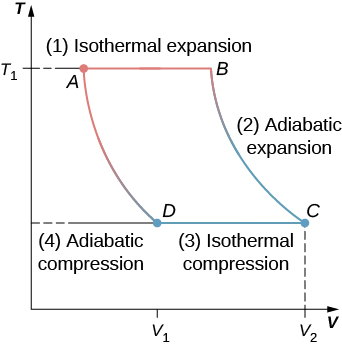
Sketch a Carnot cycle on a temperature-volume diagram.

Answer


The graph shows isotherms and adiabatic curves for Carnot cycle with four points A, B, C and D. The x-axis is V and y-axis is T. The value of T at A and B is T subscript 1 and at C and D is T subscript 2.

4-39 §4.5 source ↗

An engine operating between heat reservoirs at 20°C and 200°C extracts 1000 J per cycle from the hot reservoir. (a) What is the maximum possible work that engine can do per cycle? (b) For this maximum work, how much heat is exhausted to the cold reservoir per cycle?

Answer

a. 381 J; b. 619 J

4-41 §4.5 source ↗

A Carnot engine is used to measure the temperature of a heat reservoir. The engine operates between the heat reservoir and a reservoir consisting of water at its triple point. (a) If 400 J per cycle are removed from the heat reservoir while 200 J per cycle are deposited in the triple-point reservoir, what is the temperature of the heat reservoir? (b) If 400 J per cycle are removed from the triple-point reservoir while 200 J per cycle are deposited in the heat reservoir, what is the temperature of the heat reservoir?

Answer

a. 546 K; b. 137 K

4-43 §4.6 source ↗

Two hundred joules of heat are removed from a heat reservoir at a temperature of 200 K. What is the entropy change of the reservoir?

Answer

–1 J/K

4-45 §4.6 source ↗

An ideal gas at 300 K is compressed isothermally to one-fifth its original volume. Determine the entropy change per mole of the gas.

Answer

–13 J(K mole)

4-47 §4.6 source ↗

A metal rod is used to conduct heat between two reservoirs at temperatures ThandTc, respectively. When an amount of heat Q flows through the rod from the hot to the cold reservoir, what is the net entropy change of the rod, the hot reservoir, the cold reservoir, and the universe?

Answer

0 (no net heat remains in or leaves the rod), − QTh, QTc, Q(1Tc−1Th)

4-49 §4.6 source ↗

A 5.0-kg piece of lead at a temperature of 600°C is placed in a lake whose temperature is 15°C. Determine the entropy change of (a) the lead piece, (b) the lake, and (c) the universe.

Answer

a. –709 J/K; b. 1300 J/K; c. 591 J/K

4-51 §4.6 source ↗

An ideal monatomic gas is confined to a rigid container. When heat is added reversibly to the gas, its temperature changes from T1toT2. (a) How much heat is added? (b) What is the change in entropy of the gas?

Answer

a. Q=32nRΔT; b. S= 32nRln(T2/T1)

4-53 §4.7 source ↗

A copper rod of cross-sectional area 5.0cm2 and length 5.0 m conducts heat from a heat reservoir at 373 K to one at 273 K. What is the time rate of change of the universe’s entropy for this process?

Answer

3.78 × 10 −3 W/K

4-55 §4.7 source ↗

Fifty grams of water at 0°C are changed into vapor at 100°C. What is the change in entropy of the water in this process?

Answer

370 J/K

4-57 §4.7 source ↗

Two hundred grams of water at 0°C is brought into contact with a heat reservoir at 80°C. After thermal equilibrium is reached, what is the temperature of the water? Of the reservoir? How much heat has been transferred in the process? What is the entropy change of the water? Of the reservoir? What is the entropy change of the universe?

Answer

80°C, 80°C, 6.70×10⁴J, 215 J/K, –190 J/K, 25 J/K

4-59 §4.7 source ↗

Two hundred grams of water at 0°C is brought into contact into thermal equilibrium successively with reservoirs at 20°C, 40°C, 60°C, and 80°C. (a) What is the entropy change of the water? (b) Of the reservoir? (c) What is the entropy change of the universe?

Answer

ΔSH2O= 215J/K, ΔSR=−208J/K, ΔSU=7J/K

4-61 §4.7 source ↗

The Carnot cycle is represented by the temperature-entropy diagram shown below. (a) How much heat is absorbed per cycle at the high-temperature reservoir? (b) How much heat is exhausted per cycle at the low-temperature reservoir? (c) How much work is done per cycle by the engine? (d) What is the efficiency of the engine?
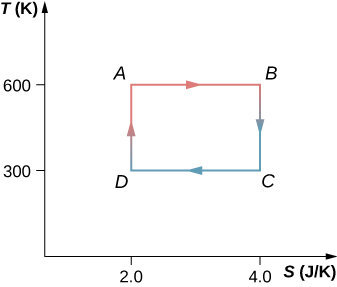
The figure shows a graph with x-axis S in J divided by K and y-axis T in K. The four points A (2.0, 600), B (4.0, 600), C (4.0, 300) ad D (2.0, 300) are connected to form a closed loop.

Answer

a. 1200 J; b. 600 J; c. 600 J; d. 0.50

4-63 §4.7 source ↗

A monoatomic ideal gas (n moles) goes through a cyclic process shown below. Find the change in entropy of the gas in each step and the total entropy change over the entire cycle.
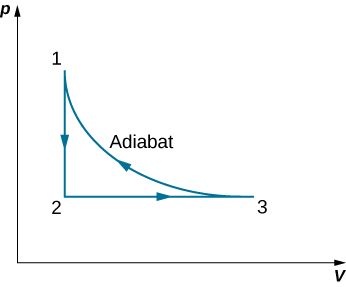
The figure shows a closed loop graph with three points 1, 2 and 3. The x-axis is V and y-axis is p. The value of V at 1 and 2 is equal and the value of p at 2 and 3 is equal.

Answer

ΔS= n C V ln( T 2 T 1 )+ n C p ln( T 3 T 2 )

4-65 §4.7 source ↗

A Carnot engine performs 100 J of work while discharging 200 J of heat each cycle. After the temperature of the hot reservoir only is adjusted, it is found that the engine now does 130 J of work while discarding the same quantity of heat. (a) What are the initial and final efficiencies of the engine? (b) What is the fractional change in the temperature of the hot reservoir?

Answer

a. 0.33, 0.39; b. 0.91

4-67 §4.AP source ↗

A 300-W heat pump operates between the ground, whose temperature is 0°C, and the interior of a house at 22°C. What is the maximum amount of heat per hour that the heat pump can supply to the house?

Answer

1.45 × 10 7 J

4-69 §4.AP source ↗

A Carnot engine employs 1.5 mol of nitrogen gas as a working substance, which is considered as an ideal diatomic gas with γ=7/5 at the working temperatures of the engine. The Carnot cycle goes in the cycle ABCDA with AB being an isothermal expansion. The volume at points A and C of the cycle are 5.0×10⁻³m3 and 0.15 m3, respectively. The engine operates between two thermal baths of temperature 500 K and 300 K. (a) Find the values of volume at B and D. (b) How much heat is absorbed by the gas in the AB isothermal expansion? (c) How much work is done by the gas in the AB isothermal expansion? (d) How much heat is given up by the gas in the CD isothermal compression? (e) How much work is done by the gas in the CD isothermal compression? (f) How much work is done by the gas in the BC adiabatic expansion? (g) How much work is done by the gas in the DA adiabatic compression? (h) Find the value of efficiency of the engine based on the net work and heat input. Compare this value to the efficiency of a Carnot engine based on the temperatures of the two baths.

Answer

a. VB= 0.042m3, VD= 0.018m3; b. 13,000 J; c. 13,000 J; d. –8,000 J; e. –8,000 J; f. 6200 J; g. –6200 J; h. 39%; with temperatures efficiency is 40%, which is off likely by rounding errors.

4-71 §4.AP source ↗

A system consisting of 20.0 mol of a monoatomic ideal gas is cooled at constant pressure from a volume of 50.0 L to 10.0 L. The initial temperature was 300 K. What is the change in entropy of the gas?

Answer

–670 J/K

4-73 §4.AP source ↗

A Carnot engine operates between 550°C and 20°C baths and produces 300 kJ of energy in each cycle. Find the change in entropy of the (a) hot bath and (b) cold bath, in each Carnot cycle?

Answer

a. –570 J/K; b. 570 J/K

4-75 §4.AP source ↗

A 0.50-kg piece of aluminum at 250°C is dropped into 1.0 kg of water at 20°C. After equilibrium is reached, what is the net entropy change of the system?

Answer

80 J/K

4-77 §4.AP source ↗

A heat engine operates between two temperatures such that the working substance of the engine absorbs 5000 J of heat from the high-temperature bath and discharges 3000 J to the low-temperature bath. The rest of the energy is converted into mechanical energy of the turbine. Find (a) the amount of work produced by the engine and (b) the efficiency of the engine.

Answer

a. 2000 J; b. 40%

4-79 §4.AP source ↗

A coal power plant consumes 100,000 kg of coal per hour and produces 500 MW of power. If the heat of combustion of coal is 30 MJ/kg, what is the efficiency of the power plant?

Answer

60 %

4-81 §4.AP source ↗

A Carnot engine working between two heat baths of temperatures 600 K and 273 K completes each cycle in 5 sec. In each cycle, the engine absorbs 10 kJ of heat. Find the power of the engine.

Answer

1100 W

4-83 §4.CP source ↗

(a) An infinitesimal amount of heat is added reversibly to a system. By combining the first and second laws, show that dU=TdS−dW. (b) When heat is added to an ideal gas, its temperature and volume change from T1andV1toT2andV2. Show that the entropy change of n moles of the gas is given by

ΔS= nCvlnT2T1+ nRlnV2V1.

Answer

derive

4-85 §4.CP source ↗

With the help of the two preceding problems, show that ΔS between states 1 and 2 of n moles an ideal gas is given by

ΔS= nCplnT2T1− nRlnp2p1.

Answer

derive

4-87 §4.CP source ↗

A diatomic ideal gas is brought from an initial equilibrium state at p1=0.50atm and T1=300K to a final stage with p2=0.20atm and T1=500K. Use the results of the previous problem to determine the entropy change per mole of the gas.

Answer

18 J/K

4-89 §4.CP source ↗

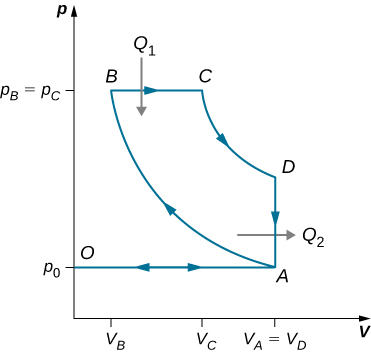
An ideal diesel cycle is shown below. This cycle consists of five strokes. In this case, only air is drawn into the chamber during the intake stroke OA. The air is then compressed adiabatically from state A to state B, raising its temperature high enough so that when fuel is added during the power stroke BC, it ignites. After ignition ends at C, there is a further adiabatic power stroke CD. Finally, there is an exhaust at constant volume as the pressure drops from pD to pA, followed by a further exhaust when the piston compresses the chamber volume to zero.

(a) Use W=Q1−Q2, Q1= nCp(TC−TB), and Q2= nCv(TD−TA) to show that e= WQ1= 1− TD−TAγ(TC−TB).

(b) Use the fact that A→B and C→D are adiabatic to show that

e= 1− 1γ(VCVD)γ−(VBVA)γ(VCVD)−(VBVA).

(c) Since there is no preignition (remember, the chamber does not contain any fuel during the compression), the compression ratio can be larger than that for a gasoline engine. Typically, VA/VB= 15andVD/VC= 5. For these values and γ=1.4, show that ε=0.56, or an efficiency of 56%. Diesel engines actually operate at an efficiency of about 30%to35% compared with 25%to30% for gasoline engines.

The figure shows a closed loop graph with four points A, B, C and D. The x-axis is V and y-axis is p. The value of V at A and D is equal and the value of p at B and C is equal.

Answer

proof

4-91 §4.CP source ↗

Derive a formula for the coefficient of performance of a refrigerator using an ideal gas as a working substance operating in the cycle shown below in terms of the properties of the three states labeled 1, 2, and 3.

The figure shows a closed loop graph with three points 1, 2 and 3. The x-axis is V and y-axis is p. The value of V at 1 and 2 is equal and the value of p at 2 and 3 is equal.

Answer

K R = 3 ( p 1 − p 2 ) V 1 5 p 2 V 3 − 3 p 1 V 1 − p 2 V 1

4-93 §4.CP source ↗

A Carnot refrigerator, working between 0°C and 30°C is used to cool a bucket of water containing 10−2m3 of water at 30°C to 5°C in 2 hours. Find the total amount of work needed.

Answer

W = 110,000 J

Loading chapter 5…

Problems and answers are adapted from University Physics Volume 2 by Samuel J. Ling, Jeff Sanny and William Moebs, OpenStax, and are used under the CC BY-NC-SA 4.0 licence. Access for free at https://openstax.org/books/university-physics-volume-2/pages/1-introduction. Illustrations: Copyright Rice University, OpenStax, under CC BY-NC-SA 4.0 license. This adaptation is released under the same licence, is non-commercial, and is neither affiliated with nor endorsed by OpenStax or Rice University.