Every problem in the chapter beside the book’s answer, a chapter at a time as you scroll.

Chapter 2: The Kinetic Theory of Gases

56 problems · 1 figure

Check Your Understanding 2.1 §2.1 source ↗

The recommended daily amount of vitamin B3 or niacin, C6NH5O2, for women who are not pregnant or nursing, is 14 mg. Find the number of molecules of niacin in that amount.

Answer

We first need to calculate the molar mass (the mass of one mole) of niacin. To do this, we must multiply the number of atoms of each element in the molecule by the element’s molar mass.
(6mol of carbon)(12.0g/mol)+(5mol hydrogen)(1.0g/mol)+(1mol nitrogen)(14g/mol)+(2mol oxygen)(16.0g/mol)=123g/mol
Then we need to calculate the number of moles in 14 mg.
(14mg123g/mol)(1g1000mg)= 1.14×10⁻⁴mol.
Then, we use Avogadro’s number to calculate the number of molecules:
N= nNA= (1.14×10⁻⁴mol)(6.02×10²³molecules/mol)= 6.85×10¹⁹molecules.

Check Your Understanding 2.2 §2.1 source ↗

The density of air in a classroom (p=1.00atm and T=20°C) is 1.28kg/m3. At what pressure is the density 0.600kg/m3 if the temperature is kept constant?

Answer

The density of a gas is equal to a constant, the average molecular mass, times the number density N/V. From the ideal gas law, pV=NkBT, we see that N/V=p/kBT. Therefore, at constant temperature, if the density and, consequently, the number density are reduced by half, the pressure must also be reduced by half, and pf= 0.500atm.

Check Your Understanding 2.3 §2.1 source ↗

Liquids and solids have densities on the order of 1000 times greater than gases. Explain how this implies that the distances between molecules in gases are on the order of 10 times greater than the size of their molecules.

Answer

Density is mass per unit volume, and volume is proportional to the size of a body (such as the radius of a sphere) cubed. So if the distance between molecules increases by a factor of 10, then the volume occupied increases by a factor of 1000, and the density decreases by a factor of 1000. Since we assume molecules are in contact in liquids and solids, the distance between their centers is on the order of their typical size, so the distance in gases is on the order of 10 times as great.

Check Your Understanding 2.4 §2.2 source ↗

If you consider a very small object, such as a grain of pollen, in a gas, then the number of molecules striking its surface would also be relatively small. Would you expect the grain of pollen to experience any fluctuations in pressure due to statistical fluctuations in the number of gas molecules striking it in a given amount of time?

Answer

Yes. Such fluctuations actually occur for a body of any size in a gas, but since the numbers of molecules are immense for macroscopic bodies, the fluctuations are a tiny percentage of the number of collisions, and the averages spoken of in this section vary imperceptibly. Roughly speaking, the fluctuations are inversely proportional to the square root of the number of collisions, so for small bodies, they can become significant. This was actually observed in the nineteenth century for pollen grains in water and is known as Brownian motion.

Check Your Understanding 2.5 §2.2 source ↗

Which has a longer mean free path, liquid water or water vapor in the air?

Answer

In a liquid, the molecules are very close together, constantly colliding with one another. For a gas to be nearly ideal, as air is under ordinary conditions, the molecules must be very far apart. Therefore the mean free path is much longer in the air.

Check Your Understanding 2.6 §2.3 source ↗

Suppose 2 moles of helium gas at 200 K are mixed with 2 moles of krypton gas at 400 K in a calorimeter. What is the final temperature?

Answer

As the number of moles is equal and we know the molar heat capacities of the two gases are equal, the temperature is halfway between the initial temperatures, 300 K.

2-1 §2.1 source ↗

Two H2 molecules can react with one O2 molecule to produce two H2O molecules. How many moles of hydrogen molecules are needed to react with one mole of oxygen molecules?

Answer

2 moles, as that will contain twice as many molecules as the 1 mole of oxygen

2-3 §2.1 source ↗

A constant-volume gas thermometer contains a fixed amount of gas. What property of the gas is measured to indicate its temperature?

Answer

pressure

2-5 §2.1 source ↗

In the last chapter, free convection was explained as the result of buoyant forces on hot fluids. Explain the upward motion of air in flames based on the ideal gas law.

Answer

The flame contains hot gas (heated by combustion). The pressure is still atmospheric pressure, in mechanical equilibrium with the air around it (or roughly so). The density of the hot gas is proportional to its number density N/V (neglecting the difference in composition between the gas in the flame and the surrounding air). At higher temperature than the surrounding air, the ideal gas law says that N/V=p/kBT is less than that of the surrounding air. Therefore the hot air has lower density than the surrounding air and is lifted by the buoyant force.

2-7 §2.2 source ↗

If one kind of molecule has double the radius of another and eight times the mass, how do their mean free paths under the same conditions compare? How do their mean free times compare?

Answer

The mean free path is inversely proportional to the square of the radius, so it decreases by a factor of 4. The mean free time is proportional to the mean free path and inversely proportional to the rms speed, which in turn is inversely proportional to the square root of the mass. That gives a factor of 8 in the numerator, so the mean free time decreases by a factor of 2.

2-9 §2.2 source ↗

Why do the atmospheres of Jupiter, Saturn, Uranus, and Neptune, which are much more massive and farther from the Sun than Earth is, contain large amounts of hydrogen and helium?

Answer

Since they’re more massive, their gravity is stronger, so the escape velocity from them is higher. Since they’re farther from the Sun, they’re colder, so the speeds of atmospheric molecules including hydrogen and helium are lower. The combination of those facts means that relatively few hydrogen and helium molecules have escaped from the outer planets.

2-11 §2.2 source ↗

Which is more dangerous, a closet where tanks of nitrogen are stored, or one where tanks of carbon dioxide are stored?

Answer

One where carbon dioxide is stored, as excess CO2 will cause a feeling of suffocating, but excess nitrogen and insufficient oxygen will not.

2-13 §2.3 source ↗

One might think that the internal energy of diatomic gases is given by Eint=5RT/2. For diatomic gases near room temperature, what additional considerations would cause the internal energy to be less than that? What would cause the internal energy to be more than that? Hint: Their internal energy includes the total energy added in raising the temperature from the boiling point (very low) to room temperature.

Answer

Their internal energy includes the total energy added in raising the temperature from the boiling point (very low) to room temperature. At lower temperatures their heat capacity was only 3R/2, which lowers the calculated value of the total internal energy. On the other hand, using 5R/2 for the heat capacity assumes 5 degrees of freedom: 3 translational and 2 rotational. A diatomic molecule will also have vibrational degrees of freedom, which, if the vibrational frequency is low enough, may be partially activated, raising the heat capacity. This is the case for some heavy molecules with weak bonds, i.e., small gap vibrational frequencies such as I2 (iodine molecule). Interactions between molecules also change the value of the internal energy. Looking at the heat capacity at constant volume of some diatomic gases, we see that H2 has Cv/R = 2.47 at room temperature, slightly less than 5/2, while O2 has Cv/R = 2.53, slightly higher than 5/2.

2-15 §2.4 source ↗

One cylinder contains helium gas and another identical cylinder contains krypton gas at the same temperature. Mark each of these statements true, false, or impossible to determine from the given information. (a) The rms speeds of atoms in the two gases are the same. (b) The average kinetic energies of atoms in the two gases are the same. (c) The internal energies of 1 mole of gas in each cylinder are the same. (d) The pressures in the two cylinders are the same.

Answer

a. false; b. true; c. true; d. true

2-17 §2.4 source ↗

An ideal gas is at a temperature of 300 K. To double the average speed of its molecules, what does the temperature need to be changed to?

Answer

1200 K

2-19 §2.1 source ↗

Suppose a gas-filled incandescent light bulb is manufactured so that the gas inside the bulb is at atmospheric pressure when the bulb has a temperature of 20.0°C. (a) Find the gauge pressure inside such a bulb when it is hot, assuming its average temperature is 60.0°C (an approximation) and neglecting any change in volume due to thermal expansion or gas leaks. (b) The actual final pressure for the light bulb will be less than calculated in part (a) because the glass bulb will expand. Is this effect significant?

Answer

a. 0.137 atm; b. pg= (1atm)T2V1T1V2− 1atm. Because of the expansion of the glass, V2=0.9989. Multiplying by that factor does not make any significant difference.

2-21 §2.1 source ↗

How many moles are there in (a) 0.0500 g of N2 gas (M=28.0g/mol)? (b) 10.0 g of CO2 gas (M=44.0g/mol)? (c) How many molecules are present in each case?

Answer

a. 1.79×10⁻³mol; b. 0.227 mol; c. 1.08×10²¹ molecules for the nitrogen, 1.37×10²³ molecules for the carbon dioxide

2-23 §2.1 source ↗

Calculate the number of moles in the 2.00-L volume of air in the lungs of the average person. Note that the air is at 37.0°C (body temperature) and that the total volume in the lungs is several times the amount inhaled in a typical breath as given in Example 2.2.
Example 2.2 Calculating the Number of Molecules in a Cubic Meter of Gas in the book ↗

Answer

7.84 × 10 −2 mol

2-25 §2.1 source ↗

A company advertises that it delivers helium at a gauge pressure of 1.72×10⁷Pa in a cylinder of volume 43.8 L. How many balloons can be inflated to a volume of 4.00 L with that amount of helium? Assume the pressure inside the balloons is 1.01×10⁵Pa and the temperature in the cylinder and the balloons is 25.0°C.

Answer

1.87 × 10 3

2-27 §2.1 source ↗

An expensive vacuum system can achieve a pressure as low as 1.00×10⁻⁷N/m2 at 20.0°C. How many molecules are there in a cubic centimeter at this pressure and temperature?

Answer

2.47 × 10 7 molecules

2-29 §2.1 source ↗

A bicycle tire contains 2.00 L of gas at an absolute pressure of 7.00×10⁵N/m2 and a temperature of 18.0°C. What will its pressure be if you let out an amount of air that has a volume of 100cm3 at atmospheric pressure? Assume tire temperature and volume remain constant.

Answer

6.95×10⁵Pa; 6.86 atm

2-31 §2.1 source ↗

A high-pressure gas cylinder contains 50.0 L of toxic gas at a pressure of 1.40×10⁷N/m2 and a temperature of 25.0°C. The cylinder is cooled to dry ice temperature (−78.5°C) to reduce the leak rate and pressure so that it can be safely repaired. (a) What is the final pressure in the tank, assuming a negligible amount of gas leaks while being cooled and that there is no phase change? (b) What is the final pressure if one-tenth of the gas escapes? (c) To what temperature must the tank be cooled to reduce the pressure to 1.00 atm (assuming the gas does not change phase and that there is no leakage during cooling)? (d) Does cooling the tank as in part (c) appear to be a practical solution?

Answer

a. 9.14×10⁶Pa; b. 8.22×10⁶Pa; c. 2.15 K; d. no

2-33 §2.1 source ↗

Calculate the depth to which Avogadro’s number of table tennis balls would cover Earth. Each ball has a diameter of 3.75 cm. Assume the space between balls adds an extra 25.0% to their volume and assume they are not crushed by their own weight.

Answer

40.7 km

2-35 §2.2 source ↗

In the problems in this section, assume all gases are ideal.

A person hits a tennis ball with a mass of 0.058 kg against a wall. The average component of the ball’s velocity perpendicular to the wall is 11 m/s, and the ball hits the wall every 2.1 s on average, rebounding with the opposite perpendicular velocity component. (a) What is the average force exerted on the wall? (b) If the part of the wall the person hits has an area of 3.0m2, what is the average pressure on that area?

Answer

a. 0.61 N; b. 0.20 Pa

2-37 §2.2 source ↗

In the problems in this section, assume all gases are ideal.

Five bicyclists are riding at the following speeds: 5.4 m/s, 5.7 m/s, 5.8 m/s, 6.0 m/s, and 6.5 m/s. (a) What is their average speed? (b) What is their rms speed?

Answer

a. 5.88 m/s; b. 5.89 m/s

2-39 §2.2 source ↗

In the problems in this section, assume all gases are ideal.

Typical molecular speeds (vrms) are large, even at low temperatures. What is vrms for helium atoms at 5.00 K, less than one degree above helium’s liquefaction temperature?

Answer

177 m/s

2-41 §2.2 source ↗

In the problems in this section, assume all gases are ideal.

What is the ratio of the average translational kinetic energy of a nitrogen molecule at a temperature of 300 K to the gravitational potential energy of a nitrogen-molecule−Earth system at the ceiling of a 3-m-tall room with respect to the same system with the molecule at the floor?

Answer

4.54 × 10 3

2-43 §2.2 source ↗

In the problems in this section, assume all gases are ideal.

The product of the pressure and volume of a sample of hydrogen gas at 0.00°C is 80.0 J. (a) How many moles of hydrogen are present? (b) What is the average translational kinetic energy of the hydrogen molecules? (c) What is the value of the product of pressure and volume at 200°C?

Answer

a. 0.0352 mol; b. 5.65×10⁻²¹J; c. 139 J

2-45 §2.2 source ↗

In the problems in this section, assume all gases are ideal.

If the rms speed of oxygen molecules inside a refrigerator of volume 22.0ft.3 is 465 m/s, what is the partial pressure of the oxygen? There are 5.71 moles of oxygen in the refrigerator, and the molar mass of oxygen is 32.0 g/mol.

Answer

21.1 kPa

2-47 §2.2 source ↗

In the problems in this section, assume all gases are ideal.

The escape velocity from the Moon is much smaller than that from the Earth, only 2.38 km/s. At what temperature would hydrogen molecules (molar mass is equal to 2.016 g/mol) have a root-mean-square velocity vrms equal to the Moon’s escape velocity?

Answer

458 K

2-49 §2.2 source ↗

In the problems in this section, assume all gases are ideal.

Suppose that the typical speed (vrms) of carbon dioxide molecules (molar mass is 44.0 g/mol) in a flame is found to be 1350 m/s. What temperature does this indicate?

Answer

3.22 × 10 3 K

2-51 §2.2 source ↗

In the problems in this section, assume all gases are ideal.

There are two important isotopes of uranium, 235U and 238U; these isotopes are nearly identical chemically but have different atomic masses. Only 235U is very useful in nuclear reactors. Separating the isotopes is called uranium enrichment (and is often in the news as of this writing, because of concerns that some countries are enriching uranium with the goal of making nuclear weapons.) One of the techniques for enrichment, gas diffusion, is based on the different molecular speeds of uranium hexafluoride gas, UF6. (a) The molar masses of 235U and 238UF6 are 349.0 g/mol and 352.0 g/mol, respectively. What is the ratio of their typical speeds vrms? (b) At what temperature would their typical speeds differ by 1.00 m/s? (c) Do your answers in this problem imply that this technique may be difficult?

Answer

a. 1.004; b. 764 K; c. This temperature is equivalent to 915ºF, which is high but not impossible to achieve. Thus, this process is feasible. At this temperature, however, there may be other considerations that make the process difficult. (In general, uranium enrichment by gaseous diffusion is indeed difficult and requires many passes.)

2-53 §2.2 source ↗

In the problems in this section, assume all gases are ideal.

Dry air consists of approximately 78%nitrogen, 21%oxygen, and1%argon by mole, with trace amounts of other gases. A tank of compressed dry air has a volume of 1.76 cubic feet at a gauge pressure of 2200 pounds per square inch and a temperature of 293 K. How much oxygen does it contain in moles?

Answer

65 mol

2-55 §2.2 source ↗

In the problems in this section, assume all gases are ideal.

(a) Given that air is 21% oxygen, find the minimum atmospheric pressure that gives a relatively safe partial pressure of oxygen of 0.16 atm. (b) What is the minimum pressure that gives a partial pressure of oxygen above the quickly fatal level of 0.06 atm? (c) The air pressure at the summit of Mount Everest (8848 m) is 0.334 atm. Why have a few people climbed it without oxygen, while some who have tried, even though they had trained at high elevation, had to turn back?

Answer

a. 0.76 atm; b. 0.29 atm; c. The pressure there is barely above the quickly fatal level.

2-57 §2.3 source ↗

To give a helium atom nonzero angular momentum requires about 21.2 eV of energy (that is, 21.2 eV is the difference between the energies of the lowest-energy or ground state and the lowest-energy state with angular momentum). The electron-volt or eV is defined as 1.60×10⁻¹⁹J. Find the temperature T where this amount of energy equals kBT/2. Does this explain why we can ignore the rotational energy of helium for most purposes? (The results for other monatomic gases, and for diatomic gases rotating around the axis connecting the two atoms, have comparable orders of magnitude.)

Answer

4.92×10⁵K; Yes, that’s an impractically high temperature.

2-59 §2.3 source ↗

A sealed, rigid container of 0.560 mol of an unknown ideal gas at a temperature of 30.0°C is cooled to −40.0°C. In the process, 980 J of heat are removed from the gas. Is the gas monatomic, diatomic, or polyatomic?

Answer

polyatomic

2-61 §2.3 source ↗

A steel container of mass 135 g contains 24.0 g of ammonia, NH3, which has a molar mass of 17.0 g/mol. The container and gas are in equilibrium at 12.0°C. How much heat has to be removed to reach a temperature of −20.0°C ? Ignore the change in volume of the steel and treat the ammonia as an ideal gas with 6 degrees of freedom (3 translational and 3 rotational; at room temperature, the vibrational degree of freedom is inactive.)

Answer

3.08 × 10 3 J

2-63 §2.3 source ↗

Heliox, a mixture of helium and oxygen, is sometimes given to hospital patients who have trouble breathing, because the low mass of helium makes it easier to breathe than air. Suppose helium at 25°C is mixed with oxygen at 35°C to make a mixture that is 70% helium by mole. What is the final temperature? Ignore any heat flow to or from the surroundings, and assume the final volume is the sum of the initial volumes.

Answer

29.2 °C

2-65 §2.3 source ↗

In car racing, one advantage of mixing liquid nitrous oxide (N2O) with air is that the boiling of the “nitrous” absorbs latent heat of vaporization and thus cools the air and ultimately the fuel-air mixture, allowing more fuel-air mixture to go into each cylinder. As a very rough look at this process, suppose 1.0 mol of nitrous oxide gas at its boiling point, −88°C, is mixed with 4.0 mol of air (assumed diatomic) at 30°C. What is the final temperature of the mixture? Use the measured heat capacity of N2O at 25°C, which is 30.4J/mol°C. (The primary advantage of nitrous oxide is that it consists of 1/3 oxygen, which is more than air contains, so it supplies more oxygen to burn the fuel. Another advantage is that its decomposition into nitrogen and oxygen releases energy in the cylinder.)

Answer

−1.6 °C

2-67 §2.4 source ↗

Using the approximation ∫v1v1+Δvf(v)dv≈f(v1)Δv for small Δv, estimate the fraction of nitrogen molecules at a temperature of 3.00×10²K that have speeds between 290 m/s and 291 m/s.

Answer

0.00157

2-69 §2.4 source ↗

By counting squares in the following figure, estimate the fraction of argon atoms at T=300K that have speeds between 600 m/s and 700 m/s. The curve is correctly normalized. The value of a square is its length as measured on the x-axis times its height as measured on the y-axis, with the units given on those axes.
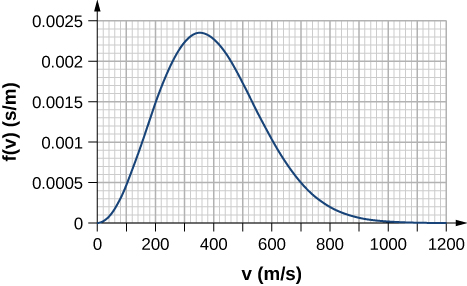
The figure is a plot of f of v in seconds per meter as a function of v in meters per second. The horizontal scale is 0 to 1200 seconds per meter, with major grid lines every 0.0005 and with minor grid lines every 0.0001. The vertical scale is 0 to 0.0025 meters per second, with major grid lines every 200 and with minor grid lines every 20. The function peaks at v equal to about 350 with a value of f of about 0.00235. Additional values of the function over the full range shown are as follows, in ordered pairs of v and f: 0, 0; 100, 0.0005; 200, 0.0015; 300, 0.0022; 400, 0.0023; 500, 0.00152; 600, 0.001; 700, 0.0005; 800, 0.0002; 900, 0.0001; 1000 and higher, 0. From 600 to 800, the function has approximate coordinates of: 600, 0.001; 620, 0.0009; 640, 0.0008; 660, 0.0007; 680, 0.0007; 700, 0.0005; 720, 0.0004; 740, 0.00035; 760, 0.0003; 780, 0.00023; 800, 0.0002.

Answer

About 0.072. Answers may vary slightly. A more accurate answer is 0.074.

2-71 §2.4 source ↗

Find (a) the most probable speed, (b) the average speed, and (c) the rms speed for nitrogen molecules at 295 K.

Answer

a. 419 m/s; b. 472 m/s; c. 513 m/s

2-73 §2.4 source ↗

At what temperature is the average speed of carbon dioxide molecules (M=44.0g/mol) 510 m/s?

Answer

541 K

2-75 §2.4 source ↗

a) At what temperature do oxygen molecules have the same average speed as helium atoms (M=4.00g/mol) have at 300 K? b) What is the answer to the same question about most probable speeds? c) What is the answer to the same question about rms speeds?

Answer

2400 K for all three parts

2-77 §2.AP source ↗

(a) Find the density in SI units of air at a pressure of 1.00 atm and a temperature of 20°C, assuming that air is 78%N2, 21%O2, and1%Ar, (b) Find the density of the atmosphere on Venus, assuming that it’s 96%CO2and4%N2, with a temperature of 737 K and a pressure of 92.0 atm.

Answer

a. 1.20kg/m3; b. 65.9kg/m3

2-79 §2.AP source ↗

When an air bubble rises from the bottom to the top of a freshwater lake, its volume increases by 80%. If the temperatures at the bottom and the top of the lake are 4.0 and 10 °C, respectively, how deep is the lake?

Answer

7.9 m

2-81 §2.AP source ↗

One process for decaffeinating coffee uses carbon dioxide (M=44.0g/mol) at a molar density of about 14,600mol/m3 and a temperature of about 60°C. (a) Is CO2 a solid, liquid, gas, or supercritical fluid under those conditions? (b) The van der Waals constants for carbon dioxide are a= 0.3658Pa·m6/mol2 and b= 4.286×10⁻⁵m3/mol. Using the van der Waals equation, estimate the pressure of CO2 at that temperature and density.

Answer

a. supercritical fluid; b. 3.00×10⁷Pa

2-83 §2.AP source ↗

On a warm day when the air temperature is 30°C, a metal can is slowly cooled by adding bits of ice to liquid water in it. Condensation first appears when the can reaches 15°C. What is the relative humidity of the air?

Answer

40.18 %

2-85 §2.AP source ↗

The mean free path for helium at a certain temperature and pressure is 2.10×10⁻⁷m. The radius of a helium atom can be taken as 1.10×10⁻¹¹m. What is the measure of the density of helium under those conditions (a) in molecules per cubic meter and (b) in moles per cubic meter?

Answer

a. 2.21×1027molecules/m3; b. 3.67×10³mol/m3

2-87 §2.AP source ↗

In the chapter on fluid mechanics, Bernoulli’s equation for the flow of incompressible fluids was explained in terms of changes affecting a small volume dV of fluid. Such volumes are a fundamental idea in the study of the flow of compressible fluids such as gases as well. For the equations of hydrodynamics to apply, the mean free path must be much less than the linear size of such a volume, a≈dV1/3. For air in the stratosphere at a temperature of 220 K and a pressure of 5.8 kPa, how big should a be for it to be 100 times the mean free path? Take the effective radius of air molecules to be 1.88×10⁻¹¹m, which is roughly correct for N2.

Answer

8.2 mm

2-89 §2.AP source ↗

(a) Estimate the specific heat capacity of sodium from the Law of Dulong and Petit. The molar mass of sodium is 23.0 g/mol. (b) What is the percent error of your estimate from the known value, 1230J/kg·°C?

Answer

a. 1080J/kg°C; b. 12%

2-91 §2.AP source ↗

Find the ratio f(vp)/f(vrms) for hydrogen gas (M=2.02g/mol) at a temperature of 77.0 K.

Answer

2e/3 or about 1.10

2-93 §2.AP source ↗

Unreasonable results. (a) Find the average speed of hydrogen sulfide, H2S, molecules at a temperature of 250 K. Its molar mass is 31.4 g/mol (b) The result isn’t very unreasonable, but why is it less reliable than those for, say, neon or nitrogen?

Answer

a. 411 m/s; b. According to Table 2.3, the CV of H2S is significantly different from the theoretical value, so the ideal gas model does not describe it very well at room temperature and pressure, and the Maxwell-Boltzmann speed distribution for ideal gases may not hold very well, even less well at a lower temperature.
Table 2.3 C V / R for Various Monatomic, Diatomic, and Triatomic Gases in the book ↗
Gas CV/R at 25°C and 1 atm
Ar 1.50
He 1.50
Ne 1.50
CO 2.50
H2 2.47
N2 2.50
O2 2.53
F2 2.8
CO2 3.48
H2S 3.13
N2O 3.66

2-95 §2.CP source ↗

Eight bumper cars, each with a mass of 322 kg, are running in a room 21.0 m long and 13.0 m wide. They have no drivers, so they just bounce around on their own. The rms speed of the cars is 2.50 m/s. Repeating the arguments of Pressure, Temperature, and RMS Speed, find the average force per unit length (analogous to pressure) that the cars exert on the walls.

Answer

29.5 N/m

2-97 §2.CP source ↗

Verify the normalization equation ∫0∞f(v)dv=1. In doing the integral, first make the substitution u= m2kBTv= vvp. This “scaling” transformation gives you all features of the answer except for the integral, which is a dimensionless numerical factor. You’ll need the formula

∫ 0 ∞ x 2 e − x 2 dx= π 4

to find the numerical factor and verify the normalization.

Answer

Substituting v=2kBTmu and dv=2kBTmdu gives
∫0∞4π(m2kBT)3/2v2e−mv2/2kBTdv=∫0∞4π(m2kBT)3/2(2kBTm)u2e−u22kBTmdu=∫0∞4πu2e−u2du=4ππ4=1

2-99 §2.CP source ↗

Verify that vrms= v2–= 3kBTm.

Answer

Making the scaling transformation as in the previous problems, we find that
v2–= ∫0∞4π(m2kBT)3/2v2v2e−mv2/2kBTdv= ∫0∞4π2kBTmu4e−u2du.
As in the previous problem, we integrate by parts:
∫0∞u4e−u2du= [−12u3e−u2]0∞+ 32∫0∞u2e−u2du.
Again, the first term is 0, and we were given in an earlier problem that the integral in the second term equals π4. We now have
v2–= 4π2kBTm32π4= 3kBTm.
Taking the square root of both sides gives the desired result: vrms=3kBTm.

Loading chapter 3…

Problems and answers are adapted from University Physics Volume 2 by Samuel J. Ling, Jeff Sanny and William Moebs, OpenStax, and are used under the CC BY-NC-SA 4.0 licence. Access for free at https://openstax.org/books/university-physics-volume-2/pages/1-introduction. Illustrations: Copyright Rice University, OpenStax, under CC BY-NC-SA 4.0 license. This adaptation is released under the same licence, is non-commercial, and is neither affiliated with nor endorsed by OpenStax or Rice University.