Every problem in the chapter beside the book’s answer, a chapter at a time as you scroll.
Chapter 12: Sources of Magnetic Fields
54 problems · 22 figuresCheck Your Understanding 12.1 §12.1 source ↗
Answer
Check Your Understanding 12.2 §12.1 source ↗
Answer
Check Your Understanding 12.3 §12.2 source ↗
Answer
Check Your Understanding 12.4 §12.3 source ↗
Answer
Check Your Understanding 12.5 §12.4 source ↗
Answer
Check Your Understanding 12.6 §12.5 source ↗
Answer
Check Your Understanding 12.7 §12.6 source ↗
Answer
Check Your Understanding 12.8 §12.7 source ↗
Answer
12-1 §12.1 source ↗
Answer
12-3 §12.1 source ↗
Answer
12-5 §12.2 source ↗
Answer
12-7 §12.3 source ↗
Answer
12-9 §12.4 source ↗
Answer
12-11 §12.5 source ↗
Answer
12-13 §12.6 source ↗
Answer
12-15 §12.7 source ↗
Answer
12-17 §12.1 source ↗
Ten amps flow through a square loop where each side is 20 cm in length. At each corner of the loop is a 0.01-cm segment that connects the longer wires as shown. Calculate the magnitude of the magnetic field at the center of the loop.

Answer
12-19 §12.1 source ↗
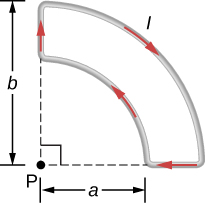
The accompanying figure shows a current loop consisting of two concentric circular arcs and two perpendicular radial lines. Determine the magnetic field at point P.
Answer
12-21 §12.1 source ↗
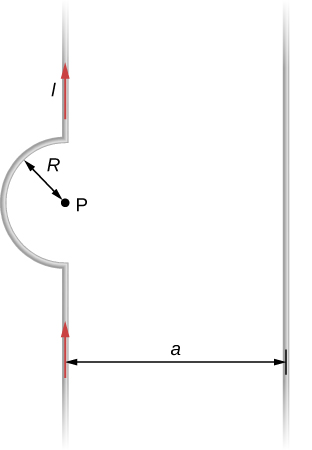
Two long wires, one of which has a semicircular bend of radius R, are positioned as shown in the accompanying figure. If both wires carry a current I, how far apart must their parallel sections be so that the net magnetic field at P is zero? Does the current in the straight wire flow up or down?
Answer
12-23 §12.2 source ↗
Answer
12-25 §12.2 source ↗
Answer
12-27 §12.2 source ↗
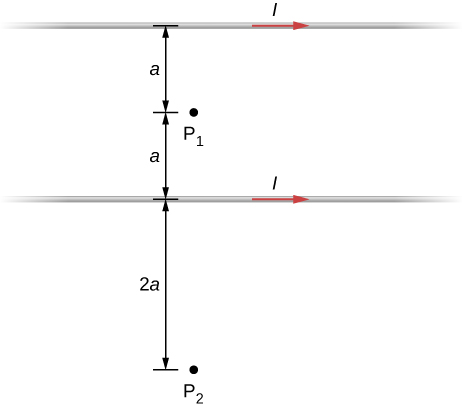
The accompanying figure shows two long, straight, horizontal wires that are parallel and a distance 2a apart. If both wires carry current I in the same direction, (a) what is the magnetic field at (b)
Answer
12-29 §12.2 source ↗
Answer
12-31 §12.3 source ↗
Answer
12-33 §12.3 source ↗
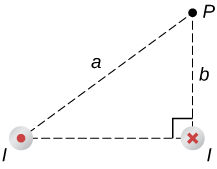
A circuit with current I has two long parallel wire sections that carry current in opposite directions. Find magnetic field at a point P near these wires that is a distance a from one wire and b from the other wire as shown in the figure.
Answer
12-35 §12.4 source ↗
Answer
12-37 §12.4 source ↗
Answer
12-39 §12.4 source ↗
Answer
12-41 §12.5 source ↗
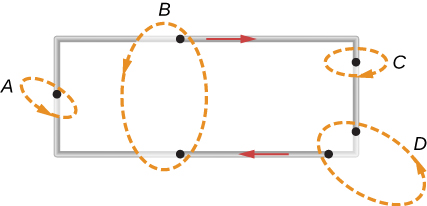
A current I flows around the rectangular loop shown in the accompanying figure. Evaluate for the paths A, B, C, and D.
Answer
12-43 §12.5 source ↗
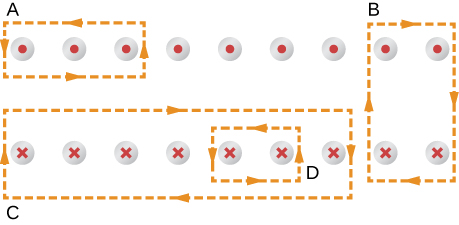
The coil whose lengthwise cross section is shown in the accompanying figure carries a current I and has N evenly spaced turns distributed along the length l. Evaluate for the paths indicated.
Answer
12-45 §12.5 source ↗
Answer
12-47 §12.5 source ↗
Answer
12-49 §12.6 source ↗
Answer
12-51 §12.6 source ↗
Answer
12-53 §12.6 source ↗
)
Answer
12-55 §12.6 source ↗
Answer
12-57 §12.6 source ↗
Answer
12-59 §12.7 source ↗
Answer
12-61 §12.7 source ↗
Answer
12-63 §12.7 source ↗
Answer
12-65 §12.AP source ↗
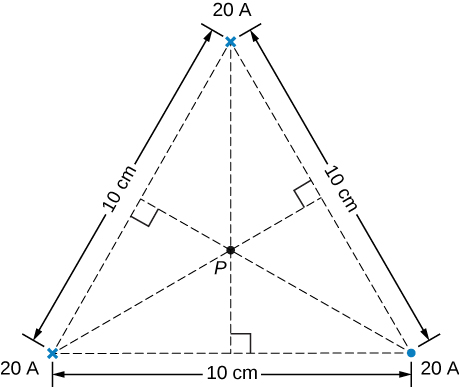
Three long, straight, parallel wires, all carrying 20 A, are positioned as shown in the accompanying figure. What is the magnitude of the magnetic field at the point P?
Answer
12-67 §12.AP source ↗
The accompanying figure shows a long, straight wire carrying a current of 10 A. What is the magnetic force on an electron at the instant it is 20 cm from the wire, traveling parallel to the wire with a speed of Describe qualitatively the subsequent motion of the electron.


Answer
12-69 §12.AP source ↗
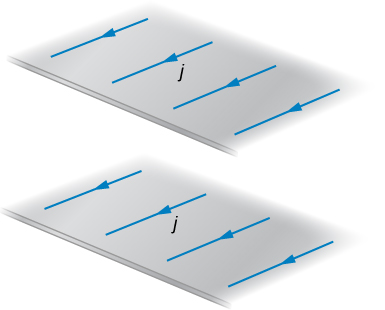
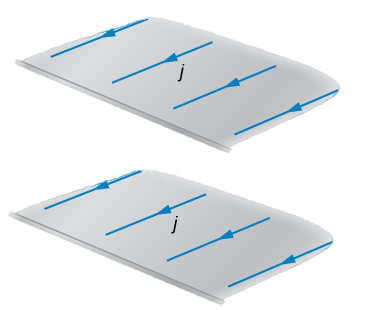
(a) Use the result of the previous problem to calculate the magnetic field between, above, and below the pair of infinite sheets shown in the accompanying figure. (b) Repeat your calculations if the direction of the current in the lower sheet is reversed.
Answer
12-71 §12.AP source ↗
Answer
12-73 §12.AP source ↗
Answer
12-75 §12.AP source ↗
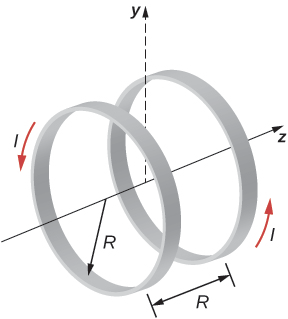
A reasonably uniform magnetic field over a limited region of space can be produced with the Helmholtz coil, which consists of two parallel coils centered on the same axis. The coils are connected so that they carry the same current I. Each coil has N turns and radius R, which is also the distance between the coils. (a) Find the magnetic field at any point on the z-axis shown in the accompanying figure. (b) Show that dB/dz and are both zero at z = 0. (These vanishing derivatives demonstrate that the magnetic field varies only slightly near z = 0.)
Answer
12-77 §12.AP source ↗
Answer
12-79 §12.AP source ↗
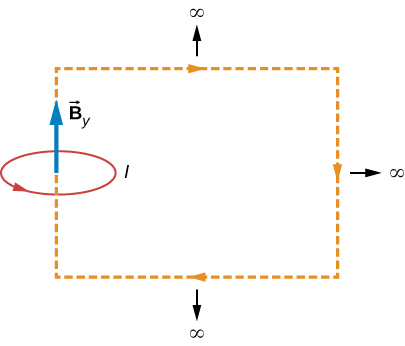
Consider the axial magnetic field of the circular current loop shown below. (a) Evaluate Also show that (b) Can you deduce this limit without evaluating the integral? (Hint: See the accompanying figure.)
Answer
12-81 §12.AP source ↗
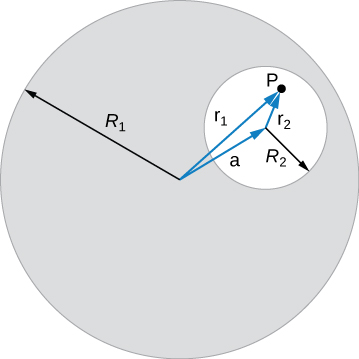
A long, straight, cylindrical conductor contains a cylindrical cavity whose axis is displaced by a from the axis of the conductor, as shown in the accompanying figure. The current density in the conductor is given by where is a constant and is along the axis of the conductor. Calculate the magnetic field at an arbitrary point P in the cavity by superimposing the field of a solid cylindrical conductor with radius and current density onto the field of a solid cylindrical conductor with radius and current density Then use the fact that the appropriate azimuthal unit vectors can be expressed as and to show that everywhere inside the cavity the magnetic field is given by the constant where and is the position of P relative to the center of the conductor and is the position of P relative to the center of the cavity.
Answer
12-83 §12.AP source ↗
Answer
12-85 §12.AP source ↗
Answer
12-87 §12.AP source ↗
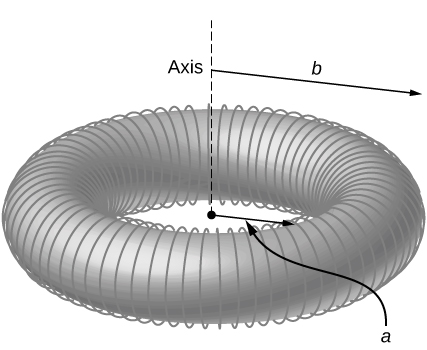
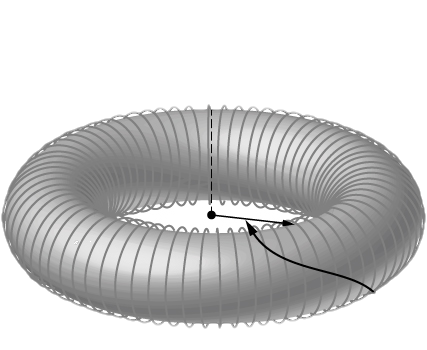
Magnetic field inside a torus. Consider a torus of rectangular cross-section with inner radius a and outer radius b. N turns of an insulated thin wire are wound evenly on the torus tightly all around the torus and connected to a battery producing a steady current I in the wire. Assume that the current on the top and bottom surfaces in the figure is radial, and the current on the inner and outer radii surfaces is vertical. Find the magnetic field inside the torus as a function of radial distance r from the axis.
Answer
12-89 §12.CP source ↗
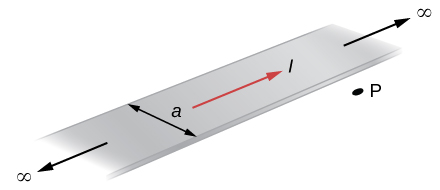
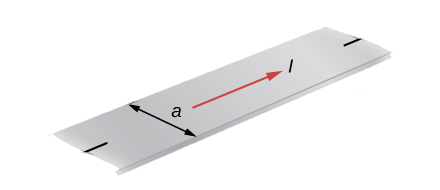
The accompanying figure shows a flat, infinitely long sheet of width a that carries a current I uniformly distributed across it. Find the magnetic field at the point P, which is in the plane of the sheet and at a distance x from one edge. Test your result for the limit
Answer
12-91 §12.CP source ↗
Answer
Loading chapter 13…
Problems and answers are adapted from University Physics Volume 2 by Samuel J. Ling, Jeff Sanny and William Moebs, OpenStax, and are used under the CC BY-NC-SA 4.0 licence. Access for free at https://openstax.org/books/university-physics-volume-2/pages/1-introduction. Illustrations: Copyright Rice University, OpenStax, under CC BY-NC-SA 4.0 license. This adaptation is released under the same licence, is non-commercial, and is neither affiliated with nor endorsed by OpenStax or Rice University.