Every problem in the chapter beside the book’s answer, a chapter at a time as you scroll.

Chapter 9: Current and Resistance

57 problems · 5 figures

Check Your Understanding 9.1 §9.1 source ↗

Handheld calculators often use small solar cells to supply the energy required to complete the calculations needed to complete your next physics exam. The current needed to run your calculator can be as small as 0.30 mA. How long would it take for 1.00 C of charge to flow from the solar cells? Can solar cells be used, instead of batteries, to start traditional internal combustion engines presently used in most cars and trucks?

Answer

The time for 1.00 C of charge to flow would be Δt= ΔQI= 1.00C0.300×10−3C/s= 3.33×10³s, slightly less than an hour. This is quite different from the 5.55 ms for the truck battery. The calculator takes a very small amount of energy to operate, unlike the truck’s starter motor. There are several reasons that vehicles use batteries and not solar cells. Aside from the obvious fact that a light source to run the solar cells for a car or truck is not always available, the large amount of current needed to start the engine cannot easily be supplied by present-day solar cells. Solar cells can possibly be used to charge the batteries. Charging the battery requires a small amount of energy when compared to the energy required to run the engine and the other accessories such as the heater and air conditioner. Present day solar-powered cars are powered by solar panels, which may power an electric motor, instead of an internal combustion engine.

Check Your Understanding 9.2 §9.1 source ↗

Circuit breakers in a home are rated in amperes, normally in a range from 10 amps to 30 amps, and are used to protect the residents from harm and their appliances from damage due to large currents. A single 15-amp circuit breaker may be used to protect several outlets in the living room, whereas a single 20-amp circuit breaker may be used to protect the refrigerator in the kitchen. What can you deduce from this about current used by the various appliances?

Answer

The total current needed by all the appliances in the living room (a few lamps, a television, and your laptop) draw less current and require less power than the refrigerator.

Check Your Understanding 9.3 §9.2 source ↗

In Example 9.4, the drift velocity was calculated for a 2.053-mm diameter (12-gauge) copper wire carrying a 20-amp current. Would the drift velocity change for a 1.628-mm diameter (14-gauge) wire carrying the same 20-amp current?

Answer

The diameter of the 14-gauge wire is smaller than the diameter of the 12-gauge wire. Since the drift velocity is inversely proportional to the cross-sectional area, the drift velocity in the 14-gauge wire is larger than the drift velocity in the 12-gauge wire carrying the same current. The number of electrons per cubic meter will remain constant.

Check Your Understanding 9.4 §9.2 source ↗

The current density is proportional to the current and inversely proportional to the area. If the current density in a conducting wire increases, what would happen to the drift velocity of the charges in the wire?

Answer

The current density in a conducting wire increases due to an increase in current. The drift velocity is proportional to the current (vd=InqA), so the drift velocity would increase.

Check Your Understanding 9.5 §9.3 source ↗

Copper wires are routinely used for extension cords and house wiring for several reasons. Copper has the highest electrical conductivity rating, and therefore the lowest resistivity rating, of all nonprecious metals. Also important is the tensile strength, where the tensile strength is a measure of the force required to pull an object to the point where it breaks. The tensile strength of a material is the maximum amount of tensile stress it can take before breaking. Copper has a high tensile strength, 2×10⁸Nm2. A third important characteristic is ductility. Ductility is a measure of a material’s ability to be drawn into wires and a measure of the flexibility of the material, and copper has a high ductility. Summarizing, for a conductor to be a suitable candidate for making wire, there are at least three important characteristics: low resistivity, high tensile strength, and high ductility. What other materials are used for wiring and what are the advantages and disadvantages?

Answer

Silver, gold, and aluminum are all used for making wires. All four materials have a high conductivity, silver having the highest. All four can easily be drawn into wires and have a high tensile strength, though not as high as copper. The obvious disadvantage of gold and silver is the cost, but silver and gold wires are used for special applications, such as speaker wires. Gold does not oxidize, making better connections between components. Aluminum wires do have their drawbacks. Aluminum has a higher resistivity than copper, so a larger diameter is needed to match the resistance per length of copper wires, but aluminum is cheaper than copper, so this is not a major drawback. Aluminum wires do not have as high of a ductility and tensile strength as copper, but the ductility and tensile strength is within acceptable levels. There are a few concerns that must be addressed in using aluminum and care must be used when making connections. Aluminum has a higher rate of thermal expansion than copper, which can lead to loose connections and a possible fire hazard. The oxidation of aluminum does not conduct and can cause problems. Special techniques must be used when using aluminum wires and components, such as electrical outlets, must be designed to accept aluminum wires.

Check Your Understanding 9.6 §9.3 source ↗

A strain gauge is an electrical device to measure strain, as shown below. It consists of a flexible, insulating backing that supports a conduction foil pattern. The resistance of the foil changes as the backing is stretched. How does the strain gauge resistance change? Is the strain gauge affected by temperature changes?
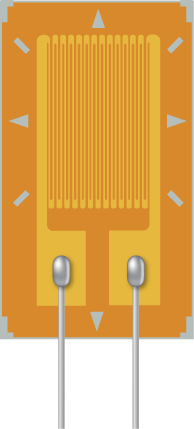
Picture is a schematic drawing of a strain gauge device that consists of the conducting pattern deposited on the insulated surface. Metal contacts are made to the two large pads at the origin of the conducting pattern.

Answer

The foil pattern stretches as the backing stretches, and the foil tracks become longer and thinner. Since the resistance is calculated as R=ρLA, the resistance increases as the foil tracks are stretched. When the temperature changes, so does the resistivity of the foil tracks, changing the resistance. One way to combat this is to use two strain gauges, one used as a reference and the other used to measure the strain. The two strain gauges are kept at a constant temperature

Check Your Understanding 9.7 §9.3 source ↗

The resistance between the two conductors of a coaxial cable depends on the resistivity of the material separating the two conductors, the length of the cable and the inner and outer radius of the two conductor. If you are designing a coaxial cable, how does the resistance between the two conductors depend on these variables?

Answer

The longer the length, the smaller the resistance. The greater the resistivity, the higher the resistance. The larger the difference between the outer radius and the inner radius, that is, the greater the ratio between the two, the greater the resistance. If you are attempting to maximize the resistance, the choice of the values for these variables will depend on the application. For example, if the cable must be flexible, the choice of materials may be limited.

Check Your Understanding 9.8 §9.4 source ↗

The voltage supplied to your house varies as V(t)= Vmaxsin(2πft). If a resistor is connected across this voltage, will Ohm’s law V=IR still be valid?

Answer

Yes, Ohm’s law is still valid. At every point in time the current is equal to I(t)=V(t)/R, so the current is also a function of time, I(t)= VmaxRsin(2πft).

Check Your Understanding 9.9 §9.5 source ↗

Electric motors have a reasonably high efficiency. A 100-hp motor can have an efficiency of 90% and a 1-hp motor can have an efficiency of 80%. Why is it important to use high-performance motors?

Answer

Even though electric motors are highly efficient 10–20% of the power consumed is wasted, not being used for doing useful work. Most of the 10–20% of the power lost is transferred into heat dissipated by the copper wires used to make the coils of the motor. This heat adds to the heat of the environment and adds to the demand on power plants providing the power. The demand on the power plant can lead to increased greenhouse gases, particularly if the power plant uses coal or gas as fuel.

Check Your Understanding 9.10 §9.5 source ↗

Is the efficiency of the various light bulbs the only consideration when comparing the various light bulbs?

Answer

No, the efficiency is a very important consideration of the light bulbs, but there are many other considerations. As mentioned above, the cost of the bulbs and the life span of the bulbs are important considerations. For example, CFL bulbs contain mercury, a neurotoxin, and must be disposed of as hazardous waste. When replacing incandescent bulbs that are being controlled by a dimmer switch with LED, the dimmer switch may need to be replaced. The dimmer switches for LED lights are comparably priced to the incandescent light switches, but this is an initial cost which should be considered. The spectrum of light should also be considered, but there is a broad range of color temperatures available, so you should be able to find one that fits your needs. None of these considerations mentioned are meant to discourage the use of LED or CFL light bulbs, but they are considerations.

9-1 §9.1 source ↗

Can a wire carry a current and still be neutral—that is, have a total charge of zero? Explain.

Answer

If a wire is carrying a current, charges enter the wire from the voltage source’s positive terminal and leave at the negative terminal, so the total charge remains zero while the current flows through it.

9-3 §9.1 source ↗

When working with high-power electric circuits, it is advised that whenever possible, you work “one-handed” or “keep one hand in your pocket.” Why is this a sensible suggestion?

Answer

Using one hand will reduce the possibility of “completing the circuit” and having current run through your body, especially current running through your heart.

9-5 §9.2 source ↗

It was stated that the motion of an electron appears nearly random when an electrical field is applied to the conductor. What makes the motion nearly random and differentiates it from the random motion of molecules in a gas?

Answer

Even though the electrons collide with atoms and other electrons in the wire, they travel from the negative terminal to the positive terminal, so they drift in one direction. Gas molecules travel in completely random directions.

9-7 §9.2 source ↗

An incandescent light bulb is partially evacuated. Why do you suppose that is?

Answer

In the early years of light bulbs, the bulbs are partially evacuated to reduce the amount of heat conducted through the air to the glass envelope. Dissipating the heat would cool the filament, increasing the amount of energy needed to produce light from the filament. It also protects the glass from the heat produced from the hot filament. If the glass heats, it expands, and as it cools, it contacts. This expansion and contraction could cause the glass to become brittle and crack, reducing the life of the bulbs. Many bulbs are now partially filled with an inert gas. It is also useful to remove the oxygen to reduce the possibility of the filament actually burning. When the original filaments were replaced with more efficient tungsten filaments, atoms from the tungsten would evaporate off the filament at such high temperatures. The atoms collide with the atoms of the inert gas and land back on the filament.

9-9 §9.3 source ↗

Do impurities in semiconducting materials listed in Table 9.1 supply free charges? (Hint: Examine the range of resistivity for each and determine whether the pure semiconductor has the higher or lower conductivity.)
Table 9.1 Resistivities and Conductivities of Various Materials at 20 °C in the book ↗
Material Conductivity, σ
(Ω·m)−1
Resistivity, ρ
(Ω·m)
Temperature
Coefficient, α
(°C)−1
Conductors
Silver 6.29×10⁷ 1.59×10⁻⁸ 0.0038
Copper 5.95×10⁷ 1.68×10⁻⁸ 0.0039
Gold 4.10×10⁷ 2.44×10⁻⁸ 0.0034
Aluminum 3.77×10⁷ 2.65×10⁻⁸ 0.0039
Tungsten 1.79×10⁷ 5.60×10⁻⁸ 0.0045
Iron 1.03×10⁷ 9.71×10⁻⁸ 0.0065
Platinum 0.94×10⁷ 10.60×10⁻⁸ 0.0039
Steel 0.50×10⁷ 20.00×10⁻⁸
Lead 0.45×10⁷ 22.00×10⁻⁸
Manganin (Cu, Mn, Ni alloy) 0.21×10⁷ 48.20×10⁻⁸ 0.000002
Constantan (Cu, Ni alloy) 0.20×10⁷ 49.00×10⁻⁸ 0.00003
Mercury 0.10×10⁷ 98.00×10⁻⁸ 0.0009
Nichrome (Ni, Fe, Cr alloy) 0.10×10⁷ 100.00×10⁻⁸ 0.0004
Semiconductors[1]
Carbon (pure) 2.86×10⁴ 3.50×10⁻⁵ −0.0005
Carbon (2.86−1.67)×10−6 (3.5−60)×10−5 −0.0005
Germanium (pure) 600×10−3 −0.048
Germanium (1−600)×10−3 −0.050
Silicon (pure) 2300 −0.075
Silicon 0.1−2300 −0.07
Insulators
Amber 2.00×10⁻¹⁵ 5×10¹⁴
Glass 10−9−10−14 109−1014
Lucite <10−13 >1013
Mica 10−11−10−15 1011−1015
Quartz (fused) 1.33×10⁻¹⁸ 75×1016
Rubber (hard) 10−13−10−16 1013−1016
Sulfur 10−15 1015
TeflonTM <10−13 >1013
Wood 10−8−10−11 108−1011
[1] Values depend strongly on amounts and types of impurities.

Answer

In carbon, resistivity increases with the amount of impurities, meaning fewer free charges. In silicon and germanium, impurities decrease resistivity, meaning more free electrons.

9-11 §9.3 source ↗

If aluminum and copper wires of the same length have the same resistance, which has the larger diameter? Why?

Answer

Copper has a lower resistivity than aluminum, so if length is the same, copper must have the smaller diameter.

9-13 §9.4 source ↗

Shown below are the results of an experiment where four devices were connected across a variable voltage source. The voltage is increased and the current is measured. Which device, if any, is an ohmic device?
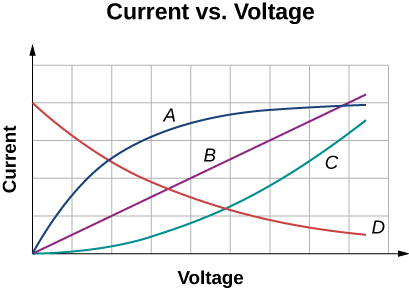
Figure is a plot of current versus voltage. For A, current originally increases with voltage, then saturates and remains the same. For B, current linearly increases with voltage. For C current increases with voltage at a growing late. For D current decreases with voltage approaching zero.

Answer

Device B shows a linear relationship and the device is ohmic.

9-15 §9.5 source ↗

Common household appliances are rated at 110 V, but power companies deliver voltage in the kilovolt range and then step the voltage down using transformers to 110 V to be used in homes. You will learn in later chapters that transformers consist of many turns of wire, which warm up as current flows through them, wasting some of the energy that is given off as heat. This sounds inefficient. Why do the power companies transport electric power using this method?

Answer

Although the conductors have a low resistance, the lines from the power company can be kilometers long. Using a high voltage reduces the current that is required to supply the power demand and that reduces line losses.

9-17 §9.5 source ↗

Resistors are commonly rated at 18W, 14W, 12W, 1 W and 2 W for use in electrical circuits. If a current of I=2.00A is accidentally passed through a R=1.00Ω resistor rated at 1 W, what would be the most probable outcome? Is there anything that can be done to prevent such an accident?

Answer

The resistor would overheat, possibly to the point of causing the resistor to burn. Fuses are commonly added to circuits to prevent such accidents.

9-19 §9.6 source ↗

What requirement for superconductivity makes current superconducting devices expensive to operate?

Answer

Very low temperatures necessitate refrigeration. Some materials require liquid nitrogen to cool them below their critical temperatures. Other materials may need liquid helium, which is even more costly.

9-21 §9.1 source ↗

A Van de Graaff generator is one of the original particle accelerators and can be used to accelerate charged particles like protons or electrons. You may have seen it used to make human hair stand on end or produce large sparks. One application of the Van de Graaff generator is to create X-rays by bombarding a hard metal target with the beam. Consider a beam of protons at 1.00 keV and a current of 5.00 mA produced by the generator. (a) What is the speed of the protons? (b) How many protons are produced each second?

Answer

a. v= 4.38×10⁵ms;
b. Δq= 5.00×10⁻³C, no. of protons= 3.13×10¹⁶

9-23 §9.1 source ↗

How many electrons flow through a point in a wire in 3.00 s if there is a constant current of I=4.00A?

Answer

I= ΔQΔt, ΔQ= 12.00C
no. of electrons = 7.5×10¹⁹

9-25 §9.1 source ↗

The quantity of charge through a conductor is modeled as Q= 4.00Cs4t4− 1.00Cst+ 6.00mC.

What is the current at time t=3.00s?

Answer

I ( t ) = 0.016 C s 4 t 3 − 0.001 C s I ( 3.00 s ) = 0.431 A

9-27 §9.1 source ↗

The charge on a capacitor in a circuit is modeled as Q(t)= Qmaxcos(ωt+ϕ). What is the current through the circuit as a function of time?

Answer

I(t)= − I max sin(ωt+ϕ)

9-29 §9.2 source ↗

The current of an electron beam has a measured current of I=50.00μA with a radius of 1.00 mm. What is the magnitude of the current density of the beam?

Answer

|J|= 15.92 A/m 2

9-31 §9.2 source ↗

Consider a wire of a circular cross-section with a radius of R=3.00mm. The magnitude of the current density is modeled as J= cr2= 5.00×10⁶Am4r2. What is the current through the inner section of the wire from the center to r=0.5R?

Answer

I= 3.98× 10 –5 A

9-33 §9.2 source ↗

The current supplied to an air conditioner unit is 4.00 amps. The air conditioner is wired using a 10-gauge (diameter 2.588 mm) wire. The charge density is n= 8.48×1028electronsm3. Find the magnitude of (a) current density and (b) the drift velocity.

Answer

a. |J|= 7.60×10⁵Am2; b. vd= 5.60×10⁻⁵ms

9-35 §9.3 source ↗

Calculate the effective resistance of a pocket calculator that has a 1.35-V battery and through which 0.200 mA flows.

Answer

R = 6.750 k Ω

9-37 §9.3 source ↗

What is the resistance of a 20.0-m-long piece of 12-gauge copper wire having a 2.053-mm diameter?

Answer

R = 0.10 Ω

9-39 §9.3 source ↗

If the 0.100-mm-diameter tungsten filament in a light bulb is to have a resistance of 0.200Ω at 20.0°C, how long should it be?

Answer

R = ρ L A L = 3 cm

9-41 §9.3 source ↗

Find the ratio of the diameter of aluminum to copper wire, if they have the same resistance per unit length (as they might in household wiring).

Answer

R Al L Al R Cu L Cu = ρ Al 1 π ( D Al 2 ) 2 ρ Cu 1 π ( D Cu 2 ) 2 = ρ Al ρ Cu ( D Cu D Al ) 2 = 1, D Al D Cu = ρ Al ρ C u

9-43 §9.3 source ↗

(a) To what temperature must you raise a copper wire, originally at 20.0°C, to double its resistance, neglecting any changes in dimensions? (b) Does this happen in household wiring under ordinary circumstances?

Answer

a. R= R0(1+αΔT), 2= 1+ αΔT, ΔT= 256.4°C, T= 276.4°C;
b. Under normal conditions, no it should not occur.

9-45 §9.3 source ↗

Of what material is a resistor made if its resistance is 40.0% greater at 100.0°C than at 20.0°C?

Answer

R=R0(1+αΔT)α=0.005°C−1, tungsten

9-47 §9.3 source ↗

(a) Of what material is a wire made, if it is 25.0 m long with a diameter of 0.100 mm and has a resistance of 77.7Ω at 20.0°C? (b) What is its resistance at 150.0°C?

Answer

a. R= ρLA, ρ= 2.44×10⁻⁸Ω·m, gold;
b. R=ρLA(1+αΔT)R=2.44×10⁻⁸Ω·m(25mπ(0.100×10⁻³m2)2)(1+0.0034°C−1(150°C−20°C))R=112Ω

9-49 §9.3 source ↗

A copper wire has a resistance of 0.500Ω at 20.0°C, and an iron wire has a resistance of 0.525Ω at the same temperature. At what temperature are their resistances equal?

Answer

R Fe = 0.525 Ω , R Cu = 0.500 Ω , α Fe = 0.0065 ° C −1 α Cu = 0.0039 ° C −1 R Fe = R Cu R 0 Fe ( 1 + α Fe ( T − T 0 ) ) = R 0 Cu ( 1 + α Cu ( T − T 0 ) ) R 0 Fe R 0 Cu ( 1 + α Fe ( T − T 0 ) ) = 1 + α Cu ( T − T 0 ) T = 2.91 ° C

9-51 §9.4 source ↗

A resistor rated at 250kΩ is connected across two D cell batteries (each 1.50 V) in series, with a total voltage of 3.00 V. The manufacturer advertises that their resistors are within 5% of the rated value. What are the possible minimum current and maximum current through the resistor?

Answer

R min = 2.375 × 10 5 Ω , I min = 12.63 μ A R max = 2.625 × 10 5 Ω , I max = 11.43 μ A

9-53 §9.4 source ↗

A resistor is placed in a circuit with an adjustable voltage source. The voltage across and the current through the resistor and the measurements are shown below. Estimate the resistance of the resistor.
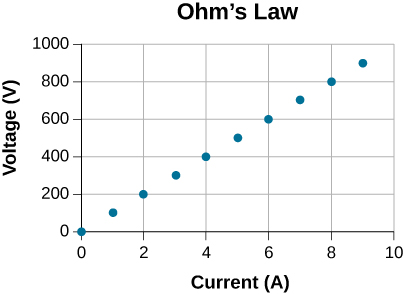
Figure is a plot of voltage versus current. There is a linear relationship between voltage and the current. It is zero Volts at zero Amperes, 200 Volts at 2 Amperes, 400 Volts at 4 Amperes, 600 Volts at 6 Amperes, and 800 Volts at 8 Amperes.

Answer

R = 100 Ω

9-55 §9.5 source ↗

A 20.00-V battery is used to supply current to a 10-kΩ resistor. Assume the voltage drop across any wires used for connections is negligible. (a) What is the current through the resistor? (b) What is the power dissipated by the resistor? (c) What is the power input from the battery, assuming all the electrical power is dissipated by the resistor? (d) What happens to the energy dissipated by the resistor?

Answer

a. I=2mA; b. P=0.04W; c. P=0.04W; d. It is converted into heat.

9-57 §9.5 source ↗

A heater is being designed that uses a coil of 14-gauge nichrome wire to generate 300 W using a voltage of V=110V. How long should the engineer make the wire?

Answer

P=V2RR=40Ω, A=2.08mm2ρ=100×10−8Ω·mR=ρLAL=83m

9-59 §9.5 source ↗

The power dissipated by a resistor with a resistance of R=100Ω is P=2.0W. What are the current through and the voltage drop across the resistor?

Answer

I= 0.14A, V= 14V

9-61 §9.5 source ↗

A physics student has a single-occupancy dorm room. The student has a small refrigerator that runs with a current of 3.00 A and a voltage of 110 V, a lamp that contains a 100-W bulb, an overhead light with a 60-W bulb, and various other small devices adding up to 3.00 W. (a) Assuming the power plant that supplies 110 V electricity to the dorm is 10 km away and the two aluminum transmission cables use 0-gauge wire with a diameter of 8.252 mm, estimate the percentage of the total power supplied by the power company that is lost in the transmission. (b) What would be the result is the power company delivered the electric power at 110 kV?

Answer

a. I≈3.00A+100W110V+60W110V+3.00W110V=4.48AP=493WR=9.91Ω,Ploss=200.W%loss=40%
b. P=493WI=0.0045AR=9.91ΩPloss=201μW%loss=0.00004%

9-63 §9.6 source ↗

Consider a power plant is located 60 km away from a residential area uses 0-gauge (A=42.40mm2) wire of copper to transmit power at a current of I=100.00A. How much more power is dissipated in the copper wires than it would be in superconducting wires?

Answer

R copper = 23.77 Ω P = 2.377 × 10 5 W

9-65 §9.6 source ↗

Digital medical thermometers determine temperature by measuring the resistance of a semiconductor device called a thermistor (which has α=−0.06/°C) when it is at the same temperature as the patient. What is a patient’s temperature if the thermistor’s resistance at that temperature is 82.0% of its value at 37°C (normal body temperature)?

Answer

R = R 0 ( 1 + α ( T − T 0 ) ) 0.82 R 0 = R 0 ( 1 + α ( T − T 0 ) ) , 0.82 = 1 − 0.06 ( T − 37 ° C ) , T = 40 ° C

9-67 §9.6 source ↗

A 12-gauge gold wire has a length of 1 meter. (a) What would be the length of a silver 12-gauge wire with the same resistance? (b) What are their respective resistances at the temperature of boiling water?

Answer

a. RAu= RAg, ρAuLAuAAu= ρAgLAgAAg, LAg= 1.53m;
b. RAu,20 °C= 0.0074Ω, RAu,100 °C= 0.0094Ω, RAg,100°C= 0.0096Ω

9-69 §9.AP source ↗

A coaxial cable consists of an inner conductor with radius ri=0.25cm and an outer radius of ro=0.5cm and has a length of 10 meters. Plastic, with a resistivity of ρ= 2.00×10¹³Ω·m, separates the two conductors. What is the resistance of the cable?

Answer

d R = ρ 2 π r L d r R = ρ 2 π L ln r o r i R = 2.21 × 10 11 Ω

9-71 §9.AP source ↗

A nichrome rod that is 3.00 mm long with a cross-sectional area of 1.00mm2 is used for a digital thermometer. (a) What is the resistance at room temperature? (b) What is the resistance at body temperature?

Answer

a.
R0=0.003Ω; b.
Tc=37.0°CR=0.00302Ω

9-73 §9.AP source ↗

When 100.0 V is applied across a 5-gauge (diameter 4.621 mm) wire that is 10 m long, the magnitude of the current density is 2.0×10⁸A/m2. What is the resistivity of the wire?

Answer

ρ= 5.00× 10 −8 Ω·m

9-75 §9.AP source ↗

What is the resistivity of a wire of 5-gauge wire (A=16.8×10⁻⁶m2), 5.00 m length, and 5.10mΩ resistance?

Answer

ρ= 1.71× 10 −8 Ω·m

9-77 §9.AP source ↗

Currents of approximately 0.06 A can be potentially fatal. Currents in that range can make the heart fibrillate (beat in an uncontrolled manner). The resistance of a dry human body can be approximately 100kΩ. (a) What voltage can cause 0.06 A through a dry human body? (b) When a human body is wet, the resistance can fall to 100Ω. What voltage can cause harm to a wet body?

Answer

a. V=6000V; b. V=6V

9-79 §9.AP source ↗

A battery with an emf of 24.00 V delivers a constant current of 2.00 mA to an appliance. How much work does the battery do in three minutes?

Answer

P= W t , W= 8.64J

9-81 §9.CP source ↗

A 10-gauge copper wire has a cross-sectional area A=5.26mm2 and carries a current of I=5.00A. The density of copper is ρ=8.95g/cm3. One mole of copper atoms (6.02×10²³atoms) has a mass of approximately 63.50 g. What is the magnitude of the drift velocity of the electrons, assuming that each copper atom contributes one free electron to the current?

Answer

V = 7.09 cm 3 n = 8.49 × 10 28 electrons m 3 v d = 7.00 × 10 −5 m s

9-83 §9.CP source ↗

A particle accelerator produces a beam with a radius of 1.25 mm with a current of 2.00 mA. Each proton has a kinetic energy of 10.00 MeV. (a) What is the velocity of the protons? (b) What is the number (n) of protons per unit volume? (b) How many electrons pass a cross sectional area each second?

Answer

a. 4.38 x 10⁷ m/s b. v= 5.81×10¹³protonsm3 c. 1.25electronsm3

9-85 §9.CP source ↗

A current of I=25A is drawn from a 100-V battery for 30 seconds. By how much is the chemical energy reduced?

Answer

E = 75 kJ

9-87 §9.CP source ↗

A resistor of an unknown resistance is placed in an insulated container filled with 0.75 kg of water. A voltage source is connected in series with the resistor and a current of 1.2 amps flows through the resistor for 10 minutes. During this time, the temperature of the water is measured and the temperature change during this time is ΔT=10.00°C. (a) What is the resistance of the resistor? (b) What is the voltage supplied by the power supply?

Answer

a. P=52WR=36Ω; b. V=43.54V

9-89 §9.CP source ↗

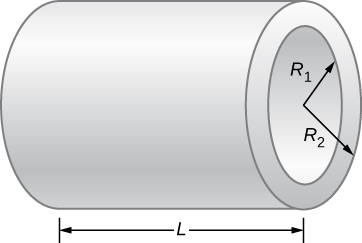
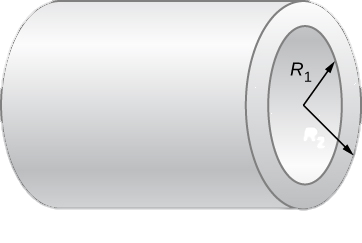
Consider a resistor made from a hollow cylinder of carbon as shown below. The inner radius of the cylinder is Ri=0.20mm and the outer radius is R0=0.30mm. The length of the resistor is L=0.90mm. The resistivity of the carbon is ρ= 3.5×10⁻⁵Ω·m. (a) Prove that the resistance perpendicular from the axis is R= ρ2πLln(R0Ri). (b) What is the resistance?

Picture shows a cylinder of the length L. Internal radius is R1, external radius is R2.Picture shows a cylinder of the length L. Internal radius is R1, external radius is R2.

Answer

a. R= ρ2πLln(R0Ri); b. R=2.5mΩ

9-91 §9.CP source ↗

A student uses a 100.00-W, 115.00-V radiant heater to heat the student’s dorm room, during the hours between sunset and sunrise, 6:00 p.m. to 7:00 a.m. (a) What current does the heater operate at? (b) How many electrons move through the heater? (c) What is the resistance of the heater? (d) How much heat was added to the dorm room?

Answer

(a) 0.870 A
(b) #electrons = 2.54 × 10²³ electrons
(c) 132 ohms
(d) q = 4.68 × 10⁶ J

9-93 §9.CP source ↗

A physics student uses a 115.00-V immersion heater to heat 400.00 grams (almost two cups) of water for herbal tea. During the two minutes it takes the water to heat, the physics student becomes bored and decides to figure out the resistance of the heater. The student starts with the assumption that the water is initially at the temperature of the room Ti=25.00°C and reaches Tf=100.00°C. The specific heat of the water is c=4180Jkg∙K. What is the resistance of the heater?

Answer

P= 1045W, P= V 2 R , R= 12.27Ω

Loading chapter 10…

Problems and answers are adapted from University Physics Volume 2 by Samuel J. Ling, Jeff Sanny and William Moebs, OpenStax, and are used under the CC BY-NC-SA 4.0 licence. Access for free at https://openstax.org/books/university-physics-volume-2/pages/1-introduction. Illustrations: Copyright Rice University, OpenStax, under CC BY-NC-SA 4.0 license. This adaptation is released under the same licence, is non-commercial, and is neither affiliated with nor endorsed by OpenStax or Rice University.