Every problem in the chapter beside the book’s answer, a chapter at a time as you scroll.
Chapter 7: Electric Potential
67 problems · 5 figuresCheck Your Understanding 7.1 §7.1 source ↗
Answer
Check Your Understanding 7.2 §7.1 source ↗
Answer
Check Your Understanding 7.3 §7.1 source ↗
Answer
Check Your Understanding 7.4 §7.2 source ↗
Answer
Check Your Understanding 7.5 §7.2 source ↗
Answer
Check Your Understanding 7.6 §7.2 source ↗
Answer
Check Your Understanding 7.7 §7.2 source ↗
Answer
Check Your Understanding 7.8 §7.3 source ↗
Answer
Check Your Understanding 7.9 §7.3 source ↗
Answer
Check Your Understanding 7.10 §7.3 source ↗
Answer
Check Your Understanding 7.11 §7.4 source ↗
Answer
Check Your Understanding 7.12 §7.5 source ↗
Answer
7-1 §7.1 source ↗
Answer
7-3 §7.1 source ↗
Answer
7-5 §7.2 source ↗
Answer
7-7 §7.2 source ↗
Answer
7-9 §7.2 source ↗
Answer
7-11 §7.2 source ↗
Answer
7-13 §7.3 source ↗
Answer
7-15 §7.3 source ↗
Answer
7-17 §7.4 source ↗
Answer
7-19 §7.5 source ↗
Answer
7-21 §7.5 source ↗
Answer
7-23 §7.5 source ↗
Answer
7-25 §7.6 source ↗
Answer
7-27 §7.6 source ↗
Answer
7-29 §7.1 source ↗
Answer
b.
7-31 §7.1 source ↗
Answer
7-33 §7.2 source ↗
Answer
7-35 §7.2 source ↗
Answer
7-37 §7.2 source ↗
Answer
7-39 §7.2 source ↗
Answer
b.
7-41 §7.2 source ↗
Answer
b.
7-43 §7.2 source ↗
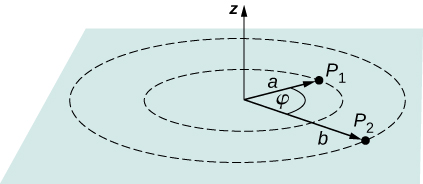
The electric field in a region is pointed away from the z-axis and the magnitude depends upon the distance s from the axis. The magnitude of the electric field is given as where is a constant. Find the potential difference between points , explicitly stating the path over which you conduct the integration for the line integral.
Answer
7-45 §7.3 source ↗
Answer
7-47 §7.3 source ↗
Answer
The charge is positive because the potential is positive.
7-49 §7.3 source ↗
Answer
b. ;
c.
7-51 §7.3 source ↗
Answer
;
b. To double the potential difference, move the point from 20 cm to infinity; the potential at 20 cm is halfway between zero and that at 10 cm.
7-53 §7.3 source ↗
Answer
and ;
b. and
7-55 §7.4 source ↗
Answer
7-57 §7.4 source ↗
Answer
as expected.
7-59 §7.5 source ↗
Answer
7-61 §7.5 source ↗
Answer
b.
7-63 §7.5 source ↗
Answer
7-65 §7.5 source ↗
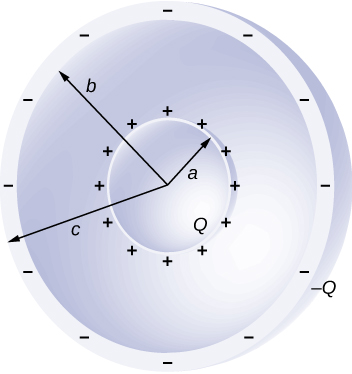
Concentric conducting spherical shells carry charges Q and –Q, respectively. The inner shell has negligible thickness. What is the potential difference between the shells?
Answer
7-67 §7.5 source ↗
Answer
7-69 §7.6 source ↗
Answer
a. ;
The electric field is towards the surface of Earth. b. The coulomb force is much stronger than gravity.
7-71 §7.6 source ↗
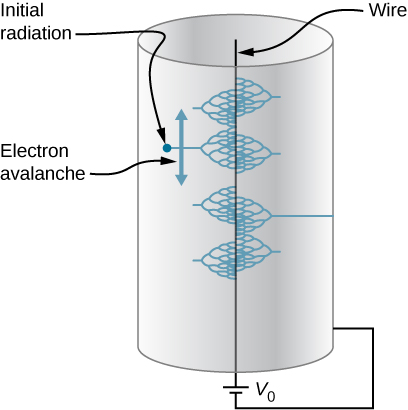
In a Geiger counter, a thin metallic wire at the center of a metallic tube is kept at a high voltage with respect to the metal tube. Ionizing radiation entering the tube knocks electrons off gas molecules or sides of the tube that then accelerate towards the center wire, knocking off even more electrons. This process eventually leads to an avalanche that is detectable as a current. A particular Geiger counter has a tube of radius R and the inner wire of radius a is at a potential of volts with respect to the outer metal tube. Consider a point P at a distance s from the center wire and far away from the ends. (a) Find a formula for the electric field at a point P inside using the infinite wire approximation. (b) Find a formula for the electric potential at a point P inside. (c) Use and find the value of the electric field at a point 1.00 cm from the center.
Answer
7-73 §7.6 source ↗
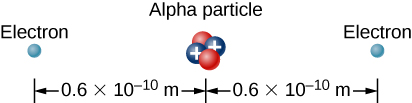
To form a helium atom, an alpha particle that contains two protons and two neutrons is fixed at one location, and two electrons are brought in from far away, one at a time. The first electron is placed at from the alpha particle and held there while the second electron is brought to from the alpha particle on the other side from the first electron. See the final configuration below. (a) How much work is done in each step? (b) What is the electrostatic energy of the alpha particle and two electrons in the final configuration?
Answer
b.
7-75 §7.6 source ↗
Answer
b.
7-77 §7.6 source ↗
An electron enters a region between two large parallel plates made of aluminum separated by a distance of 2.0 cm and kept at a potential difference of 200 V. The electron enters through a small hole in the negative plate and moves toward the positive plate. At the time the electron is near the negative plate, its speed is Assume the electric field between the plates to be uniform, and find the speed of electron at (a) 0.10 cm, (b) 0.50 cm, (c) 1.0 cm, and (d) 1.5 cm from the negative plate, and (e) immediately before it hits the positive plate.
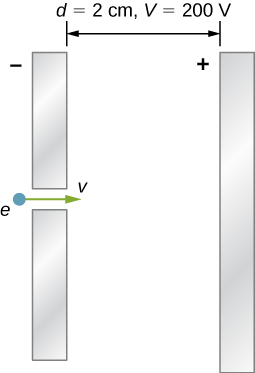
Answer
7-79 §7.6 source ↗
Answer
b.
7-81 §7.6 source ↗
Answer
7-83 §7.6 source ↗
Answer
b. ;
c. The expansion of the steam upon boiling can literally blow the tree apart.
7-85 §7.6 source ↗
Answer
7-87 §7.6 source ↗
Answer
(Size of gold nucleus is about ).
7-89 §7.AP source ↗
Answer
7-91 §7.AP source ↗
Answer
7-93 §7.AP source ↗
A CD disk of radius () is sprayed with a charged paint so that the charge varies continually with radial distance r from the center in the following manner: .
Find the potential at a point 4 cm above the center.
Answer
7-95 §7.AP source ↗
Answer
7-97 §7.AP source ↗
Answer
7-99 §7.AP source ↗
Answer
7-101 §7.AP source ↗
Answer
b. ;
c.
7-103 §7.AP source ↗
Answer
; the charge is 9 times larger than .
7-105 §7.AP source ↗
Answer
b.
c.
d.
7-107 §7.CP source ↗
Answer
7-109 §7.CP source ↗
Answer
Loading chapter 8…
Problems and answers are adapted from University Physics Volume 2 by Samuel J. Ling, Jeff Sanny and William Moebs, OpenStax, and are used under the CC BY-NC-SA 4.0 licence. Access for free at https://openstax.org/books/university-physics-volume-2/pages/1-introduction. Illustrations: Copyright Rice University, OpenStax, under CC BY-NC-SA 4.0 license. This adaptation is released under the same licence, is non-commercial, and is neither affiliated with nor endorsed by OpenStax or Rice University.