Every problem in the chapter beside the book’s answer, a chapter at a time as you scroll.
Chapter 6: Gauss's Law
54 problems · 21 figuresCheck Your Understanding 6.1 §6.1 source ↗
Answer
Check Your Understanding 6.2 §6.1 source ↗
Answer
Check Your Understanding 6.3 §6.2 source ↗
Answer
Check Your Understanding 6.4 §6.3 source ↗
Answer
Check Your Understanding 6.5 §6.3 source ↗
Answer
Check Your Understanding 6.6 §6.4 source ↗
Answer
6-1 §6.1 source ↗
Answer
6-3 §6.1 source ↗
Answer
6-5 §6.2 source ↗
Answer
6-7 §6.2 source ↗
Answer
6-9 §6.2 source ↗
Answer
6-11 §6.2 source ↗
Answer
6-13 §6.3 source ↗
Answer
6-15 §6.3 source ↗
Answer
6-17 §6.4 source ↗
Answer
6-19 §6.4 source ↗
Answer
6-21 §6.1 source ↗
Answer
6-23 §6.1 source ↗
Answer
6-25 §6.1 source ↗
Answer
b. ; c.
6-27 §6.1 source ↗
Answer
6-29 §6.1 source ↗
Answer
6-31 §6.2 source ↗
Find the electric flux through the closed surface whose cross-sections are shown below.
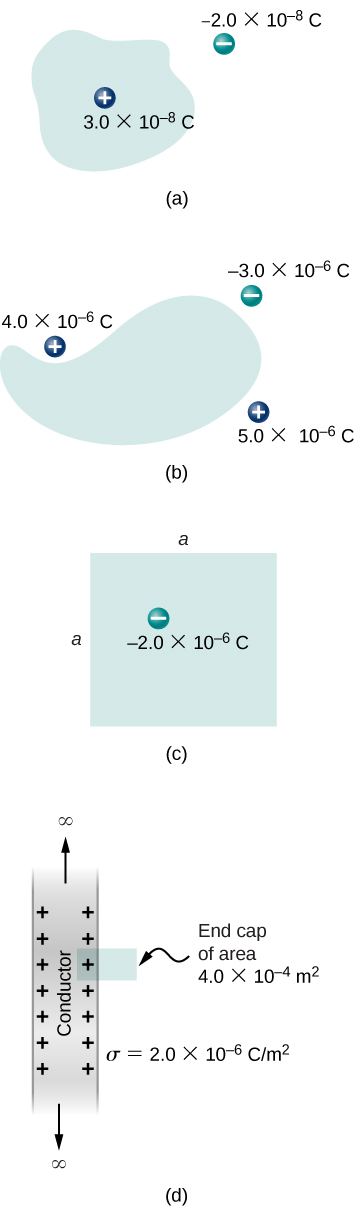

Answer
c. ;
d.
6-33 §6.2 source ↗
Answer
6-35 §6.2 source ↗
A charge q is placed at one of the corners of a cube of side a, as shown below. Find the magnitude of the electric flux through the shaded face due to q. Assume .
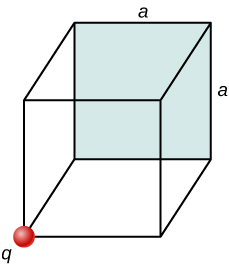
Answer
.
6-37 §6.2 source ↗
Answer
6-39 §6.2 source ↗
Answer
6-41 §6.3 source ↗
Answer
6-43 §6.3 source ↗
Answer
6-45 §6.3 source ↗
Answer
6-47 §6.3 source ↗
Answer
6-49 §6.3 source ↗
Answer
6-51 §6.3 source ↗
Answer
;
b.
6-53 §6.3 source ↗
Charge is distributed uniformly with a density throughout an infinitely long cylindrical volume of radius R. Show that the field of this charge distribution is directed radially with respect to the cylinder and that
Answer
6-55 §6.3 source ↗
Answer
6-57 §6.3 source ↗
Answer
6-59 §6.3 source ↗
Answer
6-61 §6.4 source ↗
An uncharged spherical conductor S of radius R has two spherical cavities A and B of radii a and b, respectively as shown below. Two point charges and are placed at the center of the two cavities by using non-conducting supports. In addition, a point charge is placed outside at a distance r from the center of the sphere. (a) Draw approximate charge distributions in the metal although metal sphere has no net charge. (b) Draw electric field lines. Draw enough lines to represent all distinctly different places.
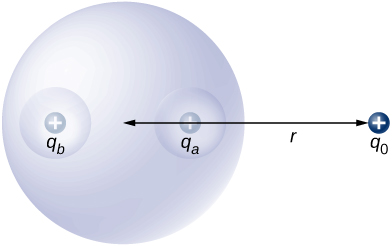
Answer
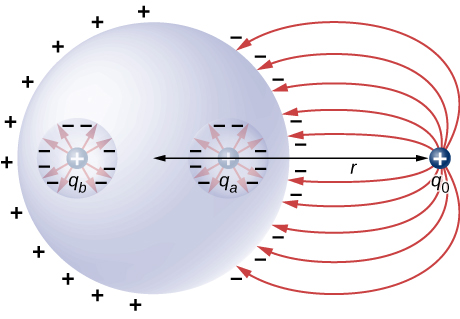
6-63 §6.4 source ↗
Answer
a. Outside: ; Inside ; b.
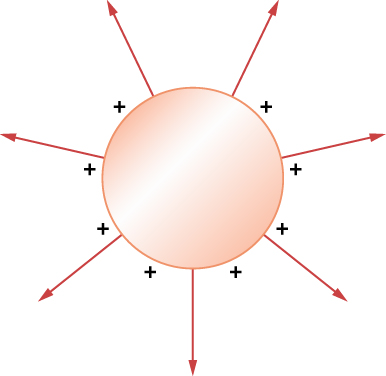
6-65 §6.4 source ↗
Answer
a. E inside equals 0; b.
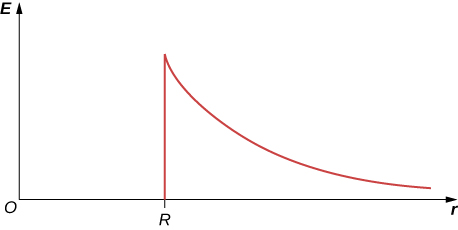
6-67 §6.4 source ↗
Answer
6-69 §6.4 source ↗
The surface charge density on a long straight metallic pipe is . What is the electric field outside and inside the pipe? Assume the pipe has a diameter of 2a.

Answer
6-71 §6.4 source ↗
Answer
6-73 §6.AP source ↗
Answer
6-75 §6.AP source ↗
(a) Calculate the electric flux through the open hemispherical surface due to the electric field (see below). (b) If the hemisphere is rotated by around the x-axis, what is the flux through it?
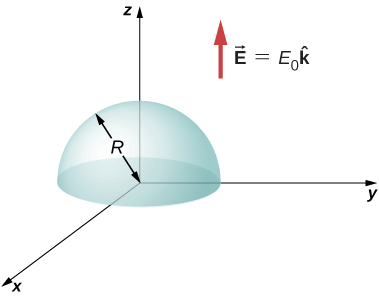
Answer
6-77 §6.AP source ↗
The electric field in a region is given by where and What is the net charge enclosed by the shaded volume shown below?
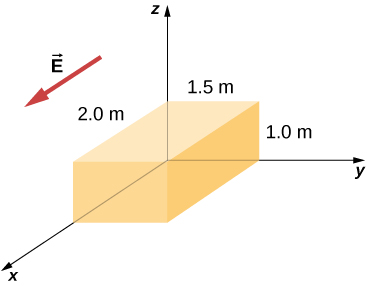
Answer
where the minus sign indicates that at , the electric field is along positive x and the unit normal is along negative x. At , the unit normal and the electric field vector are in the same direction: .
6-79 §6.AP source ↗
Answer
6-81 §6.AP source ↗
Answer
6-83 §6.AP source ↗
The infinite slab between the planes defined by and contains a uniform volume charge density (see below). What is the electric field produced by this charge distribution, both inside and outside the distribution?
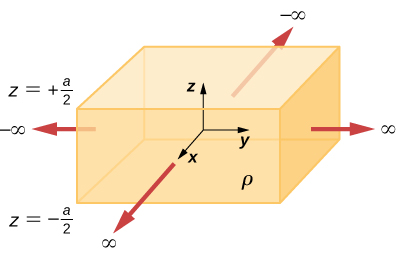
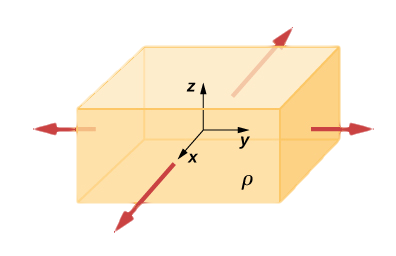
Answer
,
6-85 §6.AP source ↗
A non-conducting spherical shell of inner radius and outer radius is uniformly charged with charged density inside another non-conducting spherical shell of inner radius and outer radius that is also uniformly charged with charge density . See below. Find the electric field at space point P at a distance r from the common center such that (a) (b) (c) (d) and (e) .
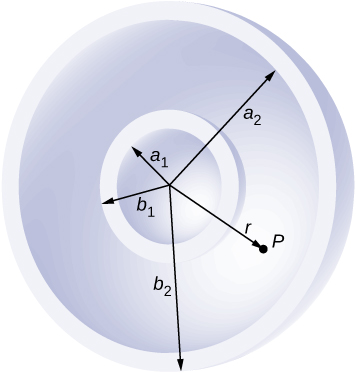
Answer
b. ;
c. ;
d. ; e. 0
6-87 §6.AP source ↗
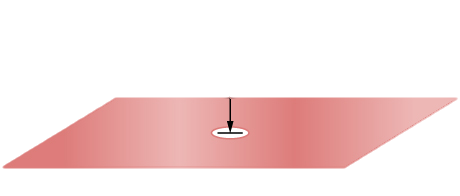
A disk of radius R is cut in a non-conducting large plate that is uniformly charged with charge density (coulomb per square meter). See below. Find the electric field at a height h above the center of the disk. (Hint: Fill the hole with
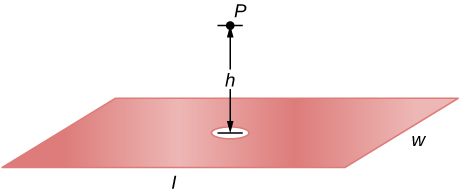
Answer
Electric field of just hole filled with .
Thus, .
6-89 §6.AP source ↗
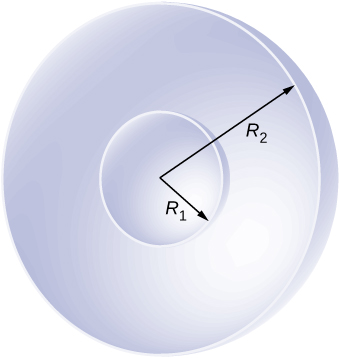
Shown below are two concentric conducting spherical shells of radii and , each of finite thickness much less than either radius. The inner and outer shell carry net charges and respectively, where both and are positive. What is the electric field for (a) (b) and (c) (d) What is the net charge on the inner surface of the inner shell, the outer surface of the inner shell, the inner surface of the outer shell, and the outer surface of the outer shell?
Answer
6-91 §6.CP source ↗
Answer
6-93 §6.CP source ↗
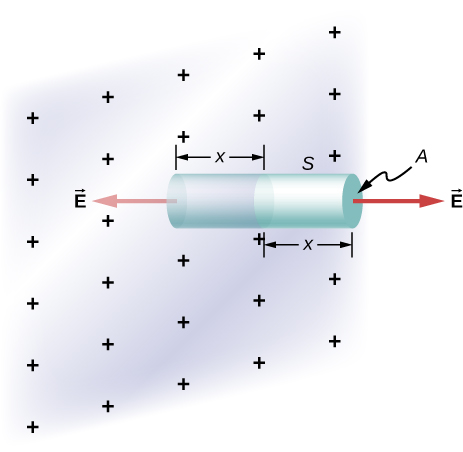
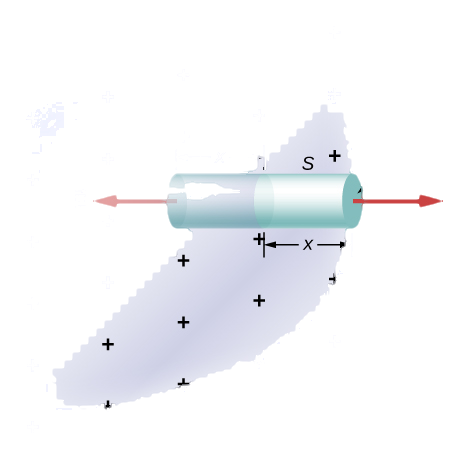
An infinite plate sheet of charge of surface charge density is shown below. What is the electric field at a distance x from the sheet? Compare the result of this calculation with that of worked out in the text.
Answer
in agreement with the calculation of in the text.
6-95 §6.CP source ↗
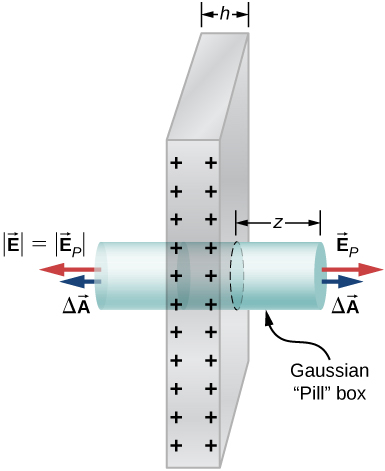
Find the electric field of a large conducting plate containing a net charge q. Let A be area of one side of the plate and h the thickness of the plate (see below). The charge on the metal plate will distribute mostly on the two planar sides and very little on the edges if the plate is thin.
Answer
Loading chapter 7…
Problems and answers are adapted from University Physics Volume 2 by Samuel J. Ling, Jeff Sanny and William Moebs, OpenStax, and are used under the CC BY-NC-SA 4.0 licence. Access for free at https://openstax.org/books/university-physics-volume-2/pages/1-introduction. Illustrations: Copyright Rice University, OpenStax, under CC BY-NC-SA 4.0 license. This adaptation is released under the same licence, is non-commercial, and is neither affiliated with nor endorsed by OpenStax or Rice University.