Every problem in the chapter beside the book’s answer, a chapter at a time as you scroll.

Chapter 16: Electromagnetic Waves

60 problems · 3 figures

Check Your Understanding 16.1 §16.1 source ↗

When the emf across a capacitor is turned on and the capacitor is allowed to charge, when does the magnetic field induced by the displacement current have the greatest magnitude?

Answer

It is greatest immediately after the current is switched on. The displacement current and the magnetic field from it are proportional to the rate of change of electric field between the plates, which is greatest when the plates first begin to charge.

Check Your Understanding 16.2 §16.1 source ↗

Could a purely electric field propagate as a wave through a vacuum without a magnetic field? Justify your answer.

Answer

No. The changing electric field according to the modified version of Ampère’s law would necessarily induce a changing magnetic field.

Check Your Understanding 16.3 §16.2 source ↗

The wave equation was obtained by (1) finding the E field produced by the changing B field, (2) finding the B field produced by the changing E field, and combining the two results. Which of Maxwell’s equations was the basis of step (1) and which of step (2)?

Answer

(1) Faraday’s law, (2) the Ampère-Maxwell law

Check Your Understanding 16.4 §16.2 source ↗

What conclusions did our analysis of Maxwell’s equations lead to about these properties of a plane electromagnetic wave:
(a) the relative directions of wave propagation, of the E field, and of B field,
(b) the speed of travel of the wave and how the speed depends on frequency, and
(c) the relative magnitudes of the E and B fields.

Answer

a. The directions of wave propagation, of the E field, and of B field are all mutually perpendicular. b. The speed of the electromagnetic wave is the speed of light c=1/ε0μ0 independent of frequency. c. The ratio of electric and magnetic field amplitudes is E/B=c.

Check Your Understanding 16.5 §16.4 source ↗

How would the speed and acceleration of a radiation-propelled spacecraft be affected as it moved farther from the Sun on an interplanetary space flight?

Answer

Its acceleration would decrease because the radiation force is proportional to the intensity of light from the Sun, which decreases with distance. Its speed, however, would not change except for the effects of gravity from the Sun and planets.

Check Your Understanding 16.6 §16.5 source ↗

How do the electromagnetic waves for the different kinds of electromagnetic radiation differ?

Answer

They fall into different ranges of wavelength, and therefore also different corresponding ranges of frequency.

16-1 §16.1 source ↗

Explain how the displacement current maintains the continuity of current in a circuit containing a capacitor.

Answer

The current into the capacitor to change the electric field between the plates is equal to the displacement current between the plates.

16-3 §16.1 source ↗

Why is it much easier to demonstrate in a student lab that a changing magnetic field induces an electric field than it is to demonstrate that a changing electric field produces a magnetic field?

Answer

The first demonstration requires simply observing the current produced in a wire that experiences a changing magnetic field. The second demonstration requires moving electric charge from one location to another, and therefore involves electric currents that generate a changing electric field. The magnetic fields from these currents are not easily separated from the magnetic field that the displacement current produces.

16-5 §16.2 source ↗

In which situation shown below will the electromagnetic wave be more successful in inducing a current in the wire? Explain.
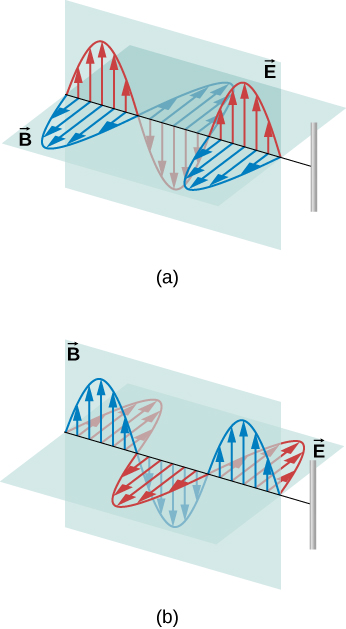
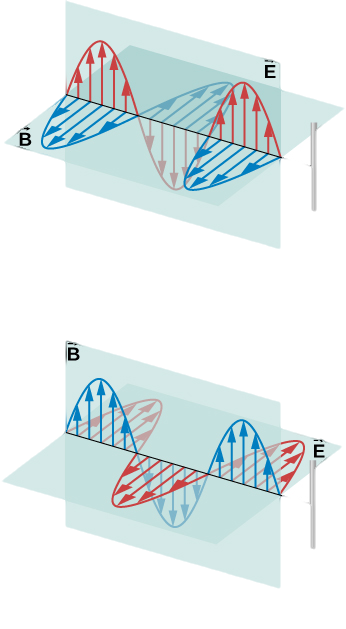
Figures a and b show electromagnetic waves with both electic and magnetic components. In figure a, the electric field is parallel to the wire and the magnetic field is perpendicular. In figure b, the magnetic field is parallel to the wire and the electric field is perpendicular.Figures a and b show electromagnetic waves with both electic and magnetic components. In figure a, the electric field is parallel to the wire and the magnetic field is perpendicular. In figure b, the magnetic field is parallel to the wire and the electric field is perpendicular.

Answer

in (a), because the electric field is parallel to the wire, accelerating the electrons

16-7 §16.2 source ↗

Under what conditions might wires in a circuit where the current flows in only one direction emit electromagnetic waves?

Answer

A steady current in a dc circuit will not produce electromagnetic waves. If the magnitude of the current varies while remaining in the same direction, the wires will emit electromagnetic waves, for example, if the current is turned on or off.

16-9 §16.3 source ↗

When you stand outdoors in the sunlight, why can you feel the energy that the sunlight carries, but not the momentum it carries?

Answer

The amount of energy (about 100W/m2) is can quickly produce a considerable change in temperature, but the light pressure (about 3.00×10⁻⁷N/m2) is much too small to notice.

16-11 §16.3 source ↗

What is the physical significance of the Poynting vector?

Answer

It has the magnitude of the energy flux and points in the direction of wave propagation. It gives the direction of energy flow and the amount of energy per area transported per second.

16-13 §16.4 source ↗

Why is the radiation pressure of an electromagnetic wave on a perfectly reflecting surface twice as large as the pressure on a perfectly absorbing surface?

Answer

The force on a surface acting over time Δt is the momentum that the force would impart to the object. The momentum change of the light is doubled if the light is reflected back compared with when it is absorbed, so the force acting on the object is twice as great.

16-15 §16.4 source ↗

(a) If the electric field and magnetic field in a sinusoidal plane wave were interchanged, in which direction relative to before would the energy propagate?
(b) What if the electric and the magnetic fields were both changed to their negatives?

Answer

a. According to the right hand rule, the direction of energy propagation would reverse. b. This would leave the vector S→, and therefore the propagation direction, the same.

16-17 §16.5 source ↗

Accelerating electric charge emits electromagnetic radiation. How does this apply in each case: (a) radio waves, (b) infrared radiation.

Answer

a. Radio waves are generally produced by alternating current in a wire or an oscillating electric field between two plates; b. Infrared radiation is commonly produced by heated bodies whose atoms and the charges in them vibrate at about the right frequency.

16-19 §16.5 source ↗

Part of the light passing through the air is scattered in all directions by the molecules comprising the atmosphere. The wavelengths of visible light are larger than molecular sizes, and the scattering is strongest for wavelengths of light closest to sizes of molecules.
(a) Which of the main colors of light is scattered the most? (b) Explain why this would give the sky its familiar background color at midday.

Answer

a. blue; b. Light of longer wavelengths than blue passes through the air with less scattering, whereas more of the blue light is scattered in different directions in the sky to give it is blue color.

16-21 §16.5 source ↗

Certain orientations of a broadcast television antenna give better reception than others for a particular station. Explain.

Answer

A typical antenna has a stronger response when the wires forming it are orientated parallel to the electric field of the radio wave.

16-23 §16.5 source ↗

Is the visible region a major portion of the electromagnetic spectrum?

Answer

No, it is very narrow and just a small portion of the overall electromagnetic spectrum.

16-25 §16.5 source ↗

Radio waves normally have their E and B fields in specific directions, whereas visible light usually has its E and B fields in random and rapidly changing directions that are perpendicular to each other and to the propagation direction. Can you explain why?

Answer

Visible light is typically produced by changes of energies of electrons in randomly oriented atoms and molecules. Radio waves are typically emitted by an ac current flowing along a wire, that has fixed orientation and produces electric fields pointed in particular directions.

16-27 §16.5 source ↗

Illustrate that the size of details of an object that can be detected with electromagnetic waves is related to their wavelength, by comparing details observable with two different types (for example, radar and visible light).

Answer

Radar can observe objects the size of an airplane and uses radio waves of about 0.5 cm in wavelength. Visible light can be used to view single biological cells and has wavelengths of about 10−7m.

16-29 §16.5 source ↗

In what range of electromagnetic radiation are the electromagnetic waves emitted by power lines in a country that uses 50-Hz ac current?

Answer

ELF radio waves

16-31 §16.5 source ↗

A leaky microwave oven in a home can sometimes cause interference with the homeowner’s WiFi system. Why?

Answer

The frequency of 2.45 GHz of a microwave oven is close to the specific frequencies in the 2.4 GHz band used for WiFi.

16-33 §16.1 source ↗

Show that the magnetic field at a distance r from the axis of two circular parallel plates, produced by placing charge Q(t) on the plates is
Bind= μ02πrdQ(t)dt.

Answer

B ind = μ 0 2 π r I ind = μ 0 2 π r ε 0 ∂ Φ E ∂ t = μ 0 2 π r ε 0 ( A ∂ E ∂ t ) = μ 0 2 π r ε 0 A ( 1 d d V ( t ) d t ) = μ 0 2 π r [ ε 0 A d ] [ 1 C d Q ( t ) d t ] = μ 0 2 π r d Q ( t ) d t because C = ε 0 A d

16-35 §16.1 source ↗

A potential difference V(t)= V0sinωt is maintained across a parallel-plate capacitor with capacitance C consisting of two circular parallel plates. A thin wire with resistance R connects the centers of the two plates, allowing charge to leak between plates while they are charging.
(a) Obtain expressions for the leakage current Ires(t) in the thin wire. Use these results to obtain an expression for the current Ireal(t) in the wires connected to the capacitor.
(b) Find the displacement current in the space between the plates from the changing electric field between the plates.
(c) Compare Ireal(t) with the sum of the displacement current Id(t) and resistor current Ires(t) between the plates, and explain why the relationship you observe would be expected.

Answer

a. Ires= V0sinωtR; b. Id= CV0ωcosωt;
c. Ireal= Ires+ dQdt= V0sinωtR+ CV0ddtsinωt= V0sinωtR+ CV0ωcosωt; which is the sum of Ires and Ireal, consistent with how the displacement current maintaining the continuity of current.

16-37 §16.1 source ↗

The potential difference V(t) between parallel plates shown above is instantaneously increasing at a rate of 107V/s. What is the displacement current between the plates if the separation of the plates is 1.00 cm and they have an area of 0.200m2 ?

Answer

1.77 × 10 −3 A

16-39 §16.1 source ↗

The voltage across a parallel-plate capacitor with area A=800cm2 and separation d=2mm varies sinusoidally as V= (15mV)cos(150t), where t is in seconds. Find the displacement current between the plates.

Answer

I d = (7.97× 10 −10 A)sin(150t)

16-41 §16.2 source ↗

If the Sun suddenly turned off, we would not know it until its light stopped coming. How long would that be, given that the Sun is 1.496×10¹¹m away?

Answer

499 s

16-43 §16.2 source ↗

An electromagnetic wave has a frequency of 12 MHz. What is its wavelength in vacuum?

Answer

25 m

16-45 §16.2 source ↗

The electric field of an electromagnetic wave traveling in vacuum is described by the following wave function: E→= (5.00V/m)
cos[kx−(6.00×10⁹s−1)t+0.40]j^ where k is the wavenumber in rad/m, x is in m, t is in s.
Find the following quantities:
(a) amplitude
(b) frequency
(c) wavelength
(d) the direction of the travel of the wave
(e) the associated magnetic field wave

Answer

a. 5.00 V/m; b. 9.55×10⁸Hz; c. 31.4 cm; d. toward the +x-axis;
e. B= (1.67×10⁻⁸T)cos[kx−(6×10⁹s−1)t+0.40]k^

16-47 §16.2 source ↗

The following represents an electromagnetic wave traveling in the direction of the positive y-axis: Ex=E0cos(ky−ωt); Ey= 0; Ez=0Bx=0;By=0;Bz=B0cos(ky−ωt).
The wave is passing through a wide tube of circular cross-section of radius R whose axis is along the x-axis. Find the expression for the displacement current through the tube.

Answer

I d = π ε 0 ω R 2 E 0 sin(kx−ωt)

16-49 §16.3 source ↗

A plane electromagnetic wave travels northward. At one instant, its electric field has a magnitude of 6.0 V/m and points eastward. What are the magnitude and direction of the magnetic field at this instant?

Answer

The magnetic field is downward, and it has magnitude 2.00×10⁻⁸T.

16-51 §16.3 source ↗

A radio station broadcasts at a frequency of 760 kHz. At a receiver some distance from the antenna, the maximum magnetic field of the electromagnetic wave detected is 2.15×10⁻¹¹T.
(a) What is the maximum electric field? (b) What is the wavelength of the electromagnetic wave?

Answer

a. 6.45×10⁻³V/m; b. 394 m

16-53 §16.3 source ↗

At what distance does a 100-W lightbulb produce the same intensity of light as a 75-W lightbulb produces 10 m away? (Assume both have the same efficiency for converting electrical energy in the circuit into emitted electromagnetic energy.)

Answer

11.5 m

16-55 §16.3 source ↗

A 150-W lightbulb emits 5% of its energy as electromagnetic radiation. What is the magnitude of the average Poynting vector 10 m from the bulb?

Answer

5.97 × 10 −3 W/m 2

16-57 §16.3 source ↗

At the top of Earth’s atmosphere, the time-averaged Poynting vector associated with sunlight has a magnitude of about 1.4kW/m2.
(a) What are the maximum values of the electric and magnetic fields for a wave of this intensity? (b) What is the total power radiated by the sun? Assume that the Earth is 1.5×10¹¹m from the Sun and that sunlight is composed of electromagnetic plane waves.

Answer

a. E 0 = 1027V/m, B 0 = 3.42× 10 −6 T; b.3.96× 10 26 W

16-59 §16.3 source ↗

What is the intensity of an electromagnetic wave with a peak electric field strength of 125 V/m?

Answer

20.8 W/m 2

16-61 §16.3 source ↗

An AM radio transmitter broadcasts 50.0 kW of power uniformly in all directions. (a) Assuming all of the radio waves that strike the ground are completely absorbed, and that there is no absorption by the atmosphere or other objects, what is the intensity 30.0 km away? (Hint: Half the power will be spread over the area of a hemisphere.) (b) What is the maximum electric field strength at this distance?

Answer

a. 4.42×10‒6W/m2; b. 5.77×10‒2V/m

16-63 §16.3 source ↗

A 2.50-m-diameter university communications satellite dish receives TV signals that have a maximum electric field strength (for one channel) of 7.50μV/m (see below). (a) What is the intensity of this wave? (b) What is the power received by the antenna? (c) If the orbiting satellite broadcasts uniformly over an area of 1.50×10¹³m2 (a large fraction of North America), how much power does it radiate?
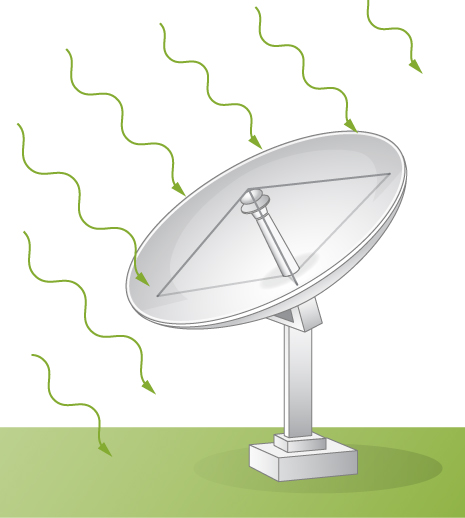
Figure shows waves incident on a dish antenna.

Answer

a. 7.47×10⁻¹⁴W/m2; b. 3.66×10⁻¹³W; c. 1.12 W

16-65 §16.4 source ↗

A 150-W lightbulb emits 5% of its energy as electromagnetic radiation. What is the radiation pressure on an absorbing sphere of radius 10 m that surrounds the bulb?

Answer

1.99 × 10 −11 N/m 2

16-67 §16.4 source ↗

A microscopic spherical dust particle of radius 2μm and mass 10μg is moving in outer space at a constant speed of 30 cm/sec. A wave of light strikes it from the opposite direction of its motion and gets absorbed. Assuming the particle accelerates opposite to the motion uniformly to zero speed in one second, what is the average electric field amplitude in the light?

Answer

F = m a = ( p ) ( π r 2 ) , p = m a π r 2 = ε 0 2 E 0 2 E 0 = 2 m a ε 0 π r 2 = 2 ( 10 −8 kg ) ( 0.30 m/s 2 ) ( 8.854 × 10 −12 C 2 / N · m 2 ) ( π ) ( 2 × 10 −6 m ) 2 E 0 = 7.34 × 10 6 V/m

16-69 §16.4 source ↗

Suppose that S→avg for sunlight at a point on the surface of Earth is 900W/m2. (a) If sunlight falls perpendicularly on a kite with a reflecting surface of area 0.75m2, what is the average force on the kite due to radiation pressure? (b) How is your answer affected if the kite material is black and absorbs all sunlight?

Answer

a. 4.50×10⁻⁶N; b. it is reduced to half the pressure, 2.25×10⁻⁶N

16-71 §16.4 source ↗

Suppose a spherical particle of mass m and radius R in space absorbs light of intensity I for time t. (a) How much work does the radiation pressure do to accelerate the particle from rest in the given time it absorbs the light? (b) How much energy carried by the electromagnetic waves is absorbed by the particle over this time based on the radiant energy incident on the particle?

Answer

a. W= 12π2r4mc2I2t2; b.E= πr2It

16-73 §16.5 source ↗

If you wish to detect details of the size of atoms (about 0.2 nm) with electromagnetic radiation, it must have a wavelength of about this size. (a) What is its frequency? (b) What type of electromagnetic radiation might this be?

Answer

a. 1.5×10¹⁸Hz; b. X-rays

16-75 §16.5 source ↗

(a) Calculate the wavelength range for AM radio given its frequency range is 540 to 1600 kHz. (b) Do the same for the FM frequency range of 88.0 to 108 MHz.

Answer

a. The wavelength range is 187 m to 556 m. b. The wavelength range is 2.78 m to 3.41 m.

16-77 §16.5 source ↗

An outdoor WiFi unit for a picnic area has a 100-mW output and a range of about 30 m. What output power would reduce its range to 12 m for use with the same devices as before? Assume there are no obstacles in the way and that microwaves into the ground are simply absorbed.

Answer

P′= ( 12 m 30 m ) 2 (100mW)= 16mW

16-79 §16.5 source ↗

A computer user finds that his wireless router transmits data at a rate of 75 Mbps (megabits per second). Compare the average time to transmit one bit of data with the time difference between the wifi signal reaching an observer’s cell phone directly and by bouncing back to the observer from a wall 8.00 m past the observer.

Answer

time for 1bit= 1.27×10⁻⁸s, difference in travel time is 5.34×10⁻⁸s

16-81 §16.5 source ↗

What are the wavelengths of (a) X-rays of frequency 2.0×10¹⁷Hz? (b) Yellow light of frequency 5.1×10¹⁴Hz? (c) Gamma rays of frequency 1.0×10²³Hz?

Answer

a. 1.5×10⁻⁹m; b. 5.9×10⁻⁷m; c. 3.0×10⁻¹⁵m

16-83 §16.5 source ↗

A radio transmitter broadcasts plane electromagnetic waves whose maximum electric field at a particular location is 1.55×10⁻³V/m. What is the maximum magnitude of the oscillating magnetic field at that location? How does it compare with Earth’s magnetic field?

Answer

5.17×10⁻¹²T, the non-oscillating geomagnetic field of 25–65 μT is much larger

16-85 §16.5 source ↗

During normal beating, the heart creates a maximum 4.00-mV potential across 0.300 m of a person’s chest, creating a 1.00-Hz electromagnetic wave. (a) What is the maximum electric field strength created? (b) What is the corresponding maximum magnetic field strength in the electromagnetic wave? (c) What is the wavelength of the electromagnetic wave?

Answer

a. 1.33×10⁻²V/m; b. 4.44×10⁻¹¹T; c. 3.00×10⁸m

16-87 §16.5 source ↗

A certain 60.0-Hz ac power line radiates an electromagnetic wave having a maximum electric field strength of 13.0 kV/m. (a) What is the wavelength of this very-low-frequency electromagnetic wave? (b) What type of electromagnetic radiation is this wave (b) What is its maximum magnetic field strength?

Answer

a. 5.00×10⁶m; b. radio wave; c. 4.33×10⁻⁵T

16-89 §16.AP source ↗

In a region of space, the electric field is pointed along the x-axis, but its magnitude changes as described by
Ex=(10N/C)sin(20x−500t)Ey=Ez=0
where t is in nanoseconds and x is in cm. Find the displacement current through a circle of radius 3 cm in the x=0 plane at t=0.

Answer

I d = (10N/C)(8.845× 10 −12 C 2 /N· m 2 )π ( 0.03 m ) 2 (5000 1 s )= 1.25× 10 −9 A

16-91 §16.AP source ↗

Use the Appendix D for the next two exercises

Galileo proposed measuring the speed of light by uncovering a lantern and having an assistant a known distance away uncover his lantern when he saw the light from Galileo’s lantern, and timing the delay. How far away must the assistant be for the delay to equal the human reaction time of about 0.25 s?

Answer

3.75×10⁷km, which is much greater than Earth’s circumference

16-93 §16.AP source ↗

Use the Appendix D for the next two exercises

On its highest power setting, a microwave oven increases the temperature of 0.400 kg of spaghetti by 45.0°C in 120 s. (a) What was the rate of energy absorption by the spaghetti, given that its specific heat is 3.76×10³J/kg·°C ? Assume the spaghetti is perfectly absorbing. (b) Find the average intensity of the microwaves, given that they are absorbed over a circular area 20.0 cm in diameter. (c) What is the peak electric field strength of the microwave? (d) What is its peak magnetic field strength?

Answer

a. 564 W; b. 1.80×10⁴W/m2; c. 3.68×10³V/m; d. 1.23×10⁻⁵T

16-95 §16.AP source ↗

Use the Appendix D for the next two exercises

Electromagnetic radiation from a 5.00-mW laser is concentrated on a 1.00-mm2 area. (a) What is the intensity in W/m2 ? (b) Suppose a 2.00-nC electric charge is in the beam. What is the maximum electric force it experiences? (c) If the electric charge moves at 400 m/s, what maximum magnetic force can it feel?

Answer

a. 5.00×10³W/m2; b. 3.88×10⁻⁶N; c. 5.18×10⁻¹²N

16-97 §16.AP source ↗

Use the Appendix D for the next two exercises

Suppose a source of electromagnetic waves radiates uniformly in all directions in empty space where there are no absorption or interference effects. (a) Show that the intensity is inversely proportional to r2, the distance from the source squared. (b) Show that the magnitudes of the electric and magnetic fields are inversely proportional to r.

Answer

a. I= PA= P4πr2∝1r2; b. I∝E02, B02⇒E02, B02∝1r2⇒E0, B0∝1r

16-99 §16.AP source ↗

Use the Appendix D for the next two exercises

The Poynting vector describes a flow of energy whenever electric and magnetic fields are present. Consider a long cylindrical wire of radius r with a current I in the wire, with resistance R and voltage V. From the expressions for the electric field along the wire and the magnetic field around the wire, obtain the magnitude and direction of the Poynting vector at the surface. Show that it accounts for an energy flow into the wire from the fields around it that accounts for the Ohmic heating of the wire.

Answer

Power into the wire = ∫ S → · d A → = ( 1 μ 0 E B ) ( 2 π r L ) = 1 μ 0 ( V L ) ( μ 0 i 2 π r ) ( 2 π r L ) = i V = i 2 R

16-101 §16.AP source ↗

Use the Appendix D for the next two exercises

If a Lightsail spacecraft were sent on a Mars mission, by what ratio of the final force to the initial force would its propulsion be reduced when it reached Mars?

Answer

0.431

16-103 §16.AP source ↗

Use the Appendix D for the next two exercises

Radar is used to determine distances to various objects by measuring the round-trip time for an echo from the object. (a) How far away is the planet Venus if the echo time is 1000 s? (b) What is the echo time for a car 75.0 m from a highway police radar unit? (c) How accurately (in nanoseconds) must you be able to measure the echo time to an airplane 12.0 km away to determine its distance within 10.0 m?

Answer

a. 1.5×10¹¹m; b. 5.0×10⁻⁷s; c. 33 ns

16-105 §16.AP source ↗

Use the Appendix D for the next two exercises

How does the wavelength of radio waves for an AM radio station broadcasting at 1030 KHz compare with the wavelength of the lowest audible sound waves (of 20 Hz). The speed of sound in air at 20°C is about 343 m/s.

Answer

sound: λ sound = v s f = 343 m/s 20.0 Hz = 17.2 m radio: λ radio = c f = 3.00 × 10 8 m/s 1030 × 10 3 Hz = 291 m; or 17.1 λ sound

16-107 §16.CP source ↗

A particle of cosmic dust has a density ρ=2.0g/cm3. (a) Assuming the dust particles are spherical and light absorbing, and are at the same distance as Earth from the Sun, determine the particle size for which radiation pressure from sunlight is equal to the Sun’s force of gravity on the dust particle. (b) Explain how the forces compare if the particle radius is smaller. (c) Explain what this implies about the sizes of dust particle likely to be present in the inner solar system compared with outside the Oort cloud.

Answer

a. 0.29μm; b. The radiation pressure is greater than the Sun’s gravity if the particle size is smaller, because the gravitational force varies as the radius cubed while the radiation pressure varies as the radius squared. c. The radiation force outward implies that particles smaller than this are less likely to be near the Sun than outside the range of the Sun’s radiation pressure.

End of the book.

Problems and answers are adapted from University Physics Volume 2 by Samuel J. Ling, Jeff Sanny and William Moebs, OpenStax, and are used under the CC BY-NC-SA 4.0 licence. Access for free at https://openstax.org/books/university-physics-volume-2/pages/1-introduction. Illustrations: Copyright Rice University, OpenStax, under CC BY-NC-SA 4.0 license. This adaptation is released under the same licence, is non-commercial, and is neither affiliated with nor endorsed by OpenStax or Rice University.