Every problem in the chapter beside the book’s answer, a chapter at a time as you scroll.
Chapter 1: Essential Ideas
62 problems · 2 figuresExample 1.1 §1.4 source ↗
(b) If the cube in part (a) is copper and has a mass of 5.34 g, what is the density of copper to two decimal places?
Answer
Example 1.2 §1.4 source ↗
Answer
Example 1.3 §1.5 source ↗
(a) 0.424 (to two significant figures)
(b) 0.0038661 (to three significant figures)
(c) 421.25 (to four significant figures)
(d) 28,683.5 (to five significant figures)
Answer
Example 1.4 §1.5 source ↗
(b) Subtract 55.8752 m from 56.533 m.
Answer
Example 1.5 §1.5 source ↗
(b) Divide 55.8752 m by 56.53 s.
Answer
Example 1.6 §1.5 source ↗
Answer
Example 1.7 §1.5 source ↗
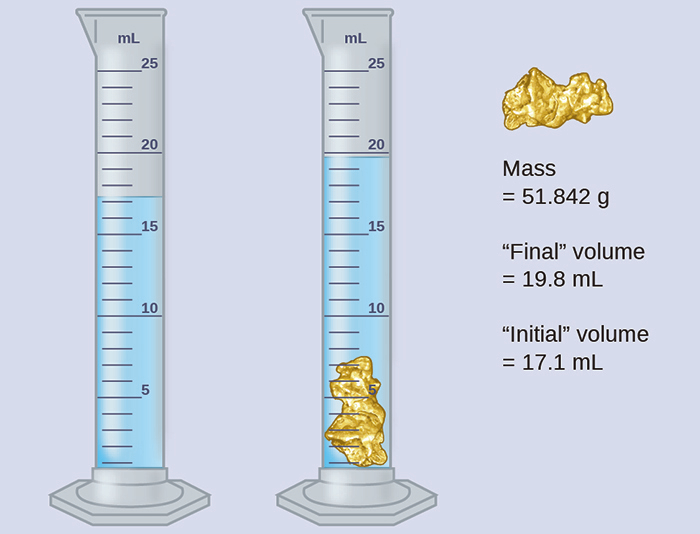
(a) Use these values to determine the density of this material.
(b) Do you have any reasonable guesses as to the identity of this material? Explain your reasoning.
Answer
| Solids | Liquids | Gases (at 25 °C and 1 atm) |
|---|---|---|
| ice (at 0 °C) 0.92 g/cm3 | water 1.0 g/cm3 | dry air 1.20 g/L |
| oak (wood) 0.60–0.90 g/cm3 | ethanol 0.79 g/cm3 | oxygen 1.31 g/L |
| iron 7.9 g/cm3 | acetone 0.79 g/cm3 | nitrogen 1.14 g/L |
| copper 9.0 g/cm3 | glycerin 1.26 g/cm3 | carbon dioxide 1.80 g/L |
| lead 11.3 g/cm3 | olive oil 0.92 g/cm3 | helium 0.16 g/L |
| silver 10.5 g/cm3 | gasoline 0.70–0.77 g/cm3 | neon 0.83 g/L |
| gold 19.3 g/cm3 | mercury 13.6 g/cm3 | radon 9.1 g/L |
Example 1.8 §1.6 source ↗
Answer
Example 1.9 §1.6 source ↗
Answer
Example 1.10 §1.6 source ↗
(a) What (average) fuel economy, in miles per gallon, did the Prius get during this trip?
(b) If gasoline costs $3.90 per gallon, what was the fuel cost for this trip?
Answer
Example 1.11 §1.6 source ↗
Answer
Example 1.12 §1.6 source ↗
Answer
1-1 §1.1 source ↗
Answer
1-3 §1.1 source ↗
Identify each of the following statements as being most similar to a hypothesis, a law, or a theory. Explain your reasoning.
(a) The pressure of a sample of gas is directly proportional to the temperature of the gas.
(b) Matter consists of tiny particles that can combine in specific ratios to form substances with specific properties.
(c) At a higher temperature, solids (such as salt or sugar) will dissolve better in water.
Answer
1-5 §1.1 source ↗
Identify each of the underlined items as a part of either the macroscopic domain, the microscopic domain, or the symbolic domain of chemistry. For those in the symbolic domain, indicate whether they are symbols for a macroscopic or a microscopic feature.
(a) A certain molecule contains one H atom and one Cl atom.
(b) Copper wire has a density of about 8 g/cm3.
(c) The bottle contains 15 grams of Ni powder.
(d) A sulfur molecule is composed of eight sulfur atoms.
Answer
1-7 §1.1 source ↗
Answer
1-9 §1.2 source ↗
Answer
1-11 §1.2 source ↗
Answer
1-13 §1.2 source ↗
Answer
1-15 §1.2 source ↗
Answer
1-17 §1.2 source ↗
Classify each of the following as an element, a compound, or a mixture:
(a) iron
(b) oxygen
(c) mercury oxide
(d) pancake syrup
(e) carbon dioxide
(f) a substance composed of molecules each of which contains one hydrogen atom and one chlorine atom
(g) baking soda
(h) baking powder
Answer
1-19 §1.2 source ↗
Answer
1-21 §1.2 source ↗
Answer
1-23 §1.2 source ↗
Answer
1-25 §1.2 source ↗
Yeast converts glucose to ethanol and carbon dioxide during anaerobic fermentation as depicted in the simple chemical equation here:
(a) If 200.0 g of glucose is fully converted, what will be the total mass of ethanol and carbon dioxide produced?
(b) If the fermentation is carried out in an open container, would you expect the mass of the container and contents after fermentation to be less than, greater than, or the same as the mass of the container and contents before fermentation? Explain.
(c) If 97.7 g of carbon dioxide is produced, what mass of ethanol is produced?
Answer
1-27 §1.3 source ↗
Classify each of the following changes as physical or chemical:
(a) condensation of steam
(b) burning of gasoline
(c) souring of milk
(d) dissolving of sugar in water
(e) melting of gold
Answer
1-29 §1.3 source ↗
Answer
1-31 §1.3 source ↗
Answer
1-33 §1.3 source ↗
The density (d) of a substance is an intensive property that is defined as the ratio of its mass (m) to its volume (V).
Considering that mass and volume are both extensive properties, explain why their ratio, density, is intensive.
Answer
1-35 §1.4 source ↗
Answer
1-37 §1.4 source ↗
Indicate the SI base units or derived units that are appropriate for the following measurements:
(a) the mass of the moon
(b) the distance from Dallas to Oklahoma City
(c) the speed of sound
(d) the density of air
(e) the temperature at which alcohol boils
(f) the area of the state of Delaware
(g) the volume of a flu shot or a measles vaccination
Answer
1-39 §1.4 source ↗
Give the name of the prefix and the quantity indicated by the following symbols that are used with SI base units.
(a) c
(b) d
(c) G
(d) k
(e) m
(f) n
(g) p
(h) T
Answer
1-41 §1.4 source ↗
Visit this density simulation and click the "turn fluid into water" button to adjust the density of liquid in the beaker to 1.00 g/mL.
(a) Use the water displacement approach to measure the mass and volume of the unknown material (select the green block with question marks).
(b) Use the measured mass and volume data from step (a) to calculate the density of the unknown material.
(c) Assuming this material is a widely available copper-containing gemstone, what is its likely identity? Compare the measured density to the values tabulated at this gemstone density guide.
(d) How are mass and density related for blocks of the same volume?
Answer
1-43 §1.4 source ↗
Visit this density simulation and click the “turn fluid into water” button to adjust the density of liquid in the beaker to 1.00 g/mL. Change the block material to foam, and then wait patiently until the foam block stops bobbing up and down in the water.
(a) The foam block should be floating on the surface of the water (that is, only partially submerged). What is the volume of water displaced?
(b) Use the water volume from part (a) and the density of water (1.00 g/mL) to calculate the mass of water displaced.
(c) Remove and weigh the foam block. How does the block’s mass compare to the mass of displaced water from part (b)?
Answer
1-45 §1.5 source ↗
Express each of the following numbers in exponential notation with correct significant figures:
(a) 704
(b) 0.03344
(c) 547.9
(d) 22086
(e) 1000.00
(f) 0.0000000651
(g) 0.007157
Answer
1-47 §1.5 source ↗
Indicate whether each of the following can be determined exactly or must be measured with some degree of uncertainty:
(a) the number of seconds in an hour
(b) the number of pages in this book
(c) the number of grams in your weight
(d) the number of grams in 3 kilograms
(e) the volume of water you drink in one day
(f) the distance from San Francisco to Kansas City
Answer
1-49 §1.5 source ↗
How many significant figures are contained in each of the following measurements?
(a) 53 cm
(b) 2.05 108 m
(c) 86,002 J
(d) 9.740 104 m/s
(e) 10.0613 m3
(f) 0.17 g/mL
(g) 0.88400 s
Answer
1-51 §1.5 source ↗
Round off each of the following numbers to two significant figures:
(a) 0.436
(b) 9.000
(c) 27.2
(d) 135
(e) 1.497 10−3
(f) 0.445
Answer
1-53 §1.5 source ↗
Perform the following calculations and report each answer with the correct number of significant figures.
(a) 628 342
(b) (5.63 102) (7.4 103)
(c)
(d) 8119 0.000023
(e) 14.98 + 27,340 + 84.7593
(f) 42.7 + 0.259
Answer
1-55 §1.5 source ↗
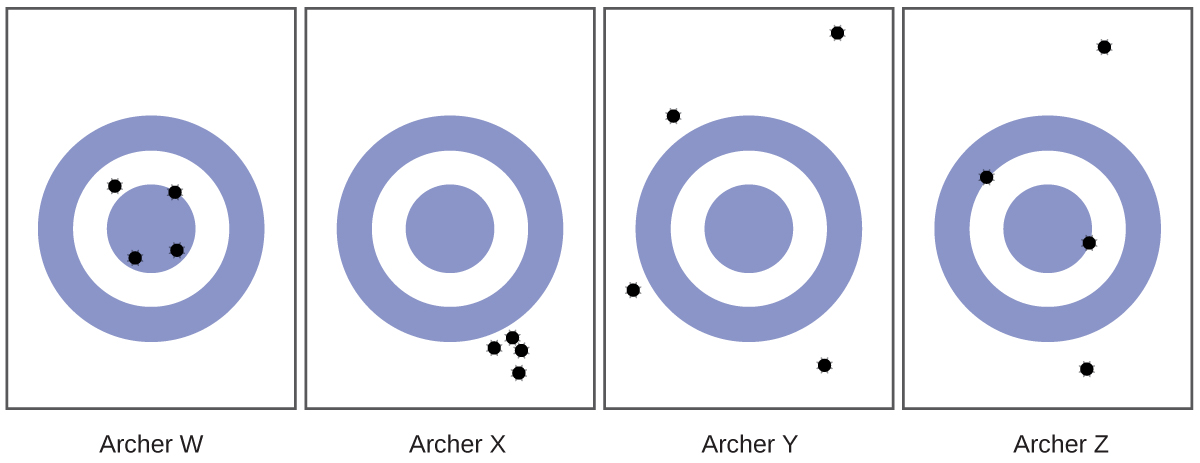
Consider the results of the archery contest shown in this figure.
(a) Which archer is most precise?
(b) Which archer is most accurate?
(c) Who is both least precise and least accurate?
Answer
1-57 §1.6 source ↗
Write conversion factors (as ratios) for the number of:
(a) yards in 1 meter
(b) liters in 1 liquid quart
(c) pounds in 1 kilogram
Answer
1-59 §1.6 source ↗
Answer
Only two significant figures are justified.
1-61 §1.6 source ↗
Answer
1-63 §1.6 source ↗
Answer
1-65 §1.6 source ↗
Answer
1-67 §1.6 source ↗
Answer
1-69 §1.6 source ↗
Answer
1-71 §1.6 source ↗
Use scientific (exponential) notation to express the following quantities in terms of the SI base units in Table 1.2:
(a) 0.13 g
(b) 232 Gg
(c) 5.23 pm
(d) 86.3 mg
(e) 37.6 cm
(f) 54 μm
(g) 1 Ts
(h) 27 ps
(i) 0.15 mK
| Property Measured | Name of Unit | Symbol of Unit |
|---|---|---|
| length | meter | m |
| mass | kilogram | kg |
| time | second | s |
| temperature | kelvin | K |
| electric current | ampere | A |
| amount of substance | mole | mol |
| luminous intensity | candela | cd |
Answer
1-73 §1.6 source ↗
Answer
1-75 §1.6 source ↗
Answer
1-77 §1.6 source ↗
Make the conversion indicated in each of the following:
(a) the length of a soccer field, 120 m (three significant figures), to feet
(b) the height of Mt. Kilimanjaro, at 19,565 ft, the highest mountain in Africa, to kilometers
(c) the area of an 8.5- × 11-inch sheet of paper in cm2
(d) the displacement volume of an automobile engine, 161 in.3, to liters
(e) the estimated mass of the atmosphere, 5.6 × 10¹⁵ tons, to kilograms
(f) the mass of a bushel of rye, 32.0 lb, to kilograms
(g) the mass of a 5.00-grain aspirin tablet to milligrams (1 grain = 0.00229 oz)
Answer
1-79 §1.6 source ↗
Answer
1-81 §1.6 source ↗
Answer
1-83 §1.6 source ↗
Answer
1-85 §1.6 source ↗
Solve these problems about lumber dimensions.
(a) To describe to a European how houses are constructed in the US, the dimensions of “two-by-four” lumber must be converted into metric units. The thickness width length dimensions are 1.50 in. 3.50 in. 8.00 ft in the US. What are the dimensions in cm cm m?
(b) This lumber can be used as vertical studs, which are typically placed 16.0 in. apart. What is that distance in centimeters?
Answer
1-87 §1.6 source ↗
Answer
1-89 §1.6 source ↗
Calculate these masses.
(a) What is the mass of 6.00 cm3 of mercury, density = 13.5939 g/cm3?
(b) What is the mass of 25.0 mL octane, density = 0.702 g/cm3?
Answer
1-91 §1.6 source ↗
Calculate these volumes.
(a) What is the volume of 25 g iodine, density = 4.93 g/cm3?
(b) What is the volume of 3.28 g gaseous hydrogen, density = 0.089 g/L?
Answer
1-93 §1.6 source ↗
Answer
1-95 §1.6 source ↗
Answer
1-97 §1.6 source ↗
Answer
1-99 §1.6 source ↗
Answer
Loading chapter 2…
Problems and answers are adapted from Chemistry: Atoms First 2e by Paul Flowers, Edward J. Neth, William R. Robinson, Klaus Theopold and Richard Langley, OpenStax, and are used under the CC BY-NC-SA 4.0 licence. Access for free at https://openstax.org/books/chemistry-atoms-first-2e/pages/1-introduction. Illustrations: Copyright Rice University, OpenStax, under CC BY-NC-SA 4.0 license. This adaptation is released under the same licence, is non-commercial, and is neither affiliated with nor endorsed by OpenStax or Rice University.