Every problem in the chapter beside the book’s answer, a chapter at a time as you scroll.

Chapter 2: Atoms, Molecules, and Ions

43 problems · 11 figures

Example 2.1 §2.1 source ↗

In the following drawing, the green spheres represent atoms of a certain element. The blue spheres represent atoms of another element. If the spheres touch, they are part of a single unit of a compound. Does the following chemical change represented by these symbols violate any of the ideas of Dalton’s atomic theory? If so, which one? This equation shows that the starting materials of the reaction are two sets of bonded, green spheres which are each being combined with two smaller, bonded blue spheres. The products of the change are two molecules that each contain one blue sphere bonded between two green spheres.

Answer

The starting materials consist of four green spheres and two blue spheres. The products consist of four green spheres and two blue spheres. This does not violate any of Dalton’s postulates: Atoms are neither created nor destroyed, but are redistributed in small, whole-number ratios.

Example 2.2 §2.1 source ↗

A sample of compound X (a clear, colorless, combustible liquid with a noticeable odor) is analyzed and found to contain 14.13 g carbon and 2.96 g hydrogen. A sample of compound Y (a clear, colorless, combustible liquid with a noticeable odor that is slightly different from X’s odor) is analyzed and found to contain 19.91 g carbon and 3.34 g hydrogen. Are these data an example of the law of definite proportions, the law of multiple proportions, or neither? What do these data tell you about substances X and Y?

Answer

In compound X, the mass ratio of carbon to hydrogen is 14.13 g C2.96 g H. In compound Y, the mass ratio of carbon to hydrogen is 19.91 g C3.34 g H. The ratio of these ratios is 14.13 g C2.96 g H19.91 g C3.34 g H= 4.77 g C/g H5.96 g C/g H= 0.800= 45. This small, whole-number ratio supports the law of multiple proportions. This means that X and Y are different compounds.

Example 2.3 §2.3 source ↗

An ion of platinum has a mass number of 195 and contains 74 electrons. How many protons and neutrons does it contain, and what is its charge?

Answer

78 protons; 117 neutrons; charge is 4+

Example 2.4 §2.3 source ↗

A sample of magnesium is found to contain 78.70% of 24Mg atoms (mass 23.98 amu), 10.13% of 25Mg atoms (mass 24.99 amu), and 11.17% of 26Mg atoms (mass 25.98 amu). Calculate the average mass of a Mg atom.

Answer

24.31 amu

Example 2.5 §2.3 source ↗

Naturally occurring copper consists of 63Cu (mass 62.9296 amu) and 65Cu (mass 64.9278 amu), with an average mass of 63.546 amu. What is the percent composition of Cu in terms of these two isotopes?

Answer

69.15% Cu-63 and 30.85% Cu-65

Example 2.6 §2.4 source ↗

A molecule of metaldehyde (a pesticide used for snails and slugs) contains 8 carbon atoms, 16 hydrogen atoms, and 4 oxygen atoms. What are the molecular and empirical formulas of metaldehyde?

Answer

Molecular formula, C8H16O4; empirical formula, C2H4O

Example 2.7 §2.4 source ↗

Beryllium is a light metal used to fabricate transparent X-ray windows for medical imaging instruments. How many moles of Be are in a thin-foil window weighing 3.24 g?

Answer

0.360 mol

Example 2.8 §2.4 source ↗

What is the mass of 2.561 mol of gold?

Answer

504.5 g

Example 2.9 §2.4 source ↗

A prospector panning for gold in a river collects 15.00 g of pure gold. How many Au atoms are in this quantity of gold?

Answer

4.585 × 10²² Au atoms

Example 2.10 §2.4 source ↗

How many moles of sucrose, C12H22O11, are in a 25-g sample of sucrose?

Answer

0.073 mol

Example 2.11 §2.4 source ↗

What is the mass of 0.443 mol of hydrazine, N2H4?

Answer

14.2 g

Example 2.12 §2.4 source ↗

How many C4H10 molecules are contained in 9.213 g of this compound? How many hydrogen atoms?

Answer

9.545 × 10²² molecules C4 H10; 9.545 × 10²³ atoms H

2-1 §2.1 source ↗

In the following drawing, the green spheres represent atoms of a certain element. The blue spheres represent atoms of another element. If the spheres of different elements touch, they are part of a single unit of a compound. The following chemical change represented by these spheres may violate one of the ideas of Dalton’s atomic theory. Which one?


This equation contains the starting materials of a single, green sphere plus two smaller, blue spheres bonded together. When the starting materials are added together the products of the change are one blue sphere bonded with one green sphere plus one blue sphere bonded with one green sphere.This equation contains the starting materials of a single, green sphere plus two smaller, blue spheres bonded together. When the starting materials are added together the products of the change are one blue sphere bonded with one green sphere plus one blue sphere bonded with one green sphere.

Answer

The starting materials consist of one green sphere and two blue spheres. The products consist of two green spheres and two blue spheres. This violates Dalton’s postulate that that atoms are not created during a chemical change, but are merely redistributed.

2-3 §2.1 source ↗

Identify the postulate of Dalton’s theory that is violated by the following observations: 59.95% of one sample of titanium dioxide is titanium; 60.10% of a different sample of titanium dioxide is titanium.

Answer

This statement violates Dalton’s fourth postulate: In a given compound, the numbers of atoms of each type (and thus also the percentage) always have the same ratio.

2-5 §2.2 source ↗

The existence of isotopes violates one of the original ideas of Dalton’s atomic theory. Which one?

Answer

Dalton originally thought that all atoms of a particular element had identical properties, including mass. Thus, the concept of isotopes, in which an element has different masses, was a violation of the original idea. To account for the existence of isotopes, the second postulate of his atomic theory was modified to state that atoms of the same element must have identical chemical properties.

2-7 §2.2 source ↗

How are protons and neutrons similar? How are they different?

Answer

Both are subatomic particles that reside in an atom’s nucleus. Both have approximately the same mass. Protons are positively charged, whereas neutrons are uncharged.

2-9 §2.2 source ↗

Predict and test the behavior of α particles fired at a Rutherford atom model.

(a) Predict the paths taken by α particles that are fired at atoms with a Rutherford atom model structure. Explain why you expect the α particles to take these paths.

(b) If α particles of higher energy than those in (a) are fired at Rutherford atoms, predict how their paths will differ from the lower-energy α particle paths. Explain your reasoning.

(c) Predict how the paths taken by the α particles will differ if they are fired at Rutherford atoms of elements other than gold. What factor do you expect to cause this difference in paths, and why?

(d) Now test your predictions from (a), (b), and (c). Open the Rutherford Scattering simulation and select the “Rutherford Atom” tab. Due to the scale of the simulation, it is best to start with a small nucleus, so select “20” for both protons and neutrons, “min” for energy, show traces, and then start firing α particles. Does this match your prediction from (a)? If not, explain why the actual path would be that shown in the simulation. Pause or reset, set energy to “max,” and start firing α particles. Does this match your prediction from (b)? If not, explain the effect of increased energy on the actual path as shown in the simulation. Pause or reset, select “40” for both protons and neutrons, “min” for energy, show traces, and fire away. Does this match your prediction from (c)? If not, explain why the actual path would be that shown in the simulation. Repeat this with larger numbers of protons and neutrons. What generalization can you make regarding the type of atom and effect on the path of α particles? Be clear and specific.

Answer

(a) The Rutherford atom has a small, positively charged nucleus, so most α particles will pass through empty space far from the nucleus and be undeflected. Those α particles that pass near the nucleus will be deflected from their paths due to positive-positive repulsion. The more directly toward the nucleus the α particles are headed, the larger the deflection angle will be. (b) Higher-energy α particles that pass near the nucleus will still undergo deflection, but the faster they travel, the less the expected angle of deflection. (c) If the nucleus is smaller, the positive charge is smaller and the expected deflections are smaller—both in terms of how closely the α particles pass by the nucleus undeflected and the angle of deflection. If the nucleus is larger, the positive charge is larger and the expected deflections are larger—more α particles will be deflected, and the deflection angles will be larger. (d) The paths followed by the α particles match the predictions from (a), (b), and (c).

2-11 §2.3 source ↗

Write the symbol for each of the following ions:

(a) the ion with a 1+ charge, atomic number 55, and mass number 133

(b) the ion with 54 electrons, 53 protons, and 74 neutrons

(c) the ion with atomic number 15, mass number 31, and a 3− charge

(d) the ion with 24 electrons, 30 neutrons, and a 3+ charge

Answer

(a) 133Cs+; (b) 127I−; (c) 31P3−; (d) 57Co3+

2-13 §2.3 source ↗

Open the Build an Atom simulation and click on the Atom icon.

(a) Pick any one of the first 10 elements that you would like to build and state its symbol.

(b) Drag protons, neutrons, and electrons onto the atom template to make an atom of your element.
State the numbers of protons, neutrons, and electrons in your atom, as well as the net charge and mass number.

(c) Click on “Net Charge” and “Mass Number,” check your answers to (b), and correct, if needed.

(d) Predict whether your atom will be stable or unstable. State your reasoning.

(e) Check the “Stable/Unstable” box. Was your answer to (d) correct? If not, first predict what you can do to make a stable atom of your element, and then do it and see if it works. Explain your reasoning.

Answer

(a) Carbon-12, 12C; (b) This atom contains six protons and six neutrons. There are six electrons in a neutral 12C atom. The net charge of such a neutral atom is zero, and the mass number is 12. (c) The preceding answers are correct. (d) The atom will be stable since C-12 is a stable isotope of carbon. (e) The preceding answer is correct. Other answers for this exercise are possible if a different element of isotope is chosen.

2-15 §2.3 source ↗

Open the Build an Atom simulation

(a) Drag protons, neutrons, and electrons onto the atom template to make a neutral atom of Lithium-6 and give the isotope symbol for this atom.

(b) Now remove one electron to make an ion and give the symbol for the ion you have created.

Answer

(a) Lithium-6 contains three protons, three neutrons, and three electrons. The isotope symbol is 6Li or 36Li. (b) 6Li+ or 36Li+

2-17 §2.3 source ↗

The following are properties of isotopes of two elements that are essential in our diet. Determine the number of protons, neutrons and electrons in each and name them.

(a) atomic number 26, mass number 58, charge of 2+

(b) atomic number 53, mass number 127, charge of 1−

Answer

(a) Iron, 26 protons, 24 electrons, and 32 neutrons; (b) iodine, 53 protons, 54 electrons, and 74 neutrons

2-19 §2.3 source ↗

Give the number of protons, electrons, and neutrons in neutral atoms of each of the following isotopes:

(a) 37Li

(b) 52125Te

(c) 47109Ag

(d) 715N

(e) 1531P

Answer

(a) 3 protons, 3 electrons, 4 neutrons; (b) 52 protons, 52 electrons, 73 neutrons; (c) 47 protons, 47 electrons, 62 neutrons; (d) 7 protons, 7 electrons, 8 neutrons; (e) 15 protons, 15 electrons, 16 neutrons

2-21 §2.3 source ↗

Repeat Exercise 2.20 using an element that has three naturally occurring isotopes.

Answer

Let us use neon as an example. Since there are three isotopes, there is no way to be sure to accurately predict the abundances to make the total of 20.18 amu average atomic mass. Let us guess that the abundances are 9% Ne-22, 91% Ne-20, and only a trace of Ne-21. The average mass would be 20.18 amu. Checking the nature’s mix of isotopes shows that the abundances are 90.48% Ne-20, 9.25% Ne-22, and 0.27% Ne-21, so our guessed amounts have to be slightly adjusted.

2-23 §2.3 source ↗

Average atomic masses listed by IUPAC are based on a study of experimental results. Bromine has two isotopes, 79Br and 81Br, whose masses (78.9183 and 80.9163 amu, respectively) and abundances (50.69% and 49.31%, respectively) were determined in earlier experiments. Calculate the average atomic mass of bromine based on these experiments.

Answer

79.90 amu

2-25 §2.3 source ↗

The average atomic masses of some elements may vary, depending upon the sources of their ores. Naturally occurring boron consists of two isotopes with accurately known masses (10B, 10.0129 amu and 11B, 11.00931 amu). The actual atomic mass of boron can vary from 10.807 to 10.819, depending on whether the mineral source is from Turkey or the United States. Calculate the percent abundances leading to the two values of the average atomic masses of boron from these two countries.

Answer

Turkey source: 20.3% (of 10.0129 amu isotope); US source: 19.1% (of 10.0129 amu isotope)

2-27 §2.4 source ↗

Explain why the symbol for an atom of the element oxygen and the formula for a molecule of oxygen differ.

Answer

The symbol for the element oxygen, O, represents both the element and one atom of oxygen. A molecule of oxygen, O2, contains two oxygen atoms; the subscript 2 in the formula must be used to distinguish the diatomic molecule from two single oxygen atoms.

2-29 §2.4 source ↗

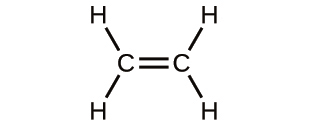
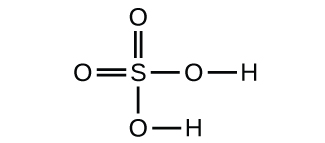
Write the molecular and empirical formulas of the following compounds:

(a)

Figure A shows a carbon atom that forms two, separate double bonds with two oxygen atoms.


(b)

Figure B shows a hydrogen atom which forms a single bond with a carbon atom. The carbon atom forms a triple bond with another carbon atom. The second carbon atom forms a single bond with a hydrogen atom.


(c)

Figure C shows a carbon atom double bonded to another carbon atom. Each carbon atom is further single bonded to two hydrogen atoms.


(d)

Figure D shows a sulfur atom forming double bonds with two oxygen atoms and single bonds with two oxygen atoms. Two of the oxygen atoms form a single bond with a hydrogen atom.

Answer

(a) molecular CO2, empirical CO2; (b) molecular C2H2, empirical CH; (c) molecular C2H4, empirical CH2; (d) molecular H2SO4, empirical H2SO4

2-31 §2.4 source ↗

Determine the empirical formulas for the following compounds:

(a) caffeine, C8H10N4O2
(b) sucrose, C12H22O11

(c) hydrogen peroxide, H2O2

(d) glucose, C6H12O6

(e) ascorbic acid (vitamin C), C6H8O6

Answer

(a) C4H5N2O; (b) C12H22O11; (c) HO; (d) CH2O; (e) C3H4O3

2-33 §2.4 source ↗

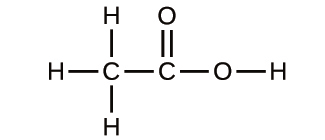
Write the empirical formulas for the following compounds:

(a)

Figure A shows a structural diagram of two carbon atoms that form a single bond with each other. The left carbon forms single bonds with three hydrogen atoms. The right carbon forms a double bond to an oxygen atom and a single bond to another oxygen atom. This second oxygen atom also forms a single bond to a hydrogen atom.


(b)

Figure B shows a structural diagram containing a leftmost carbon that forms single bonds to three hydrogen atoms each. This leftmost carbon also forms a single bond to a second carbon atom. The second carbon atom forms a double bond with an oxygen atom. The second carbon also forms a single bond to a second oxygen atom. This oxygen atom forms a single bond to a third carbon atom. This third carbon atom forms single bonds with two hydrogen atoms each as well as a single bond with another carbon atom. The rightmost carbon atom forms a single bond with three hydrogen atoms each.

Answer

(a) CH2O; (b) C2H4O

2-35 §2.4 source ↗

Use the Build a Molecule simulation to repeat Exercise 2.34, but build a molecule with two carbons, six hydrogens, and one oxygen.

(a) Draw the structural formula of this molecule and state its name.

(b) Can you arrange these atoms to make a different molecule? If so, draw its structural formula and state its name.

(c) How are the molecules drawn in (a) and (b) the same? How do they differ? What are they called (the type of relationship between these molecules, not their names)?

Answer

(a) ethanol
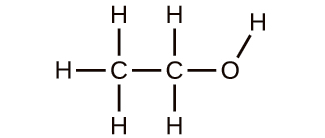
A structural formula is shown. An oxygen atom is bonded to two carbon atoms with single bonds. Each carbon atom is bonded to three hydrogen atoms with single bonds. There are a total of two carbon atoms, six hydrogen atoms, and one oxygen atom.

(b) methoxymethane, more commonly known as dimethyl ether
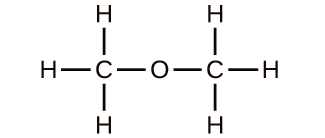
A structural formula is shown. An oxygen atom is bonded to a hydrogen atom and a carbon atom with single bonds. That carbon atom is bonded to two hydrogen atoms and another carbon atom with single bonds. That carbon atom is bonded to three hydrogen atoms with single bonds. There are a total of two carbon atoms, six hydrogen atoms, and one oxygen atom.

(c) These molecules have the same chemical composition (types and number of atoms) but different chemical structures. They are structural isomers.

2-37 §2.4 source ↗

Write a sentence that describes how to determine the number of moles of a compound in a known mass of the compound if we know its molecular formula.

Answer

Use the molecular formula to find the molar mass; to obtain the number of moles, divide the mass of compound by the molar mass of the compound expressed in grams.

2-39 §2.4 source ↗

Which contains the greatest mass of oxygen: 0.75 mol of ethanol (C2H5OH), 0.60 mol of formic acid (HCO2H), or 1.0 mol of water (H2O)? Explain why.

Answer

Formic acid. Its formula has twice as many oxygen atoms as the other two compounds (one each). Therefore, 0.60 mol of formic acid would be equivalent to 1.20 mol of a compound containing a single oxygen atom.

2-41 §2.4 source ↗

How are the molecular mass and the molar mass of a compound similar and how are they different?

Answer

The two masses have the same numerical value, but the units are different: The molecular mass is the mass of 1 molecule while the molar mass is the mass of 6.022 × 10²³ molecules.

2-43 §2.4 source ↗

Calculate the molar mass of each of the following:

(a) S8

(b) C5H12

(c) Sc2(SO4)3

(d) CH3COCH3 (acetone)

(e) C6H12O6 (glucose)

Answer

(a) 256.48 g/mol; (b) 72.150 g mol−1; (c) 378.103 g mol−1; (d) 58.080 g mol−1; (e) 180.158 g mol−1

2-45 §2.4 source ↗

Calculate the molar mass of each of the following:

(a) the anesthetic halothane, C2HBrClF3

(b) the herbicide paraquat, C12H14N2Cl2

(c) caffeine, C8H10N4O2

(d) urea, CO(NH2)2

(e) a typical soap, C17H35CO2Na

Answer

(a) 197.382 g mol−1; (b) 257.163 g mol−1; (c) 194.193 g mol−1; (d) 60.056 g mol−1; (e) 306.464 g mol−1

2-47 §2.4 source ↗

Determine the mass of each of the following:

(a) 0.0146 mol KOH

(b) 10.2 mol ethane, C2H6

(c) 1.6 × 10⁻³ mol Na2 SO4

(d) 6.854 × 10³ mol glucose, C6 H12 O6

(e) 2.86 mol Co(NH3)6Cl3

Answer

(a) 0.819 g;
(b) 307 g;
(c) 0.23 g;
(d) 1.235 × 10⁶ g (1235 kg);
(e) 765 g

2-49 §2.4 source ↗

Determine the mass of each of the following:

(a) 2.345 mol LiCl

(b) 0.0872 mol acetylene, C2H2

(c) 3.3 × 10⁻² mol Na2CO3

(d) 1.23 × 10³ mol fructose, C6H12O6

(e) 0.5758 mol FeSO4(H2O)7

Answer

(a) 99.41 g;
(b) 2.27 g;
(c) 3.5 g;
(d) 222 kg;
(e) 160.1 g

2-51 §2.4 source ↗

Determine the mass in grams of each of the following:

(a) 0.600 mol of oxygen atoms

(b) 0.600 mol of oxygen molecules, O2

(c) 0.600 mol of ozone molecules, O3

Answer

(a) 9.60 g; (b) 19.2 g; (c) 28.8 g

2-53 §2.4 source ↗

Determine the number of atoms and the mass of zirconium, silicon, and oxygen found in 0.3384 mol of zircon, ZrSiO4, a semiprecious stone.

Answer

zirconium: 2.038 × 10²³ atoms; 30.87 g; silicon: 2.038 × 10²³ atoms; 9.504 g; oxygen: 8.151 × 10²³ atoms; 21.66 g

2-55 §2.4 source ↗

Determine which of the following contains the greatest mass of aluminum: 122 g of AlPO4, 266 g of Al2Cl6, or 225 g of Al2S3.

Answer

AlPO4: 1.000 mol or 26.98 g Al
Al2Cl6: 1.994 mol or 53.74 g Al
Al2S3: 3.00 mol or 80.94 g Al
The Al2S3 sample thus contains the greatest mass of Al.

2-57 §2.4 source ↗

The Cullinan diamond was the largest natural diamond ever found (January 25, 1905). It weighed 3104 carats (1 carat = 200 mg). How many carbon atoms were present in the stone?

Answer

3.113 × 1025 C atoms

2-59 §2.4 source ↗

A certain nut crunch cereal contains 11.0 grams of sugar (sucrose, C12H22O11) per serving size of 60.0 grams. How many servings of this cereal must be eaten to consume 0.0278 moles of sugar?

Answer

0.865 servings, or about 1 serving.

2-61 §2.4 source ↗

Which of the following represents the least number of molecules?

(a) 20.0 g of H2O (18.02 g/mol)

(b) 77.0 g of CH4 (16.06 g/mol)

(c) 68.0 g of C3H6 (42.08 g/mol)

(d) 100.0 g of N2O (44.02 g/mol)

(e) 84.0 g of HF (20.01 g/mol)

Answer

20.0 g H2O represents the least number of molecules since it has the least number of moles.

Loading chapter 3…

Problems and answers are adapted from Chemistry: Atoms First 2e by Paul Flowers, Edward J. Neth, William R. Robinson, Klaus Theopold and Richard Langley, OpenStax, and are used under the CC BY-NC-SA 4.0 licence. Access for free at https://openstax.org/books/chemistry-atoms-first-2e/pages/1-introduction. Illustrations: Copyright Rice University, OpenStax, under CC BY-NC-SA 4.0 license. This adaptation is released under the same licence, is non-commercial, and is neither affiliated with nor endorsed by OpenStax or Rice University.