Every problem in the chapter beside the book’s answer, a chapter at a time as you scroll.
Chapter 3: Electronic Structure and Periodic Properties of Elements
69 problems · 8 figuresExample 3.1 §3.1 source ↗
Answer
Example 3.2 §3.1 source ↗
Answer
Example 3.3 §3.1 source ↗
Answer
Example 3.4 §3.2 source ↗
Answer
Example 3.5 §3.2 source ↗
Answer
Example 3.6 §3.3 source ↗
Answer
1.9 10–34 m.
We never think of a thrown softball having a wavelength, since this wavelength is so small it is impossible for our senses or any known instrument to detect. Since de Broglie wavelength is inversely proportional to both particle mass and velocity, the particle’s momentum (mathematical product of mass and velocity) must be sufficiently small to yield a detectably large wavelength.
Example 3.7 §3.3 source ↗
Answer
Example 3.8 §3.3 source ↗
Answer
Example 3.9 §3.3 source ↗
Answer
Example 3.10 §3.4 source ↗
(a) [Ar]4s23d5
(b) [Kr]5s24d105p6
Answer
Example 3.11 §3.4 source ↗
Answer
Example 3.12 §3.5 source ↗
Answer
Example 3.13 §3.5 source ↗
Answer
Example 3.14 §3.6 source ↗
(a) krypton
(b) selenium
(c) barium
(d) lithium
Answer
Example 3.15 §3.7 source ↗
Answer
Example 3.16 §3.7 source ↗
Answer
Example 3.17 §3.7 source ↗
Answer
Example 3.18 §3.7 source ↗
Answer
Example 3.19 §3.7 source ↗
(a) SO2
(b) CaF2
(c) N2H4
(d) Al2(SO4)3
Answer
3-1 §3.1 source ↗
Answer
3-3 §3.1 source ↗
Answer
3-5 §3.1 source ↗
Answer
3-7 §3.1 source ↗
Answer
3-9 §3.1 source ↗
Answer
3-11 §3.1 source ↗
Answer
3-13 §3.1 source ↗
Answer
3-15 §3.1 source ↗
Answer
3-17 §3.2 source ↗
Answer
3-19 §3.2 source ↗
Answer
3-21 §3.2 source ↗
Answer
3-23 §3.2 source ↗
Answer
3-25 §3.2 source ↗
Answer
3-27 §3.2 source ↗
Answer
3-29 §3.2 source ↗
Answer
3-31 §3.3 source ↗
Answer
3-33 §3.3 source ↗
Answer
3-35 §3.3 source ↗
Identify the subshell in which electrons with the following quantum numbers are found:
(a) n = 2, l = 1
(b) n = 4, l = 2
(c) n = 6, l = 0
Answer
3-37 §3.3 source ↗
Identify the subshell in which electrons with the following quantum numbers are found:
(a) n = 3, l = 2
(b) n = 1, l = 0
(c) n = 4, l = 3
Answer
3-39 §3.3 source ↗
Answer
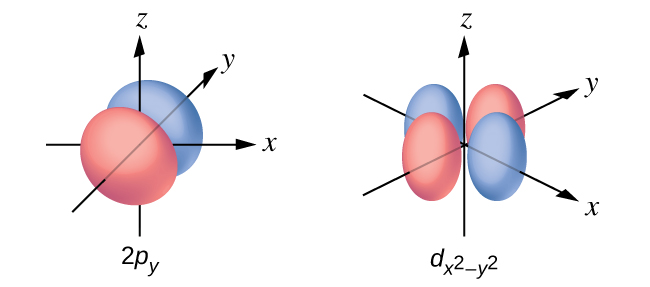
3-41 §3.3 source ↗
Consider the orbitals shown here in outline.
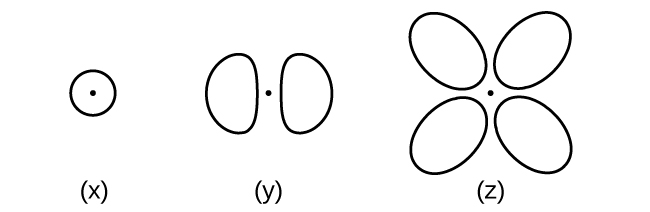
(a) What is the maximum number of electrons contained in an orbital of type (x)? Of type (y)? Of type (z)?
(b) How many orbitals of type (x) are found in a shell with n = 2? How many of type (y)? How many of type (z)?
(c) Write a set of quantum numbers for an electron in an orbital of type (x) in a shell with n = 4. Of an orbital of type (y) in a shell with n = 2. Of an orbital of type (z) in a shell with n = 3.
(d) What is the smallest possible n value for an orbital of type (x)? Of type (y)? Of type (z)?
(e) What are the possible l and ml values for an orbital of type (x)? Of type (y)? Of type (z)?
Answer
3-43 §3.3 source ↗
Answer
3-45 §3.3 source ↗
Answer
| n | l | ml | s |
|---|---|---|---|
| 4 | 0 | 0 | |
| 4 | 0 | 0 | |
| 4 | 1 | −1 | |
| 4 | 1 | 0 | |
| 4 | 1 | +1 | |
| 4 | 1 | −1 |
3-47 §3.4 source ↗
Answer
3-49 §3.4 source ↗
Using complete subshell notation (1s22s22p6, and so forth), predict the electron configuration of each of the following atoms:
(a) N
(b) Si
(c) Fe
(d) Te
(e) Tb
Answer
3-51 §3.4 source ↗
Answer
3-53 §3.4 source ↗
Use an orbital diagram to describe the electron configuration of the valence shell of each of the following atoms:
(a) N
(b) Si
(c) Fe
(d) Te
(e) Mo
Answer
(a)

(b)

(c)

(d)

(e)

3-55 §3.4 source ↗
Answer
3-57 §3.4 source ↗
Answer
3-59 §3.4 source ↗
Which of the following has two unpaired electrons?
(a) Mg
(b) Si
(c) S
(d) Both Mg and S
(e) Both Si and S.
Answer
3-61 §3.4 source ↗
Answer
3-63 §3.4 source ↗
Answer
3-65 §3.4 source ↗
Answer
3-67 §3.5 source ↗
Answer
3-69 §3.5 source ↗
Answer
3-71 §3.5 source ↗
Answer
3-73 §3.5 source ↗
Answer
3-75 §3.5 source ↗
Answer
3-77 §3.5 source ↗
Answer
3-79 §3.5 source ↗
Answer
3-81 §3.5 source ↗
Answer
3-83 §3.5 source ↗
Answer
3-85 §3.5 source ↗
Answer
3-87 §3.6 source ↗
Using the periodic table, classify each of the following elements as a metal or a nonmetal, and then further classify each as a main-group (representative) element, transition metal, or inner transition metal:
(a) uranium
(b) bromine
(c) strontium
(d) neon
(e) gold
(f) americium
(g) rhodium
(h) sulfur
(i) carbon
(j) potassium
Answer
3-89 §3.6 source ↗
Using the periodic table, identify the lightest member of each of the following groups:
(a) noble gases
(b) alkaline earth metals
(c) alkali metals
(d) chalcogens
Answer
3-91 §3.6 source ↗
Use the periodic table to give the name and symbol for each of the following elements:
(a) the noble gas in the same period as germanium
(b) the alkaline earth metal in the same period as selenium
(c) the halogen in the same period as lithium
(d) the chalcogen in the same period as cadmium
Answer
3-93 §3.6 source ↗
Write a symbol for each of the following neutral isotopes. Include the atomic number and mass number for each.
(a) the alkali metal with 11 protons and a mass number of 23
(b) the noble gas element with 75 neutrons in its nucleus and 54 electrons in the neutral atom
(c) the isotope with 33 protons and 40 neutrons in its nucleus
(d) the alkaline earth metal with 88 electrons and 138 neutrons
Answer
3-95 §3.7 source ↗
Answer
3-97 §3.7 source ↗
For each of the following compounds, state whether it is ionic or covalent. If it is ionic, write the symbols for the ions involved:
(a) NF3
(b) BaO,
(c) (NH4)2CO3
(d) Sr(H2PO4)2
(e) IBr
(f) Na2O
Answer
3-99 §3.7 source ↗
For each of the following pairs of ions, write the symbol for the formula of the compound they will form.
(a) Ca2+, S2−
(b)
(c) Al3+, Br−
(d) Na+,
(e) Mg2+,
Answer
Loading chapter 4…
Problems and answers are adapted from Chemistry: Atoms First 2e by Paul Flowers, Edward J. Neth, William R. Robinson, Klaus Theopold and Richard Langley, OpenStax, and are used under the CC BY-NC-SA 4.0 licence. Access for free at https://openstax.org/books/chemistry-atoms-first-2e/pages/1-introduction. Illustrations: Copyright Rice University, OpenStax, under CC BY-NC-SA 4.0 license. This adaptation is released under the same licence, is non-commercial, and is neither affiliated with nor endorsed by OpenStax or Rice University.