Every problem in the chapter beside the book’s answer, a chapter at a time as you scroll.

Chapter 19: Transition Metals and Coordination Chemistry

33 problems · 9 figures

Example 19.1 §19.1 source ↗

Give an example of an ion from the first transition series with no d electrons.

Answer

V5+ is one possibility. Other examples include Sc3+, Ti4+, Cr6+, and Mn7+.

Example 19.2 §19.1 source ↗

Predict what reaction (if any) will occur between HCl and Co(s), and between HBr and Pt(s). You will need to use the standard reduction potentials from Appendix L.

Answer

Co(s)+ 2HCl⟶ H2+ CoCl2(aq); no reaction because Pt(s) will not be oxidized by H+

Example 19.3 §19.1 source ↗

During the refining of iron, carbon must be present in the blast furnace. Why is carbon necessary to convert iron oxide into iron?

Answer

The carbon is converted into CO, which is the reducing agent that accepts electrons so that iron(III) can be reduced to iron(0).

Example 19.4 §19.2 source ↗

The complex potassium dicyanoargenate(I) is used to make antiseptic compounds. Give the formula and coordination number.

Answer

K[Ag(CN)2]; coordination number two

Example 19.5 §19.2 source ↗

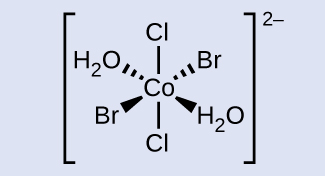
Draw the ion trans-diaqua-trans-dibromo-trans-dichlorocobalt(II).

Answer

The structure in this figure shows a structure inside brackets. A central C o atom is shown with line segments indicating bonds to C l atoms above and below the structure. Above and to the left, a dashed wedge with its vertex at the C o atom widening as it moves out from the atom indicates a bond with the O atom of a H subscript 2 O group. A second dashed wedge indicates a bond with the central C o atom with a B r atom up and to the right. Similarly, a solid wedge below and to the left indicates a bond with a B r atom. A second solid wedge below and to the right indicates a bond with the O atom of an H subscript 2 O group. This structure is enclosed in brackets. Outside the brackets to the right is the superscript 2 negative sign.

Example 19.6 §19.2 source ↗

Some alternative medicine practitioners recommend chelation treatments for ailments that are not clearly related to heavy metals, such as cancer and autism, although the practice is discouraged by many scientific organizations.1 Identify at least two biologically important metals that could be disrupted by chelation therapy.

Answer

Ca, Fe, Zn, and Cu

Example 19.7 §19.3 source ↗

The size of the crystal field splitting only influences the arrangement of electrons when there is a choice between pairing electrons and filling the higher-energy orbitals. For which d-electron configurations will there be a difference between high- and low-spin configurations in octahedral complexes?

Answer

d4, d5, d6, and d7

Example 19.8 §19.3 source ↗

Explain how many unpaired electrons a tetrahedral d4 ion will have.

Answer

4; because Δtet is small, all tetrahedral complexes are high spin and the electrons go into the t2 orbitals before pairing

Example 19.9 §19.3 source ↗

A complex that appears green, absorbs photons of what wavelengths?

Answer

red, 620–800 nm

19-1 §19.1 source ↗

Write the electron configurations for each of the following elements:

(a) Sc

(b) Ti

(c) Cr

(d) Fe

(e) Ru

Answer

(a) Sc: [Ar]4s23d1; (b) Ti: [Ar]4s23d2; (c) Cr: [Ar]4s13d5; (d) Fe: [Ar]4s23d6; (e) Ru: [Kr]5s24d6

19-3 §19.1 source ↗

Write the electron configurations for each of the following elements and its 3+ ions:

(a) La

(b) Sm

(c) Lu

Answer

(a) La: [Xe]6s25d1, La3+: [Xe]; (b) Sm: [Xe]6s24f6, Sm3+: [Xe]4f5; (c) Lu: [Xe]6s24f145d1, Lu3+: [Xe]4f14

19-5 §19.1 source ↗

Which of the following elements is most likely to be used to prepare La by the reduction of La2O3: Al, C, or Fe? Why?

Answer

Al is used because it is the strongest reducing agent and the only option listed that can provide sufficient driving force to convert La(III) into La.

19-7 §19.1 source ↗

Which of the following elements is most likely to form an oxide with the formula MO3: Zr, Nb, or Mo?

Answer

Mo

19-9 §19.1 source ↗

Why is the formation of slag useful during the smelting of iron?

Answer

The CaSiO3 slag is less dense than the molten iron, so it can easily be separated. Also, the floating slag layer creates a barrier that prevents the molten iron from exposure to O2, which would oxidize the Fe back to Fe2O3.

19-11 §19.1 source ↗

Iron(II) can be oxidized to iron(III) by dichromate ion, which is reduced to chromium(III) in acid solution. A 2.5000-g sample of iron ore is dissolved and the iron converted into iron(II). Exactly 19.17 mL of 0.0100 M Na2Cr2O7 is required in the titration. What percentage of the ore sample was iron?

Answer

2.57%

19-13 §19.1 source ↗

Find the potentials of the following electrochemical cell:

Cd | Cd2+, M = 0.10 ‖ Ni2+, M = 0.50 | Ni

Answer

0.167 V

19-15 §19.1 source ↗

The standard reduction potential for the reaction [Co(H2O)6]3+(aq)+ e−⟶ [Co(H2O)6]2+(aq) is about 1.8 V. The reduction potential for the reaction [Co(NH3)6]3+(aq)+ e−⟶ [Co(NH3)6]2+(aq) is +0.1 V. Calculate the cell potentials to show whether the complex ions, [Co(H2O)6]2+ and/or [Co(NH3)6]2+, can be oxidized to the corresponding cobalt(III) complex by oxygen.

Answer

E° = −0.6 V, E° is negative so this reduction is not spontaneous. E° = +1.1 V

19-17 §19.1 source ↗

Predict the products of each of the following reactions. (Note: In addition to using the information in this chapter, also use the knowledge you have accumulated at this stage of your study, including information on the prediction of reaction products.)

(a) Fe(s)+ H2SO4(aq)⟶

(b) FeCl3(aq)+ NaOH(aq)⟶

(c) Mn(OH)2(s)+ HBr(aq)⟶

(d) Cr(s)+ O2(g)⟶

(e) Mn2O3(s)+ HCl(aq)⟶

(f) Ti(s)+ xsF2(g)⟶

Answer

(a) Fe(s)+ 2H3O+(aq)+ SO42−(aq)⟶ Fe2+(aq)+ SO42−(aq)+ H2(g)+ 2H2O(l); (b) FeCl3(aq)+ 3Na+(aq)+ 3OH−(aq)⟶ Fe(OH)3(s)+ 3Na+(aq)+ 3Cl+(aq); (c) Mn(OH)2(s)+ 2H3O+(aq)+ 2Br−(aq)⟶ Mn2+(aq)+ 2Br−(aq)+ 4H2O(l); (d) 4Cr(s)+ 3O2(g)⟶ 2Cr2O3(s); (e) Mn2O3(s)+ 6H3O+(aq)+ 6Cl−(aq)⟶ 2MnCl3(s)+ 9H2O(l); (f) Ti(s)+ xsF2(g)⟶ TiF4(g)

19-19 §19.1 source ↗

Predict the products of the following reactions and balance the equations.

(a) Zn is added to a solution of Cr2(SO4)3 in acid.

(b) FeCl2 is added to a solution containing an excess of Cr2O72− in hydrochloric acid.

(c) Cr2+ is added to Cr2O72− in acid solution.

(d) Mn is heated with CrO3.

(e) CrO is added to 2HNO3 in water.

(f) FeCl3 is added to an aqueous solution of NaOH.

Answer

(a) Cr2(SO4)3(aq)+ 2Zn(s)+ 2H3O+(aq)⟶ 2Zn2+(aq)+ H2(g)+ 2H2O(l)+ 2Cr2+(aq)+ 3SO42−(aq); (b) 4TiCl3(s)+ CrO42−(aq)+ 8H+(aq)⟶ 4Ti4+(aq)+ Cr(s)+ 4H2O(l)+ 12Cl−(aq); (c) In acid solution between pH 2 and pH 6, CrO42− forms HCrO4−, which is in equilibrium with dichromate ion. The reaction is 2HCrO4−(aq)⟶ Cr2O72−(aq)+ H2O(l). At other acidic pHs, the reaction is 3Cr2+(aq)+ CrO42−(aq)+ 8H3O+(aq)⟶ 4Cr3+(aq)+ 12H2O(l); (d) 8CrO3(s)+ 9Mn(s)⟶Δ4Cr2O3(s)+ 3Mn3O4(s); (e) CrO(s)+ 2H3O+(aq)+ 2NO3−(aq)⟶ Cr2+(aq)+ 2NO3−(aq)+ 3H2O(l); (f) CrCl3(s)+ 3NaOH(aq)⟶ Cr(OH)3(s)+ 3Na+(aq)+ 3Cl−(aq)

19-21 §19.1 source ↗

Predict the products of each of the following reactions and then balance the chemical equations.

(a) Fe is heated in an atmosphere of steam.

(b) NaOH is added to a solution of Fe(NO3)3.

(c) FeSO4 is added to an acidic solution of KMnO4.

(d) Fe is added to a dilute solution of H2SO4.

(e) A solution of Fe(NO3)2 and HNO3 is allowed to stand in air.

(f) FeCO3 is added to a solution of HClO4.

(g) Fe is heated in air.

Answer

(a) 3Fe(s)+ 4H2O(g)⟶ Fe3O4(s)+ 4H2(g); (b) 3NaOH(aq)+ Fe(NO3)3(aq)→H2OFe(OH)3(s)+ 3Na+(aq)+ 3NO3−(aq); (c) MnO4−+ 5Fe2++ 8H+⟶ Mn2++ 5Fe3+ 4H2O; (d) Fe(s)+ 2H3O+(aq)+ SO42−(aq)⟶ Fe2+(aq)+ SO42−(aq)+ H2(g)+ 2H2O(l); (e) 4Fe2+(aq)+ O2(g)+ 4HNO3(aq)⟶ 4Fe3+(aq)+ 2H2O(l)+ 4NO3−(aq); (f) FeCO3(s)+ 2HClO4(aq)⟶ Fe(ClO4)2(aq)+ H2O(l)+ CO2(g); (g) 3Fe(s)+ 2O2(g)⟶ΔFe3O4(s)

19-23 §19.1 source ↗

Dilute sodium cyanide solution is slowly dripped into a slowly stirred silver nitrate solution. A white precipitate forms temporarily but dissolves as the addition of sodium cyanide continues. Use chemical equations to explain this observation. Silver cyanide is similar to silver chloride in its solubility.

Answer

As CN− is added,
Ag+(aq)+ CN−(aq)⟶ AgCN(s)
As more CN− is added,
Ag+(aq)+2CN−(aq)⟶[Ag(CN)2]−(aq)AgCN(s)+CN−(aq)⟶[Ag(CN)2]−(aq)

19-25 §19.1 source ↗

Give the oxidation state of the metal for each of the following oxides of the first transition series. (Hint: Oxides of formula M3O4 are examples of mixed valence compounds in which the metal ion is present in more than one oxidation state. It is possible to write these compound formulas in the equivalent format MO·M2O3, to permit estimation of the metal’s two oxidation states.)

(a) Sc2O3

(b) TiO2

(c) V2O5

(d) CrO3

(e) MnO2

(f) Fe3O4

(g) Co3O4

(h) NiO

(i) Cu2O

Answer

(a) Sc3+; (b) Ti4+; (c) V5+; (d) Cr6+; (e) Mn4+; (f) Fe2+ and Fe3+; (g) Co2+ and Co3+; (h) Ni2+; (i) Cu+

19-27 §19.2 source ↗

Give the coordination numbers and write the formulas for each of the following, including all isomers where appropriate:

(a) tetrahydroxozincate(II) ion (tetrahedral)

(b) hexacyanopalladate(IV) ion

(c) dichloroaurate(I) ion (note that aurum is Latin for "gold")

(d) diamminedichloroplatinum(II)

(e) potassium diamminetetrachlorochromate(III)

(f) hexaamminecobalt(III) hexacyanochromate(III)

(g) dibromobis(ethylenediamine) cobalt(III) nitrate

Answer

(a) 4, [Zn(OH)4]2−; (b) 6, [Pd(CN)6]2−; (c) 2, [AuCl2]−; (d) 4, [Pt(NH3)2Cl2]; (e) 6, K[Cr(NH3)2Cl4]; (f) 6, [Co(NH3)6][Cr(CN)6]; (g) 6, [Co(en)2Br2]NO3

19-29 §19.2 source ↗

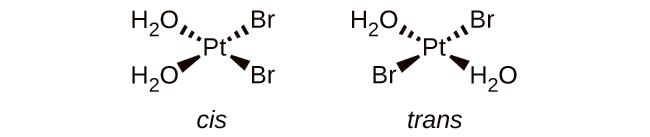
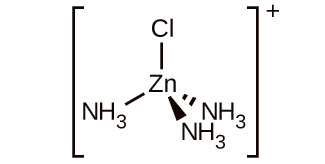
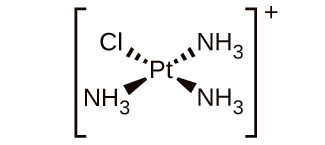
Sketch the structures of the following complexes. Indicate any cis, trans, and optical isomers.

(a) [Pt(H2O)2Br2] (square planar)

(b) [Pt(NH3)(py)(Cl)(Br)] (square planar, py = pyridine, C5H5N)

(c) [Zn(NH3)3Cl]+ (tetrahedral)

(d) [Pt(NH3)3Cl]+ (square planar)

(e) [Ni(H2O)4Cl2]

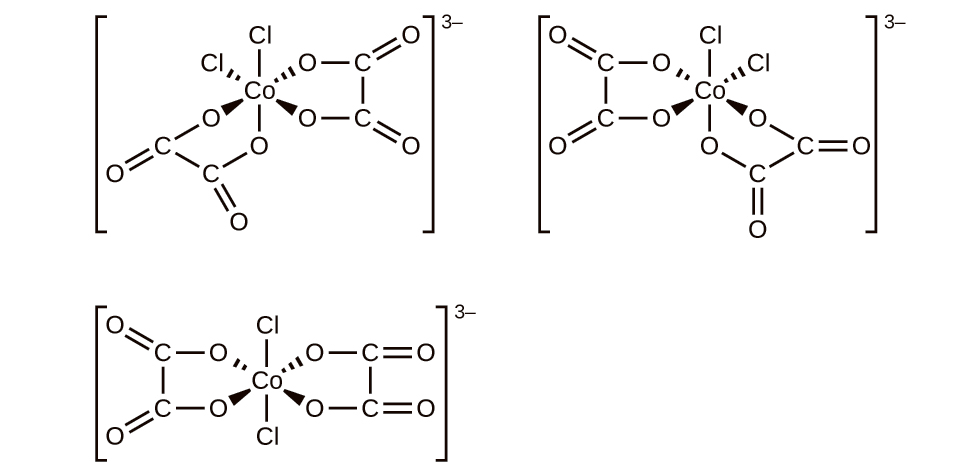
(f) [Co(C2O4)2Cl2]3− (note that C2O42− is the bidentate oxalate ion, −O2CCO2−)

Answer

(a) [Pt(H2O)2Br2]:

Two structures are shown. At the center of each is a P t atom. The structure on the left is labeled, “cis.” From this atom, a single bond represented by a dashed wedge extends from a vertex at the P t atom up and to the right to a B r atom. Similarly, a single bond represented by a solid wedge extends from a vertex at the P t atom down and to the right to a second B r atom. Another single bond represented by a dashed wedge extends from a vertex at the P t atom up and to the left to the O atom of an H subscript 2 O group. Similarly, a single bond represented by a solid wedge extends from a vertex at the P t atom down and to the left to a second O atom of an H subscript 2 O group. The structure on the right is labeled, “trans.” From the central P t atom, a single bond represented by a dashed wedge extends from a vertex at the P t atom up and to the right to a B r atom. Similarly, a single bond represented by a solid wedge extends from a vertex at the P t atom down and to the right to the O atom of an H subscript 2 O group. Another single bond represented by a dashed wedge extends from a vertex at the P t atom up and to the left to the O atom of a second H subscript 2 O group. Similarly, a single bond represented by a solid wedge extends from a vertex at the P t atom down and to the left to a second B r atom.;


(b) [Pt(NH3)(py)(Cl)(Br)]:

Three structures are shown. At the center of each is a P t atom. From this atom in the first structure on the left, a single bond represented by a dashed wedge extends from a vertex at the P t atom up and to the right to a C l atom. Similarly, a single bond represented by a solid wedge extends from a vertex at the P t atom down and to the right to the N atom of an N H subscript 3 group. Another single bond represented by a dashed wedge extends from a vertex at the P t atom up and to the left to a B r atom. Similarly, a single bond represented by a solid wedge extends from a vertex at the P t atom down and to the left to p y. The middle structure shows a single bond represented by a dashed wedge extending from a vertex at the P t atom up and to the right to a B r atom. Similarly, a single bond represented by a solid wedge extends from a vertex at the P t atom down and to the right to the N atom of an N H subscript 3 group. Another single bond represented by a dashed wedge extends from a vertex at the P t atom up and to the left to p y. Similarly, a single bond represented by a solid wedge extends from a vertex at the P t atom down and to the left to a to a C l atom. The third structure shows a single bond represented by a dashed wedge extending from a vertex at the P t atom up and to the right to p y. Similarly, a single bond represented by a solid wedge extends from a vertex at the P t atom down and to the right to the N atom of an N H subscript 3 group. Another single bond represented by a dashed wedge extends from a vertex at the P t atom up and to the left to a C l atom. Similarly, a single bond represented by a solid wedge extends from a vertex at the P t atom down and to the left to a B r atom.;


(c) [Zn(NH3)3Cl]+ :

Inside of brackets, a central Z n atom is bonded to a C l atom and three N atoms in N H subscript 3 groups in a tetrahedral spatial arrangement. Short line segments are used to represent a bond extending above to the C l atom and down and to the left to the N of the N H subscript 3 group from the Z n atom. A dashed wedge with the vertex at the Z n atom and wide end at the N atom of an N H subscript 3 group is used to represent a bond down and to the right of the Z n atom. The final bond is indicated by a similar solid wedge again directed down and only slightly right of center beneath the Z n atom to the N of an N H subscript 3 group. Outside the brackets a superscript plus sign is shown.;


(d) [Pt(NH3)3Cl]+ :

This structure shows a single bond represented by a dashed wedge extending from a vertex at the P t atom up and to the right to the N atom of an N H subscript 3 group. Similarly, two single bonds represented by solid wedges extend from vertices at the P t atom down and to the right and down and to the left to the N atoms of N H subscript 3 groups. Another single bond represented by a dashed wedge extends from a vertex at the P t atom up and to the left to a C l atom. This structure is enclosed in brackets with superscript plus sign appearing to the right of the brackets.;


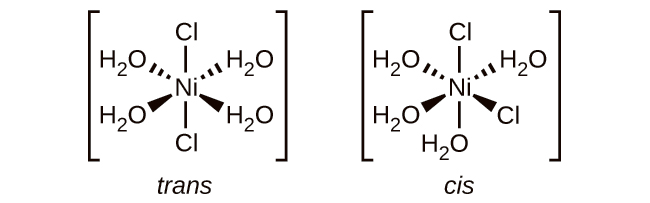
(e) [Ni(H2O)4Cl2]:

Two structures are shown. The first is labeled, “trans.” Below this label inside brackets is a central N i atom. From the N i atom, line segments indicate bonds to C l atoms above and below. Above and to both the right and left, dashed wedges with their vertex at the N i atom widening as they move out from the atom indicate bonds with O atoms of H subscript 2 O groups. Similarly, solid wedges below to both the right and left indicate bonds to the O atoms of H subscript 2 O groups. This structure is enclosed in brackets. The second structure is labeled, “cis.” Inside brackets is a central N i atom. From the N i atom, line segments indicate bonds to a C l atom above and the O atom of an H subscript 2 O group below. Above and to both the right and left, dashed wedges indicate bonds with O atoms of H subscript 2 O groups. Similarly, a solid wedge below to the right indicates a bond with a C l atom and a solid wedge to the lower left indicates a bond to the O atoms of an H subscript 2 O group. This structure is also enclosed in brackets.;


(f) [Co(C2O4)2Cl2]3−:

This figure includes three structures. The first structure includes a central C o atom that has four O atoms and two C l atoms attached with single bonds. These bonds are indicated with line segments extending above and below, dashed wedges extending up and to the left and right, and solid wedges extending below and to the left and right. C l atoms are bonded at the top and at the upper left of the structure. The remaining four bonds extend from the central C o atom to O atoms. The O atoms are each connected to C atoms which are each connected with double bonds to O atoms extending outward from the central C o atom. These C atoms are connected in pairs with bonds indicated by short line segments, forming two rings in the structure. This entire structure is enclosed in brackets. Outside the brackets to the right is a superscript 3 negative sign. The second structure, which appears to the be mirror image of the first structure, includes a central C o atom that has four O atoms and two C l atoms attached with single bonds. These bonds are indicated with line segments extending above and below, dashed wedges extending up and to the left and right, and solid wedges extending below and to the left and right. C l atoms are bonded at the top and at the upper right of the structure. The remaining four bonds extend from the central C o atom to O atoms. The O atoms are each connected to C atoms which are each connected with double bonds to O atoms extending outward from the central C o atom. These C atoms are connected in pairs with bonds indicated by short line segments, forming two rings in the structure. This entire structure is enclosed in brackets. Outside the brackets to the right is the superscript 3 negative sign. The third structure includes a central C o atom that has four O atoms and two C l atoms attached with single bonds. These bonds are indicated with line segments extending above and below, dashed wedges extending up and to the left and right, and solid wedges extending below and to the left and right. C l atoms are bonded at the top and bottom of the structure. The remaining four bonds extend from the central C o atom to the O atoms. The O atoms are each connected to C atoms which are in turn each double bonded to O atoms extending outward from the central C o atom. These C atoms are connected in pairs with bonds indicated by short line segments, forming two rings in the structure. This entire structure is enclosed in brackets. Outside the brackets, to the right, is a superscript 3 negative sign. This final structure has rings of atoms on opposite sides of the structure.

19-31 §19.2 source ↗

Name each of the compounds or ions given in Exercise 19.28, including the oxidation state of the metal.

Answer

(a) tricarbonatocobaltate(III) ion; (b) tetraaminecopper(II) ion; (c) tetraaminedibromocobalt(III) sulfate; (d) tetraamineplatinum(II) tetrachloroplatinate(II); (e) tris-(ethylenediamine)chromium(III) nitrate; (f) diaminedibromopalladium(II); (g) potassium pentachlorocuprate(II); (h) diaminedichlorozinc(II)

19-33 §19.2 source ↗

Specify whether the following complexes have isomers.

(a) tetrahedral [Ni(CO)2(Cl)2]

(b) trigonal bipyramidal [Mn(CO)4NO]

(c) [Pt(en)2Cl2]Cl2

Answer

(a) none; (b) none; (c) The two Cl ligands can be cis or trans. When they are cis, there will also be an optical isomer.

19-35 §19.2 source ↗

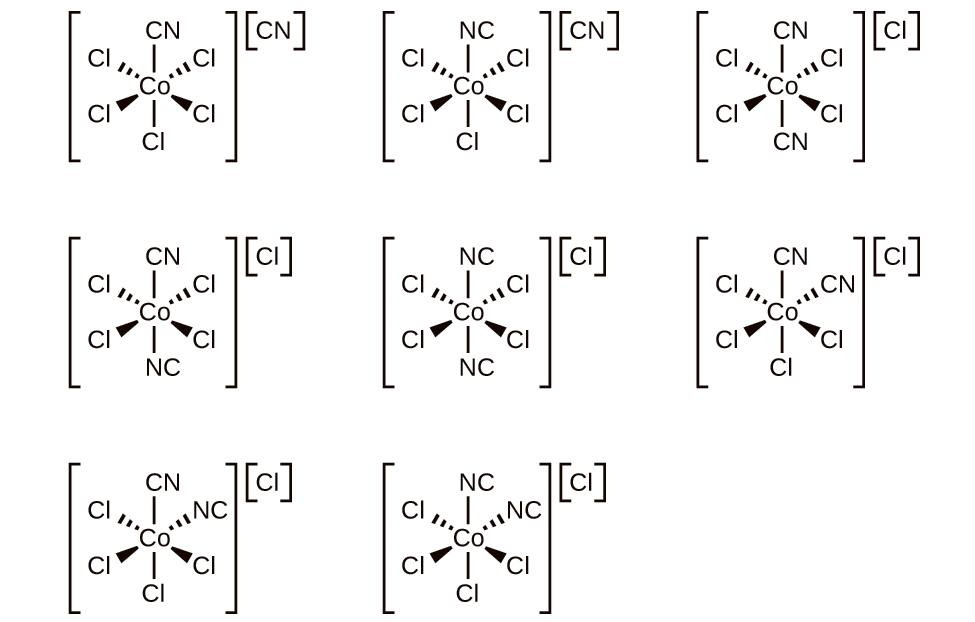
Draw the geometric, linkage, and ionization isomers for [CoCl5CN][CN].

Answer

This figure shows eight structures, each inside brackets in three rows. The first row contains three structures, the second row contains three structures, and the third row contains two structures. These structures are described in increasing order moving left to right and top to bottom in the figure. Each includes a central C o atom with line segments indicating bonds above and below the central atom. Above and to both the left and right, dashed wedges with vertices at the C o atom widening as they move out from the atom indicates single bonds. Similarly, solid wedges below and to both the left and right indicate single bonds. Outside each structure in brackets, to the right, an element or group is identified in brackets as a superscript. In the first structure, the C atom of a C N group is bonded to the C o atom. All 5 remaining bonds are with C l atoms. C N appears in brackets as a superscript outside the structure. In the second structure, the N atom of a C N group is bonded to the C o atom. All 5 remaining bonds are with C l atoms. C N appears in brackets as a superscript outside the structure. In the third structure, the C atom of two C N groups are bonded to the C o atom at the top and bottom of the structure. All 4 remaining bonds are with C l atoms. C l appears in brackets as a superscript outside the structure. In the fourth structure, the C atom of a C N groups is bonded to the C o atom at the top and the N atom of a C N group which is bonded at the bottom of the structure. All 4 remaining bonds are with C l atoms. C l appears in brackets as a superscript outside the structure. In the fifth structure, the N atom of two C N groups are bonded to the C o atom at the top and bottom of the structure. All 4 remaining bonds are with C l atoms. C l appears in brackets as a superscript outside the structure. In the sixth structure, the C atom of two C N groups are bonded to the C o atom at the top and upper right of the structure. All 4 remaining bonds are with C l atoms. C l appears in brackets as a superscript outside the structure. In the seventh structure, the C atom of a C N group is bonded to the C o atom at the top of the structure and the N atom of a C N group is bonded at the upper right of the structure. All 4 remaining bonds are with C l atoms. C l appears in brackets as a superscript outside the structure. In the eighth structure, the N atom of two C N groups are bonded to the C o atom at the top and upper right of the structure. All 4 remaining bonds are with C l atoms. C l appears in brackets as a superscript outside the structure.

19-37 §19.3 source ↗

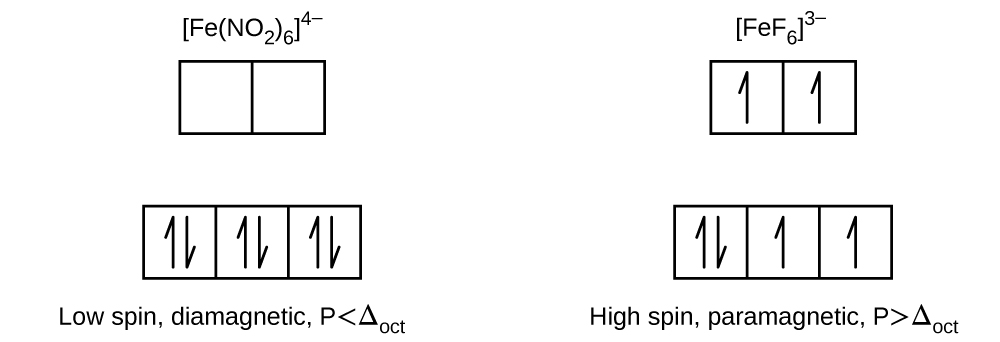
Draw the crystal field diagrams for [Fe(NO2)6]4− and [FeF6]3−. State whether each complex is high spin or low spin, paramagnetic or diamagnetic, and compare Δoct to P for each complex.

Answer


A diagram is shown with two columns and two rows of squares outlined in yellow. The first column is labeled “[ F e ( N O subscript 2 ) subscript 6 ] superscript 4 negative sign.” The second is labeled, “[ F e F subscript 6 ] superscript 3 negative sign.” In the left column, three linked squares outlined in yellow are shown. Each of the squares contains two half arrows, one pointing up and one pointing down. In a row just above, two empty linked squares are shown. The label, “Low spin, diamagnetic, P less than capital delta subscript oct,” is provided below the column. In the right column, three linked squares outlined in yellow are shown. The square on the left contains two half arrows, one pointing up and one pointing down. The other two squares each contain a single upward pointing half arrow. In a row just above, two linked squares are shown which each contain a single upward pointing half arrow. The label, “High spin, paramagnetic, P greater than capital delta subscript oct,” is provided below the column.

19-39 §19.3 source ↗

The anhydrous solid CoCl2 is blue in color. Because it readily absorbs water from the air, it is used as a humidity indicator to monitor if equipment (such as a cell phone) has been exposed to excessive levels of moisture. Predict what product is formed by this reaction, and how many unpaired electrons this complex will have.

Answer

[Co(H2O)6]Cl2 with three unpaired electrons.

19-41 §19.3 source ↗

How many unpaired electrons are present in each of the following?

(a) [CoF6]3− (high spin)

(b) [Mn(CN)6]3− (low spin)

(c) [Mn(CN)6]4− (low spin)

(d) [MnCl6]4− (high spin)

(e) [RhCl6]3− (low spin)

Answer

(a) 4; (b) 2; (c) 1; (d) 5; (e) 0

19-43 §19.3 source ↗

For complexes of the same metal ion with no change in oxidation number, the stability increases as the number of electrons in the t2g orbitals increases. Which complex in each of the following pairs of complexes is more stable?

(a) [Fe(H2O)6]2+ or [Fe(CN)6]4−

(b) [Co(NH3)6]3+ or [CoF6]3−

(c) [Mn(CN)6]4− or [MnCl6]4−

Answer

(a) [Fe(CN)6]4−; (b) [Co(NH3)6]3+; (c) [Mn(CN)6]4−

19-45 §19.3 source ↗

Would you expect the complex [Co(en)3]Cl3 to have any unpaired electrons? Any isomers?

Answer

The complex does not have any unpaired electrons. The complex does not have any geometric isomers, but the mirror image is nonsuperimposable, so it has an optical isomer.

19-47 §19.3 source ↗

Would you expect salts of the gold(I) ion, Au+, to be colored? Explain.

Answer

No. Au+ has a complete 5d sublevel.

Loading chapter 20…

Problems and answers are adapted from Chemistry: Atoms First 2e by Paul Flowers, Edward J. Neth, William R. Robinson, Klaus Theopold and Richard Langley, OpenStax, and are used under the CC BY-NC-SA 4.0 licence. Access for free at https://openstax.org/books/chemistry-atoms-first-2e/pages/1-introduction. Illustrations: Copyright Rice University, OpenStax, under CC BY-NC-SA 4.0 license. This adaptation is released under the same licence, is non-commercial, and is neither affiliated with nor endorsed by OpenStax or Rice University.