Every problem in the chapter beside the book’s answer, a chapter at a time as you scroll.

Chapter 6: Composition of Substances and Solutions

46 problems · 4 figures

Example 6.1 §6.1 source ↗

Acetaminophen, C8H9NO2, is a covalent compound and the active ingredient in several popular nonprescription pain medications, such as Tylenol. What is the molecular mass (amu) for this compound?

Answer

151.16 amu

Example 6.2 §6.1 source ↗

Calcium phosphate, Ca3(PO4)2, is an ionic compound and a common anti-caking agent added to food products. What is the formula mass (amu) of calcium phosphate?

Answer

310.18 amu

Example 6.3 §6.2 source ↗

A 24.81-g sample of a gaseous compound containing only carbon, oxygen, and chlorine is determined to contain 3.01 g C, 4.00 g O, and 17.81 g Cl. What is this compound’s percent composition?

Answer

12.1% C, 16.1% O, 71.79% Cl

Example 6.4 §6.2 source ↗

To three significant digits, what is the mass percentage of iron in the compound Fe2O3?

Answer

69.9% Fe

Example 6.5 §6.2 source ↗

What is the empirical formula of a compound if a sample contains 0.130 g of nitrogen and 0.370 g of oxygen?

Answer

N2O5

Example 6.6 §6.2 source ↗

What is the empirical formula of a compound containing 40.0% C, 6.71% H, and 53.28% O?

Answer

CH2O

Example 6.7 §6.2 source ↗

What is the molecular formula of a compound with a percent composition of 49.47% C, 5.201% H, 28.84% N, and 16.48% O, and a molecular mass of 194.2 amu?

Answer

C8H10N4O2

Example 6.8 §6.3 source ↗

A teaspoon of table sugar contains about 0.01 mol sucrose. What is the molarity of sucrose if a teaspoon of sugar has been dissolved in a cup of tea with a volume of 200 mL?

Answer

0.05 M

Example 6.9 §6.3 source ↗

What volume (mL) of the sweetened tea described in Example 6.8 contains the same amount of sugar (mol) as 10 mL of the soft drink in this example?

Answer

80 mL

Example 6.10 §6.3 source ↗

Calculate the molarity of 6.52 g of CoCl2 (128.9 g/mol) dissolved in an aqueous solution with a total volume of 75.0 mL.

Answer

0.674 M

Example 6.11 §6.3 source ↗

How many grams of CaCl2 (110.98 g/mol) are contained in 250.0 mL of a 0.200-M solution of calcium chloride?

Answer

5.55 g CaCl2

Example 6.12 §6.3 source ↗

What volume of a 1.50-M KBr solution contains 66.0 g KBr?

Answer

0.370 L

Example 6.13 §6.3 source ↗

What is the concentration of the solution that results from diluting 25.0 mL of a 2.04-M solution of CH3OH to 500.0 mL?

Answer

0.102 M CH3OH

Example 6.14 §6.3 source ↗

A laboratory experiment calls for 0.125 M HNO3. What volume of 0.125 M HNO3 can be prepared from 0.250 L of 1.88 M HNO3?

Answer

3.76 L

Example 6.15 §6.3 source ↗

What volume of a 0.575-M solution of glucose, C6H12O6, can be prepared from 50.00 mL of a 3.00-M glucose solution?

Answer

0.261 L

Example 6.16 §6.4 source ↗

A bottle of a tile cleanser contains 135 g of HCl and 775 g of water. What is the percent by mass of HCl in this cleanser?

Answer

14.8%

Example 6.17 §6.4 source ↗

What volume of concentrated HCl solution contains 125 g of HCl?

Answer

282 mL

Example 6.18 §6.4 source ↗

Wine is approximately 12% ethanol (CH3CH2OH) by volume. Ethanol has a molar mass of 46.06 g/mol and a density 0.789 g/mL. How many moles of ethanol are present in a 750-mL bottle of wine?

Answer

1.5 mol ethanol

Example 6.19 §6.4 source ↗

A 50.0-g sample of industrial wastewater was determined to contain 0.48 mg of mercury. Express the mercury concentration of the wastewater in ppm and ppb units.

Answer

9.6 ppm, 9600 ppb

6-1 §6.1 source ↗

What is the total mass (amu) of carbon in each of the following molecules?

(a) CH4

(b) CHCl3

(c) C12H10O6

(d) CH3CH2CH2CH2CH3

Answer

(a) 12.01 amu; (b) 12.01 amu; (c) 144.12 amu; (d) 60.05 amu

6-3 §6.1 source ↗

Calculate the molecular or formula mass of each of the following:

(a) P4

(b) H2O

(c) Ca(NO3)2

(d) CH3CO2H (acetic acid)

(e) C12H22O11 (sucrose, cane sugar)

Answer

(a) 123.896 amu; (b) 18.015 amu; (c) 164.086 amu; (d) 60.052 amu; (e) 342.297 amu

6-5 §6.1 source ↗

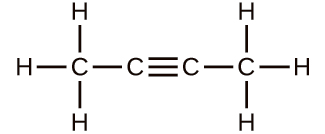
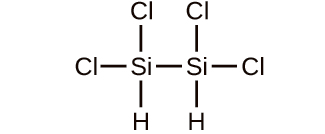
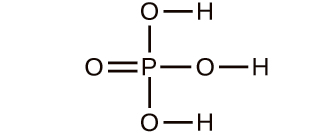
Determine the molecular mass of the following compounds:

(a)
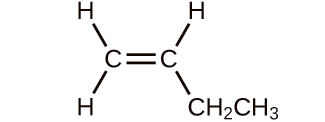
A structure is shown. Two C atoms form double bonds with each other. The C atom on the left forms a single bond with two H atoms each. The C atom on the right forms a single bond with an H atom and with a C H subscript 2 C H subscript 3 group.

(b)

A structure is shown. There is a C atom which forms single bonds with three H atoms each. This C atom is bonded to another C atom. This second C atom forms a triple bond with another C atom which forms a single bond with a fourth C atom. The fourth C atom forms single bonds with three H atoms each.

(c)

A structure is shown. An S i atom forms a single bond with a C l atom, a single bond with a C l atom, a single bond with an H atom, and a single bond with another S i atom. The second S i atom froms a single bond with a C l atom, a single bond with a C l atom, and a single bond with an H atom.

(d)

A structure is shown. A P atom forms a double bond with an O atom. It also forms a single bond with an O atom which forms a single bond with an H atom. It also forms a single bond with another O atom which forms a single bond with an H atom. It also forms a single bond with another O atom which forms a single bond with an H atom.

Answer

(a) 56.107 amu;
(b) 54.091 amu;
(c) 199.9976 amu;
(d) 97.9950 amu

6-8 §6.2 source ↗

Calculate the following to four significant figures:

(a) the percent composition of ammonia, NH3

(b) the percent composition of photographic fixer solution “hypo,” Na2S2O3

(c) the percent of calcium ion in Ca3(PO4)2

Answer

(a) % N = 82.24%
% H = 17.76%;
(b) % Na = 29.08%
% S = 40.56%
% O = 30.36%;
(c) % Ca2+ = 38.76%

6-10 §6.2 source ↗

Determine the percent ammonia, NH3, in Co(NH3)6Cl3, to three significant figures.

Answer

% NH3 = 38.2%

6-12 §6.2 source ↗

Determine the empirical formulas for compounds with the following percent compositions:

(a) 15.8% carbon and 84.2% sulfur

(b) 40.0% carbon, 6.7% hydrogen, and 53.3% oxygen

Answer

(a) CS2
(b) CH2O

6-14 §6.2 source ↗

A compound of carbon and hydrogen contains 92.3% C and has a molar mass of 78.1 g/mol. What is its molecular formula?

Answer

C6H6

6-16 §6.2 source ↗

Determine the empirical and molecular formula for chrysotile asbestos. Chrysotile has the following percent composition: 28.03% Mg, 21.60% Si, 1.16% H, and 49.21% O. The molar mass for chrysotile is 520.8 g/mol.

Answer

Mg3Si2H3O8 (empirical formula), Mg6Si4H6O16 (molecular formula)

6-18 §6.2 source ↗

A major textile dye manufacturer developed a new yellow dye. The dye has a percent composition of 75.95% C, 17.72% N, and 6.33% H by mass with a molar mass of about 240 g/mol. Determine the molecular formula of the dye.

Answer

C15H15N3

6-20 §6.3 source ↗

What information is needed to calculate the molarity of a sulfuric acid solution?

Answer

We need to know the number of moles of sulfuric acid dissolved in the solution and the volume of the solution.

6-22 §6.3 source ↗

Determine the molarity for each of the following solutions:

(a) 0.444 mol of CoCl2 in 0.654 L of solution

(b) 98.0 g of phosphoric acid, H3PO4, in 1.00 L of solution

(c) 0.2074 g of calcium hydroxide, Ca(OH)2, in 40.00 mL of solution

(d) 10.5 kg of Na2SO4·10H2O in 18.60 L of solution

(e) 7.0 × 10⁻³ mol of I2 in 100.0 mL of solution

(f) 1.8 × 10⁴ mg of HCl in 0.075 L of solution

Answer

(a) 0.679 M; (b) 1.00 M; (c) 0.06998 M; (d) 1.75 M; (e) 0.070 M; (f) 6.6 M

6-24 §6.3 source ↗

Consider this question: What is the mass of the solute in 0.500 L of 0.30 M glucose, C6H12O6, used for intravenous injection?

(a) Outline the steps necessary to answer the question.

(b) Answer the question.

Answer

(a) determine the number of moles of glucose in 0.500 L of solution; determine the molar mass of glucose; determine the mass of glucose from the number of moles and its molar mass; (b) 27 g

6-26 §6.3 source ↗

Calculate the number of moles and the mass of the solute in each of the following solutions:

(a) 2.00 L of 18.5 M H2SO4, concentrated sulfuric acid

(b) 100.0 mL of 3.8 × 10⁻⁶ M NaCN, the minimum lethal concentration of sodium cyanide in blood serum

(c) 5.50 L of 13.3 M H2CO, the formaldehyde used to “fix” tissue samples

(d) 325 mL of 1.8 × 10⁻⁶ M FeSO4, the minimum concentration of iron sulfate detectable by taste in drinking water

Answer

(a) 37.0 mol H2SO4, 3.63 × 10³ g H2SO4; (b) 3.8 × 10⁻⁷ mol NaCN, 1.9 × 10⁻⁵ g NaCN; (c) 73.2 mol H2CO, 2.20 kg H2CO; (d) 5.9 × 10⁻⁷ mol FeSO4, 8.9 × 10⁻⁵ g FeSO4

6-28 §6.3 source ↗

Consider this question: What is the molarity of KMnO4 in a solution of 0.0908 g of KMnO4 in 0.500 L of solution?

(a) Outline the steps necessary to answer the question.

(b) Answer the question.

Answer

(a) Determine the molar mass of KMnO4; determine the number of moles of KMnO4 in the solution; from the number of moles and the volume of solution, determine the molarity; (b) 1.15 × 10⁻³ M

6-30 §6.3 source ↗

Calculate the molarity of each of the following solutions:

(a) 0.195 g of cholesterol, C27H46O, in 0.100 L of serum, the average concentration of cholesterol in human serum

(b) 4.25 g of NH3 in 0.500 L of solution, the concentration of NH3 in household ammonia

(c) 1.49 kg of isopropyl alcohol, C3H7OH, in 2.50 L of solution, the concentration of isopropyl alcohol in rubbing alcohol

(d) 0.029 g of I2 in 0.100 L of solution, the solubility of I2 in water at 20 °C

Answer

(a) 5.04 × 10⁻³ M; (b) 0.499 M; (c) 9.92 M; (d) 1.1 × 10⁻³ M

6-32 §6.3 source ↗

There is about 1.0 g of calcium, as Ca2+, in 1.0 L of milk. What is the molarity of Ca2+ in milk?

Answer

0.025 M

6-34 §6.3 source ↗

If 0.1718 L of a 0.3556-M C3H7OH solution is diluted to a concentration of 0.1222 M, what is the volume of the resulting solution?

Answer

0.5000 L

6-36 §6.3 source ↗

What volume of a 0.33-M C12H22O11 solution can be diluted to prepare 25 mL of a solution with a concentration of 0.025 M?

Answer

1.9 mL

6-38 §6.3 source ↗

What is the molarity of the diluted solution when each of the following solutions is diluted to the given final volume?

(a) 1.00 L of a 0.250-M solution of Fe(NO3)3 is diluted to a final volume of 2.00 L

(b) 0.5000 L of a 0.1222-M solution of C3H7OH is diluted to a final volume of 1.250 L

(c) 2.35 L of a 0.350-M solution of H3PO4 is diluted to a final volume of 4.00 L

(d) 22.50 mL of a 0.025-M solution of C12H22O11 is diluted to 100.0 mL

Answer

(a) 0.125 M; (b) 0.04888 M; (c) 0.206 M; (d) 0.0056 M

6-40 §6.3 source ↗

A 2.00-L bottle of a solution of concentrated HCl was purchased for the general chemistry laboratory. The solution contained 868.8 g of HCl. What is the molarity of the solution?

Answer

11.9 M

6-42 §6.3 source ↗

What volume of a 0.20-M K2SO4 solution contains 57 g of K2SO4?

Answer

1.6 L

6-44 §6.4 source ↗

Consider this question: What mass of a concentrated solution of nitric acid (68.0% HNO3 by mass) is needed to prepare 400.0 g of a 10.0% solution of HNO3 by mass?

(a) Outline the steps necessary to answer the question.

(b) Answer the question.

Answer

(a) The dilution equation can be used, appropriately modified to accommodate mass-based concentration units: %mass1×mass1= %mass2×mass2. This equation can be rearranged to isolate mass1 and the given quantities substituted into this equation. (b) 58.8 g

6-46 §6.4 source ↗

What mass of solid NaOH (97.0% NaOH by mass) is required to prepare 1.00 L of a 10.0% solution of NaOH by mass? The density of the 10.0% solution is 1.109 g/mL.

Answer

114 g

6-48 §6.4 source ↗

The hardness of water (hardness count) is usually expressed in parts per million (by mass) of CaCO3, which is equivalent to milligrams of CaCO3 per liter of water. What is the molar concentration of Ca2+ ions in a water sample with a hardness count of 175 mg CaCO3/L?

Answer

1.75 × 10⁻³ M

6-50 §6.4 source ↗

In Canada and the United Kingdom, devices that measure blood glucose levels provide a reading in millimoles per liter. If a measurement of 5.3 mM is observed, what is the concentration of glucose (C6H12O6) in mg/dL?

Answer

95 mg/dL

6-52 §6.4 source ↗

Copper(I) iodide (CuI) is often added to table salt as a dietary source of iodine. How many moles of CuI are contained in 1.00 lb (454 g) of table salt containing 0.0100% CuI by mass?

Answer

2.38 × 10⁻⁴ mol

6-54 §6.4 source ↗

D5W is a solution used as an intravenous fluid. It is a 5.0% by mass solution of dextrose (C6H12O6) in water. If the density of D5W is 1.029 g/mL, calculate the molarity of dextrose in the solution.

Answer

0.29 M

Loading chapter 7…

Problems and answers are adapted from Chemistry: Atoms First 2e by Paul Flowers, Edward J. Neth, William R. Robinson, Klaus Theopold and Richard Langley, OpenStax, and are used under the CC BY-NC-SA 4.0 licence. Access for free at https://openstax.org/books/chemistry-atoms-first-2e/pages/1-introduction. Illustrations: Copyright Rice University, OpenStax, under CC BY-NC-SA 4.0 license. This adaptation is released under the same licence, is non-commercial, and is neither affiliated with nor endorsed by OpenStax or Rice University.