Every problem in the chapter beside the book’s answer, a chapter at a time as you scroll.

Chapter 9: Thermochemistry

71 problems · 6 figures

Example 9.1 §9.1 source ↗

How much heat, in joules, must be added to a 502 g iron skillet to increase its temperature from 25 °C to 250 °C? The specific heat of iron is 0.449 J/g °C.

Answer

5.07 × 10⁴ J

Example 9.2 §9.1 source ↗

A piece of unknown metal weighs 217 g. When the metal piece absorbs 1.43 kJ of heat, its temperature increases from 24.5 °C to 39.1 °C. Determine the specific heat of this metal, and predict its identity.

Answer

c = 0.451 J/g °C; the metal is likely to be iron

Example 9.3 §9.2 source ↗

A 248-g piece of copper is dropped into 390 mL of water at 22.6 °C. The final temperature of the water was measured as 39.9 °C. Calculate the initial temperature of the piece of copper. Assume that all heat transfer occurs between the copper and the water.

Answer

The initial temperature of the copper was 335.6 °C.

Example 9.4 §9.2 source ↗

A 92.9-g piece of a silver/gray metal is heated to 178.0 °C, and then quickly transferred into 75.0 mL of water initially at 24.0 °C. After 5 minutes, both the metal and the water have reached the same temperature: 29.7 °C. Determine the specific heat and the identity of the metal. (Note: You should find that the specific heat is close to that of two different metals. Explain how you can confidently determine the identity of the metal).

Answer

cmetal= 0.13 J/g °C

This specific heat is close to that of either gold or lead. It would be difficult to determine which metal this was based solely on the numerical values. However, the observation that the metal is silver/gray in addition to the value for the specific heat indicates that the metal is lead.

Example 9.5 §9.2 source ↗

When 100 mL of 0.200 M NaCl(aq) and 100 mL of 0.200 M AgNO3(aq), both at 21.9 °C, are mixed in a coffee cup calorimeter, the temperature increases to 23.5 °C as solid AgCl forms. How much heat is produced by this precipitation reaction? What assumptions did you make to determine your value?

Answer

1.34 × 10 3 kJ, or 1.34 kJ; assume no heat is absorbed by the calorimeter, no heat is exchanged between the calorimeter and its surroundings, and that the specific heat and density of the solution are the same as those for water

Example 9.6 §9.2 source ↗

When a 3.00-g sample of KCl was added to 3.00 × 10² g of water in a coffee cup calorimeter, the temperature decreased by 1.05 °C. How much heat is involved in the dissolution of the KCl? What assumptions did you make?

Answer

1.33 kJ; assume that the calorimeter prevents heat transfer between the solution and its external environment (including the calorimeter itself) and that the specific heat of the solution is the same as that for water

Example 9.7 §9.2 source ↗

When 0.963 g of benzene, C6H6, is burned in a bomb calorimeter, the temperature of the calorimeter increases by 8.39 °C. The bomb has a heat capacity of 784 J/°C and is submerged in 925 mL of water. How much heat was produced by the combustion of the benzene sample?

Answer

qrx = –39.0 kJ (the reaction produced 39.0 kJ of heat)

Example 9.8 §9.3 source ↗

When 1.34 g Zn(s) reacts with 60.0 mL of 0.750 M HCl(aq), 3.14 kJ of heat are produced. Determine the enthalpy change per mole of zinc reacting for the reaction: Zn(s)+2HCl(aq)⟶ZnCl2(aq)+H2(g)

Answer

ΔH = −153 kJ

Example 9.9 §9.3 source ↗

When 1.42 g of iron reacts with 1.80 g of chlorine, 3.22 g of FeCl2(s) and 8.60 kJ of heat is produced. What is the enthalpy change for the reaction when 1 mole of FeCl2(s) is produced?

Answer

ΔH = −338 kJ

Example 9.10 §9.3 source ↗

How much heat is produced by the combustion of 125 g of acetylene?

Answer

6.25 × 10³ kJ

Example 9.11 §9.3 source ↗

Hydrogen gas, H2, reacts explosively with gaseous chlorine, Cl2, to form hydrogen chloride, HCl(g). What is the enthalpy change for the reaction of 1 mole of H2(g) with 1 mole of Cl2(g) if both the reactants and products are at standard state conditions? The standard enthalpy of formation of HCl(g) is −92.3 kJ/mol.

Answer

For the reaction H2(g)+ Cl2(g)⟶ 2HCl(g) ΔH°= −184.6kJ

Example 9.12 §9.3 source ↗

Write the heat of formation reaction equations for:

(a) C2H5OC2H5(l)

(b) Na2CO3(s)

Answer

(a) 4C(s,graphite)+ 5H2(g)+ 12O2(g)⟶ C2H5OC2H5(l); (b) 2Na(s)+ C(s,graphite)+ 32O2(g)⟶ Na2CO3(s)

Example 9.13 §9.3 source ↗

Calculate ΔH for the process: N2(g)+2O2(g)⟶2NO2(g)

from the following information:

N2(g)+O2(g)⟶2NO(g)ΔH=180.5kJ NO(g)+12O2(g)⟶NO2(g)ΔH=−57.06kJ

Answer

66.4 kJ

Example 9.14 §9.3 source ↗

Aluminum chloride can be formed from its elements:

(i) 2Al(s)+ 3Cl2(g)⟶ 2AlCl3(s) ΔH°= ?

Use the reactions here to determine the ΔH° for reaction (i):

(ii) HCl(g)⟶ HCl(aq) ΔH(ii)°= −74.8kJ

(iii) H2(g)+ Cl2(g)⟶ 2HCl(g) ΔH(iii)°= −185kJ

(iv) AlCl3(aq)⟶ AlCl3(s) ΔH(iv)°= +323kJ/mol

(v) 2Al(s)+ 6HCl(aq)⟶ 2AlCl3(aq)+ 3H2(g) ΔH(v)°= −1049kJ

Answer

−1407 kJ

Example 9.15 §9.3 source ↗

Calculate the heat of combustion of 1 mole of ethanol, C2H5OH(l), when H2O(l) and CO2(g) are formed. Use the following enthalpies of formation: C2H5OH(l), −278 kJ/mol; H2O(l), −286 kJ/mol; and CO2(g), −394 kJ/mol.

Answer

−1368 kJ/mol

Example 9.16 §9.4 source ↗

Ethyl alcohol, CH3CH2OH, was one of the first organic chemicals deliberately synthesized by humans. It has many uses in industry, and it is the alcohol contained in alcoholic beverages. It can be obtained by the fermentation of sugar or synthesized by the hydration of ethylene in the following reaction: A set of Lewis structures show a chemical reaction. The first structure shows two carbon atoms that are double bonded together and are each single bonded to two hydrogen atoms. This structure is followed by a plus sign, then an oxygen atom with two lone pairs of electrons single bonded to two hydrogen atoms. A right-facing arrow leads to a carbon atom single bonded to three hydrogen atoms and a second carbon atom. The second carbon atom is single bonded to two hydrogen atoms and an oxygen atom with two lone pairs of electrons. The oxygen atom is single bonded to a hydrogen atom as well.

Using the bond energies in Table 9.4, calculate an approximate enthalpy change, ΔH, for this reaction.

Table 9.4 in the book ↗
Bond Bond Length (Å) Bond Energy (kJ/mol)
C–C 1.54 345
C=C 1.34 611
C≡C 1.20 837
C–N 1.43 290
C=N 1.38 615
C≡N 1.16 891
C–O 1.43 350
C=O 1.23 741
C≡O 1.13 1080

Answer

–35 kJ

Example 9.17 §9.4 source ↗

Zinc oxide, ZnO, is a very effective sunscreen. How would the lattice energy of ZnO compare to that of NaCl?

Answer

ZnO would have the larger lattice energy because the Z values of both the cation and the anion in ZnO are greater, and the interionic distance of ZnO is smaller than that of NaCl.

9-1 §9.1 source ↗

A burning match and a bonfire may have the same temperature, yet you would not sit around a burning match on a fall evening to stay warm. Why not?

Answer

The temperature of 1 gram of burning wood is approximately the same for both a match and a bonfire. This is an intensive property and depends on the material (wood). However, the overall amount of produced heat depends on the amount of material; this is an extensive property. The amount of wood in a bonfire is much greater than that in a match; the total amount of produced heat is also much greater, which is why we can sit around a bonfire to stay warm, but a match would not provide enough heat to keep us from getting cold.

9-3 §9.1 source ↗

Explain the difference between heat capacity and specific heat of a substance.

Answer

Heat capacity refers to the heat required to raise the temperature of the mass of the substance 1 degree; specific heat refers to the heat required to raise the temperature of 1 gram of the substance 1 degree. Thus, heat capacity is an extensive property, and specific heat is an intensive one.

9-5 §9.1 source ↗

Calculate the heat capacity, in joules and in calories per degree, of the following:

(a) 45.8 g of nitrogen gas

(b) 1.00 pound of aluminum metal

Answer

(a) 47.6 J/°C; 11.38 cal °C−1; (b) 407 J/°C; 97.3 cal °C−1

9-7 §9.1 source ↗

How much heat, in joules and in calories, is required to heat a 28.4-g (1-oz) ice cube from −23.0 °C to −1.0 °C?

Answer

1310 J; 313 cal

9-9 §9.1 source ↗

If 14.5 kJ of heat were added to 485 g of liquid water, how much would its temperature increase?

Answer

7.15 °C

9-11 §9.1 source ↗

A piece of unknown solid substance weighs 437.2 g, and requires 8460 J to increase its temperature from 19.3 °C to 68.9 °C.

(a) What is the specific heat of the substance?

(b) If it is one of the substances found in Table 9.1, what is its likely identity?

Table 9.1 in the book ↗
SubstanceSymbol (state)Specific Heat (J/g °C)
heliumHe(g)5.193
waterH2O(l)4.184
ethanolC2H6O(l)2.376
iceH2O(s)2.093 (at −10 °C)
water vaporH2O(g)1.864
nitrogenN2(g)1.040
air1.007
oxygenO2(g)0.918
aluminumAl(s)0.897
carbon dioxideCO2(g)0.853
argonAr(g)0.522
ironFe(s)0.449
copperCu(s)0.385
leadPb(s)0.130
goldAu(s)0.129
siliconSi(s)0.712

Answer

(a) 0.390 J/g °C; (b) Copper is a likely candidate.

9-13 §9.1 source ↗

Most people find waterbeds uncomfortable unless the water temperature is maintained at about 85 °F. Unless it is heated, a waterbed that contains 892 L of water cools from 85 °F to 72 °F in 24 hours. Estimate the amount of electrical energy required over 24 hours, in kWh, to keep the bed from cooling. Note that 1 kilowatt-hour (kWh) = 3.6 × 10⁶ J, and assume that the density of water is 1.0 g/mL (independent of temperature). What other assumptions did you make? How did they affect your calculated result (i.e., were they likely to yield “positive” or “negative” errors)?

Answer

We assume that the density of water is 1.0 g/cm3(1 g/mL) and that it takes as much energy to keep the water at 85 °F as to heat it from 72 °F to 85 °F. We also assume that only the water is going to be heated. Energy required = 7.47 kWh

9-15 §9.2 source ↗

Would the amount of heat measured for the reaction in Example 9.5 be greater, lesser, or remain the same if we used a calorimeter that was a poorer insulator than a coffee cup calorimeter? Explain your answer.
Example 9.5 Heat Produced by an Exothermic Reaction in the book ↗

Answer

lesser; more heat would be lost to the coffee cup and the environment and so ΔT for the water would be lesser and the calculated q would be lesser

9-17 §9.2 source ↗

Would the amount of heat absorbed by the dissolution in Example 9.6 appear greater, lesser, or remain the same if the heat capacity of the calorimeter were taken into account? Explain your answer.
Example 9.6 Heat Flow in an Instant Ice Pack in the book ↗

Answer

greater, since taking the calorimeter’s heat capacity into account will compensate for the thermal energy transferred to the solution from the calorimeter; this approach includes the calorimeter itself, along with the solution, as “surroundings”: qrxn = −(qsolution + qcalorimeter); since both qsolution and qcalorimeter are negative, including the latter term (qrxn) will yield a greater value for the heat of the dissolution

9-19 §9.2 source ↗

How much will the temperature of a cup (180 g) of coffee at 95 °C be reduced when a 45 g silver spoon (specific heat 0.24 J/g °C) at 25 °C is placed in the coffee and the two are allowed to reach the same temperature? Assume that the coffee has the same density and specific heat as water.

Answer

The temperature of the coffee will drop 1 degree.

9-21 §9.2 source ↗

The temperature of the cooling water as it leaves the hot engine of an automobile is 240 °F. After it passes through the radiator it has a temperature of 175 °F. Calculate the amount of heat transferred from the engine to the surroundings by one gallon of water with a specific heat of 4.184 J/g °C.

Answer

5.7 × 10² kJ

9-23 §9.2 source ↗

If a reaction produces 1.506 kJ of heat, which is trapped in 30.0 g of water initially at 26.5 °C in a calorimeter like that in Figure 9.12, what is the resulting temperature of the water?
Figure 9.12 in the book ↗
A simple calorimeter can be constructed from two polystyrene cups. A thermometer and stirrer extend through the cover into the reaction mixture.

Answer

38.5 °C

9-25 §9.2 source ↗

Dissolving 3.0 g of CaCl2(s) in 150.0 g of water in a calorimeter (Figure 9.12) at 22.4 °C causes the temperature to rise to 25.8 °C. What is the approximate amount of heat involved in the dissolution, assuming the specific heat of the resulting solution is 4.18 J/g °C? Is the reaction exothermic or endothermic?
Figure 9.12 in the book ↗
A simple calorimeter can be constructed from two polystyrene cups. A thermometer and stirrer extend through the cover into the reaction mixture.

Answer

−2.2 kJ; The heat produced shows that the reaction is exothermic.

9-27 §9.2 source ↗

The addition of 3.15 g of Ba(OH)2·8H2O to a solution of 1.52 g of NH4SCN in 100 g of water in a calorimeter caused the temperature to fall by 3.1 °C. Assuming the specific heat of the solution and products is 4.20 J/g °C, calculate the approximate amount of heat absorbed by the reaction, which can be represented by the following equation:

Ba(OH)2·8H2O(s) + 2NH4SCN(aq) ⟶ Ba(SCN)2(aq) + 2NH3(aq) + 10H2O(l)

Answer

1.4 kJ

9-29 §9.2 source ↗

If the 3.21 g of NH4NO3 in Example 9.6 were dissolved in 100.0 g of water under the same conditions, how much would the temperature change? Explain your answer.
Example 9.6 Heat Flow in an Instant Ice Pack in the book ↗

Answer

22.6. Since the mass and the heat capacity of the solution is approximately equal to that of the water, the two-fold increase in the amount of water leads to a two-fold decrease of the temperature change.

9-31 §9.2 source ↗

When a 0.740-g sample of trinitrotoluene (TNT), C7H5N2O6, is burned in a bomb calorimeter, the temperature increases from 23.4 °C to 26.9 °C. The heat capacity of the calorimeter is 534 J/°C, and it contains 675 mL of water. How much heat was produced by the combustion of the TNT sample?

Answer

11.7 kJ

9-33 §9.2 source ↗

The amount of fat recommended for someone with a daily diet of 2000 Calories is 65 g. What percent of the calories in this diet would be supplied by this amount of fat if the average number of Calories for fat is
9.1 Calories/g?

Answer

30%

9-35 §9.2 source ↗

What is the maximum mass of carbohydrate in a 6-oz serving of diet soda that contains less than 1 Calorie per can if the average number of Calories for carbohydrates is 4.1 Calories/g?

Answer

0.24 g

9-37 §9.2 source ↗

A serving of a breakfast cereal contains 3 g of protein, 18 g of carbohydrates, and 6 g of fat. What is the Calorie content of a serving of this cereal if the average number of Calories for fat is 9.1 Calories/g, for carbohydrates is 4.1 Calories/g, and for protein is 4.1 Calories/g?

Answer

1.4 × 10² Calories

9-39 §9.3 source ↗

Explain how the heat measured in Example 9.5 differs from the enthalpy change for the exothermic reaction described by the following equation:
HCl(aq)+ NaOH(aq)⟶ NaCl(aq)+ H2O(l)
Example 9.5 Heat Produced by an Exothermic Reaction in the book ↗

Answer

The enthalpy change of the indicated reaction is for exactly 1 mol HCL and 1 mol NaOH; the heat in the example is produced by 0.0500 mol HCl and 0.0500 mol NaOH.

9-41 §9.3 source ↗

Calculate the enthalpy of solution (ΔH for the dissolution) per mole of NH4NO3 under the conditions described in Example 9.6.
Example 9.6 Heat Flow in an Instant Ice Pack in the book ↗

Answer

25 kJ mol−1

9-43 §9.3 source ↗

Calculate the enthalpy of solution (ΔH for the dissolution) per mole of CaCl2 (refer to Exercise 9.25).

Answer

81 kJ mol−1

9-45 §9.3 source ↗

How much heat is produced by burning 4.00 moles of acetylene under standard state conditions?

Answer

5204.4 kJ

9-47 §9.3 source ↗

How many moles of isooctane must be burned to produce 100 kJ of heat under standard state conditions?

Answer

1.83 × 10⁻² mol

9-49 §9.3 source ↗

When 2.50 g of methane burns in oxygen, 125 kJ of heat is produced. What is the enthalpy of combustion per mole of methane under these conditions?

Answer

–802 kJ mol−1

9-51 §9.3 source ↗

A sample of 0.562 g of carbon is burned in oxygen in a bomb calorimeter, producing carbon dioxide. Assume both the reactants and products are under standard state conditions, and that the heat released is directly proportional to the enthalpy of combustion of graphite. The temperature of the calorimeter increases from 26.74 °C to 27.93 °C. What is the heat capacity of the calorimeter and its contents?

Answer

15.5 kJ/ºC

9-53 §9.3 source ↗

Homes may be heated by pumping hot water through radiators. What mass of water will provide the same amount of heat when cooled from 95.0 to 35.0 °C, as the heat provided when 100 g of steam is cooled from 110 °C to 100 °C?

Answer

7.43 g

9-55 §9.3 source ↗

Does the standard enthalpy of formation of H2O(g) differ from ΔH° for the reaction 2H2(g)+ O2(g)⟶ 2H2O(g)?

Answer

Yes.

9-57 §9.3 source ↗

How many kilojoules of heat will be released when exactly 1 mole of manganese, Mn, is burned to form Mn3O4(s) at standard state conditions?

Answer

459.6 kJ

9-59 §9.3 source ↗

The following sequence of reactions occurs in the commercial production of aqueous nitric acid:
4NH3(g)+ 5O2(g)⟶ 4NO(g)+ 6H2O(l) ΔH= −907kJ
2NO(g)+ O2(g)⟶ 2NO2(g) ΔH= −113kJ
3NO2+ H2O(l)⟶ 2HNO3(aq)+ NO(g) ΔH= −139kJ

Determine the total enthalpy change for the production of one mole of aqueous nitric acid by this process. Coproducts of the net reaction include water and nitrogen monoxide.

Answer

−494 kJ/mol

9-61 §9.3 source ↗

From the molar heats of formation in Appendix G, determine how much heat is required to evaporate one mole of water: H2O(l)⟶ H2O(g)

Answer

44.01 kJ/mol

9-63 §9.3 source ↗

Calculate ΔH° for the process
Sb(s)+ 52Cl2(g)⟶ SbCl5(s)

from the following information:
Sb(s)+32Cl2(g)⟶SbCl3(s)ΔH°=−314kJSbCl3(s)+Cl2(g)⟶SbCl5(s)ΔH°=−80kJ

Answer

−394 kJ

9-65 §9.3 source ↗

Calculate ΔH for the process Hg2Cl2(s)⟶ 2Hg(l)+ Cl2(g)

from the following information:
Hg(l)+Cl2(g)⟶HgCl2(s)ΔH=−224kJHg(l)+HgCl2(s)⟶Hg2Cl2(s)ΔH=−41.2kJ

Answer

265 kJ

9-67 §9.3 source ↗

Calculate the standard molar enthalpy of formation of NO(g) from the following data:
N2(g)+2O2(g)⟶2NO2(g)ΔH°=66.4kJ2NO(g)+O2(g)⟶2NO2(g)ΔH°=−114.1kJ

Answer

90.3 kJ/mol

9-69 §9.3 source ↗

Using the data in Appendix G, calculate the standard enthalpy change for each of the following reactions:

(a) Si(s)+ 2F2(g)⟶ SiF4(g)

(b) 2C(s)+ 2H2(g)+ O2(g)⟶ CH3CO2H(l)

(c) CH4(g)+ N2(g)⟶ HCN(g)+ NH3(g);

(d) CS2(g)+ 3Cl2(g)⟶ CCl4(g)+ S2Cl2(g)

Answer

(a) −1615.0 kJ mol−1; (b) −484.3 kJ mol−1; (c) 164.2 kJ; (d) −232.1 kJ

9-71 §9.3 source ↗

The decomposition of hydrogen peroxide, H2O2, has been used to provide thrust in the control jets of various space vehicles. Using the data in Appendix G, determine how much heat is produced by the decomposition of exactly 1 mole of H2O2 under standard conditions.
2H2O2(l)⟶ 2H2O(g)+ O2(g)

Answer

−54.04 kJ mol−1

9-73 §9.3 source ↗

Calculate the enthalpy of combustion of butane, C4H10(g) for the formation of H2O(g) and CO2(g). The enthalpy of formation of butane is −126 kJ/mol.

Answer

−2660 kJ mol−1

9-75 §9.3 source ↗

The white pigment TiO2 is prepared by the reaction of titanium tetrachloride, TiCl4, with water vapor in the gas phase: TiCl4(g)+ 2H2O(g)⟶ TiO2(s)+ 4HCl(g).

How much heat is evolved in the production of exactly 1 mole of TiO2(s) under standard state conditions?

Answer

–66.4 kJ

9-77 §9.3 source ↗

In the early days of automobiles, illumination at night was provided by burning acetylene, C2H2. Though no longer used as auto headlamps, acetylene is still used as a source of light by some cave explorers. The acetylene is (was) prepared in the lamp by the reaction of water with calcium carbide, CaC2:
CaC2(s)+ 2H2O(l)⟶ Ca(OH)2(s)+ C2H2(g).
Calculate the standard enthalpy of the reaction. The ΔHf° of CaC2 is −15.14 kcal/mol.

Answer

−122.8 kJ

9-79 §9.3 source ↗

The enthalpy of combustion of hard coal averages −35 kJ/g, that of gasoline, 1.28 × 10⁵ kJ/gal. How many kilograms of hard coal provide the same amount of heat as is available from 1.0 gallon of gasoline? Assume that the density of gasoline is 0.692 g/mL (the same as the density of isooctane).

Answer

3.7 kg

9-81 §9.3 source ↗

Among the substances that react with oxygen and that have been considered as potential rocket fuels are diborane [B2H6, produces B2O3(s) and H2O(g)], methane [CH4, produces CO2(g) and H2O(g)], and hydrazine [N2H4, produces N2(g) and H2O(g)]. On the basis of the heat released by 1.00 g of each substance in its reaction with oxygen, which of these compounds offers the best possibility as a rocket fuel? The ΔHf° of B2H6(g), CH4(g), and N2H4(l) may be found in Appendix G.

Answer

On the assumption that the best rocket fuel is the one that gives off the most heat, B2H6 is the prime candidate.

9-83 §9.3 source ↗

Ethylene, C2H4, a byproduct from the fractional distillation of petroleum, is fourth among the 50 chemical compounds produced commercially in the largest quantities. About 80% of synthetic ethanol is manufactured from ethylene by its reaction with water in the presence of a suitable catalyst. C2H4(g)+ H2O(g)⟶ C2H5OH(l)

Using the data in the table in Appendix G, calculate ΔH° for the reaction.

Answer

−88.2 kJ

9-85 §9.3 source ↗

Propane, C3H8, is a hydrocarbon that is commonly used as a fuel.

(a) Write a balanced equation for the complete combustion of propane gas.

(b) Calculate the volume of air at 25 °C and 1.00 atmosphere that is needed to completely combust 25.0 grams of propane. Assume that air is 21.0 percent O2 by volume. (Hint: We will see how to do this calculation in a later chapter on gases—for now use the information that 1.00 L of air at 25 °C and 1.00 atm contains 0.275 g of O2.)

(c) The heat of combustion of propane is −2,219.2 kJ/mol. Calculate the heat of formation, ΔHf° of propane given that ΔHf° of H2O(l) = −285.8 kJ/mol and ΔHf° of CO2(g) = −393.5 kJ/mol.

(d) Assuming that all of the heat released in burning 25.0 grams of propane is transferred to 4.00 kilograms of water, calculate the increase in temperature of the water.

Answer

(a) C3H8(g)+ 5O2(g)⟶ 3CO2(g)+ 4H2O(l); (b) 330 L air; (c) −104.5 kJ mol−1; (d) 75.4 °C

9-88 §9.4 source ↗

Using the bond energies in Table 9.3, determine the approximate enthalpy change for each of the following reactions:

(a) H2(g)+ Br2(g)⟶ 2HBr(g)

(b) CH4(g)+ I2(g)⟶ CH3I(g)+ HI(g)

(c) C2H4(g)+ 3O2(g)⟶ 2CO2(g)+ 2H2O(g)

Table 9.3 in the book ↗
Bond Bond Energy Bond Bond Energy Bond Bond Energy
H–H 436 C–S 260 F–Cl 255
H–C 415 C–Cl 330 F–Br 235
H–N 390 C–Br 275 Si–Si 230
H–O 464 C–I 240 Si–P 215
H–F 569 N–N 160 Si–S 225
H–Si 395 N=N 418 Si–Cl 359
H–P 320 N≡N 946 Si–Br 290
H–S 340 N–O 200 Si–I 215
H–Cl 432 N–F 270 P–P 215
H–Br 370 N–P 210 P–S 230
H–I 295 N–Cl 200 P–Cl 330
C–C 345 N–Br 245 P–Br 270
C=C 611 O–O 140 P–I 215
C≡C 837 O=O 498 S–S 215
C–N 290 O–F 160 S–Cl 250
C=N 615 O–Si 370 S–Br 215
C≡N 891 O–P 350 Cl–Cl 243
C–O 350 O–Cl 205 Cl–Br 220
C=O 741 O–I 200 Cl–I 210
C≡O 1080 F–F 160 Br–Br 190
C–F 439 F–Si 540 Br–I 180
C–Si 360 F–P 489 I–I 150
C–P 265 F–S 285

Answer

(a) −114 kJ;
(b) 30 kJ;
(c) −1055 kJ

9-91 §9.4 source ↗

Explain why bonds occur at specific average bond distances instead of the atoms approaching each other infinitely close.

Answer

The specific average bond distance is the distance with the lowest energy. At distances less than the bond distance, the positive charges on the two nuclei repel each other, and the overall energy increases.

9-92 §9.4 source ↗

When a molecule can form two different structures, the structure with the stronger bonds is usually the more stable form. Use bond energies to predict the correct structure of the hydroxylamine molecule:
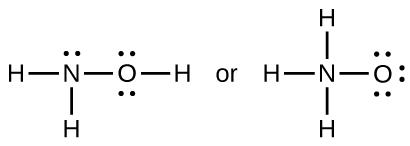
Two Lewis structures are shows with the word “or” written in between them. The left structure shows a nitrogen atom with one lone pair of electrons single bonded to two hydrogen atoms. It is also bonded to an oxygen atom with two lone pairs of electrons. The oxygen atom is bonded to a hydrogen atom. The right structure shows a nitrogen atom single bonded to three hydrogen atoms and an oxygen atom with three lone pairs of electrons.

Answer

The greater bond energy is in the figure on the left. It is the more stable form.

9-94 §9.4 source ↗

Using the standard enthalpy of formation data in Appendix G, show how the standard enthalpy of formation of HCl(g) can be used to determine the bond energy.

Answer


HCl(g)⟶12H2(g)+12Cl2(g)ΔH1°=−ΔHf[HCl(g)]°12H2(g)⟶H(g)ΔH2°=ΔHf[H(g)]°12Cl2(g)⟶Cl(g)ΔH3°=ΔHf[Cl(g)]°¯HCl(g)⟶H(g)+Cl(g)ΔH298°=ΔH1°+ΔH2°+ΔH3°
DHCl=ΔH298°=ΔHf[HCl(g)]°+ΔHf[H(g)]°+ΔHf[Cl(g)]°=−(−92.307kJ)+217.97kJ+121.3kJ=431.6kJ

9-96 §9.4 source ↗

Using the standard enthalpy of formation data in Appendix G, determine which bond is stronger: the S–F bond in SF4(g) or in SF6(g)?

Answer

The S–F bond in SF4 is stronger.

9-98 §9.4 source ↗

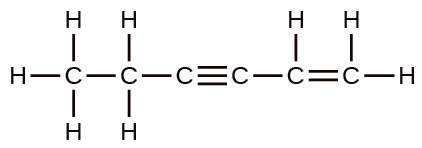
Complete the following Lewis structure by adding bonds (not atoms), and then indicate the longest bond:
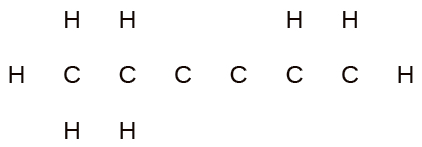
A Lewis structure is shown that is missing its bonds. It shows a horizontal row of six carbon atoms, equally spaced. Three hydrogen atoms are drawn around the first carbon, two around the second, one above the fifth, and two by the sixth.

Answer


A Lewis structure is shown. A carbon atom that is single bonded to three hydrogen atoms is bonded to a second carbon atom. The second carbon atom is single bonded to two hydrogen atoms. The second carbon atom is single bonded to a third carbon atom that is triple bonded to a fourth carbon atom and single bonded to a fifth carbon atom. The fifth carbon atom is single bonded to a hydrogen atom and double bonded to a sixth carbon atom that is single bonded to two hydrogen atoms.


The C–C single bonds are longest.

9-100 §9.4 source ↗

Use principles of atomic structure to answer each of the following:4

(a) The radius of the Ca atom is 197 pm; the radius of the Ca2+ ion is 99 pm. Account for the difference.

(b) The lattice energy of CaO(s) is –3460 kJ/mol; the lattice energy of K2O is –2240 kJ/mol. Account for the difference.

(c) Given these ionization values, explain the difference between Ca and K with regard to their first and second ionization energies.

Element First Ionization Energy (kJ/mol) Second Ionization Energy (kJ/mol)
K 419 3050
Ca 590 1140

(d) The first ionization energy of Mg is 738 kJ/mol and that of Al is 578 kJ/mol. Account for this difference.

Answer

(a) When two electrons are removed from the valence shell, the Ca radius loses the outermost energy level and reverts to the lower n = 3 level, which is much smaller in radius. (b) The +2 charge on calcium pulls the oxygen much closer compared with K, thereby increasing the lattice energy relative to a less charged ion. (c) Removal of the 4s electron in Ca requires more energy than removal of the 4s electron in K because of the stronger attraction of the nucleus and the extra energy required to break the pairing of the electrons. The second ionization energy for K requires that an electron be removed from a lower energy level, where the attraction is much stronger from the nucleus for the electron. In addition, energy is required to unpair two electrons in a full orbital. For Ca, the second ionization potential requires removing only a lone electron in the exposed outer energy level. (d) In Al, the removed electron is relatively unprotected and unpaired in a p orbital. The higher energy for Mg mainly reflects the unpairing of the 2s electron.

9-102 §9.4 source ↗

For which of the following substances is the least energy required to convert one mole of the solid into separate ions?

(a) MgO

(b) SrO

(c) KF

(d) CsF

(e) MgF2

Answer

(d)

9-104 §9.4 source ↗

The lattice energy of LiF is 1023 kJ/mol, and the Li–F distance is 201 pm. MgO crystallizes in the same structure as LiF but with a Mg–O distance of 205 pm. Which of the following values most closely approximates the lattice energy of MgO: 256 kJ/mol, 512 kJ/mol, 1023 kJ/mol, 2046 kJ/mol, or 4008 kJ/mol? Explain your choice.

Answer

4008 kJ/mol; both ions in MgO have twice the charge of the ions in LiF; the bond length is very similar and both have the same structure; a quadrupling of the energy is expected based on the equation for lattice energy

9-106 §9.4 source ↗

Which compound in each of the following pairs has the larger lattice energy? Note: Ba2+ and

K+ have similar radii; S2– and Cl– have similar radii. Explain your choices.

(a) K2O or Na2O

(b) K2S or BaS

(c) KCl or BaS

(d) BaS or BaCl2

Answer

(a) Na2O; Na+ has a smaller radius than K+; (b) BaS; Ba has a larger charge than K; (c) BaS; Ba and S have larger charges; (d) BaS; S has a larger charge

9-108 §9.4 source ↗

Which of the following compounds requires the most energy to convert one mole of the solid into separate ions?

(a) K2S

(b) K2O

(c) CaS

(d) Cs2S

(e) CaO

Answer

(e)

Loading chapter 10…

Problems and answers are adapted from Chemistry: Atoms First 2e by Paul Flowers, Edward J. Neth, William R. Robinson, Klaus Theopold and Richard Langley, OpenStax, and are used under the CC BY-NC-SA 4.0 licence. Access for free at https://openstax.org/books/chemistry-atoms-first-2e/pages/1-introduction. Illustrations: Copyright Rice University, OpenStax, under CC BY-NC-SA 4.0 license. This adaptation is released under the same licence, is non-commercial, and is neither affiliated with nor endorsed by OpenStax or Rice University.