Every problem in the chapter beside the book’s answer, a chapter at a time as you scroll.

Chapter 7: Stoichiometry of Chemical Reactions

64 problems · 1 figure

Example 7.1 §7.1 source ↗

Write a balanced equation for the decomposition of ammonium nitrate to form molecular nitrogen, molecular oxygen, and water. (Hint: Balance oxygen last, since it is present in more than one molecule on the right side of the equation.)

Answer

2NH4NO3⟶ 2N2+ O2+ 4H2O

Example 7.2 §7.1 source ↗

Diatomic chlorine and sodium hydroxide (lye) are commodity chemicals produced in large quantities, along with diatomic hydrogen, via the electrolysis of brine, according to the following unbalanced equation: NaCl(aq)+H2O(l)→electricityNaOH(aq)+H2(g)+Cl2(g)

Write balanced molecular, complete ionic, and net ionic equations for this process.

Answer

2NaCl(aq)+ 2H2O(l)⟶ 2NaOH(aq)+ H2(g)+ Cl2(g) (molecular)
2Na+(aq)+ 2Cl−(aq)+ 2H2O(l)⟶ 2Na+(aq)+ 2OH−(aq)+ H2(g)+ Cl2(g) (complete ionic)
2Cl−(aq)+ 2H2O(l)⟶ 2OH−(aq)+ H2(g)+ Cl2(g) (net ionic)

Example 7.3 §7.2 source ↗

Which solution could be used to precipitate the barium ion, Ba2+, in a water sample: sodium chloride, sodium hydroxide, or sodium sulfate? What is the formula for the expected precipitate?

Answer

sodium sulfate, BaSO4

Example 7.4 §7.2 source ↗

Write the net ionic equation representing the neutralization of any strong acid with an ionic hydroxide. (Hint: Consider the ions produced when a strong acid is dissolved in water.)

Answer

H3O+(aq)+ OH−(aq)⟶ 2H2O(l)

Example 7.5 §7.2 source ↗

Assign oxidation states to the elements whose atoms are underlined in each of the following compounds or ions:

(a) KNO3

(b) AlH3

(c) N_H4+

(d) H2P_O4−

Answer

(a) N, +5; (b) Al, +3; (c) N, −3; (d) P, +5

Example 7.6 §7.2 source ↗

This equation describes the production of tin(II) chloride: Sn(s)+2HCl(g)⟶SnCl2(s)+H2(g)

Is this a redox reaction? If so, provide a more specific name for the reaction if appropriate, and identify the oxidant and reductant.

Answer

Yes, a single-replacement reaction. Sn(s)is the reductant, HCl(g) is the oxidant.

Example 7.7 §7.2 source ↗

In basic solution, molecular chlorine, Cl2, reacts with hydroxide ions, OH−, to yield chloride ions, Cl−. and chlorate ions, ClO3−. HINT: This is a disproportionation reaction in which the element chlorine is both oxidized and reduced. Write a balanced equation for this reaction.

Answer

3Cl2(aq)+ 6OH−(aq)⟶ 5Cl−(aq)+ ClO3−(aq)+ 3H2O(l)

Example 7.8 §7.3 source ↗

How many moles of Ca(OH)2 are required to react with 1.36 mol of H3PO4 to produce Ca3(PO4)2 according to the equation 3Ca(OH)2+ 2H3PO4⟶ Ca3(PO4)2+ 6H2O?

Answer

2.04 mol

Example 7.9 §7.3 source ↗

How many NH3 molecules are produced by the reaction of 4.0 mol of Ca(OH)2 according to the following equation: (NH4)2SO4+Ca(OH)2⟶2NH3+CaSO4+2H2O

Answer

4.8 × 1024 NH3 molecules

Example 7.10 §7.3 source ↗

What mass of gallium oxide, Ga2O3, can be prepared from 29.0 g of gallium metal? The equation for the reaction is 4Ga+ 3O2⟶ 2Ga2O3.

Answer

39.0 g

Example 7.11 §7.3 source ↗

What mass of CO is required to react with 25.13 g of Fe2O3 according to the equation Fe2O3+ 3CO⟶ 2Fe+ 3CO2?

Answer

13.22 g

Example 7.12 §7.4 source ↗

Which is the limiting reactant when 5.00 g of H2 and 10.0 g of O2 react and form water?

Answer

O2

Example 7.13 §7.4 source ↗

What is the percent yield of a reaction that produces 12.5 g of the gas Freon CF2Cl2 from 32.9 g of CCl4 and excess HF?CCl4+2HF⟶CF2Cl2+2HCl

Answer

48.3%

Example 7.14 §7.5 source ↗

A 20.00-mL sample of aqueous oxalic acid, H2C2O4, was titrated with a 0.09113-M solution of potassium permanganate, KMnO4 (see net ionic equation below).2MnO4−(aq)+5H2C2O4(aq)+6H+(aq)⟶10CO2(g)+2Mn2+(aq)+8H2O(l)

A volume of 23.24 mL was required to reach the end point. What is the oxalic acid molarity?

Answer

0.2648 M

Example 7.15 §7.5 source ↗

What is the percent of chloride ion in a sample if 1.1324 g of the sample produces 1.0881 g of AgCl when treated with excess Ag+? Ag+(aq)+Cl−(aq)⟶AgCl(s)

Answer

23.76%

Example 7.16 §7.5 source ↗

A 0.00215-g sample of polystyrene, a polymer composed of carbon and hydrogen, produced 0.00726 g of CO2 and 0.00148 g of H2O in a combustion analysis. What is the empirical formula for polystyrene?

Answer

CH

7-1 §7.1 source ↗

What does it mean to say an equation is balanced? Why is it important for an equation to be balanced?

Answer

An equation is balanced when the same number of each element is represented on the reactant and product sides. Equations must be balanced to accurately reflect the law of conservation of matter.

7-3 §7.1 source ↗

Balance the following equations:

(a) PCl5(s)+ H2O(l)⟶ POCl3(l)+ HCl(aq)

(b) Cu(s)+ HNO3(aq)⟶ Cu(NO3)2(aq)+ H2O(l)+ NO(g)

(c) H2(g)+ I2(s)⟶ HI(s)

(d) Fe(s)+ O2(g)⟶ Fe2O3(s)

(e) Na(s)+ H2O(l)⟶ NaOH(aq)+ H2(g)

(f) (NH4)2Cr2O7(s)⟶ Cr2O3(s)+ N2(g)+ H2O(g)

(g) P4(s)+ Cl2(g)⟶ PCl3(l)

(h) PtCl4(s)⟶ Pt(s)+ Cl2(g)

Answer

(a) PCl5(s)+ H2O(l)⟶ POCl3(l)+ 2HCl(aq); (b) 3Cu(s)+ 8HNO3(aq)⟶ 3Cu(NO3)2(aq)+ 4H2O(l)+ 2NO(g); (c) H2(g)+ I2(s)⟶ 2HI(s); (d) 4Fe(s)+ 3O2(g)⟶ 2Fe2O3(s); (e) 2Na(s)+ 2H2O(l)⟶ 2NaOH(aq)+ H2(g); (f) (NH4)2Cr2O7(s)⟶ Cr2O3(s)+ N2(g)+ 4H2O(g); (g) P4(s)+ 6Cl2(g)⟶ 4PCl3(l); (h) PtCl4(s)⟶ Pt(s)+ 2Cl2(g)

7-5 §7.1 source ↗

Write a balanced molecular equation describing each of the following chemical reactions.

(a) Solid calcium carbonate is heated and decomposes to solid calcium oxide and carbon dioxide gas.

(b) Gaseous butane, C4H10, reacts with diatomic oxygen gas to yield gaseous carbon dioxide and water vapor.

(c) Aqueous solutions of magnesium chloride and sodium hydroxide react to produce solid magnesium hydroxide and aqueous sodium chloride.

(d) Water vapor reacts with sodium metal to produce solid sodium hydroxide and hydrogen gas.

Answer

(a) CaCO3(s)⟶ CaO(s)+ CO2(g); (b) 2C4H10(g)+ 13O2(g)⟶ 8CO2(g)+ 10H2O(g); (c) MgC12(aq)+ 2NaOH(aq)⟶ Mg(OH)2(s)+ 2NaCl(aq); (d) 2H2O(g)+ 2Na(s)⟶ 2NaOH(s)+ H2(g)

7-7 §7.1 source ↗

Colorful fireworks often involve the decomposition of barium nitrate and potassium chlorate and the reaction of the metals magnesium, aluminum, and iron with oxygen.

(a) Write the formulas of barium nitrate and potassium chlorate.

(b) The decomposition of solid potassium chlorate leads to the formation of solid potassium chloride and diatomic oxygen gas. Write an equation for the reaction.

(c) The decomposition of solid barium nitrate leads to the formation of solid barium oxide, diatomic nitrogen gas, and diatomic oxygen gas. Write an equation for the reaction.

(d) Write separate equations for the reactions of the solid metals magnesium, aluminum, and iron with diatomic oxygen gas to yield the corresponding metal oxides. (Assume the iron oxide contains Fe3+ ions.)

Answer

(a) Ba(NO3)2, KClO3; (b) 2KClO3(s)⟶ 2KCl(s)+ 3O2(g); (c) 2Ba(NO3)2(s)⟶ 2BaO(s)+ 2N2(g)+ 5O2(g); (d) 2Mg(s)+ O2(g)⟶ 2MgO(s); 4Al(s)+ 3O2(g)⟶ 2Al2O3(s); 4Fe(s)+ 3O2(g)⟶ 2Fe2O3(s)

7-9 §7.1 source ↗

Aqueous hydrogen fluoride (hydrofluoric acid) is used to etch glass and to analyze minerals for their silicon content. Hydrogen fluoride will also react with sand (silicon dioxide).

(a) Write an equation for the reaction of solid silicon dioxide with hydrofluoric acid to yield gaseous silicon tetrafluoride and liquid water.

(b) The mineral fluorite (calcium fluoride) occurs extensively in Illinois. Solid calcium fluoride can also be prepared by the reaction of aqueous solutions of calcium chloride and sodium fluoride, yielding aqueous sodium chloride as the other product. Write complete and net ionic equations for this reaction.

Answer

(a) 4HF(aq)+ SiO2(s)⟶ SiF4(g)+ 2H2O(l); (b) complete ionic equation: 2Na+(aq)+ 2F−(aq)+ Ca2+(aq)+ 2Cl−(aq)⟶ CaF2(s)+ 2Na+(aq)+ 2Cl−(aq), net ionic equation: 2F−(aq)+ Ca2+(aq)⟶ CaF2(s)

7-11 §7.1 source ↗

From the balanced molecular equations, write the complete ionic and net ionic equations for the following:

(a) K2C2O4(aq)+ Ba(OH)2(aq)⟶ 2KOH(aq)+ BaC2O4(s)

(b) Pb(NO3)2(aq)+ H2SO4(aq)⟶ PbSO4(s)+ 2HNO3(aq)

(c) CaCO3(s)+ H2SO4(aq)⟶ CaSO4(s)+ CO2(g)+ H2O(l)

Answer

(a) 2K+(aq)+C2O42−(aq)+Ba2+(aq)+2OH−(aq)⟶2K+(aq)+2OH−(aq)+BaC2O4(s)(complete)Ba2+(aq)+C2O42−(aq)⟶BaC2O4(s)(net)
(b) Pb2+(aq)+2NO3−(aq)+2H+(aq)+SO42−(aq)⟶PbSO4(s)+2H+(aq)+2NO3−(aq)(complete)Pb2+(aq)+SO42−(aq)⟶PbSO4(s)(net)
(c) CaCO3(s)+2H+(aq)+SO42−(aq)⟶CaSO4(s)+CO2(g)+H2O(l)(complete)CaCO3(s)+2H+(aq)+SO42−(aq)⟶CaSO4(s)+CO2(g)+H2O(l)(net)

7-13 §7.2 source ↗

Indicate what type, or types, of reaction each of the following represents:

(a) Ca(s)+ Br2(l)⟶ CaBr2(s)

(b) Ca(OH)2(aq)+ 2HBr(aq)⟶ CaBr2(aq)+ 2H2O(l)

(c) C6H12(l)+ 9O2(g)⟶ 6CO2(g)+ 6H2O(g)

Answer

(a) oxidation-reduction (addition); (b) acid-base (neutralization); (c) oxidation-reduction (combustion)

7-15 §7.2 source ↗

Silver can be separated from gold because silver dissolves in nitric acid while gold does not. Is the dissolution of silver in nitric acid an acid-base reaction or an oxidation-reduction reaction? Explain your answer.

Answer

It is an oxidation-reduction reaction because the oxidation state of the silver changes during the reaction.

7-17 §7.2 source ↗

Determine the oxidation states of the elements in the compounds listed. None of the oxygen-containing compounds are peroxides or superoxides.

(a) H3PO4

(b) Al(OH)3

(c) SeO2

(d) KNO2

(e) In2S3

(f) P4O6

Answer

(a) H +1, P +5, O −2; (b) Al +3, H +1, O −2; (c) Se +4, O −2; (d) K +1, N +3, O −2; (e) In +3, S −2; (f) P +3, O −2

7-19 §7.2 source ↗

Classify the following as acid-base reactions or oxidation-reduction reactions:

(a) Na2S(aq)+ 2HCl(aq)⟶ 2NaCl(aq)+ H2S(g)

(b) 2Na(s)+ 2HCl(aq)⟶ 2NaCl(aq)+ H2(g)

(c) Mg(s)+ Cl2(g)⟶ MgCl2(s)

(d) MgO(s)+ 2HCl(aq)⟶ MgCl2(aq)+ H2O(l)

(e) K3P(s)+ 2O2(g)⟶ K3PO4(s)

(f) 3KOH(aq)+ H3PO4(aq)⟶ K3PO4(aq)+ 3H2O(l)

Answer

(a) acid-base; (b) oxidation-reduction: Na is oxidized, H+ is reduced; (c) oxidation-reduction: Mg is oxidized, Cl2 is reduced; (d) acid-base; (e) oxidation-reduction: P3− is oxidized, O2 is reduced; (f) acid-base

7-21 §7.2 source ↗

Complete and balance the following acid-base equations:

(a) HCl gas reacts with solid Ca(OH)2(s).

(b) A solution of Sr(OH)2 is added to a solution of HNO3.

Answer

(a) 2HCl(g)+ Ca(OH)2(s)⟶ CaCl2(s)+ 2H2O(l); (b) Sr(OH)2(aq)+ 2HNO3(aq)⟶ Sr(NO3)2(aq)+ 2H2O(l)

7-23 §7.2 source ↗

Complete and balance the following oxidation-reduction reactions, which give the highest possible oxidation state for the oxidized atoms.

(a) Al(s)+ F2(g)⟶

(b) Al(s)+ CuBr2(aq)⟶ (single displacement)

(c) P4(s)+ O2(g)⟶

(d) Ca(s)+ H2O(l)⟶ (products are a strong base and a diatomic gas)

Answer

(a) 2Al(s)+ 3F2(g)⟶ 2AlF3(s); (b) 2Al(s)+ 3CuBr2(aq)⟶ 3Cu(s)+ 2AlBr3(aq); (c) P4(s)+ 5O2(g)⟶ P4O10(s); (d) Ca(s)+ 2H2O(l)⟶ Ca(OH)2(aq)+ H2(g)

7-25 §7.2 source ↗

Complete and balance the equations for the following acid-base neutralization reactions. If water is used as a solvent, write the reactants and products as aqueous ions. In some cases, there may be more than one correct answer, depending on the amounts of reactants used.

(a) Mg(OH)2(s)+ HClO4(aq)⟶

(b) SO3(g)+ H2O(l)⟶ (assume an excess of water and that the product dissolves)

(c) SrO(s)+ H2SO4(l)⟶

Answer

(a) Mg(OH)2(s)+ 2HClO4(aq)⟶ Mg2+(aq)+ 2ClO4−(aq)+ 2H2O(l); (b) SO3(g)+ 2H2O(l)⟶ H3O+(aq)+ HSO4−(aq), (a solution of H2SO4); (c) SrO(s)+ H2SO4(l)⟶ SrSO4(s)+ H2O

7-27 §7.2 source ↗

The military has experimented with lasers that produce very intense light when fluorine combines explosively with hydrogen. What is the balanced equation for this reaction?

Answer

H 2 (g)+ F 2 (g)⟶ 2HF(g)

7-29 §7.2 source ↗

Great Lakes Chemical Company produces bromine, Br2, from bromide salts such as NaBr, in Arkansas brine by treating the brine with chlorine gas. Write a balanced equation for the reaction of NaBr with Cl2.

Answer

2NaBr(aq)+ Cl 2 (g)⟶ 2NaCl(aq)+ Br 2 (l)

7-31 §7.2 source ↗

Lithium hydroxide may be used to absorb carbon dioxide in enclosed environments, such as manned spacecraft and submarines. Write an equation for the reaction that involves 2 mol of LiOH per 1 mol of CO2. (Hint: Water is one of the products.)

Answer

2LiOH(aq)+ CO 2 (g)⟶ Li 2 CO 3 (aq)+ H 2 O(l)

7-33 §7.2 source ↗

Complete and balance the equations of the following reactions, each of which could be used to remove hydrogen sulfide from natural gas:

(a) Ca(OH)2(s)+ H2S(g)⟶

(b) Na2CO3(aq)+ H2S(g)⟶

Answer

(a) Ca(OH)2(s)+ H2S(g)⟶ CaS(s)+ 2H2O(l); (b) Na2CO3(aq)+ H2S(g)⟶ Na2S(aq)+ CO2(g)+ H2O(l)

7-35 §7.2 source ↗

Write balanced chemical equations for the reactions used to prepare each of the following compounds from the given starting material(s). In some cases, additional reactants may be required.

(a) solid ammonium nitrate from gaseous molecular nitrogen via a two-step process (first reduce the nitrogen to ammonia, then neutralize the ammonia with an appropriate acid)

(b) gaseous hydrogen bromide from liquid molecular bromine via a one-step redox reaction

(c) gaseous H2S from solid Zn and S via a two-step process (first a redox reaction between the starting materials, then reaction of the product with a strong acid)

Answer

(a) step 1: N2(g)+ 3H2(g)⟶ 2NH3(g), step 2: NH3(g)+ HNO3(aq)⟶ NH4NO3(aq)⟶ NH4NO3(s)(after drying); (b) H2(g)+ Br2(l)⟶ 2HBr(g); (c) Zn(s)+ S(s)⟶ ZnS(s) and ZnS(s)+ 2HCl(aq)⟶ ZnCl2(aq)+ H2S(g)

7-37 §7.2 source ↗

Complete and balance each of the following half-reactions (steps 2–5 in half-reaction method):

(a) Sn4+(aq)⟶ Sn2+(aq)

(b) [Ag(NH3)2]+(aq)⟶ Ag(s)+ NH3(aq)

(c) Hg2Cl2(s)⟶ Hg(l)+ Cl−(aq)

(d) H2O(l)⟶ O2(g) (in acidic solution)

(e) IO3−(aq)⟶ I2(s) (in basic solution)

(f) SO32−(aq)⟶ SO42−(aq) (in acidic solution)

(g) MnO4−(aq)⟶ Mn2+(aq) (in acidic solution)

(h) Cl−(aq)⟶ ClO3−(aq) (in basic solution)

Answer

(a) Sn4+(aq)+ 2e−⟶ Sn2+(aq), (b) [Ag(NH3)2]+(aq)+ e−⟶ Ag(s)+ 2NH3(aq); (c) Hg2Cl2(s)+ 2e−⟶ 2Hg(l)+ 2Cl−(aq); (d) 2H2O(l)⟶ O2(g)+ 4H+(aq)+ 4e−; (e) 6H2O(l)+ 2IO3−(aq)+ 10e−⟶ I2(s)+ 12OH−(aq); (f) H2O(l)+ SO32−(aq)⟶ SO42−(aq)+ 2H+(aq)+ 2e−; (g) 8H+(aq)+ MnO4−(aq)+ 5e−⟶ Mn2+(aq)+ 4H2O(l); (h) Cl−(aq)+ 6OH−(aq)⟶ ClO3−(aq)+ 3H2O(l)+ 6e−

7-39 §7.2 source ↗

Balance each of the following equations according to the half-reaction method:

(a) Sn2+(aq)+ Cu2+(aq)⟶ Sn4+(aq)+ Cu+(aq)

(b) H2S(g)+ Hg22+(aq)⟶ Hg(l)+ S(s)(in acid)

(c) CN−(aq)+ ClO2(aq)⟶ CNO−(aq)+ Cl−(aq)(in acid)

(d) Fe2+(aq)+ Ce4+(aq)⟶ Fe3+(aq)+ Ce3+(aq)

(e) HBrO(aq)⟶ Br−(aq)+ O2(g)(in acid)

Answer

(a) Sn2+(aq)+ 2Cu2+(aq)⟶ Sn4+(aq)+ 2Cu+(aq); (b) H2S(g)+ Hg22+(aq)+ 2H2O(l)⟶ 2Hg(l)+ S(s)+ 2H3O+(aq); (c) 5CN−(aq)+ 2ClO2(aq)+ 3H2O(l)⟶ 5CNO−(aq)+ 2Cl−(aq)+ 2H3O+(aq); (d) Fe2+(aq)+ Ce4+(aq)⟶ Fe3+(aq)+ Ce3+(aq); (e) 2HBrO(aq)+ 2H2O(l)⟶ 2H3O+(aq)+ 2Br−(aq)+ O2(g)

7-41 §7.2 source ↗

Balance each of the following equations according to the half-reaction method:

(a) MnO4−(aq)+ NO2−(aq)⟶ MnO2(s)+ NO3−(aq)(in base)

(b) MnO42−(aq)⟶ MnO4−(aq)+ MnO2(s)(in base)

(c) Br2(l)+ SO2(g)⟶ Br−(aq)+ SO42−(aq)(in acid)

Answer

(a) 2MnO4−(aq)+ 3NO2−(aq)+ H2O(l)⟶ 2MnO2(s)+ 3NO3−(aq)+ 2OH−(aq); (b) 3MnO42−(aq)+ 2H2O(l)⟶ 2MnO4−(aq)+ 4OH−(aq)+ MnO2(s)(in base); (c) Br2(l)+ SO2(g)+ 2H2O(l)⟶ 4H+(aq)+ 2Br−(aq)+ SO42−(aq)

7-43 §7.3 source ↗

Determine the number of moles and the mass requested for each reaction in Exercise 7.42.

Answer

(a) 0.435 mol Na, 0.217 mol Cl2, 15.4 g Cl2; (b) 0.005780 mol HgO, 2.890 × 10⁻³ mol O2, 9.248 × 10⁻² g O2; (c) 8.00 mol NaNO3, 6.8 × 10² g NaNO3; (d) 1665 mol CO2, 73.3 kg CO2; (e) 18.86 mol CuO, 2.330 kg CuCO3; (f) 0.4580 mol C2H4Br2, 86.05 g C2H4Br2

7-45 §7.3 source ↗

Determine the number of moles and the mass requested for each reaction in Exercise 7.44.

Answer

(a) 0.0686 mol Mg, 1.67 g Mg; (b) 2.701 × 10⁻³ mol O2, 0.08644 g O2; (c) 6.43 mol MgCO3, 542 g MgCO3 (d) 768 mol H2O, 13.8 kg H2O; (e) 16.31 mol BaO2, 2762 g BaO2; (f) 0.207 mol C2H4, 5.81 g C2H4

7-47 §7.3 source ↗

Gallium chloride is formed by the reaction of 2.6 L of a 1.44 M solution of HCl according to the following equation: 2Ga+ 6HCl⟶ 2GaCl3+ 3H2.

(a) Outline the steps necessary to determine the number of moles and mass of gallium chloride.

(b) Perform the calculations outlined.

Answer

(a) volume HCl solution⟶ mol HCl⟶ mol GaCl3; (b) 1.25 mol GaCl3, 2.2 × 10² g GaCl3

7-49 §7.3 source ↗

Silver is often extracted from ores such as K[Ag(CN)2] and then recovered by the reaction
2K[Ag(CN)2](aq)+ Zn(s)⟶ 2Ag(s)+ Zn(CN)2(aq)+ 2KCN(aq)

(a) How many molecules of Zn(CN)2 are produced by the reaction of 35.27 g of K[Ag(CN)2]?

(b) What mass of Zn(CN)2 is produced?

Answer

(a) 5.337 × 10²² molecules; (b) 10.41 g Zn(CN)2

7-51 §7.3 source ↗

Carborundum is silicon carbide, SiC, a very hard material used as an abrasive on sandpaper and in other applications. It is prepared by the reaction of pure sand, SiO2, with carbon at high temperature. Carbon monoxide, CO, is the other product of this reaction. Write the balanced equation for the reaction, and calculate how much SiO2 is required to produce 3.00 kg of SiC.

Answer

SiO2+ 3C⟶ SiC+ 2CO, 4.50 kg SiO2

7-53 §7.3 source ↗

Urea, CO(NH2)2, is manufactured on a large scale for use in producing urea-formaldehyde plastics and as a fertilizer. What is the maximum mass of urea that can be manufactured from the CO2 produced by combustion of 1.00×10³kg of carbon followed by the reaction?
CO2(g)+ 2NH3(g)⟶ CO(NH2)2(s)+ H2O(l)

Answer

5.00 × 10³ kg

7-55 §7.3 source ↗

A compact car gets 37.5 miles per gallon on the highway. If gasoline contains 84.2% carbon by mass and has a density of 0.8205 g/mL, determine the mass of carbon dioxide produced during a 500-mile trip (3.785 liters per gallon).

Answer

1.28 × 10⁵ g CO2

7-57 §7.3 source ↗

What volume of a 0.2089 M KI solution contains enough KI to react exactly with the Cu(NO3)2 in 43.88 mL of a 0.3842 M solution of Cu(NO3)2?
2Cu(NO3)2+ 4KI⟶ 2CuI+ I2+ 4KNO3

Answer

161.4 mL KI solution

7-59 §7.3 source ↗

The toxic pigment called white lead, Pb3(OH)2(CO3)2, has been replaced in white paints by rutile, TiO2. How much rutile (g) can be prepared from 379 g of an ore that contains 88.3% ilmenite (FeTiO3) by mass?
2FeTiO3+ 4HCl+ Cl2⟶ 2FeCl3+ 2TiO2+ 2H2O

Answer

176 g TiO2

7-61 §7.4 source ↗

What is the limiting reactant in a reaction that produces sodium chloride from 8 g of sodium and 8 g of diatomic chlorine?

Answer

The limiting reactant is Cl2.

7-63 §7.4 source ↗

A student isolated 25 g of a compound following a procedure that would theoretically yield 81 g. What was his percent yield?

Answer

Percent yield= 31%

7-65 §7.4 source ↗

Freon-12, CCl2F2, is prepared from CCl4 by reaction with HF. The other product of this reaction is HCl. Outline the steps needed to determine the percent yield of a reaction that produces 12.5 g of CCl2F2 from 32.9 g of CCl4. Freon-12 has been banned and is no longer used as a refrigerant because it catalyzes the decomposition of ozone and has a very long lifetime in the atmosphere. Determine the percent yield.

Answer

gCCl4⟶ molCCl4⟶ molCCl2F2⟶ gCCl2F2, percent yield= 48.3%

7-67 §7.4 source ↗

Toluene, C6H5CH3, is oxidized by air under carefully controlled conditions to benzoic acid, C6H5CO2H, which is used to prepare the food preservative sodium benzoate, C6H5CO2Na. What is the percent yield of a reaction that converts 1.000 kg of toluene to 1.21 kg of benzoic acid?

2 C 6 H 5 CH 3 + 3 O 2 ⟶ 2 C 6 H 5 CO 2 H+ 2 H 2 O

Answer

percent yield= 91.3%

7-69 §7.4 source ↗

Outline the steps needed to solve the following problem, then do the calculations. Ether, (C2H5)2O, which was originally used as an anesthetic but has been replaced by safer and more effective medications, is prepared by the reaction of ethanol with sulfuric acid.

2C2H5OH + H2SO4 ⟶ (C2H5)2O + H2SO4·H2O

What is the percent yield of ether if 1.17 L (d = 0.7134 g/mL) is isolated from the reaction of 1.500 L of C2H5OH
(d = 0.7894 g/mL)?

Answer

Convert mass of ethanol to moles of ethanol; relate the moles of ethanol to the moles of ether produced using the stoichiometry of the balanced equation. Convert moles of ether to grams; divide the actual grams of ether (determined through the density) by the theoretical mass to determine the percent yield; 87.6%

7-71 §7.4 source ↗

Outline the steps needed to determine the limiting reactant when 0.50 mol of Cr and 0.75 mol of H3PO4 react according to the following chemical equation.
2Cr+ 2H3PO4⟶ 2CrPO4+ 3H2

Determine the limiting reactant.

Answer

The conversion needed is mol Cr⟶ molH3PO4. Then compare the amount of Cr to the amount of acid present. Cr is the limiting reactant.

7-73 §7.4 source ↗

Uranium can be isolated from its ores by dissolving it as UO2(NO3)2, then separating it as solid UO2(C2O4)·3H2O. Addition of 0.4031 g of sodium oxalate, Na2C2O4, to a solution containing 1.481 g of uranyl nitrate, UO2(NO3)2, yields 1.073 g of solid UO2(C2O4)·3H2O.

Na2C2O4 + UO2(NO3)2 + 3H2O ⟶ UO2(C2O4)·3H2O + 2NaNO3

Determine the limiting reactant and the percent yield of this reaction.

Answer

Na2C2O4 is the limiting reactant. percent yield = 86.56%

7-75 §7.4 source ↗

How many molecules of the sweetener saccharin can be prepared from 30 C atoms, 25 H atoms, 12 O atoms, 8 S atoms, and 14 N atoms?
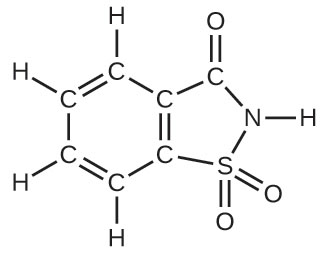
A structural formula is shown. A hexagonal ring of 6 C atoms with alternating double bonds has single H atoms bonded to four consecutive C atoms on the left side of the ring. The two C atoms on the right side of the ring, which are joined by a double bond, are also included in a 5 atom ring to their right. The C atom of this pair that is nearest the top of the structure is singly bonded to a C atom at the top of the 5 atom ring which has an O atom double bonded above. An N atom is singly bonded to the lower right of this same C atom. The N atom has an H atom bonded to its right and to its lower left, it is bonded to an S atom. The S atom is connected to the second C atom that is shared in the two rings. The S atom is also double bonded to an O atom to its lower right and is double bonded to a second O atom directly below it.

Answer

Only four molecules can be made.

7-77 §7.4 source ↗

Would you agree to buy 1 trillion (1,000,000,000,000) gold atoms for $5? Explain why or why not. Find the current price of gold at http://money.cnn.com/data/commodities/ (1 troy ounce=31.1 g)

Answer

This amount cannot be weighted by ordinary balances and is worthless.

7-79 §7.5 source ↗

Titration of a 20.0-mL sample of acid rain required 1.7 mL of 0.0811 M NaOH to reach the end point. If we assume that the acidity of the rain is due to the presence of sulfuric acid, what was the concentration of sulfuric acid in this sample of rain?

Answer

3.4 × 10⁻³ M H2SO4

7-81 §7.5 source ↗

In a common medical laboratory determination of the concentration of free chloride ion in blood serum, a serum sample is titrated with a Hg(NO3)2 solution.
2Cl−(aq)+ Hg(NO3)2(aq)⟶ 2NO3−(aq)+ HgCl2(s)

What is the Cl− concentration in a 0.25-mL sample of normal serum that requires 1.46 mL of 8.25 × 10⁻⁴ M Hg(NO3)2(aq) to reach the end point?

Answer

9.6 × 10⁻³ M Cl−

7-83 §7.5 source ↗

A sample of gallium bromide, GaBr3, weighing 0.165 g was dissolved in water and treated with silver nitrate, AgNO3, resulting in the precipitation of 0.299 g AgBr. Use these data to compute the %Ga (by mass) GaBr3.

Answer

22.4%

7-85 §7.5 source ↗

A 0.025-g sample of a compound composed of boron and hydrogen, with a molecular mass of ~28 amu, burns spontaneously when exposed to air, producing 0.063 g of B2O3. What are the empirical and molecular formulas of the compound?

Answer

The empirical formula is BH3. The molecular formula is B2H6.

7-87 §7.5 source ↗

What volume of 0.600 M HCl is required to react completely with 2.50 g of sodium hydrogen carbonate?
NaHCO3(aq)+ HCl(aq)⟶ NaCl(aq)+ CO2(g)+ H2O(l)

Answer

49.6 mL

7-89 §7.5 source ↗

What volume of a 0.3300-M solution of sodium hydroxide would be required to titrate 15.00 mL of 0.1500 M oxalic acid?
C2O4H2(aq)+ 2NaOH(aq)⟶ Na2C2O4(aq)+ 2H2O(l)

Answer

13.64 mL

7-91 §7.5 source ↗

A sample of solid calcium hydroxide, Ca(OH)2, is allowed to stand in water until a saturated solution is formed. A titration of 75.00 mL of this solution with 5.00 × 10⁻² M HCl requires 36.6 mL of the acid to reach the end point.
Ca(OH)2(aq)+ 2HCl(aq)⟶ CaCl2(aq)+ 2H2O(l)

What is the molarity?

Answer

0.0122 M

7-93 §7.5 source ↗

How many milliliters of a 0.1500-M solution of KOH will be required to titrate 40.00 mL of a 0.0656-M solution of H3PO4?
H3PO4(aq)+ 2KOH(aq)⟶ K2HPO4(aq)+ 2H2O(l)

Answer

34.99 mL KOH

7-95 §7.5 source ↗

The reaction of WCl6 with Al at ~400 °C gives black crystals of a compound containing only tungsten and chlorine. A sample of this compound, when reduced with hydrogen, gives 0.2232 g of tungsten metal and hydrogen chloride, which is absorbed in water. Titration of the hydrochloric acid thus produced requires 46.2 mL of 0.1051 M NaOH to reach the end point. What is the empirical formula of the black tungsten chloride?

Answer

The empirical formula is WCl4.

Loading chapter 8…

Problems and answers are adapted from Chemistry: Atoms First 2e by Paul Flowers, Edward J. Neth, William R. Robinson, Klaus Theopold and Richard Langley, OpenStax, and are used under the CC BY-NC-SA 4.0 licence. Access for free at https://openstax.org/books/chemistry-atoms-first-2e/pages/1-introduction. Illustrations: Copyright Rice University, OpenStax, under CC BY-NC-SA 4.0 license. This adaptation is released under the same licence, is non-commercial, and is neither affiliated with nor endorsed by OpenStax or Rice University.