Every problem in the chapter beside the book’s answer, a chapter at a time as you scroll.

Chapter 21: Organic Chemistry

42 problems · 53 figures

Example 21.1 §21.1 source ↗

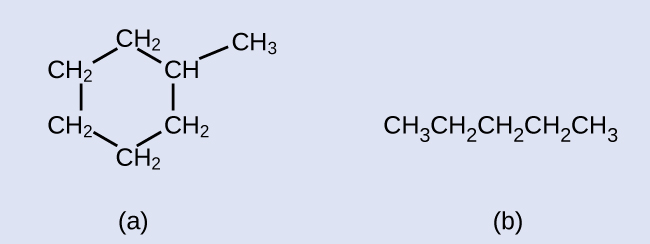
Draw the skeletal structures for these two molecules: Figure a shows five C H subscript 2 groups and one C H group bonded in a hexagonal ring. A C H subscript 3 group appears above and to the right of the ring, bonded to the ring on the C H group appearing at the upper right portion of the ring. In b, a straight chain molecule composed of C H subscript 3 C H subscript 2 C H subscript 2 C H subscript 2 C H subscript 3 is shown.

Answer

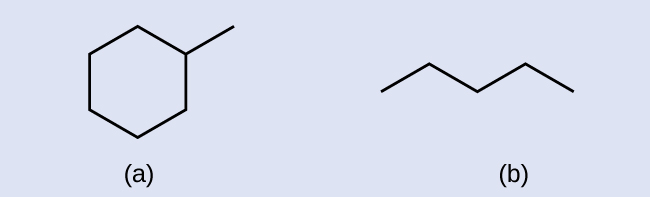
In a, a hexagon with a vertex at the top is shown. The vertex just to the right has a line segment attached that extends up and to the right. In b, a zig zag pattern is shown in which line segments rise, fall, rise, fall, and rise moving left to right.

Example 21.2 §21.1 source ↗

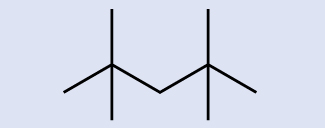
Identify the chemical formula of the molecule represented here: A skeleton model is shown with a zig zag pattern that rises, falls, rises, and falls again left to right through the center of the molecule. From the two risen points, line segments extend both up and down, creating four branches.

Answer

C9H20

Example 21.3 §21.1 source ↗

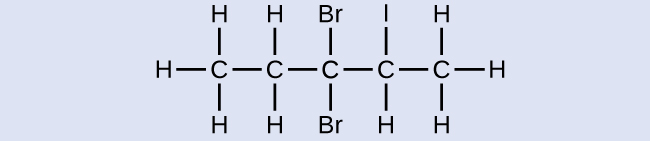
Name the following molecule: This figure shows a C atom bonded to three H atoms and another C atom. This second C atom is bonded to two H atoms and a third C atom. The third C atom is bonded to two B r atoms and a fourth C atom. This C atom is bonded to an H atom, and I atom, and a fifth C atom. This last C atom is bonded to three H atoms.

Answer

3,3-dibromo-2-iodopentane

Example 21.4 §21.1 source ↗

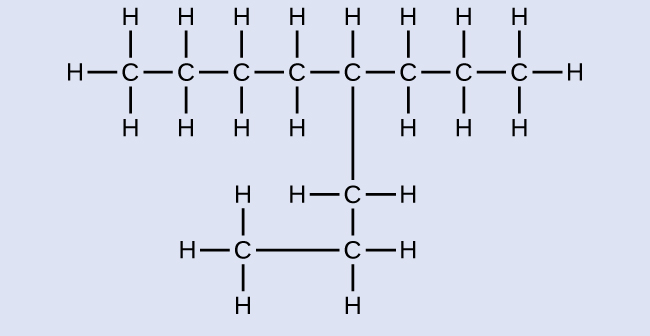
Name the following molecule: This figure shows a C atom bonded to three H atoms and another C atom. This C atom is bonded to two H atoms and third C atom. The third C atom is bonded to two H atoms and a fourth C atom. The fourth C atom is bonded to two H atoms and a fifth C atom. This C atom is bonded to an H atom, a sixth C atom in the chain, and another C atom which appears to branch off the chain. The C atom in the branch is bonded to two H atoms and another C atom. This C atom is bonded to two H atoms and another C atom. This third C atom appears to the left of the second and is bonded to three H atoms. The sixth C atom in the chain is bonded to two H atoms and a seventh C atom. The seventh C atom is bonded to two H atoms and an eighth C atom. The eighth C atom is bonded to three H atoms.

Answer

4-propyloctane

Example 21.5 §21.1 source ↗

Provide names for the reactant and product of the reaction shown: This shows a C atom bonded to three H atoms and another C atom. This second C atom is bonded to two H atoms and a third C atom. This third C atom is bonded to one H atom and also forms a double bond with a fourth C atom. This fourth C atom is bonded to one H atom and a fifth C atom. This fifth C atom is bonded to two H atoms and a sixth C atom. This sixth C atom is bonded to three H atoms. There is a plus sign followed by a C l atom bonded to another C l atom. There is a reaction arrow. no products are shown.

Answer

reactant: cis-3-hexene product: 3,4-dichlorohexane

Example 21.6 §21.1 source ↗

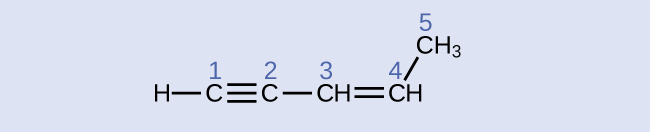
Identify the hybridization and bond angles at the carbon atoms in the molecule shown: A structural formula is shown with an H atom bonded to a C atom. The C atom has a triple bond with another C atom which is also bonded to C H. The C H has a double bond with another C H which is also bonded up and to the right to C H subscript 3. Each C atom is labeled 1, 2, 3, 4, or 5 from left to right.

Answer

carbon 1: sp, 180°; carbon 2: sp, 180°; carbon 3: sp2, 120°; carbon 4: sp2, 120°; carbon 5: sp3, 109.5°

Example 21.7 §21.1 source ↗

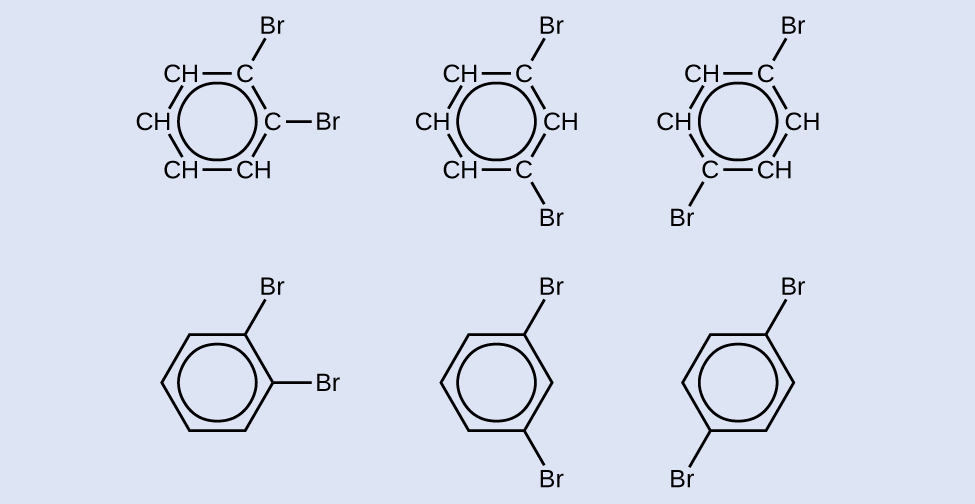
Draw three isomers of a six-membered aromatic ring compound substituted with two bromines.

Answer

Three pairs of structural formulas are shown. The first has a six carbon hydrocarbon ring in which four of the C atoms are each bonded to only one H atom. At the upper right and right of the ring, the two C atoms that do not have bonded H atoms have one B r atom bonded each. A circle is at the center of the ring. Beneath this structure, a similar structure is shown which has a hexagon with a circle inside. From vertices of the hexagon at the upper right and right single B r atoms are attached. The second has a six carbon hydrocarbon ring in which four of the C atoms are each bonded to only one H atom. At the upper right and lower right of the ring, the two C atoms that do not have bonded H atoms have a single B r atom bonded each. A circle is at the center of the ring. Beneath this structure, a similar structure is shown which has a hexagon with a circle inside. From vertices of the hexagon at the upper right and lower right single B r atoms are attached. The third has a six carbon hydrocarbon ring in which four of the C atoms are each bonded to only one H atom. At the upper right and lower left of the ring, the two C atoms that do not have bonded H atoms have B r atoms bonded. A circle is at the center of the ring. Beneath this structure, a similar structure is shown which has a hexagon with a circle inside. From vertices of the hexagon at the upper right and lower left, single B r atoms are attached.

Example 21.8 §21.2 source ↗

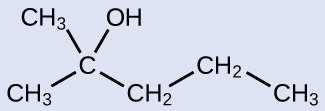
Name the following molecule: The structure shown has a C H subscript 3 group bonded up and to the right to a C atom. The C atom is bonded down and to the right to a C H subscript 2 group. The C H subscript 2 group is bonded up and to the right to a C H subscript 2 group. The C H subscript 2 group is bonded down and to the right to a C H subscript 3 group. The second C atom (from left to right) is bonded to a C H subscript 3 group and an O H group.

Answer

2-methyl-2-pentanol

Example 21.9 §21.2 source ↗

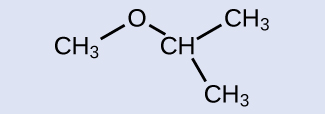
Provide the IUPAC and common name for the ether shown: A molecular structure shows a C H subscript 3 group bonded up and to the right to an O atom. The O atom is bonded down and to the right to a C H group. The C H group is bonded up and to the right to a C H subscript 3 group. The C H group is also bonded down and to the right to another C H subscript 3 group.

Answer

IUPAC: 2-methoxypropane; common: isopropylmethyl ether

Example 21.10 §21.3 source ↗

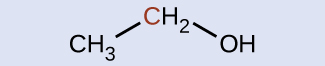
Indicate whether the marked carbon atoms in the three molecules here are oxidized or reduced relative to the marked carbon atom in ethanol: A molecular structure is shown. A C H subscript 3 group is bonded up and to the right to a C H subscript 2 group. Bonded to the C H subscript 2 group down and to the right is an O H group.

There is no need to calculate oxidation states in this case; instead, just compare the types of atoms bonded to the marked carbon atoms:
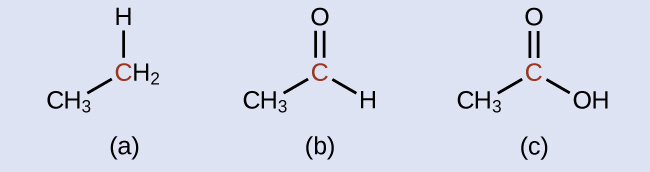
Three molecular structures are shown, each with a red central C atom. In a, a C H subscript 3 group is bonded to the lower left, an H atom is bonded above, and H subscript 2 appears to the right of the central C atom. In b, an O atom is double bonded above the central C atom, a C H subscript 3 group is bonded to the lower left, and an H atom is bonded to the lower right. In c, an O atom is double bonded above the central C atom, a C H subscript 3 group is bonded to the lower left, and an O H group is bonded to the lower right.

Answer

(a) reduced (bond to oxygen atom replaced by bond to hydrogen atom); (b) oxidized (one bond to hydrogen atom replaced by one bond to oxygen atom); (c) oxidized (2 bonds to hydrogen atoms have been replaced by bonds to an oxygen atom)

21-1 §21.1 source ↗

Write the chemical formula and Lewis structure of the following, each of which contains five carbon atoms:

(a) an alkane

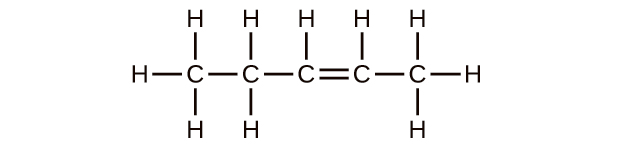
(b) an alkene

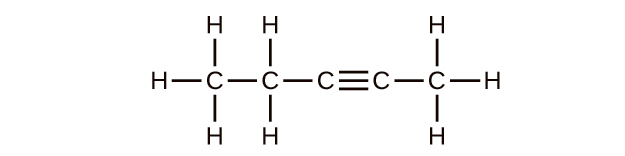
(c) an alkyne

Answer

There are several sets of answers; one is:
(a) C5H12
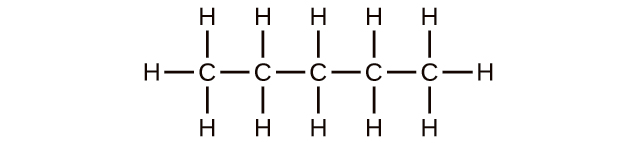
A chain of five C atoms with single bonds is shown. Each C atom has an H atom bonded above and below it. The C atoms on the end of the chain have a third H atom bonded to them each.


(b) C5H10

A chain of five C atoms is shown. The first C atom (from left to right) forms a single bond with the second C atom. The second C atom forms a single bond with the third C atom. The third C atom forms a double bond with the fourth C atom. The fourth C atom forms a single bond to the fifth C atom. The first C atom (from left to right) as three H atoms bonded to it. The second C atom has two H atoms bonded to it. The third C atom has one H atom bonded to it. The fourth C atom has one H atom bonded to it. The fifth C atom as three H atoms bonded to it.


(c) C5H8

A chain of five carbon atoms is shown. The first C atom (from left to right) forms a single bond with the second C atom. The second C atom forms a single bond with the third C atom. The third C atom forms a triple bond with the fourth C atom. The fourth C atom forms a single bond to the fifth C atom. The first C atom has three H atoms bonded to it. The second C atom has two H atoms bonded to it. The fifth C atom has three H atoms bonded to it.

21-3 §21.1 source ↗

On a microscopic level, how does the reaction of bromine with a saturated hydrocarbon differ from its reaction with an unsaturated hydrocarbon? How are they similar?

Answer

Both reactions result in bromine being incorporated into the structure of the product. The difference is the way in which that incorporation takes place. In the saturated hydrocarbon, an existing C–H bond is broken, and a bond between the C and the Br can then be formed. In the unsaturated hydrocarbon, the only bond broken in the hydrocarbon is the π bond whose electrons can be used to form a bond to one of the bromine atoms in Br2 (the electrons from the Br–Br bond form the other C–Br bond on the other carbon that was part of the π bond in the starting unsaturated hydrocarbon).

21-5 §21.1 source ↗

Explain why unbranched alkenes can form geometric isomers while unbranched alkanes cannot. Does this explanation involve the macroscopic domain or the microscopic domain?

Answer

Unbranched alkanes have free rotation about the C–C bonds, yielding all orientations of the substituents about these bonds equivalent, interchangeable by rotation. In the unbranched alkenes, the inability to rotate about the C=C bond results in fixed (unchanging) substituent orientations, thus permitting different isomers. Since these concepts pertain to phenomena at the molecular level, this explanation involves the microscopic domain.

21-7 §21.1 source ↗

Explain why these two molecules are not isomers:
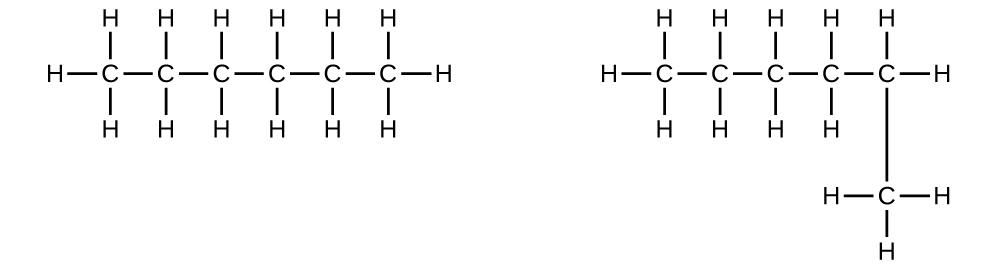
Two structural formulas are shown. In the first, a horizontal hydrocarbon chain consisting of six singly bonded C atoms is shown. Each C atom has an H atom bonded above and below it. The two C atoms on either end of the chain each have a third H atom bonded to them. In the second structure, a horizontal hydrocarbon chain composed of five C atoms connected by single bonds is shown with a sixth C atom singly bonded beneath the right-most C atom. The first C atom (from left to right) has three H atoms bonded to it. The second C atom has two H atoms bonded to it. The third C atom has two H atoms bonded to it. The fourth C atom has two H atoms bonded to it. The fifth C atom has two H atoms bonded to it. The C atom bonded below the fifth C atom has three H atoms bonded to it.

Answer

They are the same compound because each is a saturated hydrocarbon containing an unbranched chain of six carbon atoms.

21-9 §21.1 source ↗

Write the Lewis structure and molecular formula for each of the following hydrocarbons:

(a) hexane

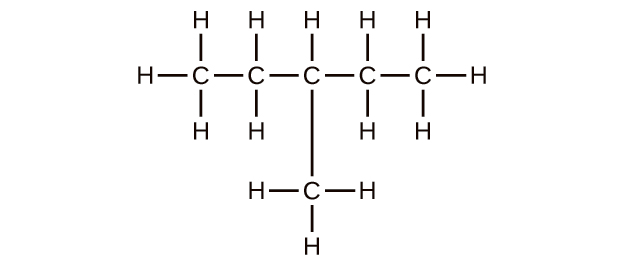
(b) 3-methylpentane

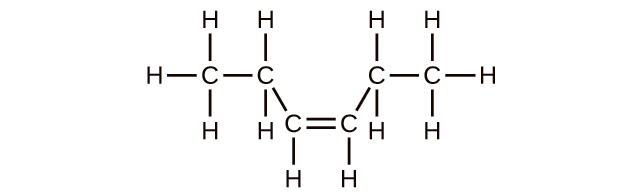
(c) cis-3-hexene

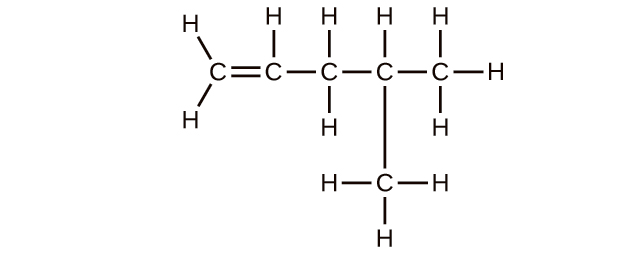
(d) 4-methyl-1-pentene

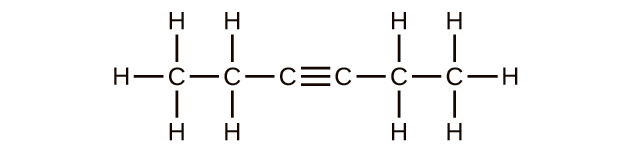
(e) 3-hexyne

(f) 4-methyl-2-pentyne

Answer

(a) C6H14
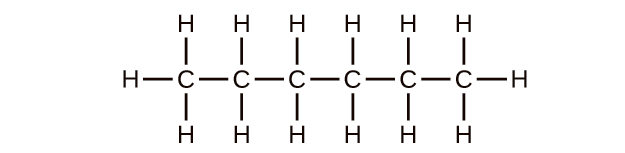
This figure shows a horizontal hydrocarbon chain consisting of six singly bonded carbon atoms. Each C atom has an H atom bonded above and below it. The two C atoms on either end of the chain each of a third H atom bonded to it.


(b) C6H14

This figure shows five C atoms bonded together with a sixth C atom bonded below the chain. The first C atom (from left to right) has three H atoms bonded to it and is also bonded to another C atom. The second C atom has two H atoms bonded above and below it and is also bonded to another C atom. The third C atom has an H atom bonded above it and a C atom bonded below it. The C atom bonded below the third C atom in the chain has three H atoms bonded to it. The third C atom is also bonded to another C atom. The fourth C atom in the chain has two H atoms bonded above and below it and is bonded to another C atom. The fifth C atom has three H atoms bonded to it.


(c) C6H12

This figure shows a C atom with three H atoms bonded to it. This C atom is bonded to another C atom with two H atoms bonded above and below it. The second C atom is also bonded to another C atom down and to the right. This C atom is bonded to one H atom and has a double bond to a fourth C atom. The fourth C atom is also bonded to one H atom. The fourth C atom has a bond up and to the right to another C atom. This C atom has two H atoms bonded above and below it. This C atom also bonds to another C atom which is bonded to three H atoms.


(d) C6H12

This figure shows a hydrocarbon chain with a length of five C atoms. The first C atom (from left to right) is bonded to two H atoms and also forms a double bond with the second C atom. The second C atom is bonded to one H atom above it and is also bonded to a third C atom. The third C atom is bonded to two H atoms and also bonded to a fourth C atom. The fourth C atom is bonded to one H atom above it and a C atom below it. The C atom bonded to the fourth C atom in the chain has three H atoms bonded to it. The fourth C atom is also bonded to a fifth C atom which is bonded to three H atoms.


(e) C6H10

This figure shows a hydrocarbon chain with a length of six C atoms. The first C atom has three H atoms bonded to it, and it is also bonded to a second C atom. The second C atom has an H atom bonded above and below it. It is also bonded to a third C atom. The third C atom forms a triple bond to a fourth C atom. The fourth C atom forms a single bond with a fifth C atom which has two H atoms bonded above and below it. The sixth C atom has three H atoms bonded to it.


(f) C6H10

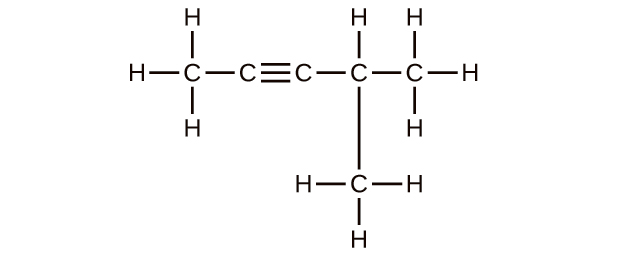
This figure shows a hydrocarbon chain with a length of five C atoms. The first C atom (from left to right) has three H atoms bonded to it. It is also bonded to a second C atom. The second C atom forms a triple bond to a third C atom. The third C atom forms a single bond with a fourth C atom. The fourth C atom has an H atom bonded above it and a C atom bonded below it. The C atom bonded below the fourth C atom has three H atoms bonded to it. The fourth C atom is bonded to a fifth C atom. The fifth C atom has three H atoms bonded to it.

21-11 §21.1 source ↗

Give the complete IUPAC name for each of the following compounds:

(a) CH3CH2CBr2CH3

(b) (CH3)3CCl

(c)

This structure shows a hydrocarbon chain composed of C H subscript 3 C H C H subscript 2 C H subscript 3 with a C H subscript 3 group attached beneath the second C atom counting left to right.

(d)

This structure shows a hydrocarbon chain composed of C H subscript 3 C H C H subscript 2 C double bonded to C H .

(e)

This structure shows a horizontal chain composed of C H subscript 3 C F C H subscript 2 C H subscript 2 C H subscript 2 C H subscript 3 with a C H subscript 2 C H triple bond C H group attached beneath the second C atom counting left to right.

(f)

This structure shows two double bounded C atoms with C l attached to the upper left, C H subscript 3 attached to the lower right, and H atoms attached to the upper right and lower left in the structure.

(g) (CH3)2CHCH2CH= CH2

Answer

(a) 2,2-dibromobutane; (b) 2-chloro-2-methylpropane; (c) 2-methylbutane; (d) 1-butyne; (e) 4-fluoro-4-methyl-1-octyne; (f) trans-1-chloropropene; (g) 4-methyl-1-pentene

21-13 §21.1 source ↗

Butane is used as a fuel in disposable lighters. Write the Lewis structure for each isomer of butane.

Answer

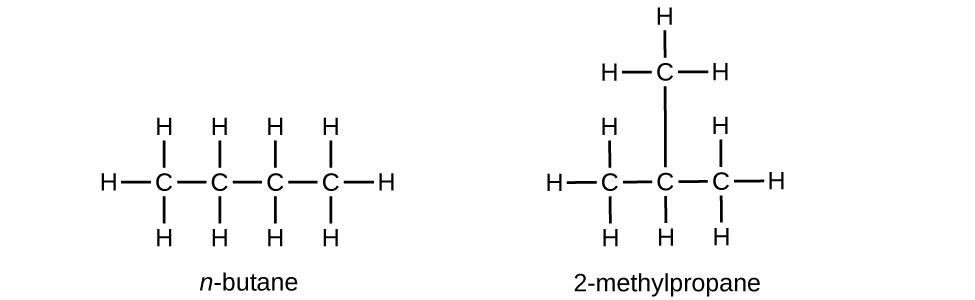
Two structures are shown. The first includes a chain of four singly bonded C atoms. Each C atom has two H atoms bonded above and below it. The two C atoms at either end of the chain each have a third H atom bonded to it. The molecule is named n dash butane. The second includes a chain of three singly bonded C atoms with a C atom bonded above the middle C atom in the chain. The first C atom (from left to right) has three H atoms bonded to it. The second C atom has one H atom bonded below it and a C atom bonded above it. The C atom bonded above the middle C atom has three H atoms bonded to it. The third C atom in the chain has three H atoms bonded to it. This molecule is named 2 dash methylpropane.

21-15 §21.1 source ↗

Write Lewis structures for the cis–trans isomers of CH3CH=CHCl.

Answer

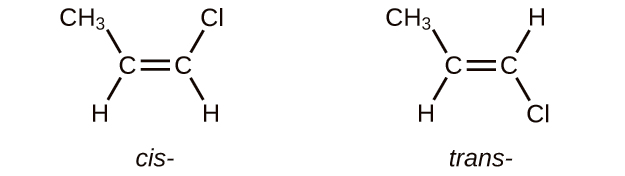
This figure includes two structural formulas. The first structure shows two double bounded C atoms with C l bonded to the upper right, C H subscript 3 bonded to the upper left, and H atoms attached to the lower right and lower left in the structure. This structure is labeled cis dash. The second structure shows two double bounded carbon atoms with C l attached to the lower right, C H subscript 3 attached to the upper left, and H atoms attached to the upper right and lower left in the structure. This structure is labeled trans dash.

21-17 §21.1 source ↗

Isooctane is the common name of the isomer of C8H18 used as the standard of 100 for the gasoline octane rating:

The hydrocarbon molecular structure shown includes C H subscript 3 C H C H subscript 2 C C H subscript 3. There is a C H subscript 3 group bonded to the second C atom in the chain (from left to right). There are two C H subscript 3 groups bonded above and below the fourth C atom in the chain.

(a) What is the IUPAC name for the compound?

(b) Name the other isomers that contain a five-carbon chain with three methyl substituents.

Answer

(a) 2,2,4-trimethylpentane; (b) 2,2,3-trimethylpentane, 2,3,4-trimethylpentane, and 2,3,3-trimethylpentane:

Three hydrocarbon molecular structures are shown. The first has C H subscript 3 bonded up and to the right to a C atom. The C atom is bonded down and to the right to C H. C H is bonded up and to the right to C H subscript 2. C H subscript 2 is bonded down and to the right to C H subscript 3. The lone C atom is bonded to two C H subscript 3 groups. The C in the C H group is bonded to a C H subscript 3 group. The second structure shows C H subscript 3 bonded up and to the right to C H which is bonded down and to the right to C H. C H is bonded up and to the right to another C H which is bonded down and to the right to C H subscript 3. The initial C atom is bonded to a C H subscript 3 group. The second C atom is bonded to a C H subscript 3 group. The third C atom is bonded to a C H subscript 3 group. The third structure shows C H subscript 3 bonded up and to the right to C H which is bonded down and to the right to C. C is bonded up and to the right to C H subscript 2 which is bonded down and to the right to C H subscript 3. The second C atom is bonded to a C H subscript 3 group. The third C atom is bonded to two C H subscript 3 groups.

21-19 §21.1 source ↗

Write Lewis structures and IUPAC names for all isomers of C4H9Cl.

Answer

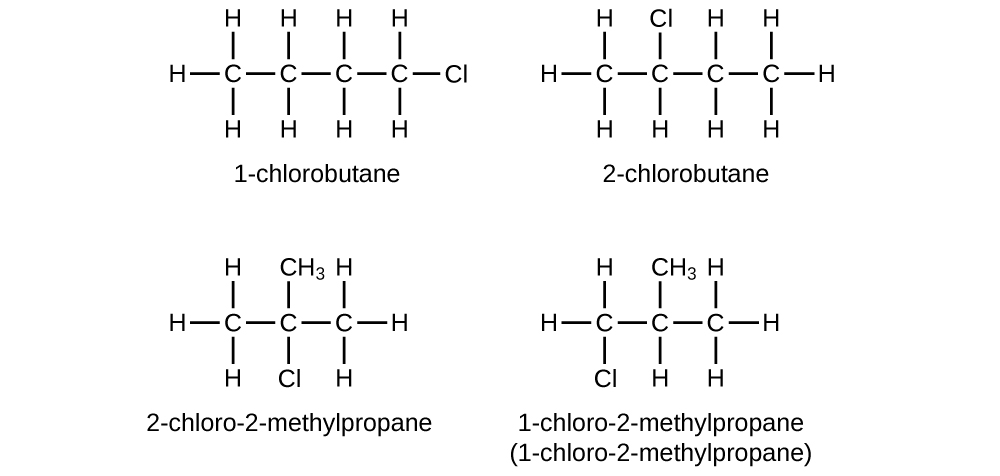
Four structural formulas are provided. The first has a hydrocarbon chain with a length of four C atom. All bonds are single. Nine H atoms are attached and a single C l atom is attached at the far right end of the structure which is labeled 1 dash chlorobutane. The second has a hydrocarbon chain with a length four C atoms. All bonds are single. Nine H atoms are attached and a single C l atom is attached above the second carbon counting left to right. This structure is labeled 2 dash chlorobutane. The third has a hydrocarbon chain with a length of three C atoms. All bonds are single. A single C l atom is bonded beneath the middle C atom and a C H subscript 3 group is also bonded above the middle C atom. Six H atoms are attached, and the structure is labeled 2 dash chloro dash 2 dash methylpropane. The fourth structure has a hydrocarbon chain with a length of three C atoms. All bonds are single. A single C l atom is bonded beneath the first C atom (from left to right) and a C H subscript 3 group is bonded above the middle C atom. Six H atoms are attached, and the structure is labeled 1 dash chloro dash 2 dash methylpropane.

21-21 §21.1 source ↗

Write the structures for all the isomers of the –C5H11 alkyl group.

Answer

In the following, the carbon backbone and the appropriate number of hydrogen atoms are shown in condensed form:
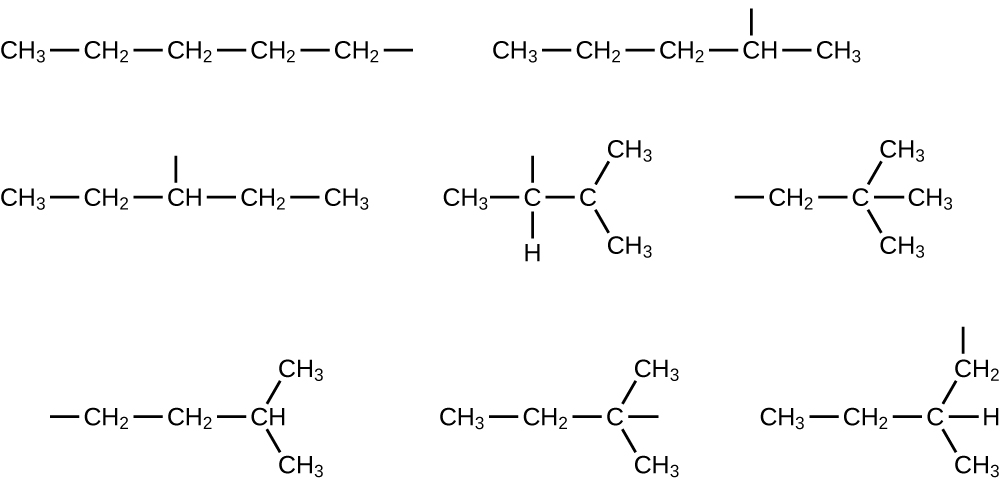
Eight structures are shown. The first includes C H subscript 3 bonded to C H subscript 2 bonded to C H subscript 2 bonded to C H subscript 2 bonded to C H subscript 2 with a bond. The second shows C H subscript 3 bonded to C H subscript 2 bonded to C H subscript 2 bonded to C H bonded to C H subscript 3. There is a bond above the fourth C atom (from left to right). The third shows C H subscript 3 bonded to C H subscript 2 bonded to C H bonded to C H subscript 2 bonded to C H subscript 3. There is a bond above the third C atom (from left to right). The five remaining examples involve branching. The fourth structure shows C H subscript 3 bonded to C bonded to C. The second C atom (from left to right) has a bond above it and a bond to an H atom below it. The third C is bonded to two C H subscript 3 groups as well as an H atom. The fifth shows a bond leading to a C H subscript 2 group which is bonded to a C atom. This C atom is bonded to three C H subscript 3 groups. The sixth shows a bond and then C H subscript 2 bonded to C H subscript 2 bonded to C H. The C H is bonded to two C H subscript 3 groups. The seventh shows C H subscript 3 bonded to C H subscript 2 bonded to C with a bond. The C is also bonded to two C H subscript 3 groups. The final structure shows C H subscript 3 bonded to C H subscript 2 bonded to C H. The C H is bonded to a C H subscript 2 group with a bond and a C H subscript 3 group.

21-23 §21.1 source ↗

Benzene is one of the compounds used as an octane enhancer in unleaded gasoline. It is manufactured by the catalytic conversion of acetylene to benzene:
3C2H2⟶C6H6

Draw Lewis structures for these compounds, with resonance structures as appropriate, and determine the hybridization of the carbon atoms in each.

Answer
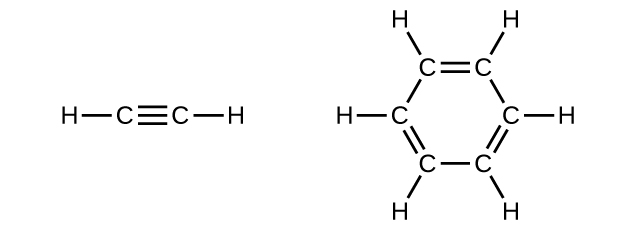
Two structural formulas are shown. The first shows two C atoms with a triple bond between them. At each end of the structure, a single H atom is bonded. The second structure involves a hydrocarbon ring of 6 C atoms with a circle at the center. There are alternating double bonds between C atoms. Each C atom is bonded to a single H atom.

In acetylene, the bonding uses sp hybrids on carbon atoms and s orbitals on hydrogen atoms. In benzene, the carbon atoms are sp2 hybridized.

21-25 §21.1 source ↗

Write two complete, balanced equations for each of the following reactions, one using condensed formulas and one using Lewis structures.

(a) 1 mol of 1-butyne reacts with 2 mol of iodine.

(b) Pentane is burned in air.

Answer

(a) CH≡CCH2CH3+ 2I2⟶ CHI2CI2CH2CH3

A reaction is shown. On the left, a four carbon hydrocarbon chain is shown with a triple bond between C atoms 1 and 2 moving left to right across the molecule. The first C is bonded to one H atom. The second C atom bonds with the third C atom. The third C atom is bonded to two H atoms and a fourth C atom. The fourth C atom is bonded to three H atoms. A plus sign is shown followed by 2 I dash I, which is followed by a reaction arrow, then a four C atom hydrocarbon chain with I atoms bonded above and below C atoms 1 and 2 from left to right. The first C atom is bonded to one H. The third C atom is bonded to two H atoms. The fourth C atom is bonded to three H atoms.


(b) CH3CH2CH2CH2CH3+ 8O2⟶ 5CO2+ 6H2O

A reaction is shown. On the left, a five C atom hydrocarbon chain is shown with all single bonds between C atoms. Each C atom is bonded to an H atom above and below it. The two C atoms at either end of the chain each have a third H atom bonded to them. A plus sign is shown followed by 8 O double bond O. To the right of the reaction arrow appears 5 followed by O double bond C double bond O plus 6 O bonded to two H atoms.

21-27 §21.1 source ↗

What mass of 2-bromopropane could be prepared from 25.5 g of propene? Assume a 100% yield of product.

Answer

74.5 g

21-29 §21.1 source ↗

Ethylene can be produced by the pyrolysis of ethane:
C2H6⟶ C2H4+ H2

How many kilograms of ethylene is produced by the pyrolysis of 1.000 × 10³ kg of ethane, assuming a 100.0% yield?

Answer

9.328 × 10² kg

21-31 §21.2 source ↗

Write condensed formulas and provide IUPAC names for the following compounds:

(a) ethyl alcohol (in beverages)

(b) methyl alcohol (used as a solvent, for example, in shellac)

(c) ethylene glycol (antifreeze)

(d) isopropyl alcohol (used in rubbing alcohol)

(e) glycerine

Answer

(a) ethyl alcohol, ethanol: CH3CH2OH; (b) methyl alcohol, methanol: CH3OH; (c) ethylene glycol, ethanediol: HOCH2CH2OH; (d) isopropyl alcohol, 2-propanol: CH3CH(OH)CH3; (e) glycerine, l,2,3-trihydroxypropane: HOCH2CH(OH)CH2OH

21-33 §21.2 source ↗

Give the complete IUPAC name and the common name for each of the following compounds:

(a)

This shows a C H subscript 3 group bonded to a C H subscript 2 group. This C H subscript 2 group is bonded to an O atom which is also bonded to a C H subscript 2 group. This C H subscript 2 group is bonded to a C H subscript 2 group. This C H subscript 2 group is bonded to a C H subscript 2 group. This C H subscript 2 group is bonded to a C H subscritp 3 group. All bonds are in a straight line.

(b)

This shows a C H subscript 3 group bonded to a C H subscript 2 group. This C H subscript 2 group is bonded to an O atom. This O atom is bonded to a C H subscript 2 group which is also bonded to another C H subscript 2 group. This C H subscript 2 group is bonded to a C H subscript 3 group. All bonds are in a straight line.

(c)

This figure shows a C H subscript 3 group bonded to an O atom. This O atom is bonded to a C H subscript 2 group which is also bonded to another C H subscript 2 group. This C H subscript 2 group is bonded to a C H subscript 3 group. All bonds are in a straight line.

Answer

(a) 1-ethoxybutane, butyl ethyl ether; (b) 1-ethoxypropane, ethyl propyl ether; (c) 1-methoxypropane, methyl propyl ether

21-35 §21.2 source ↗

Write the condensed structures of all isomers with the formula C2H6O2. Label the functional group (or groups) of each isomer.

Answer

HOCH2CH2OH, two alcohol groups; CH3OCH2OH, ether and alcohol groups

21-37 §21.2 source ↗

MTBE, Methyl tert-butyl ether, CH3OC(CH3)3, is used as an oxygen source in oxygenated gasolines. MTBE is manufactured by reacting 2-methylpropene with methanol.

(a) Using Lewis structures, write the chemical equation representing the reaction.

(b) What volume of methanol, density 0.7915 g/mL, is required to produce exactly 1000 kg of MTBE, assuming a 100% yield?

Answer

(a)

A reaction is shown. The first molecule is a C atom bonded to another C atom. The first C atom (from left to right) is bonded to two C H subscript 3 groups. The second C atom is bonded to two H atoms. There is a plus sign. The next molecule shows an H atom bonded to an O atom bonded to a C H subscript 3 group. There is an arrow pointing right. This molecule shows a C atom bonded to three C H subscript 3 groups. The C atom is also bonded to an O atom which is also bonded to a C H subscript 3 group.


(b) 4.593 × 10² L

21-39 §21.2 source ↗

Write two complete balanced equations for each of the following reactions, one using condensed formulas and one using Lewis structures.

(a) 2-butene is treated with water in dilute acid

(b) ethanol is dehydrated to yield ethene

Answer

(a) CH3CH= CHCH3+ H2O⟶ CH3CH2CH(OH)CH3
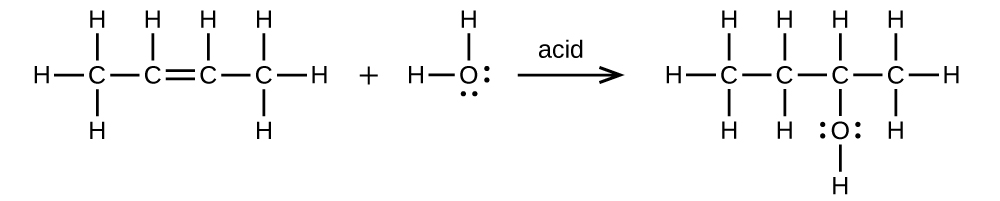
A reaction is shown. The first molecule shows a C atom bonded with three H atoms. The first C atom is bonded to another C atom. The second C atom is bonded to an H atom and also forms a double bond with a third C atom. The third C atom is bonded to one H atom and fourth C atom. The fourth C atom is bonded to three H atoms. There is a plus sign. The second molecule shows an O atom with two sets of electron dots bonded to two H atoms. There is an arrow pointing right which is labeled, “acid.” The new molecule is a C atom bonded to three H atoms and a second C atom. The second C atom is bonded to two H atoms and a third C atom. The third C atom is bonded to an H atom and an O atom with two sets of electron dots. The O atom is bonded to an H atom. The third C atom is bonded to a fourth C atom which is bonded to three H atoms.


(b) CH3CH2OH⟶ CH2= CH2+ H2O

A reaction is shown. The first molecule shows a C atom which is bonded to three H atoms and a second C atom. The second C atom is bonded to an O atom as well. The O atom has two sets of electron dots and is bonded to an H atom. There is an arrow that points to the right. The next molecule shows two C atoms forming a double bond between them. Each C atom is bonded to two H atoms. There is a plus sign. The next molecule shows an O atom with two sets of electron dots bonded to two H atoms.

21-41 §21.3 source ↗

Predict the products of oxidizing the molecules shown in this problem. In each case, identify the product that will result from the minimal increase in oxidation state for the highlighted carbon atom:

(a)
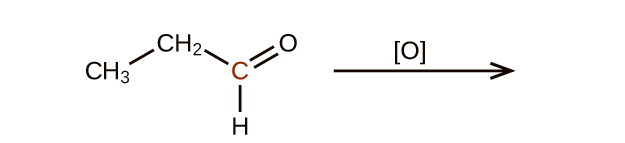
The left side of a reaction and arrow are shown. The arrow is labeled with an O in brackets. To the left of the arrow is a molecular structure. It shows a C H subscript 3 group which bonds up and to the right to a C H subscript 2 group. The C H subscript 2 group forms a bond down and to the left to a C atom. This C atom appears in red and forms a double bond with an O atom and a single bond with an H atom.

(b)

The left side of a reaction and arrow are shown. The arrow is labeled with an O in brackets. To the left of the arrow is a molecular structure. It shows a C H subscript 3 group bonded up and to the right to a C H subscript 2 group bonded down and to the right to a C H subscript 2 group which is bonded up and to the right to an O H group. The C in the second C H subscript 2 group is red.

(c)

The left side of a reaction and arrow are shown. The arrow is labeled with an O in brackets. To the left of the arrow is a molecular structure. It shows a C H subscript 3 group bonded up and to the right to a C H subscript 2 group which is bonded down and to the right to a C H group. The C in this C H group appears in red. The C in the C H group is bonded directly below it to a C H subscript 3 group. The C H group is bonded up and to the right to an O H group.

Answer

(a)

A molecular structure is shown with a C H subscript 3 group bonded up and to the right to a C H subscript 2 group which is bonded down and to the left to a C atom. This C atom appears in red. The C atom forms a double bond with an O atom up and to the right. The C atom also forms a single bond with an O H group directly below it.


(b)

A molecular structure is shown with a C H subscript 3 group bonded up and to the right to a C H subscript 2 group which is bonded down and to the left to a C group. This C atom appears in red. The C atom forms a double bond with an O atom up and to the right. Directly below the C atom is a single bond to an H atom.


(c)

A molecular structure is shown with a C H subscript 3 group which is bonded up and to the right to a C H subscript 2 group. The C H subscript 2 group is bonded down and to the left to an C atom. This C atom appears in red. The C atom forms a double bond with an O atom up and to the right. The C atom also forms a single bond to a C H subscript 3 group which appears directly below it.

21-43 §21.3 source ↗

Explain why it is not possible to prepare a ketone that contains only two carbon atoms.

Answer

A ketone contains a group bonded to two additional carbon atoms; thus, a minimum of three carbon atoms are needed.

21-45 §21.3 source ↗

Fatty acids are carboxylic acids that have long hydrocarbon chains attached to a carboxylate group. How does a saturated fatty acid differ from an unsaturated fatty acid? How are they similar?

Answer

Since they are both carboxylic acids, they each contain the –COOH functional group and its characteristics. The difference is the hydrocarbon chain in a saturated fatty acid contains no double or triple bonds, whereas the hydrocarbon chain in an unsaturated fatty acid contains one or more multiple bonds.

21-47 §21.3 source ↗

Write a condensed structural formula, such as CH3CH3, and describe the molecular geometry at each carbon atom.

(a) 2-propanol

(b) acetone

(c) dimethyl ether

(d) acetic acid

(e) 3-methyl-1-hexene

Answer

(a) CH3CH(OH)CH3: all carbons are tetrahedral; (b) CH3COCH3: the end carbons are tetrahedral and the central carbon is trigonal planar; (c) CH3OCH3: all are tetrahedral; (d) CH3COOH: the methyl carbon is tetrahedral and the acid carbon is trigonal planar; (e) CH3CH2CH2CH(CH3)CHCH2: all are tetrahedral except the right-most two carbons, which are trigonal planar

21-49 §21.3 source ↗

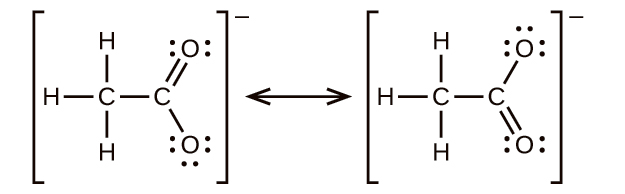
Write the two-resonance structures for the acetate ion.

Answer

A structure shows in brackets a C atom with H atoms bonded above, below, and to the left, and a C atom bonded to the right. This second C atom has an O atom double bonded above and to the right and a second O atom single bonded below and to the right. Outside the brackets to the right appears a superscript minus sign. This is followed by a double headed arrow. To the right of this arrow in brackets is a C atom with H atoms bonded above, below, and to the left, and a C atom bonded to the right. This second C atom has an O atom single bonded above and to the right and a second O atom double bonded below and to the right. Outside the brackets to the right appears a superscript minus symbol. Double bonded O atoms have two pairs of electron dots and single bonded O atoms have 3 pairs of electron dots.

21-51 §21.3 source ↗

Write two complete balanced equations for each of the following reactions, one using condensed formulas and one using Lewis structures.

(a) 1-butanol reacts with acetic acid

(b) propionic acid is poured onto solid calcium carbonate

Answer

(a) CH3CH2CH2CH2OH+CH3C(O)OH⟶ CH3C(O)OCH2CH2CH2CH3+ H2O:

A reaction is shown. The first molecular structure shows a C atom bonded to three H atoms and another C atom. This second C atom is bonded to two H atoms and a third C atom. This third C atom is bonded to two H atoms and a fourth C atom. This C atom is bonded to two H atoms and an O atom. The O atom is bonded to an H atom. The O atom has two pairs of electrons dots. There is a plus sign. The next molecular structure shows a C atom bonded to three H atoms and another C atom. This C atom forms a double bond with an O atom and a single bond with another O atom. The O atom forms a bond with an H atom. Both O atoms have two pairs of electron dots. There is a reaction arrow that points right. The next molecular structure shows a C atom bonded to three H atoms and another C atom. This second C atom forms a double bond with an O atom and a single bond with another O atom. This second O atom is bonded to a C atom which is bonded to two H atoms and another C atom. This C atom is bonded to two H atoms and another C. This C atom is bonded to two H atoms and another C atom. The C atom is bonded to three H atoms. The O atoms have two pairs of electron dots. There is a plus sign. The final molecular structure shows an O atom bonded to two H atoms. The O atom has two pairs of electron dots.


(b) 2CH3CH2COOH+ CaCO3⟶ (CH3CH2COO)2Ca+ CO2+ H2O:

A reaction is shown. There is a 2 in front of the first molecular structure. This first structure shows a C atom bonded to three H atoms and another C atom. This second C atom is bonded to two H atoms and a third C atom. This third C atom forms a double bond with an O atom and a single bond with another O atom. This second O atom forms a single bond with an H atom. Both O atoms have two pairs of electron dots. There is a plus sign and C a superscript 2 plus sign. Beside the C a superscript 2 plus sign is a set of brackets. Inside the brackets is a central C atom bonded to three O atoms. Two O atoms have three pairs of electron dots, and one O atom has two pairs of electron dots. A 2 minus sign appears as a superscript to the brackets. There is an arrow pointing right. There is a 2 and a set of brackets. Inside the brackets is a C atom bonded to three H atoms and another C atom. This C atom is bonded to two H atoms and a third C atom. This C atom is bonded to two O atoms. One O atom has two pairs of electron dots, and one O atom has three pairs of electron dots. Outside the brackets a minus sign appears as a superscript. C a superscript 2+ also appears beside the brackets. There is a plus sign. The next molecular structure shows a C atom that forms two sets of double bonds with two O atoms. Each O atom has two pairs of electron dots. There is a plus sign. The final molecular structure shows an O atom bonded to two H atoms. The O atom has two pairs of electron dots.

21-53 §21.3 source ↗

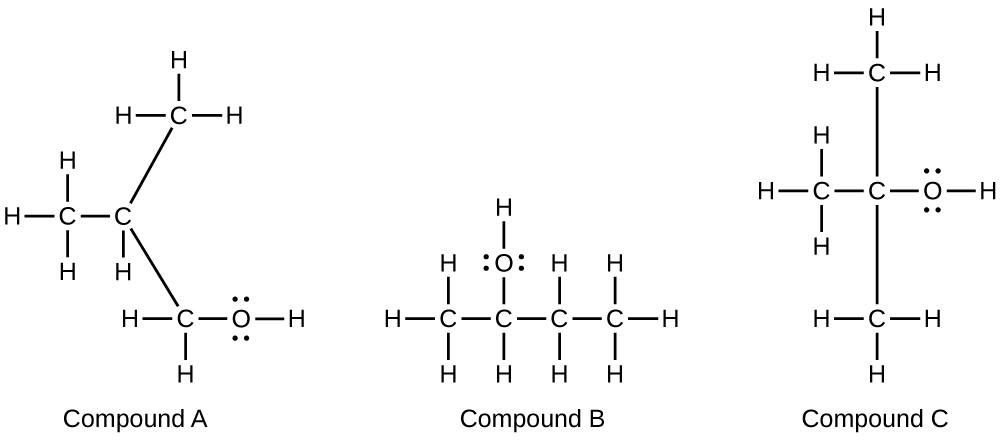
Alcohols A, B, and C all have the composition C4H10O. Molecules of alcohol A contain a branched carbon chain and can be oxidized to an aldehyde; molecules of alcohol B contain a linear carbon chain and can be oxidized to a ketone; and molecules of alcohol C can be oxidized to neither an aldehyde nor a ketone. Write the Lewis structures of these molecules.

Answer

This figure shows three molecular structures labeled compound A, compound B, and compound C. In A, a C atom is shown bonded the three H atoms and a second C atom. This C atom is bonded to one H atom. Up and to the right it is bonded to another C atom which is bonded to three H atoms. Down and to the left it is bonded to another C atom which is bonded to two H atoms and an O atom. The O atom is bonded to an H atom. The O atom has two pairs of electron dots. In B, a C atom is bonded to three H atoms and another C atom. This second C atom is bonded to an H atom and an O atom. The O atom has two pairs of electron dots and is bonded to an H atom. The second C atom is bonded to third C atom which is bonded to two H atoms. The third C atom is bonded to a fourth C atom which is bonded to three H atoms. In C, a C atom is bonded to three H atoms and another C atom. This C atom is bonded above to another C atom which is bonded to three H atoms, and below to a C atom which is bonded to three H atoms. It is also bonded to an O atom which is bonded to an H atom. The O atom has two pairs of electron dots.

21-55 §21.4 source ↗

What is the molecular structure about the nitrogen atom in trimethyl amine and in the trimethyl ammonium ion, (CH3)3NH+? What is the hybridization of the nitrogen atom in trimethyl amine and in the trimethyl ammonium ion?

Answer

Trimethyl amine: trigonal pyramidal, sp3; trimethyl ammonium ion: tetrahedral, sp3

21-57 §21.4 source ↗

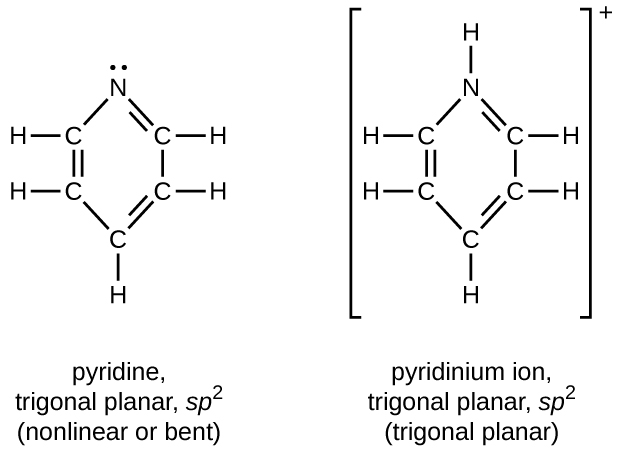
Draw Lewis structures for pyridine and its conjugate acid, the pyridinium ion, C5H5NH+. What are the hybridizations, electron domain geometries, and molecular geometries about the nitrogen atoms in pyridine and in the pyridinium ion?

Answer

Two structures are shown, one for pyridine, which is trigonal planar and is labeled s p superscript 2. The second is for the pyridium ion, which is also trigonal planar and is labeled s p superscript 2. Both structures include a hexagonal ring composed of 5 C atoms and 1 N atom which is shown at the top of each structure. In both rings, double bonds alternate and single H atoms extend outward from each C atom. The only structural difference between the two structures involves the unshared electron pair on the N atom in pyridine. This is replaced by a bonded H atom in the pyridium ion which is represented in brackets with a superscript plus symbol outside the brackets.

21-59 §21.4 source ↗

Write two complete balanced equations for the following reaction, one using condensed formulas and one using Lewis structures.

Methyl amine is added to a solution of HCl.

Answer

CH3NH2+ H3O+⟶ CH3NH3++ H2O

A reaction is shown. The first structure shown on the left shows a C atom with H atoms bonded above, below, and to the left. To the right, an N atom is bonded which has an unshared pair of electrons above it and H atoms bonded to its right and below. This structure is followed by a plus sign. A structure follows in brackets which includes an O atom with H atoms bonded above, to the left, and below. A single unshared electron pair is shown on the O atom. Outside the brackets is a superscript plus sign. This is followed by a plus sign and C l surrounded by 4 pairs of electron dots and a superscript minus sign. Following a reaction arrow is another structure in brackets. This structure shows a C atom with H atoms bonded above, below, and to the left. To the right, an N atom is bonded which has H atoms bonded above, below, and to the right. Outside the brackets is a superscript plus sign. This is followed by C l surrounded by 4 pairs of electron dots and superscript minus. This is followed by another plus sign and an H atom which forms a single bond to an O atom to which a second H atom is bonded above. The O atom has two sets of electron dots.

21-61 §21.4 source ↗

Identify any carbon atoms that change hybridization and the change in hybridization during the reactions in Exercise 21.26.

Answer

CH3CH = CHCH3(sp2) + Cl ⟶ CH3CH(Cl)H(Cl)CH3(sp3); 2C6H6(sp2) + 15O2 ⟶ 12CO2(sp) + 6H2O

21-63 §21.4 source ↗

Identify any carbon atoms that change hybridization and the change in hybridization during the reactions in Exercise 21.51.

Answer

The carbon in CO32−, initially at sp2, changes hybridization to sp in CO2.

End of the book.

Problems and answers are adapted from Chemistry: Atoms First 2e by Paul Flowers, Edward J. Neth, William R. Robinson, Klaus Theopold and Richard Langley, OpenStax, and are used under the CC BY-NC-SA 4.0 licence. Access for free at https://openstax.org/books/chemistry-atoms-first-2e/pages/1-introduction. Illustrations: Copyright Rice University, OpenStax, under CC BY-NC-SA 4.0 license. This adaptation is released under the same licence, is non-commercial, and is neither affiliated with nor endorsed by OpenStax or Rice University.